Trope Tuesday: Worthy Opponent

Sometimes, it’s not the Big Bad the heroes are fighting against, so much as an almost friendly opponent who is not so different from them after all. That’s what this trope is all about.

The Worthy Opponent is no mere redshirt or mook–quite often, in fact, he’s the Dragon of the opposing side–but unlike the Big Bad or the Evil Chancellor, he won’t stab his enemies in the back or willfully break the rules of war.  He keeps his word, fights like a gentleman, and may even have a soft spot for the hero.  He’ll duel to the death, but will hand the hero back his sword rather than hit him when he’s down.  If he’s in a position of command, he’ll most likely be a father to his men, and sorely regret the loss of life that he is forced to oversee.  When defeated, it’s not unusual to hear him say that it has been an honor.
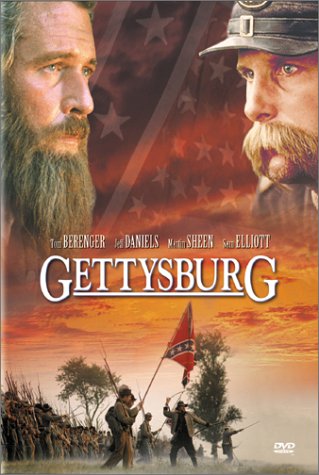
gettysburg-DVDcoverThis trope has been on my mind recently because I’ve been on something of a Civil War trip, watching and rewatching the movie Gettysburg.  It’s a fascinating movie, not the least because there are no clear bad guys.  In the battle of ideologies, I side solidly with the Union, but in the battle of men, I don’t know who to side for.

General Lee is one of my favorite characters, and certainly the commander for whom I have the most respect.  When General Longstreet is forced to order his men on the suicidal charge on the third day, I can’t help but cringe.  And perhaps the most touching moment of the whole movie is when the wounded General Armistead asks to see his old friend, General Hancock, only to learn that he has been shot as well:

BG Armistead: I would like … to see General Hancock. Can you tell me … where General Hancock may be found?

Lt. Chamberlain: I’m sorry, sir. The general’s down, he’s been hit.

BG Armistead: No! Not … both of us! Not … all of us! Please, God!

The main appeal to me of this movie, and in a more general sense of this entire trope, is the roll that honor plays in the characters’ interactions with each other.  Yes, they may be bitter enemies, and they may not hesitate to kill each other, but they aren’t fighting because they hate each other–they’re fighting because honor demands it.  And just like how the Fettered gains great strength through strict obedience to his personal code, so too does the Worthy Opponent gain both strength and respect by being a man of honor.

Obviously, this sort of antagonist makes it almost impossible to tell a story with black and white morality.  But with this trope, that’s kind of the point.  It exists to tell us that the enemy is not so different from us, and that not every bad guy is completely evil.  It doesn’t have to be used to set up an Aesop, though–when done well (as it was in Gettysburg), it’s satisfying enough on its own.

I played a lot with this trope in Stars of Blood and Glory.  In that book, Abaqa, a young Hameji warrior trying to build a name for himself, falls prisoner to Danica and her band of Tajji mercenaries, who he has been taught all his life to hate.  Gradually, though, they come to respect each other, to the point where … well, I won’t spoil it for you.  But it was definitely fun to write. 😀

I haven’t played a lot with this trope yet in other stories, but I definitely hope to in the future.  I’ve got another novel I’d like to write from Danica’s point of view, sort of a prequel novel to explore her and Roman’s origins, as well as the other Tajji mercenaries.  And then there’s Heart of the Nebula, which needs a major rewrite but has some elements of this trope in it.  So yeah, you can definitely expect to see more of this sort of thing from me in the future.
Trope Tuesday: Schrödinger’s Gun

The world of a fictional universe isn’t fixed beyond what the author has revealed to the reader.

This is what happens when Schrödinger’s cat gets hold of Chekhov’s gun.  There are a whole lot of interesting and potentially useful plot points lying around, but the writers are pantsing it as they go, playing a game of Xanatos speed chess with the readers (or the gamers, as the case may be).  Consequently, the story doesn’t actually take shape until it’s been told.

As you can imagine, this trope only really works in a story medium where there’s some degree of interaction between the writer and the audience, such as video games and RPGs.  However, there are some classic examples in more fixed media, such as film and books.  The movie Clue is a good example, where the filmmakers made three separate endings, and secretly showed different ones in different theaters (the DVD has all three).  The Choose Your Own Adventure series is also a classic example.

With the changes brought about by digital media, there are all sorts of possibilities opening up right now for this kind of storytelling.  Besides the Choose Your Own Adventure type stories, there’s also the serial format, where a writer releases a chapter at a time.  This is what a lot of web comics eventually become, especially the ones like Girl Genius, Schlock Mercenary, and Freefall with a HUGE extended story arc.  The same kind of thing is happening in ebooks too, on a spectrum between straight-up serials and series of longer works.

As you can imagine, it can be quite a challenge to keep all the storylines straight.  That’s because the one rule with this trope is that you CANNOT retcon.  Until the story is told, anything can happen–but once it does, the Schrödinger wave equation breaks down, and all the possibilities drop to 0 or 1.  The story becomes fixed, and in all future installments, you have to work with it.

Another interesting thing about this type of storytelling is the possibility for ascended fanon, where fan-created stuff like fanfic or fanart actually gets co-opted into the canon of the story.  The flip side is that it encourages the fans to get together and analyze things so thoroughly that any surprising plot twists get predicted long before they actually happen.  Still, I suppose there’s a special kind of squee in finding out that your predictions were right.

The reason I’m interested in this trope is because I’m more or less doing it with my Star Wanderers series.  It’s not strictly a serial, since each novella is a complete self-contained story, but taken together they sketch out a much larger arc that I’m only starting to discover.  Parts I-IV made a complete story arc in itself, all told from Jeremiah’s point of view, but right now I’m revisiting those stories from the viewpoints of some of the other characters.  That, in turn, is seeding all sorts of other stories, with new characters and wider conflicts.

There are challenges, though.  Today I started Part VIII: Deliverance, (from Lucca and Mariya’s viewpoints) and I got stuck on the second paragraph.  The second freaking paragraph.  It starts in the Zarmina system, but what class of star is it?  Have I mentioned it in any of the previous stories?  Thank goodness for word search functionalities, otherwise I’d be ripping my hair out!

So yeah, I’m going to have to be a lot more diligent about making and keeping a world bible.  I’m usually a pantser, so outlines are kind of anathema to my creative process, but having a solid reference for the stuff that I’ve already written is quite helpful.  Currently, I’m using Wikidpad, which seems to be the perfect tool for this sort of thing.

Fortunately, the challenges are a lot more fun than discouraging.  I had a great time writing Dreamweaver, getting into Noemi’s head and revisiting that story from her point of view.  It sounds so cliché, but that story really did write itself.  I kept a window with Outworlder in the background, and whenever I needed to see what would happen next, I’d just go to it and read the next couple of paragraphs.  Benefactor and Reproach have been much the same way.

Eventually, I plan to branch out a lot further, with other interesting characters and situations.  I have no idea what those will be exactly, but that’s kind of the point.  Until you actually pull the trigger, Schrödinger’s gun can exist in any state, from a musket to an AK-47 to a rocket-propelled grenade.  Whatever form it ends up taking, the important thing is to make sure it goes off with a bang.

Sorry, no Trope Tuesday (again)

Yeah, sorry, no Trope Tuesday this week.  Third week missed in a row!  Not so good.  Thing is, I’m really focused on finishing Star Wanderers: Reproach (Part VII) right now, with a self-imposed deadline of May 31st. I figure that’s more important, and I really don’t want to break my momentum.

I’ve been vacillating a lot about this project.  Sometimes, I think it’s halfway decent, perhaps even good.  Other times, I wonder how the @#$! I came to be trapped in this story and why I’m wasting the best years of my life writing this crap.  The other Star Wanderers stories are selling decently well, but this one is so shite that it’s bound to kill the series and why am I writing this why why WHY??? 

And then I get the chains back on my inner editor and drag him down to the dungeon, where I keep him on a strict diet of bread crusts and rotten cheese.  No wonder he hates me.

I know those trope posts are a popular feature around here, so I’ll get back on top of them once this project is finished (which WILL be this week!  It WILL!!)  In the meantime, if you’re looking for a trope fix, you should check out Anita Sarkeesian’s latest Feminist Frequency video.  She does an awesome job deconstructing feminist video game tropes, in a much more meticulous and thoughtful manner than I have ever achieved here:

Part of me wants her to take my own stories and analyze them for feminist tropes.  The other part shudders in abject horror at what she might possibly find.

Whoops, looks like the inner editor just got loose again.  Better go hang out on the KBoards until I’ve got him back in the dungeon.

Later!

Trope Tuesday: After the End

i am legend2It’s the end of the world as we know it … so why do we feel fine?

On the apocalyptic scale of world destruction, when the thing that wipes out civilization doesn’t quite kill everyone, we’re left with an After the End type setting.  Depending on where the writers fall on the sliding scale of idealism vs. cynicism, this may range from a futuristic Arcadia to a crapsack post- hell on Earth.

Whatever the case, expect to see lots of modern ruins and schizo tech mashups (horse-driven cars?  Wood-wheeled bicycles?).  If anarchism reigns, expect to see lots of punks roaming the wastelands in muscle cars and motorcycles.  If Ragnarok Proofing is in effect and the ruins of civilization haven’t quite decayed yet, expect some variation of a scavenger world.  And if someone from our modern era finds himself lost in this bizarre post-apocalyptic future, expect him to find some sort of constant to reinforce that he’s not in Kansas anymore.

Unlike dystopian settings, where society evolves (or is deliberately turned) into a horrible, hellish place, a post-apocalyptic setting represents a reboot of civilization itself, where one society has passed away and a new one is slowly picking itself up from the ashes.  It has the potential to be a lot more hopeful, and to give the reader a lot more wish fulfillment.  After all, who wouldn’t want to be one of the lucky survivors tasked with rebuilding civilization?  Sure there may be zombies or nuclear nasties wandering about, but on the plus side, you don’t have to worry about your bills or your deadbeat job anymore.

Douglas Rushkoff has some interesting ideas about why this type of story is becoming more and more popular nowadays.  In his new book Present Shock which he’s been promoting recently, he argues that many of us are so overwhelmed by a world where everything happens now that we wish we could end it all and start over.  When we live in an ever-changing present without a coherent narrative to reference our past or our future, we long for something to restore that sense that we’re part of a larger story, even if that story is racing towards a horrible, tragic end.

But every ending is a new beginning, and that’s what lies at the very core of this trope.  When our world passes away, what will the new world look like that takes its place?  Will we learn from our mistakes, or are we doomed to repeat our worst atrocities?  Will we eat each other like dogs, or will we tap into some deeper part of human nature where mercy and compassion lie?

This is all on my mind right now, because I’m writing a post-apocalyptic novel (with the working title Lifewalker) that takes place in Utah 200 years after the end.  Humanity was hit by a plague that kills everyone over the age of 25, so that the only people left are orphans, teenage adults, and their babies.  It’s fascinating to wonder what from our era would fall apart and what would remain, or what would be preserved and how the new society will take shape.

But it’s not the apocalypse itself that I’m interested in, so much as what happens after things stabilize.  The main character is one of the few people who’s immune to the plague, so naturally he feels like a complete outcast.  He’s walking the Earth, riding down the ruins of I-15 with a copy of Brandon Sanderson’s Mistborn in his saddlebag.  And the people he meets … well, let’s just say I wasn’t very kind to Las Vegas.

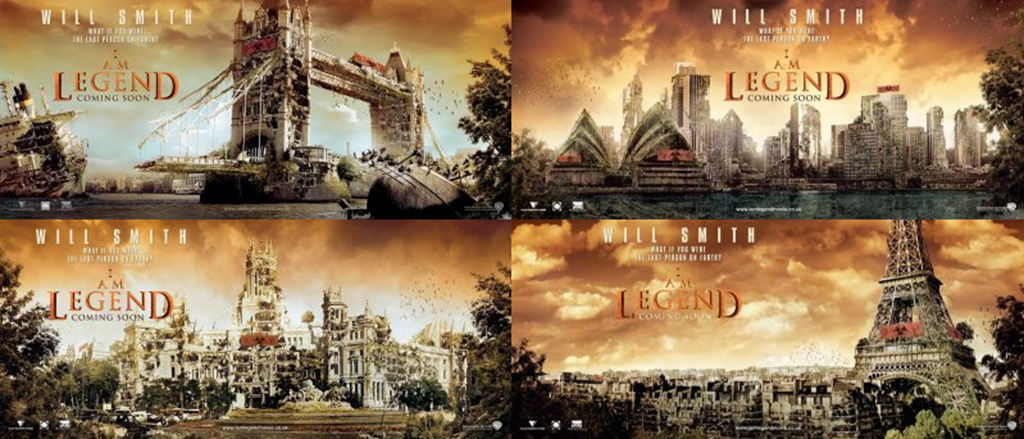
I think that’s another part of the appeal of this trope: it takes our own world and twists it into something fantastic, so that instead of having to wrap our minds around a whole new set of history and physics, we can build on the familiar in wild and interesting ways.  A Canticle for Leibowitz did this very well, with another post-apocalyptic tale set in Utah.  However, the most famous popular example is probably the movie I Am Legend.  I love those long panoramic shots with Will Smith hunting deer in Times Square, or hitting golf balls off the wing of a fighter jet.  Stuff like that really sparks the imagination because it combines something familiar with something wild and different.

Believe it or not, this trope has actually happened in real life.  After the bubonic plague swept across Europe, whole cities were depopulated, with as much as 60% casualties in some places.  When the Pilgrims settled at Plymouth, they were actually building over the ruins of a large Indian settlement that had been wiped out by smallpox just a few years before.  And using DNA evidence, scientists now believe that all of modern humanity is descended from a small group of just 50 females who survived a global volcanic eruption some 70,000 years ago.

So yeah, this is definitely a trope I like playing with.  I’m on track to finish Lifewalker by the end of May, so you can definitely expect to hear more about it in the weeks and months to come.

Also, for those of you looking for resources to help you visualize what the world will look like after the end of human civilization, here are a couple of excellent resources I’ve found.  First, check out The World Without Us, an excellent book written by an environmentalist that poses a basic thought experiment: what would happen if all humans everywhere magically vanished, and all that was left was the stuff that we’ve built?  What, if anything, would remain? (spoilers: not much) If you want to explore that idea but you don’t want to read the whole book, check out this wiki on Life After People, a series of History Channel documentaries that basically posed the same question.  The answers may surprise you.

Trope Tuesday: Fridge Logic, Fridge Horror, and Fridge Brilliance

It's amazing how many existential story questions arise from this view.
It’s amazing how many stories suddenly stop making sense from this point of view.

You know that moment after the end of the show, when the credits are rolling and the glory of that crowning moment of awesome is just beginning to fade?  When you go to the fridge to get something to eat, and all of a sudden that gaping plot hole or internal consistency problem with the story hits you?  Yeah, that’s fridge logic.

The key, though, is that it’s not something you normally question while you’re reading the book or watching the show.  While you’re in the story itself, the narrative is so compelling that you just don’t question it–that, or rule of cool is in play.  It’s only after the story is over that those questions start to arise.

It doesn’t have to come from bad writing.  Sometimes, it’s a result of values dissonance, especially for stories written in a different time or culture (although by no means is this phenomenon immune to bad writing).  Sometimes, it’s a result of a tomato surprise, where a reveal of something the characters have known all along completely changes the audience’s understanding of the story (though certainly, this isn’t immune to bad writing either).

Not all fridge logic is bad.  Fridge horror happens when a story becomes even more terrifying the more you think about it.  Some of the scariest horror stories have done this to me, as well as some that weren’t really intended to finish on downer endings but kinda sorta did.  Cracked.com did an interesting article on six movies that went that way.

But the best is when a story turns around and gives you fridge brilliance–that moment when you realize that that thing that bothered you actually changes the nature of the story in a way that suddenly makes it your favorite.

My favorite novel of all time, The Neverending Story, totally did this to me.  When I first read it in fourth grade, there were so many things that made the story awesome: the Temple of a Thousand Doors, the test of the three gates, the old man who is the exact opposite of the Childlike Empress in every way, and of course the signature phrase “but that is another story and shall be told another time.” But when I reread it in college, I realized that the real story–the underlying story that brings everything together–isn’t about a loser kid having all sorts of adventures in a fantastic world, but about the power of storytelling itself, and how it can fill the world with love.

Another moment of fridge brilliance came to me when I learned the story behind the writing of Legend, my favorite novel by David Gemmell, my favorite fantasy writer.  The book is about a hopeless battle that everyone knows cannot be won, and the people who decide to go and fight it anyway.  That’s all well and good, except that David Gemmell wrote it immediately after he was diagnosed with terminal cancer.  The story of the battle itself was a metaphor for his own life, and his struggle with his own impending death.  Lucky for all of us, after he finished writing it the doctor came back and told him that the first test was a false positive–that he was going to live after all.  He then went on to write almost thirty more books, all of them off-the-charts awesome.

So yeah, there you have it.  These are more reader tropes than writer tropes, but as a writer it’s good to keep them in mind.  Don’t be lazy, otherwise your fans will pick your stories apart (or if you have to leave a hole, be sure to hang a lampshade on it).  And if you find yourself smacking your forehead over something you’ve already written and published, see if you can’t revisit it in later books in the series and turn it into fridge brilliance.

Trope Tuesday: It Has Been an Honor

If there ever was a phrase that invoked manly tears, it’s this one.

It has been an honor” is pretty much the go-to catch phrase for any Heroic Sacrifice or Bolivian Army Ending.  It’s often a precursor to a Crowning Moment of Awesome, and as far as last words go, it ranks right up there with “I die free,” “I die as myself,” and “I regret nothing.” Expect to hear it a lot from blood knights, members of the proud warrior race, or anyone who belongs to a martyrdom culture.

Occasionally, you’ll hear a villain say this when he acknowledges the hero as a worthy opponent.  In such cases, the villain may evolve into a friendly enemy or a fire-forged friend. Or, if the trope is played straight, they just die.

One time you won’t hear this phrase is when someone is trying to play More Hero than Thou.  In that case, two or more good guys in a friendly rivalry basically argue over who has to bite the bullet, so the honor becomes a point of competition between them.

In my opinion, the heart and soul of this trope is the idea that some things are worth dying for.  Obviously, a character facing death is not going to say this unless he values his honor more than his life.  What exactly constitutes “honor” may be up for debate (with the potential for some unfortunate implications, especially in real-life martyrdom cultures like Japan), but the core element here is that the hero is fully willing to give up his life for something greater than himself.  Bonus points if he starts out as a coward and this trope marks the conclusion of his growth arc.

While this phrase often leads to a death of some kind, that isn’t always the case.  The cavalry can still show up to save them, or one of the characters can ultimately survive (either the one who says this phrase, or the one to whom it is said).  The important thing, though, is that the characters face death in a meaningful way.  Without that, this phrase doesn’t have nearly as much power.

In my own work, this trope tends to pop up a lot, especially in the more military sci-fi books in the Gaia Nova series.  It shows up multiple times in Stars of Blood and Glory, and also in Bringing Stella Home, though more in a posthumous way than anything else.  I suppose you could also say it happens in Star Wanderers: Homeworld, if you use a broader interpretation.

But either way, I’m definitely a big fan of this trope.  Expect to see it many more times in my own work in the future.

As a final note, it’s worth pointing out that the bandmaster’s violin from the real-life Titanic has recently been recovered and confirmed genuine.  It’s now on display in Belfast, less than two miles from where the Titanic was built.

Trope Tuesday: Rebellious Princess

Marle2You know that innocent and beautiful fairy tale princess, with the tricked out dress and the power to summon woodland creatures?  The one with a tendency to get kidnapped, but who always ends up happily ever after with her prince charming?

Yeah, that’s not this princess.

A rebellious princess would just as soon puke if she were any of those things.  She hates being royalty–she’d rather be one of the common folk, or at least be out doing something (which is why she’s often involved in politics).  She hates all those frilly dresses and tends to wear her hair in a tomboyish ponytail.  Rather than wait for her white knight to save her, she’s much more likely to be an action girl in disguise, or at least something of a badass.  When she grows up, she may become a lady of war.  Invariably, she hates whatever marriage has been arranged for her and often scandalizes those of her class to marry for love (if she even marries at all).

As you might have already guessed, this trope is extremely common, not the least because the princess classic has largely been discredited (at least, outside of Disney).  There’s a lot of variation on it too, with some stories featuring the rebellious princess as the love interest, and others showcasing her as the hero.

George R.R. Martin (Song of Ice and Fire) deconstructs the trope with Arya, who eventually becomes something of a sociopath, and Brandon Sanderson (Elantris) subverts it with Sarene, who very much has the personality but uses her royal position to her advantage.  Frank Herbert (Dune) zigzags with Lady Jessica, who is undylingly loyal to the Atreides family but rebels against the Bene Gesserit.  As you might expect, J.R.R. Tolkien plays it straight, not once but twice: Éowyn in Lord of the Rings, and Lúthien in The Silmarillion.

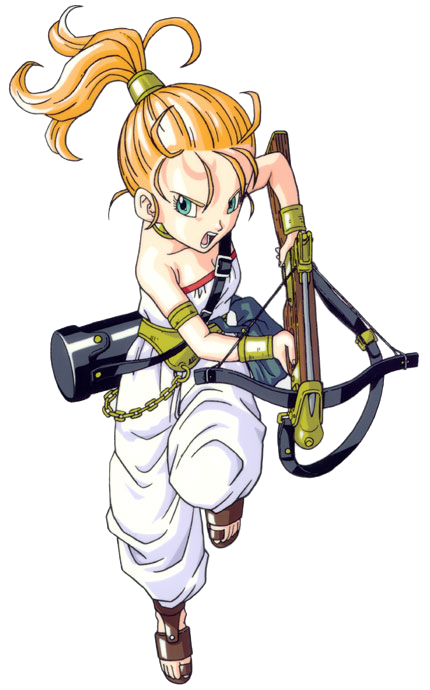
It transcends cultures, too.  In Crouching Tiger, Hidden Dragon, Jen might not technically be royalty, but she is the governor’s daughter and she does reject an arranged marriage to run away and become a wandering warrior.  And in classic RPGs, especially the old Japanese ones from Square, this trope is everywhere.  The princess in the picture above is Marle from Chrono Trigger, who fits this trope to a T.

So why is this trope so prevalent nowadays?  Probably because the modern feminist movement led us to discard most of our old-fashioned feminine ideals, as well as the characters who were held up as shining examples of them.  That, and rule of drama.  Everything ultimately comes down to rule of drama.

In my own work, Hikaru from Stars of Blood and Glory is an example of this trope, though she’s more of a president’s daughter than a hero or a love interest.  She does have her own story arc, though, and I’ve got a sequel in the works with her as the main character.  Scientists aren’t exactly royalty, but they do consider themselves elites in Genesis Earth, which means that Terra has echoes of this trope.  And in Heart of the Nebula (as-yet unpublished), I’ve got a character who isn’t exactly rebellious, but she does qualify as a badass princess (though the society in question is a perfect techno-democracy and not a monarchy).

Trope Tuesday: Mexican Standoff

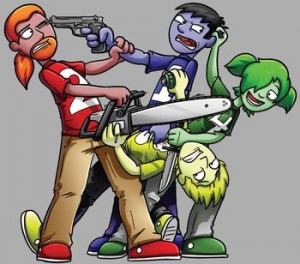
rsz_standoff_9776In a typical standoff, such as a hostage situation, two characters face off without immediately shooting at each other.  One or both of them may be using a human shield, or be reluctant to shoot first for fear that the other will take them with him.  A Mexican standoff, however, takes that up to a whole new level.

Perhaps the best explanation is the one from Wikipedia:

A Mexican standoff is most precisely a confrontation among three opponents. The tactics for such a confrontation are substantially different than for a duel, where the first to shoot has the advantage. In a confrontation among three mutually hostile participants, the first to shoot is at a tactical disadvantage. If opponent A shoots opponent B, then while so occupied, opponent C can shoot A, thus winning the conflict. Since it is the second opponent to shoot that has the advantage, no one wants to go first.

Basically, it’s Mutually Assured Destruction (MAD) on the level of individuals rather than nations.  The classic example is the finale from The Good, the Bad, and the Ugly.  Clint Eastwood’s character rigged it, though, so the outcome was never really in dispute.  Elsewhere, things rarely end so cleanly.

If the Cavalry doesn’t show up to save the day, these situations tend to lead to a messy free for all.  Heck, that may happen even if someone from the outside comes to save the hero.

If the resulting fight has a little more thought and strategy to it, though, you’ll get a Mêlée à Trois.  This happens in The Hobbit with the Battle of Five Armies, and in Downbelow Station with the stationers, merchanters, and Captain Mallory.  It also tends to happen a lot in A Song of Ice and Fire, with the various factions in that world.  Heck, it happened in real life during the Lebanese civil war, and is probably happening right now between the Christians, Sunnis, Shia, and Alawites of Syria.

When the fight has room for a little more scheming, you’ll often see things like a gambit pileup or a kingmaker scenario.  This is where things get really tricky, and the intrigue becomes positively delicious.  It isn’t enough just to have two parties duking it out–you’ve got to have lots of characters and factions, each with their own agenda.  That way, even the weakest party can win if they can convince everyone else to fight each other.

All of that happens after the Mexican standoff, though.  The standoff itself is the moment of tension and uncertainty before the crap hits the fan.  When done well, it’s an awesome moment of tension that can really boost the suspense.  When done poorly (or just for laughs), it’s over-the-top crazy, like Duke Nukem meets Scooby Doo.

I haven’t played around with this trope too much yet.  Stars of Blood and Glory has a little more intrigue than some of my other works, but I can’t think of a specific Mexican standoff moment in the book.  The situation near the end of Desert Stars is kind of like this, but with relationships and marriage alliances rather than guns.  I’m sure that’s a different trope, but I’m not sure which one.

Yet another reason to keep trawling tvtropes…

Trope Tuesday? Oh yeah, about that…

I’ve been so hard at work on the edits and book teaser for Stars of Blood and Glory that I completely forgot about Trope Tuesday.  In addition, I’m working a two week job that runs 8 to 5, with a half hour lunch break.  Sorry for those of you who enjoy this feature, but it looks like Trope Tuesday will be on hold for a week or two.

I haven’t forgotten about it, though.  If there’s any particular trope you’d like me to cover, I’m open to requests.  Just mention them in the comments below.

In the meantime, here’s a good example of the cannon fodder trope.  After watching this video, no explanation should be necessary.

Take care!

Trope Tuesday: Planetville (aka Adventure Planets)

swmapsmall

Adventure townsIN SPAAACE!!!

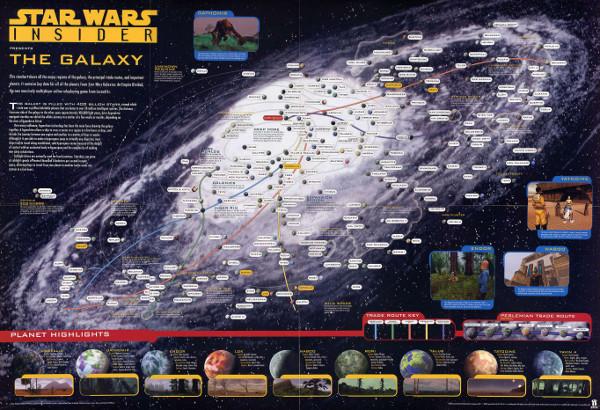
Seriously, that’s the best way to describe it.  In Westerns and TV serials, the heroes travel from town to town, with a new adventure in each place.  Well, in science fiction, we don’t hop towns, we hop planets.  Why?  Because we can.

Unfortunately, since planets and towns are actually pretty different kinds of places, there’s a lot of room to do things poorly and turn this trope into a cliche.  Any story that doesn’t consider (or at least lampshade) the implications of space travel and planetary colonization is in danger of becoming over-the-top campy–although, to be fair, there is an audience for that.

That doesn’t mean there isn’t room for this trope in fiction that takes itself a little more seriously.  In fact, I take issue with some of the descriptions on the Planetville page.  From tvtropes:

Unfortunately, because Sci-Fi Writers Have No Sense of Scale, stories about Planetville make no sense. Nobody seems to realize how BIG a planet is — everything in Planetville takes the same amount of time as stories set in towns or countries. In the updated Wild West story, the outlaws are “exiled from the planet” just like they’d be exiled from Dodge City, and have to quietly leave… instead of flat out challenging the authorities to find them when they have an entire planet in which to hide. When the space Nazis invade, they seem to need the same number of soldiers and time as the Earth Nazis needed to invade Europe. And when the crew of the Cool Starship finds the cure for the alien plague, the logistical issues of distributing it to an entire planet rarely get mentioned at all. These considerations are minimized or left out entirely in many stories.

To address these criticisms point by point:

1) Scale is relative to technology and the predominant modes of transportation.  When my ancestors crossed the plains to settle in modern-day Utah, they had to walk.  It took them months to get here and many of their family members died along the way.  Today, I can make the same trip by car in a day or two.  As technology changes, so does the sense of scale.

2) Unlike what some tropes would have you believe, not all planets are Earth-like.  In fact, it appears that most planets outside our solar system are wildly different.  In practical story terms, this means that any part of the world that’s remotely habitable is probably going to be immediately around the colony. Consequently, the local authorities probably will have the power to exile trouble makers from an entire planet, since exile from the colony would mean de facto exile from the planet as well.

3) Anyone venturing outside of the dome would have to carry just about everything necessary for life, including air, water, food, etc.  You might as well try to hide in Antarctica as hide on an alien planet.  It can be done, of course, but to do all that and stay hidden, that’s going to be tough.  You might as well set up a rival colony for all the effort–but at that point, the story is about a lot more than just hiding from the authorities.

4) If your planetary colonies are only as populous as an average WWII era city/town, then yeah, you’ll only need as many soldiers as it took to conquer them.  The biggest difference is that they’ll fly a really cool starship.

5) Again, if the planet isn’t habitable and the population is contained within a handful of relatively small colonies, then distribution shouldn’t be too much of a problem.

However, the tvtropes page does make this valid point:

A side effect of this is that the characters never realize that things can happen in parts of planets. You will never see aliens trying to capture a planet’s equator, or its polar caps — it’s the whole planet or bust.

In the end, I think the key to doing this trope well is to know your setting well enough to fit the story to it.  Tropes are tools, and when done well, this trope can accomplish everything it sets out to do while making perfect sense within the context of the story.

In my own work, this trope is most prevalent in the Star Wanderers series.  Every novella takes place at a different planet or space station, sometimes multiple planets per station.  Because most of the stars in this universe have only recently been settled, the colonies are small and terraforming is quite limited.  In Desert Stars, I used a similar concept, except with large domed areas of a single planet, instead of multiple planets (Adventure townsUNDER THE DOME!!!).  In cases where the planets are Earth-like, however, or where travel between planets is costly and difficult, this trope doesn’t really ever come into play.