The rough AI draft of The Soulbond and the Sling is complete!

So I just finished the rough AI draft of The Soulbond and the Sling, after nine days of outlining and prewriting, and five days of working with Sudowrite to generate it. The rough draft clocks in at 18 chapters (plus a prologue and an epilogue), 80 scenes, and 153,254 words. I used about 770,000 AI credits from start to finish, including for generating all of the characters and worldbuilding in addition to the text of the draft itself.

I have to say, I am really impressed with the incremental improvements over at Sudowrite, and with Claude 3.7, which was the AI model that I used to generate most of this book. I did try out Sudowrite’s new Muse model, but I wasn’t too impressed with it, at least for generating new chapters. For the in-chapter tools, such as guided write, expand, or rewrite, it’s probably fantastic, but with generating new chapters from my outline it just felt too much like it threw all my worldbuilding into a blender. Most likely I either had the creative setting set too high, or I gave it too many prompts.

But when I switched to Claude 3.7 (Sudowrite’s “Excellent” model), the results were amazing. I seriously felt less like I was writing the novel and more like I was reading it for the first time. There’s still a lot of work to be done, especially in the second half of the book, where many of the scenes strayed from the overall story structure, either forgetting things that had already happened or assuming things that hadn’t yet. There’s also quite a bit of worldbuilding that I would like to add in, and a handful of small hallucinations that need to be cut out, as well as a major change that I made in one of the characters and need to smooth out in other scenes… but overall, I found myself really enjoying this book, and was frankly surprised at how well it fleshed out the setting and characters, making them really stand out. It also added some really great dialogue that is probably going to make it to the final draft.

I was originally planning to lay this WIP aside while I switch to another project, but I think now the best course will be to work on the AI draft until I make it as good as I can. That way, I can tinker with the AI prompts while they are still fresh in my mind. Once I’ve gotten the AI draft as good as I can make it, I’ll lay it aside for awhile to let my subconscious work on the story, so that when I pick it up again, I’ll be better able to do an awesome human draft.

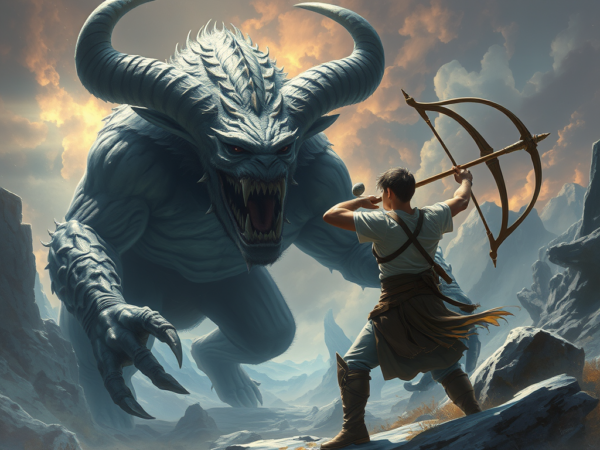
I would have added a mock-up for the book cover, but you would not believe how hard it is to get an AI image generator to give you a picture of David and Goliath that doesn’t have David holding a bow and arrow! Seriously—every time I prompt it for a fantasy illustration of David and Goliath, where Goliath is a giant horned monster, it shows David with a bow and arrow instead of a sling. It’s almost as bad as the strawberry problem! But let’s see if WordPress can do it…

Nope. Yet another AI image fail. I even specifically said he was wielding a balearic sling. Sigh.

The Sudowrite draft of The Riches of Xulthar is finished!

It only took about a month, but it would have been much faster if I’d used Story Engine. Honestly, I probably could have generated the text in a week if I’d used that tool, or perhaps even an afternoon. Instead, I outlined the project myself, wrote the first couple of paragraphs for each individual scene, and wrote / generated the rest.

Most of what I used Sudowrite for was on a sentence and paragraph level for this draft. Typically, I would write a bit, get to a point where I wasn’t sure what to write next, generate some text, and then either 1) use it as-is, 2) use it, but run it through a couple of rewrite filters first, 3) use it, but tweak it myself, or 4) throw it out entirely and keep writing. Because the AI didn’t have an outline to work with, it often took the story off in weird and non-useful directions, but there were a couple of times where it surprised me in a good way, and I decided to keep it in.

One of the things I found was that Sudowrite is terrible for magic systems, world-building, character arcs, foreshadowing, unresolved sexual tension, or anything else that happens on a macroscopic scale, especially if that story element changes over the course of the novel. For example, he AI engine wanted every scene involving both my male and female leads to culminate in the climax of their romantic subplot. Likewise, it was very difficult to get the AI to hit the right beats for their character growth; that was something where I really had to babysit it.

But for those microscopic, word / sentence / paragraph level story elements, I was pleasantly surprised with how Sudowrite performed. It felt a bit like I was riding in the front of a tandem bicycle, instead of writing alone. When I hit stretches that required a lot of uphill effort, I could rely on the AI engine to do most of the work while I steered. Of course, riding a tandem is no fun unless both people are pedaling, so I still had to do my part, but the hills and the rocky parts felt a lot easier, which was nice.

This Sudowrite draft isn’t anywhere near publishable, but that wasn’t what I was going for. Instead, the goal was to get it good enough to use as a starting point to rewrite the entire thing myself. Rough drafts are pretty hard for me, but rewriting and revising comes much easier after I have something to work with. Even if I end up throwing out every word, I expect that I can power through this “humanized” draft in a fraction of the time it would take me to write the novel from scratch. I may even finish it this week!

But perhaps the area where the Sudowrite draft did the most was with helping me to be productive even when my attention was being pulled in multiple directions by small children. A significant chunk of this book was written in the BYU Library’s family study room, with one eye on my three year-old daughter as she played with the other kids. Even after I had to step in to referee a bit, or to take her for a snack or a potty break, the AI tools enabled me to jump right back in and keep writing.

The amount of focus it takes to write with AI tools is much, much less than what it takes to write without them. At least, that has been my experience. Granted, my goal with this draft was not to make it publishable, but to make it good enough for the next phase, which is more like 95% human effort and 5% AI, as opposed to 40% human effort and 60% AI, which I used for this draft.

But I doubt there are any AI tools right now that can get a book into a published state with minimal human effort. In general, I’ve found that these AI-assisted writing tools are great for getting a book from terrible to passable, but not as useful for getting a book from passable to genuinely good—and as for getting a book from good to genuinely great, you can forget it with our current set of AI tools. Much better to rely on human efforts for that.

To use another analogy, it’s kind of like using a two stage rocket to get to orbit, where the booster rocket is the Sudowrite draft and the second stage rocket is the humanized draft. The booster won’t get you to orbit on its own, but it will get you through max Q and send you high enough that the second stage can finish the job. And since you’re going up in two stages instead of just one, it doesn’t take nearly as much fuel to get there.

Another advantage of doing it this way is that the final draft will be almost 100% human-written. There’s no copying or pasting in the humanized draft—every sentence and every word is typed out by hand, and while some of it may come verbatim from the Sudowrite draft, most of it is going to be changed in some way, sometimes quite substantially. For example, today I “humanized” a scene that was about 750 words in the Sudowrite draft, but ended up at around 1500 words.

What I’ll probably do is pick a few scenes from this novel and post the before and after, to show how substantially it’s changed. But even the Sudowrite draft isn’t totally AI generated, at least with the way I’ve been using these tools. Like I said above, it’s much closer to 60/40.

The Sudowrite draft of The Riches of Xulthar clocks in at about 33.2k words. That still falls short of the 40k word minimum threshold for a novel, but it will get longer with the next draft, and I expect it to end up somewhere between 40k and 45k words. With luck, I’ll finish the humanized draft by the end of this week, and the revisions before the end of this month.

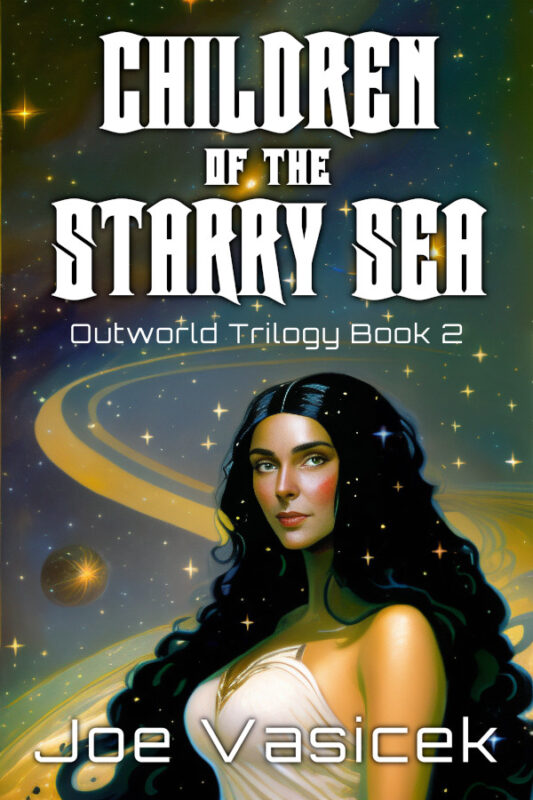
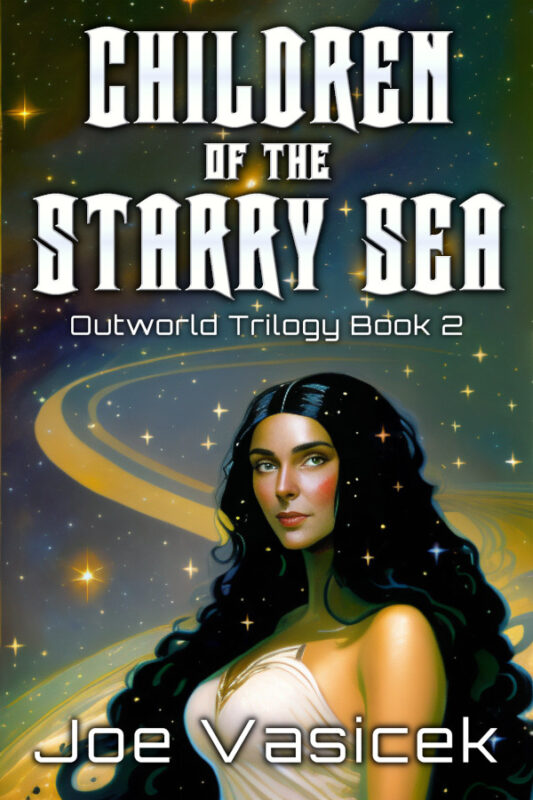
Children of the Starry Sea cover reveal!

Behold!

This is the ebook cover for Children of the Starry Sea, coming out sometime this summer! If it looks familiar, that’s because I kept the art from my earlier experiments with Stable Diffusion—the feedback was so positive, including from my writing group, that I decided to make only a few minor tweaks, such as the stars in her hair, and removing the weird watermelon-planet thing that was originally in the bottom left corner. Made a few minor changes to the typography too, though I decided to keep the fonts.

Also, you’ll be interested to know that I just finished the first revision pass of this WIP a few hours ago! I’ve been racing to finish it before the new baby comes, because it’s probably going to be touch-and-go after that. Now I just need to do two more revision passes, one to look for and clean up any issues that I may have missed, and another to trim it down by 10% and make sure the writing is all solid. After that, it’s off to the editor!

IT IS DONE

At long last, after more than a year, the rough draft of Children of the Starry Sea is now complete! It clocked in at just over 149k words, which makes it the longest book I have written since I started publishing (the first novel I ever finished was a 168k word train wreck that will never see the light of day. I wrote Genesis Earth next, and that was my first published novel).

I will probably pare it down to around 130k words, which will still make it my longest book when I publish it. Since I’ve been cycling through the revision drafts as I write, I will hopefully finish all the revisions within the next month and put it up for preorder shortly after that.

I am super excited, not only about this novel, but at the recent changes in my writing process that enabled me to finish it so quickly, and will hopefully help me to write a lot more books moving forward. Because of those changes, I’m confident that I can finish the third book in the trilogy (Return of the Starborn Son) before the end of the year, perhaps even before the end of the summer. It will be really fantastic to have this trilogy complete.

And after that? I’m not entirely sure. I currently have two other unfinished trilogies, and I hope to finish those soon, but I may also want to start a new one. If I can write at least three novels a year, I can finish a trilogy and start a new one every year going forward.

Anyway, I’m really excited that book two is done. Looking forward to writing the next one!

How I hacked my ADHD to triple my daily word count

Writing with ADHD can be tough. It’s easy to beat yourself up for being “undisciplined” or “lazy” when the greater problem is that you’re trying to work against your ADHD instead of finding ways to make it work for you. It’s like swimming against a rip current instead of swimming sideways to get out of it.

In the last month, I’ve made a really fantastic breathrough that I think will change the way I write from here on out. So far, it’s helped me to double or even triple my usual word count. The novel I’ve been wrestling with for more than a year now—the longest one I’ve written since I started indie publishing—now looks like it will be finished in just a few of weeks, when I expected it to take a couple of months. Needless to say, I’m really excited.

What changed? I found a way to make my ADHD work for me, rather than against me.

In my previous post, A reading hack for the ADHD addled brain, I explained how I exploited my ADHD to read more books. Basically, I did the same thing, but for writing. There was a lot that had to happen first, though, and the biggest of those was that I had to learn how to make and keep an outline.

Step 1: Learn how to outline properly

For years, I just sort of assumed that I was a discovery writer, probably because of the ADHD. Most of creativity has to do with finding novel or unexpected ways to combine two or more ideas, and when you have ADHD, your brain naturally jumps from idea to idea. That was why I always hated taking meds when I was a kid: I felt that it stifled my creativity. And since most of this idea jumping happened subconsciously, I assumed that outlining would also kill that process.

But after a few years of struggling as an indie author, I realized that my writing process was too slow. In order to succeed, I needed to publish more frequently, but in order to do that, I needed to produce more content regularly. Back then, I would usually write a novel from start to finish, laying it aside for a month or two if I ran into a serious block, and also after finishing each draft. A typical novel would go through two or three revision drafts, so it would literally take years before a +70k word novel was ready to publish.

I decided that the best way to shorten my writing process was to “cycle” through the book, combining all the drafts so that I was working on revisions while simultaneously writing the rough draft. In order to keep track of all that, I needed to keep an outline. So I tried out a few different methods and tweaked them until I came up with a method that worked well for me.

The thought of outlining can scare a lot of writers who consider themselves “pantsers” or “discover writers,” but the thing to keep in mind is that there is no one right way to keep an outline. In fact, there are probably as many ways to outline as there are writers. For some, a couple of quick sketches on the back of a napkin is enough, while for others, it turns into a massive story bible that’s just as long (or longer) than the actual book. But without trying out a lot of different methods, you’ll never figure out what works for you.

It took me a couple of years, but I eventually developed a method that worked really well for me. With it, I was able to write Edenfall and The Stars of Redemption, as well as the last two Gunslinger books, in much less time than it took for my other ones. I was also able to combine all eight of the Star Wanderers novellas into a novel—something I probably wouldn’t have been able to do very well without a solid outline to keep it straight.

But I still would run into blocks that would occasionally derail the project, at least for a little while. I ran into that a lot with my current WIP, Children of the Starry Sea. Sometimes, they were genuine story problems that I needed to work through. More often than not, though, the problem was one of momentum: I was having too many bad writing days interspersed with the good writing days, so that each day felt like I was starting from zero. After a while, that becomes difficult to keep up.

Step 2: Allow yourself to write out of order

When I came back from my second hiatus to work on Children of the Starry Sea, it was clear that my new method wasn’t working as well as I needed it to work. Children of the Starry Sea is much longer than anything I’ve published so far, and I found that I just wasn’t producing enough new words consistently to make my “cycling” process of revisions work.

Around this time, I remembered something I’d heard on a recent convention panel, where one of the authors shared how he collaborated with another author. Instead of going back and forth, he told his cowriter: “how about you just write all the odd chapters, and I’ll write the even chapters, and when we’re both done we’ll combine it all together and see how it turns out.” To their surprise, it actually turned out really well.

So with that in mind, I decided to experiment with skipping around my current WIP, rather than writing it in order from start to finish. If I woke up and felt like I wanted to write an action scene, I would pick one of the action scenes out of my outline and write that. If I felt like I wanted to write the ending, I would skip ahead and write that. If I felt like I wanted to write the next scene, I would go back to where I’d left off and write that.

The outline was the key. Without it, there’s no way I’d be able to keep everything straight and know where each part is supposed to go. The outline also had the added benefit of dividing the novel up into smaller chunks, making the overall project much less intimidating. The way to eat an elephant is to take one bite at a time, just like the way to climb a mountain is to take one step at a time. Same thing with novels.

That’s all well and good, you may be thinking, but what happens when you’ve written all the stuff that you want to write, and all that’s left is the stuff you didn’t want to write? Isn’t that a bit like eating your dessert first, and leaving your vegetables for last? Not really, because chances are that if you really don’t want to write a particular scene, the reader probably won’t want to read it either. So if you can find a way to rework your story so that scene becomes unnecessary, you’re probably better off doing that.

But I actually haven’t had that problem yet. The thing about ADHD is that it actually feels right to jump around all over the place like that. Just because I don’t want to write a particular scene on one day doesn’t mean that I won’t want to come back to it sometime later. And more often than not, writing a later scene actually makes things fall into place with the earlier scenes, and makes me more excited to write them.

It’s as if the project itself is a puzzle. Can you imagine trying to put a puzzle together in linear order, starting from the top left corner and moving to the bottom right? That would be pure torture! Instead, you pick up whatever pieces catch your eye, and try to fit them in with other, similar pieces, until the puzzle itself begins to take shape.

There a lot of disadvantages to writing with ADHD, but there are some areas where the ADHD can actually become a strength, if you learn to work with it instead of against it. I’ve already mentioned how it can help with creativity, since your mind is always bouncing around between different ideas. What I’ve learned in the last month is that writing out of order is another great way to harness ADHD as a strength, since something that leaps out from writing one scene can often lead to a breakthrough in another. Writing out of order gives your ADHD brain the space it needs to make those intuitive leaps, and harnesses the “oh, shiny!” toward something productive, rather than driving you to procrastinate.

Step 3: Start in the middle, not the beginning

For me, the hardest part of writing is getting started. That’s probably my ADHD: it’s always easier to get distracted than it is to settle down and do what you’re supposed to do. Once I’ve settled down, though, and gotten into a groove, I can usually stick with a task until it’s done. In fact, once you’re in something of a flow state, the ADHD can actually make you hyperfocus.

So if the hardest part of writing is getting started, how do you turn that from a weakness into a strength? By leaving the next scene(s) unfinished, so that the next time you sit down to write, the scene has already been started and you just need to figure out the next word. One word leads to the next, and before you know it, you’re in the groove again.

By far, this has been the biggest part of my breakthrough: realizing that I don’t have to write every scene from start to finish in one sitting. In fact, it’s better if I don’t. Instead, I’ll typically finish one or two scenes in the morning, then pick out three to four scenes in the afternoon and write the first couple hundred words or so, deliberately leaving them unfinished so that I have a variety of scenes to choose from the next day.

If the hardest part of writing is getting started, then the hardest part of getting started is feeling overwhelmed at how much you have to do. But if all I have to do is write a couple hundred words, that’s easy! It also works with my ADHD instead of against it, since I get to jump from scene to scene instead of getting bogged down.

With the way that I used to write, most of my “writing blocks” had less to do with the actual writing and more to do with working myself up to write. Many times, I found that if I just sat down and opened up my WIP without thinking too much about it first, the writing would come a lot easier. Starting in the middle is a great way to harness that, because you aren’t confronted with a blank page the moment you sit down. It takes a lot less effort to find the next word than it does to find the first word.

So with where things stand right now, I just need to start four new scenes every day this week and I’ll have every remaining scene in my novel WIP started by Saturday. From there, if I can finish two or three scenes a day, I can easily finish the rough draft stage of this novel WIP before the end of February—which will be amazing, since I’m only at the 65% mark right now, and historically that’s always the part where I find it most difficult to write.

I’m really looking forward to writing a whole novel from start to finish using this method. As soon as Children of the Starry Sea is finished, I’ll start outlining the sequel, Return of of the Starborn Son, and write it the same way. If things go well with my current WIP, I’ll be very optimistic about finishing the next one before the end of the year—perhaps even before the end of the summer.

I do expect things to get crazy around here soon, though. Our second child is due in the early spring, which means enduring a month or two of chronic sleep deprivation. I’ve gotten to be pretty comfortable with writing at 4AM, but we’re also getting a lot more uninterrupted sleep than we were when Princess Hiccup was a newborn. I anticipate that we’ll have at least a month where nothing gets productively done.

So it will be really fantastic if I can finish Children of the Starry Sea NOW, before the baby comes—and not just the rough draft, but the revisions too. Fortunately, I don’t think I’ll have too much difficulty with the revisions. I’ve already cycled through the first half of the book a couple of times, and it’s working pretty well. Also, revisions come a lot easier to me than writing new words. I’m not sure why that’s true, but it is.

And for the record, I don’t advocate jumping around all over the place while doing revisions. It’s probably best to do that part in sequential order, if nothing else than to make sure that all the scenes and chapters flow properly. I haven’t gotten to that part of this writing method yet, so it will be interesting to see how it goes. So far, the stuff I’ve cycled through actually seems to flow pretty well, but I need to take it from the beginning to really be sure.
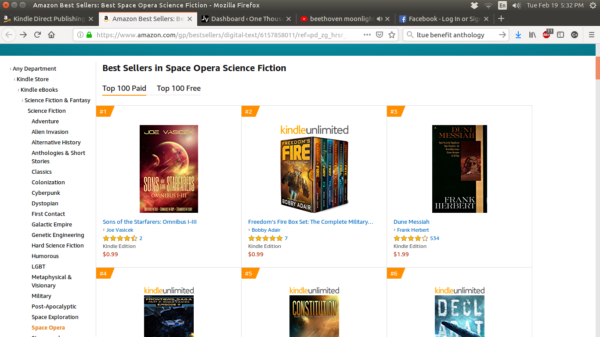
Sons of the Starfarers: Omnibus I-III just hit the #1 spot!

OMH! Oh my heck! Sons of the Starfarers just hit the #1 spot on Amazon’s Science Fiction > Space Opera subcategory!

No secret here, other than a 99¢ BookBub featured deal. I’ve sold a couple thousand copies on Amazon already, easily earning back what I spent on the ad. Looks like BookBub still has legs!

The deal runs until Saturday, so if you haven’t already picked up a copy, now is your chance!

Gunslinger to the Stars Progress Update

The 2.0 draft of Gunslinger to the Stars is now complete—and right on deadline, too!

Gunslinger to the Stars
Phase:2.0 Draft
Due:9 years ago
100%

This draft ended at about 62k words, 13% less than the first draft. Leaner, tighter writing, with a lot less exposition and a lot more character voice.

Before I publish it, I do want to get some more feedback and do another editing pass. In particular, I want to make sure there aren’t any plot holes or other major problems. But it is at a point where I can write up the book description and commission cover art, so that should be coming in the next few weeks.

In the meantime, I’m gong to celebrate with a half-gallon of ice cream. Take care!

The Sword Keeper 1.0 is finished!

It’s been roughly four and a half years since I wrote the first word in The Sword Keeper, and now the first draft is finally complete! I finished it on Monday and promptly came down with the flu, which is why I’m only writing about it now.

This is my first complete fantasy novel, which is kind of a weird thing to realize. I started writing fantasy back in high school, but I never actually finished anything until college, and by then I was writing science fiction almost exclusively. Of course, the line between fantasy and science fiction is pretty fuzzy, especially the science fiction I tend to write, but still it’s a different set of tropes and a different kind of story.

In terms of other fantasy books, this one is pretty light. It’s just under 100k words, which makes it about 1/3 to 1/4 the size of a Brandon Sanderson novel. There’s magic, and it does drive the story, but the magic system itself isn’t the main driving factor of the plot. No elves, no dwarves, no dragons.

Instead, there’s an ancient order of magic sword bearers, a secret brotherhood of dark mages, a prophecy about saving the world, and a tavern girl (not a farmboy) who turns out to be the chosen one. About half of the fighting happens in the Void between the mortal and immortal realms. Oh, and the cost of magic is death.

There’s no question that this book needs a lot of work before it’ll be ready to publish. That said, I’m really excited about it. If all goes well, I expect it to be out sometime next year.

New story, new release!

I have a story out in the latest issue of Perihelion! To read “L’enfer, c’est la Solitude,” click here. It’s free to read!

Those of you following the blog for a while will recognize this as a story I wrote almost exactly two years ago. Here’s what I said about it back then:

I can’t stand people who humbrag, so I’m just going to come out and say that this story is awesome. Seriously. Kickass freaking awesome. It may be the best short story I’ve written to date.

I’d like to think that I’ve written much better stories since then, but after re-reading it, it’s still pretty good. So go check it out!


So two years later, what do I think is the most kickass freaking awesome thing I’ve ever written? The fifth Sons of the Starfarers book, of course, which I just recently put up for pre-order!

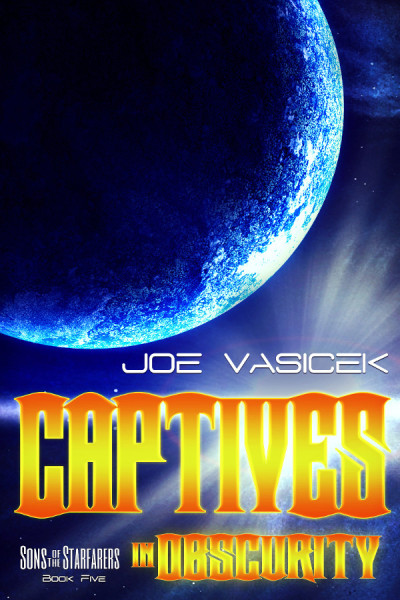
Captives in Obscurity (Sons of the Starfarers: Book V) is now available for pre-order all across the internets! This the fifth of a nine-book series, and I think it’s pretty kickass freaking awesome. I’m biased, though, so you’ll have to wait until May 15th to read it and make up your own mind.

For those of you following the Sons of the Starfarers series, I’m hoping to get the next book out eight months from now, in November. I am definitely committed to finishing this series, though I have a few other awesome projects that are taking my time as well. The goal at this point is to space out the next four books six months from each other.

But if you’ve been anxiously awaiting Captives in Obscurity, you can pre-order your copy now!

Captives in Obscurity

Captives in Obscurity

There is no escape beyond Star's End.

Isaac and Reva are running out of time. Gulchina's cruelty knows no bounds, and on the edge of known space, no one can stop her. But an unexplored planet holds an ancient alien secret that may prove to be a game changer.

Order Now!
About the Book

There is no escape beyond Star’s End.

The deadliest pirates in the galaxy have stolen the technology that will transform it. Now, on the edge of known space, they are poised to start an empire of their own.

Isaac and Reva are running out of time. Neither of them knows the extent of Gulchina’s plans, or whether the madwoman will keep them both alive after she achieves them.

But an unexplored planet beyond the Far Outworlds holds an ancient alien secret that not even Gulchina has uncovered. That secret will tip the balance in

SONS OF THE STARFARERS
BOOK V: CAPTIVES IN OBSCURITY

Details
Author: Joe Vasicek
Series: Sons of the Starfarers, Book 5
Genres: Science Fiction, Space Opera
Tag: 2016 Release
Publication Year: May 2016
Length: short novel
List Price: $9.99
eBook Price: $2.99
Joe Vasicek

Joe Vasicek fell in love with science fiction and fantasy when he read The Neverending Story as a child. He is the author of more than twenty books, including Genesis Earth, Gunslinger to the Stars, The Sword Keeper, and the Sons of the Starfarers series. As a young man, he studied Arabic at Brigham Young University and traveled across the Middle East and the Caucasus Mountains. He lives in Utah with his wife and two apple trees.

Some of the links in the page above are "affiliate links." This means if you click on the link and purchase the item, I will receive an affiliate commission. You will not receive any additional charge. As an Amazon Associate I earn from qualifying purchases.


How going indie is like driving a manual (plus a cover reveal)

A couple of weeks ago, I got a new (to me) car. It’s a 2005 Ford Focus / Saleen: a two-door hatchback that drives like a racing car and gets about thirty miles per gallon (WA-A-AY better than the gas guzzler I was driving before). It’s also a manual transmission, which is perhaps the biggest difference between this and my previous car.

This is my first time driving stick shift, and I have to say, it is a lot of fun! When you drive a stick, each hand and each foot is doing something different. There’s a lot more to keep track of, and if you do things in the wrong order (like braking without engaging the clutch, or starting without giving it some gas), you run the risk of making the car stall or doing nasty things to your transmission. On the other hand, driving a manual gives you a much better feel for the engine and what it’s capable of. You can feel when you’re putting too much stress on it–or alternately, when you can push it a little further.

I usually like to walk everywhere, but ever since I got this car, I just want to drive it! It’s way more fun than driving an automatic, even with (or indeed, because of) the extra challenge. So today, while I was walking to BYU campus (alas, the parking situation there makes driving a major pain), I got to thinking about it, and I realized that driving a manual is a lot like being an indie author.

When you’re an indie, you have a lot more things to juggle, just like driving a manual. This gives you much greater control of your career, but it also makes it easier to stall or screw up. At the same time, because of that extra control, you’ve got a much better feel for the market, and probably a better connection with your readers. And for me at least, the extra challenge doesn’t make it less enjoyable, it actually makes me enjoy it more!

Nothing Found

This week, I had the first day where I sold 100+ books in a 24 hour period. That was pretty awesome! I’ve been running a $.99 sale for Star Wanderers: The Jeremiah Chronicles (Omnibus I-IV), and it got picked up by a couple of ebook sites that really pushed it in the right way. Now that I know how to run a sale like that, I hope to do it again, perhaps for Black Friday. And if you haven’t picked up this one yet, it’s on sale for $.99 through Friday.

Marketing and promotion is one of the harder parts about going indie for me, kind of like how finding the clutch point and starting without stalling is hard when you first drive a manual. The more that I practice, though, the better that I get at it, and the more I enjoy it.

Another area where I think I’ve more or less stalled is in my covers. When I put out the first few Gaia Nova novels, I spent a fair amount of money hiring out artists to do the illustrations, but I did the typography myself. On those earlier covers, it definitely shows. For my later books, I worked with a bunch of cover designers, and seeing their work made me realize that there’s definitely room for improvement on those earlier ones, especially for the print editions.

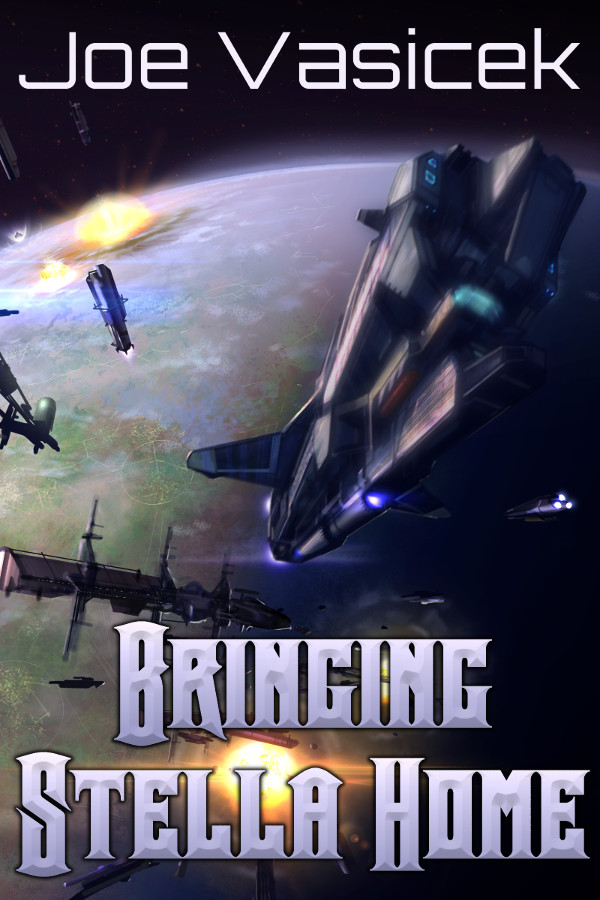
I’ve decided to redo the covers for those three novels (Bringing Stella Home, Desert Stars, and Stars of Blood and Glory), keeping the illustrations but changing the typography. I tried to find a cover designer to do it, but I wasn’t able to find one that did satisfactory work, and after playing around with them for a bit I think I can actually do them myself. I’ve got a lot more experience with covers and cover design now than I did when I was starting out, and I’ve learned a few photoshop tricks as well.

In any case, here is what I came up with for Bringing Stella Home:

BSH (cover)How do you like it? I rather like how it turned out, though I’ll admit I’m still learning. I did the new design just this morning, so I figure I ought to wait a couple of days and maybe seek out some feedback from professional designers before I go through with it.

I hope to have the new edition out before the end of the month. The content and story will all be the same, but the cover and metadata will be updated, and some minor errors such as typos will be fixed. I also hope to do the same thing with Desert Stars and Stars of Blood and Glory. Once the new editions are out, I’ll probably run some sales and giveaways with them, so definitely stay tuned!

As for my other projects, the next book in the Sons of the Starfarers series is out with my first readers, so it’s on track for a January release. My next WIP is The Sword Keeper, a fantasy novel I think I’ve mentioned before, and I hope to get that one knocked out in about a month or so. It’s already halfway finished, so the hard part is just ahead. There are also a couple of Gaia Nova novels that I’ve been meaning to get around to, and probably will before the end of the year.

That just about does it. Look out for more covers soon! I’m definitely having fun with the new ones. 😀