The Meaning of Home in Genesis Earth

Genesis Earth is a thought-provoking science fiction novel about humanity, isolation, and the search for home in a vast and empty universe. In this post, I explore the deeper themes behind the story—how the meaning of home shapes the characters, and what that says about us as human beings.

What does it mean to be human when everything familiar—home, society, the Earth itself—is gone? What does it mean to lose one’s home, or to never really have a home in the first place?

In Genesis Earth, a work of existential science fiction, the story of Michael and Terra explores what it means to be human when isolation pushes the boundaries of identity and connection. Michael and Terra grew up away from Earth, isolated and estranged from humanity’s homeworld.

Their need to be rooted in something (or someone) drives the core theme of belonging and identity in the book. The mission is supposed to be about discovery, but what they truly discover is themselves—how fragile, lonely, and deeply human they are.

Where the Idea Came From

The central concept of Genesis Earth is that humanity has created an artificial black hole and opened a wormhole to some unknown part of the universe. In order to create that black hole, though, they would need to travel far from Earth, on the fringes of our Solar System—hence the isolated colony mission where Michael and Terra grew up. And because of the long distances from the wormhole to the star system on the other end, their mission would isolate them even further, not only in space but in time. Everyone would be gone by the time they got back home, if they could even call it “home” by then.

All of this drove me to explore the meaning of home, and how it would play out for these characters who are so isolated and separated from the rest of humanity.

How the Meaning of Home Shapes the Story

In Genesis Earth, Michael begins as a dutiful scientist. He’s loyal to “the Mission,” but that loyalty is hollow—he’s chasing a ghost of Earth rather than living for anything real. His arc is about realizing that meaning doesn’t come from data or duty, but from connection.

The story strands two people—Michael and Terra—alone in deep space. The physical isolation mirrors their emotional one. Their arguments, awkward silences, and gradual trust-building drive the tension far more than the alien mystery.

The “alien ship” and “new Earth” they find are really reflections of humanity’s own legacy: ruins of a civilization that destroyed itself but left behind traces of what it once was. This discovery forces Michael to see that knowledge without empathy leads nowhere. The universe is full of dead monuments to reason untempered by love.

In the end, the story is less about finding Earth again—or finding home—as it is about beginning it anew, through human love and connection.

What the Meaning of Home Says About Us

Michael and Terra inherit a civilization that has mastered the stars but lost its soul. Their journey shows that intellect without empathy leads to extinction. We can map galaxies, but if we forget why we exist or who we’re doing it for, all that brilliance turns sterile and meaningless.

It’s a mirror to our own age: we’ve never known more, but we’ve rarely been lonelier. And ultimately, the message of Genesis Earth is that we are not defined by where we come from, but by whom we choose to love and what we choose to build. Heart and home matter more than hubris and knowledge.

Why the Meaning of Home Matters to Me

After I left home, I spent nearly two decades of my young life as something of a modern nomad, rarely living in one place for more than six months. During this time, my parents moved not once but twice, so I lost all connection to my childhood home.

This personal loss of home and sense of being uprooted was a major influence in the writing of this book, though I didn’t realize it at the time. And the conclusion that Michael and Terra ultimately come to—that “home” isn’t found in a place so much as it is in the depths of the connections with the people in your life—was something I experienced as well, as I ultimately settled down and started a family of my own.

Where to Get the Book

Related Posts and Pages

Explore the series index for the Genesis Earth Trilogy.

Visit the book page for Genesis Earth for more details.
Read more to learn if Genesis Earth is for you.

See all of my books in series order.

2019-09-19 Newsletter Author’s Note

This author’s note originally appeared in the September 19th edition of my author newsletter. To subscribe to my newsletter, click here.

It’s September, which means (among other things) that it’s time to revisit my business plan and update it for the next year. Every January 1st, I print out a new and revised copy of my business plan, which provides a great opportunity to evaluate my efforts and hone in on the things I need to do better.

For the last couple of weeks, I’ve been working on the section titled “What I Write.” In this year’s business plan, it was a pretty straightforward breakdown of all of the series in my catalog. But for next year, I took a few steps back to address things like what is a Joe Vasicek book? or what are some of my books’ recurring themes? or what kind of science fiction and fantasy do I write specifically, and how does my work contribute to the genre?

The exercise really got me to think about why I write. In the day to day life of a writer, it’s very easy to lose sight of the forest for the trees. Deadlines and daily word count goals keep the focus on the page right in front of you, and when you do think ahead it’s usually just to the next chapter. But without taking time to step back and look at the bigger picture, it’s easy to lose that creative drive, or settle for second-rate work.

So what is a Joe Vasicek book? I hope it’s a book that’s memorable and meaningful. It may be dark, but never dismal. It may push you out of your comfort zone, but it also leaves you feeling rejuvenated and inspired. It features interesting characters wrestling with complex ethical dilemmas and struggling to do the right thing as best as they know how.

What are some of my books’ recurring themes? The balance between liberty and responsibility is a huge one. Actions have consequences, and true liberty is taking ownership of those consequences as well as your actions. Another is the sanctity of sex, contrasting selfish gratification with the affirmation of commitment and love. The yearning for God is another recurring theme, with a great deal of religious diversity in the starfaring civilizations of my books. Another theme I keep coming back to is the call of the frontier.

I’m curious, though, to hear what you guys think. What do you think makes a Joe Vasicek book? What tropes or recurring themes have you enjoyed in my books? As a writer, I’m often too close to my own work to see what’s obvious to everyone else. What do you think is my biggest contribution to the genre?

Extra Sci-Fi S3E4: The Return of the King

Okay, I think the folks at Extra Credits got it wrong with this one in a really big way.

Gollum didn’t redeem himself. That’s the entire point. Redemption is an important and very Christian theme of Lord of the Rings, but so is the problem of evil. Several comments on the video point this out:

I disagree about Gollum. He gave into the temptation of the Ring. I think more he is there for how God can turn evil into a good.

MJBull515

Gollum is more a Judas figure. Judas was not redeemed for betraying Jesus, but his evil actions did allow for the salvation of Man through Christ’s sacrifice.

Isacc Avila

“A traitor may betray himself and do good he does not intend.” Judas betraying Jesus was the catalyst that led to salvation. Gollum’s final act of greed was the catalyst that led to the destruction of the Ring.

Jet Tanyag

The thing that really gets to me, though, and the part where I think the folks at Extra Credits really do a disservice to these books, is how they argue, very subtly, that Gollum shouldn’t be held responsible for his own actions, that it wasn’t really his fault that he was addicted to the ring—that he “couldn’t escape his own sin.” (4:50)

No. Just, no.

The entire point of redemption is that we CAN escape from our sins. We see that with Theoden, we see that with the Dead Men of Dunharrow, and we see that in all the other examples of redemption that were not discussed in this video, like Boromir. In fact, Boromir is a far better example of “redemption through a single, all-important act.”

But it goes much deeper than that. In order to be meaningful, sacrifice must be intentional. It’s not just the act that matters, but the intention behind the act.

With that in mind, consider Gollum’s intentions when he bit off Frodo’s finger. The only way you can argue that his intentions weren’t evil is that the Smeagol half of his split-personality overcame the Gollum half, and flung him into the lava. But the support for that reading is ambigous at best. And if that isn’t true, and Gollum simply fell into the lava by accident, then it wasn’t a sacrifice on his part, and therefore there was no redemption.

To say that Gollum made an “accidental” sacrifice is nonsense. And to say that he redeemed himself through that sacrifice is not only a faulty argument—it completely undermines the themes of redemption and sacrifice throughout the entire book.

Gollum was never redeemed. Through him, Middle Earth was saved, but he was never personally redeemed, and that’s the point:

I’ve heard a different interpretation where Gollum’s sacrifice wasn’t an act of redemption, and was never meant to be. In the end, it was the ring’s own power that caused it to be destroyed; not Frodo, not Gollum, it was an accidental suicide. As far as I understand it, the message wasn’t “good triumphs over evil”, instead it was “evil is more powerful than good, but all it can do is destroy; in the end it will always destroy itself”.

EvilBarrels

Extra Sci-Fi S3E2: The Fellowship of the Ring

Another fascinating episode from Extra Credits, this one focusing on the themes of generational passing and the diminishing of ages that is present in Tolkien’s Lord of the Rings. I have a lot of thoughts on this episode, but they all basically boil down to one thing:

Every generation reinvents the world.

It’s a theme that’s also present in my favorite novel of all time, The Neverending Story. The Childlike Empress of Fantastica is dying, and the only way to save her is for someone from the human realm to give her a new name. Fantastica, of course, is the realm of all fictional stories, and the Childlike Empress receives a new name when the next generation makes the old stories their own. There is nothing new under the sun.

This is also a theme present in Star Wars: The Last Jedi. I’m not a huge fan of the movie, but the best argument I’ve heard in favor of it basically boils down to this theme: that the old generation has to pass away in order for the new one to rise and take its place. I’m still not entirely convinced that The Last Jedi did this well, but I can see how someone who loved the movie would see it that way.

As a writer, this theme weighs especially on me because I feel that I’m personally living it with ever book that I write. All of the greats of the genre, like Tolkien, Herbert, Heinlein, Asimov, Bradbury, Card, Le Guin—the list goes on and on—loom over me every day. With their passing, the world feels somehow diminished. They left us with a great gift—their books—and yet as time passes and the old world crumbles into dust, these gifts from the previous generation feel increasingly out of place. It is time for a new generation to rise and give the Childlike Empress a new name.

I want my books to be a part of that. I hope that one day, mine will be one of the voices that helps to reshape the world. I hope to one day leave behind a gift as great as the ones that we were given: stories and books that made us feel deeply and taught us meaning and love. Is there anything greater than this? Raising a family, perhaps, but that too is a form of generational passing.

I’m sure this theme of generational passing applies to a lot of fields too, not only in the arts, but in trades, and crafts, and sciences too. Indeed, it is a fundamental part of the human story, because of this singular truth: that every generation reinvents the world. There are curses as well as blessings that are passed down from generation to generation, but it is up to each of us to decide whether those curses and blessings stop with us, or whether we will continue to pass them down.

Lots of interesting stuff to ponder and think about. That’s part of what makes Tolkien so great. He spent an entire lifetime writing Lord of the Rings, and that time was not wasted.

Sholpan, or The Great Novella Experiment

So now that I’m finished with Desert Stars, the next project I’m working on is a companion novella to Bringing Stella Home titled Sholpan.  While Bringing Stella Home is about James and his quest to rescue his brother and sister, Sholpan is entirely from Stella’s point of view and traces her rise in Hameji society, from prisoner and slave to…well, I won’t ruin it for you.

I started writing it on Monday, and so far it’s been a lot of fun.  In some ways, it’s kind of a break for me, since I already know the story (most of the material is lifted straight from Bringing Stella Home, with a few extra changes to make the viewpoint tighter and build more character development).

At the same time, though, it’s a challenge because I’ve never written in the novella format before.  The definition as given by SFWA, has mostly to do with length:

For the purposes of the Nebula Awards, the categories are defined as follows:

  • Novel — 40,000 words or more
  • Novella — 17,500–39,999 words
  • Novelette — 7,500–17,499 words
  • Short Story — 7,499 words or fewer

However, I can’t help but feel that there are many other artistic elements to consider.  For example, the Oxford Dictionary of Literary Terms gives this definition:

novella [nŏ‐vel‐ă], a fictional tale in prose, intermediate in length and complexity between a short story and a novel, and usually concentrating on a single event or chain of events, with a surprising turning point.

Other sites I’ve browsed (including this post from The Galaxy Express, this review from 2009 of several small press novellas, and another interesting post on short stories vs. novellas vs. novels) leave me with the impression that novellas typically

  • can be read in one long sitting, such as a train ride,
  • center around one major conflict, idea, or issue,
  • have more room for rich settings and lavish descriptions,
  • tend to focus more intimately on character,
  • are compact enough to take risks with voice and theme, and
  • can end without a definitive conclusion to the central idea or conflict.

I must confess, I’m not an avid reader of novellas.  I’ve read some of the classics, of course: Dr. Jekyll & Mr. HydeThe Time Machine, Animal Farm, etc, but in terms of modern sf novellas, all I’ve really read is I Am Legend (and a few golden/silver age “novels,” if you count them).  Point is, I’m not an expert on novellas by any means.

However, the novella seems like a very promising format for epublishing, especially in conjunction with a novel.  Readers can pick up the novella for $.99 and get both a sample of the writer’s longer novel-length stuff, as well as a complete story in itself.

That’s what I want to do with Sholpan.  I want to write a less-expensive derivative work that’s artistically sound in its own right, while also driving interest in the full length novel.  Besides, it’s just fun to experiment with new styles and formats.

If this is successful, I can see myself writing a companion novella to most, if not all of my novels.  And who knows?  Maybe I’ll be able to sell some of those to more traditional print and electronic markets.  It’s worth a shot, and no matter what happens, I’m bound to learn something new.

So yeah, that’s my current writing project.  If all goes well, expect to see it out sometime this fall.  And if you have any comments or suggestions regarding novellas, please share!  I’m very interested to learn anything I can.

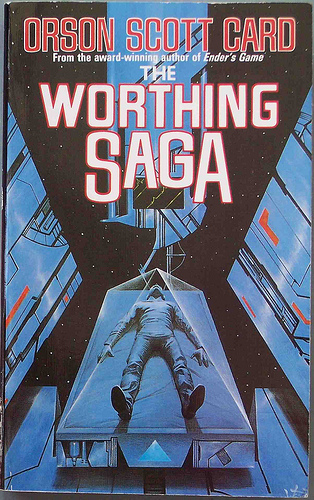
The Worthing Saga by Orson Scott Card

Somec: the miracle drug that allowed the rich and well connected to sleep through the centuries and postpone death almost indefinitely.  While the masses continued to live out their lives in normal time, the social elite watched over centuries as their investments multiplied, and their kingdoms grew into empires…

…and ultimately crumbled.

Thousands of years have passed.  Somec is unknown, except to the one man who saved humanity from its own corruption.  He has slept through the eons to find out if his last gambit brought about the peaceful and benevolent society that he hoped to leave behind.

But as he awakens from his slumber, he finds himself in a universe infinitely stranger than he could have imagined–among a people who revere him as their god.

I’ve heard that Orson Scott Card considers this book his best work, and I’d have to say, I agree with him.  Right up until the ending, it’s at least as good–if not better–than Ender’s Game, his most famous book.

The book unfolds magically from the first page, drawing you in to this beautiful, fantastical world.  The characters have depth and feeling, especially the ones from ages long past, whose stories are powerful and haunting.

I absolutely loved this book–right up to the end, which had a twist that caught me off guard, and not in a good way.

Story-wise, the ending was great.  It was a beautifully foreshadowed twist, right on the order of Ender’s Game and Speaker for the Dead.  Thematically, however, I had a hard time not feeling that it undermined everything that had come before.  I can’t get into details because I don’t want to give spoilers, but the last couple of pages jolted me out of the book and left me saying: “Huh?  How is that right?” I eventually warmed up to it, but it took a while.

Still, I’d definitely give the book five stars, or at least four and a half.  Everything about it is monumentally amazing.  The characters, the worldbuilding, the sense of wonder, the thought-provoking questions and issues it raises, and just the sheer joy of the experience of reading it.  This is a book that I can get lost in, and not just once.

As a side note, the book includes the short novel The Worthing Chronicles, as well as several short stories that take place in the same universe.  The short stories were all quite good, but personally I preferred the novel by itself.  Perhaps it’s because the epic scope came through so much better in the novel than in the stories, or because the stories didn’t allow me to spend much time with any of the characters.  Your mileage may vary, of course.

Interestingly, The Worthing Chronicles is a retelling of Hot Sleep, Orson Scott Card’s first novel.  As a writer, I find it interesting that Card revisited his first novel in this way–to basically rewrite it, keeping all the major events but telling it from the point of view of someone who meets the main character of the first (Worthing) much later in his life.  I haven’t read Hot Sleep, so I can’t compare the two, but The Worthing Chronicles turned out amazingly well.

Will I ever attempt something like this?  Not sure–but it’s interesting to think about.

Gah! It sucks

I’m about a third of the way through To Search the Starry Sea, and my greatest fear at this point is that it isn’t as good as the last novel I wrote.  Because if it isn’t as good, that means that I’m getting worse, not better, and if I’m getting worse, that means I’m never going to make it as an author, because I’m not even published yet, and if I’m not going to make it as an author, that means I’m going to have to do what I’m doing NOW for the rest of my life, which means that I’m going to be miserable and life is going to suck…

<pant> <pant> <pant>

Seriously, though, sometimes I wonder if I’ve really made the right choice.  To Search the Starry Sea is much more of a happy adventure story, but sometimes I feel that it lacks depth and meaning.  I’m starting to get feedback from my alpha readers for Bringing Stella Home, and their reactions to it are surprisingly encouraging.  That story moved people–but this one?  I don’t know.

Then again, Bringing Stella Home is dark, gritty, and very tragic.  I remember feeling depressed by the story even as I wrote it.  Is that the kind of story I want to be known for?  If I can write something deep and meaningful and have it be optimistic and adventuresome, that would be a lot better.

I’m discovery writing it hardcore, which means that side characters often come to play a much more central role than I’d thought, and events that I thought I could cover in a chapter, I have to cover in two.  I have an idea where the story is going to end up, though, and it’s going to be awesome. How awesome?  Let me show you:

Yeah, it’s going to be awesome.

I think the key to keeping it meaningful is 1) to keep in mind the main character’s inner conflicts, framing them in a way that the readers can relate to their struggles, and 2) keeping the overall growth arc constantly in mind.  How does what’s happening affect how the character is changing?  That kind of stuff.

I hope I can finish this in two months.  I’m mired in the middle of it right now, and the end is far from sight.

In the meantime, I think I’ll get some sleep.

The Dispossessed by Ursula K. Le Guin

Urras and Annares, a world and its moon, separated by the gulf of space and two hundred years of mutual contempt.  On Urras, capitalist and socialist nations vie for dominance over the world’s rich and abundant resources.  On  Annares, the anarchist exiles scrounge for a meager living, but live in peace–and in hope.

Shevek has never known any other world than the anarchist utopia of Annares.  His life’s work is to develop a unified theory of simultaneity–a tremendous feat that will rework the paradigm of space travel and communication.  When the people of Annares reject his theory, however, he voyages to Urras in the hopes that by offering his theory as a gift to all nations, he can bridge the gap between the worlds.

Hopelessly inexperienced in the cutthroat ways of the propertarians, Shevek has no idea what he is getting himself into.  In his gilded prison, with nations vying for control of his person, can he find allies who share his idealistic, utopian vision?  Or is he alone in a world of greed, lies, and murder?

This is, quite possibly, one of the most impressive and beautiful works of literary science fiction that I have read.  It may be the best novel I’ve read all year.  Le Guin’s characters are so deep, her ideas so compelling, her worlds so rich, her writing so poetic and beautiful that I hardly know where to start.

One of the many things that made this book so good was the depth of Le Guin’s character development.  The story had a plot, and Le Guin dropped just enough pieces of it here and there for you to know that there was one, but more than anything this book is a portrait of an incredibly interesting man, Shevek.

The book actually contains two stories that merge into one in the end.  One taking place in the present, after Shevek arrives at Urras, and the other is a series of flashbacks showing how he arrived at that point.  Le Guin alternates brilliantly between past and present to reveal insights into Shevek’s character that would otherwise remain unexplored.  By the end of this novel, I felt that I knew this man–and loved him–better than anyone in real life, including myself.  It blew me away.

Le Guin’s worldbuilding, too is incredible.  Before reading this book, I didn’t consider myself an anarchist, but after spending so much time in the utopian society of Anarres, I almost want to become one.  Le Guin meticulously extrapolates her world from her highly perceptive understanding of human nature, paying such attention to detail that her anarchist world is not only surprisingly plausible, but enviable as well.  This is the kind of world that I would like to visit, explore, and perhaps even settle down in and live.

Her ideas, like her world, are meticulously well thought out and incredibly compelling.  In the Hainish cycle, Shevek is the inventor of the ansible drive, the technology that eventually enables peaceable diplomatic missions to other worlds, such as the one chronicled in The Left Hand of Darkness. Shevek’s struggle is to find a way to let this technology bring peace and break down walls, rather than empower tyrants to conquer and destroy.  Time and again, Shevek’s egalitarian, anarchist values come to the surface, clashing not only with those of capitalist Urras, but with our own.

All of this would be enough to make this a compelling, memorable story–but Le Guin’s stunning, beautiful prose puts this book into a league of its own.  The rhythm and beauty in her words made every page a joy to read, with descriptions that kept me entranced and dialogue that made her characters leap off of the page.  Above all, her prose conveys with powerful and compelling clarity the many life-changing ideas and themes of this story.  The book’s last words still haunt me.

The Dispossed is, without a doubt, is one of the best works of Science Fiction that I have read.  I would even go so far as to claim that it is a superior book to Le Guin’s better known work, The Left Hand of Darkness. If I could read a book this insightful every month, I would be a much better man, and have a much deeper and imaginative understanding of the world than I presently have.  This book is a true masterpiece.

A Canticle for Leibowitz by Walter M. Miller, Jr.

It was said that God, in order to test mankind which had become swelled with pride as in the time of Noah, had commanded the wise men of that age, among them the Blessed Leibowitz, to devise great engines of war such as had never before been upon the Earth, weapons of such might that they contained the very fires of Hell, and that God had suffered these Magi to place the weapons in the hands of princes, and to say to each prince: ‘Only because thine enemies have such a thing have we devised this for thee, in order that they may know that thou hast it also, and fear to strike.’

But the princes, putting the words of their wise men to naught, thought each to himself: ‘If I but strike quickly enough, and in secret, I shall destroy those others in their sleep, and there shall be none to fight back; the earth shall be mine.’

Such was the folly of princes, and there followed the Flame Deluge…

In the new dark ages of man following the nuclear apocalypse, an order of Catholic monks preserves the last vestiges of civilization: a shopping list, an electrical diagram, and other assorted scraps of a long-dead world.  As mankind rises from the dust, inevitable tensions arise between the church and the world, between Jerusalem and Babylon, Christ and Lucifer.

This book is epic.  Epic. I can’t begin to describe how incredible it is.  Virtually every page, especially towards the end, is packed with meaning.  A cautionary tale of the folly of man in this fallen world, this story held me captivated right up to the chilling final chapter.  Bravo.

As I understand it, Walter M. Miller Jr. wrote this book in the late 50s / early 60s, during the height of the Cold War.  Science fiction at that time was both sweepingly visionary and frighteningly pessimistic about the future of mankind, and this book successfully captures both extremes.  Like Asimov’s Foundation series, it reads more like a collection of elongated short stories, but Miller’s characterization and attention to detail is superior, in my opinion, to Asimov’s.

The most fascinating aspect about this book is the way that Miller hearkens to the past to give us a vision of our future.  Many of his ideas are straight out of Augustine and Aquinas–indeed, in several places, the story feels like it’s set in 3rd or 4th century Europe, which only adds to the delicious irony.

Yet, while this book has a strong Catholic feel, I never felt alienated or excluded from its intended audience.  Maybe it’s because my Mormon heritage is more compatible with Catholicism than other religious beliefs, but I don’t think it’s just that; the issues in this book are human issues, not just religious issues, and by focusing on that fact, Miller makes the story much more universal.

Even with all the deep, philosophical elements, this story is wonderfully entertaining.  Irony abounds, especially in the first section, in which a young novice takes a simple electrical diagram from the pre-deluge world and, completely unaware of its significance (or lack thereof), spends the rest of his life making a beautiful illuminated manuscript of it.  Even though the sections were  short, I quickly fell in love with the characters in each one, and connected with them almost instantly.

The final scene, in particular, was incredibly touching.  I won’t spoil it for you, but let me just say, if you are or ever have considered taking your own life, read this book, just for the final scene.   The degree to which the last abbot clings to life, even in the face of so many good reasons to give up, is just incredible.  And the final scene, in which…I won’t ruin it for you.  Just read it!

A Canticle for Leibowitz is one of the most powerful, meaningful books I have read in my life.  It is more than a good read, more than epic.  I class it as one of the best works of fiction this genre has ever produced.  If you have ever wondered about the destiny of mankind, or the proper relationship between the secular and the spiritual in our modern age–read this book!

Thoughts after finishing A Canticle for Leibowitz

Wow.  Wow.

This book is INCREDIBLE. I’ll review it later, but first I want to put down some of my initial thoughts.

With any great book, you come to a point where you realize, consciously or not, that it just can’t get any better.  The story, the characters, the world, the ideas and stakes, the overarching conflict–it combines so perfectly that you don’t think you could possibly ask for more.

And then, if it’s a true masterpiece, it crosses that threshold and gets even better.

A Canticle for Leibowitz did that.  Somewhere in the second half, after I was completely caught up in the story, it exceeded my expectations and went to a whole new level.  I remember the exact passage where it happened:

They shook hands gingerly, but Dom Paulo knew that it was no token of any truce but only of mutual respect between foes. Perhaps it would never be more.

But why must it all be acted again?

The answer was near at hand; there was still the serpent whispering: For God doth know that in what day soever you shall eat thereof, your eyes shall be opened: and you shall be as Gods. The old father of lies was clever at telling half-truths: How shall you “know” good and evil, until you shall have sampled a little? Taste and be as Gods. But neither infinite power nor infinite wisdom could bestow godhood upon men. For that there would have to be infinite love as well.

I love books like this: books that not only have a good, entertaining story, but that have a deeper, more thoughtful dimension. Stories that make me think and reflect on the real world, that open my eyes and help me to see things in a new way. It’s what I read for.

Yes, the story was somewhat didactic and preachy…but it worked. Even though it was trying to make an explicit point, so much of the symbolism and metaphor was open ended that the readers could draw their own conclusions–and see a number of things that perhaps went beyond the point the author was trying to make.

I guess there’s two ways to write didactic fiction: the open approach, and the closed approach. With the open approach, the author uses a lot of symbolism and allegory, but in a way that explores principles and themes rather than building up to a predetermined point. Good examples of this (in my opinion) include The Chronicles of Narnia and The Neverending Story. The closed approach involves consciously working everything around a conscious agenda: examples of this include His Dark Materials and Lord of the Flies.

I don’t care much for the closed approach–I can’t stand it even when I agree with the underlying ideology (as in Orson Scott Card’s Empire).  Those kinds of books don’t stimulate genuine thought or reflection.  The open kind, though–that I can appreciate.  Even though I disagree with many of Heinlein’s views, I can appreciate his books even when they’re preachy because they make me think.

Anyways, those were some of my thoughts after finishing A Canticle for Leibowitz. This book is epic–truly epic.  It wowed me just as much as David Gemmell’s Legend. This is a book I’m going to remember for a long, long time.

If you care at all about the role of faith in forming our society, or the complex interplay between religion and politics, or the ultimate end of humanity–you have got to read this book!