W is for Wagon Train to the Stars

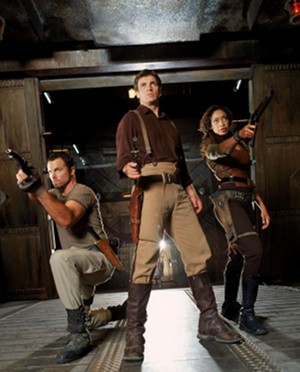
big_damn_heroes_moment_smallWhen Gene Roddenberry pitched the original Star Trek series back in the 60s, Westerns were all the rage.  Consequently, he pitched his show as a “wagon train to the stars,” where a bunch of quirky characters on an awesome starship travel from adventure town to interstellar adventure town, exploring and pioneering the final frontier.

Sound familiar?  Yeah, I thought so.  The concept proved so catchy that it’s been redone time and again, from Battlestar Galactica to Firefly to Doctor Who.  Even though Westerns aren’t nearly as popular as they used to be, many of its tropes are so well suited to Science Fiction that they drive the genre even today.

For example, adventure planets.  In a typical Western, the characters travel from town to town, with a different adventure in each one.  Well, in Science Fiction, the characters do the same thing, except that they’re traveling from planet to planet.  And really, if you’ve got the ability to travel to other worlds, how can you not have an adventure in each one?

A large reason for the Western / Science Fiction crossover is the whole concept of space as the final frontier, which we explored earlier in this series with I is for Interstellar.  There’s a very real sense of manifest destiny in the space exploration community, not because of humano-ethnocentrism (heck, we don’t even know we’re not alone in our local stellar neighborhood), but to ensure humanity’s long-term survival.  The parallels between that and the westward movement in 19th century America aren’t perfect, but they do exist.

Similarly, as we explored in R is for Rebel, the notion of space as the final frontier has a special resonance with the American audience.  The days of the old frontier may be over, but its spirit lives on in our culture, from guns to road trips to our glorification of the rugged, self-made individual.  Today’s Science Fiction, especially the space-focused SF of Space Opera, grew out of the adventure fiction of the pulps, which thrived on that frontier American ethos.

In fiction, the frontier can still be found in two major genres: the Western, which is historical and therefore more backward-looking, and Science fiction, which is futuristic and therefore more forward-looking.  Because Science Fiction isn’t burdened with all of the historical baggage of the traditional Western, it’s a much more flexible medium for story, readily adaptable to contemporary issues and concerns.

For example, where Star Trek echoes the large-scale nation to nation conflicts of the Cold War (Federation vs. Klingons and Romulans), the new Battlestar Galactica series echoes the much more asymmetrical conflicts of the post-9/11 world (Cylon agents who are indistinguishable from humans and may not even know that they are cylons).  At the same time, the wholesale co-opting of Western tropes enables a latent sense of nostalgia, evident in the look and feel of Firefly, or the famous opening lines from Star Wars: A long time ago in a galaxy far, far away.

My first real experience with a wagon train to the stars type of story was probably Star Trek: Voyager, which I watched religiously with my dad every Wednesday night until maybe 9th or 10th grade.  The Western-borrowed tropes are somewhat more muted in that series, but they exist, especially the planetville / adventure towns stuff.  However, it wasn’t until Firefly and Serenity that I really experienced the awesomeness of a true Space Western.  There were a lot of things in Firefly that I really loved, especially the character interactions, the gun-toting action scenes, and especially the starship Serenity.  There were some things I didn’t like so much, like the fact that every planet is basically Wyoming, but overall I really enjoyed the show.

It wasn’t until I started getting more acquainted with straight-up Westerns that I saw the real potential for crossover between the genres.  Stories about mountain men like Jeremiah Johnson really captured my imagination–what would this look like if it were set in space?  In that sense, I came to the Space Western more from the classic Science Fiction side first, rather than the pulp adventure stuff.  But once I discovered the crossover connection, it naturally found a way into my own work.

That’s basically how the story idea for Star Wanderers first came to me.  I was lying on my bed, daydreaming about having my own starship like the Serenity, when I wondered what it would be like for a starship pilot to get roped into an accidental marriage like in the movie Jeremiah Johnson?  The collision between the two ideas was like a supernova exploding in my brain.  I rolled out of bed and started writing, coming up with chapter one of Outworlder almost exactly like it’s written today.  And the more invested I became in those characters and that world, the more the story grew.  I’m writing Part VII right now (Reproach, from Noemi and Mariya’s POV), and so long as people read them I’ll keep writing more.

Genre mash-ups and crossovers are a great way to keep things fresh and come up with some really interesting stories.  Some genres aren’t very well suited for each other (Erotica and Middle Grade, for example), but others come together so well that they seem almost complementary.  That certainly seems to be the case with Westerns and Science Fiction, at least here in the United States where the spirit of the frontier still echoes through the popular culture.

V is for Vast

Pale_Blue_Dot

If you don’t know anything else about the universe, you should know this: it’s big.  Really, really, REALLY big.

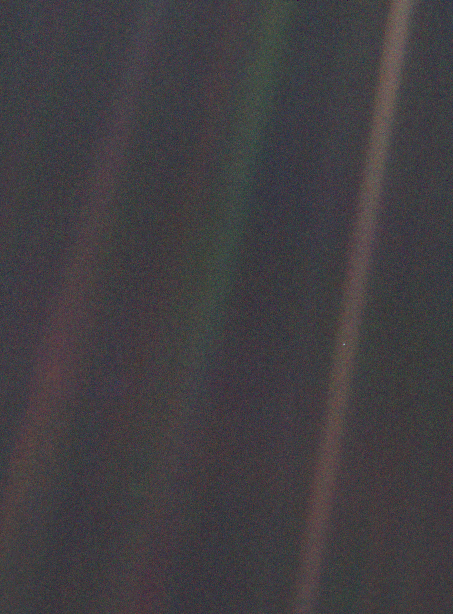
How big, you ask?  Well, for starters, take a look at Earth in the picture above.  Can you see it?  It’s the pale blue dot in the beam of starlight on the right side of the picture.  As Carl Sagan so famously put it:

From this distant vantage point, the Earth might not seem of any particular interest. But for us, it’s different. Consider again that dot. That’s here. That’s home. That’s us. On it everyone you love, everyone you know, everyone you ever heard of, every human being who ever was, lived out their lives. The aggregate of our joy and suffering, thousands of confident religions, ideologies, and economic doctrines, every hunter and forager, every hero and coward, every creator and destroyer of civilization, every king and peasant, every young couple in love, every mother and father, hopeful child, inventor and explorer, every teacher of morals, every corrupt politician, every “superstar,” every “supreme leader,” every saint and sinner in the history of our species lived there – on a mote of dust suspended in a sunbeam.

The picture was taken by the Voyager 1 spacecraft more than a decade ago.  At the time, the spacecraft was about 6,000,000,000 kilometers from Earth, or 5.56 light-hours.  A light-hour is the distance a particle of light can travel in one hour (assuming it’s traveling through a vacuum).  To give you some sense of scale, in one light-second, a particle of light can travel around the circumference of the Earth seven and a half times.

And lest you think that’s actually a distance of any cosmic significance, consider this: the nearest star, Proxima Centauri, is about 4.24 light-years away.  That’s more than 6,500 times the distance in the photograph above–and that’s just the closest star!

Our galaxy, the Milky Way, is between 100,000 to 120,000 light-years across.  If you were on the other side of the galaxy and had a telescope powerful enough to get a good view of Earth, you would see a gigantic ice sheet over both of the poles with no visible sign of humanity whatosever.  The light from all our cities, from our prehistoric ancestors’ campfires, has not yet traveled more than a fraction of the distance across this galactic island universe we call home.

Seriously, the universe is huge.  If you don’t believe me, download Celestia and take yourself for a spin.  In case you haven’t heard of it, Celestia is basically like Google Earth, except for the universe.  Everything is to scale, and there are all sorts of plugins and mods for exoplanets, nebulae, space probes, and other fascinating celestial objects.

I remember what it was like when I first tried out Celestia back in 2010.  I was at the Barlow Center for the BYU Washington Seminar program, in the little library just below the dorms.  I think it was twilight or something, and I hadn’t yet turned on the lights.  The building had a bit of that Northeast feel to it, like something old and rickety (though not as old as some of the buildings up here in New England).  I turned off the ambient light option to make it look more realistic, and began to zoom out.

Let me tell you, the chills I got as the Milky Way disappeared to blackness were like nothing I’ve felt ever since.  So much space, so much emptiness.  It’s insane.  The vastness between stars is just mind boggling–absolutely mind-boggling.

I got my first introduction to science fiction when I saw Star Wars IV: A New Hope as a seven year old boy.  In the next few years, I think I checked out every single Star Wars novel in our local library’s collection.  It wasn’t enough.  Whenever I was on an errand with my mom, I tried to pick up a new one.  I think they even left some copies of the Young Jedi Knight series under my pillow when I lost my last few baby teeth.

One of those summers, we drove down to Texas for a family vacation.  I picked up the second Star Wars book in the Corellian trilogy, written by Roger Allen McBride.  It was completely unlike any of the other Star Wars books I’d ever read.  In it, Han Solo’s brother leads a terrorist organization in the heart of their home system of Corellia.  They hijack an ancient alien artifact and use it to set up a force field that makes it impossible for anyone to enter hyperspace within a couple of light hours from the system sun.  The part that blew my mind was that without FTL tech, it would take the good guys years to get to the station with the terrorists.

All of a sudden, the Star Wars universe didn’t seem so small anymore.  And it only got crazier.  Roger Allen McBride did an excellent job getting across the true vastness of space.  At one point, Admiral Ackbar mused on just how puny their wars must seem to the stars, which measure their lifespans in the billions of years. For the ten year old me, it was truly mind boggling.

That was my first taste of science fiction that went one step beyond the typical melodrama of most space opera.  And once I had that taste, I couldn’t really stop.  As much as I love a good space adventure, real-life astronomy offers just as much of a sense of wonder.  When a good author combines the classic tropes of science fiction in a space-based setting that captures the true vastness of this universe we live in, it’s as delicious as chocolate cake–more so, even.

I try to capture a bit of that in my own fiction, though I’m not always sure how much I succeed.  In Star Wanderers, the vastness of space is especially significant for the characters because their FTL tech is so rudimentary that it still takes months to travel between stars.  All of that time out in the void can really make you feel lonely–or, if you have someone to share it with, it can bring you closer together than almost anything else.  It’s the same in Genesis Earth, which is also about a boy and a girl who venture into the vastness alone.  The Gaia Nova books lean closer to the action/adventure side of space opera, but the same sensibility is still there.

The best science fiction, in my opinion, both deepens and broadens our relationship with this marvelous place we call the universe.  It’s not just a fantastic setting for the sake of a fantastic setting–it’s the universe that we actually live in, or at least a plausible version of it set in a parallel or future reality.  The universe is an amazing, beautiful place, and my appreciation for it only grows the more science fiction I read.  If I can get that across in my own books, then I know that I’ve done something right.

R is for Rebel

rebel_allianceJust as sprawling interstellar empires are a staple of space opera, so are the plucky rebels that fight against them.  From Star Wars to Battlestar Galactica, Firefly to FTL, there’s no shortage of characters in science fiction trying to stick it to the man.

I’m not sure how it is in other cultures, but in America, it seems like science fiction upholds a host of values closely related to rebel tropes, such as self-reliance, individualism, freedom and independence, frontier justice, enterprising self-made men, etc.  A lot of this probably grew out of the genre’s early ties with pulp-era adventure fiction, which often featured former Confederate soldiers leaving the civilized world for the realms of adventure following the US Civil War.  That’s certainly the case with John Carter in A Princess of Mars, and echoed to some extent with the Browncoats from Firefly.

It may go even further, though, to the revolutionary origins of the United States itself.  The frontier has always loomed large in our culture, shaping our values in the early days of settlement and, now that the age of the frontier is largely over, standing for an idealized nostalgic past.  Americans have always favored the self-made individual who stands up to injustice and corruption in high places, and we’ve always had an aversion to the centralization of power and authority.

Back in the days of the Cold War space race, when writers like Heinlein and shows like Star Trek really started to popularize the genre, there seems to have been a real push to promote American identity and values.  The science fiction of that day certainly got caught up in all that, which is weird because as pro-Americanism became the establishment, a genuinely rebellious counterculture began to push back.  To its credit, though, there was plenty of science fiction that embraced the counterculture, especially in the New Wave movement that followed the Golden Age.

So why are we so enamored with rebels?  Probably for the same reason that we all love a good rogue.  Since space is the final frontier, it’s naturally the kind of place that would attract a more rugged, individualistic type.  At the same time, rogues and rebels are much more likely to have exciting adventures than the more mild-mannered folk who are apt to stay at home and conform.  Let’s not forget that most people who read science fiction are adolescent boys (of all ages), hungry for adventure and often a little rebellious themselves.

Though the rebels are often the good guys, that’s not always the case.  It all depends on who they’re fighting against, and how black and white the story is trying to be.  If they’re fighting against the Empire, then they’re almost always courageous freedom fighters standing up for truth and justice and all that, but if they’re fighting against the Federation, things can be a lot more gray.  In FTL, for example, the rebels are the outright antagonists, and you have to save the galaxy by defeating them.

The rebels don’t always win, either.  In stories like Star Wars that skew towards idealism, then in the end they usually do, but in darker, grittier tales (such as most cyberpunk), they may or may not.  And even in some happy-go-lucky adventure stories, the rebels are apt to be martyrs for a lost cause–again, think of the Browncoats from Firefly.

The wide variety in the role of rebels in science fiction is a good indication of a healthy, vibrant back-and-forth in the genre that’s been going on for some time.  It also means that there’s plenty of room for a new writer to take these old, worn tropes and shake them up in a new and exciting way.  As much as we love Luke Skywalker, we love Han Solo just as much, and if you combine him with John Carter to get Mal, then you’ve got a rebellious character that a whole new generation can come to know and love.

I love playing around with these tropes, and do so quite often in my own fiction.  In Bringing Stella Home, James McCoy is very much a rebel, though it’s not the Hameji that he’s fighting against so much as everything standing between him and his brother and sister.  In that sense, he’s kind of a martyr without a cause, a determinator who shakes his fist at the universe even when the more sensible thing is to learn how to cope.  Similarly, Danica and her band of Tajji mercenaries all fought in a failed revolution and have been wandering the stars ever since.  Their backstory features much more prominently in Stars of Blood and Glory, in which things come around full circle.  And then, of course, there’s Terra from Genesis Earth, who isn’t about standing up to the man so much as giving him the finger and running off somewhere where none of that even matters–the frontier ethic taken to its furthest extreme.

So yeah, I’m a fan of this trope, and have been ever since I saw Star Wars and fell in love with the genre.  You can definitely expect to find lots of rebellious characters throughout my books in the future.

M is for Merchanter

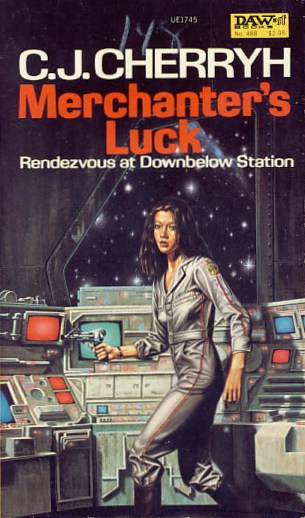
CherryhMerchantersLuckCoverIf space is an ocean and interstellar colonization is happening on a grand scale, then it should come as no surprise that so many starship captains are intrepid merchants, traveling the galaxy in pursuit of a good business deal.  Whether they’re doing it legally as entrepreneurs or illegally as smugglers, you can find these guys in almost any space opera, from Star Wars and Star Trek to Firefly and Foundation.

Ever since Marco Polo and Sindbad the Sailor, intrepid merchants have played a major role throughout history.  The brave adventurers who travels to exotic locales to bring you all the best deals, these are often the guys at the forefront of exploration and expansion.  After all, Columbus sailed the ocean blue to find a better trade route to India–discovering a new world was just a side benefit.  The British Empire had its origins in mercantilism, forming the empire to protect their trade routes (and later, to secure markets and resources for their industrialized economy).

Unlike their real-world counterparts, however, space merchanters have a lot more challenges to contend with than sandstorms and bandits.  Science fictional universes are teeming with all sorts of exotic dangers, from black holes and solar flares to space pirates and strange alien races.  Unless FTL communication is in force, the immensity of space often makes it impossible to know exactly what to expect on your next FTL jump.  And then there’s all the normal space stuff, like busted airlocks and critical failures in the oxygen recyclers.

The best stories, though, are the ones that world build their merchanters to the point where they form their own distinct society.  This may overlap with the proud merchant race, though IMO it works best when it’s more than just a hat that everyone wears.  The merchanters from C.J. Cherryh’s Alliance-Union universe are a great example, where the entire society has restructured itself around the nomadic spacefaring lifestyle.  Another is Heinlein’s Citizen of the Galaxy, where the free traders have developed a strict social hierarchy that defines everyone’s role in running the spaceships.

Since space-centered science fiction largely grew up in the Cold War era, I wonder how much of this trope stems out of the clash between communism and capitalism.  The original Star Trek certainly shows a lot of Cold War influences, with the Klingons originally playing proxy for the Russians.  Is the genre’s fascination with the adventurous space merchant somehow an outgrowth of that world-shaping conflict?  And if so, how do the stories differ on the Soviet side?  It makes me wish I could read Russian, since the Soviets certainly had their own fascination with science fiction and space opera.

In my own work, this trope plays a central role.  Most of the major characters in my stories are merchants of one stripe or another.  James McCoy from Bringing Stella Home is the son of a merchanter, and comes from a mining colony where interplanetary trade drives the local economy (setting up the conflict for Heart of the Nebula after the Hameji take over).

But the trope takes special prominence in my Star Wanderers novellas, which was largely a reaction to C.J. Cherryh and Heinlein.  I wanted to create a spacefaring society on the starbound frontier that revolved not only around trade and colonization, but much more personal struggles like finding love and fighting loneliness.  In that sense, the stories are a lot more like Merchanter’s Luck than Downbelow Station–more about the lives of individual characters than the grand sweep of galactic history.

Either way, I’m a big fan of this trope.  If you’ve got any examples from your favorite books, please share!  Wish-fulfillment is a huge part of any fictional genre, and science fiction is no exception.  If I could leave it all behind to become a merchant to the stars, you can bet I’d do it in an instant!

J is for Jedi

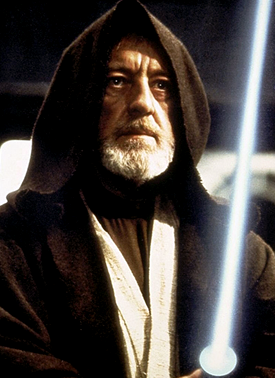
Ben_KenobiAs much as science fiction looks to the future, it also of necessity looks to the past.  And as much confidence as it places in the scientific method, it often turns to religion, simply because of the scope of the great cosmic questions that such stories inevitably pose.

For these reasons, it should come as no surprise that the best science fiction stories often include knights and shamans, priests and warrior monks.  Far from degrading our view of the future, they greatly enrich and humanize it, bringing a sense of meaning and destiny to an otherwise cold and lonely universe.

The best example of this is probably the Jedi from the original Star Wars trilogy.  I still get shivers when I hear Yoda explain the force:

Size matters not. Look at me. Judge me by my size, do you? Hmm? Hmm. And well you should not. For my ally is the Force, and a powerful ally it is. Life creates it, makes it grow. Its energy surrounds us and binds us. Luminous beings are we, not this crude matter. You must feel the Force around you; here, between you, me, the tree, the rock, everywhere, yes. Even between the land and the ship.

There are plenty of other examples too, of course–harsh ones like the creeds the Cylons follow in the re-imagined Battlestar Galactica, which they use to justify their genocidal war against the humans.  And then there are the quaint and simplistic ones that happen when a primitive race makes first contact with humanity … as well as the ones from a race so advanced that they make us look like barely evolved monkeys.

So why is religion so prominent in science fiction?  Probably because the best science fiction stories act as a mirror that allows us to see ourselves better.  Throughout history, religion has been one of the most important parts of any human civilization.  Even the modern secular cultures still grasp at the same cosmic questions, striving to find meaning beyond the animal drives of food, sleep, and sex.

At its core, every religion is about telling a cosmic story.  There’s a reason why the Bible starts with the words “in the beginning,” and why the first sura of the Qur’an names Allah “The Merciful and The Compassionate.” Since the best science fiction also tells a cosmic story, is it any surprise that there should be overlap between the two?

The best science fictional religions are the ones that make you want to believe.  The Force in Star Wars was definitely like that to me (the original trilogy, of course–before all that midi-chlorian nonsense).  Orson Scott Card’s philotic web also turned me into a believer, at least for the duration of those books.  Even Eywa from the movie Avatar had some deep undertones that made me wish I was a part of that world.

Religion plays a huge role in my own books, not just the stuff that I believe in real life (though I’m sure that influences my writing), but the stuff that I think the characters would believe.

In Star Wanderers, for example, most of the outworlders are pagans who pray to the stars.  In that universe, astrogation is an act of worship.  The Deltans subscribe to a fusion of pagan and Christian beliefs, which in turn affects how much they value families and children.  I won’t spoil it, since it comes as something of a reveal in Homeworld, but it definitely drives the series.  And of course there’s Jeremiah’s New Earther background, with its guilt complex that leaves him emotionally scarred.

My favorite religion to write so far was the faith of the desert tribesmen in Desert Stars.  I wrote that book just after spending a summer in the Middle East, and my experience of the Muslim culture definitely was a huge influence.  The tribesmen pray to the Temple of a Thousand Stars, the temple erected to the memory of Earth soon after the first colonists made planetfall.  The first half of the book follows Jalil’s pilgrimage to the ancient temple, through the domes filled with strange and decadent people.

When I started the Gaia Nova series, I wanted to create a science fictional universe where any of our real-world religions could still plausibly be true.  The way I got around all the conflicting prophecies of the end times was to have a human colony mission leave Earth soon after our time.  When the colonists woke up, they’d lost the location of Earth, so naturally all the religions developed around the idea that Earth had received its prophesied glorification and become a heavenly paradise.

That’s the short explanation, anyways.  But the books themselves aren’t so much about that as they are about the characters.  If religion is important to them, then that becomes an important part of their story.  And since religion is so important to us here on Earth, I can’t help but believe that it will follow us to the stars.

I is for Interstellar

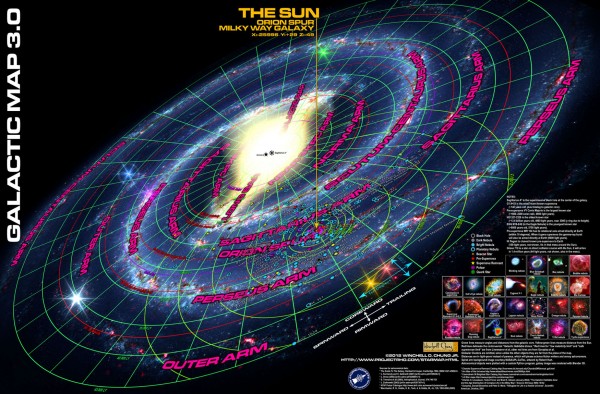
winchgalmap3SampleRight after I went through my Dinosaur phase, I saw Star Wars IV: A New Hope for the first time.  Instantly, all that childlike excitement and exuberance was transferred from paleontology to astronomy.  We had a series of about twenty astronomy books in my elementary school’s LRC (Asimov’s astronomy series, I believe–the ones with the gray dust jackets), and in about a year I’d read them all.

Star Wars was fun, but what was really fascinating was learning about the stars.  When I started to grasp the scale of our galaxy–that if our solar system was the size of a milk carton, the Milky Way would be the size of North America–my mind was totally blown.  Quasars, pulsars, black holes, white dwarfs, red giants–it was so amazing!  And then, when I started thinking about all the other worlds out there, and what it would be like to visit them–that’s when I became a science fiction fan for life.

It goes without saying that you can’t have space opera without setting the story somewhere in space.  But the best space opera goes much further than that–it’s about space as the final frontier, and humanity’s ultimate destiny among the stars.  After all, if we as a species stay put on this pale blue dot, sooner or later we’ll kill ourselves off or suffer another mass extinction event that wipes us all out like the Dinosaurs.

For that reason, classic space opera often takes undertones of manifest destiny, except on a galactic scale.  The stars are not just interesting places to visit, they’re absolutely crucial to our survival, and no matter what alien dangers await us, we will face them boldly and either conquer or be conquered.

Of course, not all space opera stories take place during the exploration and colonization phase of human interstellar expansion.  Plenty of stories take place thousands of years later, once humanity has comfortably established itself among the stars.  Even so, there are still more than enough wonders remaining to be explored–if not for the characters, then for the readership.  The vastness of space is so great that there really is no end to it, and the possibilities are only bounded by the writer’s imagination.

One of my favorite space opera computer games is Star Control II, also know as the Ur-Quan Masters.  In the game, you’re the captain of a giant starship built with alien precursor technology.  The races of the Federation, including humanity, have been defeated and enslaved by an aggressive warrior race known as the Ur-Quan.  You must travel from star to star, gathering resources to upgrade your starship and convincing the other alien races to join the new alliance.

By far, the best part about that game is the starmap.  It’s HUGE!  More worlds than anyone can possibly visit in any one playthrough, or five, or even ten.  And each alien race has its own history, its own culture, its own set of goals and objectives–and oftentimes, most of these goals have very little to do with the actual conflict of the game.  In fact, there are some races like the Arilou which don’t even seem to know that there’s a war going on.  They’re much more interested in something frightening and mysterious from another dimension that they never quite explained, but that may involve the Orz somehow…

With each new world that you discover, you learn that the galaxy has a very, very, very long history.  So long, in fact, that the human race has only really existed for a blip in time.  The other races are involved in their own disputes, and many of these go back to the times when our ancestors were swinging through the trees somewhere in central Africa.  But whether or not we want to be a part of it, we’re involved, simply by virtue of where our star happens to be located.

The best space opera isn’t just about our world: it’s about our place in a much wider universe.  Whether it’s a serious tale about humanity’s ultimate destiny, or an action-packed intergalactic romp, there’s always that sense of something greater than us–that same sense of wonder that gripped me as a boy when I first started to learn about the stars.

Image by nyrath at Project Rho. I highly recommend checking out his excellent starmaps!

H is for Hologram

cortanaIn real life, the term “hologram” means something fairly specific.  But in science fiction, it can mean a number of different things.

For example, in Star Wars it’s basically a three dimensional video recording projected on a flat surface.  In Halo, it’s the visual form that the AI character Cortana takes when she wants to interact with the Master Chief.  And in Star Trek, the holograms actually have a degree of physical substance, so that in some episodes they go rogue and try to take over the ship.

The basic underlying idea, though, is the same: blurring the line between the virtual world and the real world through a virtual projection that we can interact with.  And in that sense, this is actually an area where science fact is fast catching up with science fiction.

Some sub-genres, such as cyberpunk, focus almost solely on the tension between the real and the virtual.  Often set in a near-future world, cyberpunk stories often feature a crapsack future, from which the only meaningful escape is a virtual reality.  But the thing about virtual realities is that they can be reprogrammed in such a way as to give the ones controlling it almost absolute power over the lives of the people inside.  For that reason, the main characters are often hackers, struggling against the corporate evil overlords.

But holograms aren’t restricted to cyberpunk.  They’re quite common in space opera, too, and not just because they’re cool.  For one thing, they can be really useful for training simulations (which often leads to holodeck malfunctions, courtesy of the rule of drama).  They can also be useful as disguises or decoys, especially in the Halo series.

But perhaps the most memorable holograms are the ones who develop a close relationship with their real-world human counterparts.  This may include romance, which, combined with the existential angst that typically surrounds androids, robots, and cyborgs, makes for some very interesting tension.  A good example of this is Cortana from the Halo series, an alien AI who took on a younger form of her human handler, Doctor Halsey, and then developed a very close relationship with her Spartan bodyguard, the Master Chief.  It never actually went anywhere (at least in the main series arc), but it certainly made for an interesting story.

Jane from the Ender’s Game series would probably be my favorite hologram, though she’s more of a shapeshifting AI who can take many different forms, depending on what suits her.  Cortana is definitely up there too.  I haven’t used this trope much in my own fiction yet, but I’m playing with it in Heart of the Nebula, a currently unpublished direct sequel to Bringing Stella Home.  Not sure exactly where I want to take it yet, but it should be interesting.

E is for Empire

terran_empireAlmost every far future science fiction story has a galactic empire of some kind.  From Dune to Foundation, from Star Wars to Firefly, there’s always someone trying to rule the galaxy, often in a way that makes life difficult for the protagonists.

Why?  Rule of drama, of course, but also because it gives the story a truly epic scope.  Just as the classics such as Homer’s Iliad and Tolstoy’s War and Peace are as much about entire civilizations as they are about the people characters within them, so it is with science fiction, especially space opera.  Combine that with science fiction’s forward-thinking nature, and you have the potential for some truly amazing stories about humanity’s destiny among the stars.

But why empire?  Because even if we make it out to the stars, we’ll probably still take with us all of the baggage that makes us human.  Science fiction may be forward looking, but history repeats itself, and you can’t have a clear view of the future without understanding and acknowledging the past.

Not all galactic empires are evil, but most of them are.  We shouldn’t have to look further than the real-world history of Imperialism to see why.  Oppression, exploitation, slavery, genocide–all of these have been done in the name of Empire, and many more evils besides.  Even benevolent hegemonic powers (such as, I would argue, the United States of America) often end up doing great harm, either through action or inaction.

Of course, all of this makes for some really great stories.  When Asimov wrote his Foundation series, he quite literally based it on The History of the Decline and Fall of the Roman Empire by Edward Gibbon.  When Frank Herbert wrote Dune, he drew extensively from his background as an orientalist and based the overworld story on the Muslim conquests of the 7th and 8th centuries.  Star Wars is based loosely on the collapse of the Roman Republic, and Firefly echoes many of the old Western tales of former Confederate soldiers heading west after the US Civil War.

It’s worth pointing out that the Galactic Empire is by no means the only form of political organization in space opera.  There are actually several, including:

  • The FederationA loose organization of stars and planets that usually exists to foster cooperation and mutual peace between galactic civilizations.  Rarely evil, but can be crippled by red tape.
  • The RepublicA more centralized version of the Federation, typically.  Exercises more control over its citizens, but not in an oppressive way.  Usually features some form of representative government.
  • The AllianceA team of political underdogs united to overthrow the Empire and establish a more just form of government in its place.  If they win, they usually become the Republic or the Federation.
  • The KingdomA smaller government within the larger political system, often struggling for survival against more powerful forces. Not always democratic, but is often good, at least to its own citizens.
  • The Hegemonic EmpireLike the Empire, but rules primarily through soft power, ie co-opting their enemies rather than crushing them.  May overlap with the Republic or the Federation.
  • The People’s Republic of TyrannyThe Empire pretending to be the Federation.
  • The Vestigial EmpireWhat the Empire becomes when it’s been defeated but not yet destroyed.  Still oppressive and evil, but rules a smaller territory and struggles for relevance and survival.
  • The RemnantAn element from the Alliance that’s gone rogue.  The war may be over, but these guys are still fighting it, even if they’ve lost sight of what they’re fighting for.
  • The HordeA highly aggressive and expansionist warlord state.  By far the most violent and brutal of any political organization, it seeks to conquer and subjugate the entire galaxy.

As a political science major, all these forms of government really fascinate me.  I’ve played with quite a few of them, especially the Horde (Bringing Stella Home), the Empire (Desert Stars), the Hegemonic Empire (Star Wanderers), the Kingdom (Stars of Blood and Glory), and the Remnant (also Stars of Blood and Glory).  You can definitely expect to see me play with them again in the future.

D is for Droids

droidsSome of the best-loved characters in science fiction don’t even have a heartbeat.  Why?  They’re robots, that’s why!

Unlike the mechanical “slaves” (the original meaning of the Czech root robota) that built your car or enable your GPS devices, these robots are a lot more human.  In fact, the word “droid” is short for “android,” which comes from the Greek root for “man” (andr-) and means “manlike.”

In other words, the thing that defines these robots is that they blur the line between machine and man.  And ever since they made their first appearance in some of the earliest works of science fiction (Frankenstein by Mary Shelley was arguably the first), that’s exactly what they’ve been doing.

Star Trek loves to play with this trope, from Data in The Next Generation to the doctor in Voyager.  But where the droids in Star Trek tend to be angsty and existential, the ones who populate Star Wars already know their place and don’t have any qualms filling it.

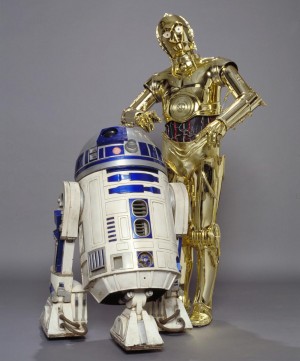
My first exposure to droids was when I saw the original Star Wars trilogy as a little boy.  An image of C3PO with his golden humanoid body wandering across the dune wastes of Tatooine will probably be stamped on my subconscious forever.  That, and the little traveling flea market the Jawas ran from their sand crawler.

One of the neat things about droids is that you can go either direction with them.  If you want to get all existential about the nature of humanity and whatnot, you can use them to explore those questions since they’re almost human but not quite.  On the other hand, if you just want an exciting space romp with some unique and interesting characters, you can bring them out as regular characters.

An advantage that droids have over humans is that they’re harder to kill and easier to bring back to life.  Star Wars leaned on this a lot, especially in episodes IV and V.  When R2D2 got shot in the battle of Yavin IV, right before Luke blew up the Death Star, I just about died.  And yet, they brought him back easily enough for the throne room scene because he’s a robot–all they had to say was “we’ll fix him up” and you knew that everything would be better.

So yeah, droids.  I haven’t done much with droids yet in my own writing, mostly because I’m a bit conflicted in my thoughts about the upper limits of AI (which I explored somewhat in Genesis Earth).  Most of my robots are actually cyborgs, and that’s something completely different.  Still, I can see myself playing with this trope at some point in the future, probably when/if I introduce some aliens or start a new series.

A is for Aliens

cantinaAlien races–what would science fiction be without them?  They’re as fundamental to the genre as elves and dwarves are to fantasy.  If you’re reading a book and an alien being from another planet shows up on the page, that in itself is usually enough to make the story science fiction.

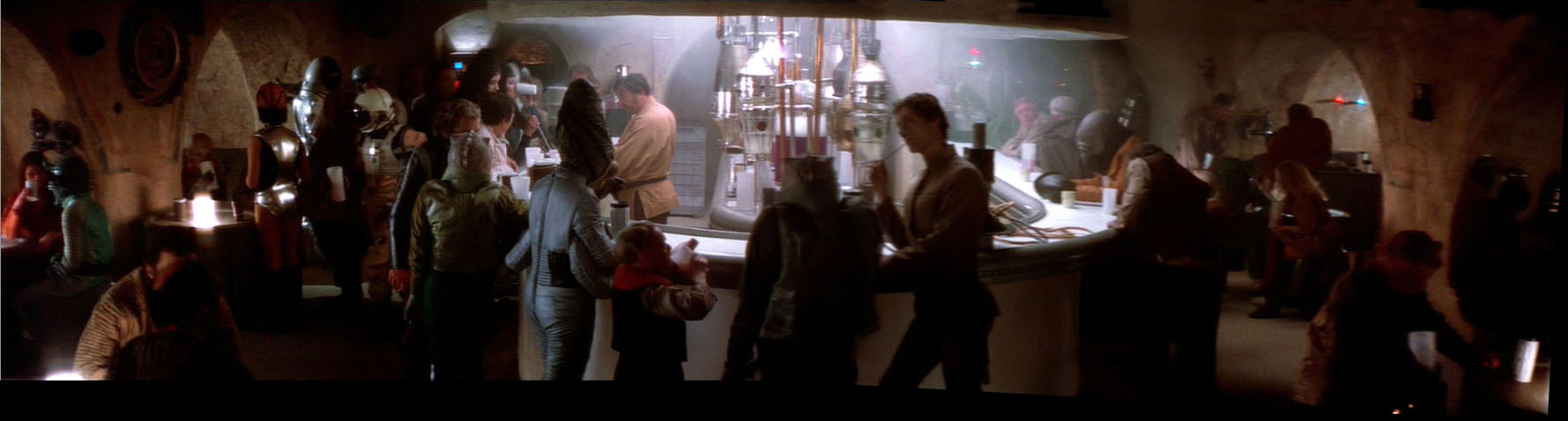
My first exposure to aliens came from Star Wars IV: A New Hope, which I saw as a kid sometime back in the early nineties.  The cantina scene with the weird, catchy music and all the frighteningly creatures both scared and fascinated me.  Here were a bunch of humans, mingling with these things that looked like monsters as if nothing were strange or unusual.  In fact, it soon became clear that these weren’t monsters at all, but regular people–that is, as regular as you can be without being human.

I think the main reason for including aliens in a space opera story is that it makes the setting feel more exotic and otherworldly.  It can also add all sorts of interesting possibilities for plot and character, depending on the different capabilities of the various alien races and the way their culture shapes them.  Babylon 5 is a great example of this, with the characters from each alien race interacting with each other in ways unique to their various cultures.

One way to think of science fictional aliens is to put them on a spectrum with two extremes.  On the one side, you have the more familiar aliens–the races from Star Trek, for example, which are basically human-like except with weird skin or bone ridges to physically distinguish them.  On the other side, you have the truly bizarre–the kinds of aliens that are so different from us, we cannot possibly conceive their thoughts or the way they see the world.

The main advantage of the more familiar alien types is that they’re easy to understand and relate to.  Yeah, they may look weird, but they don’t think or act much differently than the Russians, or the Arabs, or whatever human culture they roughly parallel.  In fact, it’s not uncommon in fiction of this type for the aliens to be less “alien” than the Japanese (at least, in Western fiction–obviously, it’s different in manga and anime).  This, in turn, is the main weakness with aliens of this type: they are so readily understandable that it’s easy to lose that sense of otherness.

The main advantage of the more extreme kind of alien is that it can make a much stronger impact, which makes for a more compelling and thought-provoking story.  For example, the Hypotheticals in Robert Charles Wilson’s Spin trilogy are so fascinating because we know so little about them.  They have the power to shape entire worlds, manipulating space and time itself, and yet none of the reasons behind what they’re doing make sense–if indeed there’s any reason behind it at all.  Or in Octavia Butler’s Xenogensis trilogy, it’s not too hard to figure out what the aliens are trying to do, but the way in which they do it, impregnating the main character through their tri-sexual biological capabilities makes for a profoundly disturbing story.

The disadvantage, of course, is that aliens of this kind are much more difficult for readers to relate to.  If the aliens are so advanced that their thoughts transcend our own, or if their sensory organs are so different that we cannot possibly conceive of how they see the world, then it’s very difficult for us to get inside of their heads.  For this reason, aliens of this kind tend to become more of a force of nature than actual characters–or characters in the aggregate, in the way that humanity is the main character of most of Arthur C. Clarke’s books.

Personally, I’m more of a fan of the extreme alien type.  The universe is so vast, and our understanding of it is so lacking, that it rings a lot truer to me.  The odds that we are alone in the universe are so infinitesimally small that refusing to believe in the existence of aliens would be akin to believing in 1492 that the Earth is flat, and yet if/when we ever make contact, I can’t help but wonder how different from us they’ll be.  So much of what we take for granted is just a fluke of our particular circumstances here on this planet–the chance combination of so many variables that changing any one of them would completely rewrite the story of how our species evolved, much less our civilization.

There is a place for the more familiar aliens of space opera, though. They make for some very entertaining stories, provide a fun escape from this world when that’s what we need.  They also give us a chance to look at ourselves through a lens that strips away our stereotypes and prejudices.  We might have some very strong opinions about immigrants, for example, or people of a different race or color, but none of us are prejudiced against Sand People, or Klingons, or Androsynth.  In space opera, most alien races are loosely based on real-world cultures, so it’s possible to draw parallels without all the cultural and historical baggage.

In a sense, all fiction is just the culture speaking to itself, so when we read about aliens we are really reading about ourselves.  Encountering the Other in a non-threatening fictional world enables us to face the real-world Other with understanding and compassion.

I haven’t written very many alien stories yet, but I have a couple cooking in the back of my mind.  Genesis Earth has an alien encounter with a bit of a twist to it, but the characters in my Star Wanderers and Gaia Nova series are all human (well, mostly).  If/when I do introduce an alien race, I plan to do it right, which will almost certainly involve a first contact story.  But that’s for Saturday’s blog post, not today’s.