A clip of this podcast showed up in my YouTube recommendations, and it was interesting enough that I clicked through to the full-length interview. Definitely worth a listen. Adam Lane Smith really knows his stuff—and he’s not at all woo woo or touchy feely like most of the women people giving relationship advice. Just solid, practical, down-to-earth “this is how it is,” kind of like hoe_math except concise and to-the-point, with a Christian angle and scientific evidence. Very interesting stuff.
Tag: sex
Fantasy from A to Z: L is for Love
What is love? (Baby don’t hurt me…)
Seriously, though, what counts as “love” in fantasy these days? The romantasy subgenre is taking the field by storm, but much of it seems to be outright pornography, at least to me. Back when Twilight was all the rage, I at least understood the romantic angle, even if I didn’t particularly care for it. But now, there’s all this stuff about mate-bonding, consent/non-consent, something called “the omega-verse,” and a weird hierarchy of various forms of bestiality that I frankly cannot follow at all.
I should take a few steps back, and perhaps abandon romantasy altogether. I’m sure there are plenty of non-pornographic books in that subgenre—in fact, I’m fairly certain that one of my old college friends, Charlie Holmberg, was a pioneer in it. Everything of hers that I’ve read is pretty good, and also quite understandable, even to a dopey guy like me.
Outside of romantasy (and paranormal romance, which it appears that romantasy has more or less cannibalized), the love stories are pretty straightforward. Epic fantasy in particular tends to have at least a couple of romantic subplots in every book—which makes sense, considering how expansive the subgenre is trying to be. After all, if you’re writing a story where the world itself is a major character, you’ve got to have at least a few good love stories in there too.
But as the internet has continued to spawn narrower and narrower niches and subcultures, all existing in their own little subcultures, things on the extremes have gotten… weird. And as the gender divide appears to be widening with each subsequent generation, especially in areas like politics and culture, it’s beginning to seem like we aren’t even speaking the same language, even when it comes to something as basic and essential as love.
Now, male-coded romances are pretty easy to understand (though I could be biased… I am a man, after all). It starts with a boy who really wants a girl. Like, really, really, really wants a girl. He likes her so much, he spends the whole book trying to get her—and by the end, he either wins her, or he realizes that he doesn’t actually want her, he wants this other girl he met along the way. If things get spicy, it’s all very straightforward and everyone generally has a good time. If there are issues with rape or non-consent, those are generally separate from the romantic subplot
And often, male-coded romances don’t even include much spicy content at all. Even Robert E. Howard’s original Conan the Barbarian stories were pretty mild, in terms of spiciness. Yes, there was usually a scantily-clad female love interest, described in such a way as to increase Howard’s chances of getting his story featured on the magazine cover (and thus earning double the pay). But when it came to the actual, you know, kissing and stuff, Howard never went into graphic detail. The most he would do was hide behind euphemisms like “he crushed her in his arms.” All of the ejaculations in his stories were saidisms—as in, “look out!” he ejaculated, waving his hands wildly (and you would be shocked how often he used “ejaculated” as a saidism—seriously, I think there’s at least one in every classic Conan story).
(Side note: just because Robert E. Howard’s Conan stories were pretty mild on the spiciness scale, that does not mean that subsequent authors kept it mild. Lin Carter and L. Sprague de Camp tended to keep it more in the vein of the original, but Robert Jordan’s Conan was… let’s just say, it was too much for me.)
And it used to be that female-coded romances were pretty simple, too. An ordinary, boring girl somehow finds herself the object of attraction between two incredibly powerful (and incredibly sexy) men from the other side of fairy, who are positively obsessed with her. However will she choose between them both? Oh, look—now they’re fighting each other to determine which one gets her. Stop fighting, you sexy fairy men! But seriously, however will she choose?
Somewhere along the line, that morphed into a thing called “reverse-harem,” which (as I understand it) is where the girl throws up her hands and decides that she can’t possibly choose between them, so she chooses them all. Which meant, of course, that the love triangles quickly turned into love dodecahedrons—since if you’re going to have a harem, you might as well fill it up with as many sexy fair men as you can.
And then somehow, things got really weird—and also, really toxic. According to Malcolm and Simone Collins (who know more about this subject than I do), some of the more toxic behaviors that romantasy normalizes include:
- Fated or “mate-bond” relationships that override consent,
- Extreme male possessiveness portrayed as genuine love,
- Drugging and public humiliation portrayed as romantic tension,
- Huge age and maturity gaps between partners,
- Serial betrayal framed as female empowerment and playing hard-to-get,
- Intentional miscommunication, with heroines refusing to talk through their problems—again, often framed as female empowerment,
- Violence rebranded as safety, since the love interest will never really hurt the heroine,
- Wish-fulfilment with serial partners, often framed as a justification for serial betrayal mentioned above, and
- Lazy trope stacking (eg “rich-fey-boyfriend,” scent/marking, etc) without confronting the darker implications of coercive and non-consenting relationships.
Sadly, it seems that all of these toxic aspects of romantasy are reflections of the current state of modern dating and relationships. For example, in a world of online dating where ghosting and fading is all-too common, serial betrayal is a bit of a power fantasy, as is wish-fulfillment with serial partners, since if “true love” doesn’t work out, there’s always another one just a swipe away. Similarly, because women who have taken multiple sexual partners find it difficult to pair-bond with any of the later ones, the concept of “mate-bonding” may have arisen as a way to recapture that lost sense of bonding that comes with the “first time.”
Call me old fashioned or out of touch, but I preferred it when things were simpler, and the traditional boundaries around sex and relationships were still very much in force. There’s something charming about the love stories that were written before birth control and the sexual revolution, where men had to woo their women and get them to say “I do” before any of the bedroom gymnastics became a factor. Of course, I’m totally biased, because my wife and I both have a “body count” of exactly one.
I think romantic love is one of the greatest things in the world. I think that sex is also a wonderful and a beautiful thing, especially when it is used to fulfill its primary purpose: to facilitate lifelong pair-bonding between a man and a woman. In my experience, this is an even more important purpose of sex than procreation, though of course that is a very important (and very fulfilling) secondary purpose.
I don’t read or write romantasy, so you won’t find any of those tropes in my books. You will find a lot of romantic love, though, especially in my sea mage cycle books. Rescuer’s Reward is probably the closest thing I’ve written to a straight up romance, at least in the fantasy genre. The Widow’s Child also has a strong romantic subplot, though it goes a little further than fade-to-black. And of course, the Soulbond King books are going to have a lot of romance, since the magic system requires a man and a woman to become bonded in love in order to unlock their unique magical powers. Those books are going to be a lot of fun to write.
Why I no longer consider myself to be a libertarian
I’ve been going back and forth on this post for almost a year now, wondering how exactly to express my thoughts. Some of the positive reviews on my fiction have expressed that I write “libertarian fiction,” and in some ways, I think that’s accurate: certainly, I value liberty very strongly, and support those government policies that are designed to safeguard our liberties while opposing those that seek to destroy it. That has not changed. But my views of libertarianism more generally have, perhaps in some ways that might surprise my longtime readers.
First, a little bit of my personal history. I grew up in one of the most liberal parts of the country, Pioneer Valley, Massachusetts, and considered myself a conservative while I lived there. Then, after serving a two-year mission for my church in Silicon Valley, California—what is probably the most progressive, leftist part of the country—I went to college at Brigham Young University, in the most Republican county of the most Republican state in the United States. At that point, I considered myself to be a sort of left-leaning classical liberal. When Dick Cheney spoke at BYU’s commencement, I blogged about the protests and attended the alternate commencement where Ralph Nader spoke.
I graduated in 2010, in the middle of the Great Recession, and made the fateful decision not to go to grad school at that time. To this day, I count that as the single best decision I ever made in my life (right up there with deleting my Facebook and Twitter accounts). Not only did this force me to learn how to navigate the real world, but it also got me out of the indoctrination factory that the national university system has become, even to a degree at my alma mater, BYU.
About five years after I graduated, I got red-pilled and started listening to right-wing commentators like Glenn Beck, Ben Shapiro, and Dennis Prager. I also looked seriously into Ron Paul and the libertarian movement, and became something of a libertarian. As fractitious as libertarianism is as a political philosophy, it seemed like the most logically coherent and intellectually honest way of understanding the world, whereas leftism and conservatism were both riddled with internal contradictions.
But then I got married and started a family. That experience has changed me in a lot of ways, perhaps even more than all the rest of my life experiences combined. But politically, the biggest thing it has caused me to rethink is this question:
What is the fundamental unit of society?
I’d always played lip service to the belief that the family is the fundamental unit of society, but starting a family of my own has made that real for me—indeed, has made me realize—in a way that simple bumper-sticker slogans never could. Before, I was living for myself. Now, I live for my children. Before, I was the hero of my own story, and that story was a single volume. Now, my story is just a single volume in an ongoing saga, a link in the chain of the generations that came before and will go on after me.
Libertarians believe that they stand in opposition to authoritarians of all stripes, be they communists, fascists, socialists, etc. But both libertarians and authoritarians operate on the unspoken assumption that the individual, not the family, is the fundamental unit of society. Leftists want to destroy the family and put the state in charge of raising and educating children, in order to make them obedient to government authority. Libertarians, on the other hand, romanticize this idea of the atomized individual who follows his own path and eschews all forms of collectivism, including the family. Ayn Rand’s books are populated by ubermensch who seem like they’ve sprung forth from the head of Zeus, and the children in her novels are basically just adults in miniature.
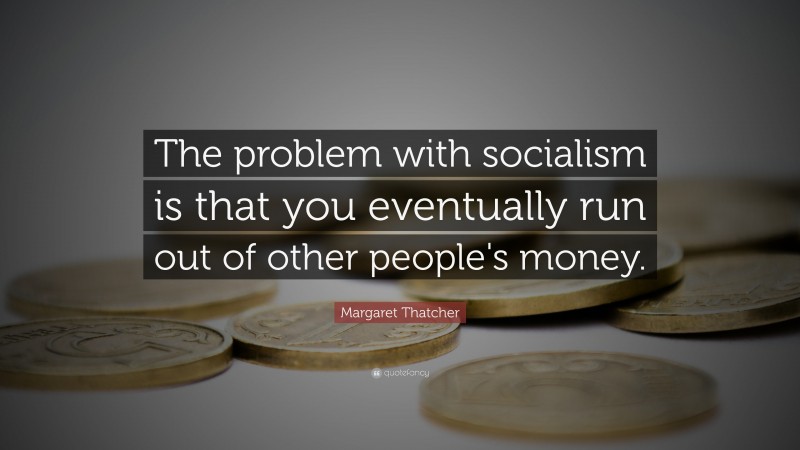
Allow me to put it this way: Margaret Thatcher had a brilliant quote about socialism that libertarians love to repeat. And from a purely economic standpoint, I believe that the libertarians are correct. But change that quote just a little, and you get this:
The problem with
socialismlibertarianism is that you eventually run out of other people’smoneyfamilies.
Families don’t just happen. They take a lot of work to build and to maintain, and unless they are planted in a culture that nourishes them, they will wither and die. Libertarianism does not foster that kind of a culture, yet it depends on families in order to raise the kind of people who can make a libertarian society work. People from broken families often lack the mental and emotional maturity to take upon themselves the personal responsibilities that come with personal liberty—in other words, they lack the capacity for personal independence which libertarianism depends on. Growing up in a healthy family isn’t the only way to develop that sort of independence, but a society of broken families will invariably fail to produce such a people.
This is why libertarianism ultimately leads to authoritarianism. We aren’t all characters in an Ayn Rand novel: we aren’t all ubermensch all of the time, reshaping the world by the strength of our will. And when we inevitable fail, where can we turn to for help? If society is nothing more than a group of individuals, then ultimately the only place to turn to is the state. Perhaps there may be churches, companies, or other private civic organizations to which a person may turn, but any form of libertarianism that rejects altruism as a moral good will fail to foster these organizations as well. So, in the absense of anywhere else to turn, individuals will, over time, turn increasingly to the state, trading their libertarian freedoms for economic and social security. A society that exalts the individual at the expense of the family will always, in the end, devolve into a statist tyranny.
If you want to create a stable society that recognizes individual freedom, you have to recognize the family as the fundamental unit of that society, and you have to proactively enact policies that will foster a culture of strong families. Not only does this give you a social safety net that is totally apart from the state, but it also ensures that your society will be self-perpetuating, since one of the central purposes of the family is to create and raise children.
In fact, the family is perhaps the best antidote to government power creeping into every facet of society, which also makes it the best way to push back against woke leftism, ESG, and the Great Reset. Hence why everything about leftist progressivism is calculated to destroy the family. Parents concerned about CRT in their schools? Domestic terrorists. Kids who say that they’re transgender? Transition them without telling the parents, and take them away from their families if the parents object.
But it’s not just a partisan issue. If the family is the fundamental unit of society and needs to be strengthened, then there are things on both the left and the right that need to change. For example, poverty is a huge issue for families, since poor families are much more likely to break up due to the stress. But conservatives often ignore the issue of income inequality, mouthing platitudes about the free market while giving us socialism for the rich and capitalism for the poor. And the libertarians are little better, what with how they push for the legalization of drugs, prostitution, abortion, and pornography. Few things have done more to destroy the family than widespread substance abuse and the hypersexualization of our society.
This is why I’ve mostly given up on reading Heinlein anymore. He’s a brilliant writer with a fascinating take on some of science fiction’s most fundamental tropes, but whenever he writes about sex or sexuality, all I can think of is “the problem with libertarianism is that you eventually run out of other people’s families.” Heinlein and his boomer readership took the family for granted, neglected their own, and gave us a world of widespread sexual promiscuity, where society is falling apart.
So that’s why I don’t consider myself a libertarian anymore, even though there are many tenets of libertarianism that I still admire and believe, especially on the economic side. I suppose you say that I’m a conservative, but that isn’t really accurate either, because most strains of conservatism in 2024 really seem more about conserving the leftism of two or three generations ago. So I guess that means I’m politically homeless—just like most of my fellow Americans these days.
How I would vote now: 1958 Hugo Award (Best Novel)
The Nominees
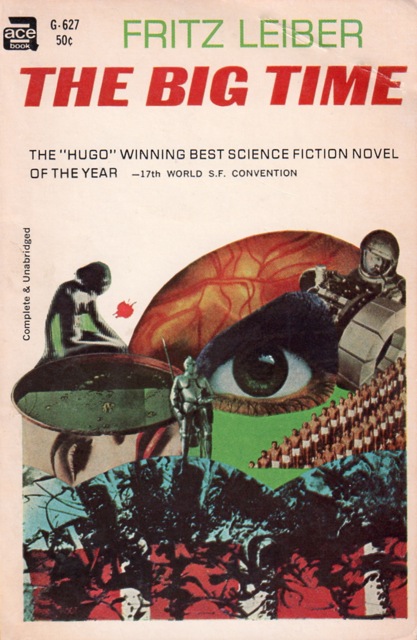
The Big Time by Fritz Leiber.
The Actual Results
- The Big Time by Fritz Leiber.
How I Would Have Voted
- (Abstain)
Explanation
The Big Time has a lot of things in it that I normally would like. It’s a time travel story that bucks the popular convention of the butterfly effect—the idea that small changes in the past lead to big changes in the future. Instead, Leiber’s view of time travel is much closer to Connie Willis’s, in that the continuum itself tends to seek a stable equilibrium, negating the effect of small changes. But unlike Willis’s books, the time travelers aren’t just a bunch of cloistered academics looking to be passive observers of history. Instead, there’s a full-on time war between two monolithic factions, each of which has screwed so much with the timeline that they hardly know who they are anymore.
So what’s so bad about it that I feel it didn’t earn my vote? I’ve tried twice to read this book, and I’ve DNFed it both times because I just can’t get over the fact that it’s about a bunch of comfort women—with everything that term implies—servicing the time warriors of their particular faction. In WWII, “comfort women” was a euphemistic term for civilian sex slaves taken captive by the Japanese Imperial Army. That’s basically what’s happening here, except it’s played straight, with no ick factor, or even really an acknowledgment that an ick factor might exist. And that’s what turns me off—not just the ick factor itself, but the way that the author treats it as something normal and blase—progressive, even. After all, every good time soldier needs a “sex therapist.” </sarc>
Usually when older science fiction turns me off, it has something to do with the sexual content. So many scifi writers in the 50s, 60s, and 70s had these almost utopian visions of a free love future, or at least a very optimistic view of the sexual revolution. They never imagined that we might become even more prudish than the Victorians, or that incels would be a thing, or that we’d be facing a loneliness epidemic, a population collapse, and both a war on men and a war on women because, in large part, of how the Boomers tore down all the boundaries around sex and sexuality—which is to say nothing of how so many people can’t even define what a woman is these days.
These scifi writers were supposed to be our visionaries, but they were so totally blinded by their own carnal lusts that they failed to predict the second- and third-order effects of the kind of free love future they were writing about. That’s not exactly the case with The Big Time, but it falls into that same trap, along with most of Fritz Leiber’s work that I’ve read. However, it wasn’t so bad that I’d vote No Award over this book. Rather, it was more of a background element that rubbed me the wrong way, to the point where I just couldn’t finish the book.
A Much Deserved Fisking
In the November issue of Locus magazine, Cory Doctorow wrote an op-ed piece defending Jeannette Ng and the decision to strip Campbell’s name from the Campbell Award. At least, that’s how it started out, but it quickly devolved into a hatchet piece against everyone in science fiction whose politics lie somewhere to the right of Stalin.
Ever since Sad Puppies III, I’ve more or less gotten used to the gaslighting, hypocrisy, and projection that has become de rigeur in the traditional publishing side of the field. But somehow, Doctorow’s hit piece manages to hit a new high water mark for leftist insanity.
Since my own politics lie somewhere between Boadicea and Genghis Khan, I thought it would be fun to give the piece a good old-fashioned fisking. I can’t pretend to be as good at it as Larry Correia (and I sincerely hope he fisks it himself), but damn, if anything ever was written to be fisked, it was this ridiculous piece.
Doctorow writes:
At the Hugo Awards ceremony at this summer’s Dublin Worldcon, Jeannette Ng was presented with the John W. Campbell Award for Best New Writer. Ng gave an outstanding and brave acceptance speech
Translation: Ng reinforced the dominant far-left narrative in the science fiction field, telling the gatekeepers exactly what they wanted to hear and earning widespread praise for it.
True bravery is Jordan Peterson deleting his $35,000/month Patreon in protest of their hate speech policies, or Kanye West coming out as a devout Christian, producing a worship album, and announcing that he will no longer perform any of his old songs.
in which she called Campbell – the award’s namesake and one of the field’s most influential editors – a “fascist” and expressed solidarity with the Hong Kong pro-democracy protesters.
You know who else shows solidarity with the Hong Kong protests? That’s right—everyone’s favorite deplorable frog!
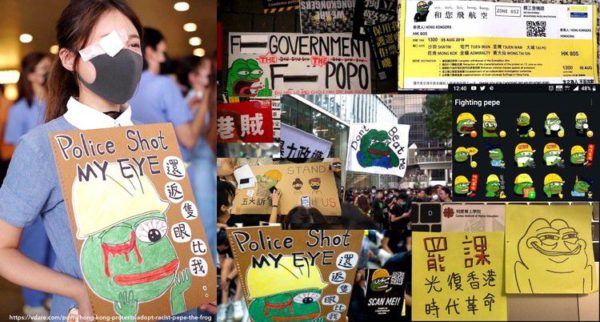
Now that’s a dank meme.
I’m curious: does this make Ng a white supremacist for showing solidarity with people who use such a rascist hate symbol? Does it make Cory Doctorow a dog whistler to the far right for appealing to these obviously racist deplorables?
Of course not, but that’s the level of insanity we’ve fallen to.
I am a past recipient of the John W. Campbell Award for Best New Writer (2000) as well as a recipient of the John W. Campbell Memorial Award (2009). I believe I’m the only person to have won both of the Campbells,
All red flags to deplorable readers like me,
which, I think, gives me unique license to comment on Ng’s remarks, which have been met with a mixed reception from the field.
I think she was right – and seemly – to make her remarks. There’s plenty of evidence that Campbell’s views were odious and deplorable.
There’s that word: “deplorable.” Whenever someone uses it unironically, it’s a sure sign that they hate you. It’s also a sign that they don’t actually have a good argument.
It wasn’t just the story he had Heinlein expand into his terrible, racist, authoritarian, eugenics-inflected yellow peril novel Sixth Column.
I haven’t heard of that one. Thanks for the recommendation, Cory! I’ve already ordered it.
Nor was it Campbell’s decision to lean hard on Tom Godwin to kill the girl in “Cold Equations” in order to turn his story into a parable about the foolishness of women and the role of men in guiding them to accept the cold, hard facts of life.
Okay, I call bullshit. “Cold Equations” wasn’t about the “foolishness of women,” it was about how when our inner humanity comes into conflict with the hard realities of the universe, the hard realities always win.
Switch the genders—a female pilot and a teenage boy stowaway—and the story still works. Switch the endings—have the pilot decide to keep the stowaway, dooming himself and the sick colonists—and it does not.
In fact, it makes the girl even more of a hapless, weak feminine stereotype. Stepping into the airlock voluntarily is an act of bravery. In some ways, she’s stronger than the pilot—and that’s kind of the point.
The thing that makes “Cold Equations” such a great story is that it functions as something of a mirror. It’s the same thing with Heinlein: those who see him as a fascist are more likely to be authoritarians, while those who see him as a libertarian are more likely to be libertarians themselves. After all, fascism is “citizenship guarantees service,” not “service guarantees citizenship.”
It’s also that Campbell used his op-ed space in Astounding to cheer the murders of the Kent State 4. He attributed the Watts uprising to Black people’s latent desire to return to slavery.
Was John Campbell a saint? No, and I don’t think anyone’s claiming that. In the words of Ben Shapiro, two things can be true at once: John Campbell had some racist, sexist views, and stripping his name from the award is wrong. (Also, that Doctorow is full of shit.)
The Campbell award isn’t/wasn’t named after him because he was a perfect, flawless human being. It was named after him because of his contributions to the field. If we’re going to purge his name from the award, are we also going to purge all of the classic golden-age books and stories that he edited, too? Are we going to have the digital equivalent of a book burning? Because that strikes me as a rather fascist thing to do.
These were not artefacts of a less-englightened [sic] era. By the standards of his day, Campbell was a font of terrible ideas, from his early support of fringe religion and psychic phenomena to his views on women and racialized people.
What are the standards of our own day? In what ways are we less-enlightened? Are future generations likely to accuse Doctorow of being a “font of terrible ideas,” just like he accuses Campbell here?
Do unborn black lives matter? If Trump is truly a fascist, why does the left want him to take all our guns? Is it okay to be white? Is Islam right about women? Is transgender therapy for prepubescent children just another form of conversion therapy? Are traps gay?
When you free your mind to explore new ideas, a lot of them are bound to be terrible. It’s simply Sturgeon’s law. So is Doctorow criticizing Campbell for having an open mind, or for not conforming to Doctorow’s values and beliefs?
Who’s supposed to be the fascist again?
So when Ng held Campbell “responsible for setting a tone of science fiction that still haunts the genre to this day.
I’m pretty sure that taking hormone blockers and getting your balls cut off makes you a hell of a lot more sterile than anything else. Lesbians, gays, transgenders, queers—all of these tend to be sterile as a general rule. Most babies are still made the old-fashioned way.
Male.
Isn’t her word choice kind of sexist here? I mean, she could have used the word “patriarchal,” but she didn’t. She. Deliberately. Used. The. Word. “Male.”
White.
Is she saying that it isn’t okay to be white?
Exalting in the ambitions of imperialists and colonisers,
Come on, Ng. Let’s not be racist. There were plenty of imperialists and colonizers who weren’t white Europeans. After all, how can we forget Imperial Japan and the Rape of Nanking? Now that was an ambitious massacre. The Turks also ran a pretty brutal empire, as did the Zulus and the Aztecs. You can’t tell me that cutting out the beating hearts of more than 80,000 prisoners to rededicate your temple isn’t ambitious.
settlers and industrialists,”
Find me one place that was not built by “settlers.” Find me one human being on this planet who has not benefitted from “industrialists.” Who do you think makes the vaccines and antibiotics? Who do you think makes machines that harvest your food?
Just for a single day, I would like to see all of these anti-capitalist types live without any of the benefits that capitalism and modern industry provide.
she was factually correct.
And yet, so completely full of shit.
In the words of Andrew Klavan, you can’t be this stupid without a college education.
Not just factually correct: she was also correct to be saying this now.
Because it’s [current year]!
Science fiction (like many other institutions) is having a reckoning with its past and its present. We’re trying to figure out what to do about the long reach that the terrible ideas of flawed people (mostly men) had on our fields.
The best way to fight a terrible idea is to allow it out in the open while fostering freedom of speech. In the words of Andrew Breitbart, sunlight is the best disinfectant.
The reckoning that Doctorow is calling for is something that’s already built into the field. Science fiction is constantly evolving and revisiting its past. Good science fiction not only builds on the stuff that came before, it critiques it while taking the ideas in a new direction.
We don’t need to tear down the legacy of the giants in the field who came before us; we simply need to build up our own legacies for the generations that come after us. But that’s not what Ng and the social justice warriors want to do.
It isn’t a coincidence that the traditionally published side of the field is rapidly losing market share as the SF establishment seeks to purge everything that could possibly offend their progressive sensibilities. The people doing the purging can’t compete on the open market because their toxic ideologies don’t resonate with the buying public, so they’re forced to resort to the digital equivalent of burning books and tearing down statues. Meanwhile, indie publishing is eating their lunch.
Get woke, go broke.
We’re trying to reconcile the legacies of flawed people whose good deeds and good art live alongside their cruel, damaging treatment of women. These men were not aberrations: they were following an example set from the very top and running through the industry and through fandom,
Future generations will struggle to reconcile our good deeds and our good art with our cruel and inhuman treatment of the unborn.
None of this is new. All of us are flawed; every generation is tainted with blood and sins that are reprehensible to those that follow. Realizing all this, you would think a little introspection is in order. But the people today who are so eager to throw stones are completely lacking in self-introspection that they can’t—or rather, won’t—see their own blood and sins.
to the great detriment of many of the people who came to science fiction for safety and sanctuary and community.
Is science fiction a “safe space,” or is it the genre of ideas? It can’t be both at the same time. Ideas are inherently dangerous.
It’s not a coincidence that one of the first organized manifestations of white nationalism as a cultural phenomenon within fandom was in the form of a hijacking of the Hugo nominations process.
Bullshit. If you think that the Sad Puppies were white nationalists, you’re either stupid or willfully ignorant (a distinction without a difference).
Larry Corriea’s flagship fantasy series, the Saga of the Forgotten Warrior, is set in an Indian-inspired fantasy world populated entirely by brown people. Brad Torgerson has been happily married to a woman of color for decades. Sarah Hoyt is both latina and an immigrant.
If this article was written three years ago, you would have just called them all racists, but you can’t do that now because “racist” has lost its edge. You’ve cried wolf far too many times, and no one pays attention to those accusations anymore. That’s why you use words like “fascist,” “white nationalist,” and “white supremacist” to describe your enemies—not because you actually believe it, but because those accusations haven’t yet lost their edge.
While fandom came together to firmly repudiate its white nationalist wing, those people weren’t (all) entryists who showed up to stir up trouble in someone else’s community. The call (to hijack the Hugo Award) was coming from inside the house: these guys had been around forever, and we’d let them get away with it, in the name of “tolerance” even as these guys were chasing women, queer people, and racialized people out of the field.
Translation: we’re done with paying lip service to “tolerance” and “open-mindedness.” From now on, if you don’t look like us, act like us, or think like us, we’re going to do everything we can to destroy you.
I’m telling you, these people hate us. That’s why they call us “deplorables.” That’s why they paint us as racists and fascists, even when we’re nothing of the sort. They don’t want to listen to us. They don’t want to give us a fair hearing. They want to destroy us.
Stripping Campbell’s name from the Campbell Award is just another example of this toxic cancel culture. It isn’t about reckoning or reconciliation. It’s a naked power grab.
Those same Nazis went on to join Gamergate, then became prominent voices on Reddit’s /r/The_Donald, which was the vanguard of white nationalist, authoritarian support for the Trump campaign.
See, this is why I can’t trust you, Cory. Gamergate had legitimate grievances with Anita Sarkeesian, Zoe Quinn, and Gawker. Trump supporters had legitimate reasons to want to stop Hillary Clinton from becoming president. Yet you casually dismiss all these people as deplorables, racists, and fascists without even listening to them.
That’s intelluctually dishonest, Cory. It’s also a form of gaslighting.
The connections between the tales we tell about ourselves and our past and futures have a real, direct outcome on the future we arrive at. White supremacist folklore, including the ecofascist doctrine that says we can only avert climate change by murdering all the brown people, comes straight out of SF folklore, where it’s completely standard for every disaster to be swiftly followed by an underclass mob descending on their social betters to eat and/or rape them (never mind the actual way that disasters go down).
I don’t think Cory Doctorow has any idea what actually happens when society collapses. When the thin veneer of civilization gets stripped away, people will eat each other. We’ve seen this just recently in Venezuela, Syria, and Mexico. Here in the US, we can see the seeds of our own collapse in Chicago, Portland, San Francisco, Baltimore, and Detroit (all very blue and progressive cities, by the way).
Also, I don’t think Cory Doctorow has any idea what he’s talking about when he says “white supremacist folklore.” What is that even supposed to mean? Just a couple of paragraphs ago, he called all the Sad Puppies “white nationalists,” and that obviously isn’t true. By “white supremacist folklore,” does he mean all the science fiction that doesn’t fit his radical progressive political ideology? Once again, he’s painting with an overly broad brush.
Also, notice how he uses “white supremacist” instead of “racist.” He can’t use “racist” because that word has been overused. Give it a couple of years, and “white supremacist” will lose its edge as well.
When Ng picked up the mic and told the truth about Campbell’s legacy, she wasn’t downplaying his importance: she was acknowledging it. Campbell’s odious ideas matter because he was important, a giant in the field who left an enduring mark on it. No one questions that. What we want to talk about today is what Campbell’s contribution was, and what it means.
Whenever the people on the progressive left claim that they want to have a “conversation” about something, what they really mean is “shut up and let me tell you how I’m right and you’re wrong.” There is no way to have an honest dialogue with these people, because they will not listen to us “deplorables.” Cory Doctorow has already demonstrated this with his blanket accusations against all the supporters of Gamergate, the Sad Puppies, and President Trump.
These people don’t want to talk about “what Campbell’s contribution was, and what it means.” They want to purge him from the field. Metaphorically, they want to burn his books and tear down his statues.
Look, I’m not trying to defend all of Campbell’s views here. I’m all for having an honest discussion about his bad ideas and how they’ve influenced the field. But I don’t believe I can have that discussion with people who clearly hate me, and will do whatever it takes to cancel and destroy me.
After Ng’s speech, John Scalzi published a post where he pointed out that many of the people who were angry at Ng “knew Campbell personally,” or “idolize and respect the writers Campbell took under his wing… Many if not most of these folks know about his flaws, but even so it’s hard to see someone with no allegiance to him, either personally or professionally, point them out both forcefully and unapologetically. They see Campbell and his legacy abstractly, and also as an obstacle to be overcome. That’s deeply uncomfortable.”
Scalzi’s right, too: the people who counted Campbell as a friend are authentically sad to confront the full meaning of his legacy. I feel for them.
Do you really, though?
It’s hard to reconcile the mensch who was there for you and treated his dog with kindness and doted on his kids with the guy who alienated and hurt people with his cruel dogma.
Did you catch the sneaky rhetorical trick that Doctorow uses here? He assumes that we’ve already accepted his argument that Campbell’s views were odious enough to have his name stripped from the award. Now he’s using an appeal to emotion to smooth it over.
Gaslighting of the highest order.
Here’s the thing: neither one of those facets of Campbell cancels the other one out. Just as it’s not true that any amount of good deeds done for some people can repair the harms he visited on others, it’s also true that none of those harms cancel out the kindnesses he did for the people he was kind to.
Or cancel all of his contributions to the field?
If Doctorow actually believes all this, why does he support Ng, who argues that everything Campbell did should be cancelled out by his most odious views? If anything, this is an argument against stripping Campbell’s name from the award.
Life is not a ledger. Your sins can’t be paid off through good deeds. Your good deeds are not cancelled by your sins. Your sins and your good deeds live alongside one another. They coexist in superposition.
Yes, and you should never underestimate the capacity of the human mind to believe two mutually exclusive ideas at the same time, especially when his name is Cory Doctorow.
You (and I) can (and should) atone for our misdeeds.
Not in today’s cancel culture, where everything you’ve accomplished can be erased by the one bad thing you tweeted or posted to Facebook ten years ago. There’s also no forgiveness or repentance, when you will be forever remembered for the worst thing you said or did.
We can (and should) apologize for them to the people we’ve wronged.
No. Giving a public apology is the absolute worst thing you can do in today’s cancel culture, because your enemies will smell blood in the water and come in for the kill.
Never apologize to a mob.
We should do those things, not because they will erase our misdeeds, but because the only thing worse than being really wrong is not learning to be better.
Oh, this is rich.
You first, Cory. Have you taken a good, hard look in the mirror? Have you really, truly asked yourself “what if I’m wrong?”
I don’t see eye to eye with Vox Day about everything, but he was right about this: you social justice types always lie, you always double down, and you always project your own worst faults onto your enemies. That’s why you’re so blind to your own hypocrisy, even when it’s staring you in the face.
I completely and totally agree that we should all strive to admit when we’re wrong and learn to be better for it, but you’re not in a position to tell me that, Cory. Not after painting all us “deplorables” with such a broad brush.
People are flawed vessels. The circumstances around us – our social norms and institutions – can be structured to bring out our worst natures or our best. We can invite Isaac Asimov to our cons to deliver a lecture on “The Power of Posterior Pinching” in which he would literally advise men on how to grope the women in attendance, or we can create and enforce a Code of Conduct that would bounce anyone, up to and including the con chair and the guest of honor, who tried a stunt like that.
Honest question: was the sexual revolution a mistake?
Asimov, Heinlein, Farmer, and all the other science fiction writers who explored questions of sexuality back the 60s and 70s were speaking to a culture that had abandoned traditional morality for a new, “free love” ethic. In other words, having thrown out all the rules, they now felt free to explore their newly “liberated” sexuality.
Was Asimov wrong in his attempt to rewrite our sexual norms? Personally, I believe it was, but I come from a religious tradition that still practices total abstinence before marriage and total fidelity within. Even then, it still depends on context. Groping a random stranger at a science fiction convention is obviously wrong, but playfully pinching my wife when the two of us are alone? Not so much.
I find it really fascinating that the woke-scolds of the left have become far more puritanical and prudish than the religious right ever was. Within the bonds of marriage, most of us religious types are actually very sex positive—after all, where do you think all those babies come from?
And Ng calls us “sterile.” Heh.
We, collectively, through our norms and institutions, create the circumstances that favor sociopathy or generosity. Sweeping bad conduct under the rug isn’t just cruel to the people who were victimized by that conduct: it’s also a disservice to the flawed vessels who are struggling with their own contradictions and base urges.
Fair enough, but there’s nothing generous about today’s cancel culture, which is frankly pathological in the way it defines everyone by their worst flaws and basest urges.
Creating an environment where it’s normal to do things that – in 10 or 20 years – will result in your expulsion from your community is not a kindness to anyone.
But how can we know what will and will not be acceptable in 10 to 20 years?
Twenty years ago, it wasn’t considered hate speech to say that there are only two genders. Ten years ago, “micro-aggressions,” “safe spaces,” and “white privilege” were not a thing. In fact, we’d just elected our first black president, bringing an end to our racially divisive past. /sarc
In the next 10 to 20 years, will we adopt all the theories and ideologies of the radical left? Or will the pendulum swing back in favor of more conservative morals and standards? We don’t know yet, because the future has not been written, and frankly, it’s not our place to write it. Every generation reinvents the world.
There are terrible men out there today whose path to being terrible got started when they watched Isaac Asimov grope women without their consent and figured that the chuckling approval of all their peers meant that whatever doubts they might have had were probably misplaced. Those men don’t get a pass because they learned from a bad example set by their community and its leaders – but they might have been diverted from their path to terribleness if they’d had better examples.
Certainly. I’m just not convinced that these virtue signalling, social justice warrior types are the examples that we should hold up.
They might not have scarred and hurt countless women on their way from the larval stage of shittiness to full-blown shitlord, and they themselves might have been spared their eventual fate, of being disliked and excluded from a community they joined in search of comradeship and mutual aid. The friends of those shitty dudes might not have to wrestle with their role in enabling the harm those shitty dudes wrought.
I’m confused. Does Doctorow believe that women are strong and independant, or does he believe that they’re tender, fragile creatures that need to be protected from socially inept, “larval” shitlords? I mean, I can see how they need to be protected from predators, since all of us—women and men—are vulnerable to various degrees… but you’d think that a strong, independent woman would be able to hold her own against a socially incompetent geek who is simply a “flawed vessel.”
Since her acceptance speech, Ng has been subjected to a triple-ration of abuse and vitriol,
Join the club.
much of it with sexist and racist overtones.
You keep using those words. I do not think they mean what you think they mean.
But Ng’s bravery hasn’t just sparked a conversation, it’s also made a change. In the weeks after Ng’s speech, both Dell Magazines (sponsors of the Campbell Award) and the James Gunn Center at the University of Kansas at Lawrence (who award the other Campbell Award at an event called “The Campbell Conference”) have dropped John W. Campbell from the names of their awards and events. They did so for the very best of reasons.
No, they did it because they were bullied into it by the woke-scolds.
As a winner of both Campbell Awards, I’m delighted by these changes. Campbell’s impact on our field will never be truly extinguished (alas),
Yes, because what you really want is to tear down all the statues and burn all the books. Who’s the fascist again?
but we don’t need to celebrate it.
Back when the misogynist/white supremacist wing of SF started to publicly organize to purge the field of the wrong kind of fan and the wrong kind of writer, they were talking about people like Ng.
Bullshit.
The entire point of the Sad Puppies (which Doctorow intentionally and dishonestly mischaracterizes as “the misogynist/white supremacist wing of SF”) was to bring more attention to a diversity of conservative and libertarian writers, many of whom are also women and people of color. We were the ones who were excluded, not the ones doing the excluding. In fact, we invented the words “wrongfan” and “wrongfun” to describe the unfair way that we were treated by the mainstream establishment.
Please stop trying to gaslight us, Mr. Doctorow. Please stop projecting your own faults onto us, and recognize your own hypocrisy which is laced throughout this article. I don’t expect a public apology, since I wouldn’t offer one myself, but do wish for once that you would just listen to the people on the other side of these issues. Just. Listen.
I think that this is ample evidence that she is in exactly the right place, at the right time, saying the right thing.
Meanwhile, traditional publishing and the SF establishment will continue to implode, and indies will continue to eat your lunch.
If all you want is to be king of the ashes, you can have it. The rest of us are off to build the new world.
2019-09-19 Newsletter Author’s Note
This author’s note originally appeared in the September 19th edition of my author newsletter. To subscribe to my newsletter, click here.
It’s September, which means (among other things) that it’s time to revisit my business plan and update it for the next year. Every January 1st, I print out a new and revised copy of my business plan, which provides a great opportunity to evaluate my efforts and hone in on the things I need to do better.
For the last couple of weeks, I’ve been working on the section titled “What I Write.” In this year’s business plan, it was a pretty straightforward breakdown of all of the series in my catalog. But for next year, I took a few steps back to address things like what is a Joe Vasicek book? or what are some of my books’ recurring themes? or what kind of science fiction and fantasy do I write specifically, and how does my work contribute to the genre?
The exercise really got me to think about why I write. In the day to day life of a writer, it’s very easy to lose sight of the forest for the trees. Deadlines and daily word count goals keep the focus on the page right in front of you, and when you do think ahead it’s usually just to the next chapter. But without taking time to step back and look at the bigger picture, it’s easy to lose that creative drive, or settle for second-rate work.
So what is a Joe Vasicek book? I hope it’s a book that’s memorable and meaningful. It may be dark, but never dismal. It may push you out of your comfort zone, but it also leaves you feeling rejuvenated and inspired. It features interesting characters wrestling with complex ethical dilemmas and struggling to do the right thing as best as they know how.
What are some of my books’ recurring themes? The balance between liberty and responsibility is a huge one. Actions have consequences, and true liberty is taking ownership of those consequences as well as your actions. Another is the sanctity of sex, contrasting selfish gratification with the affirmation of commitment and love. The yearning for God is another recurring theme, with a great deal of religious diversity in the starfaring civilizations of my books. Another theme I keep coming back to is the call of the frontier.
I’m curious, though, to hear what you guys think. What do you think makes a Joe Vasicek book? What tropes or recurring themes have you enjoyed in my books? As a writer, I’m often too close to my own work to see what’s obvious to everyone else. What do you think is my biggest contribution to the genre?
Motatseba, or how to bag a wife—literally (Blast from the Past: April 2012)
With the rise of #MeToo, I thought it would be interesting to revisit this old post from my time in the Republic of Georgia. Here in the US, we seem to be in the process of completely reworking the societal norms for how men and woman interact in the public sphere. On one extreme, we have serial predators getting ousted from power in industries that enabled their abuses for years. On the other extreme, we have the perpetually outraged calling for blood because someone greeted a woman in public with an unwanted hug. False and anonymous accusations abound, while clear and obvious abusers like the Clintons have gotten off scot-free. In short, it’s a mess.
Changes this drastic always produce unintended consequences. One of the unintended consequences of #MeToo may be the blurring of the lines of consent. After all, if a woman can call it rape because she decided afterward that she regretted it, is positive consent worth anything in the first place? In eastern Europe and central Asia, consent has also been blurred, which is part of the reason why bridenapping is still a thing. In Georgia, I came face to face with this reality.
Let me make it clear that I do not condone bridenapping in any form. Cultures are not equal, and some cultures (or some aspects of a culture) are better than others. A culture that condones the kidnapping and forced marriage of women is much worse than a culture that ennobles and empowers women to be agents of their own destiny.
With that in mind, here’s the updated post.
 მოტაცება (pronounced motatseba) is the Georgian word for bride kidnapping, as opposed to regular kidnapping, which takes a different word. It’s an ancient practice in the Caucasus region that still occasionally happens, especially in the rural areas. Today, most Georgians condemn it, but there’s still a whole slew of lingering cultural subtexts that can be very difficult for a Westerner like me to understand and navigate.
This is how it works: boy meets girl. Boy decides to marry girl. Boy gets his friends together and kidnaps the girl, with or without her consent, holding her captive overnight. The next morning, boy contacts girl’s parents to ask for girl’s hand in marriage.
Since the girl has been held overnight, the implication is that she’s been raped (which may or may not be true). Therefore, to avoid a scandal which could tarnish the family’s reputation, the parents will usually marry their daughter off as quickly as possible. However, if the girl can escape, or the girl’s brothers can rescue her before nightfall, the crisis can be averted.
Basically, it’s capture the flag with sex.
I first heard about motatseba from this post on Georgia On My Mind, back when I was looking into teaching English. It disturbed me, but not enough to dissuade me from coming to Georgia. A couple of weeks ago, however, I learned that that was how my host parents got married.
Here’s the thing, though: they both seem to remember it fondly. In fact, when my host mom saw a comedy skit on the subject, she couldn’t stop laughing. Her mom lives with them now, and from time to time they go out to visit his family in the village, so it looks like everyone’s on pretty good terms.
So what the heck happened?
Here’s the story, as best as I can piece it together. They were introduced by his sister, who was her coworker at the hospital. He liked her, but was too poor to afford a dowry, having just gotten out of the Red Army. After a month, he got together with some friends and tricked her into coming out to his family’s house out in the village. She was surprised and upset at first, of course, but her parents gave their consent, probably because she was starting to get into old maid territory (she was 29 at the time). They were married the next day by a magistrate. Now, they’ve got four kids—a huge family, by Georgian standards—and seem to be happy together.
As a Westerner, it blows my mind that a strong, healthy family can come out of something as violent as an act of kidnapping. Indeed, I have yet to be convinced that that’s a normal outcome. However, after asking around and doing some research, I’ve come to realize that motatseba isn’t a black and white issue: there are all sorts of cultural subtexts that make it much more complicated.
The key to understanding how all this works is the following proverb, which underscores Georgian concepts of gender roles and the differences between men and women:
If a woman says no, she means maybe. If she says maybe, she means yes. If she says yes, she is not a woman.
From this, two things follow:
Men should be more assertive
As a man in Georgia, I get this all the time. All three of my co-teachers are women, and all of them constantly defer to me, even though they have far more teaching experience than I do. When I had some pretty serious differences over teaching methodologies with one of them, she suggested that I take over the next lesson and teach it without her interference, so that she could get a better idea that way. This isn’t the case with the female volunteers. Many of them complain about how hard it is to get anyone to take their suggestions seriously.
A woman can never say no—or yes
If “no” is constantly interpreted as “maybe,” then it follows that no one is going to believe that a woman is even capable of saying “no.” On the other hand, if a real woman can never say “yes,” then the man ultimately has to take matters into his own hands. This turns the whole concept of rape into a nebulous gray area, which is why motatseba isn’t universally considered to be a horrible thing.
This is not to say that in Georgian culture, women are doormats or property (even though that’s what some TLGers claim). Women have a number of support networks, such as family, friends, and other women, and can use these networks to ward off unwanted attention. When I asked my host sister if she’s worried that she would ever be kidnapped, she said no, because if she was, her brothers would kick some serious ass.
On top of all this, Georgians have no real concept of casual dating. If a girl and a guy are seeing each other, they’re either married or about to be married. This shows up in the way they use Facebook and other social networks: instead of listing themselves as “in a relationship,” the girl will give her password to the guy she’s dating. And they don’t just do it because the guy demands it—when my host sister was seeing someone, he asked her if she wanted to give her password to him, as if that was the natural next step in their relationship. From the way she told me, she seemed to be worried that she’d made a mistake by telling him no.
Combine all of these together, and you should start to get a clearer picture of some of the subtext surrounding motatseba.
When I asked my first co-teacher about it, she said it was only an ancient practice and absolutely didn’t happen anymore. When I brought up rape and asked if that was also a part of it, she was horrified and didn’t want to talk about it. However, when I asked if it’s possible for a happy marriage to come of it, she kind of smiled a little and said that if the woman likes it, then why not?
My second co-teacher was much more straightforward with me. Yes, it happens occasionally, though it was a lot more “fashionable” about twenty or thirty years ago. No, it’s not romantic. Yes, a lot of the marriages aren’t very happy, which is why so many of them end in divorce. She told me that one of her friends from college was married through motatseba, and that she knows of at least one case in our school where an 8th grader was kidnapped and married. However, motatseba is now considered a serious crime, so it’s not as common as it used to be.
My third co-teacher’s answer was a lot sketchier. The first time I asked about it was in passing, as she walked in on the conversation I was having with my first co-teacher. When I asked her about rape, she laughed and said “well yes, of course it happens!” as if that wasn’t a big deal. Later, however, she sat me down and said quite seriously that motatseba is a horrible thing, that it’s a criminal act, that it doesn’t happen anymore, etc etc.
However—and this was perhaps the most illuminating thing—she said that sometimes, when a guy and a girl are in love, but she’s being wishy-washy and non-committal, he’ll sweep her off her feet and carry her off. In fact, that was what happened with her: her boyfriend wanted to marry her, but she kept putting it off, so one day he tricked her into getting in the car and told her “all right, enough is enough—we’re getting married this weekend.” And they did.
When I asked her if that was motatseba, she said no, but the subtext was clearly similar. A real man knows how to assert himself and take what he wants. Since a real woman will never say yes, sometimes you just have to man up and tell her how it’s going to be. And don’t worry if she says no—she just doesn’t know yet that she wants it. She’ll come around eventually. They always do.
It sounds pretty horrible, but that seems to be how it works. And really, there are gradations of it. Most Georgians will agree that it’s wrong for a guy to kidnap a girl he doesn’t know so that he can rape her. But if the guy and the girl know each other, and are already pretty serious, and he wants to speed things up—or, alternately, if she knows her parents would never say yes otherwise—that’s when everyone starts to wink and nod.
And really, can we say that our culture’s problems are any less abhorrent? What about teenage pregnancy? Secret abortions? Date rape? At least with motatseba, the guy is trying to marry the girl, not just sleep with her and walk away. If it’s just sex that the guy is after, there are plenty of other options for that.
Either way, learning about motatseba firsthand has certainly been an interesting anthropological experience.
Content Ratings for Books
A couple of weeks ago, there was a discussion on The Passive Voice blog about trigger warnings and how they are destroying literature. The post spawned a discussion that went on for 240 comments before Passive Guy closed it (probably because we got too political), but it ended up being very insightful.
Laying aside any issues of politics social justice, the fact exists that there is simply not a standard content rating system for books. We have rating systems for movies (MPAA is the main one here in the US) and video games (ESRB), but the majority of books are published without any sort of rating at all.
Is this a bad thing? Personally, I don’t think so, but I know that it matters to others. Last year, there was a big kerfluffle in the book world over an app called Clean Reader that screened objectionable content based on a number of user-controlled filters. It seems that there is an unmet need for some sort of system to help readers avoid offensive content.
That was why the discussion on TPV was so fascinating to me. Between the cries of “censorship!” and “triggering!” there were some very interesting points brought up. Yes, there are politically-motivated people who use “trigger warnings” as a means of advancing the political correctness regime, but there are also sensative readers who appreciate that sort of thing. When I first published Bringing Stella Home, I put a warning on it that stated “if this were a movie, it would be rated PG-13,” and at least one reviewer really appreciated that.
It’s a little bit ridiculous to equate trigger warnings with censorship, though both may be found on the same slippery slope. Still, there are places that scan your metadata and block you from publishing based not on the actual content, but your description of the content. Erotica writers know far more about navigating this maze than I do, though I have experienced it with books like Sholpan. Ironically, adding a content warning to the book description can sometimes get your book blocked altogether, even though the content is far tamer than some of the books on the site from traditional publishers.
So what’s an indie author to do? The commenters at TPV mentioned a site called AO3, or Archive of Our Own, as a place to check out. It’s a massive repository of fanfiction with a very refined system of filters and tags, along with a rating system that seems to work really well.
Since I really don’t want to reinvent the square wheel, I decided to check it out and see if this was the sort of thing I could apply to my own original books. I’ve never been a big reader of fanfiction, but I know that many of my readers are, so adapting the AO3 system seemed like a good way to present them with a system that felt intuitive and familiar.
The AO3 content ratings system has four components: content ratings, pairings/orientations, content warnings, and finished/unfinished. Obviously, the last one really doesn’t apply, since anything I publish commercially is going to be a finished work. The pairings/orientations component also seems unnecessary, since in a book where romance is a major plot driver, the reader should be able to gather from the book description whether it’s M/F, M/M, F/F, or whatever. Also, fanfic readers tend to read for that sort of thing, while general readers do not.
That means that the relevant part of the system is the content rating and the content warnings. I looked for a more detailed official explanation, but it really does seem like ultimate discretion is left to the writers.
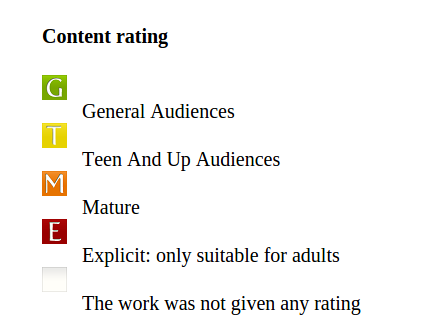 There are four countent ratings: G, T, M, and E. If you’re more familiar with AO3 than I am, please correct me if I’m wrong, but it seems that the equivalent MPAA ratings are as follows:
- G: General Audiences.
- T: PG and PG-13.
- M: Restricted.
- E: NC-17.
Of course, it’s virtually impossible to avoid some degree of subjectivity with these sorts of things. What is the threshold between a T and an M? I’m not sure, but I think it lies somewhere between an implied sex scene and one that describes the actual act, or violence that advances thea plot versus violence that IS the plot. There’s also the threshold between an M and an E, but I’m less concerned about that because my books don’t tend to be that extreme.
The key part of the AO3 system, which also removes a great deal of ambiguity, is the content warnings:
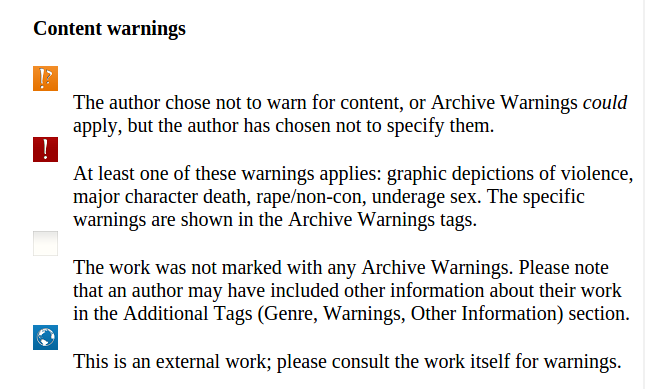 The key part here is the ! tag, since the last two obviously don’t apply and the ?! tag is too purposefully ambiguous to be useful. The ! tag very clearly states that one of the following things will be true:
- A major character will die, OR
- The descriptions of violence will be graphic, OR
- There will be rape or non-consensual sex, OR
- The sex will involve minors.
In other words, the ! tag indicates a trigger warning. A book rated T, for example, may have some non-triggering crude or obscene language, but a book rated T! is going to have something that would trigger, say, a rape victim, or a victim of child abuse. Obviously, some readers won’t be triggered as much as others, but adding a warning tag makes it easier for readers to use their own discretion.
Again, correct me if I’m wrong, but I think that this is the best way to adapt the AO3 system. Towards that end, I’ve added a rating to all of my books, so that if you’re familiar with the AO3 content rating system, you should be able to tell pretty easily where each of my books rate. Unless something drastic changes, I expect to use this system to rate all my books in the future.
Why I stopped watching House of Cards
 I started watching House of Cards a couple of weeks ago, and really got into it for a while. As longtime readers of this blog will remember, I spent a semester in DC at a high-powered K street internship, and was thoroughly disgusted by what I found there. House of Cards is all about the sleazy back-room political machinations of scrupulously ambitious people, so it gave me a lot of satisfaction to watch them all screw with each other.
Kevin Spacey’s performance in particular is absolutely fantastic. Periodically throughout the show, he breaks the fourth wall and turns toward the camera to give a monologue about the nature of political power. It’s such a characteristic part of the show that they spoofed it at the 2013 Grammys.
By the start of the third season, though, I started to have some misgivings. At various points in the show, I asked myself who my favorite character was, as a way of analyzing the writing. In the first season, I had several favorites. In the second season, those characters either died or did things that made me hate them. By the start of the third season, I didn’t like any of the characters—I only hated them in varying degrees.
The only potential exception to that was Senator Mendoza, the main antagonist of the third season who sets himself up as the Republican nominee for president. While all of the main characters consider him an asshole, that’s mostly because he doesn’t honor any of the back-room deals and secret combinations that they do. But since the story was setting him up to go head-to-head with Frank Underwood, I could tell early on that things wouldn’t end well for him.
The main reason I stopped watching, though, was because of all the gratuitous sex. Don’t get me wrong—I’m not one of those people who throws a book across the room the moment sex is acknowledged as part of the human experience. I’ve read and enjoyed (and even written) plenty of books where sex is an important part of the story. But when it becomes gratuitous—in other words, when it no longer serves the story—that’s when I get tired of it.
In order to do sex well, I think it needs to 1) convey an important facet of someone’s character (for example, Kirk in Star Trek), 2) serve an important plot point, or 3) impact the character arc in some important way. If the story can hold together just fine without the sex, then the sex is actually a sign of weak writing. Throwing it in just to titilate or hook the audience is like using adverbs to convey emotion: if the writing was strong enough to begin with, you wouldn’t have to do that.
So without getting into spoilers, that’s why I checked out of House of Cards. I hated all the characters, the writing was getting weaker, and the sex was too gratuitous.
Starliner by David Drake
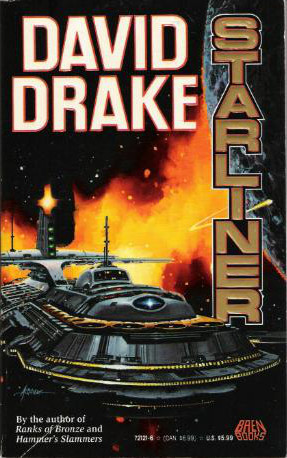 Welcome to the Empress of Earth, the finest luxury liner in all of settled space. Whether you’re alien or human, first class or economy, there is a place on the ship for you. Just watch out for those Grantholmers and Nevassans–those planets are about to go to war, but don’t worry, the Empress is strictly neutral territory. The envoys from Earth will see to that. And as for the rumors that one of those sides might try to hijack the ship, I’m sure the crew is capable enough to deal with such threats. Even if they are unarmed…
I saw this book on my also-boughts on Amazon, so I decided to pick it up. It was an enjoyable read. David Drake is very good at showing competent characters dealing with all sorts of complicated problems, operating within a strict chain of command while sometimes bending the rules a bit to get the job done.
The book is really a series of small vignettes, all tied together through the main viewpoint character, Ran Colville. There is an overarching storyline about the Empress’s role as a coveted pawn in a larger interstellar war, but that only really drives the story at the very end. Really, it’s more of a slice-of-life story about the crew of the ship, punctuated by all of the strange and exotic stops along the way–and boy, are there plenty of those!
Even though the Empress is neutral, she’s a potentially valuable military asset that both sides in the Grantholm-Nevassan war want to capture. To complicate matters further, some of the passengers are dignitaries from either side. At one point, there’s a romance between the peacenik daughter of a Nevassan diplomat and the son of a Grantholmer nobleman who is honor-bound to fight in the war. That subplot was a lot of fun.
As you can imagine, there’s plenty of violence. And really, what would you expect from one of the world’s best military science fiction writers? Drake does a really good job showing the adrenaline-soaked excitement of combat, as well as all the ugliness. Even the mooks get a viewpoint from time to time, and when they die, it’s messy and traumatic. For that reason, the violence feels very realistic, especially in how it affects the main characters.
Ran is something of a player, so there is a fair amount of explicit sex (including a bit of inter-species action). Drake doesn’t mince words or shy away from the gritty details–he puts it all on the page as matter-of-factly as any other aspect of life. The sex was brief enough that it didn’t really bother me that much, but Ran’s relationship toward one of his coworkers takes a turn at the end that seemed to come completely out of left-field. I could understand why, for the purposes of the story, it had to happen, but the way it was handled I just didn’t buy it.
That was probably my biggest gripe. If I had another, it would be that the story seems to meander a bit in the first two-thirds, but the world-building was interesting enough that it didn’t really bother me. Overall, it was a fun, light read (well, light for military sf). The ebook version is free on Amazon, so it’s definitely worth picking up. If you haven’t read any David Drake yet, this isn’t a bad place to start.