The Madness Season by C. S. Friedman

In the 21st century, Earth was conquered by an alien collective consciousness known as the Tyr.  Now, five hundred years later, humankind has been scattered across the Tyr-occupied worlds as slaves.  It is a dark and uncertain existence, under the rule of masters who do not care whether their charges live or die.

For the last five hundred years, Daetrin has been a survivor.  An anomaly among humans–a man with the power to live indefinitely–Daetrin is used to keeping his true nature hidden.  But when the Tyr learn of his strange abilities and take him away for further study, he finds himself on the run, out in the open.

In order to survive, however, he must face his greatest fear–the fear that he isn’t entirely human.

This book was interesting.  C. S. Friedman’s prose is quite good, and her main character has a very unique and engaging voice.  For some reason, she wrote all of Daetrin’s stuff in first person, while the other characters in third person.  I think that the main reason for this was to preserve the sense of surprise and horror when he made certain discoveries while at the same time revealing certain critical aspects of her world that the reader absolutely needed to know in order for the story to make sense.  It didn’t bother me–in fact, I think she did it quite well–but it might not work for you.

In terms of story, this book was interesting but a little confusing.  It lagged at times, especially towards the beginning, and towards the end so many things came together at once that it was difficult for me to keep track of them.  I’m not entirely sure why that was, but I think it’s related to the fact that I never felt a very clear sense of progression.  Plotwise, things happened, but I didn’t see how one led necessarily to the next, or where things were going overall.

That said, the ending was satisfying, and I enjoyed reading this book.  You don’t realize it until the end, but the whole book is basically Friedman’s sf take on a certain type of well known, very popular mythical monster.  I won’t spoil the book by telling you which one, but when I saw it, it made me smile.

In terms of science fiction, there are a lot of old tropes with very few new ideas, except for the shapeshifting alien species known as the Marra.  Their culture was interesting, and I thought Friedman did a very good job conveying both the familiarity and the alien-ness of that species.  The Tyr weren’t quite as interesting, because they were basically just the Borg with scales and spikes, but the Hraas and the Tekk (who are a type of human) were also well done.

This is definitely the kind of book you’d want to sit down and read, rather than take everywhere with you and read whenever you get a spare moment.  Without sitting down and dedicating some time to it, it’s very difficult to really get into the story or feel immersed in the world.  I made that mistake, and it took me nearly a month to finish it.  That said, it was a good book; I’ll definitely be reading some Friedman again.

Dying of the Light by George R. R. Martin

Worlorn is a planet without a sun, wandering on the fringes of the galaxy where the skies are starless.  Though it came to life briefly as it passed the red giant Fat Satan, those days are over, and the world is slowly dying.

Dirk T’Larien never thought he would find himself on such a forsaken world. But when his onetime lover, Gwen Delvano, sends him a plea for help, he realizes that more than anything, he wants to have her back.

It will not be easy, however.  Gwen is betheyn to two men: Jaantony Vikary, whom she loves, and Garse Janacek, whom she hates.  Both are from Kavalar, a warlike planet where offworlders are considered subhuman.  And even though Worlorn is slowly dying, a colony of extremist Kavalars has taken root, planning to bring back the old ways when offworlders were hunted like beasts.

I picked up this book at Pioneer Books a couple weeks ago; I saw that it was by George R. R. Martin and decided to give it a try.  I was very much impressed.  For the last hundred pages, I couldn’t put it down, and the story haunted me for a couple days after I’d finished it.

The strongest element of the story was definitely the setting.  The story may be set in a grand galactic empire with spaceships and alien worlds, but make no mistake, this beautiful piece of space opera reads more like fantasy than science fiction.  There’s even a thirty page glossary of terms in the back, for ease of reference.

The effect of Martin’s grandiose worldbuilding is a haunting sense of wonder that keeps you, as the reader, hooked.  The more you read, the more you immerse yourself in the world; and the more you immerse yourself, the more you want to read.  After the story ends, you still find yourself thinking about the fantastic worlds, as if you’ve actually been there.  It’s awesome.

Another thing that kept me hooked was the basic premise of the plot.  The main character, Dirk T’Larien, is trying to win back the affection of an ex-girlfriend and get back together.  That’s something with which I can definitely relate–the ex even has the same name (roughly) as a girl I once chased after (quite unrequitedly, may I add).  Because of this, I was drawn into the story right away.

Martin is known for his plot twists, however, and though the story began as a basic love triangle, it very quickly became… something else.  I’m not entirely sure how to describe it without giving major spoilers, but I will say that I found it impossible to predict how this story would end.  I found that a lot more annoying than enjoyable, however–just when I thought things were headed in a certain direction, something happened to nullify everyone’s efforts and turn things completely around.

Despite this, however, the story…worked.  I don’t know quite how to describe it.  The basic markers were all there, even though they were jumbled in unpredictable patterns.  No death was meaningless, no success was insignificant; there was no excess baggage in the story that didn’t somehow belong.

All around, it was a very good book.  Kind of dark, but not nearly as edgy as I was expecting.  This is definitely the kind of science fiction that a fantasy reader would go for–and probably most science fiction readers as well.

Old story notebook, part 3

Alright, it’s time to finish up with the old story notebook I discovered a couple of weeks ago.  These ideas were written down back in 2007, when I was writing the first draft of Ashes of the Starry Sea. Without further ado:

In the future, people live in arcologies, and wars are fought outside by robots. It will be a new system of feudalism: arcologies are like castles or walled towns, and people won’t die in the wars, just change sides.

I’m not sure I knew very much about feudalism as an economic system back then, but the basic idea, I think, was that life would be localized in the arcologies and nationalism as a unifying principle would die out.

In the Middle Ages, warfare was basically a contest between nobles, and though it certainly disrupted the lives of the peasants, they didn’t really care which side they were on because it didn’t make a difference. Napoleon revolutionized the world because he galvanized the peasants through the new concept of nationalism and made them actually care about the outcome of the wars.

An AI falls in love with a CS major, but the CS major loves a real girl.

The Little Mermaid, with a modern twist. And the mermaid AI commits suicide by uploading herself to a trashy old computer that’s on the verge of crashing. The final scene shows the wrecked computer somewhere in rural China, being scrapped for the metal parts in a vat of toxic chemicals. Awesome.

A character who’s an android and sees the world in terms of numbers.

The story should revolve around the question: if math is a language, how do you say “I love you” in numbers?

An election where people can scientifically predict best and worst case scenarios, based on each candidate’s qualities and the world situation.

Political science may not be a hard science, but it is awesome for science fiction.

Voter preferences are normally distributed around a common mean, but parties choose opposing points of view because of an information shortfall about the nature of that mean. What if the information problem were solved?

We would have exactly two parties that are identical in every meaningful way…wait a minute…

Someone discovers a language that is intuitive in all humans and overcomes many barriers of language in describing the world.

Linguistics is good for sf&f, too.

What if galaxies themselves were sentient?

Sounds like something out of a Robert Charles Wilson novel. I love it!

A space colony that, due to information technology, is a pure democracy.

I’m using this idea right now in Mercenary Savior. When I first started planning the novel, I wanted to do a story about the Mongols in space, but I knew it would need more than that, so I thought “what if one of the places they invaded was this pure democracy?” As soon as I combined the two ideas, BAM! I had a story.

An advanced society without public education or health care.

Uggggh, don’t even want to go there. Not until Obama’s out of office.

The Mormon pioneer exodus in space.

I tried to use this idea with Hero in Exile, but for some reason it didn’t work. It was as if the story wanted to go in a completely different direction. Oh well–you win some, you lose some. Besides, it’s not a total loss; it’s always possible to recycle.

A kingdom that will be cursed if ruled by anyone other than a direct heir. What if the direct heir is a child?

An attempt to brainstorm some fantasy.

Robot prostitutes–one who has no feeling or emotion, but develops artificial intelligence. This is what will fuel the development of androids.

Sad, but true.

A spaceship so massive that it generates tides when it enters orbit.

Sounds like something out of Arthur C. Clarke.

A tomagachi becomes sentient and uploads itself to the internet. OR…an AI disguises itself as a tomagachi.

Tomagachis! Whatever happened to them? They were so trendy…for like six months in the 90s.

What if our most deeply held beliefs had the power, under the right circumstances, to turn into monsters–real, literal, fantastic beings of awesome power?

Now there’s an idea with some interesting potential. We could build battle arenas and watch our beliefs duke it out, literally. Which ones would win?

A society that values myths more than facts.

I’m sure that societies like this have actually existed–or may still exist today.

American suicide bombers.

Hey! It could happen.

Ghosts on a spaceship.

Nowhere to run, nowhere to hide…

A culture where kissing (or any other public display of romantic affection) initiates marriage.

Now THIS I would like to see, or maybe even use someday. It could be interesting.

And that concludes the old story notebook, bringing us to the end of 2008 when I finished Ashes of the Starry Sea and left for the 2008 BYU Jordan study abroad.

How Avatar should have ended

Before I came out to Washington DC, I saw Avatar in the theaters.  AWESOME movie.  Loved the concept, loved the characters, LOVED the science fiction elements and how well they were woven into the story.

However, like much of the stuff that comes out of Hollywood, I was disappointed with the ending.  It felt too cheap–kind of like Matrix: Revolutions.

ONCE AND FUTURE SPOILER WARNING!  MAJOR SPOILERS AHEAD!

The ending of the story didn’t really solve the initial problem–it only put off the inevitable defeat of the good guys.  Do you REALLY think that the corporations of Earth are going to let a band of primitive aliens keep them from exploiting the natural resources of Pandora?  No way–they’ll be back, and with much bigger guns than before.  The ending solves nothing.

What they should have done was created an interstellar authority that the corporation needed to answer to–a weak, toothless one, at least initially, but one that becomes more important as the movie progresses.  This is because the real bad guy was the CEO, not the colonel–the colonel always answered back to the guy running the company.  HE was the one who made all the real decisions for the bad guys.

Things started to get cheesy once the rogue pilot sprung Jake, Norm, and Dr. Grace from the holding cell.  She should have hidden the trailer for the outpost, then sprung them out, since the only place they would go after leaving the base was the remote outpost. Where else could they go to access the avatars?

Moreover, Jake and his allies wouldn’t want to hide the trailer near the alien holy place.  That’s one of the last places they’d want to go–the aliens would just kill them, after the destruction of the mother tree.

Capturing the red and yellow dragon bird was a good way to get the legitimacy Jake needed to lead the aliens, but would the young prince really cave in so easily? I think not–especially after Jake stole his betrothed.

And summoning all the other alien tribes from across the planet? This was when I thought things had gone too far–no way was a coalition of bow and arrow wielding blue people take down the human armada.

This is where the interstellar authority comes in.  Without any oversight, the corporation can do whatever it wants.  Even if the aliens drive them off the planet, they or someone else will just come back.  Instead, the authority should have played the key role in defeating the evil corporate bad guys.

The scientists working for the corporation should have been in connection with scientists back at Earth from the very beginning.  Once the corporation pulled the plug on the science operation, it would have created discontent back home–only among the scientific elite at first, but as knowledge of Pandoran biology and its secrets begins to spread, public sympathy for the alien’s cause would grow–and with it, political capital that the scientists could leverage to stop the corporation.

Knowing this, the CEO would do everything in his power to keep the alien sympathizers from sharing their full discoveries with the scientists back on Earth.  To counter this, the good guys would have to either use their spy or covertly break into the facility to transmit the information to the people who can leverage it.

This sets up a “time bomb,” so that the goal of the good guys is no longer to defeat the bad guys in one last spectacular battle (which, let’s face it, they never could have realistically won), but instead to hold out until the cavalry arrives to save them.

There’d be a show down with the colonel, and a big epic battle to save the holy place, but the REAL victory would come when the interstellar authority comes in, arrests the CEO and his staff, freezes their operations, and slaps a whole host of regulations on the corporation, effectively saving Pandora–FOR GOOD.

That’s the way I think it should have ended.  I look forward to seeing how the guys at How It Should Have Ended.com handle it.

In the meantime, check out their take on Twilight:

I agree 110%!

The Dispossessed by Ursula K. Le Guin

Urras and Annares, a world and its moon, separated by the gulf of space and two hundred years of mutual contempt.  On Urras, capitalist and socialist nations vie for dominance over the world’s rich and abundant resources.  On  Annares, the anarchist exiles scrounge for a meager living, but live in peace–and in hope.

Shevek has never known any other world than the anarchist utopia of Annares.  His life’s work is to develop a unified theory of simultaneity–a tremendous feat that will rework the paradigm of space travel and communication.  When the people of Annares reject his theory, however, he voyages to Urras in the hopes that by offering his theory as a gift to all nations, he can bridge the gap between the worlds.

Hopelessly inexperienced in the cutthroat ways of the propertarians, Shevek has no idea what he is getting himself into.  In his gilded prison, with nations vying for control of his person, can he find allies who share his idealistic, utopian vision?  Or is he alone in a world of greed, lies, and murder?

This is, quite possibly, one of the most impressive and beautiful works of literary science fiction that I have read.  It may be the best novel I’ve read all year.  Le Guin’s characters are so deep, her ideas so compelling, her worlds so rich, her writing so poetic and beautiful that I hardly know where to start.

One of the many things that made this book so good was the depth of Le Guin’s character development.  The story had a plot, and Le Guin dropped just enough pieces of it here and there for you to know that there was one, but more than anything this book is a portrait of an incredibly interesting man, Shevek.

The book actually contains two stories that merge into one in the end.  One taking place in the present, after Shevek arrives at Urras, and the other is a series of flashbacks showing how he arrived at that point.  Le Guin alternates brilliantly between past and present to reveal insights into Shevek’s character that would otherwise remain unexplored.  By the end of this novel, I felt that I knew this man–and loved him–better than anyone in real life, including myself.  It blew me away.

Le Guin’s worldbuilding, too is incredible.  Before reading this book, I didn’t consider myself an anarchist, but after spending so much time in the utopian society of Anarres, I almost want to become one.  Le Guin meticulously extrapolates her world from her highly perceptive understanding of human nature, paying such attention to detail that her anarchist world is not only surprisingly plausible, but enviable as well.  This is the kind of world that I would like to visit, explore, and perhaps even settle down in and live.

Her ideas, like her world, are meticulously well thought out and incredibly compelling.  In the Hainish cycle, Shevek is the inventor of the ansible drive, the technology that eventually enables peaceable diplomatic missions to other worlds, such as the one chronicled in The Left Hand of Darkness. Shevek’s struggle is to find a way to let this technology bring peace and break down walls, rather than empower tyrants to conquer and destroy.  Time and again, Shevek’s egalitarian, anarchist values come to the surface, clashing not only with those of capitalist Urras, but with our own.

All of this would be enough to make this a compelling, memorable story–but Le Guin’s stunning, beautiful prose puts this book into a league of its own.  The rhythm and beauty in her words made every page a joy to read, with descriptions that kept me entranced and dialogue that made her characters leap off of the page.  Above all, her prose conveys with powerful and compelling clarity the many life-changing ideas and themes of this story.  The book’s last words still haunt me.

The Dispossed is, without a doubt, is one of the best works of Science Fiction that I have read.  I would even go so far as to claim that it is a superior book to Le Guin’s better known work, The Left Hand of Darkness. If I could read a book this insightful every month, I would be a much better man, and have a much deeper and imaginative understanding of the world than I presently have.  This book is a true masterpiece.

A Canticle for Leibowitz by Walter M. Miller, Jr.

It was said that God, in order to test mankind which had become swelled with pride as in the time of Noah, had commanded the wise men of that age, among them the Blessed Leibowitz, to devise great engines of war such as had never before been upon the Earth, weapons of such might that they contained the very fires of Hell, and that God had suffered these Magi to place the weapons in the hands of princes, and to say to each prince: ‘Only because thine enemies have such a thing have we devised this for thee, in order that they may know that thou hast it also, and fear to strike.’

But the princes, putting the words of their wise men to naught, thought each to himself: ‘If I but strike quickly enough, and in secret, I shall destroy those others in their sleep, and there shall be none to fight back; the earth shall be mine.’

Such was the folly of princes, and there followed the Flame Deluge…

In the new dark ages of man following the nuclear apocalypse, an order of Catholic monks preserves the last vestiges of civilization: a shopping list, an electrical diagram, and other assorted scraps of a long-dead world.  As mankind rises from the dust, inevitable tensions arise between the church and the world, between Jerusalem and Babylon, Christ and Lucifer.

This book is epic.  Epic. I can’t begin to describe how incredible it is.  Virtually every page, especially towards the end, is packed with meaning.  A cautionary tale of the folly of man in this fallen world, this story held me captivated right up to the chilling final chapter.  Bravo.

As I understand it, Walter M. Miller Jr. wrote this book in the late 50s / early 60s, during the height of the Cold War.  Science fiction at that time was both sweepingly visionary and frighteningly pessimistic about the future of mankind, and this book successfully captures both extremes.  Like Asimov’s Foundation series, it reads more like a collection of elongated short stories, but Miller’s characterization and attention to detail is superior, in my opinion, to Asimov’s.

The most fascinating aspect about this book is the way that Miller hearkens to the past to give us a vision of our future.  Many of his ideas are straight out of Augustine and Aquinas–indeed, in several places, the story feels like it’s set in 3rd or 4th century Europe, which only adds to the delicious irony.

Yet, while this book has a strong Catholic feel, I never felt alienated or excluded from its intended audience.  Maybe it’s because my Mormon heritage is more compatible with Catholicism than other religious beliefs, but I don’t think it’s just that; the issues in this book are human issues, not just religious issues, and by focusing on that fact, Miller makes the story much more universal.

Even with all the deep, philosophical elements, this story is wonderfully entertaining.  Irony abounds, especially in the first section, in which a young novice takes a simple electrical diagram from the pre-deluge world and, completely unaware of its significance (or lack thereof), spends the rest of his life making a beautiful illuminated manuscript of it.  Even though the sections were  short, I quickly fell in love with the characters in each one, and connected with them almost instantly.

The final scene, in particular, was incredibly touching.  I won’t spoil it for you, but let me just say, if you are or ever have considered taking your own life, read this book, just for the final scene.   The degree to which the last abbot clings to life, even in the face of so many good reasons to give up, is just incredible.  And the final scene, in which…I won’t ruin it for you.  Just read it!

A Canticle for Leibowitz is one of the most powerful, meaningful books I have read in my life.  It is more than a good read, more than epic.  I class it as one of the best works of fiction this genre has ever produced.  If you have ever wondered about the destiny of mankind, or the proper relationship between the secular and the spiritual in our modern age–read this book!

Why I love Robert Charles Wilson

From Mysterium, which I plan to review here soon:

“Do you ever wonder, Howard, about the questions we can’t ask?
“Can’t answer, you mean?
“No. Can’t ask.
“I don’t understand.”
Stern leaned back in his deck chair and folded his hands over his gaunt, ascetic frame. His glasses were opaque in the porch light. The crickets seemed suddenly loud.
“Think about a dog,” he said. “Think about your dog–what’s his name?”
“Albert.”
“Yes. Think about Albert. He’s a healthy dog, is he not?”
“Yes.”
“Intelligent?”
“Sure.”
“He functions in every way normally, then, within the parameters of dogness. He’s an exemplar of his species. And he has the ability to learn, yes? He can do tricks? Learn from his experience? And he’s awarer of his surroundings; he can distinguish between you and your mother, for instance? H’es not unconscious or impaired?”
“Right.”
“But despite all that, there’s a limit on his understanding. Obviously so. If we talk about gravitons or Fourier transforms, he can’t follow the conversation. We’re speaking a language he doesn’t know and cannot know. The concepts can’t be translated; his mental universe simply won’t contain them.”
“Granted,” Howard said. “Am I missing the point?”
“We’re sitting here,” Stern said, “asking spectacular questions, you and I. About the universe and how it began. About everything that exists. And if we can ask a question, probably, sooner or later, we can answer it. So we assume there’s no limit to knowledge. But maybe your dog makes the same mistake! He doesn’t know what lies beyond the neighborhood, but if he found himself in a strange place he would approach it with the tools of comprehension available to him, and soon he would understand it–dog-fashion, by sight and smell and so on. There are no limits to his comprehensions, Howard, except the limits he does not and cannot ever experience.
“So how different are we? We’re mammals within the same broad compass of evolution, after all. Our forebrains are bigger, but the difference amounts to a few ounces. We can ask many, many more questions than your dog. And we can answer them. But if there are real limits on our comprehension, they would be as invisible to us as they are to Albert. So: Is there anything in the universe we simply cannot know? Is there a question we can’t ask? And would we ever encounter some hint of it, some intimation of the mystery? Or is it permanently beyond our grasp?”

This is the kind of science fiction that I love: the kind that brings me right up to the limits of human knowledge and makes me feel naked in the face of the unknown. The kind where the aliens truly feel alien, not like an unusually bizarre race of human beings. I want the aliens to surprise me–I want to feel that there’s something about them that is completely beyond my comprehension. Something sublime, something romantic.

In all of his books that I’ve read, Robert Charles Wilson captures this feeling spectacularly. So does Arthur C. Clarke, C. J. Cherryh, and Orson Scott Card. Larry Niven, Jerry Pournelle, John Scalzi and Alastair Reynolds are excellent writers, and I’ve genuinely enjoyed their books, but their aliens are too…understandable. Too clear cut, too defined. After a while, you don’t feel that there’s anything left to surprise you, anything that is so alien it’s beyond your grasp.

In some ways, I think this boils down to the author’s worldview. Those with a more positivist worldview believe that the world is fundamentally understandable, and that every phenomenon can be modeled and predicted, provided that we have a sophisticated enough understanding of natural law. The interpretivist worldview, on the other hand, posits that while truth may exist, there are limits to our understanding–that some things are inherently unpredictable and impossible to model.

I used to think that I was a positivist. Then I took Poli Sci 310 with Goodliffe, and it turned my world upside down. Genesis Earth is, in some ways, a product of that personal worldview shift. I don’t think I’m anywhere near on par with my aliens as Wilson, Clarke, and Card are with theirs, but I hope I’m on my way.

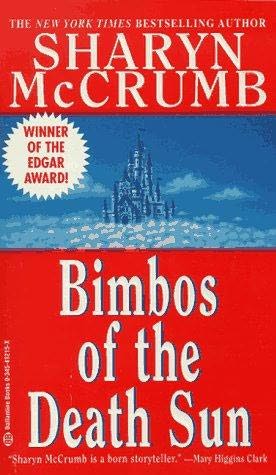
Bimbos of the Death Sun by Sharyn McCrumb

It’s that time of year! Elves, Klingons, slave women, gamers, computer geeks, aspiring writers, and superfans are converging on Rubicon, the annual science fiction convention. Mild mannered citizens beware!

Newest among the motley crew is Jay Omega, a young, local computer professor and first-time author on a mission: make sure that nobody he knows in real life finds out that he is the author of Bimbos of the Death Sun. Fortunately, his friend and secret lover (but only a secret to him), Marion, is there to promote his book and keep him from getting hopelessly lost.

But then, Appin Dungannon, famous author of the prolific adventure series of Tratyn Runewind, is found dead in his hotel suite.  Who could possibly want him dead?  Turns out, just about everyone: Appin is also famous for hating the series more than any other person on the planet, and for treating his fans like slime.

As the convention threatens to fall apart, Jay takes on the case and tries to answer: who killed Dungannon, and why? In a world where fantasy has more power than fact, however, the answer is stranger than anyone in theiTr right mind would expect.

This book was hilarious. Sharyn McCrumb explores science fiction and fantasy fandom the way a drunk anthropologist would explore an aboriginal jungle tribe. Even though her characters are all shallow caricatures of the real thing, their clumsy interactions turn the story into a wonderful farce that is as entertaining as it is educational.

There were only a couple of parts that bothered me. At one point, McCrumb gets into the head of an overweight, hopelessly ugly fangirl cosplayer and shows her thought process as she pursues a romantic relationship with an equally ugly and socially incompetent fanboy. I didn’t feel that McCrumb authentically portrayed the character’s own thoughts–it sounded more like a person from the outside giving their take on the experience. Then again, McCrumb was going for humor, not true character depth.

Besides that, this book is definitely dated. The computer technology in the novel is ridiculously primitive, on par with the Commodore 64, the Tandy 400, and the trusty old 386. In other ways, too, this book is solidly 80s–any science fiction convention nowadays would probably have less Trekkies and more Anime cosplayers. However, the dated aspects only make the novel more endearing, in my opinion. Who wouldn’t be nostalgic for the good old days of the 386?

This book isn’t high literature, and Sharyn McCrumb would probably be the first to admit it. It was, however, wonderfully entertaining, one of those rare and beautiful books that made me laugh out loud, heartily. For someone like me who is just starting to become involved in science fiction and fantasy fandom, it was a hilarios and helpful primer to this fascinating subculture. As McCrumb states in her foreward:

Science fiction writers build castles in the air; the fans move into them; and the publishers collect the rent. It’s a nice place to visit, but please don’t try to live there.

That said, I find it telling that it was people in fandom who recommended this book to me. Good to know that at least a few of us don’t take ourselves too seriously.

Spin by Robert Charles Wilson

What would you do if you knew that the world was going to end in the next thirty years? That one day, before the end of your natural lifespan, the oceans will boil and the forests burst into flames, and life on this planet will come to an end? That you, your children, and even humanity itself have no future–that everything will end with you?

When the mysterious beings known as the Hypotheticals encase Earth in a temporal warp field that causes years to pass outside for every second on Earth, that is the uncomfortable question that all of mankind must confront. In five billion years–less than forty years on Earth–the sun will burn up its hydrogen and expand into a red giant star. When that happens, the sun will swallow the Earth and every living thing will die.

Some people turn to religion for answers.  Some turn to Science.  Some put off the question, living their lives as if the end will not come.  But as the years pass and the unavoidable apocalypse looms nearer, humanity begins to spiral out of control, and civilization itself looms on the verge of collapse.

The year the stars fell from the sky, thirteen year old Tyler Dupree discovers that he is in love with his best friend (Jason Lawton)’s sister, Diane.  The dynamics of the friendship between the three, however, make it impossible for Tyler to express his true feelings–and, in any case, Diane doesn’t seem interested in being anything more than a friend.

When the Spin hits, all three of them find themselves on radically different and sometimes conflicting paths.  Diane turns to evangelical Christianity and the frenzied religious outporing the Spin inspires.  Through his father, Jason rises to become one of the most influential scientists and directors in the Perihelion Foundation, the premier aerospace agency and Spin-related policy forming body in the US.  

Tyler, however, pursues the same middle class life he probably would have followed anyway–medical school, followed by a career as a doctor.  Still, his undiminished feelings for Diane and his frienship with Jason draw him into the center of the Spin hysteria and behind the scenes in the circuitous Spin-era politics.

Diane, now married to a fervent believer in a free love fundamentalist cult, comes to rely on Tyler as her only link to the outside world.  Meanwhile, Jason Lawton pursues perhaps the most grandiose and ambitious project mankind has ever attempted; the terraformation of Mars. 

With the temporal distortion of the Spin, millions of years of evolution turn Mars into a verdant green world in only one Earth year.  When Jason launches the first manned mission to the planet, barely a week passes before the the first Martian-born human returns to mankinds ancestral home–a descendant of a civilization millenia older than our own.  This small, dark-skinned, wrinkled man comes with a tantalizing message that may prove the key to finally understanding the Hypotheticals and the Spin itself.

But all of this may be too late, because the Spin membrane is finally beginning to show distressing signs of failure, and the sun has already grown hot enough to boil the oceans and scorch the planet.

I loved this book.  Honestly, I have to say it is one of the best science fiction books I have ever read.  Better even than Ender’s Game, better even than Foundation or any of the other classics.  No other book that I’ve read has done everything that I believe a good science fiction book should do.  I would highly recommend this book to anyone and everyone.

Like Clarke and a lot of the older classics in the science fiction tradition, Spin addresses some of the grand questions with which science and humanity have always wrestled.  What is the ultimate end of mankind?  The ultimate end of evolution?  Are we unique in this universe?  What is our place in the cosmos?  What is transcendence, and can we as a mortal species achieve it?

Unlike much of the older works, however, Spin addresses these questions through solid, developed, rich characters and a human drama that is as engaging as anything in any other genre.  When I read this book, I felt connected with these characters.  I genuinely cared about them.  They were real, distinct people who changed and grew based on their choices and experiences.  Furthermore, their struggles and conflicts echoed my own.  It felt true.  Tyler’s unrequited love was not only utterly believable, it kept me just as engaged as the grand ideas and the science fiction elements.

As science fiction, the ideas in this book were some of the most original and eye-popping ideas I’ve ever seen.  There was definitely a sense of wonder, as thick and beautiful as Clarke or Heinlein or Asimov.  The thing that made these ideas so great, however, was the eminent believability that accompanied them.  Robert Charles Wilson thought out the implications of everything, and showed them through concrete, human details.  His Martian landscapes were as real and believable as his picture of the New England countryside.  I not only felt that I was there, I felt that I was in this world, where the end-of-everything panic had set in, causing all sorts of bizarre, almost post-apocalyptic (pre-apocalyptic?) social changes.  It was truly fascinating.

But it wasn’t just the storytelling that engaged me: Robert Charles Wilson’s prose is among some of the best that I’ve ever read.  Reading this book really was like eating cheesecake.  The writing not only flowed, it shined, yet in a way that illuminated the meaning behind the words rather than drawing attention to the words themselves.  Wilson’s metaphors were not only rich and beautiful, they expressed the meaning behind the text so clearly that in each case, I don’t think he could have gotten across that particular impression, that feeling, in any other way.  Everything was calculated, and I would read pages and pages of text without even realizing how far I’d come.  Incredible.

I did have one issue with my first readthrough, back in July of last year: the Martian civilization, while grand, didn’t feel grand enough.  I mean, in 0nly four thousand years of history, look how far we’ve come here on Earth–all of our religions, all of our science, all of our discoveries and everything else.  We can hardly even remember what it was like, four thousand years ago–yet in Spin, the Martians know all about the reasons why Earth spawned their civilization, all of the questions that the Earthers have been asking about the Hypotheticals, etc.  I almost think that the Martians would have a more mystical view of Earth; that their understanding of us would be steeped in legend, and that they would have forgotten who we really are.

In my second readthrough, however, this was less of an issue to me.  Wilson really does make the Martians seem alien, a separate, distinct culture with a long, rich tradition.  His Martian citizen is very distinct from any of the Earthers, and notices some very small things that we always take for granted.  So, even though there could be more of a feeling of grandeur, Wilson already paints a very believable, very grand view of the Martian civilization he invents.

I am not exaggerating one bit when I say that this is probably the best science fiction book I have ever read.  I would recommend it above and beyond anything else I’ve reviewed here on this website.  If you haven’t already, pick up this book and read it.

Getting into it

Three days into Bringing Stella Home 1.1 and I’m really getting into it.  I’ve reworked the first and second chapters a ton.  It’s coming along surprisingly well, considering I was just about ready to throw in the towel a month ago.

So far I’m over 12,000 words into the story, which shows up on the progress bar as 10% because I upped my estimated ending wordcount to 120k.  I’ve heard that 90k per novel is what you really should be shooting for in science fiction, but then again, some of my favorite sf novels are well over 90k.  Publishers make exceptions, I suppose–as long as the story and the writing is good.

I’ve been spending several hours writing every day, and I’ve noticed that I’m starting to produce more.  Despite the fact that I’ve been doing some fairly substantial revisions to this piece, I’m clocking in at around 5k or 6k every day.  Last week, I felt like I was stretching myself if I did more than 3k.  If I keep this up, maybe by the end of the spring term I’ll be doing 10k or 12k words every day.  Maybe.

That reminds me–I got an email back from the agency in  New York.  Turns out they haven’t yet chosen the person to fill their intern position…and they were wondering if I was in New York so I could interview with Joshua personally.  Well, I’m not in New York, but they told me that was okay and it wouldn’t hurt my chances at getting this thing.

So…maybe I will be going to New York. :p Who knows?  They told me they’d let me know one way or the other, and I haven’t heard back from them, so there is a chance that I’ll be catching a flight back east sometime next week.

The cool thing about this, though, is that whatever happens, it’s a win-win situation for me.  If I stay, I’ll go ahead with the plans I’ve already set, and have an awesome summer working on my writing.  If I go, I’ll have an awesome time in New York getting to know the publishing world a little better.  I can’t go wrong with either option–my happiness and satisfaction doesn’t depend on other people.  That’s the best position to be in.

One final thing: while rummaging around some old posts in my blog aggregator, I came across a link to Shannon Hale’s blog.  She’s a young YA writer with some impressive accomplishments (such as a Newberry award) and some even more awesome things to say about writing, reading, and literature.  One of the really cool things is this collection of essays on writing.  She’s got some advice in there that’s simultaneously sobering and encouraging, which is probably the best kind that’s out there.