How I hacked my ADHD to triple my daily word count

Writing with ADHD can be tough. It’s easy to beat yourself up for being “undisciplined” or “lazy” when the greater problem is that you’re trying to work against your ADHD instead of finding ways to make it work for you. It’s like swimming against a rip current instead of swimming sideways to get out of it.

In the last month, I’ve made a really fantastic breathrough that I think will change the way I write from here on out. So far, it’s helped me to double or even triple my usual word count. The novel I’ve been wrestling with for more than a year now—the longest one I’ve written since I started indie publishing—now looks like it will be finished in just a few of weeks, when I expected it to take a couple of months. Needless to say, I’m really excited.

What changed? I found a way to make my ADHD work for me, rather than against me.

In my previous post, A reading hack for the ADHD addled brain, I explained how I exploited my ADHD to read more books. Basically, I did the same thing, but for writing. There was a lot that had to happen first, though, and the biggest of those was that I had to learn how to make and keep an outline.

Step 1: Learn how to outline properly

For years, I just sort of assumed that I was a discovery writer, probably because of the ADHD. Most of creativity has to do with finding novel or unexpected ways to combine two or more ideas, and when you have ADHD, your brain naturally jumps from idea to idea. That was why I always hated taking meds when I was a kid: I felt that it stifled my creativity. And since most of this idea jumping happened subconsciously, I assumed that outlining would also kill that process.

But after a few years of struggling as an indie author, I realized that my writing process was too slow. In order to succeed, I needed to publish more frequently, but in order to do that, I needed to produce more content regularly. Back then, I would usually write a novel from start to finish, laying it aside for a month or two if I ran into a serious block, and also after finishing each draft. A typical novel would go through two or three revision drafts, so it would literally take years before a +70k word novel was ready to publish.

I decided that the best way to shorten my writing process was to “cycle” through the book, combining all the drafts so that I was working on revisions while simultaneously writing the rough draft. In order to keep track of all that, I needed to keep an outline. So I tried out a few different methods and tweaked them until I came up with a method that worked well for me.

The thought of outlining can scare a lot of writers who consider themselves “pantsers” or “discover writers,” but the thing to keep in mind is that there is no one right way to keep an outline. In fact, there are probably as many ways to outline as there are writers. For some, a couple of quick sketches on the back of a napkin is enough, while for others, it turns into a massive story bible that’s just as long (or longer) than the actual book. But without trying out a lot of different methods, you’ll never figure out what works for you.

It took me a couple of years, but I eventually developed a method that worked really well for me. With it, I was able to write Edenfall and The Stars of Redemption, as well as the last two Gunslinger books, in much less time than it took for my other ones. I was also able to combine all eight of the Star Wanderers novellas into a novel—something I probably wouldn’t have been able to do very well without a solid outline to keep it straight.

But I still would run into blocks that would occasionally derail the project, at least for a little while. I ran into that a lot with my current WIP, Children of the Starry Sea. Sometimes, they were genuine story problems that I needed to work through. More often than not, though, the problem was one of momentum: I was having too many bad writing days interspersed with the good writing days, so that each day felt like I was starting from zero. After a while, that becomes difficult to keep up.

Step 2: Allow yourself to write out of order

When I came back from my second hiatus to work on Children of the Starry Sea, it was clear that my new method wasn’t working as well as I needed it to work. Children of the Starry Sea is much longer than anything I’ve published so far, and I found that I just wasn’t producing enough new words consistently to make my “cycling” process of revisions work.

Around this time, I remembered something I’d heard on a recent convention panel, where one of the authors shared how he collaborated with another author. Instead of going back and forth, he told his cowriter: “how about you just write all the odd chapters, and I’ll write the even chapters, and when we’re both done we’ll combine it all together and see how it turns out.” To their surprise, it actually turned out really well.

So with that in mind, I decided to experiment with skipping around my current WIP, rather than writing it in order from start to finish. If I woke up and felt like I wanted to write an action scene, I would pick one of the action scenes out of my outline and write that. If I felt like I wanted to write the ending, I would skip ahead and write that. If I felt like I wanted to write the next scene, I would go back to where I’d left off and write that.

The outline was the key. Without it, there’s no way I’d be able to keep everything straight and know where each part is supposed to go. The outline also had the added benefit of dividing the novel up into smaller chunks, making the overall project much less intimidating. The way to eat an elephant is to take one bite at a time, just like the way to climb a mountain is to take one step at a time. Same thing with novels.

That’s all well and good, you may be thinking, but what happens when you’ve written all the stuff that you want to write, and all that’s left is the stuff you didn’t want to write? Isn’t that a bit like eating your dessert first, and leaving your vegetables for last? Not really, because chances are that if you really don’t want to write a particular scene, the reader probably won’t want to read it either. So if you can find a way to rework your story so that scene becomes unnecessary, you’re probably better off doing that.

But I actually haven’t had that problem yet. The thing about ADHD is that it actually feels right to jump around all over the place like that. Just because I don’t want to write a particular scene on one day doesn’t mean that I won’t want to come back to it sometime later. And more often than not, writing a later scene actually makes things fall into place with the earlier scenes, and makes me more excited to write them.

It’s as if the project itself is a puzzle. Can you imagine trying to put a puzzle together in linear order, starting from the top left corner and moving to the bottom right? That would be pure torture! Instead, you pick up whatever pieces catch your eye, and try to fit them in with other, similar pieces, until the puzzle itself begins to take shape.

There a lot of disadvantages to writing with ADHD, but there are some areas where the ADHD can actually become a strength, if you learn to work with it instead of against it. I’ve already mentioned how it can help with creativity, since your mind is always bouncing around between different ideas. What I’ve learned in the last month is that writing out of order is another great way to harness ADHD as a strength, since something that leaps out from writing one scene can often lead to a breakthrough in another. Writing out of order gives your ADHD brain the space it needs to make those intuitive leaps, and harnesses the “oh, shiny!” toward something productive, rather than driving you to procrastinate.

Step 3: Start in the middle, not the beginning

For me, the hardest part of writing is getting started. That’s probably my ADHD: it’s always easier to get distracted than it is to settle down and do what you’re supposed to do. Once I’ve settled down, though, and gotten into a groove, I can usually stick with a task until it’s done. In fact, once you’re in something of a flow state, the ADHD can actually make you hyperfocus.

So if the hardest part of writing is getting started, how do you turn that from a weakness into a strength? By leaving the next scene(s) unfinished, so that the next time you sit down to write, the scene has already been started and you just need to figure out the next word. One word leads to the next, and before you know it, you’re in the groove again.

By far, this has been the biggest part of my breakthrough: realizing that I don’t have to write every scene from start to finish in one sitting. In fact, it’s better if I don’t. Instead, I’ll typically finish one or two scenes in the morning, then pick out three to four scenes in the afternoon and write the first couple hundred words or so, deliberately leaving them unfinished so that I have a variety of scenes to choose from the next day.

If the hardest part of writing is getting started, then the hardest part of getting started is feeling overwhelmed at how much you have to do. But if all I have to do is write a couple hundred words, that’s easy! It also works with my ADHD instead of against it, since I get to jump from scene to scene instead of getting bogged down.

With the way that I used to write, most of my “writing blocks” had less to do with the actual writing and more to do with working myself up to write. Many times, I found that if I just sat down and opened up my WIP without thinking too much about it first, the writing would come a lot easier. Starting in the middle is a great way to harness that, because you aren’t confronted with a blank page the moment you sit down. It takes a lot less effort to find the next word than it does to find the first word.

So with where things stand right now, I just need to start four new scenes every day this week and I’ll have every remaining scene in my novel WIP started by Saturday. From there, if I can finish two or three scenes a day, I can easily finish the rough draft stage of this novel WIP before the end of February—which will be amazing, since I’m only at the 65% mark right now, and historically that’s always the part where I find it most difficult to write.

I’m really looking forward to writing a whole novel from start to finish using this method. As soon as Children of the Starry Sea is finished, I’ll start outlining the sequel, Return of of the Starborn Son, and write it the same way. If things go well with my current WIP, I’ll be very optimistic about finishing the next one before the end of the year—perhaps even before the end of the summer.

I do expect things to get crazy around here soon, though. Our second child is due in the early spring, which means enduring a month or two of chronic sleep deprivation. I’ve gotten to be pretty comfortable with writing at 4AM, but we’re also getting a lot more uninterrupted sleep than we were when Princess Hiccup was a newborn. I anticipate that we’ll have at least a month where nothing gets productively done.

So it will be really fantastic if I can finish Children of the Starry Sea NOW, before the baby comes—and not just the rough draft, but the revisions too. Fortunately, I don’t think I’ll have too much difficulty with the revisions. I’ve already cycled through the first half of the book a couple of times, and it’s working pretty well. Also, revisions come a lot easier to me than writing new words. I’m not sure why that’s true, but it is.

And for the record, I don’t advocate jumping around all over the place while doing revisions. It’s probably best to do that part in sequential order, if nothing else than to make sure that all the scenes and chapters flow properly. I haven’t gotten to that part of this writing method yet, so it will be interesting to see how it goes. So far, the stuff I’ve cycled through actually seems to flow pretty well, but I need to take it from the beginning to really be sure.

Toward a new writing technique

For the last year, I’ve been struggling to write this novel (Children of the Starry Sea, Book 2 of the Outworld Trilogy) according to my new novel writing method, which I’ve been developing since about 2017. The method involves creating a rigorous scene-by-scene outline and cycling through each scene multiple times, so that you basically revise the book as you go.

However, for a novel WIP the size of Children that doesn’t seem to work very well: either my mind is stuck in the revisions, or I’m so focused on producing new words that I don’t get around to revising, or (as happens most often) I’m so torn between both that I can never get in the right headspace, and my productivity suffers.

One of the things that happens is that I get hung up on a scene that I don’t really want to write. There are other parts of the story that appeal to me, but in order to get to them, I have to write that scene first… IF I’m writing the whole book in order from start to finish. So because I don’t want to write the next scene, I end up working on revisions for a while, which makes it harder to get back into the right headspace to write new stuff… you get the picture.

But the thing is, because I have such a rigorous scene-by-scene outline, I don’t actually need to write all the scenes in order. So lately, I’ve been picking and choosing which scene to write next, experimenting with writing the book out of order.

So far, it’s worked out pretty well. The outline gives me all of the plot points and character arcs that need to be worked out, so I can treat each scene as a sort of mini-story, which helps to eat the proverbial elephant. (How do you eat an elephant? One bite at a time.) Also, my ADHD-addled brain really loves the creative freedom of being able to pick and choose what to work on next, ignoring whether it has anything to do with what I wrote yesterday.

Of course, this means that the revisions will have to wait until all the holes in the narrative have been filled. I may be able to do it on a chapter-by-chapter basis, with the first revision happening once all the scenes in a chapter are done, and the next revision focused on fitting the chapters together, but I don’t know. It may just be better to put off the revisions altogether until the entire rough draft is complete.

Then again, there are advantages to cycling through the manuscript during the drafting process. It can help to identify plot and story problems as they emerge, which can help to remove writing blocks before they become really onerous. Also, it leaves me with a lot less work to get to the final version, once the initial manuscript is complete.

So here’s how I think I’m going to do it:

  • Prewriting: Develop a rigorous outline that includes a scene-by-scene map with all important plot points and character/relationship arcs.
  • Rough Draft: Pick and choose which scenes to write, focusing on hitting the plot/character/relationship points and making each scene cohesive.
  • First Revision: Fix all the points in the revision notes (such as things that need to be foreshadowed) and focus on making each chapter cohesive.
  • Second Revision: Fix any remaining revision notes and focus on overall story and chapter flow.
  • Final Revision: Focus on the sentence and paragraph level writing to cut the book’s word count by at least 10%.

So maybe I’ll do the first revision in-line with the rough draft, as each chapter comes together. Unless the book has major problems, the second revision should be pretty straightforward and not take longer than a week or two—besides, it should probably wait until the first draft is totally done, since that’s the time to work on overall story flow. And the final revision can go in-line with that.

I don’t know if any of that makes any sense to anyone but me. Thinking out loud does help to put my thoughts together, though I’m not sure how much it makes for good internet content. Still, I’m curious if anyone has any thoughts on the subject. Have you tried out something similar? Or does the very thought of writing like this feel like scraping nails on a chalkboard? Let me know! I’m curious to hear your take on it.

Plugging along with Gunslinger

Gunslinger to the Stars
Phase:3.0 Draft
100%

So I’ve passed the 50% mark on Gunslinger to the Stars, which is kind of pathetic because I was hoping to finish it by today. Regardless, it WILL be finished soon, and when it is, it’s going straight to the editor.

Right now, I’m shooting for a publication date of May 15th. Things are on track to put it up for pre-order by the end of February, except I probably won’t put it up on Amazon until a month before it comes out (Amazon nerfs pre-orders for indies). Regardless, I am REALLY excited.

I’ve also got a super rough book description. Seriously, it took maybe twenty minutes and definitely needs some work. But if you’ve been following Gunslinger’s progress and are curious to see it, here it is. Feedback is definitely appreciated.

The name’s Sam Kletchka. Perhaps you’ve heard of me: captain of the Star Runner, military contractor for Earthfleet and interstellar privateer. But before all that, I was a hired gun, freelancing across the galaxy one gunslinging job at a time.

Perhaps you’ve also heard about the incident in the Gorinal Star Cluster. There’s a lot of things that the powers that be, especially the Immortals, don’t want you know. I’m here to set that record straight. When the jumpgate went dark, I was there, along with Jane Carter, my better half, Tarak, my telepathic copilot, and the empath shapeshifters of the Silver Diadem.

It was a tough scrape, but fortunately, I brought some friends: LOVE, my 1911 9mm; KINDNESS, my 2011 .45 ACP; MERCY, my Ruger .22 Charger Rimfire; FAITHFULNESS, my .300 AAC Blackout; RIGHTEOUSNESS, my .50 Beowulf; JUDGMENT, my M203 grenade launcher, PRESERVATION, my Mossberg 590A1; and TRUST, my 15″ Chainpure Kukhri. But the greatest of these is CHARITY, my alien-modified AR-15.

If you never want to leave your safe space, then stay down there on Earth. As for the rest of us, we’ll be chasing our destiny among the stars.

Yeah, that’s definitely not going to be the final version.

It’s interesting just how much this book has changed through the last two revisions. The story hasn’t changed at all, but it’s shed more than 20% of the words in the revision process and I’m not even finished with the third draft. When I told my roommate that I wanted to cut out a good 10k words this draft, he thought I’d have to cut out a character or something. Yet that hasn’t been the case.

It’s amazing how much you can improve a story by cutting out all the unnecessary words. It’s the difference between a small shot of deliciously thick hot chocolate, and a large mug that is far too watered down. I thought I had the main character’s voice down, but it didn’t really shine until I started aggressively cutting.

That’s the thing about measuring progress by word count. Sometimes, it’s not about how much you can write, but how much you can cut out.

Between now and May, I’m going to write a short story from Jane Carter’s point of view. It’ll be something of a prequel, and hopefully showcase a bit of her character. I’d also really like to write a short story from Tarak’s POV, but that’s going to take a bit more thinking through.

Lots of interesting story stuff going on behind the scenes. I’ll do my best to keep you guys updated on the blog!

January update

I had hoped to write a big blog post detailing my goals and plans for the year, but January got off to a rocky start (food poisoning, the flu, massive back-to-back snowstorms, and sub-zero temperatures), and this week I’m working a temp job. The big New Year’s post will have to wait.

I do have plans, however, and they’re already in motion. The main thing for now is to finish the 3.0 draft of Gunslinger to the Stars. The story is pretty much ready to go, so now I’m doing a final draft to tighten it up. I’m hoping to get it down from 66k words to just under 50k. Should make for a rip-roaring adventure.

My original deadline for Gunslinger was the end of this week, but with the job eating up all my time, it looks like I’ll have to push that back to Wednesday. Fortunately, that’s still quite doable. Revision is a pain, but it goes a lot faster for me than drafting, especially if the story is already in place.

After that, I plan to work on The Sword Keeper and finish the 2.0 draft. These are major story revisions, so it’s going to take some time to work them all out. My plan is to publish it in August, and I want to have it finished before it goes out for pre-order.

With luck, both of those projects will be finished by mid-February, freeing me up to really throw myself into Edenfall. You guys have been asking for it, and I plan to deliver. The Genesis Earth trilogy has waited long enough!

There also seems to be a great deal of interest in more J.M. Wight stories. “Worlds Without Number” has been performing exceptionally well, especially without any kind of promotion. I have some great ideas for more stories in that universe, and do hope to finish Starship Lachoneus sometime in 2018. There’s still a lot of work to do before that can happen, but if this is the story you guys want to read, I’ll move it up from the back burner.

I also just came up with a great idea for the next two Gunslinger books. The first one will be Gunslinger to the Stars, the second, Gunslinger to the Galaxy, and the third, Gunslinger to Earth. If the first one does well, I’d love to expand it into a trilogy.

But first! I’ve got to finish book one. The next big step is to find a good cover artist, then send it out for edits and put it up for pre-order. Right now, it’s scheduled to release in May, going up for Amazon pre-order in April and everywhere else in February. Gotta get on that!

TL;DR, things are crazy crazy busy around here (but in a good way). I do have a resolution to blog more frequently this year, especially with these quick update posts. Let me know what you think, or if there’s any particular book you’re looking forward to! In the meantime, thanks for reading!

Four-part structure and the writing process

Over the course of writing Gunslinger to the Stars, I’ve learned some interesting new things about my writing process, as well as being reminded of some of the basic lessons I learned back when I was getting started. These lessons have helped me to have some fantastic writing days, like today, where I hit 2200 WPH at one point and knocked off 1.7k words before lunch.

Just a week ago, though, I was struggling to write anything, which was strange considering how well the story had been coming along up to that point. The realization that helped me to get through that and get back to writing strong was that my difficulty was a function of story structure, and that different parts of the story require a different process.

What follows are my personal conclusions about my own writing process, which may or may not be similar to your own. Every writer is different, so what works for me may not work for you. At the same time, there are enough similarities that I hope my own process may provide some insight into your own.

Four-Part Story Structure

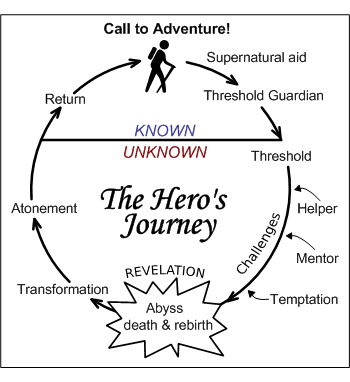
First of all, let’s talk about story structure. There are a lot of different possible structures, but the most common one in the West is the three-act structure. This often echoes the hero’s journey, which goes something like this:

heros_journeyFor purposes of this blog post, I’ll assume you’re already familiar with both the three-act structure and the hero’s journey. If not, there are plenty of other resources where you can learn about them in-depth.

I prefer to think in terms of four-part structure, however, where act two is divided into two halves. In typical three-act structure, the hero hits his lowest point at the midpoint of act two. This is also the midpoint of the story itself, where the hero reaches the nadir of the hero’s journey. In four-part structure, that midpoint is just treated like a plot point, dividing part two from part three. Everything else is the same.

Thus, when you frame a particular story in four-part structure, it looks like this:

  1. The Call to Adventure
  2. Tests, Allies, and Enemies
  3. The Darkest Hour
  4. The Final Battle

Part One: The Call to Adventure

The first part of the story typically starts in the ordinary world, until the inciting incident somewhere around the middle of part one calls the hero to adventure. He then either refuses the call (which usually leads to bad things because the call knows where you live), or he accepts it and has to fight off some threshold guardians to get into the realm of adventure (sometimes, he refuses it and has to fight the guardians). Typically around this point, he meets a mentor to help him on his way.

Prewriting: To get off to a good start, I have found that the key is to know (or at least have a good idea) how the story is going to end before I begin to write it. That way, I know that I’m starting in the right part and I have a general idea where I’m going. I don’t know how I’m going to get there yet, but that doesn’t really matter yet.

Writing: The hardest part about writing this part is the first scene. After that, it usually comes quite easily. It helps to do a bit of world building, or to outline the characters and their backstories, but it isn’t always necessary. Personally, I’ve found that I can discovery-write these things pretty well (and yes, if you haven’t guessed already, I’m a pantser).

Revising: This is usually the part that needs the most revising. It’s also the part that can get me into the most trouble if I don’t do it well. I’m a chronological writer, and if something in the story is seriously off, I have to go back and fix it before I can proceed to the end. I’ve forced myself to finish even when I knew that things were broken, and it only made the writing process worse. So for me, the beginning usually gets the most revision work, whether I plan on it or not.

Part Two: Tests, Allies, and Enemies

Part two is where the adventure really begins. The hero crosses the threshold into the unfamiliar world, and everything is new and exciting. This is also the part where things start to become truly dangerous. Not everyone is who they seem in this part, and the hero may fall into some traps. But the mentor is usually still there to help him get back up.

Prewriting: In my experience, this is the part that needs the least pre-writing. It’s almost always pure discovery. With the ending clearly in mind but still distant enough not to worry about, I can afford to let the story meander a little and take me to some unexpected places.

Writing: This is usually the easiest part of the story to write, for the same reasons as above. I can afford to do almost 100% discovery writing at this part, and it usually feels quite effortless. When the writing does get blocked, it’s usually because something in part one is totally broken.

Revising: Most of the revision process for part two consists of making sure that later events are properly foreshadowed. I usually don’t add enough foreshadowing when I write the first draft, so it’s essential to go back and add it later. Thankfully, this can usually be accomplished by a couple of tweaks, or adding a couple extra paragraphs to an already extant scene.

Part Three: The Darkest Hour

This is where the story gets real. The hero falls into a much larger trap than any of the others, and the mentor can no longer help him (usually because he’s dead). Alone, the hero has to find his own way out, usually hitting rock bottom along the way. Just when it looks like all is lost, some new twist sends the hero in a different direction, setting things up for the final act.

Prewriting: This is where prewriting goes from being unimportant to absolutely essential. Whereas in part two, I can afford to let the story meander a little bit, in part three I absolutely need direction. It’s not enough just to know how the story will ultimately end: at this point, I’ve found that I really need to map my way there.

Writing: This is also typically the most difficult part for me to write. However, when the prewriting is done well and the plot is set up properly, it’s actually not that bad. But it’s important to go really hard on your characters—to make life truly miserable for them. There can be no easy way outs for them, otherwise the entire story will suffer.

Revising: For part three, revising usually consists of putting scenes in the proper order, not in rewriting them completely from scratch. If the foundational elements of the previous two parts were set up correctly, then everything in part three will usually come out well too, but they’re almost always in the wrong order. Transitions then are the part that usually need the most cleanup.

Part Four: The Final Battle

At this point, the hero has a clear direction and a knowledge of how to get there. In climbing up from his lowest point, he finds the boon that will save the world, makes peace with the higher power, and comes back stronger than ever before. But the forces of evil have never been stronger either, and the clash marks the climax of the entire story. There may be a big damn hero moment, or a last minute rescue from the cavalry. There may also be a standoff with no apparent solution, or some truly complex power plays. Inevitably, though, there is a resolution, followed by a return (even if only to the world of adventure). The hero saves the world, gets the girl, and rides off into the sunset. Curtains, applause, and lights.

Prewriting: By this point, most of the prewriting has already been done. The important thing is to have the flexibility to change and adjust, because this is the point where the story often surprises me. It is also the point where discovery-writing is often the most satisfying.

Writing: At this point, I’m usually tearing it up in a white-hot heat of creative energy. It’s extremely rare that I’ll get blocked at this point, but if I do, the key is almost always to just write through it. Often, I’ll make notes of things to change in revision and just barrel ahead—and it works, because there’s no need to set anything up for later. This is the moment of truth, where everything comes together.

Revising: Most of the revision at this point of the story has to do with tying up loose ends. That’s usually not a problem for me, though, because I tend to write very clean. If there is a loose end, it’s usually something that I’ve made a note to fix earlier in the story. For me, the ending is usually the part that needs revising the least.

So there you have it. The biggest lesson I’ve learned just recently is how important it is not to neglect the prewriting aspect of the creative process, especially around part-three. When everything is in place, it makes the story flow so much better.

What are your thoughts? Any plotters or outliners out there with a different take on the process? Everyone is different, but we’re all basically trying to do the same thing, so it’s interesting to see what works for different people!

Where’s SONS OF THE STARFARERS: BOOK IV?

have you seen it yetSo it’s been several months since I released Strangers in Flight (Sons of the Starfarers: Book III), and I’ve already gotten some flak from people waiting impatiently for Book IV: Friends in Command. Some of you may be wondering about that yourself, considering how I wrote and released the first three books within a couple of months of each other.

Well, here’s what’s going on. I wrote Friends in Command a couple of months ago and sent it out to my test readers, hoping that they would enjoy it. Many of them did, but they pointed out some problems that required a major rewrite. Essentially, I had put the entire novel in one character’s point of view, but there were plot points that happened outside of her point of view that made that not work.

So I went back and did a major revision, throwing in Aaron as the secondary POV character. And the plot points turned much smoother. But when I sent it out to a second round of test readers, they told me that it felt too much like a bridge story—that something was still missing. It wasn’t that the book was broken, or that the story didn’t come together properly. The story was good, but the book wasn’t as satisfying as I wanted it to be.

Now, Friends in Command is part four in a nine-part series, so in a lot of ways it really is a bridge. But I want this story to be more than that—to be strong enough to stand on its own, and not just set things up for the later books. Kind of like how Star Wars V: The Empire Strikes back sets things up for Jedi, but is an amazing movie in its own right (arguably the best one in the whole franchise). So with the new feedback, I identified some character elements that I needed to develop, and went back to work.

So far in the series, each book has centered around a different character. The first book, Brothers in Exile, focused on Isaac, the older and more responsible brother. The second book, Comrades in Hope, focused on Aaron, the younger brother who is eager for a chance to prove himself. Strangers in Flight revolved around Reva, the girl that they rescued in the first book, and Friends in Command revolves around Mara, the close friend and confidante that Aaron makes in book two.

The main thing is that I’m doing all I can to make this book as great as possible. I could have pushed it out a couple of months ago just for the sake of putting it out quickly, but I didn’t want to do that until I knew I’d written a quality book. So don’t be worried that I’ve dropped the ball, or that I’ve abandoned the series—I definitely have not! I’m just hard at work making sure it’s done right.

If you’ve been eagerly awaiting the next Sons of the Starfarers book, the good news is that I think I’m just about ready to release it. I’m finishing up with the third round revisions today, and I feel really good about it. I’m still going to send it out for one last test reading pass, just to make sure, and if everything’s good I’ll send it out to my editor before the end of the month. My cover designer is already working on the cover, and my editor says he should have a slot open very soon.

So if all goes well, I’ll put Friends in Command up for pre-order in the first or second week of April. The pre-order price will be $.99, with a tentative release date of May 1st. If things don’t go well, I may have to do another revision pass, but I’ll still do my best to release the book by June.

Six months without a new release is far, far too long. Fortunately, I have some other books coming down the pipeline, such as Heart of the Nebula, a full-length novel and direct sequel to Bringing Stella Home. With luck, that one will be out before the end of the year. And I’m about halfway through with The Sword Keeper, another awesome novel that I think you guys are really going to enjoy.

Lots of stuff going on! I’d better get back to work, but don’t worry—the books are coming!

Excited for a new old project

So a couple of weeks ago, I picked up the manuscript for a novel I’d written years ago, looking to see how much work it would take to salvage it. It’s a direct sequel to Bringing Stella Home, with James McCoy (again) as the main character. Long-time readers of this blog may remember it as Heart of the Nebula.

I wrote the first draft in 2010-2011 (started it almost exactly four years ago, in fact), and right from the start I could tell there were a lot of problems with it. I tried to throw in a romantic subplot that backfired horribly, and several of the major plot points weren’t thought out very well. I pushed through and finished it, though, and in spite of a few extra arms growing out of weird places, there was a lot of stuff in there that I liked.

(Come to think of it, I think this was my NaNoWriMo attempt back in 2010. That would explain why I pushed myself to finish the thing, even though I knew it had problems. I dropped it before the end of November and didn’t pick it up again until March, but since the only other books I had going on at the time were Desert Stars and Bringing Stella Home, I forced myself to finish it just so I had another one. This was back when I was under the impression that every book needs at least five or six revisions to be any good, and that most of the work in writing is actually revising. I no longer labor under those myths).

Over the next few years, I went back to it from time to time to dust it off and run it through a revision pass. Unlike my other novels, though, this one was so broken to begin with that revising wasn’t enough. I changed a lot in the 2.0 revision, cutting out most of the worst problems but not really replacing them with anything better. In the 3.0 revision, I mixed things around a bit but didn’t substantially change the story. Then I went through a bunch of incomplete revision attempts, tweaking scenes and rewriting sentences, but not really changing the story as a whole.

Then last year, I read through all the sundry drafts that I’d written of this story and put together a massive set of revision notes for the 4.0 draft. This time, I tore into the heart of the story itself, reworking plot points and adding new subplots to replace the ones that didn’t work. I went through the whole thing by chapter and scene, making a list of bullet points for all the changes that needed to be made. I also made notes for scenes that I needed to write entirely from scratch, and other notes for scenes that I needed to recycle from previous versions.

It was a massive undertaking, and I got about halfway through it before putting it on hold for other projects. That was nine months ago. Between then and now, enough time passed for me to more or less forget most of my ideas for it.

So earlier this month, I had an opening in my schedule and decided to take a look at this one again. Instead of picking it up where I’d left of, I decided to start from the beginning. Immediately, I was struck by how much better the story was. This wasn’t the three-armed baby I’d stuffed into the closet back in 2011–this was a really compelling story, with an intriguing hook and great potential to go places. The further I got in it, the better it became.

There were a couple of scenes early on that just didn’t work. I could tell that I’d reworked them to death, so I threw them out and wrote completely new ones. This time, they actually worked! By completely getting rid of the problem scenes, amputating those mutated limbs at the base, I was able to free the story from the mess in which it had spawned. For some of these scenes, revision is not enough–they need to be tossed and rewritten from scratch.

Over the last two weeks, I’ve really gotten excited about this project. Not only do I think it’s salvageable, I think I can make a really awesome story from it. I just got to the middle of it today, past the part where I’d stopped back in February. For the next few chapters, I think I’m going to throw out the revision notes entirely and just see where the story goes. I’ll probably write toward the stuff I know I want to keep, but throw out everything else.

So yeah, you can expect to see Heart of the Nebula come out sometime next year, probably in the spring. I still want to run it past my first readers, but I don’t think it’s going to need any major revisions after this one (at least, not any that should take more than a week). Keep an eye out for it!


The Writer by Dosshaus on deviantART

The next few months are going to be CRAZY

I knew that back in March, but with Brothers in Exile about to be published, I’m right in the thick of it! Fortunately, it looks like everything is proceeding more or less according to schedule, which is good for my readers because it means a steady stream of books all summer.

First of all, I’m just about ready to publish Brothers in Exile–in fact, if all goes well, I should be able to hit “publish” tomorrow (it still takes about 24 hours for the book to actually go up for sale, but yeah). Yesterday I got the cover art, today I went through all the edits, and tomorrow I’ll write up the author’s note, format the thing and put it up on Amazon, Smashwords, Kobo, and Barnes & Noble.

The second book, Comrades in Hope, is coming along quite well and should be ready in six weeks at the latest. I’ve gotten enough feedback from my first readers to do a quick revision draft, probably in about a week or so, before getting the publishing gears ready to grind. My first readers ate this book up–many of them said they finished it in one sitting. It’s short, but not super short–about the length of a 60s sci-fi novel–so that tells me it’s just about ready to go.

The third book, Strangers in Flight, is going to be a bit more tricky, but I should be able to get it out six weeks after Comrades in Hope. I’m still writing the first draft, and am maybe 1/4 to 1/3 of the way through it, but the story is coming along well and shouldn’t hit any major snags <crosses fingers>. I know exactly how it’s going to end, and I predict a lot of you are going to squeal at the cliffhanger, but don’t worry–I’ll try to throw in at least some resolution, since it might be a few months before book IV.

Right now, I foresee at least nine books in the Sons of the Starfarers series, perhaps as many as twelve. Like Paul Atreides, I can only catch a few fragmentary glimpses of what will happen in the next few books, but the overall direction is very clear. These books are going to be a lot of fun to write–if you guys enjoy reading them as much as I’ve enjoyed writing them, you’re in for a real treat.

The books are fairly short–not as short as the Star Wanderers books, but not too much longer. They straddle the line between novellas and short novels, kind of like the long-form science fiction from the golden and silver ages. Unlike those books, though, these are more character-driven than idea-driven, with the overarching galactic conflict tying all the characters together, rather than the other way around.

Once I’ve finished writing Strangers in Flight, I’ll take a short break to work on some other projects. I’ll come back to Sons of the Starfarers sometime in the fall, though, with the same grueling schedule for the next three books. It’s hectic but fun–I’m definitely not complaining.

So that’s what the next few months are going to look like. With luck, tomorrow will be the day I upload Brothers in Exile–I can hardly wait to get it out to you guys! Definitely look out for it in the next couple of days or so!

Operation SB #3: L’enfer, c’est la solitude

Title: L’enfer, c’est la solitude
Genre: Science Fiction
Word Count: 6,962
Time: about 40 days

I can’t stand people who humbrag, so I’m just going to come out and say that this story is awesome. Seriously. Kickass freaking awesome. It may be the best short story I’ve written to date. Six months from now, I may come to hate it (like I’ve come to hate some of my other stories), but I seriously doubt that will be the case with this one. This represents some of my best work, and I’m extremely proud of it.

Now that that’s out of the way, I guess I should explain a little what this story is about. The title (which I didn’t figure out until after I’d written the story) is a play on the Sartre quote: “L’enfer, c’est les autres” (“hell is other people”). The story basically takes the exact opposite point of view, by showing how two people from opposing planets stranded on an isolated post basically go through hell because of their isolation, and the way it both brings them together and pits them against each other.

The idea for the story came to me years ago, when I was studying political science and modern philosophy. I imagined a situation where two worlds in a cold war type standoff both claimed an isolated, unpopulated planet somewhere, where each maintained a tiny outpost with only one person in order to stake the claim. Even though they’re enemies, the two opposing soldiers would, in many ways, be closer to each other than to their other comrades. Or would they?

The balance of power changes when one soldier’s station goes down in a meteoroid collision and he’s forced to go over to the other soldier’s station in order to survive. On the way, though, he gets a transmission from his superiors that their two worlds are now at war, and he has orders to kill the enemy soldier who has just saved his life. Can he carry them out? Is it right for him to do so? Or did the other soldier receive the same order, and is he now planning to kill him?

The idea for this story bounced around in my head for a long, long time, but I never sat down to write it because I didn’t know how to resolve it. Then, a little over a month ago, I got a crazy awesome idea for how to do it. All the other details came together, and I knew exactly what was supposed to happen.

I wish I could say that the story practically wrote itself from there, but unfortunately that was not the case. I started it back in early February, but kept putting it off because the story in my mind was so awesome, I didn’t know if I could do it justice on the page. That fear was absolutely crippling, and it’s the main reason I didn’t write any short stories at all for the month of February. It wasn’t that what I had written was bad–in fact, the beginning was pretty good. It was the fear that my skills just weren’t yet up to writing this one.

Well, those fears were pretty unfounded. While talking about the story with some friends this last Tuesday, I realized that the whole thing was silly and I should just sit down and write it. Two days later, the story was finished–and it was actually pretty good.

I know as a part of this short story challenge, I’m supposed to keep Heinlein’s rules, including rule 3 which states “you must refrain from revising, except to editorial order.” I mostly kept to that rule for this one, but not entirely. I did a lot of cycling–reading through and tweaking previous sections before putting new words on the page–as well as some significant cutting. The original draft clocked in at about 7,700 words, and Analog puts a cap at 7,000, so I went through and cut about 10%. Hopefully, though, that will just make it stronger.

I really, really like this story. It’s in first person, and the voice is quite a bit darker than some of my other stuff, but I really connected with the viewpoint character and I think it shows. Besides that, the buildup and suspense was just a ton of fun. I really hope this story gets picked up soon, because I think you’re really going to enjoy it!

This brings the number of short stories on submission now to three. I’ve garnered two rejections for “The Infiltrator,” but that’s it so far. I’m honestly not sure whether to just trunk that one, but I’ll keep it on submission for a while just in case. As Kris Rusch said in a recent blog post, you should let the editor decide what goes in her magazine without pre-editing for her.

That’s just about it. One short down for March–seventeen days to write the second one. Let’s do it!

Looking for a new title

So I’m about a quarter of the way through the revisions for the next Gaia Nova book, currently titled Heart of the Nebula. The thing is, the story is changing a lot in the revision, to the point where that title doesn’t really make sense any more.

This tends to happen with most of my longer books. The original working title for Genesis Earth was THE WORMHOLE PARADIGM. Desert Stars started out as HERO IN EXILE, switched to WORLDS AWAY FROM HOME, then simplified briefly to WORLDS AWAY before finally settling on its current tile. Bringing Stella Home is actually the original working title for that book, but it briefly changed to MERCENARY SAVIOR before switching back again. The only novel of mine that hasn’t had two or three different titles is Stars of Blood and Glory, but that book was unusual in a number of ways.

In fact, Heart of the Nebula has already gone through one title change. It started out as “Into the Nebulous Deep,” not the most inspiring title but definitely accurate (perhaps even mildly spoilerific). I thought about changing it to “Into the Heart of the Nebula” before shortening that to the title it has now.

Anyway. For reasons I don’t really care to get into, I need a new title for this one. Here are some of the ones I’ve come up with so far:

  • STAR WOLF
  • THE LONE WOLF OF THE NEBULA
  • HOPE OF THE FREEDOM STAR
  • LEGEND OF THE FREEDOM STAR
  • EXODUS OF THE FREEDOM STAR
  • LONE WOLF OF THE FREEDOM STAR

I really like the words “wolf,” “legend,” “exodus,” and “freedom star,” but I’m not sure how to combine them in the best way. I’m kind of partial to STAR WOLF, just because it’s shortest, but LONE WOLF OF THE FREEDOM STAR has a ring to it that comes closest to what I’m shooting for.

Those are my thoughts for the moment, anyway. What do you guys think?