January Reading Recap

Books that I finished

Pox Romana by Colin Elliott

Homeschooling by Ginny Yurich

Mojave Crossing by Louis L’Amour

The Cunning Man by David Butler

Writing Great Fiction by James Hynes

Elon Musk by Walter Isaacson

The Sackett Brand by Louis L’Amour

Writing the Great American Romance Novel by Catherine Lanigan

The First Year of Homeschooling Your Child by Linda Dobson

Work Pray Code by Carolyn Chen

Civil Rights by Thomas Sowell

A Revolution of Common Sense by Scott Jennings

(Side note: Why is this book excluded from the Amazon Associates program? It couldn’t possibly have anything to do with Amazon’s woke political bias, could it? Surely not!)

Rocket Dreams by Christian Davenport

The Elements of Eloquence by Mark Forsyth

While Time Remains by Yeonmi Park

The Happiness Files by Arthur C. Brooks

The Sacrament and Your Endowment by Mark A. Shields

The Sky-Liners by Louis L’Amour

Books tha I DNFed

  • The Sorceress and the Cygnet by Patricia A. McKillip
  • Status & Culture by W. David Marx
  • Virtual Light by William Gibson
  • When Homeschooling Gets Tough by Diana Johnson
  • Techniques of the Selling Writer by Dwight V. Swain
  • Why Women Read Fiction by Helen Taylor
  • The Pride of Chanur by C.J. Cherryh
  • The Origin & History of Consciousness by Erich Neumann

How I Hacked My ADHD to Read 5-15 Books Every Month

For a long time, I wanted to read more books. Year after year, I would set a reading goal, only to fail miserably.

I have a mild case of ADHD, which makes it very difficult to focus exclusively on a monotonous task for longer than about fifteen minutes (or alternately, makes it difficult to notice anything else when I’m in a state of hyperfocus). Because most novels take around 8-10 hours to read, it was usually my ADHD that made it difficult to finish any of them.

Then on year, I set a resolution to read or DNF (“did not finish”) every novel that has ever won a Hugo or a Nebula award. I knew that it would be difficult, so I went in with a plan. Long story short, the plan worked out amazingly well, and by the end of the year I had read (or DNFed) nearly 150 books.

But I didn’t stop there. After accomplishing the reading goal, I kept up with the same plan, tweaking it here and there until it became the main process by which I read books. And it still works amazingly well, as you can see from my current stats for this year:

  • January: 11 books read, 6 DNFed
  • February: 8 books read, 2 DNFed
  • March: 15 books read, 6 DNFed
  • April: 6 books read, 6 DNFed
  • May: 10 books read, 5 DNFed

So how does it work? Basically, by hacking my ADHD to turn it into an asset instead of a liability. Here is what I do:

1. Read lots of books simultaneously

This is the main principle that drives my reading process. Instead of trying to work against my ADHD and force myself to focus on the same book all the time, I keep a pile of books that I’m currently reading, and cycle through them. Whenever I get bored of my current book, I put it down and allow myself to become distracted with the next book. In this way, even though I’m constantly getting distracted, I’m also constantly reading, since the distractions are just other books.

If you don’t have ADHD, this might sound like it’s a little maddening—and for normal people, it probably is. But one of the nice things I’ve found about ADHD is that it really expands my capacity to hold multiple thoughts or ideas in my head at the same time. Yes, my mind is constantly bouncing around between all of them, but because I have enough room to hold them all, it’s actually not that hard to read, say, a dozen books simultaneously and remember what’s going on in each of them. I just have to make sure that I don’t let too much time slip by between the last time I pick it up.

Which leads to…

2. Keep a spreadsheet to measure daily progress

Because ADHD can really hamper my executive function, I try to simplify and automate as much as I can. For reading, that means tracking my progress on a spreadsheet, so that I don’t need to keep any of that in my head. Instead, when the time comes to restack my currently-reading pile, I just check the spreadsheet and stack them in the order that it tells me.

As an added bonus, seeing the numbers on the spreadsheet go up over time gives me a lot of motivation to keep reading. And when I’m in a place of low motivation, the spreadsheet helps me to pull back and reorder things, putting the short, easy books at the top and pulling the hard, longer books out of what I’m currently reading, to pick up later. Because it’s all tracked, when the time comes to pick up a book again after setting it aside for a few months, the spreadsheet helps me to do that quickly.

3. Have dedicated reading time

Another huge thing that helps with the executive function issue is keeping to a routine that includes some reading time, so that I don’t have to think about reading—I just do it. Personally, I’ve found that the best time for this is at night, shortly after putting the kids to bed. I’ll usually read through about half a dozen books before I become sleepy enough that it’s time to turn off the light.

I’ll admit, I’m not always great about keeping to this routine, but thankfully it’s the sort of thing that you can pick up easily after missing for a couple of days. It also helps that my wife usually likes to read in bed with me at the same time.

4. Start a new book almost every day

The thing I’ve found with ADHD is that it really makes me crave novelty. So whenever I feel like my reading habits are flagging, one thing that usually helps is to pick up a new book and put it on the top of the pile. After reading the first ten or so pages of a new book, that’s usually enough to put me into reading mode, and then I’ll devour the rest of the pile.

5. DNF early and often

Of course, if I’m starting a new book almost every day, that’s a recipe for getting buried in books really quickly! So to counteract that, and give myself room to experience more novelty in my reading life, I don’t force myself to finish every book that I start. In fact, there are some months where it seems I DNF more books than I finish! But that’s okay, because it makes room for the really good books. And honestly, there are so many books in the world that it just doesn’t make sense to spend a lot of time on the mediocre or terrible ones.

So that’s how I do it. How about you? What are some hacks that you’ve found that help to read more books?

1001 Parsecs Books: The Storm Testament IV by Lee Nelson

If you haven’t read my book blog yet, you should go check it out! I’m posting over there twice a week, with reviews and ruminations on the books I read. This particular one is on Lee Nelson’s The Storm Testament IV, which I think is the best in the series so far.

Print vs. Ebook vs. Audiobook: Pros and Cons

Print

Pros:

  • A printed book is a hard, physical copy that cannot be altered, edited, deleted, revoked, remotely accessed, or otherwise tampered with by a third party who does not have physical access to the book.
  • The reading experience is totally private. Governments, corporations, and other third parties cannot easily know about what you read or how you read it.
  • Marginalia is easier with a print copy. All you need is a pencil and maybe some tabs or sticky notes.
  • It is easier to flip through a print book than any other book format. Much better for reference.
  • Print books are fantastic for sharing and borrowing. You don’t need any devices, permissions, or anything. Just take it off the shelf and put it into the borrower’s hands.
  • Does not require any sort of power source or electricity to read. Works perfectly fine when the power is down.
  • Print books can be quite collectible, and some are worth quite a lot, depending on first editions, cover art, etc.
  • You can get your copy signed by the author(s), which is always fun. It also makes the book more collectible.
  • When you finish reading the book, you have a totem or artifact to commemorate the reading experience.
  • The books that you choose to put on a public shelf can be a way of expressing yourself: your tastes, opinions, and any fandoms or communities to which you belong.
  • Used copies are typically very cheap, even for bestsellers and signed copies, and with enough patience and resourcefulness they are not too difficult to find.

Cons:

  • Because they exist in the physical world, print books take up space, and can be quite heavy and bulky.
  • Print books are prone to damage from things like water, mold, food, drink, fire, blood, parasites, etc.
  • Even though you don’t need electricity to read a printed book, you do need some kind of light source.
  • Print books are easy to lose, especially if you loan them out. A portion of the people who borrow your books will invariably lose them or forget to return them.
  • Because of their bulkiness, it is difficult to transport books, especially in large quantities. Even a single book has limited portability, especially if it is a hardback.
  • If you want to borror a printed book from the library, you have to go to the library to get it.
  • Print books are not text-searchable.
  • Print book$ can be quite expen$ive to buy new, e$pecially the hardback edition$.

Ebook

Pros:

  • Ebooks are the most portable format, by far.
  • The file size is tiny, typically just a few megabytes.
  • You can read an ebook on almost any digital device.
  • You can read ebooks in the dark, especially with an ereader that has a backlight. This makes it possible to read in bed when your spouse/partner is asleep.
  • Fonts are adjustable, so if you need large print to read, you can do that with any ebook.
  • It is very easy to borrow an ebook from the library. All you need is a library account and an internet connection.
  • Footnotes can be hyperlinked, so they don’t take up space on the bottom of the page (or worse, interrupt the narration).
  • You can easily save comments, highlights, notes, etc, and share them all with your friends.
  • Marginalia is not permanent with ebooks, nor does it mar or deface the book.
  • It’s easy to look up unfamiliar words using the ereader device’s (or app’s) dictionary.
  • If you’re reading something potentially embarassing, people in your immediate vicinity can’t tell.
  • Ebooks are length agnostic, meaning that the reading experience is the same for a short story as it is for a novel. No having to lug around a bulky chihuahua-killing doorstop of a tome. You can read a massive million-plus word box set just as easily as a pamphlet.
  • Indie books are typically very cheap, and you can fill up your ereader with free books quite easily.
  • With enough patience and a keen eye for good deals, you can even buy traditionally published ebooks at a good price.
  • Ebooks are text-searchable.

Cons:

  • Ebooks require a power source. While most ereader batteries hold a charge for quite a while, you do eventually need to recharge them.
  • While you don’t need an internet connection to read an ebook, you do require internet to download it to your device.
  • Legally speaking, when you purchase an ebook, you’re actually just licensing it and don’t technically own it.
  • Ebooks can be changed remotely by third parties, or even deleted and removed from your device.
  • Privacy is a potential issue with ebooks, as third parties can see what you’re reading, and corporate entities can—and often do—gather data on your reading behavior.
  • PDFs and images are clunky and difficult to read, at least on some devices.
  • Bad formatting is much more of an issue ebooks, and can actually make the book unreadable.
  • It is a lot more difficult to flip through an ebook.
  • Traditionally publi$hed ebook$ are ridiculou$ly expen$ive.
  • Sifting through all of the crappy self-published ebooks to find the few good ones can be quite a challenge.

Audiobook

Pros:

  • Unlike print books and ebooks, which require your eyeballs to read, you can listen to an audiobook while your attention is focused elsewhere.
  • Because listening is a more passive activity than reading, you don’t need to concentrate as much to listen to an audiobook as you do to read a print book or ebook.
  • It’s easier to get through (most) longer or more difficult books in audio than it is in print or ebook format.
  • Borrowing audiobooks from the library is easy: all you need is an account and reliable internet.
  • Audiobooks are as portable as your smartphone, tablet, or other device that you use to listen to them.
  • Audiobooks can fit reading into the interstitial spaces of your day, such as when you are commuting or doing chores. Time that would otherwise be spent in mindless activity can now be used to fit in your reading time, making it possible to read a lot more books.

Cons:

  • Audiobook file sizes are enormous. It’s difficult to fit a sizeable library of audiobooks on a single device.
  • It is almost impossible to browse or “flip through” an audiobook, so they aren’t great for reference and good luck if you ever lose your place.
  • Marginalia is difficult with audiobooks. Most apps allow you to take little audio clips, but it’s still quite clunky.
  • Just like ebooks, audiobooks can be altered or deleted by remote third parties.
  • Just like ebooks, privacy is a potential issue, with third parties gathering and selling data on your reading behavior.
  • Just like ebooks, you don’t technically own your audiobook. What you’ve purchased is the license, not the copy itself.
  • Audiobooks are much more temporally constrained. You can listen on 2x speed and higher, but that isn’t the same as skimming or speed-reading.
  • Because the reading experience is more passive, audiobooks tend to be more forgetable than print/ebooks.
  • A bad narrator or performance can kill an audiobook, much more than a bad presentation kills a print/ebook.
  • Because it requires less mental concentration, the reading experience is not as deep with an audiobook as with an ebook, and you may have difficulty recalling details.
  • Mo$$t audiobook$$ are ridiculou$$ly expen$$ive, even more $$o than traditionally publi$$hed ebook$$.

Did I miss any?

Reading Resolution Update: April

My 2022 reading resolution: Read or DNF every novel that has won a Hugo or a Nebula award, and acquire all the good ones.

In 2007, when I was a sophomore in college, I went up to Salt Lake City with some friends and was browsing the awesome (and fairly run down, even at the time) used bookstore near the Gallivan Plaza TRAX stop, which has since changed names and moved to another location. It was a really awesome used bookstore, and I determined to buy a SF novel while I was there, since I was really getting back into SF after my mission. I saw a massive 600+ page trade paperback edition of Cyteen by C.J. Cherryh, and since I was reading Downbelow Station at the time, I decided to get that one.

For the next fifteen years, I lugged that book everywhere, through more than a dozen moves (though for the biggest move, where I made the pioneer trek in the wrong direction and repented 8 months later, I boxed it up with my other books and left it in a friend’s basement). In all that time, I never actually read it—or even opened it up, really—but it was always there, somewhere in the middle of my dismally long TBR list.

It wasn’t that I didn’t want to read it: I just didn’t have (or make) the time. Downbelow Station had been an okay read, if not spectacular, but I had really enjoyed some of C.J. Cherryh’s shorter books, like Merchanter’s Luck and Voyager in Night. Also, space opera books about sprawling galactic empires were right up my wheelhouse, so it didn’t seem odd for me to own such a book that I hadn’t yet read. In fact, most of the books that I owned throughout this time were books that I wanted to read but hadn’t gotten around to yet. If I have a superpower, it’s an uncanny ability to acquire books no matter where I am. Unfortunately, I’m not as good at reading them.

Fast forward to 2022. I’ve gotten married, had a daughter, launched my own writing career, and become a homeowner—and I’m still lugging this massive 600+ page trade paperback book that I’ve never read. But I’ve just set a resolution to read (or DNF) every Hugo and Nebula award-winning novel, and Cyteen is on the list. So around the middle of March, I finally open it up and start reading it.

After about a month, I decided to DNF it.

It’s not that it was terrible. Perhaps you enjoyed it, and that’s fine. I just found it to be too drawn out and confusing. I think C.J. Cherryh does better when she’s focusing on just a few characters, rather than trying to give the grand sweep of galactic civilization or whatever. I didn’t finish Foreigner for similar reasons. Maybe someday I’ll return to that one and Cyteen, but for now, I’m counting it as a DNF.

But the thing is, I was hauling around this massive book for most of my adult life. When I bought it in 2007, I figured that since it had won a Hugo, it had to be good. Perhaps, if I’d read it back then, I would have been more patient with it and slogged through to the end. Perhaps I would have decided it was just as good as Downbelow Station. Or perhaps, if I read Downbelow Station today, I would end up DNFing it as well.

The point is, I wish I’d been a lot more discerning about my reading when I was younger, and not just acquired books that I hoped to read “someday”… because books (at least the paper ones) are heavy and take up a lot of space. And a lot of them really aren’t worth reading. Of course, you’ve got to read a few stinkers to figure out what you really like, so it isn’t always a waste… but libraries exist for a reason.

So what this experience really tells me is that Mrs. Vasicek and I are doing the right thing by taking our family to our local library once a week. Also, it tells me that the second part of my resolution—to actually acquire all of the books that I think were worth reading—is just as important as actually reading them. Because, if the ultimate goal is to “seek… out of the best books words of wisdom,” then it’s not enough to just make a list: you actually have to read the damned things, and keep your own personal library in order to revisit those words and share them with others. Because ultimately, you have to discover which books are the “best books” on your own, and your best books list isn’t going to be the same as anyone else’s best books list. Which means that you can’t rely on anyone else’s list. You can use it as a starting point to make your own list, but that’s all you should use it for.

So now I want to go through all of the books I’ve acquired over the years and figure out which ones I ought to get rid of, because Cyteen certainly wasn’t the only one. In fact, most of the books in our family library are books that I haven’t (yet) read. By my count, there are just under 150 of them, totalling about 55k words. Even at a rate of 100 words or two hours of reading each day, that’s still going to take almost two years… and that’s not counting all the library books that we’re sure to check out in the meantime.

Oh well. I suppose this is more of a process than anything else. Journey before destination, and all that. And I’m sure I’ll have fun in the process, since despite the fact that I DNF far more books than I actually read, I do genuinely enjoy reading.

In any case, here are all of the Hugo and Nebula award-winning books that I read (or DNFed) in the month of April:

Books that I read and plan to or have already acquired:

  • Rainbows End by Vernor Vinge (2007 Hugo)
  • Blackout by Connie Willis (2011 Hugo and Nebula) (audio)

Books that I read and do not plan to acquire:

  • Blackout by Connie Willis (2011 Hugo and Nebula) (print)

Books that I did not finish:

  • A Time of Changes by Robert Silverberg (1972 Nebula)
  • The Gods Themselves by Isaac Asimov (1973 Hugo and Nebula)
  • The Fountains of Paradise by Arthur C. Clarke (1980 Hugo and Nebula)
  • The Claw of the Conciliator by Gene Wolfe (1982 Nebula)
  • Cyteen by C.J. Cherryh (1989 Hugo)
  • Tehanu by Ursula K. Le Guin (1991 Nebula)
  • The Diamond Age by Neal Stephenson (1996 Hugo)
  • The Moon and the Sun by Vonda N. McIntyre (1998 Nebula)
  • Parable of the Talents by Octavia E. Butler (2000 Nebula)
  • 2312 by Kim Stanley Robinson (2013 Nebula)
  • Beyond This Horizon by Robert A. Heinlein (1943 Retro Hugo, awarded in 2018)
  • The Nemesis from Terra by Leigh Brackett (1945 Retro Hugo, awarded in 2020)

Total books remaining: 26 out of 110 (currently reading 12 and listening to 3).

A reading hack for the ADHD-addled brain

I’ve got a mild case of ADHD. As a kid, I took ritalin from grade 3 through about grade 8, and as an adult, I occasionally self-medicate with caffeine (usually in the form of soft drinks, since I don’t drink coffee or tea). I can function all right without treating it, but I am more prone to getting distracted when I don’t. But leaving it untreated also makes it easier for me to make interesting connections between seemingly unrelated subjects, which improves my creativity, so it’s more of a trade-off between being more productive vs. being able to make leaps of logic and switch between subjects more easily.

In terms of reading, ADHD makes it very difficult for me to finish long books, unless I’m hooked all of the way through, which is rare. I’ll often start books but drift away from them without either finishing them or making the conscious decision not to finish them. Over time, this makes me less enthusiastic about reading, since I’ve got a huge pile of unfinished books behind me that I can’t easily get back into, because I’ve forgotten what was happening in them.

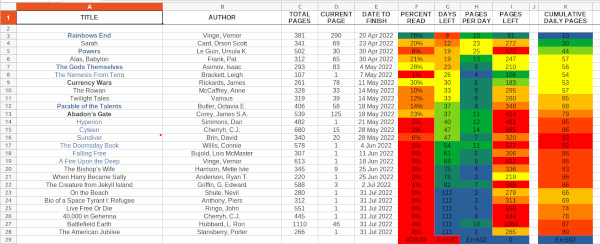
Well, I recently found a new reading technique (or rather, a new reading accountability technique) that helps me to hack my ADHD to read more, not less. It starts with keeping a reading log on a separate spreadsheet, with columns to track total pages, pages already read, and the date to finish reading, among other things.

Most importantly, it has a column for “cumulative daily pages,” which is just the sum of all the pages you have left to read up to a certain date, divided by the number of days left. In the spreadsheet above, the formula is “=(SUM(C$3:C[current row]-SUM(D$3:D[current row]))/G[current row]”.

What the cumulative daily pages tells you is how many pages you have to read each day, not just of the given book, but of all the books before it, in order to finish that book by the given date. So in the screenshot above, if I want to finish Sundiver by May 28th, I need to read 93 pages per day across any of the books listed above it. I can read all 93 of those pages in Sundiver and still stay on goal, or I can read 93 pages of Cyteen instead, or I can spread them out by reading 7-8 pages of each of the 14 books with a “due” date before May 28th. Or any other combination.

Changing the “due” date also changes the cumulative daily pages, so I can also bring that number down by extending the deadline and reordering the books in descending order by “due” date. I’ve also color coded the pertinent columns using conditional formatting, but that’s just for personal convenience. The redder a number is, the more I need to bring it down (or up, in the case of percent read). For daily cumulative pages, I like to keep the half-dozen books with the soonest “due” date pretty low, so that I don’t have to focus on them exclusively.

And that’s where the ADHD hack comes in. Because instead of trying to read just one book from start to finish, the reading log allows me to skip from book to book without losing track of which ones I still have to read. That way, when one book begins to feel like a slog, I read to the end of the chapter and skip to the next book. My ADHD-addled brain says “Oh look! Something new!” and I get excited about reading again. And I don’t fall into the trap of feeling like I’m not making any progress, because I can see it all there on the spreadsheet.

Of course, the big danger is that when I think back on what I’ve read, I’ll remember an epic tale about how rabbits colonized Mars and uplifted dolphins while the dark lord raised the cauldronborn and killed vampires for the government. In space. But hey, at least I’m reading lots of books now!

Reading Resolution

My resolution last year was to read or DNF 100 books. I was doing pretty well on it through the summer, but then I stopped using Goodreads and lost count. (No particular reason, other than that I just fell out of using the site. It’s clunky and difficult to navigate, and after I started using my wife’s spreadsheet system for tracking my reading, I just didn’t feel like posting updates.) Counting children’s books, I definitely hit 100—probably more like 120—but without counting children’s books, it was probably closer to 80.

I do really want to keep up on my long-term goal to become a better reader—or to be more well-read, which amounts to the same thing. This last week, I’ve been giving that goal some serious thought, and I’ve decided on the following new year’s resolution for 2022:

Read or DNF every novel that has won a Hugo or a Nebula award, and acquire all of the good ones.

Ever since 2015, I’ve been pretty jaded about the Hugos (and the Nebulas, to a lesser extent). However, for a long time they were the most important and authoritative awards in science fiction, and by using it as a reading list, I hope to get a better sense of how the genre has evolved over the years, including how in recent years it has fallen to the woke insanity of our time.

There are 110 novels that have won either a Hugo or a Nebula award (or both). Of those, I’ve already read or DNFed 33 as of today, January 1st. I anticipate that I will DNF many of the rest, but I’ll give them all an honest try, and differentiate between hard DNFs (where I know I’ll never get back to reading it) and soft DNFs (where I intend to come back to it later). For purposes of this resolution, though, I’ll count both, since as a reader I believe in DNFing early and often.

As for acquiring them, that shouldn’t be too hard, and will help to build our family library, which is one of my long-term goals. Paperback Swap is great for acquiring used books, especially mass market paperbacks, which is actually my preferred format for most books (great for stuffing in a back pocket or tossing in a backpack, and you don’t mind it as much if someone borrows and never returns it). The added benefit of using Paperback Swap is that it will help me to get rid of some of the books I’ve acquired over the years that I’ll probably never read.

That’s actually a huge problem for me, and I was thinking about making another resolution to have read at least half of the fiction books that we own before the end of the year, but I think this reading resolution will help with that enough that I don’t need to make it more complicated. I’ve found that it’s generally better to set one resolution and focus on that, rather than setting so many that I’ll probably forget all of them by mid-March. Besides, having a bunch of unread books isn’t actually much of a problem, unless you don’t have a place to store them. We do.

While putting together the spreadsheet of all the Hugo and Nebula winning books, I discovered some very interesting things. One of them had to do with the age of each winner at the time they won the award. The average age was about 46, with Samuel Delany coming in as the youngest for Babel-17 in 1967 at age 25, and Ursula K. Le Guin as the oldest for Powers in 2009, at age 80. (Her first novel to win either award was The Left Hand of Darkness, in 1970 when she was 41.) The average age skewed younger in earlier decades; now, it’s closer to 50.

Another very interesting thing to look at is which authors have had children and which ones haven’t. Of the Hugo and Nebula award-winning novels that I’ve DNFed, almost all of them are from authors who are childless. That’s not too surprising when you consider how much it changes your perspective on the world to have or adopt a child. What’s really surprising to me is how many of these authors are childless, and how many of the childless authors are writing books for children. Since 2015 and 2016 respectively, none of the living authors who have won a Hugo or a Nebula award for best novel have had any children of their own—or if they have, it’s not public knowledge and the internet doesn’t know.

So anyways, that’s basically the long and short of it. I’ll keep track of this goal through the detailed spreadsheet I’ve set up for it, and post updates throughout the year. And when I’m done with the Hugos and Nebulas, I’ll probably move on to the Dragon Awards, which may actually be harder since 1) there are more than half a dozen sub-categories, 2) many of the winning novels are the umpteenth book in a long-running series, and 3) I probably won’t DNF as many of them.

What are your reading resolutions?

2019-11-07 Newsletter Author’s Note

This author’s note originally appeared in the November 7th edition of my author newsletter. To subscribe to my newsletter, click here.

One of the things I’ve come to really love about married life is reading in bed with Mrs. Vasicek. Right now, I’m finishing House of Assassins by Larry Correia, and she’s reading the Westmark Trilogy by Lloyd Alexander. She just finished the mystery novel A Better Man (making a few jokes about the title), and I just finished Genghis Khan and the Making of the Modern World, which has revived my perennial fascination with the Mongols.

It’s great to share a book with someone you love, but it’s also great to share the same space as the person you love while totally immersed in a book. Those are two different things. I’m also rediscovering how refreshing it is to end a long day by unwinding with a good book for an hour or two.

Reading stands apart from other leisure activities. Whenever I spend too much time on YouTube, or playing computer games, or doing something else involving the internet and a screen, I always come away feeling drained. Not so with reading. In fact, it’s the exact opposite.

Reading a good book always leaves me feeling replenished, like I’ve just come back from an exciting adventure, or come to the end of a perfect day. The books that stick with me always seem to have changed me in some way, even if it’s so subtle that I can’t tell how.

Unlike watching TV or YouTube, reading takes work. It isn’t laborious, but the act of reading requires just enough effort that when I’m tired or worn out, screens and the internet usually win out. But when I make the conscious decision to turn away from those things and open up a book instead, I never regret it. The same can’t be said when I come to the end of a YouTube binge.

It’s never too late to start a new habit or set a new resolution, but there’s something about getting married that makes it easier. So in an effort to read more (and finally get to all the books that I’ve accumulated over the last few years), I’m setting a goal to read two books a week. That’s 100 books over the course of a year, with a bit of allowance for unforeseen interruptions.

A hundred books sounds like a lot, but as a writer, it’s probably on the low end of what I should be reading anyway. Hopefully the quality of my writing improves as I do it. If I get into the habit now, then it shouldn’t be too difficult to make and keep that resolution for 2020.

What are some of the ways that you enjoy reading? With a spouse? With a pet? Alone? In a warm and quiet place? With a beverage of something tasty? Or maybe in a crowded place, with lots of opportunities for people watching?

I suppose there are just as many ways to read as there are ways to write, which is to say that there’s one for every reader. May you be fortunate enough to spend lots of time with yours!

A quick update

If life had a crazy-meter, the needle on mine would be somewhere in the yellow green right now and trending toward the red.

Next week, Future Mrs. Vasicek and I will be traveling to Iowa for my nephew’s baptism. It’s going to be a big family affair. Future Mrs. Vasicek has met everyone already, minus some of the nieces and nephews, but this will be the first time that we’re all in the same place together. Should be fun, but also very busy.

Next month, we’re getting married, and that’s a whole other source of craziness right there. Good craziness, but craziness all the same. Things are coming together one thing at a time, but there’s still a bunch of stuff to figure out, and a bunch of unknown unknowns as well. It will probably take at least a couple of months after we’re married before everything fully shakes out.

As far as writing goes, I’m making slow but steady progress on Edenfall, and should still finish it before the wedding. I’ll share more details on that in the email newsletter that I plan to send out this week, but the short version is that I seem to be over the hump and making good progress. That’s where I’m putting most of my energy, so if the blog falls off for a while, don’t worry—I’m still here.

As for the publishing side of things, I’m figuring out how to get all my books out in print, which was something I thought I’d figured out back in January until I learned just how crappy KDP Paperback really is. That said, it’s the best option for the present time, so I’m trying to figure out how to work within those limitations and design covers that their POD printers won’t mangle too badly. Still, it’s going to be a while.

An area where I’ve really dropped the ball is short stories. It’s been months since I wrote the last one, and I need to put a bunch out on submission again too. Also, marketing is an area that I need to do better in. I’m experimenting a bit with AMS ads, but it is so freakishly complicated that I hardly know where to begin.

But reading is an area that I really need to do better. I try to spend an hour or two each night reading, but the last couple of weeks that hasn’t happened at all. My TBR list is about three shelves long right now, and that’s just the print books. That’s definitely an oversight that needs to be rectified.

At the same time, I’m well on my way toward collecting all of the works of David Gemmell, mostly through Paperback Swap. If everyone has a superpower, mine is the ability to acquire books, so Paperback Swap is a really fantastic way to leverage that. The Neverending Story is my favorite book, but David Gemmell is my favorite author, so I definitely want to have all of his books in my personal library.

That’s pretty much it. Still need to figure out cover work for Edenfall. Still need to assemble my first readers and get stuff figured out for that. All of these are good problems, though. Hopefully, I’ll be trading up for better problems in the very near future.