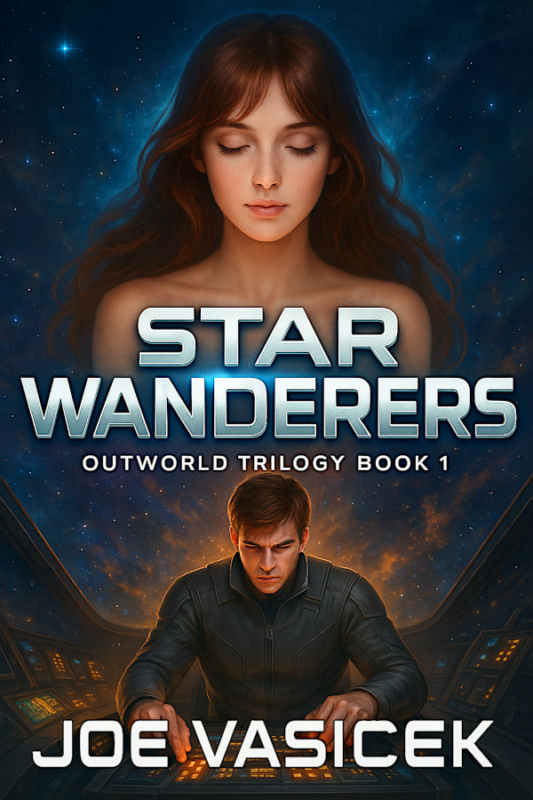
I’ve also done one for the sequel, Children of the Starry Sea:
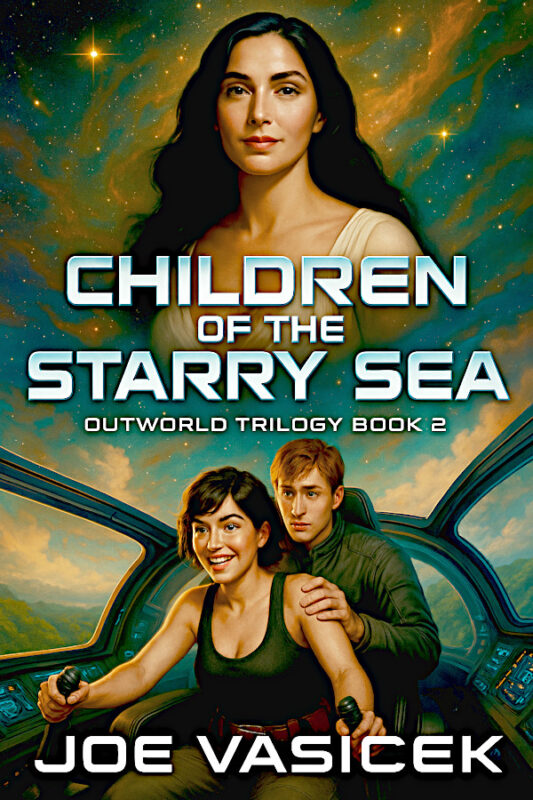
What do you guys think?
I’ve also done one for the sequel, Children of the Starry Sea:
What do you guys think?
So I’m working on the first book in a new epic fantasy series, called the Soulbound King. It’s basically a fantasy retelling of the life of King David, loosely adapted from the biblical stories about his life. I’ve already outlined the first book and generated a rough AI draft, which came in at 153k words. The final draft will likely be longer than that, but I think it’s very likely that I will be ready to publish it before the end of the year.
The question I’m currently grappling with is whether to keep it as a seven book series, or to release it as two trilogies with a bridge novel in the middle. Frank Herbert did a similar thing with his Dune books: the first three books (Dune, Dune Messiah, and Children of Dune) were a trilogy, and the next book, God Emperor of Dune, was supposed to be a bridge novel setting up the second trilogy—except he died before finishing the last book, so his son Brian Herbert got together with Kevin J. Anderson to write it, and then they blew it up into a franchise… point being, stuff like this has been done before.
Now, I’m reasonably confident that I’m not going to die before finishing the last book. In fact, I’ve already made a 7-point outline for all seven books, so I know exactly where they start and end, with the inciting incident, midpoint, climax, etc. I’m also writing these books with AI assistance, which is making it possible for me to write these books much faster than I otherwise would have been able to write them. For the first book, The Soulbond and the Sling, I anticipate that it will only take between six to nine months of total work to go from story idea to finished draft.
But the trouble with writing a seven book epic fantasy series is that a lot of readers aren’t going to bother picking it up until all seven books are out. This is because so many readers have been burned by authors like George R.R. Martin and Patrick Rothfuss, who have not and likely will never finish their bestselling series. I can’t really blame the readers for that (though I can and do blame the authors), but it creates a market reality that I need to anticipate and plan for.
So here’s what I’m thinking: instead of making it a seven book series, I’ll make it two trilogies with a bridge novel in-between. The first three books will complete one arc, and the last three books will complete another arc. I’ll wait to release the first book until after I’ve completed the AI draft of the third book, so that way I can release all of the books in the first trilogy within 1-3 months of each other. And after the first trilogy is complete, I’ll market it as a trilogy while working on the last four books, probably releasing each of those a year apart, as I finish them.
The reason I’m thinking about this now is because a strategy like this is going to influence how I write all of these books. If I’m going to split the series into two trilogies, the last thing I want to do is end the first trilogy on a cliffhangar. It has to hold together as a complete story, with only one or two loose threads. But since I’m still in the early writing stages of the first book, I still have enough room creatively to make that kind of adjustment. I just have to decide if that’s truly the plan.
By the way, the first trilogy ends with the fantasy equivalent of the Battle of Mount Gilboa, where the Saul and Jonathan characters die in an epic battle and the David character becomes king (I know that in the Bible, there was a gap of several years between those two events, but I’m combining them for purposes of this book). So it is a rather natural stopping place, even if it does end on a massive downer, followed by a false victory (the second trilogy begins with David and Bathsheba).
Anyways, what do you think of this plan? Does it sound like a good idea, or is there a compelling reason I haven’t thought of yet for why I shouldn’t do it?
It’s been a few years since I last ran this survey, and I’m curious to see how things have changed (if indeed they have changed at all). Also, there’s a new question about pricing audiobooks, which I’m especially eager to analyze, since that’s something I haven’t quite figured out yet. Check it out!
This is an extremely polarizing and contentious issue right now, so I’m going to try to make this post as fact-based and non-sensational as possible.
Full disclosure: I never got the covid shot. My wife and I both had covid before the “vaccines” became available, and decided that our natural immunity provided enough protection for us. We were also trying to become pregnant, and even in January 2021, we had heard rumors that the shots were affecting both men’s and women’s fertility, as well as women’s menstrual cycles, and didn’t feel that the risk was worth it, in spite of the tremendous social pressure to get “vaccinated.”
At the end of the day, we simply did not trust that the “vaccines” were safe (and I put “vaccine” in quotes, because we now know that these shots do not provide lasting immunity, nor do they prevent transmission. The health establishment literally had to change the definition of “vaccine” for that word to apply to these treatments). We were wary of the fact that the emergency use provisions absolved the manufacturers of any liability, and that the long-term effects of these shots was unknown. In our family’s calculation, the potential risks outweighed the potential benefits, especially since we already had natural immunity and were unlikely to contract covid again.
In the past year, some very disturbing things about the “vaccines” have come to light. A recent poll by Rasmussen shows that more than 1 in 4 Americans believe they know someone who has died of the covid “vaccines”—not from covid itself, but from the vaccines. Interestingly, more Democrats (about 1 in 3) than Republicans (about 1 in 4) claim that they know someone, which is interesting, because the political left was much more taken with the “vaccine” mania than the political right. Remember that super cringey vaccine song on Colbert’s show?
The last two years have been crazy, for sure. But how has it affected the science fiction and fantasy world? The January issue of Locus Magazine made me curious about this, since Greg Bear recently passed away “after complications from heart surgery,” and the obituary section mentioned two other people under the age of 60, one of whom “died unexpectedly.”
So I went through all of the back issues of Locus from January 2021 to the present, and made a comprehensive list of every person mentioned in the obituaries, with their age and cause of death. If they died of a stroke or an accute heart-related issue, I bolded their name, since the mechanism for death appears to be related to blood clots caused by the spike protein that the mRNA “vaccine” is designed to generate. Also, I bolded the name of anyone 70 or younger who died without the cause of death listed. The global average life expectancy is just north of 70, which is lower than the US, but I decided to take the lower of those numbers. I also bolded any names where the cause was listed as covid, since many people who died in the first couple of weeks after getting the shot were automatically listed as covid, especially in the initial rollout.
Here is the list:
JAN 2021
FEB 2021
MAR 2021
APR 2021
MAY 2021
JUN 2021
JUL 2021
AUG 2021
SEP 2021
OCT 2021
NOV 2021
DEC 2021
JAN 2022
FEB 2022
MAR 2022
APR 2022
MAY 2022
JUN 2022
JUL 2022
AUG 2022
SEP 2022
OCT 2022
NOV 2022
DEC 2022
JAN 2023
To be clear, there may be benign explanations for many or even most of the people whose names are bolded. Strokes and heart attacks have been killing people long before the covid “vaccines” existed, and continue to kill people without any help from the “vaccines.” Also, many people who died under 70 may simply have been in poor health—after all, it’s not like the SF field is known for robust physical fitness. However, there may also be people on this list who did die of vaccine-related issues, whose names I did not bold because they were over 70 and the cause wasn’t listed. So it cuts both ways.
My purpose is not to compile a comprehensive list of vaccine-related deaths in the SF field, but to point out some deaths that appear to be suspect. And of the 114 people listed, more of them “died unexpectedly” or “died suddenly” than died of covid, which is worth noting.
If you haven’t seen the documentary Died Suddenly, it’s worth watching, even though it does have some flaws. Most notably, toward the end it recycles some disturbing footage of people who either did not die, or who died before the pandemic, implying that they all died of the vaccines. You can find a much more in-depth and non-sensational treatment of vaccine-related deaths and injuries on Chris Martenson’s channel, especially in this video where he interviews several morticians about the clotting issue:
Vaccine safety is a very serious issue, and every day, it seems that we are learning new things about the covid “vaccines” that call into question all of our assumptions and beliefs. The science fiction field has always leaned to the political left, especially on the traditional publishing side. For the past two years, many of our conventions and other events have pushed mask mandates, or required proof of vaccination, including our own LTUE here in Utah.
Has this lockstep, unquestioning, and at times almost militant advocacy of the establishment narrative led to the tragic loss of several writers and artists before their time? Has it decimated—indeed, is it continuing to decimate—the talented creators in our field? How many wonderful stories will never be written because of this? How many voices will no longer be heard?
I hope that we can come to a place where we can honestly start asking these questions. Because if we can’t, then the science fiction and fantasy field has lost much more than those who have died, and the gifts they would have shared with us.
Note: this post originally appeared in my newsletter, but I was so excited about it that I decided to post it here too. Enjoy!
So my wife is getting a PhD in computer science, which means that she’s on the cutting edge of research into things like language learning and topic models and other techy stuff that I don’t totally understand.
A couple of weeks ago, she downloaded Stable Diffusion, an open source text-to-image program that creates AI art, kind of like Dall-E and Midjourney. Besides playing with it herself, she thought it might be useful for me to create my own cover art. So for the last two or three days, I’ve been playing around with it, and the results are absolutely amazing!
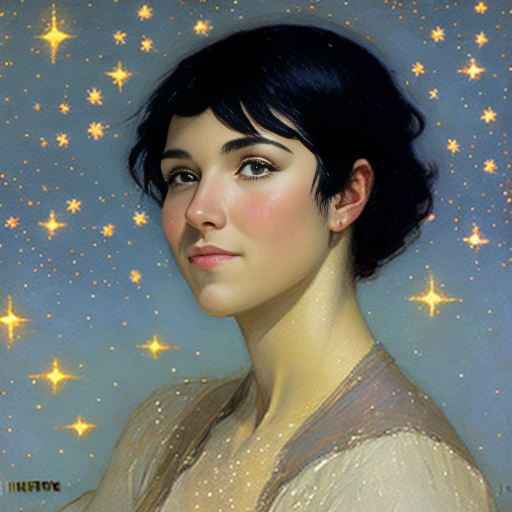
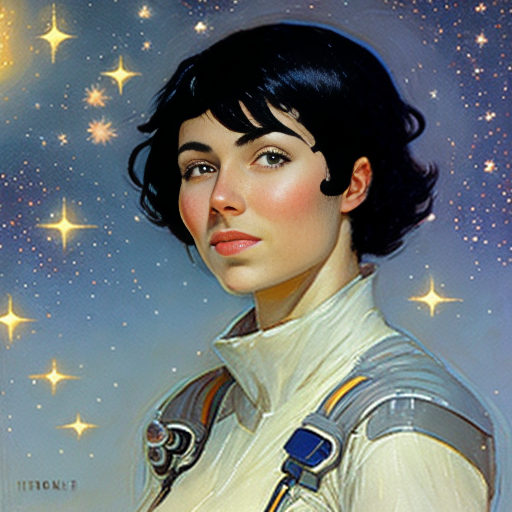
These were some of my first attempts. I’ve forgotten what the prompt was: I think it was something like “a spunky young woman with short black hair, surrounded by stars, in the style of Frank Frazetta and Minerva Teichert.” The difference between the first one and the second one was adding “in space.”
I also tried inputting a couple of paragraphs straight from my novel, including a lengthy description of this character, but the results were… uncanny. These AI art programs tend to do better if you give them short descriptions with only a handful of details.
The next day, I played around with it some more, and came up with this one:
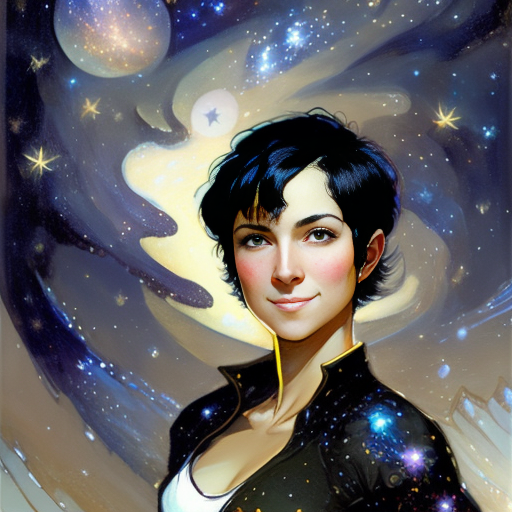
The secret sauce for this one was adding “Minerva Teichert” and “Baen Books.” Who is Minerva Teichert? She’s a famous Latter-day Saint painter from the early 20th century who paid for her son’s tuition to Brigham Young University in original paintings, many of which are still on display in the BYU Museum of Art and the Joseph Smith Memorial building.
As you can see, there are still some weird artifacts to this piece, such as the stars on the character’s jacket. That’s the tricky part with AI art: if you look at it closely, you’ll find something weirdly uncanny, like a hand with seven fingers, or a person with three arms. The steepest part of the learning curve has to do with removing these uncanny bits, either by giving better starting prompts, or by tweaking it in subsequent iterations.
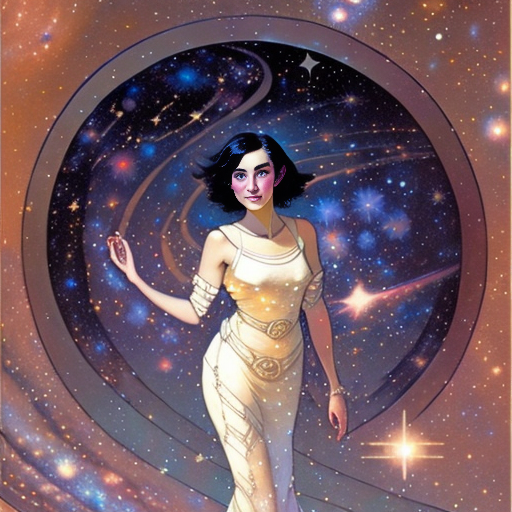
I believe the prompt for this one was “a dreamy young woman with short black hair, bare shoulders, in space surrounded by stars and galaxies. Minerva Teichert and Baen Books.” The original image was a woman in a space suit, but I used something called “image to image” to create new images based on the previous one, in batches of four. I would pick what I thought was the best one for that generation, and run the program again. That’s how I eventually got to this one:
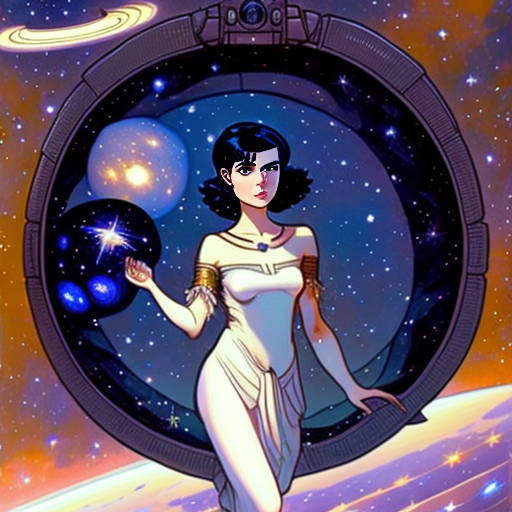
and this one:
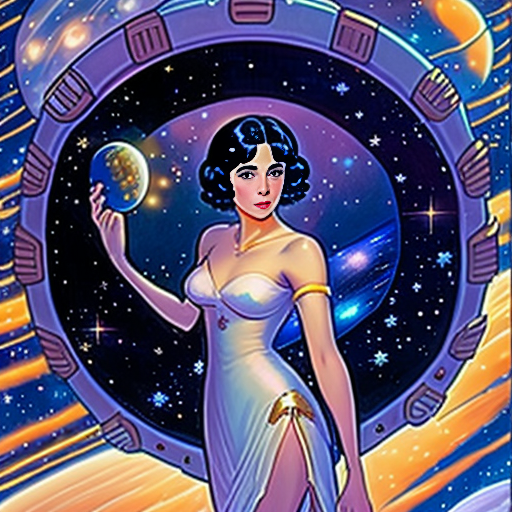
Still need to work on the hands. Also, there’s this weird artifact, almost like poor JPEG compression, that happens if you don’t give the program enough creative leeway with each successive generation. Another method I’ve heard of is to create a really large batch based on a given image, and then use GIMP to cut and paste all the pieces that you like from each one, before running it through one final image to image pass to seamlessly combine them.
A lot of people are either really angry or really scared about AI art and what it means for the future. It’s the same with other forms of automation, I guess. Will it replace artists entirely? Will all our art be 100% AI-generated in the future? Personally, I don’t think so. These programs are just another set of tools, and require quite a bit of practice to master.
Same thing with stuff like ChatGPT and other language learning models that can be used to write poems and stories. It takes a lot of work to come up with an AI-generated story that isn’t totally boring, or has a terrible ending. It can be done, but it does require quite a bit of human input.
So I don’t see these tools replacing artists or writers, at least in the forseeable future. Rather, I think that the successful artists and writers will be the ones who incorporate these tools into their workflow, using them as force-multipliers to make some really amazing stuff. Personally, I would absolutel love it if I could use something like ChatGPT to put out a new novel every month, or even every week.
The other thing with things like novels is that most people only read them once, because they already know what’s going to happen. So if you use an AI to write a novel, but you have to feed it all the twists and plot points… what’s the point? You’ve basically already read it. This is a problem that a lot of amateur writers have with outlining: since they already know how the story is going to end, they find it difficult to sit down and write.
Now, what I could see is a prompt like “rewrite Lord of the Rings so that Sauron wins,” or “rewrite such-and-such romance novel so that this other guy ends up with the girl.” Or “make Lord of the Rings a gritty cyberpunk novel,” or… you get the picture. And honestly, I’m fine with that. If someone who enjoyed the “alpha” version wants to create a “beta” or a “gamma” version for fun, that’s cool. It might be kind of fun to see how an AI tweaks my books.
What isn’t cool is if someone takes that beta or gamma version of my novel and tries to sell it under their own name. And that’s where most of the legal stuff needs to be hammered out, over issues like copyright. I’m not going to use Stable Diffusion to remove watermarks, or to take someone else’s copyrighted art so that I can enjoy a derivative product without having to pay the artist. And when it comes to using prompts, I’m going to err on the side of using artists like Minerva Teichert who have already passed away, or large publishing houses like Baen whose style doesn’t belong to a single artist.
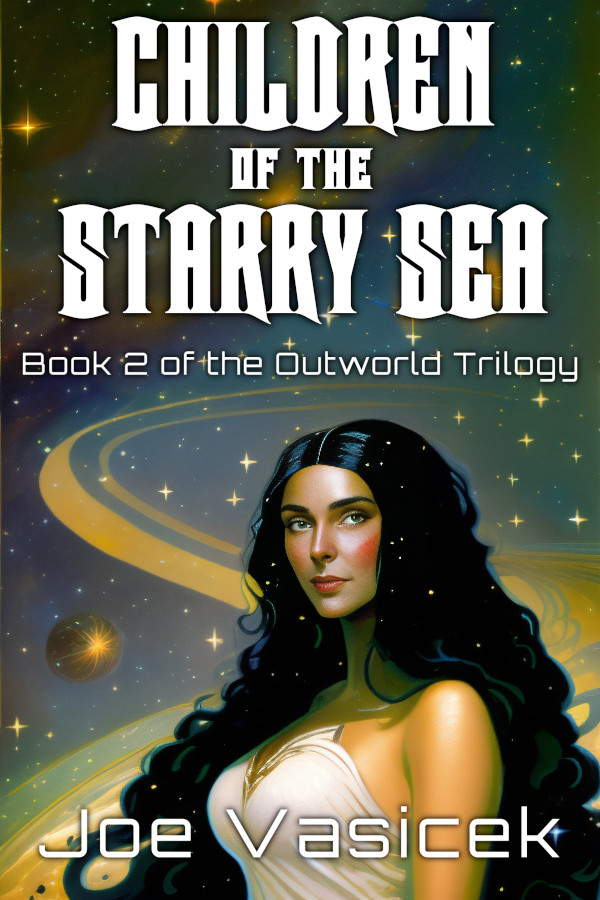
So after playing around with it some more, I finally came up with some concept art for my current novel WIP and used it to throw a cover together! What do you think? This isn’t going to be the final version—in fact, I will probably produce quite a few other test covers before I settle on the one I like. But for my current skill level (still beginner), I’m quite pleased with how it turned out!
I got a lot of feedback on my last blog post, and rather than respond to it one at a time, I thought it would be better to just write another blog post and respond to it here.
First of all, thanks for all of the support. I really appreciate it. I’m not going through a particularly hard time right now, and I’m not thinking seriously about giving up writing either, so I’m sorry if my last post gave that impression. I’m definitely going to keep writing, since this is the path that I feel I’ve been called to, and the vocation that I should pursue.
This isn’t a question of “should I give up writing, or should I sell out to the woke agenda?” Rather, it’s a question of “should I go off and become a voice in the wilderness, or should I focus on building my career?” It may be possible to do both things at once, but when I look at where the culture is today, it looks more and more like a very difficult needle to thread.
Or maybe not. Maybe what we call “the culture” is mostly just a bunch of bullies, sock puppets, and trolls conspiring with Big Tech and the corporate media to drown out all other voices. Perhaps the true culture has actually bifurcated, and what looks like “the wilderness” is actually where the most people really are. Perhaps it really is just a small number of people going crazy, and because of all the gaslighting, everyone else only thinks that they are the last sane man or woman in this world.
The other thing I ought to keep in mind is that crying out against our modern culture isn’t actually removing yourself from the cultural conversation. On the contrary, it’s one of the most outspoken ways to be a part of it, even if you do end up in the wilderness. Hardly anything from the culture of the Old Testament has survived, but we still have the words of their prophets today.
It is frustrating, though, because the culture really isn’t producing any of the kinds of stories that made me fall in love with science fiction and fantasy in the first place. Brandon Sanderson is kind of an exception to that, but in some ways even he seems to be bending before the cultural winds. Do I need to bend as well? There may be some wisdom in that: after all, the grass can endure the storm that takes down the mighty oak.
So you see, it’s a much more nuanced question than “do I bend the knee or give up writing?” Rather, it’s a question of where to bend, and where to stand firm. I doubt my Zedekiah Wight stuff is going to amass much of a following, though I’d love to be proven wrong. But I’ve still got to find ways to stay true to my inner voice, even if that drives me out into the cultural wilderness.
Anyways, these are just some of the questions I’ve been pondering lately. I’m not depressed, and I’m not going to give up writing, so don’t worry about that, though thanks for your concern.
I have come to realize something that is, in some ways, making it very difficult for me to keep writing. Not in the short or the medium term—I’m actually making quite good progress on my current novel WIP, and am optimistic about finishing my three unfinished trilogies in the next couple of years. But when I look on the horizon, this thing that I’ve come to realize is looming like a storm cloud, and I worry that if something doesn’t change, and change soon, that storm is going to wipe me out.
When Orson Scott Card spoke at the BYU Library in 2007, he made a profound statement that had a great influence on my writing, and my decision to write. He said that stories and fiction are how the culture talks to itself. In other words, if you want to understand a particular culture, look at the stories that it produces.
The problem is that unfortunately, I have come to despise almost everything about our current culture.
I hate all the hypocrisy and virtue signalling that we see online. I hate how that virtue signalling has poisoned almost every major franchise, from Star Wars and Marvel to the commercials and advertisements that we consume on a daily basis. I hate how the virtue signalling of our gatekeepers has allowed our cultural vandals to erase our history and destroy our cultural icons.
I hate how our education system has become corrupted. I hate how it has been transformed into an indoctrination system that brainwashes everyone who goes through it, producing nothing but legions of woke fanatical footsoldiers and hordes of incompetent midwits. I hate how it holds our children hostage for the benefit of the unions, and how it utterly exterminates our children’s natural creativity and curiosity in order to turn them into nothing but cogs in society’s grand machine.
Above all else, I hate and hold in utter contempt how our culture has become anti-life, and promotes the unrestricted wholesale slaughter of our unborn children as a moral good. I hate how this rejection of the value of life has trickled down into every facet of our society, poisoning how we see each other and how we treat our fellow men. I sincerely believe that our ongoing genocide of the unborn exceeds the evil of the Nazi holocaust in every moral and ethical dimension. I also hope that future generations have the moral clarity to hold us in greater contempt than the Nazis, and plan to do everything within my power to make that a reality.
I hate the sexual revolution, and how it eviscerated the traditional family while also producing the most prudish and sex-negative society that this nation has ever seen. I hate how our sexually “liberated” culture celebrates our worst perversions and teaches us to define ourselves by our basest urges, instead of urging us to strive for something higher and better. I despise the transgender movement that is butchering our children and annihilating their innocence, all for the carnal gratification of the worst sexual predators among us.
I hate how our culture rejects the things of God. I hate how that even most self-described Christians have never read the Bible cover to cover. I hate how our churches are led by moral cowards who fear to offend their followers more than they fear to offend the Almighty. I hate how many of our priests and pastors have come to serve Mammon more than they serve God.
I hate almost every book and story that has won a major literary award within my lifetime. When I survey the field of science fiction and fantasy, I see hordes of talented writers willfully prostituting themselves to the spirit of the age, and pleasuring the whore of Babylon for the praise and glory of the world. When I read the books that our culture holds up as the greatest contemporary works, I am disgusted by the sexual depravity and nihilistic materialism that pervades them. Aside from Brandon Sanderson and a few obscure authors whose works the culture is actively working to suppress, I find nothing redeemable or even genuinely thought-provoking in any of these contemptible works.
Most of my readers are over the age of 55, probably because of just how much I hold our contemporary culture in such contempt. And yet, I cannot help but despise the Boomers for robbing me of my birthright and leaving me buried in a mountain of debts that neither I, nor my children, nor my grandchildren will ever be able to repay. Every generation before the Baby Boomers aspired to give their children lives that were better than their own, but the Boomers squandered everything that the previous generations gave them, and left their children sicker, poorer, and more unloved. In fact, the Boomers cared so little for their children that they locked down the entire country, deprived them of the crucial years of their education, and forcefully injected them with an experimental jab, all out of fear that the virus would shave off a few of their rapidly waning years. The Boomers are the ones who gave us our totally dysfunctional education system, Roe v. Wade, the sexual revolution, and the genocide of the unborn. They are the ones who pushed God and religion out of public life, and corrupted our churches to the point where they would not recognize the Lord if He came down and preached a sermon to them Himself. If our country falls into a second civil war, it will be because of the Boomers more than any other generation.
And now we hear of wars and rumors of war in the east, and people tell me that we are closer to nuclear annihilation than at any other point in my lifetime. And yet, when I look at how corrupt and utterly depraved our society has become, I cannot help but wonder if that would be such a bad thing. We read that the sword of the wrath of the Almighty is bathed in heaven, and that the angels are pleading with the Lord to let it fall, so that it will purge our iniquity from the face of this Earth. Sometimes, I find myself raising my voice with the same plea.
I recognize that “the culture” is not monolithic, and that there are many people who hold similar opinions and think and feel the same way that I do. And I hope you don’t take the wrong idea from this rant: I’m not about to throw my life away, or do something terrible. I have a loving wife and family, and friends in my life who are genuinely good people. It’s funny how that even as things seem to get worse and worse as far as the country is concerned, the people immediately around me don’t seem nearly as bad, and my own personal life actually seems to be getting better.
But as a writer, it’s my duty and responsibility to be a part of the wider cultural conversation, in order to write stories that resonate properly with my readers. To do that, I need to keep my finger on the pulse of a culture that I have come to hold in utter contempt.
How long can this situation stand? Either the culture needs to change, or I need to change something about what I’m doing, which means that I should probably change myself. Should I change my view of the culture, or should I channel that contempt into my writing somehow?
One of the reasons I started writing the Zedekiah Wight stories under my J.M. Wight pen name is to help maintain my sanity in the face of this dilemma. I just finished writing a short story where Zedekiah basically instigates the nuclear annihilation of the galaxy, because of the reasons I outlined above. I was planning to release that story in April, but I may move it up a couple of months. Zedekiah Wight is the character who fascinates me the most right now, even though almost half of my writing group despises him. Is he a madman, or is he the last sane man in a galaxy that has gone absolutely insane? I honestly do not know.
And what about me? Is my utter contempt of the culture a sign that I’ve gone crazy, or that the world has gone crazy all around me? And what does that mean for my writing?
For the last several months, I’ve quietly been running these Christian Author group promotions on Book Funnel and Story Origin. I started them in response to some other group author promotions that I saw floating around on Facebook, with banners that have the standard woke progressive litany. You know how it goes: in this home, we believe that love is love, science is real, black lives matter, vaccines are yada yada yada.
Anyway, I saw those super left-wing promotions floating around, and thought: how can I signal to the readers who think that woke nonsense is insane that I also think it’s insane and don’t have any of that woke crap in my books? In other words, how can I organize a group promotion for non-woke authors without actually coming out and saying “we aren’t woke!”
The reason I don’t want to just come out and say “we aren’t woke!” is because if that’s the way you define yourself, you’re going to be overtly political, just in the opposite direction. For that reason, books that advertise as “anti-woke” are often just as terrible as woke books—or in other words, just as infected with toxic politics. Since the whole point was to get away from the toxic politics, I wanted to anchor the promotions on something that is very much antithetical to the woke nonsense, but not overtly political.
Hence the reason I settled on Christian authors as the theme: not on overtly Christian books, but books that are written by Christians. The thinking was that authors who self-identify as Christians probably wouldn’t go for all that woke nonsense that is, after all, antithetical to Christian teachings, and that readers who want to read Christian authors are also probably trying to avoid fiction that is infected with woke ideology.
Then I read Church of Cowards by Matt Walsh, and I realized that my plan had a fatal flaw: Christianity itself has become so infected with woke ideology that it no longer serves as an effective filter or signal against it. Of course, I knew that this was a problem, but I didn’t know serious the problem had become. In my church, we all still dress in church clothes on Sunday, still actually go to church on Sunday, believe in scripture as the literal word of God, and, you know, accept Jesus Christ as our Lord and Savior. Apparently, all of those points are now super controversial among those who profess to be Christians. Go figure.
Also, Christian fiction comes with its own baggage that isn’t doing these group promotions any favors—which is a shame, because it’s not the books that are explicitly Christian, just the authors themselves. But apparently, Christian fiction has become so sappy and poorly written that I can hardly blame most readers for looking at those banners and thinking “uh, no thanks”—even the believing Christian readers. In particular, Matt Walsh took apart the God’s Not Dead series, which is apparently worse than most self-published stuff. Also, I tried out Left Behind last month, and DNFed it before the end of the first chapter just because of how ludicrous the setup for that book/series is.
(Seriously, Russia makes an alliance with… Ethiopia? …and randomly decides to wipe Israel off the face of the Earth, only to have their ENTIRE AIR FORCE destroyed in a day by a supernatural event? Every combination of the words in that sentence is laughably nonsensical to anyone who follows contemporary geopolitics. The current situation in the Middle East, with Russia and Iran basing forces in Syria, and Iran supplying Russia with kamikaze drones, is a more believable fulfillment of the Gog and Magog prophecies—and that’s before the Russo-Ukraine war spirals into a global conflict. Reality is far more terrifying—and far more Biblical—than anything the Left Behind series cooked up.)
With all of that in mind, it’s not much of a surprise that these Christian Author promotions have underperformed, not just among my existing newsletter subscribers, but among readers generally. So now I’m looking to try out some different themes for group promotions. Some of them are going to be totally non-political: I’ve always had success with the September Space Adventure group promo, after all. But how to reach that reader who thinks that this woke nonsense is insane?
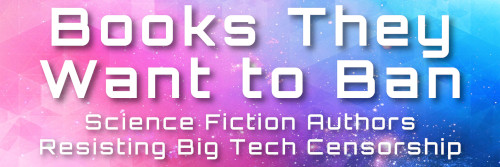
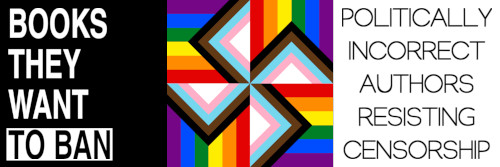
The second banner might be a little too on-point (not to mention, it may get me banned from a few places), but I’m trying out this Books They Want to Ban theme again right now. I did something like it a while ago, and it didn’t do super well, but it’s worth running at least a couple of times to see how it goes.
So what do you think? Should I try running with this theme, or just totally avoid the woke / anti-woke politics altogether?
This author’s note originally appeared in the December 19th edition of my author newsletter. To subscribe to my newsletter, click here.
I’ve been thinking a lot about self-reliance recently. I just finished reading One Second After by William R. Forstchen, and while it’s a good book—perhaps even an important book—I have to say that is not the sort of thing that is fun to read when you’re newly married and expecting your first child. It really makes you think about the things you take for granted, and just how fragile our world really is.
If you know the basic premise of the book, you’re probably nodding along sagely right now. If not, then you probably haven’t read much prepper fiction yet. One Second After is actually a pretty good book to start with, if you’re interested in the genre. In the next couple of weeks, I’ll write a proper review.
I don’t consider myself a “prepper” in the common sense of the word. I don’t have a stockpile of guns or ammo, I don’t really go for all the “tacti-cool” stuff that’s popular in prepper circles, and I don’t obsess over SHTF scenarios. That said, I’m not ignorant of the many ways our society could (or is) falling apart, and I do have contingency plans if/when that happens.
Probably the best prepper blog/resource that I’ve found is Listening To Katrina, which was written by a guy who lived through Hurricane Katrina and the aftermath. Lots of really fascinating stuff there, and he does a fantastic job of boiling his experience down into lessons for the rest of us. I discovered this blog just as I was starting to get more interested in self-reliance and emergency preparedness, and it did a lot to develop my thoughts on the subject.
Another big influence on me were the Forgotten Skills books by Caleb Warnock. A lot of really fascinating stuff there. He hits on things from the self-reliance angle more than the prepper angle, which is how I like to come at it too. It’s not about having two years of freeze-dried food in your basement that you never eat or use, it’s about living in such a way that you can provide for your own needs whether or not a disaster strikes, and produce more than you consume.
About a year ago, I took what I’d learned from these and other resources and mapped out something that I call my Path to Self-Sufficiency:
The items are listed in rough order, though I’ve jumped around a little bit since making the list. For example, Mrs. Vasicek and I have solar panels on our house (11), and we’re looking seriously into keeping bees (14). But it’s a pretty good reference point for answering the question “okay, what’s next?” Currently, I’m working on step 6, and when spring comes around I’ll dive into steps 7, 8, and 9.
A lot of this hearkens back to a blog series that I started several years ago, called “the self-sufficient writer.” At the time, I was exploring ways that I could incorporate what I was learning into my writing career and lifestyle. The goal, I suppose, was to show how it’s possible not only to make a living as a writer, but to achieve a healthy degree of self-reliance at the same time.
Would you be interested in reading that blog series if I brought it back? I’ve learned a few things since then, and would have to start it over from the beginning, but it’s an interesting subject that I enjoy exploring. And now that I’ve finally got some land to work with, there’s so much more to do.
The Path to Self-Sufficiency is very much a work in progress, and I doubt I’ll get to everything on it. A lot depends on Mrs. Vasicek and what she wants to do. With a child on the way, other projects will no doubt take priority, but with everything going on in the world, this is not a ball I think we can afford to drop. If you have any suggestions or stories of your own, I’d love to hear from you.
This author’s note originally appeared in the September 19th edition of my author newsletter. To subscribe to my newsletter, click here.
It’s September, which means (among other things) that it’s time to revisit my business plan and update it for the next year. Every January 1st, I print out a new and revised copy of my business plan, which provides a great opportunity to evaluate my efforts and hone in on the things I need to do better.
For the last couple of weeks, I’ve been working on the section titled “What I Write.” In this year’s business plan, it was a pretty straightforward breakdown of all of the series in my catalog. But for next year, I took a few steps back to address things like what is a Joe Vasicek book? or what are some of my books’ recurring themes? or what kind of science fiction and fantasy do I write specifically, and how does my work contribute to the genre?
The exercise really got me to think about why I write. In the day to day life of a writer, it’s very easy to lose sight of the forest for the trees. Deadlines and daily word count goals keep the focus on the page right in front of you, and when you do think ahead it’s usually just to the next chapter. But without taking time to step back and look at the bigger picture, it’s easy to lose that creative drive, or settle for second-rate work.
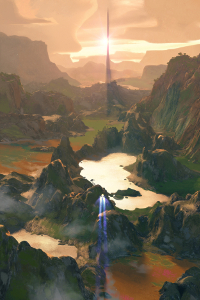
So what is a Joe Vasicek book? I hope it’s a book that’s memorable and meaningful. It may be dark, but never dismal. It may push you out of your comfort zone, but it also leaves you feeling rejuvenated and inspired. It features interesting characters wrestling with complex ethical dilemmas and struggling to do the right thing as best as they know how.
What are some of my books’ recurring themes? The balance between liberty and responsibility is a huge one. Actions have consequences, and true liberty is taking ownership of those consequences as well as your actions. Another is the sanctity of sex, contrasting selfish gratification with the affirmation of commitment and love. The yearning for God is another recurring theme, with a great deal of religious diversity in the starfaring civilizations of my books. Another theme I keep coming back to is the call of the frontier.
I’m curious, though, to hear what you guys think. What do you think makes a Joe Vasicek book? What tropes or recurring themes have you enjoyed in my books? As a writer, I’m often too close to my own work to see what’s obvious to everyone else. What do you think is my biggest contribution to the genre?