Trope Tuesday: The Chessmaster

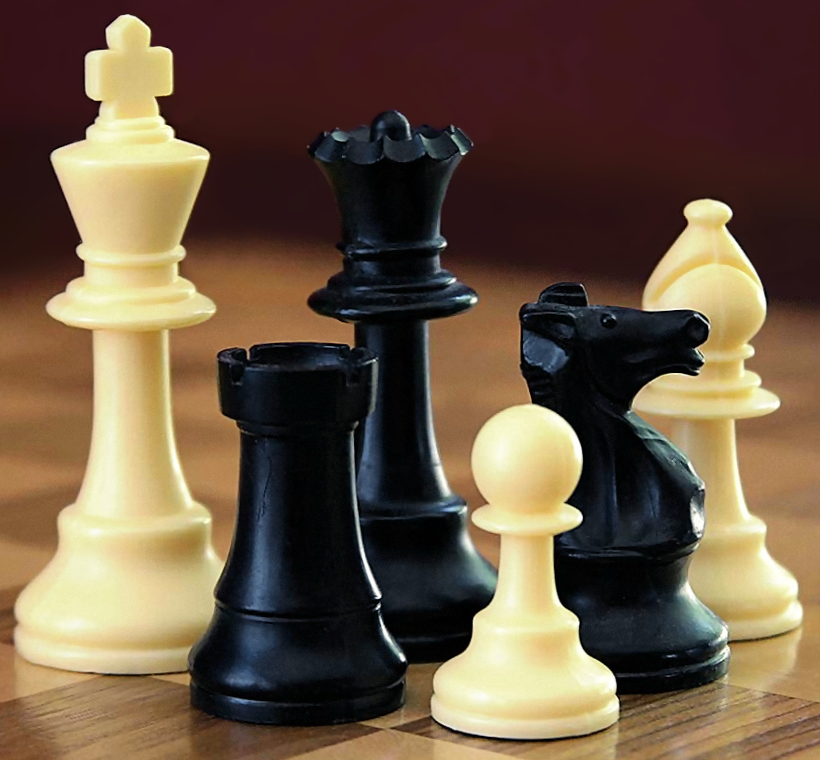
The Chessmaster is a fun trope, especially when done well. A good villain is always at least one step ahead of the good guys, so when it turns out that he’s three or four or ten steps ahead of them, it can make for some interesting plot twists.

Of course, the chessmaster isn’t always the bad guy. Sometimes, it turns out that the mysterious figure behind the scenes pulling all the strings is actually working for good, even though he may sacrifice a few pawns along the way. Or is he? There’s always that tension, simply because of the chessmaster’s manipulative nature.

I’ve played it both ways. The last time I wrote a chessmaster was Gunslinger to the Stars, but the Patrician in Heart of the Nebula definitely also qualifies. In both cases, the character was introduced as a mysterious employer. I won’t tell you which one was the bad guy, and which one was the good guy.

I’ve never written a story from the perspective of the chessmaster. I imagine it would be quite difficult, since all of the plot twists would have to be telegraphed and/or th reader would have to be kept in the dark about the main character’s plans. Dune is an excellent example of the former, but I can’t think of any good examples of the latter. The Davinci Code comes to mind, but the way it kept the viewer in the dark (seen the movie, haven’t read the book) didn’t work for me.

Even as a non-viewpoint character, the chessmaster can be difficult to write. Careful plotting is key, of course, but so is the iceberg principle. For everything the reader can see, there has to be a bunch of stuff beneath the surface that they can’t see. It doesn’t require the same level of detail as the surface level stuff, of course, but you have to at least have an idea of what the chessmaster would do if the story went in a very different direction. Even if the chessmaster never reveals those plans, you can bet that he still has them figured out.

In part, this is what made Heart of the Nebula so difficult to write. The final draft bears little resemblance to the first draft, with characters and subplots cut out or combined with others. Still, I’m satisfied with how it turned out, and it seems that the readers are as well.

In Sons of the Starfarers, Gulchina isn’t a chessmaster so much as a magnificent bastard with delusions of grandeur. She has plans and does tend to be three or four steps ahead of everyone else, but she’s less interested in manipulating events than she is in manipulating people. Her ultimate goal, as revealed in Captives in Obscurity, is to establish a proud warrior race that will one day wipe out and take over both the Empire and the Outworlds. She doesn’t know how that’s going to happen, but she knows what needs to be done to lay the foundation for that work.

The chessmaster is a challenging trope to write well, but I’m sure I’ll use it many more times in the future. The storytelling potential is just too great to leave it out.

Pantser vs. plotter? There is no such thing

I have come to the conclusion that the “pantsing vs. plotting” way of thinking about writing is as impractical and useless as nature vs. nurture, or talent vs. learned ability.

Are you a pantser who discovery writes from the seat of his pants, or a plotter who has to outline every character, every plot point, and the whole world first? Well, that’s about as useful as asking whether you were born stupid or whether you were taught to be. Probably a combination of both.

The pantsing vs. plotting dichotomy is something I learned early on, when I was just starting out as a writer. At the time, it seemed like a useful distinction to make. Beginning writers tend to make a lot of mistakes, and those range from world-builder’s disease (where you spend all your time outlining instead of actually writing), to rewriting the first chapter into oblivion, to writing yourself into a corner and having all your characters scream at you. It’s amazing how many things you can get wrong. By dividing these things up into pantsing problems vs. plotting problems, it was helpful to figure out how to fix those.

But then you start to identify with one side or the other, and that leads to an entirely new set of problems. Because the truth is that to write well, you need both. A pure pantser often writes himself into problems that he can’t easily get out of, or misses key elements that render the rest of the story moot (like “if only these two people would talk with each other, the obstacles to their romance would all go away” or “if only Hermione would use the time-turner to stop Voldemort from becoming the dark lord, no one else would have to die”). In contrast, a pure plotter often writes stories that are too mechanical and predictable, telegraphing every plot turn and reducing every character into an avatar for some theme or idea.

So, while thinking of it in terms of pantsing vs. plotting may be useful for the beginning writer in diagnosing the areas they need to work on, I’ve found that it’s not particularly useful for the professional writer. In fact, it can be damaging.

For the last several years, I’ve considered myself to be a pantser. Discovery writing is my mojo—give me a few good ideas and the barest outline of a plot, and I’m off to the races. Except… I always tend to stumble and fall in the middle. In fact, I often have to throw out entire chapters or set a story aside for months at a time, to “let the ideas percolate.” For the last several years, that’s been my modus operandi.

Until now.

With Son of the Starfarers, I’m working on a set of very tight deadlines to finish the damn series as quickly as I can. It took way too many months to write book 7, and I can’t afford to take that much time for the last two books because that’s time I’m robbing from other projects (like Edenfall or Gunslinger to the Galaxy or The Sword Bearer). As a pantser, I can write any book if given an infinite amount of time, but that’s not practical. I need to find a new way to write, one that maximizes my efficiency.

And I think I’ve found it. I’m still tweaking it, of course, but it involves <gasp!> outlining. But wait—I’m a pantser, not a plotter! Except, it turns out, that I’m not. Because no one is.

Pantsing vs. plotting does not describe the writer so much as the method of writing. It’s not a question of where you fall on the spectrum, it’s a question of whether this particular project requires more discovery writing or more outlining. And it turns out out that there are ways to outline stories that actually make your discovery writing better. Every battle plan falls apart upon contact with the enemy, but you need the plan to know which direction to march your troops.

In the next few weeks, I’ll go over some of the new outlining methods I’ve been trying out. It took me almost five months to write A Queen in Hiding, struggling over multiple drafts, but it’s been only four weeks since I started An Empire in Disarray and I’m more than 2/3rds of the way through it, with a clean first draft, and I’m on track to have something finished and publishable by the end of next week. There are still a few kinks in the process to work out, but I think I have it down well enough to share.

So if you consider yourself a “pantser” or a “plotter,” and you’re still struggling to write as much or as well as you’d like, I’d urge you to revisit your basic assumptions about your writing process. That’s what I did, and it’s made all the difference.

Four-part structure and the writing process

Over the course of writing Gunslinger to the Stars, I’ve learned some interesting new things about my writing process, as well as being reminded of some of the basic lessons I learned back when I was getting started. These lessons have helped me to have some fantastic writing days, like today, where I hit 2200 WPH at one point and knocked off 1.7k words before lunch.

Just a week ago, though, I was struggling to write anything, which was strange considering how well the story had been coming along up to that point. The realization that helped me to get through that and get back to writing strong was that my difficulty was a function of story structure, and that different parts of the story require a different process.

What follows are my personal conclusions about my own writing process, which may or may not be similar to your own. Every writer is different, so what works for me may not work for you. At the same time, there are enough similarities that I hope my own process may provide some insight into your own.

Four-Part Story Structure

First of all, let’s talk about story structure. There are a lot of different possible structures, but the most common one in the West is the three-act structure. This often echoes the hero’s journey, which goes something like this:
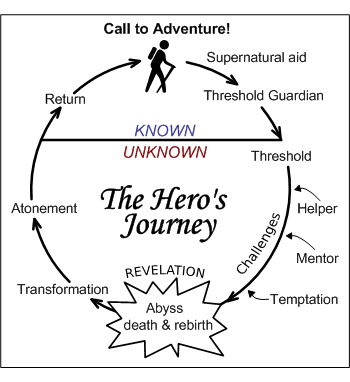
heros_journeyFor purposes of this blog post, I’ll assume you’re already familiar with both the three-act structure and the hero’s journey. If not, there are plenty of other resources where you can learn about them in-depth.

I prefer to think in terms of four-part structure, however, where act two is divided into two halves. In typical three-act structure, the hero hits his lowest point at the midpoint of act two. This is also the midpoint of the story itself, where the hero reaches the nadir of the hero’s journey. In four-part structure, that midpoint is just treated like a plot point, dividing part two from part three. Everything else is the same.

Thus, when you frame a particular story in four-part structure, it looks like this:

  1. The Call to Adventure
  2. Tests, Allies, and Enemies
  3. The Darkest Hour
  4. The Final Battle

Part One: The Call to Adventure

The first part of the story typically starts in the ordinary world, until the inciting incident somewhere around the middle of part one calls the hero to adventure. He then either refuses the call (which usually leads to bad things because the call knows where you live), or he accepts it and has to fight off some threshold guardians to get into the realm of adventure (sometimes, he refuses it and has to fight the guardians). Typically around this point, he meets a mentor to help him on his way.

Prewriting: To get off to a good start, I have found that the key is to know (or at least have a good idea) how the story is going to end before I begin to write it. That way, I know that I’m starting in the right part and I have a general idea where I’m going. I don’t know how I’m going to get there yet, but that doesn’t really matter yet.

Writing: The hardest part about writing this part is the first scene. After that, it usually comes quite easily. It helps to do a bit of world building, or to outline the characters and their backstories, but it isn’t always necessary. Personally, I’ve found that I can discovery-write these things pretty well (and yes, if you haven’t guessed already, I’m a pantser).

Revising: This is usually the part that needs the most revising. It’s also the part that can get me into the most trouble if I don’t do it well. I’m a chronological writer, and if something in the story is seriously off, I have to go back and fix it before I can proceed to the end. I’ve forced myself to finish even when I knew that things were broken, and it only made the writing process worse. So for me, the beginning usually gets the most revision work, whether I plan on it or not.

Part Two: Tests, Allies, and Enemies

Part two is where the adventure really begins. The hero crosses the threshold into the unfamiliar world, and everything is new and exciting. This is also the part where things start to become truly dangerous. Not everyone is who they seem in this part, and the hero may fall into some traps. But the mentor is usually still there to help him get back up.

Prewriting: In my experience, this is the part that needs the least pre-writing. It’s almost always pure discovery. With the ending clearly in mind but still distant enough not to worry about, I can afford to let the story meander a little and take me to some unexpected places.

Writing: This is usually the easiest part of the story to write, for the same reasons as above. I can afford to do almost 100% discovery writing at this part, and it usually feels quite effortless. When the writing does get blocked, it’s usually because something in part one is totally broken.

Revising: Most of the revision process for part two consists of making sure that later events are properly foreshadowed. I usually don’t add enough foreshadowing when I write the first draft, so it’s essential to go back and add it later. Thankfully, this can usually be accomplished by a couple of tweaks, or adding a couple extra paragraphs to an already extant scene.

Part Three: The Darkest Hour

This is where the story gets real. The hero falls into a much larger trap than any of the others, and the mentor can no longer help him (usually because he’s dead). Alone, the hero has to find his own way out, usually hitting rock bottom along the way. Just when it looks like all is lost, some new twist sends the hero in a different direction, setting things up for the final act.

Prewriting: This is where prewriting goes from being unimportant to absolutely essential. Whereas in part two, I can afford to let the story meander a little bit, in part three I absolutely need direction. It’s not enough just to know how the story will ultimately end: at this point, I’ve found that I really need to map my way there.

Writing: This is also typically the most difficult part for me to write. However, when the prewriting is done well and the plot is set up properly, it’s actually not that bad. But it’s important to go really hard on your characters—to make life truly miserable for them. There can be no easy way outs for them, otherwise the entire story will suffer.

Revising: For part three, revising usually consists of putting scenes in the proper order, not in rewriting them completely from scratch. If the foundational elements of the previous two parts were set up correctly, then everything in part three will usually come out well too, but they’re almost always in the wrong order. Transitions then are the part that usually need the most cleanup.

Part Four: The Final Battle

At this point, the hero has a clear direction and a knowledge of how to get there. In climbing up from his lowest point, he finds the boon that will save the world, makes peace with the higher power, and comes back stronger than ever before. But the forces of evil have never been stronger either, and the clash marks the climax of the entire story. There may be a big damn hero moment, or a last minute rescue from the cavalry. There may also be a standoff with no apparent solution, or some truly complex power plays. Inevitably, though, there is a resolution, followed by a return (even if only to the world of adventure). The hero saves the world, gets the girl, and rides off into the sunset. Curtains, applause, and lights.

Prewriting: By this point, most of the prewriting has already been done. The important thing is to have the flexibility to change and adjust, because this is the point where the story often surprises me. It is also the point where discovery-writing is often the most satisfying.

Writing: At this point, I’m usually tearing it up in a white-hot heat of creative energy. It’s extremely rare that I’ll get blocked at this point, but if I do, the key is almost always to just write through it. Often, I’ll make notes of things to change in revision and just barrel ahead—and it works, because there’s no need to set anything up for later. This is the moment of truth, where everything comes together.

Revising: Most of the revision at this point of the story has to do with tying up loose ends. That’s usually not a problem for me, though, because I tend to write very clean. If there is a loose end, it’s usually something that I’ve made a note to fix earlier in the story. For me, the ending is usually the part that needs revising the least.

So there you have it. The biggest lesson I’ve learned just recently is how important it is not to neglect the prewriting aspect of the creative process, especially around part-three. When everything is in place, it makes the story flow so much better.

What are your thoughts? Any plotters or outliners out there with a different take on the process? Everyone is different, but we’re all basically trying to do the same thing, so it’s interesting to see what works for different people!
Trope Tuesday: Character Alignment

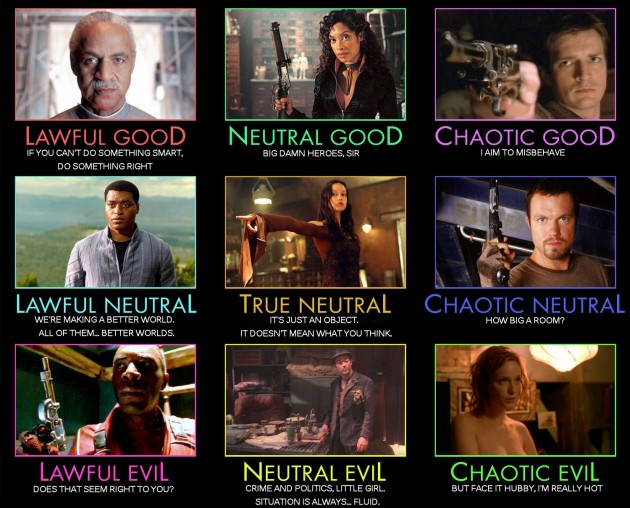
Alternate versions put 20th Century Fox in the Lawful Evil slot.

I love personality tests.  There’s something immensely satisfying about putting yourself on a grid that tells you something new and insightful about yourself and the people around you.  My personal favorite is the Meyers-Briggs test (I’m an ENTP), but I like playing around with others as well.

Character alignment is what you get when you combine fictional characters with the role they’re supposed to play in the story.  It’s a way to categorize the different ways they react to problems and ethical dilemmas, and to see which are inclined to be enemies and  which are inclined to be allies.

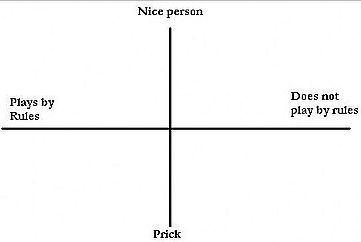
These systems initially arose out of RPG systems like Dungeons and Dragons, which use numbers, charts, and statistics to turn a story into a playable game.  There are many different kinds of alignments, but the most well-known is probably the one used by D&D, which charts characters along a good-evil axis and a lawful-chaotic axis.  In practice, the result looks a little like this:

Of course, that’s a very simplified version.  The tvtropes page goes into much greater depth, but I’ve personally found that this page right here does a much better job explaining the concepts behind the chart.

The horizontal axis, law vs. chaos, describes how much the character values order and authority vs. their own independence and freedom.  Lawful characters value honor and obedience, while chaotic characters value innovation and rebelliousness.  Characters who are neutral with regards to law and chaos generally respect authority, but put their own interests first and go against the established norms when that’s the best way to further their own ends.

The vertical axis, good vs. evil, describes how well (or poorly) characters tend to treat other people.  Good characters are altruistic and make sacrifices to protect the defenseless, whereas evil characters will kill, rob, or torture the innocent simply for the evulz.  Characters who are neutral with regards to good and evil don’t like to hurt others, but are not above pursuing questionable means to achieve their own goals.

Put together, the alignments create a 9-square chart, like the one at the top of the post.  While it’s certainly not obligatory to fill every slot, doing so can add a greater degree of depth to your story, as it certainly did with Firefly.

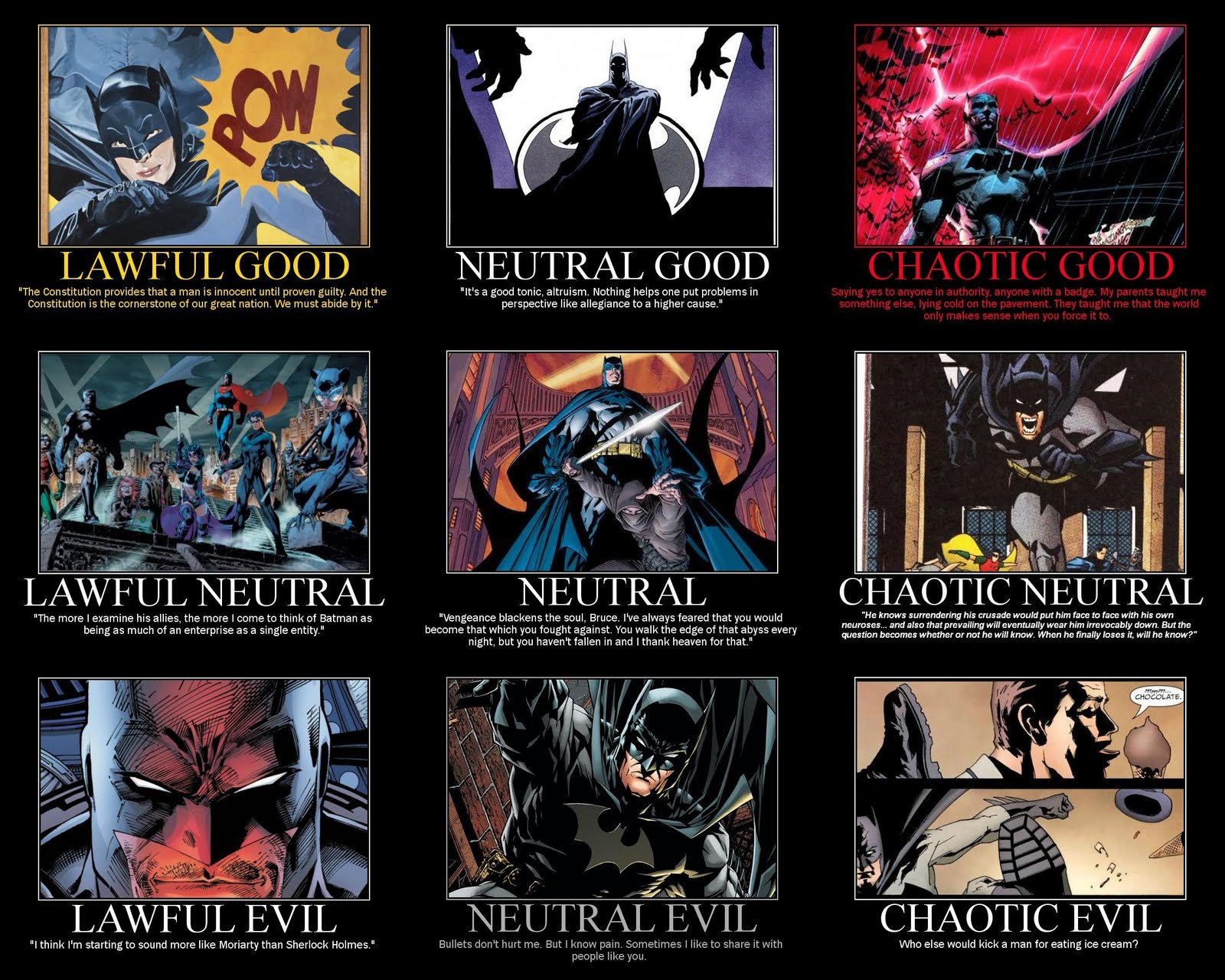
As with any formula, however, there is danger in holding too closely to the chart and becoming inflexible.  In real life, people switch alignments all the time, just as personalities can change and evolve (in high school, for example, I was an INTP).  Not only that, but some characters even fulfill all the possible roles, depending on the incarnation and the story.

Because I'm BATMAN!

The point is, character alignment is just a tool, not a hard-and-fast rule that needs to be used with every story.  If it’s a helpful way to think about your characters and set them up with interesting conflicts, great.  If not, don’t sweat it; Homer and Shakespeare were telling great stories long before this chart.

I’m going to be going overseas soon, so I expect my internet access is going to be spotty for the next couple of months.  Because of that, I’m going to write up a bunch of Trope Tuesday posts on each of the nine alignments and schedule them to post automatically.  So stay tuned for more!

Climbing the 10k mountain

Many Bothans died to bring you this.

I recently read an amazing blog post by Rachel Aaron, in which she explains how she went from writing about 2k words per day (about what I’m doing) to routinely breaking 10k.

This is something I really want to do with my own writing.  As I noted a couple of weeks ago, I need to pick up the pace if I’m going to keep up with my professional goals.  If I could go from 2k to 10k, and make 10k the standard…holy cow, that’s a 500% jump in productivity.  Who wouldn’t want that?

From Rachel’s blog:

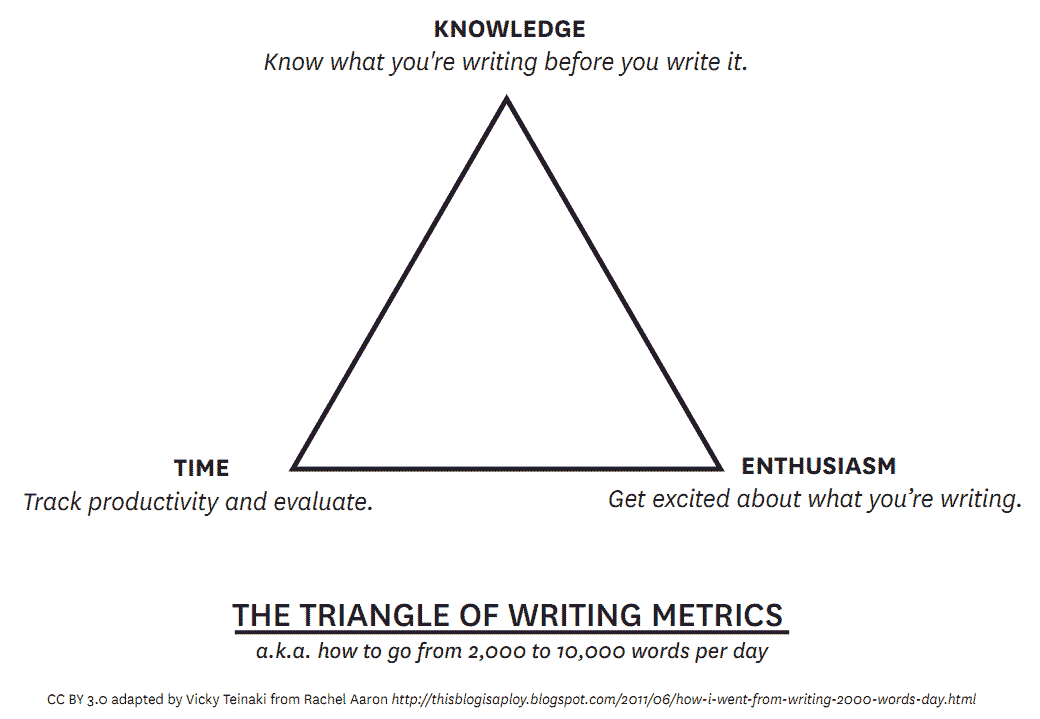
Drastically increasing your words per day is actually pretty easy, all it takes is a shift in perspective and the ability to be honest with yourself (which is the hardest part). Because I’m a giant nerd, I ended up creating a metric, a triangle with three core requirements: Knowledge, Time, and Enthusiasm. Any one of these can noticeably boost your daily output, but all three together can turn you into a word machine. I never start writing these days unless I can hit all three.

The point that I probably need to work on the most is time: I tend to start off the day slow, checking Facebook and blogs and other stuff before getting into the writing, then write for a little while before running off and doing some chore or allowing myself to get distracted again.  Sometimes, I don’t really buckle down until a couple of hours before I should go to bed, and that’s bad.

But really, I think the main obstacle is just thinking that writing is difficult.  If everything comes together in the right way, there really isn’t any reason why 5k or 6k or even 10k should be too difficult–and yet we naturally think that if 2k is hard, anything more should be that much harder.

I’m in a weird state of limbo right now between moving and preparing to go overseas, but I’m going to start a daily writing log so that I can figure out what time of day is most productive.  You can’t wait for life to settle down before you get to work; you have to roll with what you’re given.  Also, I’m going to put a lot more effort into outlining and planning, so that I don’t get hung up by research when I should be writing.  Even discovery writers need a little bit of time to ponder things before putting words to the page.

Also, after considerable thought and effort, I’ve decided to put Star Wanderers on the back burner again.  I finished the novelette last week and submitted it to Writers of the Future; I think it’s quite good, and stands a good chance of finding a home in one of the short markets.  But the full length novel, for various reasons, just isn’t coming to me.  I don’t know if it’s because I lack the life experience to write it, or because I’m too close to it to see what’s broken, but regardless of the reason, I need the break.

I’m not sure whether to do Edenfall or Stars of Blood and Glory next, but I’m leaning towards Stars of Blood and Glory.  This is a novel set in the Gaia Nova universe, with characters from Desert Stars, Bringing Stella Home, and Heart of the Nebula.  I’ve been itching to write it since this summer, but never got around to it because other projects got in the way.  Well, hopefully now that will change.

I know from emails and other correspondence that some of you are really looking forward to Edenfall, but don’t worry, I’ll get around to it soon.  In order to do it justice, I feel I need to reread Genesis Earth and immerse myself in some Carl Sagan, but right now I’m still running on a sci fi adventure trip.  If I can implement some of these metrics and push my daily word count upwards of 10k, it shouldn’t be long before Edenfall gets my attention again.  My goal is to finish it before the end of the year, so there’s a very good chance it’ll be published sometime in late 2012.

As for Star Wanderers, I’ll shop the novelette around after I hear back from Writers of the Future.  I think it has a good chance at winning the quarter, but of course I can’t count on it.  At this point in my career, I should probably be playing both the traditional markets as well as the indie field.

That’s just about it.  Now, if you’ll excuse me, I need to write…

Soundtrack for an untitled book

I’ve got this great idea for a novel, with a rough plot outline, an awesome ending, setting and characters all worked out, even the soundtrack–but no title.

I enjoy making soundtracks for my novels, but this is the first time I’ve made one before writing the first draft.  Usually, my first drafts are so all over the place that I end up hating whatever music I try to associate with my work–that, or the feel of the book ends up being so different from the feel of the soundtrack that I just have to abandon it.

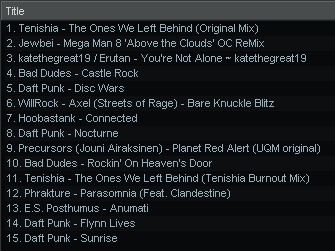
In spite of all this, I couldn’t really help myself from putting together a playlist for my next big project, a Gaia Nova novel combining characters from Bringing Stella Home and Desert Stars.  Here it is:

For me, soundtracks are all about the emotion that a story evokes.  I’m going for a tense and gritty feel, with heart-rending losses and soul-crushing defeats interspersed with poignant moments of personal triumph.

The really cool thing is that the soundtrack has helped me out a ton with the outlining process.  I’ve spent a lot of time in the past month hiking in the mountains around Provo, just listening to music and thinking about this story.  Whenever I put on the soundtrack, something would click and I’d see exactly what the story needed.  I kid you not, all of the plot twists and big reveals came to me while listening to this music.

Now if only I could come up with a title…

Fighting for a Homeland

For the past few weeks, I’ve been brainstorming ideas for my next big novel project.  One of the ways I’ve been doing this is to by trawling tvtropes and putting together a mashup of the story tropes I’d like to play with.

By far, the one that’s struck me the most is Fighting for a Homeland.  This is basically when a band of displaced warriors is wandering the Earth, trying to find their own promised land.  There are a lot of examples of this on the tropes page, but the coolest one is probably this from real life:

The first Czech legion, after World War one. Their country was then merely a province of Austria-Hungary, who started the war and teamed up with the Germans. The Czechs had very little reason to fight for them, and surrendered to the opposing Russians whenever they could. Through a lot of political scheming, the Russians were convinced to raise a Czech legion of 60,000 men to fight against the Austrians.

Then the Revolution broke out, and with the peace treaty between Russia and Austria, and the vicious warfare and politicking in Russia, they would not get their goal, an independent Czechia, so they turned to the western allies. They could not leave the country through the western side, so the allies chose to rendezvous with them in the port of Vladivostok, on the other side of Russia.

They crossed the country in three years, using the railways that they hijacked, joined with the Russian White Army (anti-communists) and the allies, stole the Tsar’s gold, traded it for free passage to Vladivostok with the advancing reds when they lost, and safely sailed home, to the newly founded country of Czechoslovakia.

Isn’t that friggin awesome?  What’s even cooler is that I might have ancestors who fought in the legion.  My great grandfather emmigrated from Moravia right around that time, perhaps a little before.  Man, if I ever write a historical novel…

But yeah, the trope almost perfectly characterizes Danica and her band of mercenaries, who feature prominently in Bringing Stella Home.  Their homeworld, Tajjur V, was fighting for independence right before the Hameji conquests began, and the New Gaian Empire put down the rebellion rather forcibly.  Later, when the system fell to the Hameji, their homeworld was bombarded and slagged into oblivion, leaving them with nowhere to call their own.

Long story short, the story of the Czech Legions and their epic journey across Siberia has totally inspired me for this next novel.  I’m going to make Roman (Danica’s NCO) a major viewpoint character, bring back the old mercenary team, throw in a few new ones (including a character from Desert Stars)…man, it’s going to be AWESOME!

In other news, “Decision LZ1527” and “From the Ice Incarnate” are both available for free from Diesel Ebooks.  Genesis Earth is also up there too, so if you feel inclined to post a review, I would certainly appreciate it!

Also, if you REALLY want to help, drop by the Amazon pages for “Decision LZ1527” and “From the Ice Incarnate” and fill out the little form where it says “tell us about a lower price.” I’m trying to get Amazon to offer my short stories for free, but the only way to do that is to make it free somewhere else and get Amazon to price match.

Hopefully, by making them free it will get me more exposure and drive more interest in the novels.  Moses Siregar did a guest post on that just this morning.

Also, I think I’ve found a new template that might work well for this blog.  What do you think?  Obviously, I would tweak the background and header (and possibly the color scheme as well). The main thing is that it has multiple sidebars, which will make more room for my books.  But if you have a better suggestion, please let me know.

Deciding on the next project

First, you know how I said I’d raise the price of Genesis Earth as an experiment?  Well, after thinking it through a little more, I figured that it’s more important at this point to build a following, and to do that I should probably have at least one novel at the $2.99 price point.  Since Genesis Earth is the only novel I have out right now, I decided to drop the price, where it will probably stay for a while.  Flakey, I know, but so be it.

More importantly, I’m coming up on the end of the third draft of Desert Stars.  It’s going to be a push, but I hope to finish it by the end of the week.  It’s an awesome book and I’m way excited with it, but it leaves me wondering: what next?

I’m currently torn between two projects.  The first one, Edenfall, is the sequel to Genesis Earth, and the second in the trilogy.  It’s been kicking around in my mind for a long time, and I’ve already got it all outlined and ready to go.

But…the flashier, more exciting project to me right now is the next book in the Gaia Nova series, an indirect sequel to both Desert Stars and Bringing Stella Home, which I hope to epublish later this month.  Even though I have a ton of ideas for it, I have absolutely NO outline whatsoever.  Nothing.  All I know is that it’s basically the Battle of Ain Jalut in space, with Rina from Desert Stars and Danica, Roman, and the other mercenaries from Bringing Stella Home.  Oh, and Stella and Qasar’s son, a Hameji prince who makes an appearance in Into the Nebulous Deep.  That’s it.

And yet…I am sooo excited to work on it.  You have no idea.

So…should I go with the safe, reliable project?  Or the sexy, mysterious one?  There are good reasons to go with either.  Edenfall should be fairly straightforward, taking no more than two months.  With the first in the series already out and selling, I should probably write it sooner rather than later.  However, the Gaia Nova series is much more expansive, and since I’m already immersed in that universe from working on Desert Stars, it would be much easier to jump right into it.

Right now, I’m leaning more toward the second project, but knowing my personal writing process, I’ll probably get stuck somewhere in the middle and switch to Edenfall.  But hey, if it works, it works.  That’s how I’ve written all of my other books so far: start the rough draft with a frenzied burst of creative energy, then let it sit for a while and move on to other projects before coming back and finishing the first.

Either way, I’m not going to pull a Rothfuss or a Martin.  My goal is to finish my next project in 8 weeks or less, which will be tough with my current job, but not impossible.  Which reminds me of yet another reason why I never want to be salaried (unless I’m the one running the business).  Not that I plan on ever being pregnant…

Thoughts on outlining

I’m on track to finish my fifth novel in a couple days, and surprisingly, the writing has been going very smoothly.

Usually by this point, my eyes are bleeding and I feel as if I have a hundred caltrops in my pants.  Finishing a rough draft is still the hardest part for me, since by the end everything seems to suck and I just want to trash the whole project.

I still feel a little bit of that with Into the Nebulous Deep, but not nearly as much as with my previous stuff.  Part of that is probably because I feel confident that I can fix whatever I screw up, but the other part probably has to do with the way I’ve learned to outline.  In one short sentence, here’s what I’ve learned:

An outline is simply the story you tell yourself to help you tell the story.

I don’t think there’s any mortal writer on this planet who can keep a whole novel in their head at one time.  Scenes, yes; chapters, maybe; novels, absolutely not.

However, since everyone’s creative mind works a little differently, everyone has to find the process that works for them.  Brandon Sanderson, for example, writes story bibles that are almost 100k words long.  If I were to try to do that, I’d get bored halfway through and spend the rest of the day dorking around on youtube.  Other people prefer to fly by the seat of their pants, and while there’s something to say about trusting your subconscious, I need a little structure to keep from getting totally lost.

It took me a while to figure out the process that best works for me, but based on how ITND has been going, I think I’ve hit my stride.  Breaking it down into plot, setting, and character, here’s how I basically do it:

Plot

For me, the basic plot of the story comes in a flash of creative insight once all the ideas in my head have reached a critical mass.  It’s like watching a fissure shoot across a smashed window pane, or lightning arcing from the ground to the sky.

If I don’t have time to start the project right away, I’ll let the plot mull around in my head for a couple days, then open up notepad and free write the basic structure of the story in an unedited stream of consciousness.  When I do start the project, I’ll look back to the free write to refresh my memory, but otherwise work out of what’s in my head (which may have changed).

While the project is ongoing, I’ll divide the whole novel into parts, chapters, and scenes.  For the chapter I’m currently working on, I’ll have the various scenes listed in bold with their corresponding point of view character (eg: “1.1: James“), followed by a brief one or two line description of the action and plot significance.  If I introduce a new character in that scene, I’ll write their name in ALL CAPS (I believe that’s a screenwriting convention I picked up from my old college roommate).

For chapters I haven’t written yet, I just write a few lines of description for what I envision happening in them.  When I first start out, I usually have a clear idea where I want the story to end, but I don’t bother outlining all the stuff in the middle since that usually changes based on stuff that comes before.  I only keep my outline a few chapters ahead of where I currently am, and may change things completely if something new comes up.

This process works very well for me.  I use it for every draft, and refer to it often.

Character

I’ve found that I need to do a lot more outlining to figure out my characters than I do with my plot.  However, it’s like Tracy Hickman said with the marbles: don’t hold onto your outline too tight, or all the marbles will slip out between your fingers.

The things I absolutely need to know about my characters are:

  • back story
  • motivations
  • first impressions
  • flaws & handicaps
  • strengths & advantages
  • why the reader should care about / sympathize with them

For some odd reason, I find it most helpful to write this out longhand, usually while taking a walk.  For additional help, sometimes I’ll take a personality test on behalf of my character and get a handle on them through their personality type; for that, I prefer the Meyers-Briggs typology.

But once I feel I have a solid handle on a character, I’ll throw everything out if it feels instinctively right for a character to do something completely different.  Thing is, I need the outline (especially the motivations and back story) to get to the point where I know the character well enough to let them take over.

And for some reason, all my main characters feel too…generic.  I’m not sure why, but that’s something I’ve got to work on.

Setting

Setting, for me, is all about discovery writing.  I’ve tried using wikidpad to worldbuild my universe before I start, but that’s never worked.  Instead, I daydream a lot and trust my subconscious to give me what I need when I need it.

That’s not to say I don’t do research–just that most of my research is on the fly.  If I only stay on wikipedia and the footnotes and references, no problem; if I get sidetracked on facebook, however…

Often, when I’m doing setting descriptions, I’ll run a quick google image search to pull up pictures to give me a better visual idea of what I’m describing.  I especially use this for clothing; that’s why, if you check my search history (please don’t), you’ll find all these weird, girly terms like “ottoman dress,” “jumpsuit,” “leather jerkin,” and “full frontal snogging” (whoops, where did THAT come from??).

The big problem is when I figure something at the beginning of the book and then forget about it halfway through.  For that reason, I should probably invest in a good copy editor when I start to publish.  I should also take the time to draw out a starmap, since it’s getting REALLY hard for me to remember where the Belarian system is in relation to Tajjur and Karduna Prime…hmm…

I should probably figure out a better system to keep track of my settings, but as far as outlining them goes, the less the better.  I love waving my hand and creating stuff–it’s one of the main reasons why I’m a science fiction writer.

So anyways, that’s more or less the outlining system I currently use.  I might end up outgrowing certain aspects of it, or finding a better system, but this is what works best for me now.

Of course, I still have a lot to learn.

Just another update

A few updates, in case you’re interested in what’s going on with me:

I’m getting ready to post a new story to Amazon.  This is going to be the one that won first place in the 2009 Mayhew short story contest at BYU.  It’s also an excerpt for Genesis Earth, which is currently in the quarter finals for the 2011 Amazon Breakthrough Novel Award.  More news on that as it comes out.

Into the Nebulous Deep is coming along.  Surprisingly, the rough draft follows a very tight, coherent plot structure.  At this stage, every other novel I’ve written is usually all over the place.  This one looks like it’s going to be twenty chapters, with four parts of five chapters each.

Right now, I’m in the middle of chapter 13.  I was hoping to finish it this week, but my sister was in town this weekend, so I spent most of my time with her instead.  Not that that’s a problem; I can probably catch up tomorrow.  I’m hoping to finish part III before the end of next week.

It’s going to be tough, though, because I’m starting a new temp job on Monday.  It’s 40 hours per week at $9, which is pretty sweet, especially since my tax return is basically going to cover all my expenses this month.  Hooray for cheap Utah summers!  The full time work is going to be tough on the writing, though.

Which brings me to my last update: the guys at Pioneer Book called me back today and set up a job interview on Tuesday!  Hooray!  I’m totally stoked–this bookstore job would be awesome.  I might even postpone my TEFL plans for a while if I get the job.  It probably won’t be full time or pay much more than minimum wage, but dude, it’s a bookstore. Plus, part time work is perfect for writing.  As long as I have enough to get by, I’ll be happy.

And to close, let me leave you with this awesome trailer my brother in law shared with me.  I haven’t seen this movie, but it looks absolutely freaking awesome–like the kind of film my old roommate Steve Dethloff would make.

Man, Steve and I would make an awesome duo in a post-apocalyptic world. I should move to Dallas just so we can be ready to team up when it happens. If they made a movie of our exploits together, it would totally be just like this. Lost Vegas…

Steve, if you’re reading this, I want you to know that there’s no one I’d rather be killing zombies with than you.