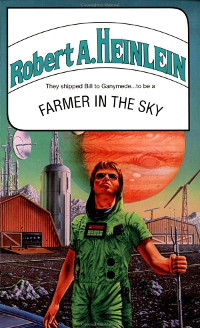
As a general rule, Heinlein novels are either really controversial (The Moon is a Harsh Mistress), really meta (The Number of the Beast), really fun (Citizen of the Galaxy), or some combination of all three (Starship Troopers). Farmer in the Sky is one of the really fun ones.
This novel was written before the Apollo 11 moon landing, but it read like something from an alternate reality long after that pioneering era, where the space program never slowed down. For that reason alone, it was a fascinating book. You can really see how it inspired people back in the 50s and 60s to reach for the stars.
More than that, it was really fascinating to get into the knitty gritty of colonizing a world like Ganymede. This is one of Heinlein’s juveniles, so he doesn’t get too technical, but you can definitely tell that he did the research and built a plausible near future world. More than that, it’s the kind of world I’d actually love to live in. Ganymede is the new frontier, and the colonists who settle it are pioneers in every sense of the word. Not everyone makes it, of course, but those who do are rugged, resourceful, and remarkable.
This was a really quick read. There was a lot of little stuff that dates it to the 50s, like gender relations and the prevalence of the Boy Scouts, who are sadly no longer a cultural force in today’s society. None of it bothered me or threw me out of the story. If anything, it added to the novel’s charm.
Heinlein knows his stuff. This was a really fun book. If you’ve never read any Heinlein, Farmer in the Sky is a good place to start.
They say that the golden age of science fiction is about twelve years old. That’s definitely true for me.
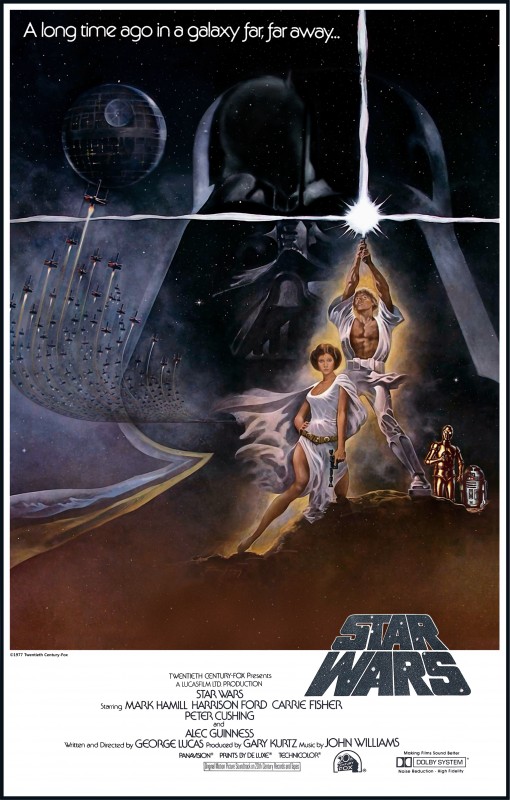
My first exposure to the genre was Star Wars: A New Hope. I saw it when I was seven, right around the height of my dinosaur phase. Everything about the movie completely blew me away, from the Jawas and Sand People of Tatooine to the stormtrooper gunfights and lightsaber duels. After watching Luke blow up the Death Star, I spent the next few hours running around the yard pretending to fly my own starfighter.
In a lot of ways, I’ve never really stopped.
My parents made me wait until I was nine to watch The Empire Strikes back, because it was rated PG. Without any exaggeration, I can say that those were the longest two years of my life. I was literally counting down days by the end, and to pass the time without going crazy, I read up on all the books about space that I could possibly find.
My father bought the original X-wing flight simulator game somewhere around then, and I soon became totally engrossed in it. Since the 386 was our only entertainment system (no Super Nintendo–I had to visit a friend’s house for that), X-wing became the defining game of my childhood. I spent hours and hours on that game, to the point where I knew exactly which simulated missions the characters from the books were flying and how to complete them faster and easier.
I thought The Empire Strikes Back was a little slow the first time I saw it, but it’s since grown on me, to the point where now it’s my favorite film in the whole series. Thankfully, my parents let me watch Return of the Jedi the next day, and for the next few months my life felt utterly complete.
Around this time I discovered the Star Wars novels and soon immersed myself in them. The Courtship of Princess Leia by Dave Wolverton soon became one of my favorites, as well as the Heir to the Empire trilogy by Timothy Zahn and the X-wing series by Michael A. Stackpole.
But it was Roger Allen McBride who first introduced me to a different flavor of science fiction with his Corellia trilogy. As I mentioned in V is for Vast, those books had just enough of a touch of hard science to intrigue me about the other possibilities of the genre. That was the last Star Wars series that I read before branching out into other works of science fiction.
The Tripod trilogy by John Christopher was my first introduction to the dystopian / post-apocalyptic genre, depicting an enslaved humanity after an alien invasion. Those books really captured my imagination for a while. The Giver was also quite interesting and thought provoking, though since it didn’t involve spaceships or aliens it wasn’t nearly as compelling.
I read a lot of fantasy in my early high school years, including Tracy Hickman, Lloyd Alexander, and (of course) J.R.R. Tolkien. While I enjoyed those books and immersed myself in them for a while, my true love was still science fiction. For almost a year, I watched Star Trek: Voyager religiously with my dad. And every now and again, I’d pick out a science fiction book from the local town library and give it a try. That’s how I discovered Frank Herbert’s Dune.
In eleventh grade, my English teacher had us choose an author and focus our term papers solely on their books for the entire year. She suggested I choose Orson Scott Card, but I chose Cormac McCarthy instead. I’m not sure if that was the worst decision of my high school career, or the best decision, since assigned high school reading tends to make any book feel like it sucks. I discovered Ender’s Game the following summer, and finished it in a delirious rush at 3am the morning after checking it out from the local library.
More than any other book, Ender’s Game cemented my love for the genre, and showed me just how powerful and moving the genre could be. It opened so many insights into the world and human nature, reading that book made me feel like I’d opened a pair of eyes that I didn’t even know I’d had. Looking back, that was probably the moment when I knew I would be a science fiction writer. I’d known I was going to be a writer ever since I read A Wrinkle in Time at age eight, but to be a science fiction writer specifically, that goal was probably cemented by reading Orson Scott Card.
After high school, I served a two year mission for my church, during which I didn’t read any novels or watch any TV or movies. When I came back, though, Orson Scott Card and Madeline L’Engle helped me to ease through the awkwardness of adjusting back to normal civilian life. When I left for college, I expanded my horizons even further, starting with Isaac Asimov’s Foundation series and Edgar Rice Burrough’s Princess of Mars.
When I discovered Pioneer Books in downtown Provo, I knew I’d found my favorite bookstore in Utah Valley. I have so many fond memories sitting cross-legged on the floor in the science fiction section, browsing through the musty used books for hours at a time. That’s where I discovered C.J. Cherryh, Arthur C. Clarke, Robert A. Heinlein, Ursula K. Le Guin, and numerous other authors who are among my favorites today.
When I discovered Spin, Robert Charles Wilson soon became one of my favorites. I picked up that novel as a free PDF from Tor, and read it over the summer while studying abroad in Jordan. Once again, that same hard sf sensibility I’d gotten from Roger Allen McBride touched me in an unforgettable way. But it was the human element of that book that really moved me–in fact, it’s always been about the human element. The world building in Downbelow Station was great and all, but the romance of Merchanter’s Luck had a much more lasting impact. Starship Troopers had some good ideas, but it was Mandella’s personal journey in The Forever War that moved me almost to tears. The intrigue of the Ender’s Shadow series was quite entertaining, but it was Ender’s Game and Speaker for the Dead that really taught me what it means to be human.
I finished my first novel, Genesis Earth, shortly after returning from that study abroad, and tried to capture the same sensibility from Spin as well as the intimately human element. Since then, I’ve written several more sci-fi novels, some of them tragic, some triumphant, but in all of them I’ve tried to get as close as I can to the personal lives of the characters. I don’t know if I’ll ever write a character portrait so intimate as Shevek’s in Ursula K. Le Guin’s The Dispossessed, but I certainly hope to someday.
For me, science fiction started out as a wonderfully exciting entertainment and turned into something much more meaningful. If there’s anything the genre has taught me, though, it’s that the two aren’t mutually exclusive–that you can have your adventure and learn what it means to be human as well. Indeed, the more imaginative the adventure, the greater the truths I’ve taken from it.
Because of that, even though I’m almost in my thirties now, I can’t possibly foresee a time when science fiction isn’t a major part of my life. It’s a love affair that’s grown just as much as I have, and continues to grow with each new author I discover and each new book I write. When I’m old and grizzled and pushing eighty, I’m sure there will still be a part of that twelve year old boy in me, still running around the yard flying his starship.
If you don’t know anything else about the universe, you should know this: it’s big. Really, really,REALLY big.
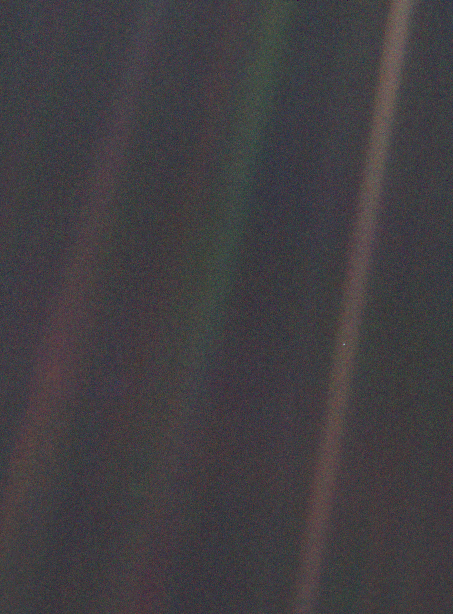
How big, you ask? Well, for starters, take a look at Earth in the picture above. Can you see it? It’s the pale blue dot in the beam of starlight on the right side of the picture. As Carl Sagan so famously put it:
From this distant vantage point, the Earth might not seem of any particular interest. But for us, it’s different. Consider again that dot. That’s here. That’s home. That’s us. On it everyone you love, everyone you know, everyone you ever heard of, every human being who ever was, lived out their lives. The aggregate of our joy and suffering, thousands of confident religions, ideologies, and economic doctrines, every hunter and forager, every hero and coward, every creator and destroyer of civilization, every king and peasant, every young couple in love, every mother and father, hopeful child, inventor and explorer, every teacher of morals, every corrupt politician, every “superstar,” every “supreme leader,” every saint and sinner in the history of our species lived there – on a mote of dust suspended in a sunbeam.
The picture was taken by the Voyager 1 spacecraft more than a decade ago. At the time, the spacecraft was about 6,000,000,000 kilometers from Earth, or 5.56 light-hours. A light-hour is the distance a particle of light can travel in one hour (assuming it’s traveling through a vacuum). To give you some sense of scale, in one light-second, a particle of light can travel around the circumference of the Earth seven and a half times.
And lest you think that’s actually a distance of any cosmic significance, consider this: the nearest star, Proxima Centauri, is about 4.24 light-years away. That’s more than 6,500 times the distance in the photograph above–and that’s just the closest star!
Our galaxy, the Milky Way, is between 100,000 to 120,000 light-years across. If you were on the other side of the galaxy and had a telescope powerful enough to get a good view of Earth, you would see a gigantic ice sheet over both of the poles with no visible sign of humanity whatosever. The light from all our cities, from our prehistoric ancestors’ campfires, has not yet traveled more than a fraction of the distance across this galactic island universe we call home.
Seriously, the universe is huge. If you don’t believe me, download Celestia and take yourself for a spin. In case you haven’t heard of it, Celestia is basically like Google Earth, except for the universe. Everything is to scale, and there are all sorts of plugins and mods for exoplanets, nebulae, space probes, and other fascinating celestial objects.
I remember what it was like when I first tried out Celestia back in 2010. I was at the Barlow Center for the BYU Washington Seminar program, in the little library just below the dorms. I think it was twilight or something, and I hadn’t yet turned on the lights. The building had a bit of that Northeast feel to it, like something old and rickety (though not as old as some of the buildings up here in New England). I turned off the ambient light option to make it look more realistic, and began to zoom out.
Let me tell you, the chills I got as the Milky Way disappeared to blackness were like nothing I’ve felt ever since. So much space, so much emptiness. It’s insane. The vastness between stars is just mind boggling–absolutely mind-boggling.
I got my first introduction to science fiction when I saw Star Wars IV: A New Hope as a seven year old boy. In the next few years, I think I checked out every single Star Wars novel in our local library’s collection. It wasn’t enough. Whenever I was on an errand with my mom, I tried to pick up a new one. I think they even left some copies of the Young Jedi Knight series under my pillow when I lost my last few baby teeth.
One of those summers, we drove down to Texas for a family vacation. I picked up the second Star Wars book in the Corellian trilogy, written by Roger Allen McBride. It was completely unlike any of the other Star Wars books I’d ever read. In it, Han Solo’s brother leads a terrorist organization in the heart of their home system of Corellia. They hijack an ancient alien artifact and use it to set up a force field that makes it impossible for anyone to enter hyperspace within a couple of light hours from the system sun. The part that blew my mind was that without FTL tech, it would take the good guys years to get to the station with the terrorists.
All of a sudden, the Star Wars universe didn’t seem so small anymore. And it only got crazier. Roger Allen McBride did an excellent job getting across the true vastness of space. At one point, Admiral Ackbar mused on just how puny their wars must seem to the stars, which measure their lifespans in the billions of years. For the ten year old me, it was truly mind boggling.
That was my first taste of science fiction that went one step beyond the typical melodrama of most space opera. And once I had that taste, I couldn’t really stop. As much as I love a good space adventure, real-life astronomy offers just as much of a sense of wonder. When a good author combines the classic tropes of science fiction in a space-based setting that captures the true vastness of this universe we live in, it’s as delicious as chocolate cake–more so, even.
I try to capture a bit of that in my own fiction, though I’m not always sure how much I succeed. In Star Wanderers, the vastness of space is especially significant for the characters because their FTL tech is so rudimentary that it still takes months to travel between stars. All of that time out in the void can really make you feel lonely–or, if you have someone to share it with, it can bring you closer together than almost anything else. It’s the same in Genesis Earth, which is also about a boy and a girl who venture into the vastness alone. The Gaia Nova books lean closer to the action/adventure side of space opera, but the same sensibility is still there.
The best science fiction, in my opinion, both deepens and broadens our relationship with this marvelous place we call the universe. It’s not just a fantastic setting for the sake of a fantastic setting–it’s the universe that we actually live in, or at least a plausible version of it set in a parallel or future reality. The universe is an amazing, beautiful place, and my appreciation for it only grows the more science fiction I read. If I can get that across in my own books, then I know that I’ve done something right.
Planets are not the only setting for science fiction stories–space stations are common as well. From the Death Star (“that’s no moon…”) to Downbelow Station, the Venus Equilateral to ISPV 7 to the Battle School in Ender’s Game, space stations are a major staple of any space-centered science fiction.
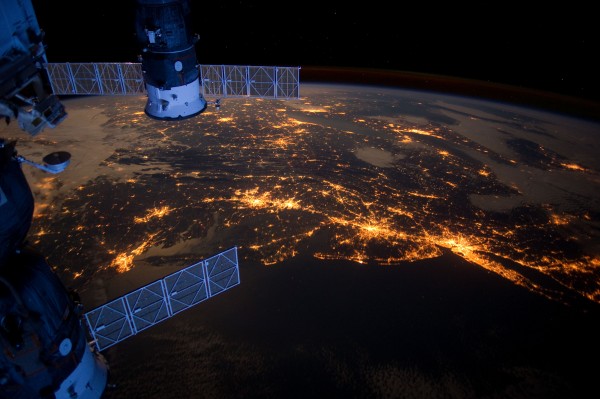
The reasons for this should be fairly obvious. Before we can go to the planets and the stars, we need to have a permanent presence outside of this massive gravity well we call Earth. The easiest and most logical place to expand first is to orbit, where supplies can be ferried up without too much difficulty and astronauts can escape in case of an emergency. Indeed, with the International Space Station, that’s exactly what we’re doing right now.
In science fiction, of course, space stations go much further than they do in real life. They’re often giant orbital cities, with thousands of people living and working there permanently. Often, they feature some sort of rotating toroidal structure in order to simulate gravity. If there are settlements on the planet below, the station often serves as a major hub for commerce, serving as a waypoint for interstellar merchants and wholesalers who ferry their wares up to orbit. And if the planet is still being colonized, then the space station often serves as an important umbilical to the outside universe.
They can also have strategic value in the event of a war. Battleships need to be serviced too, after all, and a station’s position in orbit can provide an excellent platform from which to bombard or lay siege to the planet. Alternately, outposts at more distant locations like the Lagrange points can serve as a staging ground for future attacks–a sort of astronomical “high ground,” if you will. If nothing else, abandoned stations may contain supply caches that can aid a fleeing starship, or provide shelter behind enemy lines, as was the case with the first Halo game.
Stations can come in all sorts of different flavors, from the puny to the magnificent. The most eye-popping station of all is probably the Ringworld from Larry Niven’s series of the same name. As the name would imply, the station is a giant ring–so huge, its circumference is the orbit of a habitable planet, with the sun at its center! Gravity is provided by rotation, and night and day by giant orbiting panels that block out the sun at regular intervals.
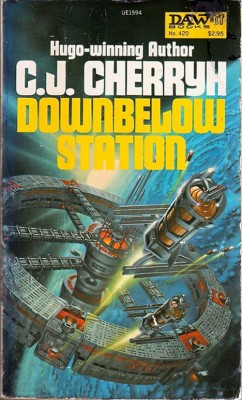
My favorite stations, though, are the more realistic ones–the ones that I can imagine myself living on someday. That was one of the things I enjoyed about Downbelow Station by C.J. Cherryh–her depiction of human expansion into space is eminently believable, and her stations are a natural extension of that. I also really enjoyed her focus on the social dynamics of living on a giant station, and what it would be like to live in such a society.
The Battle School from Ender’s Game is another huge favorite of mine. One of the advantages of building a structure in space is that gravity becomes malleable, so that some parts of the structure can simulate Earth-surface gravity while others leave people completely weightless. The Battle School uses that to its advantage, with the main training room a zero-g laser tag battle arena, where the students have to learn how to stop thinking in terms of the planar dimensions, where “up” and “down” have any meaning. It’s really quite fascinating.
It should come as no surprise that space stations pepper my own works. They’re especially common in the Star Wanderers series, where few worlds have been terraformed and orbital platforms make up the majority of human living space (at least in the Outworlds). In Sholpan and Bringing Stella Home, James, Ben, and Stella are all from a space station–a distinction that is especially useful for Stella, since her Hameji captors despise the “planetborn.” Genesis Earth takes that a step further, as spaceborn Michael and Terra have never been to the surface of a planet before until midway through the novel. Just as going into space is paradigm shifting for us, the experience of walking on a planet proves just as transformative for them.
One of the best things about a good science fiction story is that it can take you to another world–literally! Well, not in the sense of actually physically taking you there, but if you want to experience the thrills of an alien world from the safety of your favorite chair, the best way to do it is to immerse yourself in a good space adventure story.
Planets are to science fiction what islands and continents are to fantasy. It’s possible to tell a story where no one ever sets foot on one, but then you’ve basically got a sea story (since space is an ocean, at least in most space opera). Even then, your characters are probably going to put into port from time to time, if for nothing else than a change of scenery to make things interesting. And if there’s anything science fiction interesting, it’s the wide variety of possible planet types.
For example, what would a planet be like if it were covered completely by water? If the world-ocean was so deep that there was no visible land? Assuming that the planet orbits within its sun’s habitable zone, where the temperature ranges allow water to exist as a liquid, then you would have a pretty interesting place. What would the hurricanes be like? A lot more intense than the ones here on Earth, that’s for sure.
Then again, suppose that the planet was a bit closer to its sun, and most of that water existed in the atmosphere as a gas. You’d have some pretty intense atmospheric pressures on the surface, but the density of the atmosphere would make it much easier to keep airships and flying castles aloft. In fact, that might be the most practical way to settle that kind of a world.
In our own solar system, there is an incredible amount of variety. On Mars, for example, glaciers of dry ice cover the southern pole, while the sun sets blue in a normally dirty brown sky. The tallest mountain actually summits above the atmosphere, and every few years, dust storms cover the whole world. And believe it or not, Mars is a lot more similar to Earth than anything else in our solar system.
On Titan, rivers of liquid methane flow down mountains of water ice, while black carbon dunes drift across a desert shrouded in orange haze. While the sun rises and sets with predictable regularity, the planet Saturn is suspended at the same point on the horizon and dominates a large portion of the sky. Don’t expect to see any rings, though–Titan orbits along Saturn’s ring plane, so the rings are mostly invisible.
Europa, one of the four Galilean moons of Jupiter, is also dominated by its host planet. Water ice covers the surface, but deep, deep below, there’s a massive liquid ocean that has never seen the light of the sun. What sort of monsters lurk in those depths–an ocean buried beneath a world?
Jupiter itself is pretty intense. A gas giant world with swirling bands of planet-sized clouds, it hosts a monstrous hurricane large enough to swallow at least two Earths. This vortex has been churning across the planet for over 150 years, and possibly as much as 350. I still remember the chills I got when I read 2001: A Space Odyssey, and the scientists’ probe dropped through the haze to a cloud deck as massive as one of our continents here on Earth.
Gas giant planets can be really interesting. They aren’t human habitable, since the gravity and pressure are so intense that anything man-made would be crushed before it could hit the surface, but those same forces can lead to some other interesting things. For example, at the lower levels, you may find storms that rain diamonds. Go further still, and you find an intense magnetic core that’s just on the verge of being able to sustain nuclear fusion. Detonate enough nuclear material down there, like they did in a short story from the Halo universe, and you can turn the planet into a star.
And that’s just our solar system. What about the hundreds of exoplanets that astronomers are now discovering? The first one to be confirmed, believe it or not, was orbiting of all things a pulsar! Imagine that–instead of the life-giving rays of a sun, the planet is bathed in highly lethal X-rays and gamma rays.
Of course, there are plenty of planets orbiting stars like our sun, but most of the ones discovered so far are hot Jupiters–gas giant worlds that orbit so close to their sun that the years are measured in hours. Some of these planets are so close that the sun is actually blasting the atmosphere away. We haven’t discovered the rocky core of a gas giant world that’s been destroyed in this manner, but theoretically it could exist.
Or what about the planets with highly elliptical orbits that traverse the habitable zone of their stars? Imagine: a world where the winters are so cold that the oceans freeze solid. After several of our Earth years, the spring brings a massive thaw. For a few short months the weather is actually quite balmy. Then, as spring turns to summer, the heat grows more and more intense, until the oceans begin to boil! When the summer reaches its zenith, the planet is nothing but a scorched desert wasteland. Soon, though, the autumn cool brings back the rains, with storms so intense that they refill the oceans in just a matter of months! Then, the deep freeze of winter begins, and the world returns to its long icy tomb.
One of my favorites, though, is the ribbon world that Asimov predicted in some of his stories. Worlds like this occur most commonly at class M red dwarf stars, which are so cool compared to our sun that planets within the habitable zone are tidally locked. This means that the sun neither rises nor sets, but remains stationary in the sky. The day side is burning hot, with either a barren desert wasteland or a giant hurricane large enough to cover most of the hemisphere. The night side, on the other hand, is so cold that all the water is completely frozen. The only habitable parts of the planet exist in a ribbon-like swath where the sun is just on the other side of the horizon, casting the land in perpetual twilight.
Believe it or not, we’ve actually discovered a planet like this in the Gliese system. Gliese 581g, or “Zarmina’s World” as the lead astronomer dubbed it, was discovered back in 2010. I was so excited by the discovery that I dedicated a blog post to it. Since then, the findings have not yet been confirmed, so it isn’t safe to call it a planet for sure, but if/when it ever is confirmed, it may be one of the first truly Earth-like planets to be discovered (at least, as Earth-like as a ribbon world can be).
In much of science fiction, there’s a tendency to make planets single biome only. Thus, you have your desert planets (Arrakis, Tatooine, Gunsmoke), your ice planets (Hoth, Gethen), your ocean planets (Calamari, Aqua), your jungle/forest planets (Dagobah, Lusitania, Kashyyyk), and even planets that are nothing but giant cities (Trantor, Coruscant). Some of the more recent series like Halo try to avert this, but even today it’s still fairly common.
If there’s anything that modern astronomy is showing us, though, it’s that the variety of planets and worlds out there is beyond anything we could possibly imagine. This is why I get a bit irked when an otherwise excellent series like Firefly makes out every planet to be like Wyoming. What about Gliese 581g? Kepler 22b? GJ 1214b? Kepler 16b?
As more exoplanets are discovered, I can’t help but believe that science fiction is going to experience a paradigm shift. What was once purely the realm of imagination is now being confirmed as reality. Alien worlds exist–alien Earths, even. And just as our conception of Mars changed from the Sword & Planet tales of Edgar Rice Burroughs’ Princess of Mars to the hard sf epics of Kim Stanley Robinson’s Red Mars, Green Mars, Blue Mars, so will our conception of other alien worlds.
I’ve got a lot of different planets in my own books, some borrowing a lot from the recent exoplanet discoveries, others leaning closer to the single biome worlds of classic space opera. In Desert Stars, Gaia Nova is kind of a cross between Arrakis and Trantor, with giant domed arcologies covering half the planet’s surface while the rest is mostly desert and wasteland. In Bringing Stella Home, Kardunash IV is (or rather, was) an Earth-like world, with forests, mountains, and oceans. In Stars of Blood and Glory, New Rigel is a straight up ocean world, while Ebitha from Star Wanderers is an ocean world tidally locked to its dwarf M class sun. I haven’t yet played with the elliptical planet, but I probably will someday.
One of the things I love most about a good science fiction story is that it takes me out of this world. With all the incredible new discoveries that astronomers are making, that aspect of the genre is only bound to get better. They’ve certainly enriched my own work, and will doubtless continue to do so in the future.
One of the key things that makes space different from Earth is that nothing is ever stationary. Anything close to our planet that isn’t moving at a good clip (measured in miles/kilometers per second) is liable to plummet like a brick. Gravity is still in effect, even though you’re in free fall and thus don’t really feel it.
The way to get around the falling problem is to orbit whatever celestial body you’re plummeting towards. When your tangential velocity gets high enough, gravity becomes your centripetal acceleration, and the system becomes rotational rather than discrete. In other words, you’re still falling, but you’re moving fast enough to cross the edge of the horizon before you hit.
Just to give you a scale of how fast you have to go to make this work, the International Space Station (ISS) is orbiting at about 230 miles (370 kilometers) above sea level, and it makes a complete rotation around the earth every 90 minutes. That means that the good folks who live and work up there see about 16 sunrises and sunsets per day.
If you’ve spent your whole life living planetside, orbital mechanics can be a bit difficult to grasp. Here are just a few of the basics:
Since orbit is basically free fall, you don’t need to fire your engines to stay aloft. In fact, once you’re parked in a stable orbit, you can stay there almost indefinitely. This is how satellites work: we use a rocket to put them in position, but once they’re there all they need is a minor adjustment from time to time. The moon is basically a giant natural satellite, and it doesn’t need any sort of thrust to stay aloft.
As objects fall closer to the body they’re orbiting, they orbit faster. Just think about how figure skaters speed up when they pull their arms in closer to their bodies. The main reason for this is that the object has a much shorter distance to travel to make a complete revolution. To understand how this works, take a CD and measure the inside edge versus the outside edge.
However, since your tangential velocity is proportional to your centripetal acceleration (ie gravity), the way to jump to a higher orbit is to speed up. Conversely, the way to fall to a lower orbit is to slow down. An object’s angular momentum (mass X tangential velocity) is proportional to the distance of the object from the rotational system’s center of mass, so changing the object’s velocity will also change its distance from the center.
So if you’re in a spaceship and you’re about to collide with an object on a parallel orbit, the way to avoid it is not to nose your ship up like an airplane. Instead, fire your engines and try to go faster (or slower, as the case may be). It’s a bit counter-intuitive, but your altitude will change accordingly. The anime/manga series Planetes really got this right.
However, even though you’re moving faster at a higher orbit, you have a lot more distance to travel, so it actually takes longer to make a complete orbit. If you go high enough, you can eventually get to the point where the orbital period equals the rotational period of the celestial body you’re orbiting. We call this a geosynchronous orbit. If you’re orbiting around the celestial body’s equator, then to a person on the surface, it appears as if you’re stationary. You’re not, of course–nothing in space really is–but both you and the person on the planet’s surface are moving in tandem, so that’s how it appears.
Ever wonder why satellite dishes all point in the same direction? This is why. The signal comes from a satellite in geostationary orbit, where it doesn’t move relative to the people on the surface. Thus, if you know where to point your dish, you will always get a signal since the satellite doesn’t appear to move.
An orbit doesn’t have to be circular, but the barycenter (ie the center of mass for the whole system, where the mass of both objects cancels each other out) has to be at one of the focal points of an ellipse. This is how comets work. An object in an elliptical orbit will speed up when it gets closer to the object it’s orbiting, and slow down when it gets further away.
It’s possible–indeed, quite common–to orbit two celestial bodies simultaneously. For example, since the Earth orbits the sun, anything orbiting the Earth must also orbit the sun at the same time. If you’re close enough to the Earth, this doesn’t really matter since the Earth exerts a much more immediate force. But when you get further away, interesting things start to happen.
A Lagrangian point is a point of gravitational balance between two orbiting celestial bodies of unequal mass. Basically, they’re points of equilibrium where objects appear to remain stationary, so long as they continue to orbit in tandem with the other two celestial bodies.
In science fiction, these are great places to put space stations and other orbital settlements, since they appear as fixed points relative to the planet or moon that they’re moving around. In real life, asteroids tend to clump around these points in a planet’s orbit, especially the L5 and L4 points. Jupiter has so many of them that we call them the Trojans and the Greeks.
Since orbital mechanics can be a bit difficult to grasp, a lot of science fiction gets it wrong, especially space opera. For a recent example, just look at the Halo series–unless those Covenant ships have some sort of magical drive, there’s no way they could hover above the surfaces of planets the way they do. Orbiting does NOT equal hovering. And in Halo: Reach, where Jorge knocks out the main ship for the Covenant advance force … yeah, if a ship that large actually fell from orbit into the surface of a planet, it would be moving fast enough to make a crater the size of a small continent, kicking up enough dust and debris to cause a mass extinction event like the one that killed the Dinosaurs.
At the same time, when a science fiction story goes the length to get the orbital mechanics right, it can add a surprising amount of realism. A good example of this is Passage at Arms by Glen Cook. I loved how he depicted the orbital siege of the main colony world, with the way the orbital space battles looked like from the planet’s surface. The human forces were able to keep a toehold on space due to a low orbiting asteroid that the aliens couldn’t get to without exposing their forces to attack, and that served as the staging ground for the main characters to fight back.
For hard sci-fi, orbital mechanics is absolutely essential–you’ll be tarred and feathered if you get any of it wrong. For soft sci-fi like space opera, it’s not essential, but it adds a lot to the story if you can get it right. In any magic system, the limitations are what make it interesting. If you’re writing science fiction, then physics is your magic system, so knowing how it works can really add a lot to your story.
For example, in the recent Schlock Mercenary storyline, the characters board a spaceship with an artificial gravity generator centered around a large cylindrical pylon that runs the length of the ship. One of the implications of having Earth-strength gravity around such a small object is that you can actually throw a baseball into orbit. And that’s just the beginning! Needless to say, I’m really interested to see where Howard Tayler takes this story in the weeks and months to come.
Even though I write more space opera / science fantasy type stuff, I do the best I can to get my orbital dynamics right. You can see this in the space battles in Stars of Blood and Glory and Bringing Stella Home, as well as the setting elements in Desert Stars. When the desert tribesmen look up at the night sky, they gaze at the stars and satellites–hundreds of satellites, many of them starships bound for distant spaceports on the more civilized side of the world. One of the reviewers said that the world felt so real it was almost like he could reach out and touch it, so I guess I did something right. I’ll definitely keep it up in the future.
Right after I went through my Dinosaur phase, I saw Star Wars IV: A New Hope for the first time. Instantly, all that childlike excitement and exuberance was transferred from paleontology to astronomy. We had a series of about twenty astronomy books in my elementary school’s LRC (Asimov’s astronomy series, I believe–the ones with the gray dust jackets), and in about a year I’d read them all.
Star Wars was fun, but what was really fascinating was learning about the stars. When I started to grasp the scale of our galaxy–that if our solar system was the size of a milk carton, the Milky Way would be the size of North America–my mind was totally blown. Quasars, pulsars, black holes, white dwarfs, red giants–it was so amazing! And then, when I started thinking about all the other worlds out there, and what it would be like to visit them–that’s when I became a science fiction fan for life.
It goes without saying that you can’t have space opera without setting the story somewhere in space. But the best space opera goes much further than that–it’s about space as the final frontier, and humanity’s ultimate destiny among the stars. After all, if we as a species stay put on this pale blue dot, sooner or later we’ll kill ourselves off or suffer another mass extinction event that wipes us all out like the Dinosaurs.
For that reason, classic space opera often takes undertones of manifest destiny, except on a galactic scale. The stars are not just interesting places to visit, they’re absolutely crucial to our survival, and no matter what alien dangers await us, we will face them boldly and either conquer or be conquered.
Of course, not all space opera stories take place during the exploration and colonization phase of human interstellar expansion. Plenty of stories take place thousands of years later, once humanity has comfortably established itself among the stars. Even so, there are still more than enough wonders remaining to be explored–if not for the characters, then for the readership. The vastness of space is so great that there really is no end to it, and the possibilities are only bounded by the writer’s imagination.
One of my favorite space opera computer games is Star Control II, also know as the Ur-Quan Masters. In the game, you’re the captain of a giant starship built with alien precursor technology. The races of the Federation, including humanity, have been defeated and enslaved by an aggressive warrior race known as the Ur-Quan. You must travel from star to star, gathering resources to upgrade your starship and convincing the other alien races to join the new alliance.
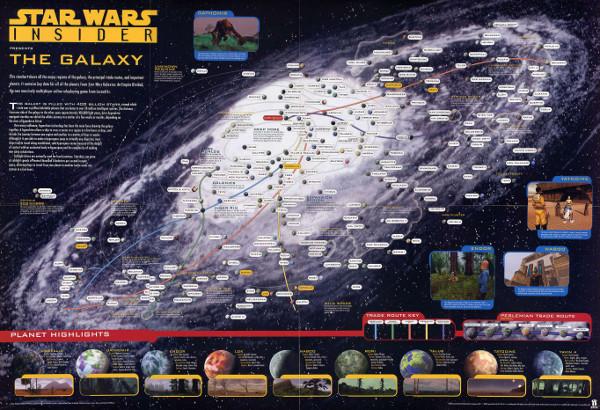
By far, the best part about that game is the starmap. It’s HUGE! More worlds than anyone can possibly visit in any one playthrough, or five, or even ten. And each alien race has its own history, its own culture, its own set of goals and objectives–and oftentimes, most of these goals have very little to do with the actual conflict of the game. In fact, there are some races like the Arilou which don’t even seem to know that there’s a war going on. They’re much more interested in something frightening and mysterious from another dimension that they never quite explained, but that may involve the Orz somehow…
With each new world that you discover, you learn that the galaxy has a very, very, very long history. So long, in fact, that the human race has only really existed for a blip in time. The other races are involved in their own disputes, and many of these go back to the times when our ancestors were swinging through the trees somewhere in central Africa. But whether or not we want to be a part of it, we’re involved, simply by virtue of where our star happens to be located.
The best space opera isn’t just about our world: it’s about our place in a much wider universe. Whether it’s a serious tale about humanity’s ultimate destiny, or an action-packed intergalactic romp, there’s always that sense of something greater than us–that same sense of wonder that gripped me as a boy when I first started to learn about the stars.
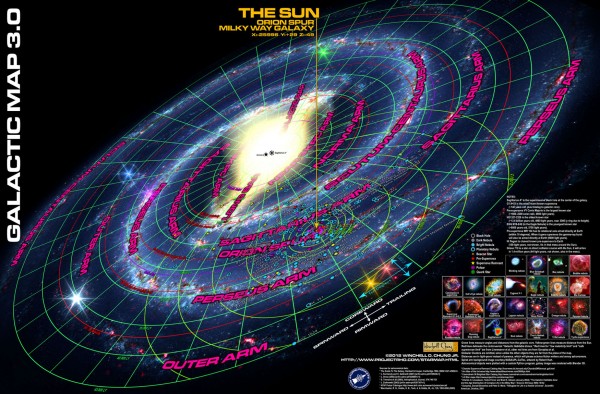
Image by nyrath at Project Rho. I highly recommend checking out his excellent starmaps!
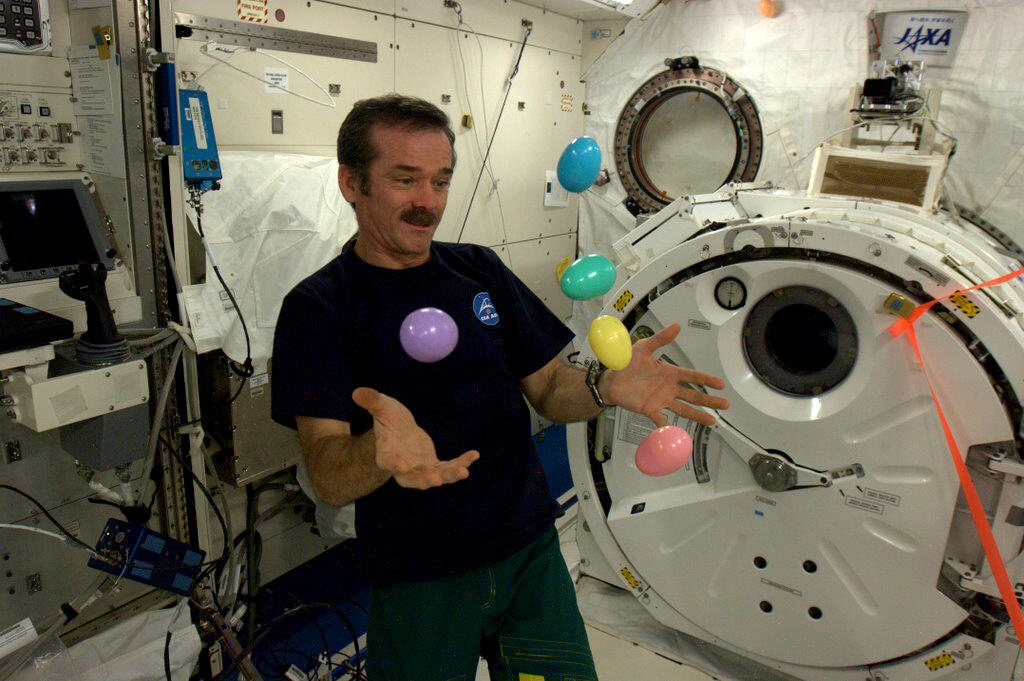
Commander Hadfield planning a zero-g easter egg hunt earlier this month on the ISS.
Possibly one of the most defining aspects of space is the sensation of free fall. Of course, gravity exists in space, the same as it does everywhere else in the universe (probably), but in space we feel its effects differently because we aren’t close enough to a body of sufficient mass to feel a strong pull. That, and our spaceship itself is also in free fall, so if that’s our frame of reference we feel no weight because there’s nothing for weight to push back on … but that’s a concept probably best left for O is for Orbit.
The thing is, as fun as weightlessness can be, in the long-term it can have some negative health effects, such as deterioration of bone and muscles, weakening of the immune system, etc. The effects of micro gravity on human fertility are not very well-studied, but there’s some speculation that conception and gestation would be impossible, since embryos need gravity in order to implant properly. Humans are adapted to live on the surface of Earth, and that means living with a constant 10 m/s2 or so of gravitational acceleration.
For future space colonies and spacefaring civilizations, this means we need to find a way to simulate the effects of gravity in a micro-gravity environment. There are a few common ways to deal with this problem:
Artificial Gravity — Applied phlebotinum that creates a field within which the gravity is normal. A necessary weaselhand wave that you’ll see most often in soft sci-fi and space opera, where the plot and characters are more important than the science.
Centrifugal Gravity — The illusion of gravity created by spinning a can-like spaceship or space station in a circle, pressing the humans against the inside wall. You’ll see this in both hard and soft sci-fi. Scale it up, and you get Ringworld Planets.
Powerful Starship Drive — If your starship drive is powerful enough, it can accelerate you at 10 m/s2, effectively creating the sensation of gravity. Your starship will be like a flying skyscraper, where “down” is in the direction of the engines. At this rate of acceleration, you should reach 99.9% the speed of light in about a year, which opens up all sorts of possibilities for relativistic space travel (provided you have a sufficiently massive energy source to sustain that reaction). Just be sure to give yourself the same amount of time to decelerate, otherwise bad things may happen.
Baby Planet — An asteroid no larger than a small asteroid that still, for some reason, has normal Earth-like gravity. Think Le Petit Prince. Not nearly as common as the other three, but the existence of gravitational waves means that it may be possible (or at least plausible) to create gravity generators that work this way.
Roll with it — Yeah, so everything is weightless in space. So what? Deal.
Another problem related to gravity is rapid deceleration. Unless you don’t mind splattering everyone in your starship all over the walls and ceilings, you can’t go from zero to near-light speeds (or vice versa) without some way to counteract the sharp change in momentum. Space opera and soft sci-fi gets around this by using inertial dampers–basically, magical devices that give the starship a nice, soft ride (unless you want the bridge to explode, of course). As you might expect, stories on the harder side of sci-fi tend to play around with this a lot more.
My first exposure to artificial gravity came when I read a comic book version of The Norby Chronicles by Isaac Asimov. The characters had a device that would basically allow them to levitate, and I thought that was so cool. It wasn’t until I read the Corellia Trilogy by Roger Allen McBride that I realized that every starship in the Star Wars universe had a machine that could manipulate gravity like this. At one point, the artificial gravity generators on one of the ships failed. My mind was blown, and I’ve never looked at gravity the same since.
I tend to write stories where the characters and plot are more central than the science, so I’ll often just fall back on the standard artificial gravity field like most space opera. During combat maneuvers, though, things get a bit more tricky, with dampers on the bridge that mitigate (but don’t erase) the worst effects of rapid deceleration, and special coffin-like chambers for the crew below decks to keep them from getting splattered. In my Star Wanderers series, I also use centrifugal gravity for the larger space stations, since I figure the energy costs of artificial gravity tend to scale up.
In short, science fiction stories that address the problem of gravity in a real and thoughtful way tend to be a lot more believable and immersive, even if the solution to the problem is basically magic. As with anything in science fiction, there are so many imaginative ways of dealing with the problem that it’s actually more of an opportunity than anything else.
Unfortunately, since planets and towns are actually pretty different kinds of places, there’s a lot of room to do things poorly and turn this trope into a cliche. Any story that doesn’t consider (or at least lampshade) the implications of space travel and planetary colonization is in danger of becoming over-the-top campy–although, to be fair, there is an audience for that.
That doesn’t mean there isn’t room for this trope in fiction that takes itself a little more seriously. In fact, I take issue with some of the descriptions on the Planetville page. From tvtropes:
Unfortunately, because Sci-Fi Writers Have No Sense of Scale, stories about Planetville make no sense. Nobody seems to realize how BIG a planet is — everything in Planetville takes the same amount of time as stories set in towns or countries. In the updated Wild West story, the outlaws are “exiled from the planet” just like they’d be exiled from Dodge City, and have to quietly leave… instead of flat out challenging the authorities to find them when they have an entire planet in which to hide. When the space Nazis invade, they seem to need the same number of soldiers and time as the Earth Nazis needed to invade Europe. And when the crew of the Cool Starship finds the cure for the alien plague, the logistical issues of distributing it to an entire planet rarely get mentioned at all. These considerations are minimizedor left out entirely in many stories.
To address these criticisms point by point:
1) Scale is relative to technology and the predominant modes of transportation. When my ancestors crossed the plains to settle in modern-day Utah, they had to walk. It took them months to get here and many of their family members died along the way. Today, I can make the same trip by car in a day or two. As technology changes, so does the sense of scale.
2) Unlike what some tropes would have you believe, not all planets are Earth-like. In fact, it appears that most planets outside our solar system are wildly different. In practical story terms, this means that any part of the world that’s remotely habitable is probably going to be immediately around the colony. Consequently, the local authorities probably will have the power to exile trouble makers from an entire planet, since exile from the colony would mean de facto exile from the planet as well.
3) Anyone venturing outside of the dome would have to carry just about everything necessary for life, including air, water, food, etc. You might as well try to hide in Antarctica as hide on an alien planet. It can be done, of course, but to do all that and stay hidden, that’s going to be tough. You might as well set up a rival colony for all the effort–but at that point, the story is about a lot more than just hiding from the authorities.
4) If your planetary colonies are only as populous as an average WWII era city/town, then yeah, you’ll only need as many soldiers as it took to conquer them. The biggest difference is that they’ll fly a really cool starship.
5) Again, if the planet isn’t habitable and the population is contained within a handful of relatively small colonies, then distribution shouldn’t be too much of a problem.
However, the tvtropes page does make this valid point:
A side effect of this is that the characters never realize that things can happen in parts of planets. You will never see aliens trying to capture a planet’s equator, or its polar caps — it’s the whole planet or bust.
In the end, I think the key to doing this trope well is to know your setting well enough to fit the story to it. Tropes are tools, and when done well, this trope can accomplish everything it sets out to do while making perfect sense within the context of the story.
In my own work, this trope is most prevalent in the Star Wanderers series. Every novella takes place at a different planet or space station, sometimes multiple planets per station. Because most of the stars in this universe have only recently been settled, the colonies are small and terraforming is quite limited. In Desert Stars, I used a similar concept, except with large domed areas of a single planet, instead of multiple planets (Adventure towns…UNDER THE DOME!!!). In cases where the planets are Earth-like, however, or where travel between planets is costly and difficult, this trope doesn’t really ever come into play.