Trope Tuesday: Only the Chosen May Wield

So I’m bringing back the Trope Tuesday posts, but with a little twist: instead of talking about the trope itself and what I like / don’t like about it, I’m going to talk about how I used that trope in one of my books. And since The Sword Keeper is currently up for preorder, I’m going to spend the next few weeks using examples from it.

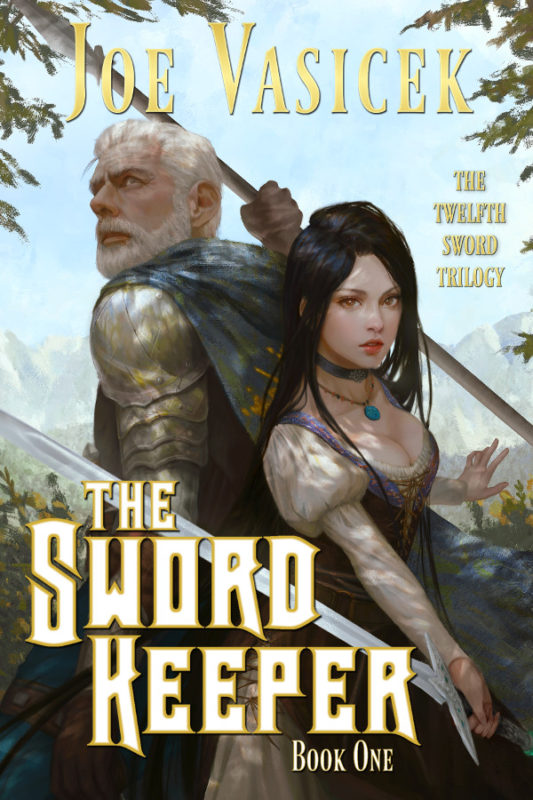
Perhaps the most central trope in the book is Only the Chosen May Wield. In the first chapter, Tamuna Leladze discovers that she is the Chosen One when a mysterious stranger arrives at her aunt’s tavern, carrying a cool sword. Unbeknownst to her, the sword is enchanted and carries the skills and memories of all the people who have wielded it. She soon learns that she is the last sword bearer of prophecy—which comes as a huge shock, since as a common tavern girl, she’s really not cut out to be a warrior.

While the book mostly plays this trope straight, there are a couple of other complications that give it some depth. First, the sword itself is an actual character. It speaks to Tamuna through the psychic link that she establishes with it, and when she sleeps, it carries her to a mountain sanctuary where she’s able to talk with it like another person. The sword becomes something of a mentor to her, sharing skills and memories as quickly as she is able to receive them (which is never quickly enough).

Second, while Tamuna never wanted to be the Chosen One, one of the members of her party did, and struggles with feelings of jealousy because of it. This becomes especially complicated because this character’s chief motivation is honor, and he’s put in a position where he has to act as a trainer/bodyguard for Tamuna until she comes into her own. It doesn’t help that he’s only a few years older than her.

I suppose there is a third complication: the fact that Tamuna can’t (or shouldn’t) wield the sword until she has been physically trained for it. Several times, Imeris tells her that he can’t share all of his knowledge of swordplay with her, because she isn’t yet strong enough. Otherwise, she’s liable to injure herself, because her body isn’t capable of executing all of the strikes and parries and ripostes that she knows how to execute in her mind. So, while no one else can wield the sword Imeris, the one person who can isn’t yet capable of doing so.

It makes for an interesting dynamic. Stories tend to get boring when things are too easy for the Hero, and in The Sword Keeper, very little comes easy for Tamuna. In fact, one of the recurring questions she asks is how in the heck she became the Chosen One in the first place. I won’t spoil it for you by revealing whether or what she discovers by the end.


The Sword Keeper comes out in twenty-five days! Preorder it now!
The Sword Keeper

The Sword Keeper

$12.99eBook: $4.99
Author: Joe Vasicek
Series: The Twelfth Sword Trilogy, Book 1
Genres: Epic, Fantasy
Tag: 2017 Release

Tamuna Leladze always dreamed of adventure, but never expected to answer its call. That changes when a wandering knight arrives at her aunt's tavern. He is the keeper of a magic sword that vanished from the pages of history more than a thousand years ago. The sword has a mind and a memory, and it has chosen Tamuna for purpose far greater than she knows.

More info →


Trope Tuesday: Forbidden Zone

For the next few Trope Tuesday posts, I’m going to pick apart some of the tropes I’m playing with in my latest WIP, Sons of the Starfarers.  One of the things I love to do when brainstorming a new story is to use tvtropes like a menu, finding the tropes that best fit my story ideas and combining them with other tropes to get even more ideas.

It’s not often hard to spot the forbidden zone in a fantastical world.  Perhaps it has an ominous name (bonus points if it has the word “doom” in it), or perhaps there’s some sort of sign saying “do not enter.” Either way, this is definitely a place where no one goes, and no one is supposed to go.

Of course, you can pretty much guarantee that the main characters are going to go there.  It’s like the forbidden fruit: the very fact that it’s off limits makes it more alluring.  If genre blindness is in effect, someone will probably make the mistake of saying “what could possibly go wrong?

There are many reasons why the zone may be forbidden.  Perhaps it’s a death world, where the characters will soon find themselves running for their lives.  Perhaps it’s not quite so dangerous, but once you go, you can never come back.  Or perhaps all the warnings were lies, and the so-called forbidden zone is actually the place that the characters needed to get to all along.  If that’s the case, then the mentor was probably a broken pedestal or the Svengali.

In any case, the forbidden zone definitely lies in the realm of adventure.  Depending on how soon or how late in the story the characters go there, it may lie just on the other side of the threshold, at the bottom of the belly of the whale, or at the very heart of the character’s nadir.

The Mines of Moria, the Toxic Jungle, Area 51, the Elephant Graveyard, and the Fire Swamp are all classic examples.  In C.S. Lewis’s Space Trilogy, Earth itself is a forbidden zone to all the other inhabitants of the solar system, which is why it’s called the silent planet.

In real life, there are plenty of these as well.  Just look at the DMZ on the Korean Peninsula, or the fallout zone around Chernobyl.  When I was living in Georgia, Abkhazia was off limits to the TLG volunteers, meaning that if you went there (and the Ministry of Education found out about it) it was grounds for immediate firing.  Of course, that only encouraged some of my TLG friends to go there even more–remember the forbidden fruit?  Others waited until their contracts were over and practically made a tour of the many forbidden zones of the Caucasus, including Nagorny Karabakh, which one friend described as safer than Philadelphia.

I’ve toyed with this trope in my own work, but never too explicitly.  The best example is probably the alien ghost ship from Genesis Earth.  It’s not exactly forbidden, since there’s no one around to tell Mike not to go there, but Terra definitely doesn’t want him to go.  Earlier in the same book, she forbids him from entering her workspace in the observatory, which leads to some complications and a major reveal when he inevitably does.  In the Gaia Nova series, the Outer Reaches qualify as a forbidden zone, since the only people who live out there are murderous barbarians like the Hameji.

In my new series, Sons of the Starfarers, the first book starts out with a forbidden zone–a derelict space colony, where everyone has died of an unknown cause.  Since the nearest settlement is light-years away (and because Aaron is perhaps too curious for his own good), that’s where Isaac and Aaron go.  What they find there propels the rest of the book–and quite possibly the rest of the series.

Check back next week for more!

Trope Tuesday: The Last DJ

armstrongIn any vast bureaucracy, you’re bound to find obstructive bureaucrats and professional butt-kissers.  But if you look long and hard enough, usually somewhere towards the bottom, you may be lucky enough to find one of the Last DJs.

The Last DJ is a man with integrity, who often puts honor before reason and cannot be bought, no matter how much his superiors try.  Consequently, he usually ends up somewhere at the bottom of the organizational hierarchy, no matter how competent he may be.  In extreme cases, he may be reassigned to Antarctica.  Either way, do not expect to see him kicked upstairs–that’s for insufferably incompetent idiots who are promoted to an administrative post so everyone else can get back to the real work.  If anything, expect this guy to get thrown under the bus.

Depending on the story, he may be a brotherly mentor figure for the main character or play some other sort of supporting role.  However, don’t expect him to be much of a plot driver, unless the story is specifically about him.  Because of his refusal to suck up or play office politics, he’s rarely in a position to effect change or become a whistle-blower.

Over time, this character may turn into something of a sour knight, developing a thick skin of crusty cynicism to protect his idealistic heart from all the crap he continually has to put up with.  Like the Obi-wan, if he’s a mentor figure, he will probably die.  If he’s the hero, though, or part of the ragtag bunch of misfits, expect him to be vindicated, possibly in a crowning moment of awesome.  Rarely if ever will this guy be the villain–that’s the obstructive bureaucrat, whom this guy hates.

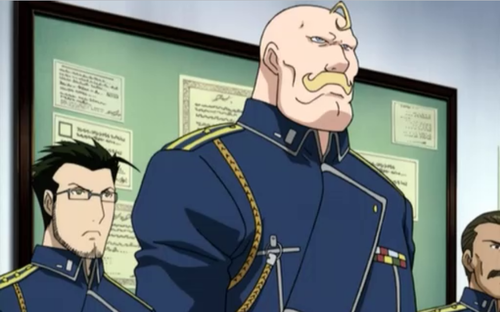
Lieutenant Armstrong from Fullmetal Alchemist is a good example of this trope.  He’s a good soldier who was passed up on all the promotions because he refused to go along with the war crimes done against the Ishvalan people.  His sister, who WAS reassigned to Antarctica (though probably by choice), is a whole other story.

Another good example of this trope is Lucius Fox from Batman Begins.  The interesting thing about this one is that he’s a mentor figure who actually survives.  This is probably because the story requires a lot of badassery from the hero, and Lucius is in no position to fill that role, so there’s no threat of him outshining Bruce Wayne.  This is also a good example of the last DJ getting vindicated in the end.

In my own work, the best example I can think of is Tiera from Desert Stars.  She’s fiercely stubborn with an uncompromising sense of honor, which results in her being stripped of her claim of inheritance due to her stepmother Shira’s wiles (although ‘stepmother’ isn’t quite the right word–how do you describe your father’s evil second wife, when he’s still married to your mother?).  I’ve got some interesting plans for a sequel where she’s the main character, but that book is still in the early conceptual stages.

In my own life, I’ve actually fulfilled this trope.  I don’t care to discuss the details of it publicly, but back when I was interning in Washington DC, I had a very negative experience that this trope describes perfectly.  It’s one of the reasons I hate Washington so much, and decided to become a global nomad who makes a difference on the ground, rather than pushing papers in someone else’s petty empire of personal influence.  It’s also one of the reasons why I started the Star Wanderers series–because I wanted to tell a story about people on the space-bound frontier, as far away from the galactic empire as possible.

I may not write many stories about vast bureaucracies or other hierarchical organizations, just because that doesn’t interest me, but whenever I do, you’ll probably see this guy pop up.  As someone who’s been there, I have a lot of sympathy for this character.  You’ll probably see him (or her) pop up in my work from time to time.