The sheer level of detail that went into this battle plan is just astounding. Now I really want to watch that movie! Maybe, with AI video, someone will do it justice.
Tag: Lord of the Rings
Redneck of the Rings
Have you thought of Rome yet today?
The comments are absolute gold!
Extra Sci-Fi S3E4: The Return of the King
Okay, I think the folks at Extra Credits got it wrong with this one in a really big way.
Gollum didn’t redeem himself. That’s the entire point. Redemption is an important and very Christian theme of Lord of the Rings, but so is the problem of evil. Several comments on the video point this out:
I disagree about Gollum. He gave into the temptation of the Ring. I think more he is there for how God can turn evil into a good.
MJBull515
Gollum is more a Judas figure. Judas was not redeemed for betraying Jesus, but his evil actions did allow for the salvation of Man through Christ’s sacrifice.
Isacc Avila
“A traitor may betray himself and do good he does not intend.” Judas betraying Jesus was the catalyst that led to salvation. Gollum’s final act of greed was the catalyst that led to the destruction of the Ring.
Jet Tanyag
The thing that really gets to me, though, and the part where I think the folks at Extra Credits really do a disservice to these books, is how they argue, very subtly, that Gollum shouldn’t be held responsible for his own actions, that it wasn’t really his fault that he was addicted to the ring—that he “couldn’t escape his own sin.” (4:50)
No. Just, no.
The entire point of redemption is that we CAN escape from our sins. We see that with Theoden, we see that with the Dead Men of Dunharrow, and we see that in all the other examples of redemption that were not discussed in this video, like Boromir. In fact, Boromir is a far better example of “redemption through a single, all-important act.”
But it goes much deeper than that. In order to be meaningful, sacrifice must be intentional. It’s not just the act that matters, but the intention behind the act.
With that in mind, consider Gollum’s intentions when he bit off Frodo’s finger. The only way you can argue that his intentions weren’t evil is that the Smeagol half of his split-personality overcame the Gollum half, and flung him into the lava. But the support for that reading is ambigous at best. And if that isn’t true, and Gollum simply fell into the lava by accident, then it wasn’t a sacrifice on his part, and therefore there was no redemption.
To say that Gollum made an “accidental” sacrifice is nonsense. And to say that he redeemed himself through that sacrifice is not only a faulty argument—it completely undermines the themes of redemption and sacrifice throughout the entire book.
Gollum was never redeemed. Through him, Middle Earth was saved, but he was never personally redeemed, and that’s the point:
I’ve heard a different interpretation where Gollum’s sacrifice wasn’t an act of redemption, and was never meant to be. In the end, it was the ring’s own power that caused it to be destroyed; not Frodo, not Gollum, it was an accidental suicide. As far as I understand it, the message wasn’t “good triumphs over evil”, instead it was “evil is more powerful than good, but all it can do is destroy; in the end it will always destroy itself”.
EvilBarrels
Extra Sci-Fi S3E2: The Fellowship of the Ring
Another fascinating episode from Extra Credits, this one focusing on the themes of generational passing and the diminishing of ages that is present in Tolkien’s Lord of the Rings. I have a lot of thoughts on this episode, but they all basically boil down to one thing:
Every generation reinvents the world.
It’s a theme that’s also present in my favorite novel of all time, The Neverending Story. The Childlike Empress of Fantastica is dying, and the only way to save her is for someone from the human realm to give her a new name. Fantastica, of course, is the realm of all fictional stories, and the Childlike Empress receives a new name when the next generation makes the old stories their own. There is nothing new under the sun.
This is also a theme present in Star Wars: The Last Jedi. I’m not a huge fan of the movie, but the best argument I’ve heard in favor of it basically boils down to this theme: that the old generation has to pass away in order for the new one to rise and take its place. I’m still not entirely convinced that The Last Jedi did this well, but I can see how someone who loved the movie would see it that way.
As a writer, this theme weighs especially on me because I feel that I’m personally living it with ever book that I write. All of the greats of the genre, like Tolkien, Herbert, Heinlein, Asimov, Bradbury, Card, Le Guin—the list goes on and on—loom over me every day. With their passing, the world feels somehow diminished. They left us with a great gift—their books—and yet as time passes and the old world crumbles into dust, these gifts from the previous generation feel increasingly out of place. It is time for a new generation to rise and give the Childlike Empress a new name.
I want my books to be a part of that. I hope that one day, mine will be one of the voices that helps to reshape the world. I hope to one day leave behind a gift as great as the ones that we were given: stories and books that made us feel deeply and taught us meaning and love. Is there anything greater than this? Raising a family, perhaps, but that too is a form of generational passing.
I’m sure this theme of generational passing applies to a lot of fields too, not only in the arts, but in trades, and crafts, and sciences too. Indeed, it is a fundamental part of the human story, because of this singular truth: that every generation reinvents the world. There are curses as well as blessings that are passed down from generation to generation, but it is up to each of us to decide whether those curses and blessings stop with us, or whether we will continue to pass them down.
Lots of interesting stuff to ponder and think about. That’s part of what makes Tolkien so great. He spent an entire lifetime writing Lord of the Rings, and that time was not wasted.
Trope Tuesday: Knight Templar
 For this one, I’m going to pull the description straight from tvtropes itself, since the whole page is pretty good:
Sometimes, the Forces of Light and Goodness get too hardcore. In a deadly combination of Well-Intentioned Extremist, The Fundamentalist and, generally speaking, not so different, they get blinded by themselves and their ideals, and this extreme becomes tyrannical sociopathy.
Usually, the Knight Templar’s primary step (or objective) to his perceived “utopia” is to get rid of that pesky “free will” thing that is the cause of crime and evil. Many Knight Templar types are utterly merciless in dealing with those whom they consider evil, and are prone to consider all crimes to be equal. The lightest offenses are met with Draconian punishments such as full imprisonment, death, brainwashing, or eternal torture.
It’s important to note that despite being villains/villainous within the context of the story, Knights Templar believe fully that they are on the side of righteousness and draw strength from that, and that their opponents are not. Trying to reason with one isn’t much good either, because many Knight Templar types believe that if you’re not with them, you’re against them. Invoking actual goodness and decency will have no effect, save for making Knights Templar demonize your cause as the work of the Devil. After all, they are certain that their own cause is just and noble, and anyone who stands in the way is a deluded fool at best.
Basically, this is what happens when the villain not only believes that he is the hero of the story, but a heroic hero. It’s not himself he’s fighting for, but his cause–and because the righteousness of his cause is unassailable, anything that stands in the way of achieving it must be destroyed.
The name of the trope comes from the Knights Templar, the medieval military order established during the Crusades to maintain European dominance in the Middle East. They were an elite fighting force that became associated with many of the atrocities of the Crusades. When Saladin conquered the Kingdom of Jerusalem, he was careful to avoid civilian casualties but took no prisoners among the Templars and Hospitaliers.
Of all the story tropes I’ve studied, this one reflects reality more accurately than most. When people believe unquestioningly that they’re right, they tend to stop listening to anyone who disagrees with them. They turn the space around them into an echo chamber, like a one-sided Facebook feed or a narrow message board community. When their beliefs reach a certain degree of fervency, they start to become angry not only with those who disagree, but with those who fail to agree with or support them. Once their cause compels them to action, it doesn’t take long for the ends to justify the means. Give them a little power, and you’ve got yourself a real life Knight Templar.
It’s precisely because this trope so closely reflects reality that it’s one of the better ways to create motivations for the villain. It’s not enough to want to take over the world, you’ve got to have some reason to take it over–and what better reason than a cause you firmly believe in? Assuming, of course, that the cause is believable–it’s still quite easy to botch things in the execution.
This is precisely the sort of thing Gandalf was trying to avoid when he refused to take the ring:
Understand. I would use this ring out of a desire to do good. But through me, it would wield a power too great and terrible to imagine!
Galadriel and Faramir refused the ring for similar reasons. Boromir succumbed to the temptation, but repented for it by giving his life to defend the hobbits against the attack of Saruman’s Uruk-Hai.
In Christopher Nolan’s Batman trilogy, this is also a recurring trope. It’s the main motivation behind Razalgul in Batman Begins, and describes Harvey Dent’s face-heel turn as he transforms from Gotham’s white knight into Two Face. Come to think of it, it seems that the superhero genre in general is teeming with this trope.
There aren’t very many true Knights Templar in my own books, but I’m writing a fantasy series that should feature a few of them. In The Sword Keeper, a brotherhood of sentient swords has passed on the fighting skills of generations of warriors, enabling their bearers to unite the world into a peaceful empire. Then, one by one, the swords go insane, driving their bearers insane with them. It all starts when one of them goes Templar, and ends when all the swords are lost or destroyed … all, that is, except the one whom the hero of prophecy will take up to save the world. And that hero happens to be a backwoods tavern wench who isn’t even strong enough to lift it, much less wield it in battle.
So yeah, even though this isn’t a trope that I’ve played with much, it’s one that really irks me in real life, so that probably means you’ll be seeing it soon my own fiction. If you have any other thoughts or examples to share, please be sure to drop a comment. I’d be very much interested to hear your thoughts on this one.
Image source: Templar Knight in Battle Dress
Trope Tuesday: Arcadia

What happens when you cross the Ghibli Hills with the Call to Agriculture? You get Arcadia, a simple, uncomplicated utopia where people keep to the good old ways and live in harmony with nature. As home sweet home for the farm boy and the country mouse, it’s often the starting point for the hero’s journey, though you’ll also see an occasional retired badass or old master take up residence after their adventuring days are over. Then again, it might just be a ten minute retirement before they’re back in harm’s way.
This is NOT a town with a dark secret or any other kind of twisted dystopia. There are no knights templar who believe that Arcadia justifies the means. If there is any sort of moral or message behind this place, it’s a green Aesop. If there’s anyone who fights to defend this place, it’s usually the good shepherd.
Because of the Rule of Drama, it seems almost paradoxical that a place as peaceful as Arcadia would exist in any story. However, sometimes it’s good to have the contrast. It also helps to raise the stakes by giving the hero a home like this to fight for. By keeping this in the back of their minds, it can be an effective way to keep them from crossing the despair event horizon.
The hero can visit Arcadia at any point in the story, but it tends to fulfill different roles depending on when they go there.
If the hero starts out in Arcadia, it’s usually the known, familiar world which he leaves behind after getting the call to adventure. He may or may not be able to go back once the adventure is over, depending on how much he’s changed and whether he can adjust to a boring, peaceful life after so much adventure. A good example of this is The Shire from The Hobbit and Lord of the Rings.
If the hero ends in Arcadia, then it’s usually a way to show that everyone lived happily ever after (more or less). Tolstoy was a big fan of this one, though he was also sure to show that living in Arcadia can be hard work–but in his view, the work is part of the reward. In Lord of the Rings, Samwise Gamgee ended in Arcadia on this note. Frodo didn’t.
If the hero visits Arcadia during the middle of the story, it’s usually part of an Arcadian Interlude. The down time may give him a chance to rest and recuperate, as with Medwyn’s realm in The Chronicles of Prydain, Resembool in Full Metal Alchemist, or Tom Bombadil in Lord of the Rings. Alternately, it may be a leave your quest test–because really, who wouldn’t want a nice, peaceful life when faced with the hardships of adventure?
While the idyllic rural setting of Arcadia seems great to us now, this wasn’t always the case. In all the old stories, when characters strayed into the country, they tended to find themselves in the Lost Woods. And while Vice City is normally considered the exact opposite of Arcadia, the Shadowland, which may or may not be rural, also qualifies.
In the end, the thing that makes Arcadia great isn’t just the rural, agricultural setting, or the simple way of life, or the lack of poverty (or extravagant wealth, for that matter), it’s the combination of all three, combined with a sense that the place is truly incorruptible. It may be full of simple-minded, naive little people who have no idea what’s going on in the rest of the world, but it’s a place where you can feel safe.
In my own work, Terra 4 Dome from Desert Stars probably qualifies as this. Even though it’s an archipelago of small islands rather than the rolling farmlands most often associated with Arcadia, it fulfills the same role more or less. I don’t think I played with this trope at all in Bringing Stella Home, though in Stars of Blood and Glory, there are a couple of places that qualify. And in Star Wanderers, various examples pop up from time to time, some more relevant than others.
As someone who dreams of settling down in a real-life version of Arcadia at some point, you can definitely expect to see me play with this trope in the future.
Trope Tuesday: Threshold Guardians
So the hero gets the call, refuses it at first (or jumps at it, as the case may be), but one way or another he eventually sets out on the adventure. As he soon discovers, though, one does not simply walk into Mordor. Adventures are not the sort of thing that anyone can do, and in order to prove his mettle, he first has to pass a few tests and confront some sort of challenge. Only then can the adventure really begin.
At the edge of the familiar world lies a threshold, the boundary separating the peaceful, boring land of the hero’s home from the dangerous and exciting lands of adventure. The threshold might be literal, such as the wall in Stardust and Sabriel, or it might be more symbolic, such as the field in Lord of the Rings that marks the furthest that Samwise has ever gone. Either way, the threshold is often the site of the hero’s first significant challenge–and the one who offers that challenge is the threshold guardian.
According to Joseph Campbell:
The ‘threshold guardian’…[stands] for the limits of the hero’s present sphere, or life horizon. Beyond them is darkness, the unknown and danger…The adventure is always and everywhere a passage beyond the veil of the known into the unknown; the powers that watch at the boundary are dangerous; to deal with them is risky; yet for anyone with competence and courage the danger fades.
In terms of story, the purpose of the threshold guardian is not to present some impossible test or to pose some sort of world-altering threat. Rather, they exist to mark the boundary between the familiar world and the unfamiliar, and to show how the hero is different from all the other people who chose to stay at home instead. In other words, their main purpose is to kick-start the adventure.
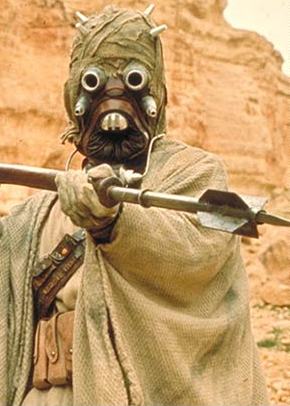
For example, in Star Wars Episode IV: A New Hope, the threshold guardians are the Tusken Raiders who roam the Jundland Wastes surrounding Luke Skywalker’s home. Venturing out into the wastes is dangerous–yet Luke does it, to bring back R2D2 after the droid runs away.
When R2D2 warns Luke that the Tuskens are approaching, Luke doesn’t run away from them–he crawls to the top of the ridge to get a better look. This leads to his first real encounter with danger, and almost gets him killed. Fortunately, Obi Wan Kenobi rescues him and takes him home, telling him about the ways of the force and presenting him with his father’s lightsaber. The adventure is off to a good start.
If Luke had never ventured out into the Jundland Wastes, or if he had run from the Tuskens at the first sign of danger, he never would have been rescued by Obi Wan, never would have learned about his father, never would have left his home and probably would have died when the Imperials attacked his uncle’s homestead. If the Tuskens had never attacked him, he would have loaded R2D2 into the speeder and gone back home, never meeting Obi Wan as well. Without the Tusken Raiders, the whole story never would have happened.
In Harry Potter and the Sorceror’s Stone, Draco Malfoy plays a similar role. If Harry Potter had joined House Slytherin, Voldemort would probably have taken over before the end of the first book. Instead, the early animosity between Draco and Harry’s newfound friends pushed him to take sides, setting the stage for everything else that was to come.
The threshold guardians don’t always have to take an adversarial role. In a lot of stories, defeating the guardian means winning an ally, even sometimes a best friend. That’s what happens when Robin Hood spars with Little John–in fact, the trope is subverted because Little John actually wins. Or perhaps the whole thing was a secret test of character, because it’s Robin Hood’s good-natured reaction to losing that wins Little John over.
Not every instance of the hero’s journey has a threshold guardian, but many of them do. It’s a clear and compelling way to mark the threshold between home and adventure, which is present in every hero’s journey, simply by definition. When done well, it’s a great way to show what makes the hero different from all the other would-be adventurers who chose to stay home.
Trope Tuesday: The Call to Adventure
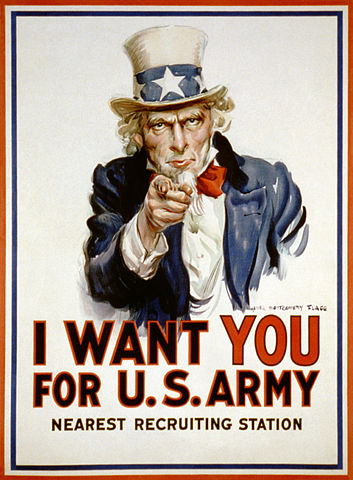 One of the first (and most important) stages of the hero’s journey is the call to adventure. It happens when the hero first confronts something outside the experience of his ordinary world that beacons him to leave it. It overlaps closely with the inciting incident, and marks the point at which the hero’s journey begins.
However, it is not typically where the story begins. In order for the hero to leave the ordinary world, he must first start out there, so we know what’s at stake and what he’s leaving behind. This is why Luke Skywalker starts out on his uncle’s homestead, and why Neo starts out as a bored and lonely employee of Metacortex. Events outside the hero’s experience may have already put him on a trajectory to leave on the adventure, but he won’t know it until the call comes.
The hero may start out in a quiet, peaceful village, far removed from any sort of conflict–or he may start out in the middle of a crapsack world, as is the case with dystopian fiction. The important thing is that it’s the world he’s always known–that he hasn’t ever really made an effort to leave or change it.
How he feels about his world largely determines how he chooses to respond to the call. In older literature, the hero typically refuses it. The advantage of this is that it gives the reader a sense of scope–that this adventure is not a small or a trivial thing. It also sets up an immediate minor conflict that gives some motion to the opening chapters.
In modern stories, though, it’s more common for the hero (or his friends) to jump at the call. There are also many advantages to this. In Lord of the Rings, it gives Frodo an immediate band of sidekicks. In Harry Potter, it plays up the sense of wonder at the magical world. In the Chronicles of Prydain, it highlights the impulsiveness and naivete of Terran, as he realizes later on in the story just how stupid of him it was.
The call itself can take many forms. It can come as a fateful visitation from a supernatural messenger, a mysterious request from a dying stranger, or a sacred trust from a dying friend. It can also be more internal, such as an important moment of decision, or a desire to find some greater purpose in life. Whatever the case, the one thing the hero cannot do is ignore it–at least, not forever. One way or another, the hero sets out, and the adventure begins.
Trope Tuesday: Deus Ex Machina
This one is by request. A Deus Ex Machina, or “God from the Machine” ending, is basically when the author writes himself into a corner and pulls something out of his butt to resolve the story.
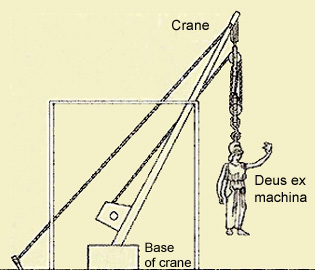
The term comes from ancient Greek theater, which often employed this technique–probably because the audience was known to get violent when the show didn’t end the way they wanted it to. Basically, a crane–the “machina,” or machine–would lower an actor playing the role of one of the gods–the “deus”–who would then resolve everything and tie up all the loose ends without the heroes having to do anything.
Sound unsatisfying? Yeah, I think so too. That’s why it’s often used as a derogatory term, much like Mary Sue. HOWEVER, it can be done well. As always, your mileage may vary, but here are some examples that pull it off:
WARNING! SPOILERS!
- Watership Down: A girl saves Hazel from her cat. Satisfying because it makes sense from the girl’s point of view, and humanizes the story by showing that it really does take place in our world.
- The Hobbit: The eagles arrive out of nowhere to turn the tide of the Battle of Five Armies just at the critical moment. Satisfying because it’s a cavalry ending as well, though some fans don’t like it.
- Lord of the Rings: Again, the eagles swoop down and save the day, this time by rescuing Frodo and Sam from the fires of Mount Doom. Satisfying because after coming this far, we really don’t want a downer ending.
- Harry Potter and the Sorcerer’s Stone: Harry is saved by his mother’s love. Satisfying because of the symbolism and the power of love.
- Lord of the Flies: Just as the boys are about to kill each other, a military ship arrives out of nowhere and rescues them. Again, satisfying because of the symbolism, as well as the collective “what have I done” moment.
- Schlock Mercenary: Many, many occasions. Satisfying because it’s brilliantly lampshaded.
- Monty Python and the Holy Grail: “…the animator had a fatal heart attack! The cartoon peril was no more!”
- Raiders of the Lost Ark: The Nazis capture Indiana Jones and get the Ark of the Covenant, but when they open it, a supernatural force kills them all. Satisfying because it squares with Indy’s general MO and his pattern of spectacular failures.
- The War of the Worlds: The humans are utterly powerless to stop the aliens, but they all die off from germs. Satisfying because of the underlying message.
Does this mean that it’s a good idea to write off any criticism that your own work suffers from a Deus Ex Machina? Probably not. This is one of those things that readers tend not to notice when it’s done well. If your readers notice it, chances are that something is broken.
As you might guess, there’s a lot of gray area as to what constitutes a Deus Ex Machina, and what is actually something else. Generally, if the ending is properly foreshadowed, either by a Chekov’s Gun or by good character development, it’s not a Deus Ex. The foreshadowing removes the “out of nowhere” aspect that readers find so unsatisfying.
Foreshadowing is one way to fix a Deus Ex Machina. Another way is to toss out the ending and rewrite it from scratch, starting at the point where hero starts getting sidelined. According to Dan Wells’ seven point story structure, the hero should typically spend the first half of the story reacting to the villain, and the second half getting the villain to react to him.
There are lots of other ways to fix a Deus Ex Machina, but those are probably the biggest ones. If you have any other suggestions, by all means, suggest away.