Some (better) advice for the chronically single

So the Daily Wire recently put out an interesting article about the current trend of chronically single young adults who want to get married but have had zero luck, especially with today’s online dating scene. From what I can tell, online dating is like a post-apocalyptic wasteland right now—which is a huge problem, because ever since the pandemic, online dating has come to replace almost every other form of getting out there and finding prospective romantic partners.

So since I graduated from the online dating scene after a period of chronic singlehood, and am now happily married, I thought I was qualified to share some of my thoughts on the subjects in the comments on the article. And since I thought some of my readers here might find it interesting, I’ve decided to cross-post my comment. Here it is:


I was chronically single until I met my wife at age 34. We met online and got married just before the pandemic. Some thoughts:

1. It sucks to be rejected, but if marriage is really what you’re looking for, you’ve got to embrace the suck. You’ll never find “the one” if you’re trying to please everyone. Know what you’re looking for, and when you write up your dating profile, share the things about you that will drive everyone else away. My profile had an explicit declaration of faith, because that was what I was looking for–and I found my wife on the third or fourth match, in part because that declaration was explicit enough to drive everyone else away.

2. The only way to stop wasting time is to embrace Jordan Peterson’s 8th rule of life. You grew up in an online world where almost everything you saw was a lie. Embrace total honesty, no matter how much it hurts. On our second date, I asked my future wife what she wanted to do with her life. She embraced total honesty and told me she wanted to be a wife and a mother more than anything else, even though she had no idea how I would respond to that. We were married less than a year later.

3. Have enough faith to trust God’s timing. My wife and I were actually enrolled in the same college class a decade before we met online. If we had dated each other then, it wouldn’t have worked out. We both needed to grow a bit first (quite a bit, in my case). Everything in this world has been prepared in the wisdom of Him who knows all things. Do your part to bring your life in line with Him, and all things will work together for your good.

4. Stop making everything about yourself. Selfishness is the root cause of every divorce, which also makes it one of the biggest deterrents to marriage and relationships. You grew up in an age of unbridled narcissism, exploited by Big Tech and social media to leverage your loneliness for corporate profits. When you think you may have found the right one (and you’re not in a codependent or abusive relationship), make it all about them. He who seeks his life shall lose it, and he who loses his life, for God’s sake, shall find it. I will never forget the impression I received when I first held my daughter: “this is her story now, not yours.”

Why books written by mothers are better than books written by childless women

I never know which posts of mine China Mike Glyer is going to pick up for his pixel scroll, or whatever he calls the daily bucket of chum that he feeds the folks over at File 770 (the ones who aren’t Chinese bots, anyway). I’ve written at much greater length about my 2022 reading resolution here, and my insights and impressions gained through the experience here and here, but for some reason the post he decided to pick up was the last one. Perhaps he thought that it would be better at ginning up outrage than the other posts? But if that were the case, surely he would have picked up the one before that instead. It was practically written for ginning up outrage among the File 770 crowd (or at least the ones who aren’t Chinese bots).

So when I got the pingback last night, I glanced over the post over at File 770 and saw this comment from Cora Buhlert:

I have to admit that whether or not writers have children is not a characteristic I pay the slightest bit of attention to. Never mind that it is difficult to tell, because even today, not every writer chooses to talk about their family or private life.

But I guess that Joe Vasicek is the sort of person for whom people without children, particularly women without children, are by definition evil.

Cora is an indie writer from Germany that I used to interact with a lot on the KBoards Writer’s Cafe, and some other indie author hangouts. She’s earned the ire of Larry Correia a couple of times, and she has a bad tendency to straw man any opinions or perspectives that challenge her worldview. On one thread, we went back and forth over whether Hitler was a creation of the political right or the political left. I tried to explain that “left” and “right” mean different things in the US than they do in Europe, but it was like trying to have a discussion with a brick wall.

So it doesn’t surprise me in the least that she’s completely mischaracterized me in the comment above. I do not believe that childless women are evil—if I did, I would not have served in the bishopric of a mid-singles ward (a mid-singles ward is a Latter-day Saints congregation of unmarried and divorced people in their 30s and 40s. I was the ward clerk—basically, the guy who handled all the finances and other paperwork for the congregation). My faith teaches me that people are not evil, but are all children of God, no matter who they are born to or what their life choices may be.

In fact, my interest in the parental status of the Hugo and Nebula winning authors has nothing to do with religion or morality, and everything to do with life experience. I didn’t get married until almost a decade after I had started to write professionally, and the experience of becoming a father was so completely lifechanging that it’s transformed my writing as well: what I choose (and don’t choose) to write about, who I choose (and don’t choose) to write for, as well as the themes and ideas that I explore in my books.

You can see this transformation if you read my Genesis Earth Trilogy. Genesis Earth was my first novel, but it wasn’t until almost nine years later—after I’d met my wife and was engaged to be married—that I felt I had the life experience necessary to write the sequel, Edenfall. And the final book, The Stars of Redemption, was not the sort of thing I was capable of writing until after I had become a father and knew what it was like to help bring a child into the world.

When my daughter was born, the very first thought that came into my mind was “this is her story now, not yours.” We all like to say that we’re the hero of our own story, and in a very basic way, that’s true. But when you become a parent (assuming that you’re a responsible parent, and not a scumbag), you’re no longer living just for yourself, but for your children. “He who findeth his life shall lose it: and he that loseth his life for my sake shall find it.”

Having a child changes your perspective on everything. Among other things, you have a much deeper and more personal investment in the future, since you know that your child will inherit that world. Your perspective on your own family history changes too, as you have become a link in the generations, not merely a byproduct of it. Life becomes a lot harder, but it also becomes more meaningful. Things that took up a great deal of your time and attention when you were single suddenly become trivial, and other things that didn’t make much sense to you about people before suddenly click into place.

So that was why, when I decided to read all of the Hugo and Nebula winning novels, I was curious about the parental status of the authors. I wanted to know if the experience of being a parent had affected the quality of their writing, since I know it’s affected mine. And honestly, it’s not that hard to look up: almost all of these authors have Wikipedia pages with a section about their personal lives. Obviously, the details about their children are sparse, but the only thing I cared about was whether or not they had any.

(As a side note, there were other stats that I decided to track, such as the age of the author when they won the award. That hasn’t seemed to have impacted my taste, except that I have not enjoyed a single award-winning novel by an author who was in their 20s at the time that they won. The only exception was Isaac Asimov with the retro-Hugo for The Mule (Foundation and Empire), but that wasn’t awarded until after he was dead. There are also three authors whose age I was unable to determine from a quick internet search: Michael Swanwick, Sarah Pinsker, and Charlie Jane Anders.)

(As another side note, I’ll be the first to admit that I may have made some errors in my research. For example, if a five-minute internet search on an author didn’t tell me anything about their kids, I assumed they didn’t have any. It’s entirely possible that they just prefer to keep that information private. Also, I didn’t bother to look up when they had their children, so it’s possible that they were still childless at the time they won the award.)

Why should I be interested in this sort of thing? Why look at things like an author’s age, gender, or parental status?

Two reasons. The first is that I wanted to do a deep dive on the Hugos and the Nebulas, the two awards which represent themselves as representing the very best of the science fiction genre. Since that is the genre that I write, I want to understand not just the kind of books that win these awards, but the kind of authors who win them. The goal is to have a deeper understanding of the genre, and to look for trends and movements within it.

Second, and more importantly, I want to have a better understanding of my own reading tastes. All of this is subjective, of course, since the act of reading is always a collaboration between the reader and the writer. I’m sure that some of the books I think are terrible are considered by others to be the best in the world, and vice versa. My goal is to look for patterns that will tell me whether I’m likely to enjoy a book (or an author), so that I can find the best books more efficiently. I don’t do this for all of the books that I read, but since the Hugo and Nebula winning books are supposed to be the very best, I figured it was worth it to do a deeper analysis—especially since my goal is to read all of them.

The thing that surprises me is that it isn’t parental status that matters, but gender + parental status. I can think of a couple of reasons why this would be the case. The most obvious is that it’s easier for me to empathize with a childless man, since that was me for such a long time. And I do think that’s a major part of it.

But I also think that there’s something specifically about being a mother—or deliberately choosing not to be one—that’s also a factor. And yes, I’m talking about biological essentialism. I mean, I’m not a biologist, but I know that I will never be able to be a mother—that’s a life experience that I will never be able to have. Conversely, I will never be able to deny my potential motherhood, an equally major life decision. Both of those experiences are bound to have a major impact on an author’s writing, either way.

I also think this factor is what lies at the heart of Roe v. Wade, the worst decided Supreme Court case since Dred Scott v. Sanford. Certainly the cultural impact of that decision has profoundly influenced how our society views children and motherhood. It’s also why I am sooo looking forward to Matt Walsh’s documentary What Is a Woman? coming out in two weeks:

With all of this in mind, I find it fascinating that every Hugo Award for best novel after 2015 (the year that the Sad Puppies had their high water mark) was won, as far as I can tell, by a childless woman. It would be interesting to see if that trend extends to nominees, or to the other categories like best short story, best novelette, and best novella. Maybe I’ll look that up sometime.

And now that I’ve referenced Roe v. Wade, I’m sure that Cora Buhlert (if she’s reading this) is saying to herself: “yup, he just thinks that all childless women are evil.” And to the extent that File 770 is read by humans and not bots, they’re no doubt picking and choosing those parts of this post that confirm their prejudices (if China Mike Glyer even has the balls to cross link to a post that includes that trailer—do it, China Mike! I dare you!)

But I don’t really care either way, because now I have a much better understanding of my own personal reading tastes, and how they contrast with the Hugo/Nebula crowd. For me, the best books are those that are written by authors who have had the life experience of being a mother, and the worst books are by those who have chosen to deny themselves that path. Apparently, the Hugo/Nebula crowd takes the opposite view. Good to know.

2019-12-05 Newsletter Author’s Note

This author’s note originally appeared in the December 5th edition of my author newsletter. To subscribe to my newsletter, click here.

We had a very eventful Thanksgiving this year. My whole side of the family was in town for a baptism and a funeral, and we had Thanksgiving dinner with Mrs. Vasicek’s family, as well as pie night, which is a tradition my in-laws have. So lots and lots of family, which was stressful in some ways but also a lot of fun.

Mrs. Vasicek and I took advantage of this to make a family announcement, which I can now share with you: we’re having a baby! The due date for little junior is in May, and we don’t yet know if it’s a boy or a girl, but we will definitely find out next month.

I don’t think it’s really hit either of us yet. Of course, it’s something we talked about while we were dating, and since both of us are in our thirties we decided it would be best not to wait. Our lives are sure to change in a major way once little junior comes along, but for now, it’s still business as usual.

It has made me think a little bit about a blog post I wrote some nine and a half years ago, right after I graduated from college. The post was a response to a New York Times article about “emerging adulthood,” or the idea that we should count the time between adolescence and full adulthood as a separate stage of life.

The article points out that there are five traditional milestones that mark the transition to adulthood:

  • Completing school
  • Leaving home
  • Achieving financial independence
  • Getting married
  • Having a child

In our parents’ and grandparents’ generations, people commonly achieved all of these milestones sometime in their early twenties. However (the NYT article argues), because that isn’t as easy in today’s modern world, and because the human brain isn’t fully developed until about age 25, we shouldn’t put too much pressure on young people to achieve these milestones until their late twenties or early thirties.

As a 25 year-old at the time I read the article, I was much more interested in how I measured up with the milestones than the argument for putting off adulthood itself. Now, at age 35, I’m finally about to hit the last one.

I never consciously tried to put off the responsibilities of adulthood. If I’d found Mrs. Vasicek in my mid-twenties, I wouldn’t have made her wait another ten years. And yet, it seems that many of my peers are putting off adulthood as long as they can—in some cases, indefinitely. There’s a reason why “adulting” is a word now, and why pajama-boy is a meme.

And yet… if I’d met Mrs. Vasicek ten years ago, I don’t think it would have worked out. And if somehow it did, I probably would have put my writing career on the back burner, or abandoned it entirely. Many of my friends who got married a year or two out of college did exactly that. Those who are still pursuing their creative careers are generally either single, married without children, or stay-at-home moms (which seems even more difficult than juggling writing with a day job, but hey).

I suppose I benefited from this idea of “emerging adulthood,” since through my mid-thirties I basically was one. But I didn’t choose it because it was the easy path. It would have been a lot easier to give up on writing—but ironically, I don’t think Mrs. Vasicek would have been attracted to me if I’d done that, and there’s a very good chance I’d still be a single basement-dweller.

So what does this mean about this idea of “emerging adulthood”? Is it something that we should recognize? Yes, but not as an excuse to put off the responsibilities and milestones of adulthood. It isn’t worth putting off your life—or your future family—just because you’re afraid to take that next step, whatever it may be.

A Change in Direction

This is going to be a rather long post. I’ll preface it with some demographic trends among my generation, then tie that in with my situation and how I got here. From there, we’ll see where it goes.

I was born in the early 80s, which technically makes me a Millennial, though it doesn’t always feel that way. Millennials get maligned for a lot of things, which is pretty typical of all generations as they rise, from what I can tell. Civilization is constantly under attack by barbarians, most of whom we call “children,” which is really just another way of saying this:

So how is my generation currently reinventing the world?

Thus far, not very well. The Great Recession hit us just as we were coming of age, and it shows. We were much more likely to move back in with our parents than previous generations. We’re putting off marriage and home ownership, some because we’re more focused on our careers, others because we just can’t seem to launch.

At the same time, not all of this is bad. In spite of the fact that most of us were never taught home economics or personal finance in high school (thanks, Baby Boomers, for all the participation trophies), we are rapidly learning more responsibility than our parents. Where six out of ten Americans would have to beg, borrow, or steal to cover a $500 emergency expense, nearly half of us Millennials have $15,000 or more in savings.

And yet, the problems we’ve inherited are truly daunting. Our national debt is $21 trillion and counting, and without facing a recession, war, or other emergency event, our deficit is still set to exceed $1 trillion per year for the forseeable future. Just this month, we learned that Medicare is set to run out of money in eight years, and Social Security is not far behind that. And don’t even get me started on the house of cards that is our national pension system.

Up until the 60s, previous generations saved and invested so that their children could be better off than they were. The Baby Boomers not only squandered this wealth, but they stole their children’s and grandchildren’s inheritance as well. History teaches us that there will be a terrible price to be paid for all of this. Our parents have proven themselves incapable of doing anything other than kicking the can down the road to oblivion.

That probably sounds more bitter than I intended it to be. Unfortunately, it’s the truth. Our parents just don’t understand the world that we’re living in. We’ve come of age in a world with far less opportunity than they did.

I had a conversation with my mother last year that demonstrates this. My mother likes to make cascarones for special events, like Easter or birthdays. To make them, however, you need a hollowed-out eggshell, which requires removing the yolk and whites in a very particular way. If you’re accumulating shells through normal consumption, it can get to be rather tedious.

One day, I came into the kitchen to find my mother blowing out eggshells and dumping the whites and yolks down the sink. She’d bought a whole bunch of them for 35¢ a dozen, and decided to just make the cascarones all at once instead of accumulating the shells over time. When I saw this, I was horrified.

“How could you waste all those eggs?” I asked.

“It’s not a waste,” she said. “They were 35¢ a dozen.”

“Yes, but we could have eaten them. That’s perfectly good food you’re dumping down the drain.”

She shrugged, as if it didn’t really matter. But I pressed her a bit further, until I came to a disturbing realization:

My mother has never been as poor as I am.

When I pointed this out to her, her answer was even more disturbing. With anger in her voice, she snapped “that’s because you choose to be poor.”
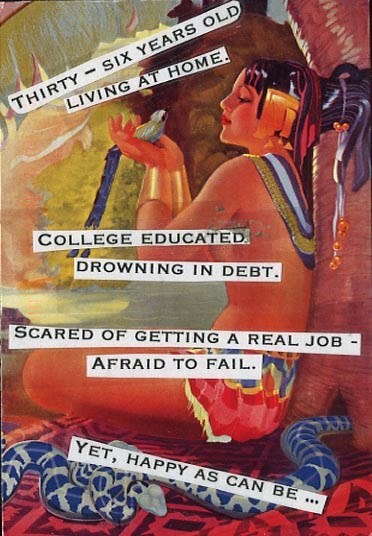
Is that true? Am I, a Millennial, poor because I choose to be poor? Perhaps. I’m not so irresponsible that I won’t own up to my life decisions, which have brought me to this place. But I think there’s this perception in the minds of our parents and grandparents that Millennials are generally like the person who wrote this postsecret above. Drowning in debt, living at home, so afraid to fail that we’ve utterly failed to launch, and yet blissfully oblivious to all of it. Perhaps that’s true for some of us, but not for those who will reinvent the world after our parents are gone.

To be clear, I love my mother and father. I don’t hold any of this against them personally, or anyone else of my parents’ generation (except the politicians who sold our Constitutional birthright, but that’s another rant altogether). Unfortunately, hard truths do not become softer because we choose to ignore them. And hard truth is this:

Hard men make good times.

Good times make soft men.

Soft men make bad times.

Bad times make hard men.
I graduated college in 2010. Through a combination of scholarship money, campus jobs, and (yes) generous parents, I was fortunate enough to graduate without any student debt. At the same time, it was the height of the Great Recession, and jobs were nearly impossible to come by. I can’t tell you how many of my writing friends put their dreams on hold, or abandoned them altogether. Almost all of them.

As a side note, I agree with Mike Rowe that “follow your passion” is bullshit advice. It ranks right up there with “be yourself,” and “you can be anything if you put your mind to it.” Don’t follow your passion. Follow opportunity, and take your passion with you.

But in 2010, I had an opportunity. Without any debt, and without any dependents or other obligations, I decided to pursue a writing career. And unbeknownst to me at the time, the industry was undergoing a revolution that would open the doors to make that possible.

I indie published my first short story, Memoirs of a Snowflake, in March 2011 and never looked back. Since then, I’ve published dozens of novels, novellas, short stories, and other works. It’s been an exhilarating journey. At the same time, it’s been the most difficult struggle of my life. And that is why I must now confront one of my most crippling fears.

Unlike the girl in the postsecret, I am not crippled by the fear of failure. If I were, I would never have published that first story, let alone all the others that followed. Instead, I have a fear of admitting failure, both publicly and to myself. It feels too much like an admission of defeat.

It’s an important distinction to make, though. The Romans admitted failure often and early—it’s how they learned from their defeats, ultimately going on to build one of the most powerful militaries in the ancient world. But they never admitted defeat. Even after Cannae, when Hannibal threatened the republic with utter extinction, the Romans refused to be defeated. And so, while Carthage fell into decline and decadence, the Romans endured until Scipio finally gave them victory at Zama, paving the way for the rise of Western Civilization.

I haven’t had a personal Cannae moment yet, but I do feel like I’ve been fighting a war of attrition. In 2014, the market shifted with the launch of Kindle Unlimited, and I failed to adapt. At that point, I was just on the cusp of going full-time with my writing, though looking back I can see that I didn’t yet have the foundation for a lasting career. Still, to have that dream snatched away when I was just on the verge of catching it, you can understand why I kept plugging along, believing that I was just a month or two from turning things around.

That’s basically what I’ve been doing for the last four years: writing full-time even though the writing doesn’t pay full-time wages. Maybe my mother is right. Maybe I have chosen to be poor.

And yet, while I now believe that I do have the foundation for a lasting career, I need to confront the fact that it may be ten years or more before I achieve it. Should I continue, like so many of my peers, to delay major life decisions until my career reaches that point? Is it worth it to put off marriage, family, and home ownership until my forties or fifties, if that’s what it takes? Or is it time to admit failure so that I can leave this dead end and find another way?

Back in 2010, I had no plan B. It was the Great Recession. I didn’t have a day job because I couldn’t find one—hardly anyone could. And from 2013 to 2014, writing paid well enough that I didn’t need one. Things were looking up, and I was just a couple months away from a sustainable long-term career.

Well, it’s time to admit that that line of thinking has turned out to be a trap. I’m approaching my mid-thirties and I’m still single and poor. I need some kind of long-term backup, because I can’t count on the writing career to take off like I need it to, at least not anytime soon.

So I’ve moved my writing onto a part-time footing. I’m limiting the number of words I write each day, leaving time for other pursuits. And I’m looking for a day job, preferably one that teaches me something useful and pays well enough to make ends meet.

I haven’t been defeated yet, though. Failure is not final until you decide to give up. I have not given up, and will continue to write, even if only on a part-time basis. And when I am making enough to go full-time, I have the foundations in place to do so.

In the meantime, though, I’m not going to put my life on hold for a dream.

Early January Update

The holidays are over. Blergh.

I don’t generally do well when my routine gets broken up by outside forces, which is why this blog has fallen by the wayside for the last week or so. I’m also not very good at creating structure in my life where none exists, so during times like the holidays I don’t tend to do very well. This is definitely a skill that I need to work on.

In any case, the holidays are over, which means it’s time to get back to work. Thank goodness!

I am about 10,000 words from finishing my current WIP, An Empire in Disarray. With the work on my friends’ basement finished and my roommate starting school in Salt Lake today, there shouldn’t be any more interruptions between now and the end of next week. This bodes well.

When that’s done, I’ll jump right into work on Victors in Liberty. I’ve got to admit, there are other projects I’d really like to work on right now, but finishing Sons of the Starfarers takes priority.

The series was supposed to be finished way back in 2015. But I underestimated the volume of work I’d taken on—and that was before I got a girlfriend. I fell behind on my writing as the relationship got really serious, and then we broke up, which didn’t help with productivity either.

Long story short, I did a lot of things wrong back in 2014. But I learned from my mistakes, and I think my books are better because of it. So instead of finishing up Sons of the Starfarers in 2015, I’m finishing it now in 2018. And then I’m moving on to other projects.

Edenfall is at the top of that list. It’s been years since I started the Genesis Earth trilogy, which is another ball that I’ve dropped. Genesis Earth does stand alone, but I’ve been promising to finish the trilogy since I published it in 2011, and judging from the reviews (as well as the slow but remarkably steady trickle of sales), this is a WIP that deserves to get priority.

One thing I’m really trying to do this year is to get better at structuring things: my writing, my publishing and marketing efforts, my daily routine, etc. Towards that end, I’ve put together a publishing schedule for 2018. Here it is as it stands at the beginning of the new year:

  • JANUARY — Patriots in Retreat (Sons of the Starfarers, Book 6)
  • FEBRUARY — The Janus Anomaly: A Short Story
  • MARCH — A Queen in Hiding (Sons of the Starfarers, Book 7)
  • APRIL — Time and Space in Amish Country: A Short Story
  • MAY — An Empire in Disarray (Sons of the Starfarers, Book 8)
  • JUNE — Lizzie-99XT: A Short Story
  • JULY — Victors in Liberty (Sons of the Starfarers, Book 9)
  • AUGUST — Edenfall (Genesis Earth Trilogy, Book 2)
  • SEPTEMBER — Sholpan
  • OCTOBER — The Sword Bearer (The Twelfth Sword Trilogy, Book 2)
  • NOVEMBER — In the Beginning: A Short Story
  • DECEMBER — Gunslinger to the Galaxy (Gunslingers Trilogy, Book 2)

Lots of book 2s and finishing series. I suppose you could say this is the year where I start to finish what I’ve started.

And while the schedule may seem a bit daunting, the first four books are already ready to go, with Patriots in Retreat and A Queen in Hiding already up for preorder. Of the ones that are left, half are already written. So even though it seems ambitious, it’s actually quite doable, even if something crazy happens and I end up eloping to Mongolia before the end of the summer.

So that’s what I’m up to. I’ll get back to blogging as I can, but my first priority is writing, followed closely by publishing. Lots of behind the scenes stuff happening which I don’t have time to get into right now.

Take care, and thanks for reading!

Joe

Back in Utah

So! It’s been a while since I updated this blog, and there’s actually a good reason for it. I quit my day job in Iowa a couple of weeks ago and just moved back to Provo. In other words, I made the pioneer trek in the wrong direction and repented.

Driving across Wyoming, I got a small sense of what my pioneer ancestors must have felt as they made the trek to Utah. Compared to Iowa and eastern Nebraska, Wyoming is a lonely, windswept wasteland. It’s not quite as empty as Nevada, but wow, is it a forlorn place. Beautiful, but lonely.

After passing through Evanston, route 80 descends from an altitude of about 7,000 feet into the mountain valleys of northern Utah. I have to say, the stretch between Evanston and Park City is gorgeous. Absolutely gorgeous. From there, I came down the eastern side of the Wasatch mountains through Heber and Provo canyon, which is also gorgeous this time of year. Fall foliage, with just a little bit of snow on the highest peaks.

It’s good to be back. I’m renting a room from my friend and cowriter Scott Bascom, who is letting me pay him back in labor to clean and improve his house. He went through a series of major life crises in the last couple of years, and a back injury prevents him from getting the house back in shape. That’s where I come in. It’s a suitable arrangement for both of us and I think it will work out quite well, especially once we get a virtuous cycle going with our writing.

That’s my going to be my focus for the next several months: writing. I have a very aggressively release schedule for the first half of 2018, and a much better business foundation after taking a small business class in Iowa. I also saved up enough money from the old day job that I can afford to focus exclusively on writing and publishing for the next several months. So that’s the plan.

In 2014, I had my first 4-figure month and thought I was doing well enough to go full time in the near future. But looking back, I can see that I didn’t have the foundation set up to sustain a profitable business. The market shifted, the things I was doing to sell suddenly didn’t work anymore, and I made some stupid mistakes that drastically hurt my business. But I learned a lot from all that, and now I’m coming back with a much better foundation, a detailed plan for how to build on it, and enough experience to know how and when to abandon that plan as circumstances change.

Lots of stuff to talk about on that end, but I’ll leave it there for now. One thing you can definitely expect, though, is for the Sons of the Starfarers series to be complete before the end 2018–hopefully before the summer. Also, Gunslinger to the Galaxy should be out next year as well. And if you’re a fan of print books, I hope to put out a paperback of every book that I’ve written in the not so distant future. Audiobooks too, in the long run.

So if you haven’t already, be sure to sign up for my email newsletter, since that’s the best way to stay abreast of my new releases. I’m not always as good at posting about them here as I should be. Also, now that the big move back to Utah is complete, expect to see more on this blog.

So long, and thanks for reading!

The thousand year view

How will your life impact the world in a thousand years?

It’s an easy question to dismiss. After all, how can one person possibly shape the course of history? Even if we accept the impact of certain great men, how can we have the hubris to think that we might one day join them?

But the truth is that our lives have more impact than we realize. Each one of us is literally a product of our ancestors. Their decisions, for good or for evil, have put us where we are today. We also have a hand in shaping the people we come into contact with. That impact can be felt through multiple degrees of separation—and how many degrees does it take to encompass the world?

In the year 1017, Europe was rising out of the ashes of the Viking age. Kievan Rus was ascendant in the east, vying with the Romans who dominated the religion and commerce of Europe (we know them today as the Byzantines). However, tensions were rising between Constantinople and the bishopric of Rome, where one of the last vestiges of the Roman state in the West would soon break communion and form the Catholic Church. Meanwhile, an apocalyptic Muslim death cult known as the Fatimids had swept from North Africa all the way to Baghdad, the cultural and scientific capital of the world. From the harsh steppe wilderness of central asia, the Seljuk Turks were building an empire that would save Baghdad from destruction, while in China, the Song dynasty had invented the first paper currency.

In short, it was a completely different world. How different will things look a thousand years from now?

By the year 3017, we will probably have established an independent colony on Mars. Other parts of the solar system will probably also be colonized, and we may have even begun our expansion to the stars. After all, faster than light starship drives are about as fantastic to us as cars, airplanes, and space stations would be for medieval serfs.

It is highly unlikely that the United States—or any other country, for that matter—will exist with its current borders. In fact, it’s highly unlikely that the majority of countries extant today will even exist at all. China is probably an exception, but let’s not forget that China is a civilization pretending to be a country.

Pessimists will say that there’s a good chance humanity won’t exist at all. They point to things like climate change, pandemics, and global war as challenges we may not overcome. But in the last millennium, we faced all those challenges and rose above them (little ice age, Mongol hordes, black plague). Same with the millennium before (extreme weather and crop failures of 535-536, Muslim conquests, plague of Justinian).

So how will your life impact the world a thousand years from now? What sort of impact do you want your life to have? How have the things you’ve done today brought you closer to leaving that legacy?

I’ve thought about this a lot over the past few weeks. I want to impact the world through my books, but it’s unlikely that most of my books will still exist. My family and descendants will, though. I want to leave them with the best foundation I can. Here’s how I plan to do it:

Step One: Master the Basics of Provident Living

Provident living is more than just learning how to do your laundry and keep up with the maintenance of your car. It’s learning how to live sustainably, with a degree of self-reliance that can see you and the ones you love through hard times. It’s all the stuff I’ve been writing about in the Self-Sufficient Writer blog series.

I’ve made a lot of progress in this area, but there’s still a lot of progress left to make. Here are the next few steps I want to take in this area:

  1. Establish a rotating 90-day food storage for dry goods.
  2. Establish a herb garden.
  3. Expand food storage to canned goods.
  4. Buy a chest freezer and expand to meats and dairy.
  5. Plant a garden and expand to fresh fruits and vegetables.
  6. Learn how to can.
  7. Learn how to hunt.
  8. Begin keeping livestock (chickens, goats, etc).

A lot of these steps are going to have to wait until I have my own land, which brings us to:

Step Two: Live Debt-Free and Own the Place Where You Live

When you live on someone else’s land and owe them a portion of your labor, that’s a form of serfdom. In both historic and modern times, this has been the norm for the vast majority of people.

It shouldn’t be.

When my ancestors came from Europe to the United States, one of the first things they did was buy land. There was a reason for this. In the old country, they were serfs. They paid the corvée. They were not free.

They knew that unless they lived on land that they owned, in a home that was theirs, their children would not be free either.

We’ve enjoyed a century of prosperity in the United States. It’s led us to believe that home loans and mortgage payments are normal. They aren’t. When your home is the collateral for a loan you’ve taken from the bank, and you spend most of your adult life paying it back to the tune of 250%, that is a modern form of serfdom.

Until you own it outright, your house is a liability, not an asset. And in some places, true ownership is impossible. After all, if the government has the power to seize your house for non-payment of taxes, did you really ever “own” it to begin with?

It’s a similar thing with debt. All debt is a form of bondage. “Leverage” is when someone else has control over you or something that belongs to you. Unless you can get out from under it, you will never truly be free.

If most of your life is spent in serfdom and bondage, the thousand-year impact of your life will be muted.

The Habsburg dynasty started with a small castle on the top of a hill. From that starting point, the family went on to shape the development of Europe into the modern world. The castle was so important in that effort that the family took their name from it.

I know how to live debt-free. I’ve been doing it for several years. But I do not currently live in a place that I own. That is my overriding goal: to own the place where I live within ten years.

The government isn’t making it easy. Neither are the central banks. A decade of 0% interest rates has ravaged the middle class. As a direct consequence, home ownership rates are dropping to historic lows. 70% of Millennials have less than $1,000 saved for a down payment on a house, while at the same time, the helicopter money from the Fed has inflated a new housing bubble larger than the one that burst in ’08. In California, Google employees with six-figure incomes are living out of RVs because they can’t afford to buy a house.

It’s brutal. These are the same economic pressures that led to the rise of medieval serfdom in Europe. But there are also opportunities, for those who know how to take advantage of them. Which leads to:

Step Three: Build Multi-Generational Wealth

Poor people buy luxuries. Middle class people buy necessities. Rich people buy investments. If I want to leave something behind for my children and descendants, I need to master the skills of investing and managing wealth.

This goes back to the thousand-year view. The biggest impact I’m probably going to make on the world is going to be through my children and descendants. Raising them will be the most important investment I can ever make. I want to give them a life of opportunity, so that they, like me, can make a thousand-year impact on the world.

This is what my ancestors did for me. My Mormon ancestors crossed the plains in the Willie handcart company so that their descendants could grow up in Zion. My first-generation immigrant Czech ancestors invested in Texas farmland that still pays a small dividend to their descendants (greatly increased now because of oil royalties). There are many other countless others who made great sacrifices so that I could enjoy a life of privilege and opportunity. I’m sure that’s not unique to me.

We seem to have forgotten, here in the United States, how important it is to make sure that our children enjoy better lives than we have. To some generations much is given, while of others much is required. I fear that we are transitioning from the former to the latter. Nations are born stoic and die epicurean, surrounded by mountains of debt.

This is why it is so important to build wealth: not for your own personal consumption, but for the security of your children and descendants.

The most important investment you can make is in your education. If I’m going to develop these skills, that’s what I need to do: invest in my own financial education.

I also need to learn by experience, so I’m taking $100 of my book earnings each month and investing them. I’ll probably experience a couple of big losses, but that’s called paying tuition. The knowledge I gain from doing this will hopefully help to accomplish this goal: to build wealth that will bless the lives of my children and descendants for generations to come.

A lot of things fall into perspective when you take the thousand-year view. When you focus on the challenges of the present, it’s easy to become pessimistic, but when you take a clear-eyed look at the future—not just the immediate future, but the long-term future as well—you cannot help but take an optimistic view.

How will your life impact the world in a thousand years?

3am thoughts, or why everyone says to be an accountant (Blast from the Past: October 2013)

A lot of my blog posts this week had to do with money, wealth, and politics, so when I was searching for an old post to bring back, this one made me stop and reflect for a while.

My opinions and perspective have changed a bit since I wrote it, but the fundamental message is still one that I agree with. I’ve trimmed out some of the parts where I think I was wrong, and left the stuff that still resonates. Hopefully it resonates with you as well. Either way, feel free to let me know.


I’ve been reading in bed on my smart phone recently, which is probably a bad idea because it makes it harder to go asleep. At the same time, it tends to get my mind rolling, and at 3am my thoughts tend to go some really interesting places. Sharing those thoughts is probably going to get me into trouble, but hey, you might find them interesting, so why not?

When I was eight years old, I knew I was going to be a writer.  There was never any question about that. I spent all my free time making up stories.  However, I knew I never wanted writing to be my job, because 1) everyone hates their jobs, and 2) everyone knows that writers can’t make a decent living. Even at eight years old, I had bought into some of society’s most pervasive myths about jobs, careers, and how to make money.

Americans are generally horrible with money. We struggle to keep budgets and put all sorts of things on credit, and pay more than twice what our houses are worth by signing mortgages we barely even read. Because we’re so horrible with money, we tend to see it as a magical force, something that can solve all our problems and make us happy. Rich people are like wizards or sorcerers, so far above the rest of us that we can hardly fathom their ways.

Nowhere is this stupidity more apparent than in the fact that most of us spend our lives working for some sort of hourly or salaried wage. Wages and salaries are basically the same, in that they convert time into money. That’s why we all measure income in terms of dollars per hour, or salary per year.  But for anyone who understands how money works, that is stupid, stupid, stupid, stupid. Money comes and goes, but time? Time is one of the most finite and precious resources known to man.

All of us are going to die someday. Most people are scared shitless by that fact, so we try to ignore it or put off thinking about it until we have to. But not all of us get the opportunity to put our affairs in order before we die. And even if we do all live to be centenarians, our time on this Earth is still finite. It’s non-renewable, too—you can’t go back and relive that day or that hour or that minute once it’s passed.

Converting time into money is basically trading gold for lead, or wine for water. Yet that’s exactly what we do, because money is this strange, magical force that so few of us understand.

Questions like “where do you work?” “what is your job?” and “what do you make?” are much more common than “what do you do for a living?” That’s because most of us have bought into this idea that money comes from working for someone else. While we’re on the clock, the company owns us and anything we produce. That’s the pact we make in exchange for this magical substance we call money.

It wasn’t until college that I started to become disabused of my childhood notions about writing for a living. First, I came to realize that lots of people love their work—that just because you do something as a job doesn’t mean that you’ll come to hate it. But it wasn’t until I graduated unemployed in the middle of a recession that I was disabused of the notion that writers can’t make a living.

People say that about every career—that is, every career except accounting. That’s because accountants are the ones who count the magical money. They’re the ones who know where it comes from. Their jobs are the ones that the people with the magical money will always need.

But there are other ways to make money—thousands of ways. Millions, even. It’s not about time it’s about producing something that people want and need. But when you’re working for yourself, that’s hard. You have to own up to your work—the failures as well as the successes.

When you work for a corporation, it’s easy to shift the blame. It’s a rare case where one person is solely responsible for bringing down the whole collective enterprise. But when you work for yourself, you can’t blame anyone else when things go wrong. You’ve got to take the risk.

That’s why everyone says that you can’t make a living as a writer. They say the same thing about any career where you strike out on your own.

In the end, though, it’s all just silly. Money isn’t a vague magical force—it comes from the value you create. It comes from producing something that people are willing to pay you for. And you don’t need to sell your time at $11 an hour or $44,000 a year to do that. You just need hard work, a great idea, and the ability to learn from your mistakes.

So can you make a living pursuing your dreams? The answer to that question depends entirely on you.

Happiness is always a choice, take 2

CGP Grey made an awesome video last week, which should come as a surprise to nobody, but this one is exceptional even by CGP Grey’s standards. In it, he borrows some of Doctor Randy J. Paterson’s work in How to Be Miserable: 40 Strategies You Already Use and gives us a seven step program on how to be miserable. Those steps are:

  1. Stay still.
  2. Screw with your sleep.
  3. Maximize your screen time.
  4. Use your screen to stoke your negative emotions.
  5. Set vapid goals.
  6. Pursue happiness directly.
  7. Follow your instincts.

Since this basically describes 80% of people on the internet at any given time, it comes as no surprise that the video soon went mega-viral.

Generally, I think most of CGP Grey’s anti-advice is spot on. However, there is one part that I disagree with rather strongly. It’s the part where he says:

True happiness is like a bird that might land on your ship, but never if you constantly stand guard to catch him. Instead, improve your ship and sail into warmer waters. The bird will land when you aren’t looking.

Happiness is not a bird that comes and goes as it pleases, without any input from you. Instead, it is a decision you make on how you will respond to things outside of your control.

In other words, happiness is always a choice.

A while ago, I wrote a blog post on the subject. In it, I said:

There are only two classes of things in this world: things that act, and things that are acted upon. Empowerment is when you give somebody the ability to act for themselves, independent of outside forces. Disempowerment is when you take that ability away.

There is nothing more empowering than to realize that no matter where you are in life—no matter how shitty your circumstances—you can always still choose to be happy.

Happiness is a feeling that only exists inside of you. It is not something external that is forced or bestowed upon you by outside forces. It is wholly internal to your heart and mind. It is a reaction to outside forces—a reaction that you choose to make.

If happiness is not a choice—if it is something over which we have no control—then we cannot have any control over any of our feelings. Our passions are external forces that act upon us, and we are powerless to stop them because our emotional development ended at age two.

Is there anything empowering or liberating about this philosophy? No. Quite the opposite. It debases mankind and makes us no better than the animals. It destroys our agency and makes us slaves to our passions.

Happiness is always a choice.

That said, I do think there’s some truth to CGP Grey’s bird analogy as well. Happiness is not like a bird, but joy, or enduring happiness, is.

Joy is a deeper form of happiness that comes as a result of hard work and accomplishment. We can’t decide to have joy without first putting in the effort. And even when we do put in the effort, there’s no guarantee that joy will be the result. There may be pain, or failure, or even tragedy.

But even as we seek to do the things that will bring us joy, we can choose to be happy along the way. Indeed, we must. If we don’t, we risk losing the hope that enables and empowers us to keep striving. Choosing to be happy, no matter the circumstances, is the first step toward finding joy.

However, it’s important to point out that this is not a cure for depression or mental illness, which are medical conditions and must be treated as such. Choosing to be happy will not cure your mental illness any more than smiling will cure diabetes.

So, perhaps not a major disagreement, but definitely a legitimate quibble. What are your thoughts?

An open letter to my 2008 self

Dear Joe,

This is yourself from the future. I know, that sounds kind of cheesy, but it’s true. Pay attention, because there are things I need to tell you. This is not to replace the life lessons that you’ll soon be learning, but to help you learn them faster so you can move on to the important stuff.

Right now, your college career is in full swing. You’re writing a lot of books on the side, and that’s great—keep it up. You will find a lot of success in your goal to be a professional writer. You’re also studying Arabic and Political Science with vague ideas of having some sort of an impact on the world. That’s fine, but unless you make those goals more specific and focused, you’re not going to accomplish anything by them. And before you try to change the world, you first need to take the time to understand it.

At this very moment, the world is transforming right before your eyes in ways that will cause you to look back and wonder. The financial collapse and housing bubble have thrown the global economy into chaos, and the resulting fallout will have a greater impact on your life than 9/11 or any other event. Up until now, you’ve focused on the Middle East, but the place you should be looking to is Europe. Why? Let’s just say there is a reason why every world war has had its origins in the European penninsula. Study the continent. Spend some time there. Learn a couple of languages, and pay attention to current events. Always be aware that you live in interesting times.

Your political affiliation on Facebook is “agnostic,” which you think is really funny. Frankly, that’s bullshit. Good and evil have political dimensions, and you aren’t doing anyone any favors by sitting on the fence. Pick a side, and choose it well. But always have the strength and integrity to admit it when you were wrong.

You’re proud of the fact that you never voted for George W. Bush. In the future, though, you’re going to regret your vote for Obama more than you ever would have regretted a vote for Bush. Obama will break every campaign promise he ever made, except to get us out of Iraq, and that will be the biggest mistake of his presidency (yes, the Iraq War was a mistake, but trust me, Obama will make it unimaginably worse). However, you will never regret your vote for Romney in 2001.

One of the most important lessons you will ever learn is that there are two kinds of people in this world: makers and takers. The makers believe in expanding the pie by creating wealth and value for everyone. In contrast, the takers believe that everyone should get “their fair share.” Somehow, this always ends up with the takers being the ones to cut the pie, with them getting the biggest slice. Don’t be a taker. Be a maker.

Enough about politics. Let’s move on to personal advice.

Don’t be afraid to change your major. Don’t put off doing an internship. Those will be the biggest regrets of your college career. Even so, there is nothing you do in college that you will deeply regret, so don’t worry about it too much. Continue to take full advantage of your time there.

At the same time, don’t worry too much about grad school. Your real education won’t begin until after you leave academia. Book learning is good, but it’s no substitute for real-world experience. Learn how to master your own personal finances. Never be ashamed to work an honest job, no matter what that job may be.

Contrary to what you currently believe, marketing and sales are not evil (though human resources certainly is). The only reason you think they’re evil is because they rule the world, and from your sheltered academic perspective you can’t see the good that capitalism creates. Embrace marketing. Learn how to properly sell yourself. You don’t have to be dishonest to be a good salesman.

People who self-publish are not as crazy as you think they are. The publishing industry is about to be turned on its head, and that is going to create a lot of opportunities for you. Keep your eyes open, but be aware that the best and worst publishing advice you will ever hear will come from the same source. Also, Miss Snark is full of shit.

Finally, don’t worry too much about dating or getting married. Definitely put yourself out there, but spend less time obsessing about it and more time having fun. Contrary to what you may think, there are actually attractive women out there who will be attracted to you. Keep an open mind, grow out your beard, and you’ll find them (if they don’t find you first!).

That pretty much sums it up. Always be happy, but never be content.

Your 2015 self.

P.S: If you want to lose weight, lift weights. Running and hiking just don’t cut it for your body type.