The Self-Sufficient Writer: Lifestyle Choices

Before I go on with this series, I feel I should take a step back and discuss the topic of lifestyle choices.

The Merriam-Webster dictionary defines lifestyle as “the typical way of life of an individual, group, or culture.” According to Wikipedia, this includes “interests, opinions, behaviors, and behavioral orientations,” and is constrained by things like demographic background, personal values, preferences, and outlooks.

In other words, your lifestyle is the way you choose to live your life within the constraints of your own circumstances. Some circumstances can be more constraining than others, but still, lifestyle is fundamentally a choice. Even in abject poverty, there are people who choose to live differently than others.

So what sort of constraints does a writing career place on your lifestyle? Well, let’s talk shop for a minute.

If you’re a writer, you’re going to need the tools of the trade. Today, that normally means a computer with a word processor, though you can also use a typewriter or pen and paper. If you have a publisher, you’re going to need some way to contact them, either by snail mail or email. If you are your own publisher, you’ll need an internet connection, a bank account, and a computer with basic formatting and image editing software (Calibre, Gimp, Blender, etc).

In other words, all you really need to be a professional writer is a computer, an internet connection, and a bank account. You may need more depending on what you’re writing and who you’re writing it for, but those are the basic tools.

So what does this mean in terms of lifestyle choices? It means that writers have a lot of options. For most careers, your income earning potential gets lower the farther out you live from a large city. Not so for writing. You could actually live in rural Mongolia with nothing but a backpack and a horse, and so long as you can come into Ulaanbataar every couple of months and find an internet cafe, you can self-publish just like anyone else.

In other words, there is no “writing lifestyle.” There are only writers who have adapted their writing careers to the kind of life they want to live.
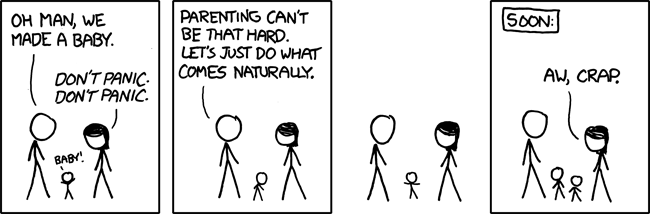
On one hand, every single one of my ancestors going back billions of years has managed to figure it out. On the other hand, that's the mother of all sampling biases.This makes it all the more important to consciously choose what sort of lifestyle you’re going to live, rather than letting circumstance choose it for you. If you don’t, it won’t be long before you find yourself in your underwear, eating nutella straight out of the jar, sitting in front of a grease-stained monitor clicking through an endless loop of Youtube videos. Just like no one is going to force you to meet your deadlines or write everyday, no one is going to force you to put your life in order.

Self-sufficiency is a lifestyle choice. It’s not a life hack, or a weird trick, or something you can learn in an afternoon. It takes work. It requires change. You will have to pay tuition by making mistakes along the way. And even though it can be fun, it can also be frustrating and painful.

When making a lifestyle change, it’s generally a good idea to take a step back first and figure out your goals and vision. By having a vision of what you want for your life, you’re much more likely to get there. This vision will be a reflection of your values and your deepest desires. Specific, measurable goals will help you to translate this vision into action, and provide the direction that you need to achieve your vision.

I have three main goals for the kind of lifestyle I hope to live. I haven’t achieved these goals yet, but I’m working toward them and hope to achieve them in the next three to five years.

Goal 1: Prepare my family well enough to survive any disaster and rebuild.

Emergency preparedness is a very important thing to me. It gives me both a sense of security and a sense of independence to know that if crap ever hits the fan, I won’t be a helpless victim.

Disasters come in a variety of flavors. There are natural disasters like hurricanes and earthquakes, man-made disasters like an economic collapse, and personal disasters like bankruptcy or the unexpected death of close family members. While it’s important to have contingency plans for each one, it’s also important to recognize that every plan falls apart upon contact with the enemy.

I plan to blog extensively about preparedness later on in this series. In the meantime, I’d recommend checking out Listening to Katrina for some very interesting perspectives on this subject. I learned a lot from reading that blog.

One of the most important things I learned is that prepping is about more than just surviving the disaster: it’s about surviving it well enough to rebuild. As much as I love reading post-apocalyptic stories, I don’t want to be stuck in a fallout shelter eating canned beans forever. We invented civilization for a reason, and if it ever falls, I want to be one of the guys who helps to rebuild it.

As a writer, I feel that emergency preparedness is even more important because the likelihood of facing a personal disaster is that much greater. If my writing career ever takes a wrong turn and falls out from under me, I want my family to be able to survive that long enough for me to successfully reinvent myself. According to Kristine Katherine Rusch, it’s common for working writers to face a major career crisis every ten to fifteen years or so, and I don’t think I’ll be an exception to that rule.

Goal 2: Develop a home economy that can provide for my family’s basic needs.

Most households in the United States produce consumer debt and not much else. If the US dollar became worthless and we all had to live off of what we had at home, within a couple of weeks, most of us would be screwed.

In a previous post, I talked a little bit about the concept of a home economy and how I experienced that concept while living overseas. It’s one of the things that I hope to implement once I have a family of my own. Instead of producing nothing but debt, I want my home economy to produce food, water, and even things like electricity and heating if it ever becomes necessary.

For me, one of the most important components of self-sufficiency is being able to produce most, if not all, of the food my family eats. Growing a garden, keeping chickens, baking bread, making cheese and yogurt—these are all things that I hope to do, and am working now to learn.

Two books that helped me get started on this path were The Forgotten Skills of Self-Sufficiency and More Forgotten Skills of Self-Sufficiency by Caleb Warnock. I’m also sharecropping this season with a local friend, building garden plots in his yard and growing cabbage, peas, radishes, broccoli, tomatoes, peppers, and zucchini. In a few weeks, we’ll build a chicken coop and get some bantams, which should make for an interesting blog post.

The goal here is not to become 100% self-sufficient in absolutely everything, but to produce enough that we can barter for the things we can’t produce on our own. For example, I don’t expect to ever own my own cow, but I do want to produce enough of a surplus of other things that I could barter with someone who does. Also, while I might not own the cow that produces the milk, I do want to have the capacity to turn that milk into things like cheese and yogurt.

This goal also encompasses being able to live off-grid. At some point, I’d like to switch to solar and become energy self-sufficient. Here in Utah, it’s legal to own and operate your own solar panels, so long as you don’t sell back so much energy to the grid that your electricity bill becomes negative. In other states, though, you have to lease your roof to a third party that technically owns the panels. I’m still learning up on all that, so I’ll probably invite a friend who knows more than me to come on with a guest post.

Goal 3: Make my home a refuge from the world where my family can feel close to God at all times.

This is the most important thing, and the one that will probably make everything else come together. Wherever I live, I want it to actually feel like a home, not just the place I live. I want it to be a safe zone for everyone in my family—a place apart from all of the bad things happening elsewhere. Most importantly, I want it to be a place of love where we can all feel close to God.

I grew up in a home that was very much like this, so for a large part of my life, it’s something that I’ve taken for granted. Having lived on my own for more than a decade and moved on average two or three times each year, I know that it’s something you’ve got to work towards.

Homemaking is often considered to be a womanly thing, but that’s exactly what this goal encompasses. At some point, I’d like to have a woman in my life who could help out with that aspect, but it’s something that I’m sure we’ll both be working on together. In the meantime, I have a sister whose brain I can rack whenever I have a question on the subject.
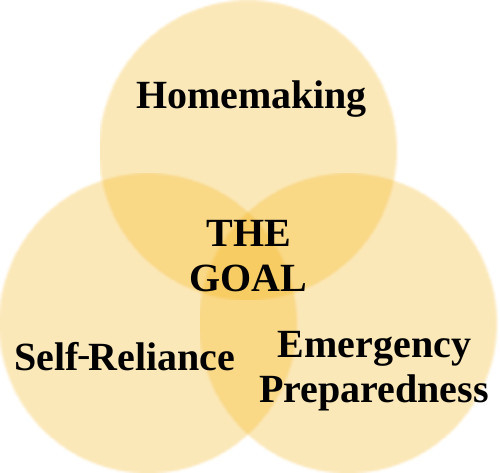
goalSo that is the kind of self-sufficient lifestyle that I personally want to live. As you can probably tell, family is one of the main themes running through everything. I’m single right now, but I do want to have a family of my own and that’s what I’m working towards.

And while my writing career isn’t explicitly mentioned in any of those goals, it’s definitely wrapped up in all of them. As a writer, my income earning potential is not dependent on how close I live to a major city. That means I can live a little farther out in the country, where we can have enough land to support a substantial home economy. Also, the flexibility of a writing career means that I can be home to spend time with my family, or still have an income if a major disaster happens and we have to bug out.

It’s quite a journey that I’ve set out on. I stumbled onto the path rather accidentally, but have since decided that this is what I want to do—that this is the kind of life I want to live. Your goals will probably look different, based on your own values and desires. If there’s anything about these goals that you find interest, though, I hope you’ll stay for the rest of this blog series where I share some of the more specific aspects of self-sufficiency that I’ve learned and how it all ties in to being a writer.
The Self-Sufficient Writer (Index)

The Self-Sufficient Writer: First Steps Toward Food Storage

For various reasons, after a year I decided to come home from overseas and move back to Utah. A lot had changed in that year, and my books were starting to earn enough that I could cover all my publishing expenses and pay myself a small salary. It wasn’t much, but the cost of living in Utah is much cheaper than it is elsewhere in the US, so I figured I’d make it work.

Right away, I started looking for ways to cut my expenses. When you’re self-employed doing what you love to do, cutting expenses is the difference between living the dream and working a dead-end job that you hate. I realized very quickly that one of my biggest expenses was food.

Backtrack a little bit. For most of my life, I’ve been a huge fan of breakfast cereal. In fact, my parents tell me that that was my very first word: “breakfast cereal.” But the thing about breakfast cereal is that it’s expensive. When I graduated college and my dad told me I was financially on my own, I realized very quickly that my cereal habit was making me broke. So I switched to oatmeal.

At first, I bought my oats in tins like this. The price was reasonable, and it lasted much longer than a box of cereal. But then I started shopping at a whole food store, and I realized that oats were much cheaper if you buy them by the pound. Some stuff you don’t want to buy that way, but oats are oats, so it really doesn’t make much of a difference where you buy them. So I switched.

Fast forward to 2013. While browsing through the grocery store looking for ways to cut my food expenses, I found one of these:

A fifty pound bag of anything is prone to give you sticker shock, but when I calculated the price per pound, I realized that the value was almost twice as good as the stuff I was buying at the whole food store. And since I had completely switched to oatmeal by this point, I knew that I would eat it.
I stood there and thought about it, checked the price again and thought some more. Then I threw caution to the winds and loaded the 50 lb bag into my cart.

The great thing about oats is that if you store them right, they will keep for decades. When food goes bad, it’s usually because something else (mold, fungus, bugs, etc) is eating it. That’s all mold is: a really disgusting organism that’s eating your food while it sits there in the fridge. In order to live, these organisms need water and/or oxygen. Since rolled oats are a dry food, if you store them in a sealed container without any oxygen in it, you can keep out the mold and the bugs practically forever.

After I hauled this giant cement-bag sized thing of oats to my third floor apartment, I realized very quickly that I needed to figure out a way to store it. Fortunately, my dad knew exactly what to do. He told me to get some dry ice, put a 1 lb. chunk of it in the bottom of a lidded bucket, and fill up the bucket with oats. Dry ice is carbon dioxide in a solid form, which sublimates (turns to gas) at room temperature. Since carbon dioxide is denser than oxygen, as the ice sublimates it will fill up the bucket from the bottom up, pushing out all of the oxygen. Put the lid on the bucket but leave it partially open, to allow the gas to escape. When you can seal the lid without the bucket starting to bulge, that means the ice has all sublimated and the bucket is ready for long-term storage.

So that’s what I did. I bought a bunch of cheap 3-gallon empty ice cream containers from the BYU Creamery, a small local grocery store owned and operated by BYU. They sell the buckets for $.50 each, so I got five and sealed up four of them after removing the oxygen with the dry ice. I then took the internet for more oatmeal recipes and came across The Oatmeal Artist, where I discovered all sorts of great recipes. Who knew you could do so much with oats?

That was how I got started with food storage. Though I have to backtrack again in order to explain.

I grew up in a devout Mormon household, where we practiced our religion as faithfully as we could. One of those principles is food storage. The idea is that in order to best help others, you first have to help yourself. Self-reliance enables you to provide for yourself and others through times of hardship and trial. By keeping this principle, the Mormon pioneers were able to thrive in a desert wilderness more than a thousand miles from civilization.

Food storage is an important component of self-reliance, not only for the major emergencies like the zombie apocalypse, but for the personal emergencies like declining book sales and a stalled career. If you only buy your food one or two weeks in advance, you’re living hand-to-mouth—literally. If you can learn how to store some of that food long-term, then even if your income streams dry up, you know that you’re still going to eat.

The #1 principle of food storage, though, is to eat what you store and store what you eat. These days, it’s pretty typical in a faithful Mormon household to have a couple buckets of rancid wheat in the basement that no one has opened in decades. We keep food storage because our religion teaches us to, but we don’t really know what to do with it because we never actually eat from it. The principle becomes just another empty practice—another rote tradition.

I knew right from the start that I didn’t want to do it that way. For one, I couldn’t afford to. But as I learned to store food that I actually liked to eat, I found that it reduced my food expenses significantly. Instead of buying oats every couple of weeks, I just gradually ate through what I already had. Since I ate oatmeal every day, and since buying in bulk cost roughly half as much as buying it by the pound, I came out ahead.

From oats, I expanded to other dry foods like rice and beans. Both of those are also easy to store long-term, and a 20 lb bag give you a significantly better value than the smaller bags (especially if you buy it on sale). I also expanded into wheat, which deserves a whole blog post of its own. And later on, I got a slow cooker to help with cooking the beans. If you’ve never cooked beans in a slow cooker, you don’t know what you’re missing. More on that in another post.

The best prices you will ever find for bulk dry goods is at an LDS Home Storage Center. It’s part of the religion, after all—many of the people who work there are volunteers doing missionary service. The last time I went there, it was $10.00 for a 25 lb. bag of oats—that’s only $.40 per pound. Beans, rice, wheat, and pasta is similarly cheap. Most of the Home Storage Centers are located in the western United States, but you can also order the products online. Or if you prefer, you can also find most of this stuff at your local grocery store.

Through food storage alone, I was able to cut my monthly food expenses by 25%. I also had the peace of mind of knowing that I would never have to starve for my art. Even if times get tough, I now have enough of a food security buffer to ride it out.

The Self-Sufficient Writer (Index)

The Self-Sufficient Writer: What I Learned by Leaving the Country

When I left the United States in 2012, I didn’t have self-reliance in mind. The plan was to break out of the cycle of poverty I’d been living in by starting a career teaching English overseas, bouncing around the world as a global nomad. If I landed a good paying ESL job somewhere like the Persian Gulf, I could come back to the States with a couple hundred thousand dollars and not have to worry about money for a long, long time. And even if I didn’t, I’d still get to see the world.

As a side note, there are quite a few people who do exactly that. While I was overseas, I met a lot of ex-pats who haven’t been back to their home country in years, traveling the world as global nomads picking up jobs wherever they can. While ESL can be something of a dead-end if it’s the only thing you pursue, there are tons of opportunities all over the world to teach English. In a lot of places, all you have to do to find work is show up.

After researching my options, I decided to volunteer with the Teach and Learn with Georgia program. The TLG program was set up by the Ministry of Education of the Republic of Georgia (formerly part of the Soviet Union) to put a native English speaker in every school in the country. I didn’t speak Georgian at all and I didn’t know anything about the country or the people, but they would take just about anybody and pay for my plane tickets up front. After getting a year of ESL experience, I could get a free ticket basically anywhere in the world—exactly the kind of launching pad that I’d been looking for.

That was the plan anyway. Like most plans, however, it fell apart and turned into something completely different. Instead of launching an ESL career, I learned that I really had no interest teaching English. I did, however, learn quite a lot about self-sufficiency.

Georgia is an interesting country. It’s got a population of about 5 million, with a little over a million people living in the capital and largest city, Tbilisi. The rest are basically scattered across the countryside in towns and villages. Kutais is the second largest city, but it’s really just a very big village with a quaint European town in the center. Yes, people live in fifty year-old communist-era apartments (“Krushchevkas”), but they still kept chickens and livestock in the yard, and usually had a grandparent or two still living in one of the outlying villages who tended to the family land.

For five months, I lived in the Avtokarkhana district in Kutaisi with a local family. After the summer, I spent another four months in Rokhi, a small village between Kutaisi and Vani, at a farmhouse owned by the math teacher at the village school.

I learned a lot of unexpected lessons from my time in Georgia, many of which I’m still parsing through. The two biggest ones that set me on a course of self-sufficiency are this:

Lesson 1: What a collapsed society looks like.

Contemporary Georgia is not a collapsed society. They’re actually growing pretty well, with a large influx of foreign investment and all sorts of recent improvements (including a new police force that makes it one of the safest countries to visit in all of Europe). But in the nineties, the country suffered a major socio-economic collapse, resulting in a civil war and the secession of three separatist regions: Adjara, Abkhazia, and South Ossetia.

All around me, I saw signs of that collapse. Most of the basic infrastructure was built during the communist era, and most of it was dilapidated or barely functional. In Kutaisi, we saved our plastic water bottles and kept them full for times when the water went out (which happened frequently in the summer). In the village, power outages happened almost daily, sometimes forcing me to go to bed at 7:00 pm just because it was too dark to do anything else.

Of course, there was a lot that had survived the collapse. In some places, people probably hardly noticed that a collapse had happened at all. A collapse does not hit all people equally, and there’s a very big difference between the collapse itself and people’s experience of it. The old women who grew up under communism had mostly fond memories of that time and wished that they could return to it. Everyone else’s attitude toward that was basically “hell, no!”

When I came back to the United States, something very strange and disturbing happened. I started to notice ways in which our own society is starting to slide toward the same state of collapse that the people in Georgia are currently pulling themselves out of. Our infrastructure is not as dilapidated as Georgia’s, but give it another ten years and it will be. In some sectors, most notably the state-run sectors like Amtrak, it already is.

We may have won the Cold War, but that doesn’t prove that our socio-economic system works. All it proved was that the Soviets collapsed faster. Our modern American society is not immune from collapse.

Lesson 2: What a home economy looks like.

According to the Merriam-Webster dictionary, an economy is “the process or system by which goods and services are produced, sold, and bought in a country or region.” A home economy, then, is the system by which goods and services are produced, sold, and bought within the home. If your home does not produce anything, you do not have a home economy.

As a volunteer, I received a 500 GEL (approximately $300) stipend each month from the Ministry of Education. This was actually more than the base salary for most Georgian school teachers at the time. Georgia is a poor country, but living expenses are certainly much higher than $300 a month—especially for a family. How, then, did school teachers manage to get by?

They had a home economy.

This was especially true in the village. We kept chickens, cows, sheep, and pigs, made our own cheese, grew our own grapes, made our own wine, etc etc. We had our own well, kept a large garden, went hunting when the weather was good, and baked most of our own bread. More than half of what we ate was easily produced right there on our own farm. And because we had a couple of fairly large vineyard, when grapes were in season, we loaded up the back of a truck and sold them at the market in Kutaisi.

For someone who grew up in a middle-class American suburb, this was absolutely fascinating. Most people here in the States do not have a home economy because they do not produce anything. They do not keep a garden, grow their own food, or do much of anything else that would be useful if the US dollar were suddenly to collapse. The only way most people can support themselves is to earn an income outside of the home—that, or go into debt. For almost half of the US population, an unexpected $400 expense would force them to either beg, borrow, or steal.

I have no idea what the personal finances looked like for the family I stayed with, but I know that if all of the outside income dried up, we would still have food on the table. Why? Because we grew it. We grew a lot of it, in fact—enough that we could probably barter for what we didn’t grow. It was hard work living that sort of lifestyle, but it brings a sense of security—real security—that you cannot get in any other way.

More than anything else I saw or experienced, this self-sufficient lifestyle had the greatest impact on me. By the time I was ready to come home, I was already thinking about how I would implement it in my own life. I had learned that true economic security comes not from the government, your job, or society at large, but from living in such a way that you can provide for your own needs and wants—from living a self-sufficient lifestyle. And that’s what I set out to do.

The Self-Sufficient Writer (Index)

The Self-Sufficient Writer: How I Got Started

One of the best things my father ever did for me was tell me that when I graduated from college, I was on my own. No more rent money or financial support from my parents—I had to become financially independent, and I had to do it soon.

I had a rather unusual college experience. I went to BYU, one of the most affordable colleges in the United States, and I had a full-ride scholarship for all four years. In addition, I started at 21, so that I qualified for the Pell Grant my junior year. Because I was studying Arabic, I also received the Smart Grant. And as if that weren’t enough, I worked an on-campus job for seven out of eight semesters while I was there. My parents paid for my rent probably just because it was the only expense left that they could help with.

All of those scholarships, grants, and jobs allowed me to graduate 100% debt free, which was extremely helpful later on. But the truth was, as a college student, I knew almost nothing about money. I didn’t know much about the world outside of academia either, since that was where I spent all my time. Even the jobs that I worked were all on-campus jobs that only put me at 20 hours per week, doing stuff that didn’t feel all that different from school. So when I graduated in 2010, I was in for a really big shock.

I graduated in the middle of the so-called “jobless recovery,” which was basically a euphemism for “the worst economic collapse in a generation, but hey it’s getting better, right? Right??” Things weren’t nearly as bad in the US as they were (and to a large part, still are) in places like Europe, but still, it was pretty hard. At the height of the recession, a job ad on KSL (the Utah equivalent of Craigslist) would get hundreds of applications in the first 24 hours, never mind how horrible the job was. People were desperate for some kind of income, and so was I.

Fortunately, I had enough time to see this coming. In 2009, I started keeping a daily budget in order to track my expenses and learn how to manage my money. At first, I used the same spreadsheet template that my father uses, but I soon figured out that that wasn’t going to cut it. So I started from the basics, dividing wants from needs, and made separate categories for things like food, rent, health, transportation, etc. I learned very quickly that I was spending too much on food, so I subdivided that into groceries and eating out. It took a while to organize my personal finances to a place where I felt I had a handle on it, but by the time I graduated, I was pretty much on top of it.

A lot of my peers were (and to a large extent, still are) moving back in with their parents after they graduated. I decided early on that I wasn’t going to do that. First of all, my father told me that if I was going to move in with them, I would have to pay rent. I’m sure that if things were really tough, they would have waived that requirement long enough to let me get on my feet, but the arrangement would not have made anyone happy. Second, all of the people I knew—and therefore, all of my best opportunities for getting on my feet—were in Utah, not in Massachusetts.

Now, a little bit of background. I was raised in a devout Mormon household, where we were all taught about the importance of self-reliance and emergency preparedness. Growing up, we had a modest food storage, and we even ground our own wheat to make bread (the most delicious bread you will ever eat is always homemade!). That said, I had never really connected any of that with my own situation. In college, I figured that I wouldn’t worry about stuff like that until I was comfortably established in my own home.

But then, things got tough. I went from working in a call center to taking temp jobs while looking for other employment. Then the temp jobs dried up, and I had to scramble for paying gigs on Craigslist. At the lowest point, I was distributing phone books from the trunk of my car just to earn enough to eat (it’s a decent paying gig if you have a pickup truck and four or five kids (ie slave labor) to do it quickly, but if you’re just one guy with a beat-up Buick, forget it). Money was drying up fast, and I didn’t know what to do.

I learned a lot from the experience, though. Probably the most important thing I learned was that 90% of the time, “security” is just an illusion. If you think you’re secure because you have a job that gives you a reliable paycheck, think again. Markets change, and your company could go down at any time, taking your job with it. That was a lesson we all learned the hard way back in the Great Recession. And if you think the government is there to help you, think again. In a lot of ways, the government only made the recession worse.

I realized very quickly that the only security I could ever hope to have was the security that I provided for myself. In other words, if I didn’t learn self-reliance, I would never have any control over my future. I wanted control—I craved it. I found myself trapped in a system where I had to trade time, one of the most limited and valuable resources, for money. No matter how much (or how little) value I created, I was still paid the same for it. It was a soul-sucking system, and I wanted out of it.

It was around this time that I started self-publishing. I saw the opportunity to take control of my own career and leaped at it. But I was still scraping by on only four figures a year, and while that’s not as bad as it sounds when you’re a healthy single man with no debts and no dependents, it was still pretty tough. With my books barely selling a dozen copies each month in that first year, I knew I couldn’t keep it up for long.

So I ran away—literally. I left the country and decided to start over.

The Self-Sufficient Writer (Index)


The Self-Sufficient Writer: Introduction

Before I graduated from college five years ago, I decided that I was going to pursue writing as a full-time career. That was my dream: to make a living telling stories that I love.

It’s been a crazy ride so far, and I don’t doubt that it’s only going to get crazier. For the better part of a year now, I’ve managed to live that dream, but a changing book market combined with a shift to writing longer books has made for rocky times ahead. That’s just the way things go when you’re self-employed: you never know how much you’re going to make each year, or when your income streams are going to dry up unexpectedly.

As a career writer, there are a lot of other economic challenges I expect to face. Health insurance, for example: the current system here in the US is completely slanted against self-employed people, especially those who don’t want to be totally dependent on the government. Without a steady paycheck, I also expect that I won’t be able to get a traditional mortgage. And self-employment taxes… don’t even get me started.

Point is, it’s tough to make a living as a career writer—and that’s without taking into account how anyone actually makes any money at it. It’s an oft repeated truth in the entertainment industry that no one knows anything, and that’s true of books more than any other segment. No one knows why some books flop and others take off, which can be really frustrating when your ability to make a living depends on that.

Fortunately, there are two sides to the “make a living” equation. It’s not just about building your income streams, it’s also about reducing your expenses. So long as the money flowing in is greater than or equal to the money flowing out, you’re in the black.

Over the past five years, I’ve come to realize that the best security I can ever hope to have comes from learning to live a self-sufficient lifestyle. That means learning how to make, store, and ideally grow my own food, how to fix, reuse, or re-purpose things that are old or broken, and how to DIY as much as reasonably possible. Basically, I’ve learned how to be something of an urban homesteader, insulating myself from economic shocks through developing the skills of self-sufficiency.

It’s been an ongoing process, and I still have a lot to learn. At the same time, though, I’ve managed to cut my expenses fairly significantly, living on just four-figures with little or no debt and still managing to put aside a little each month into savings. I’ve also learned how to eat really well on food that I’ve grown myself, which beats anything you can buy in the store. So while I’m not yet an expert, I do think I’ve learned a few things that are worth sharing.

Over the next couple of months, I plan to write a few blog posts where I share my experiences and explain what I’ve learned. If you’re an aspiring writer like I was five years ago and you want to learn how to make it, or if you’re just someone who’s interested in becoming more self-sufficient in general, I hope you’ll find this blog series interesting and informative. And if you’re already an enthusiast for self-reliant lifestyles, feel free to stick around and share your own experiences! I’m definitely interested in hearing what you guys have to say.

The Self-Sufficient Writer (Index)

Blogging vs. journal writing

So as you may have noticed, I generally blog a lot less nowadays than I did just a couple of years ago. That doesn’t mean I don’t blog at all, or that I don’t value keeping a blog, but it’s just not something I do as frequently as I used to. I’ve been wondering why that is—about what changed to make me blog less frequently. And I think I’ve found the answer.

Last year, one of my new year’s resolutions was to keep a detailed weekly personal journal. All of my other 2014 resolutions eventually fell by the wayside, but that was the one that I actually accomplished. In fact, towards the end of the year, I switched from keeping a weekly journal to keeping an almost daily journal. By December, I had written 169,000 words—more than four hundred pages—about the personal events in my life for the year 2014 alone.

I’ve been a journal writer ever since elementary school, but when I started this blog back in 2007, I kind of took a break from that. My reasoning at the time was that my blog was my journal, and while I recognized that there were some parts of my life that I wanted to keep private, I figured that those just weren’t worth writing about.

After living and studying in Jordan for a summer, I realized that there was value in keeping a private journal in addition to my blog, and I started up another one. But I kept it fairly infrequently, sometimes with months going by between journal entries. In 2012 when I went to Georgia, I had a lot more things happening in my life to write about (and a lot less access to the internet), so I kept it much more regularly. But then I came back to the States, and life fell back into a monotonous routine.

The thing that changed in 2014 was the realization that I wasn’t just keeping a journal for myself, but that I was keeping it for my children, grandchildren, and others who would come after. When I was a teenager, journal writing was an act of self-discovery, and for that reason it was much more private. As an adult, though, I already have a pretty firm sense of who I am, so the self-discovery is much less important. Keeping a personal historical record, though, both for myself and for my family, is much more important to me.

Even though I’m not just keeping a journal for myself anymore, there is still a lot of sensitive information in there that really shouldn’t be available for public consumption at the present time. That’s especially true now that my blog is less of a personal project than it was when I started it. Now that I’m a professional writer, I’m a lot more careful about what I post here. I still try to be honest and genuine, but I’m probably not going to blog about, say, my romantic relationships or personal spiritual experiences.

It’s weird, though, because the roles are now reversed. Back in 2007, I felt free to blog about anything but didn’t know what to write about in my journal. Now, I know exactly what sorts of things to write about in my journal (I’ve already up to 42,000 words for this year) but have no idea what to write for my blog. And that’s the main reason why I haven’t been posting quite as much.

So for those of you who do keep up with this blog, what sorts of things do you want to hear about? I’m happy to post weekly updates on my writing, though I’m worried it might get tedious after a while (contrary to popular belief, writing is one of the most boring professions on the planet). Do you want to hear more of my thoughts on current and political events? More reflections on life as an indie author? More insights about the worlds and characters in my books? More tvtropes?

This blog is not going anywhere, so don’t worry about that. But it’s going to change as I figure out exactly what I want to use it for.

Upcoming plans for 2015

I think my favorite time of the year is the week between Christmas and New Year’s. It’s a time for reflection, of looking at what you accomplished in the previous year and setting resolutions for the next one. In that spirit, here are some of the writing and publishing things I’d like to accomplish in 2015:

  • Publish at least six new books
  • Put out print editions of all of my books (except for short stories)
  • Get to the point where at least 50% of my book sales are outside of Amazon

I’ve got a lot of projects on the back burner, and I’m sure that I’ll start lots of new ones in the coming year, but these are the ones I really want to focus on in 2015:

Heart of the Nebula — This is one that I definitely want to release this year. It’s the fourth novel in the Gaia Nova universe, a direct sequel to Bringing Stella Home, and I’m really, really excited about it. For the past month or so, I’ve been in “finish this damn book mode” (which is why I haven’t blogged much), but I’m set to finish it by the end of this week and send it out to my first readers. You can definitely expect to see this one soon.

Sons of the Starfarers — The main reason I haven’t released Friends in Command (Book IV) yet is because my first readers told me it has some serious issues, which need to be fixed by adding another viewpoint character. It shouldn’t be too hard to do that, but before I do a major revision I always try to take a month or two off to work on other things so that I can come at the project with new eyes. I’ll pick up Friends in Command in January, and write the next one, Captives in Obscurity (Book V) immediately after.

Will I finish this series in 2015? I honestly don’t know. The books started as novellas, but each one has been a little longer than the last one, so by the end they’ll all probably end up as full novels. I could probably still do it if this was the only series I worked on all year, but I don’t want to limit myself in that way. Definitely, though, you can expect to see at least the next three books before the end of 2015.

The Sword Keeper — This unfinished fantasy novel has been sitting on my hard drive for about two years, and it’s time that I buckled down and put it out there. I tried to finish it last summer, and the main obstacle was that I had to do some serious world building. For a speculative fiction writer, that should be easy, right? Well … I’m kind of weird in that I tend to do most of my world building from the seat of my pants. But now that I’ve figured out what the holdup was, it shouldn’t be too hard to fix.

These are all books that I want to release before the end of 2015. I’m sure there will be others—perhaps even for story ideas that I haven’t come up with yet. It will be exciting to see how the year turns out!

The week from hell

That might be a bit of an overstatement, but this week is shaping up to be really crazy stressful.

First, I’ve got to move out of my current apartment. I think I’ve got a place lined up to move to, when makes things a lot less stressful than they were last week, but I’ve still got to physically move my stuff, clean up my apartment, handle all that stuff, etc.

Second, because of the move, I’ve got a serious cash flow problem until the end of the month. My current apartment won’t send me the deposit until thirty days after I move out, but I’ve still got to pay a deposit and first month’s rent in my new place, so … yeah.

Third, my book sales have unfortunately hit the summer slump–that, or they seem to have fallen off of a cliff. It’s hard not to panic when that happens. If I were better at marketing, this probably wouldn’t be happening, but unfortunately I am not. So I guess I’ll just have to write and publish my way out of it.

Fourth, however, I’m going on vacation with my girlfriend next Monday, and we’ll be gone for two weeks. That means no new releases until at least the end of the month, and not a whole lot of writing either. Which means that I need to get the revisions of Strangers in Flight (Sons of the Starfarers: Book III) done before going on vacation, or at least on the train ride out there, in order to send it to my editor in time for a late August / early September release.

Fifth, my phone died today, only to come back from the dead about an hour later. It was extremely weird: at first, my calls wouldn’t go through, then they would go through, but I wouldn’t hear anything, then I could only hear something if my headphones were plugged in, then after going into “settings” and hitting “activate phone,” everything works fine. But wow, did that give me a panic.

So yeah, I’ve got a lot on my plate right now. Which is not to say that I’m complaining, just that you’re probably not going to hear much from me for a while. I was hoping to release Strangers in Flight this month, but I’ve got to deal with these other things first, so it’s probably going to be pushed back a bit (though definitely not more than a month).

In any case, I’m keeling over from exhaustion over hear, so that’s enough for now. Later!

Why I quit Facebook

quit-facebookLast month, I made the decision to quit Facebook. Permanently. As in, the Facebook account that I created eight years ago as a college freshman no longer exists, unless Facebook continues to store and monetize data from its ex-users long after they’ve quit the service. Which wouldn’t surprise me at all, since Facebook is in the data business, which makes its users its product, not its consumer. But I’m getting ahead of myself.

I’ve thought about quitting Facebook for some time. Some of the reasons that have moved me in that direction have been that it’s a waste of time, that it’s the high fructose corn syrup of the internet, that it violates my privacy in creepy ways, that it cheapens my interactions with my friends … the list goes on. However, these reasons alone were never enough to convince me to quit. They got me to scale back my usage and cull my friends list, but never delete my profile outright.

Last month, though, Facebook revealed a new ad program where it downloads its users’ browser histories. With this program, Facebook now collects data straight from your browser–data from your internet activity outside of Facebook’s service–and sells that along with the personal data that you share on their site.

Facebook has always had major privacy issues, with the FTC stepping in in 2010 to force them to change their policies. However, until now, the argument was always that if you didn’t want your personal information to be shared, you shouldn’t put it on Facebook. Now, however, Facebook is collecting information that you don’t share with Facebook–information that they gather straight from your computer–without any reliable way to opt-out.

Facebook claims that this program is mainly for advertisers, but what’s to stop them from sharing this data with the NSA? With the Snowden revelations, we already know that there are entities within the US government that are working to create a surveillance state. Facebook is already practically in bed with these people, who have gathered personal information about Facebook users in the past. And since Facebook already has a dismal history of abusing privacy rights, changing its TOS without notice, and undermining its user privacy settings with unannounced updates, I fully expect them to gather that information and share it whether I want them to or not.

This may not be a huge change from the way Facebook used to do business, but it was a huge wake-up call for me. Since I’m not a huge fan of Facebook to begin with, this was the final straw that pushed me away.

I joined Facebook in 2006 when I was 21. I was just getting ready to head out to college, and at that point only college kids were on the site. It was a cool new thing and seemed like a great way to make and keep in touch with friends. Since I was moving away from home and starting a new phase of life, that was important to me.

My first year, I searched out and friended all of the people in my freshman ward at BYU and posted tons of pictures and other updates. It made me feel like I was very close to them! But the next year, I moved and made a new group of friends, and stayed in touch with only one of them. All those other friends just gradually drifted off into other things.

I posted a few more pictures, but mostly just profile pictures because anything else didn’t seem like it was worth the work. Facebook added groups, and I joined a bunch of silly ones just for laughs, but not any serious ones. Friends kept inviting me out to events, and my default answer was “maybe” because it didn’t make me look like as much of a jerk when I just didn’t want to go.

Then I got into a huge political debate with an old friend from high school, and it got insanely ugly. It was weird, because we always seemed to get along so well in person, but online we were just slugging it out at each other. It was very strange. I tried to get him to agree to disagree, but by this point his friends were posting to his wall and goading him on, so he refused. Then he attacked my religion, and the only way I could end the debate was to block him. I haven’t seen or talked with him since.

Facebook changed a lot over the next few years. The biggest change was probably the newsfeed, which replaced the wall. At first, I thought it was a great idea, because I could get all the updates on my friends in one place. Then the feed got swamped with updates from all the friends I’d added over the years. Most of them were people I’d drifted away from–people I’d seen a lot for a semester or two, but hadn’t bothered to keep the friendship up after we’d moved on.

Facebook became a fire-hose, and it started to eat up a disturbing amount of my time. I stayed away from all the obvious distractions, like Farmville and those other games, but it wasn’t enough. The information was just too dense, and though it gave me the illusion that I was staying close to my friends, in reality my interactions weren’t that meaningful.

Facebook developed algorithms to filter the newsfeed, but all that really did was make me use the site more. It didn’t help me to keep in touch with the people who mattered the most to me, since those weren’t the people who were posting the most. Instead, it resurrected a bunch of friendships that had long since faded in the real world and turned them into these weird zombified online relationships where we shared stupid memes, argued politics, and discussed random articles–all without ever seeing each other in person.

By the time I went overseas to teach English, Facebook had become a huge timesuck, and I wanted to break free of it. The first semester, I lived in a large town where I had constant internet access. The center of social life for us expats was a Facebook group called “Georgian Wanderers.” It felt good in some ways to be part of a community where people actually spoke English, but there was a lot of drama and ugliness in that group too. In my second semester, I lived in a tiny village where internet access was spotty, and I didn’t miss much while I was out there.

In fact, living without regular internet access was exactly what I needed. It gave me the chance to step back from my life and see how it had become cluttered. Before going back to the States, I decided to clean things up so as to keep myself from falling into the same rut. A major part of that online decluttering was to go through my 700+ friends list and delete all the people I didn’t want to stay in face-to-face contact with.

I cannot tell you how refreshing that was. At first, it felt like cutting off an arm or something, since I’d been “friends” with these people for so long and how was I going to keep in touch with them? But then, I realized that I didn’t really want to keep in touch with most of them, and besides, dropping them from my friends list wasn’t like disowning them in real life. We could still get in touch with each other in real life and strike up those friendships again.

My newsfeed was decluttered and those zombie friendships had (mostly) been neutralized, but even after all that, it didn’t seem like enough. I just wasn’t getting what I wanted out of Facebook. Every once and a while, I’d have a genuine exchange with someone, but most of the time it was just memes and random articles. I found myself slipping back into useless distractions and frustrating political debates, punctuated only occasionally by major life events from people I cared about.

Over the next year (2013), I found myself using Facebook less and less. Then the Snowden revelations came out, and Facebook seemed creepier and creepier. I’d learned from Douglas Rushkoff that Facebook’s business depended on milking its users for data, and the fact that the government was so intent on the mass collection of data profoundly disturbed me. From then, I suppose it was only a matter of time before Facebook crossed a line where I wasn’t willing to go.

Here’s the thing about Facebook: when you’re using it, it doesn’t feel like a network or a service. It feels like it’s an integral component of your closest friendships. Phrases like “Facebook official” and “pics or it didn’t happen” evince this. We become so entrenched in Facebook that permanently quitting it feels like betraying our friends.

But Facebook’s business doesn’t depend on strengthening our friendships, it depends on monetizing them–on collecting and extracting data to sell to the highest bidder. And since there’s nothing that most of us wouldn’t do for our friends, we grin and bear whatever terms Facebook feels like offering us. We tolerate the most egregious violations of our privacy because we want to keep our friendships, even as the quality of our interactions gets worse and worse.

Not only does this give Facebook incredible license to take liberty with our personal data, it gives them the power to shape and mold our interactions with each other. Just after I deleted my Facebook account, news came out that sociologists had engaged in a massive experiment to see if they could manipulate the mood of its users. The experiment confirmed that yes, Facebook most certainly can manipulate the emotional state of its users. Does this also mean that they can manipulate friendships? That over time, they can make you draw closer to some people and further from others? I’d be willing to bet that they can.

Instead of merely reflecting our relationships, giving an online dimension to friendships that exist in real life, Facebook is increasingly manipulating and constructing them. This in turn makes us more dependent on Facebook as a medium of social exchange. And the tighter we latch on to the network, the more they milk us for everything they can get.

The fundamental problem with Facebook is a misalignment of incentives. In order to make money, Facebook either has to get really creepy about the data it collects and what it does about it, or it has to control what we see on the site in order to create an artificial scarcity. Because it’s a publicly traded company now, it has to do both, because Wall Street is pressuring them to make more money.

When I was a user of Facebook, I felt like I was constantly being used. But now that I’ve quit, it feels much better. I haven’t noticed any sort of deterioration in my friendships, and I’m keeping in touch with my more distant friends just fine. Because that’s the thing about a truly close friendship: it doesn’t matter how much time goes by or how much distance comes between you–when you finally meet up again, it’s like you were never apart at all.

I don’t need Facebook to help me maintain my friendships, and I certainly don’t need it to help me make new ones. It’s one way to keep in touch, sure, but at this point, the benefits just aren’t worth the costs. And so, after eight years of being on Facebook, I deleted my profile and left for good. I doubt I’ll regret it.

Q is for Quitting the Day Job (or never having one to begin with)

Writing is one of those gigs where everyone expects you to have a day job, since common wisdom says that writers don’t make money. In traditional publishing, that may be generally true, but self-publishing is an entirely different game. It isn’t necessarily easy to make a living as an indie writer, but it is possible–much more possible than it is in the traditional industry.

I can’t speak authoritatively on when it’s right to quit the day job because I never really had one. I graduated in 2010, during the height of the “jobless recovery”–the soporific catchphrase invented by Washington policy wonks to describe the weird phenomenon where GDP was improving but unemployment was still in the crapper. For everyone outside of the Emerald City of Washington, we were still deep in the quagmire of the Great Recession.

I had just gotten back from an internship in the Emerald City that had severely disillusioned me to all things political. That rendered my degree in Political Science pretty much useless, and I found myself hitting the streets of Provo looking for something–anything–that would pay. I sold my body as a plasma donor, I sold my soul as a call center interviewer, and eventually I settled into that weird blend of mercenary prostitution that constitutes temp work. But even the temp jobs were scarce, and I found myself living from month to month, barely scraping enough to get by.

That’s when I learned about self-publishing. By this point, I already knew that I wanted to be a full-time writer. That was my plan A, and since it didn’t look like I’d ever land a steady day job, there was no plan B to fall back on. The stuff I was writing didn’t seem to be anything New York was interested in–not enough to pay a living wage, at least–so I jumped into self-publishing with both feet and never looked back.

When you first start out self-publishing, chances are that you’ll languish in obscurity for a while, barely selling enough books to make pizza money month to month. That was certainly the case with me. My economic situation wasn’t improving, so in 2012 I decided to go overseas and teach English in the Republic of Georgia.

GEORGIA | hyper – travel from Piotr Wancerz | Timelapse Media on Vimeo.

Besides temp work (which doesn’t really count), teaching English is the closest thing I’ve had to a day job. And while I loved the adventure of living in another country, the job itself wasn’t really all that fulfilling. It was really hard to balance writing with all the other stuff going on, even though the job took no more than 20 hours per week. It took up a lot of mental space, and that was enough to make writing really difficult.

So I came back to the States in 2013 and did my best to settle back in. Then, a weird thing started to happen. My books, which before had only earned pizza money, suddenly started earning grocery money. That soon grew to grocery and gas money, and before the end of the year, I was making rent money on top of that as well. My Star Wanderers books had started to take off, and even though they weren’t spectacular bestsellers, they pushed me up to the point where writing was my primary source of income.

Today it’s still touch and go, but I’m more or less making a living off of my books. I’m considering going overseas again, only this time, I’d live off of my royalties instead of getting an ESL job. Then again, there’s this girl I’ve been seeing, and she might keep me in this country for a while. If things work out, I have no idea how that would change things, but I imagine it would raise the making-a-living bar pretty substantially. With the way my book sales are growing, though, I’m confident that things will work out.

Back when I still planned on getting a day job, I thought that there would be some sort of magic threshold where, once I crossed it, I would make my entire living off of my writing career and would never work another job again. Instead, what I’ve found is that it’s more of a zone, where some (or perhaps even most) of your income is from book sales, but you still have to take on an occasional paying gig to make ends meet. There is no magic threshold at which you’ve “made it,” it’s more about just making it up as you go along.

All of this is made much, much easier by the fact that Amazon pays monthly royalties like clockwork. Barnes & Noble does too, and Smashwords and Kobo are also reliable, though a little less predictable as to when they’ll get their money to you (Smashwords seems to be holding onto my royalties until the end of this month, which is really annoying because usually they pay in the first week of each quarter). Since sales reports are instantaneous, I can look at how my books sold in March and know how much I’ll make in May.

It also helps that my earnings per book are significantly higher as an indie than they would be if I were signed with a traditional publisher. I don’t get an advance, but that’s okay because advances these days are pitiful anyway (seriously, $5,000 paid out over the course of two or three years? That’s less than I made as a volunteer ESL teacher in Georgia). And since I can publish as many books as I can write, I’ve been able to put out a lot more books as an indie, without the hassle of trying to run them past a committee of overworked editors in the bowels of some New York publishing house.

As for when it’s right to quit your day job, I have absolutely no idea because I never had one. But the fact that I (a nobody) am making it even without a day job says a lot. If you want to quit your day job and make a living as a writer, your chances of making it are a lot better if you take the indie route.