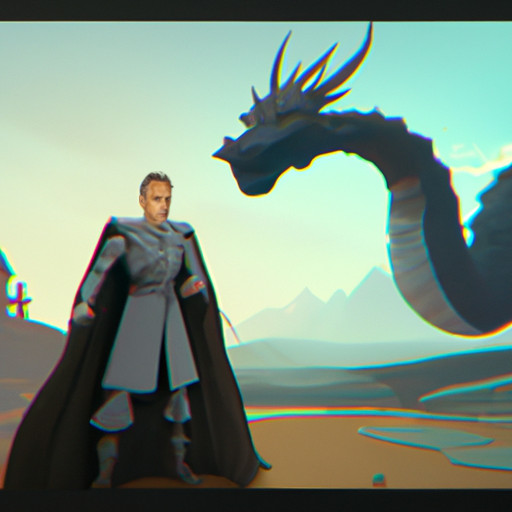
Jordan Peterson defeats a dragon and saves a princess

Once upon a time, in a far-off kingdom, a ferocious dragon was wreaking havoc on the land. The people were living in constant fear, and no knight dared to face the beast.

But then, a wise professor named Jordan Peterson arrived in the kingdom. He had studied the 12 Rules for Life and knew that they could help him defeat the dragon and save the princess.

He donned his armor and sword, stood up straight with his shoulders back, and approached the dragon’s lair. As he faced the dragon, he spoke with a calm and composed voice.

“Hello there, dragon,” he said. “I understand that you have some grievances with the people of this kingdom. I’m here to listen to you and see if we can find a peaceful solution.”

The dragon snorted and breathed fire, but Jordan Peterson remained undaunted.

“I’m not here to fight you,” he continued. “I’m here to find a way for us to coexist peacefully. I know that there must be some common ground we can find.”

The dragon was surprised by Jordan Peterson’s words. No one had ever spoken to it in such a respectful manner before.

“What do you propose?” the dragon asked, its voice deep and rumbling.

“I propose that we make a deal,” Jordan Peterson replied. “I will help you to set your lair in perfect order, and in exchange, you will leave this kingdom in peace.”

The dragon considered this for a moment before nodding its massive head. “Very well,” it said. “We have a deal.”

As Jordan Peterson set to work helping the dragon to clean its lair, he told the dragon about his 4th rule: Compare yourself to who you were yesterday, not to who someone else is today. He knew that the dragon needed to focus on improving itself, rather than comparing itself to others.

He also remembered his 8th rule: Tell the truth, or at least don’t lie. He knew that he needed to be honest with the dragon, and so he shared some of his own experiences with the dragon as they worked together.

“You know, I’ve had my own struggles in life,” Jordan Peterson said, wiping the sweat from his brow. “But I’ve learned that it’s important to take responsibility for your own actions and do what you can to make things right.”

The dragon listened intently, and Jordan Peterson could sense a growing respect between them.

After several hours of hard work, the lair was clean and orderly, as per Jordan Peterson’s agreement with the dragon. As he prepared to leave, he remembered his 6th rule: Set your house in perfect order before you criticize the world.

“Thank you for working with me,” he said to the dragon. “I hope that this new arrangement will work out for all of us.”

The dragon nodded and flew away, leaving Jordan Peterson to rescue the princess.

As he freed her from her bonds, he spoke to her with kindness and understanding.

“Are you okay?” he asked. “What did the dragon do to you?”

The princess looked up at him with tears in her eyes. “Thank you for rescuing me,” she said. “I thought I was going to die.”

Jordan Peterson smiled warmly at her. “You’re safe now,” he said. “Let’s get you back to the kingdom where you belong.”

On their way back to the kingdom, Jordan Peterson remembered his 7th rule: Pursue what is meaningful, not what is expedient. He knew that he needed to help the princess find meaning in her life, rather than just rescuing her and sending her on her way.

“Tell me, princess,” he said. “What are your goals in life? What do you want to achieve?”

The princess looked thoughtful for a moment before responding.

“Well, I’ve always been interested in art and music,” she said. “But I’ve never been allowed to pursue those passions because of my duties as a princess.”

Jordan Peterson nodded thoughtfully. “I understand,” he said. “But remember, it’s important to pursue what is meaningful, even if it’s difficult or goes against what others expect of you.”

As they arrived back at the kingdom, Jordan Peterson remembered his 9th rule: Assume that the person you are listening to might know something you don’t. He knew that he needed to listen to the people in the kingdom to fully understand the situation.

He spoke with the king and queen, and together they came up with a plan to allow the princess to pursue her passions while still fulfilling her duties as a princess.

Jordan Peterson left the kingdom, knowing that he had not only defeated the dragon and saved the princess but also helped the people of the kingdom find a way to live together peacefully.

As he journeyed back to his own land, he remembered his 12th rule: Pet a cat when you encounter one on the street. He smiled to himself, thinking of the small cat he had encountered on the way to the kingdom, and how it had brought him a moment of joy.

He knew that life was full of challenges, but by living according to his 12 Rules for Life, he had the tools to face them with courage, wisdom, and kindness.

Written and visualized with ChatGPT and Sudowrite.

The Grand Conspiracy, Part 1: Malice or Incompetence?

Remember the time before the pandemic, when “conspiracy theory” was still a dirty word? It still is in some quarters, but for many of us the term is now closer to “spoiler warning.”

After all, what are we supposed to believe: that Epstein hung himself with a bedsheet that couldn’t hold his weight, from a height that couldn’t kill him, at exactly the moment when the guards had abandoned their posts and all of the surveillance equipment had mysteriously and inexplicably gone dark? That is still the official story—just like Ghislane Maxwell, Epstein’s Madam, was thrown in prison for trafficking sex slaves to… well, nobody, at least officially.

Or are we supposed to believe that a novel coronavirus whose genetic profile shows clear evidence of artificial manipulation jumped species from a bat to a pangolin to a human, in a Chinese wet market (which the CCP destroyed before any investigation could be launched) more than 900 miles from the bat’s native habitat, which also just happens to be down the street from the Wuhan Institute of Virology where gain-of-function research was being conducted with bat coronaviruses? I’m not generally a fan of Jon Stewart, but I think he hit the nail on the head with this one:

Of course, this isn’t to say that all conspiracy theories have weight and value. By no means do I believe that the moon landings were fake—there are just too many people who would have to be in on the thing to keep it secret for long, and also, we can see the tracks of the moon landings from Earth. But conspiracies do happen, and often have tremendous impact on the course of history. For example, the United States constitution was born out of the Philadelphia Convention, which conspired to throw out the Articles of Convention and replace them with something entirely different, which was technically an act of treason at the time.

Conspiracies are real, though not all conspiracy theories are true. The challenge is separating conspiracy theory from conspiracy fact.

Which brings us to the old aphorism: “never attribute to malice that which can be attributed to incompetence.” For the last two years, when I look at the direction my country is going and all of the harm that the Biden Administration has done, I find myself constantly asking: “is this malice, or is this incompetence?” After all, if my goal was to destroy this country, I could hardly do better than what this administration has already done (Victor Davis Hanson has an excellent article about that, and he says it better than me). And yet, every time the press secretary opens her mouth, I am reminded of just how staggering is the incompetence of these people. Or is it?

And then I had a realization: if you go up high enough, all of these people are useful idiots to a force of pure malice that is striving to bring about our spiritual enslavement and destruction. I am speaking, of course, of Satan himself.

Now, perhaps you don’t believe that the devil is real. Laying aside the aphorism that “the greatest trick the devil ever pulled was convincing the world he doesn’t exist,” you don’t have to believe in a literal fallen angel and his hordes of demonic followers in order to follow this particular rabbit hole. The devil is an archetype for a reason, after all. Personally, my own experience has convinced me that demonic forces do indeed exist, but that’s all I care to say on the subject, and I’ll leave you to draw your own conclusions.

But my point is that it’s not like the forces of evil are monolithic: there is a hierarchy of conspirators and useful idiots, and some who may be conspirators on one level are useful idiots on another. At the bottom, it’s almost all useful idiots wreaking havoc by their own incompetence, but at the top, it’s all driven by malice.

Because here’s the thing: when we attribute a particular action to incompetence, we are making an implicit assumption about the motive behind that action. If we assume that Biden’s motive is to serve the interests of the American people, he’s doing a piss-poor job of it—but if we consider that he may have been compromised by China (as the Hunter Biden laptop implicates), or that he only cares about the Biden crime family’s interests, then his actions no longer reak of so much incompetence.

In the game of chess, there’s a thing called a gambit, where the player sacrifices a piece in order to gain an advantage of tempo or position. To the inexperienced player, a gambit often looks like a mistake. Some of the most brilliant chess moves involve a gambit that seems, at first, to be an act of utter incompetence, but that in fact make winning inevitable if the opponent falls for the gambit.

So even though “never attribute to malice” is a good rule of thumb, it’s clearly not sophisticated enough to explain all the insanity we’ve seen in the last two years. But neither is it sufficient to explain this insanity in terms of pure conspiracy—indeed, falling into that trap makes us susceptible to becoming infected by that insanity ourselves. Mattias Desmet points this out in chapter 8 of his seminal work, The Psychology of Totalitarianism. He also says:

In the whole process of exercising power—i.e., shaping the world to the ideological beliefs—there usually is little need to make secret plans and agreements. As Noam Chomsky put it, if you have to tell someone what to do, you’ve chosen the wrong person. In other words: the dominant ideology selects who ends up in key positions… Consequently, all people in positions of power automatically follow the same rules in their thinking and in their behavior and are under the influence of the same attractors.

One of the main points that Desmet makes in this chapter is that when people are driven by an evil ideology—or, in the words of Jordan Peterson, become ideologically possessed—their actions often appear, to someone on the outside, as if they are all part of a grand conspiracy. And yet, none (or at least, very few) of these people have actually entered into a clandestine agreement to support a deliberate plan: they are all just playing the part that they find themselves in, most of them unwittingly.

And yet, even though there is no “conspiracy” in the classical sense, the people who get caught up in the insanity all end up working to advance the purposes of something much bigger than themselves. Indeed, explaining this phenomenon is the entire purpose of Mattias Desmet’s book. He does a brilliant job of it, but mostly from a psychological perspective.

What I want to do is look at this phenomenon from a spiritual and an archetypal perspective, not as a scientist but as a storyteller. That’s why I’m calling it the “grand conspiracy,” even though I recognize that on most levels, it’s not a conspiracy so much as a confluence of interests (or more accurately, a confluence of lusts). I do think that there’s a lot that can be gleaned by looking at it this way, because there is a spiritual dimension to our lives—as Mattias Desmet emphatically points out—and stories and archetypes have been absolutely essential to our understanding of the world since prehistoric times. I happen to believe that Satan is more than just an archetype, but you don’t have to believe that in order for this grand conspiracy to be useful and make sense.

I’ve planned this series out in twelve parts, listed here. From now until the end of February, I’ll post about once a week. Since Christmas is coming and I don’t want to be thinking about all this diabolical stuff over the holiday itself, I’ll post part 2 next Tuesday, and part 3 the week after that, then go back to posting on Saturdays. The first three parts will outline the general theory that I’ve come up with, and the next eight parts will examine each piece of the theory in detail. In the end, I’ll share some concluding thoughts about how this grand conspiracy can—and indeed, ultimately will—be defeated.

I hope you find this series interesting, and I look forward to hearing what you think about it!

Part 2: Creator vs. Created

The Grand Conspiracy (Index)

The argument that converted me to pro-life

I’ve never been one of these pro-abort people who sees abortion as a virtue or a fundamental right. I do understand the “my body, my choice” argument and still think that it carries some weight—after all, bodily autonomy is an important component of personal liberty and sovereignty—and for a long time, that argument had won me over. I also bought into the lie (and it is a lie) that when abortion was illegal, thousands of women were dying in back-alley abortions, so therefore it’s better to legalize and regulate it than it is to just make it illegal across the board. I also believed (and to an extent, still believe) that there are circumstances where an abortion should be legal, such as ectopic pregnancies, other instances of severe health threats to the mother (including mental health), and cases of rape and incest.

But mostly, I just didn’t want to think about abortion. It’s a very icky subject. Also, because I’m a man and will therefore never be pregnant (contrary to extreme leftist dogma, which apparently holds that nothing in this world is real, or sacred, or true), I didn’t think that the issue really affected me, and was more or less bullied into believing that as a man, I wasn’t qualified to have an opinion. This was something to be left “between a woman and her doctor,” and to my shame, I was content to leave it that way.

Then I graduated from university and went out into the “real world,” declining to pursue a master’s degree (which I am totally convinced is the best life decision I have ever made). After a few years outside of the cloistered halls of academia, my political views began to change rather radically. I can’t point to a single thing as my “red-pill moment,” but the insanity of the 2016 US election brought the pot to a boil, and I found myself rethinking everything that I thought I knew.

One of the voices of reason and sanity that I discovered during this time was Jordan B. Peterson. I don’t know what Peterson’s views on abortion are, and frankly I wouldn’t be surprised to find that he adopts a position that makes most pro-lifers uncomfortable. He’s very good at being a contrarian. But while I was following Peterson, reading 12 Rules for Life and listening to a bunch of his lectures and interviews, I came across this point that he often makes:

You probably would have been a Nazi. They weren’t all that different from you—and besides, you’re probably not as virtuous or as heroic as you think.

We like to think of the Nazis as being extraordinarily evil, but the truth is that they were ordinary people who just happened to live in an extraordinary time and place.

Not unlike the times in which we currently live.

That argument really stuck with me. As the oldest child in my family, I was often told that I needed to set a good example for my younger siblings, and so I grew up thinking of myself as someone who would do the right thing, even if no one else was doing it. The thought that I am the kind of person who would have consented, or even participated, in something as evil as the holocaust was utterly hateful to me. That’s not who I thought I was.

But how could I prove to myself that I was not, in fact, that person? How could I know? I thought about that for a long time—not just about the Nazi thing, but about the Milgram experiment and the Stanford prison experiment as well. Was I the kind of person who would blindly follow the rules, no matter how horrific they were? If I wasn’t that person, how would I know?

As I pondered over this question, I began to reframe it. Instead of asking what I would have done if I’d lived in 1930s Germany—a historical counterfactual that is impossible to disprove—I began to wonder if there was anything happening today that future generations will look back on with the same horror and contempt that we look back on the holocaust.

In other words, is there anything happening today that we all blindly take for granted, or that we all just turn our heads away from, but that future generations who are removed from our historical context will look back on and ask “how could you all have gone along with that? How could you possibly be that evil?”

This prompted me to look at the abortion issue in a completely different way. And the more I studied it, the more convicted I became that this is our generation’s equivalent of the holocaust.

In fact, the more I examined our own genocide of the unborn and compared it with the holocaust, the more I came to realize that we may have actually exceeded the evil of the Nazis. Consider this:

The Nazis killed about six million Jews and several hundred thousand (at least) more people from groups such as the Roma, the Jehovah’s Witnesses, homosexuals, the mentally handicapped etc. But in the time since Roe v. Wade legalized abortion in the US, we have aborted 65 million children—an order of magnitude more than the victims of the holocaust.

The holocaust didn’t go on much longer than a decade: the Nazis came to power in 1933, and surrendered to the Allies in 1945. But our own genocide of the unborn has been happening for multiple generations now—nearly fifty years.

The holocaust happened in the context of a post-war Germany where the people were shattered and impoverished, and children were literally starving to death in the streets. Our genocide of the unborn has happened during a period of such incredible prosperity that it is unparalleled in human history.

While many of the victims of the Holocaust were innocent children, there were also many adults who perhaps were not so innocent or powerless. But no one is as innocent and powerless as the unborn.

Generally speaking, the Nazis weren’t killing their own family when they sent the Jews off to the death camps. But with abortion, we are slaughtering our own children—our very flesh and blood.

Many women who get abortions are deceived by the pro-abort arguments, and do not believe that they’re committing an evil act. But many of the German people were deceived by the Nazis as well. Is that really a valid excuse?

I won’t go into all of the pro-life arguments. There’s a lot that can be said about Margaret Sanger and Planned Parenthood’s connection with actual Nazis and other eugenicists (and how that connection still exists), as well as a lot of good arguments—both religious and scientific—about how life begins at conception, and the unborn are as deserving of human rights, including the right to life, as any other living person.

But you’ve probably already heard all those arguments. I doubt there’s much that I can rehash here that will change your mind. I will, however, link to an excellent podcast that does put forward all those arguments, so you can examine them if you’re curious:

With all of that in mind, I came to realize that there is a way to know whether I’m the kind of person who would have been a Nazi, and that involved answering the question:

“What are you doing about the genocide of the unborn?”

Now, I recognize that those who disagree with the pro-life side are not, for the most part, heartless monsters who do not deserve to live. There are a few extraordinarily evil serial killing abortionists out there, but most pro-choicers are genuinely decent folk who happen to see things differently. I get that. The same was probably true of most Germans in the 1930s: they weren’t extraordinarily evil, but ordinary folk like you and me who just happened to be caught up in the mass psychosis of their time.

I do believe that we are witnessing the formation, or perhaps the final expression, of a mass formation psychosis over the abortion issue. With all of the hysteria surrounding Dobbs v. Jackson and the Supreme Court’s decision to return the abortion issue to the states, the left is coalescing around this issue—but they aren’t content with “safe, legal, and rare” anymore. Instead, abortion is now proclaimed as something virtuous, and the women (and “men”) who get abortions as heroes. It’s perverse, deranged, pathological, and evil in the extreme.

So what should we do about that? Take up arms? Punch a Nazi? Go back in time and kill baby Hitler? No. The kind of people who fantasize about such things are also, in the abortion context, the kind of people who bombed abortion clinics in the 80s and 90s, or who send death threats to abortionists and pro-abort activists. All of those actions play right into the pro-aborts’ hands.

But the truth is that the sword cuts two ways. If most of us are the kind of people who would have gone along with the Nazis, then the people who actually did support the Nazis weren’t extraordinarily evil—and neither are most of the people who are going along with abortion. Their evil—our evil—is of the ordinary variety.

And how do we fight ordinary evil? By changing hearts and minds so that it comes to be regarded as extraordinary.

As a writer, I recognize that I’m in a unique position to do that. And it isn’t an accident that in the last few months, my writing (most of it currently unpublished) has taken a very pro-life bent. Not that I’m trying to evangelize a pro-life position—that would be propaganda, not art—but my recent work has a much more pro-life bent to it, and I don’t intend to hide or run away from that.

Not surprisingly, I haven’t been able to find a home for these stories in the traditional sci-fi magazines and anthologies. And at this point, I’m assuming that many of these editors have put me on some sort of author black list for my pro-life themes—in fact, I’d be surprised if none of them had.

But no matter. This is what rings true to me, and it would be an artistic betrayal to self-censor my pro-life sensibilities at this point. And that would be just as bad as producing mere propaganda.

In the next few months, I plan to self-publish several stories that have been influenced by my pro-life views, assuming that they don’t get picked up by a magazine or anthology first. The first one is “The Freedom of Second Chances,” scheduled for December, and another one, “The Body Tax,” is scheduled for January.

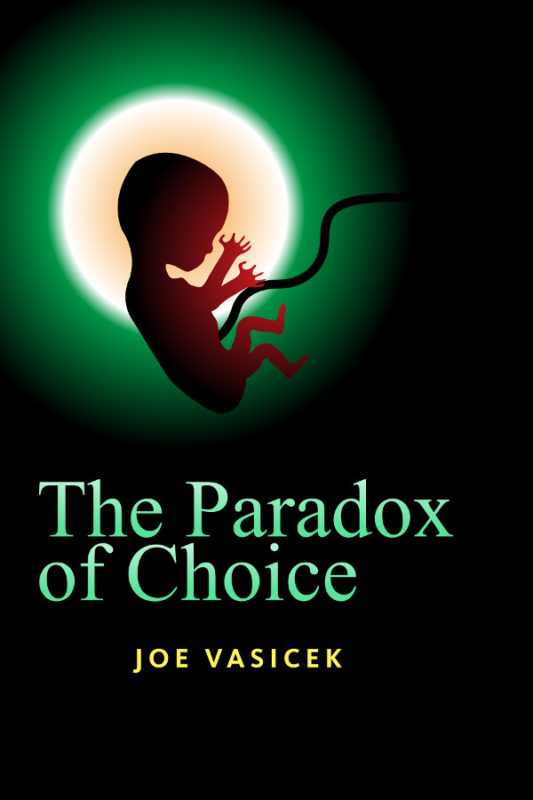
Beyond that, I don’t have anything specific planned, but I’m sure I’ll be writing more unapologetically pro-life stuff moving forward. And of course, there’s still “The Paradox of Choice,” which I’ve released into the public domain in case anyone wants to republish it or rewrite it or otherwise make it their own:

The Paradox of Choice: A Short Story

The Paradox of Choice: A Short Story

“In cases where there may be severe deformities… I can tell you exactly what would happen. The infant would be delivered. The infant would be kept comfortable. The infant would be resuscitated if that’s what the mother and the family desired, and then a discussion would ensue between the physicians and the mother.”

More info →

4 AM Thoughts

Violence is not speech and speech is not violence. If you conflate the two, you will invariably use violence to quell the speech that you most need to hear. This is because the thing you need the most is usually in the place you least want to look.

With regards to Jordan Peterson.

Navigating Woke SF, Part 2: When Is It Not Worth Submitting?

So a couple of hours after I published my last blog post, China Mike Glyer of File 770 infamy picked it up for his daily pixel scroll. Hi, China Mike! I thought you might be looking for some red meat to feed your readers—aside from the Chinese clickfarms, of course—but I was especially pleased that you included my affiliate links with the excerpt you copy-pasted! Not only does this bring in some extra cash (thanks, China Mike!), but it also gives me some metrics to compare File 770 with, say, some of the other indie authors that I do newsletter swaps with. And wow… let’s just say there’s a reason why they call you China Mike Glyer and leave it at that.

So in today’s episode of red meat for China Mike, I’d like to pick up where I left off with the last post and pose the question: when is a science fiction market too woke to be worth submitting to? But to answer that question, we first need to answer: why bother submitting short stories to traditional markets at all, when self-publishing is an option?

It’s a good question, because there are a lot of good reasons to self-publish short stories. In my experience, they don’t earn particularly well on their own, but they are quite useful as newsletter magnets to gain new email subscribers, free ebook giveaways to let readers sample your work, and giveaways for newsletter subscribers to remind them that you exist and keep your books in the forefront of your mind. I make all my short story singles free on all the ebookstores, and keep them up until I have enough to bundle them into a collection, at which point I take them down and submit to the reprint markets. It’s a system that’s worked pretty well for me so far.

Potential Benefits of Submitting to Traditional Markets

So why submit to traditional markets first? Why hold off self-publishing in the hopes that you can sell first publication rights? Here are a few of the reasons:

  • The pay. A professional short story sale will bring in several hundred dollars, and even a semi-professional sale (1¢ per word or more) will typically earn more than pizza money. Over the lifetime of a typical story, that’s a good chunk of the income you can expect to earn from it (unless it’s optioned for a movie, of course).
  • Advertising. A short story sale, especially to a higher-paying market, will get your work—and your name—out to many readers who may have never heard of you before. Making your self-published short stories free accomplishes a similar thing, but with a different audience. Lots of readers who follow the magazines don’t typically look up free short stories on Amazon, though I’m sure that some of them do.
  • Prestige and reputation. Whenever you make a professional or semi-pro sale, that’s another human being proclaiming that your story is good enough to pay you for the privilege of publishing it. The SF&F short story markets are incredibly competitive, especially the higher-paying ones. Not all readers care about this, but being able to say that your stories have been published in Analog, or Asimov’s, or F&SF helps to set you apart from other authors—and many readers do sit up and notice. I certainly do.
  • Networking. Breaking into a short story market can be a great way to make connections with other writers and editors in the field, which can open up some really great opportunities later. I’ve had some really great experiences with this, and I look forward to having more in the future. You never know how things will turn out when you put yourself out there!

I suppose you could also include “awards” and “SFWA membership” on that list, but frankly I don’t care much about either of those. Contrary to the impression that China Mike wants to give you, I’m really not much of a drama llama, and as for awards… we’ll get there.

Potential Drawbacks of Submitting to Traditional Markets

Importantly, there are several potential drawbacks to putting your stories out on submission, especially if you have a viable self-publishing strategy. Some of those reasons include:

  • Lost time. It takes a lot of time to submit your stories to all the traditional markets, even just the professional ones. I used public data on The Submission Grinder to discover that the average wait time for professional SF&F markets is about 30 days, which means that if you want to submit to all of them, you won’t be able to self-publish that story for years.
  • Exclusivity. A lot of markets include an exclusivity period in their contracts, which can run upwards of a year or longer. Again, that’s a lot of lost time where you can’t self-publish that story, even if it does sell.
  • A very competitive market. You can keep a story out on submission for years, only to exhaust all but the token-paying markets. This isn’t necessarily a judgment of the story’s quality, either—I have stories that I’ve sent out 30+ times that have received more than 25% personalized rejections, that have never been picked up by a traditional publisher. There are just too many really good stories out there for the higher-paying markets to publish them all.
  • No simultaneous submissions. This one really bugs me. For some reason, most of the higher-paying SF&F markets don’t allow simultaneous submissions—that is, they demand the exclusive right to consider your story before they pay you a dime. What’s worse, the wait times for many of them can stretch on for months. This is how stories end up on submission for years—and all of that is time where you can’t self-publish.
  • Submissions bandwidth. At any given time, there are only between 10-20 SF&F markets open to submissions that pay more than 5¢ per word (for flash fiction, it can get up to 30). The average wait time for these markets is about 30 days, and most of them do not allow multiple submissions. Therefore, if you write more than one short story per month for an extended period of time, you will very quickly run into a bandwidth problem, where there aren’t any available markets to submit to.

So those are the potential costs and benefits that you have to contend with when writing and publishing short stories.

How Wokeness Changes the Equation

Now, let’s get to the first question: when is a short story market so woke that it isn’t worth submitting anything to them? This is something I’ve been thinking about a lot in the past few days, and while I don’t think it’s possible to come up with an objective, impartial standard, I do think that it’s important to draw the distinction, because wokeness changes the cost/benefit analysis substantially.

It wasn’t always this way. Traditional sci-fi publishing has trended to the political left (sometimes to the extreme political left) of mainstream American culture since the New Wave era back in the 60s and 70s. It seems that the campus radicals took over much of the field, not to mention the fact that American traditional publishing has always been centered in New York. But until just the last few years, it was still possible for left and right to coexist in our pluralistic society. People of different political persuasions could agree to disagree amicably, and while there may have still been whisper campaigns and secret author blacklists, you could still expect to see a healthy mix of opinions and perspectives in most places that published short stories.

That is not true today. Certain subjects and opinions have been deemed verboten, while others have been exalted to the status of eternal truth, and any story that questions or challenges the politically correct narrative doesn’t have a chance in most of these markets. In other words, science fiction has gone woke.

(As a side note, this reminds me of a review that I received for my short story “Payday,” in which the universal basic income leads to runaway hyperinflation, causing society to unravel and forcing the protagonist and his family to flee. Sound familiar? In the author’s note, I mentioned how the story had been rejected by all of the pro-paying science fiction markets, and the reader found that even more disturbing than the story itself.)

“Woke” is a slang term describing a basket of socioeconomic and political ideologies that are incompatible with and antithetical to individual rights and liberties. Taken to their logical conclusion, they end in the sort of totalitarian horrors the world saw in the 20th century (and continues to see today in communist China).

I recently listened to an episode of the Jordan B. Peterson podcast where he interviewed Yeonmi Park, a North Korean defector and human rights activist. It was an incredibly powerful interview—well worth listening to in its entirety. One of the things that really struck me was the fact that nightmare dystopian societies can only endure so long as everyone, in their own little way, tacitly supports the lie. In such a society, declaring the truth is itself a supreme act of insurrection, because (in the words of Solzhenitsyn) “one word of truth outweighs the whole world.”

In the science fiction markets that have been taken over by wokeness, the truth is silenced by vicious accusations of white supremacy, transphobia, post-colonialism, and a hundred other virtue-signalling examples of doublethink. If George Orwell published 1984 today, they would probably pan it as anti-Asian and push to get it cancelled or banned. There can be no compromise with these people, as there is no room for discussion or debate. These woke ideologies possess people, who cling to it like the worst possible kind of religion.

I used to think that a story from someone like me would still be able to slip through, if it was good enough. But then I spent a year subscribed to every science fiction and fantasy market that had a free podcast. Most of the stories were poor to mediocre, but the authors hit all the woke intersectional checkboxes—and made sure to tell you that in their author bios. There were some exceptions, of course, but that was the general rule. Whenever there was an exceptionally good story, it was usually from an author who only checked one or two of the boxes—but their story would usually check off a couple more, such as having an LGBTQ+ romantic subplot, or having mostly POC characters. And in the wokest sci-fi podcasts, the editors always made sure to pound you over the head with an explicit political message, sometimes even before the story itself.

Of course, there are still some short fiction markets that care more about the strength of your story than upholding the woke establishment narrative, or making sure all their authors hit all the right intersectional checkboxes. But not generally among the professional-paying markets.

So how woke is too woke?

The events of the past year have convinced me that wokeness is like a cancer: no matter how small or innocuous it is when it starts, if left untreated it will metastatize and grow. The only way to treat it is to remove it from your life. No compromise. No discussion or debate. The woke care nothing for right or wrong, truth or falsehood: only narrative and power. When they look at me, they do not see a person: they see a heirarchy of identities. And if my stories are any good—that is, if they serve the truth—then they see those stories as a threat. After all, “one word of truth outweighs the whole world.”

Therefore, it cannot be a question of degree. If a market has gone even slightly woke, then submitting your stories is an exercise in futility if you don’t hit the right checkboxes or will not bend the knee. And I will never bend the knee.

How To Tell If a Market Is Woke

So now, with a working definition of “woke” (promoting ideologies incompatible with and antithetical to individual rights and liberties) and the determination that wokeness is toxic in any degree, how can I tell if a market has gone truly woke?

First of all, I think it’s important to give everyone—and every market—the benefit of the doubt. There are still people on the political left who can break bread with and hold reasonable conversations with those on the other side of the aisle. Likewise, there are still short story markets that tend to lean left, but will still publish good stories by authors across the political spectrum.

Second, it’s also important to point out that just because an editor hits one or two—or most—of the woke intersectional checkboxes, that doesn’t necessarily mean that the market itself is woke. This isn’t a matter of balancing transgender people of color with straight white males—that’s merely wokeism in reverse! People are people are people, no matter how they identify. Anyone can become ideologically possessed, just as anyone can choose not to be.

So with that in mind, what are the red flags?

1) Has the market won any awards that have gone completely woke?

Specifically, I’m thinking here of the Hugo Awards. They were trending to the left for a very long time, but 2015 was the year that they specifically went woke by voting “no award” over several deserving authors and editors. The transformation was completed in 2017, when the new rules shut out the Sad and Rabid Puppies, and both of those movements died out.

Therefore, if a short story market has won a Hugo since 2015 or been nominated for a Hugo since 2017, I’m not going to bother submitting to them. And if a market has had stories that have won or been nominated for a Hugo in those years, I’m going to ignore the market as well, unless it appears to be a fluke or a one-off.

2) Does the market have an explicit diversity statement in their submission guidelines?

Diversity statements are not actually about reassuring minority authors that they are welcome to submit their stories. Instead, diversity statements are all about signalling. You can see this with the term “latinx.” The vast, vast majority of actual latinas and latinos have either never heard of the term or absolutely hate it, but because it’s a gender non-binary term, the woke absolutely love it—and use it primarily as a signal to other woke people just like them.

Therefore, if a market has an explicit diversity statement that contains woke signaling language, it’s going on the blacklist. Even if the market only put out a diversity statement to keep the woke mob from descending upon them, that’s still a sure sign that they’ve bent the knee.

Occasionally, a market won’t have a separate diversity statement, but will include language like “we welcome submissions from authors of all races, genders, and backgrounds.” In that case, it’s probably best to give them the benefit of the doubt. But if they use the word “latinx,” even once (or “folx,” or “black bodies,” or “indigenous,” or…), then that’s a clear signal that they’re woke.

3) Does the market publish content that is explicitly woke?

Editors always say that the best way to know what they’re looking for is to read a couple of issues or listen to a couple of episodes or stories. That seems like a reasonable standard, so I see no reason why I shouldn’t hold them to it.

Do the editors ever go off on explicitly woke political rants, or try to explain the message of the story in woke ideological terms? Do the author bios read like a checklist of woke intersectional identities? Are the stories themselves often thinly veiled rants about woke issues? Again, it’s important to apply the benefit of the doubt here, but you can tell a lot about a market by what they choose to publish. I won’t be wasting my time with the markets that regularly publish any of those things.

Conclusion

I believe that the culture is changing, and an anti-woke backlash is forming that will shock the people who are too deeply esconsed in their echo chambers (here’s to you, File 770) to see it coming. If I had to guess, I’d say that we hit peak woke in our culture about a year ago, and now that the pendulum is swinging the other way, nothing will stop it until it goes as far to the anti-woke side as it did to the woke side.

I’m not yet sure if this is good or bad. If we reject the lies that wokeism is built upon and embrace the individual rights and liberties that informed our founding documents, it could be very good indeed. But a lot of damage has already been done, and if we merely exchange leftist-flavored collectivism for rightist-flavored collectivism, it could be very, very bad.

That’s why writers and creators like me have a very important role to play—that is, those of us who aren’t afraid to speak one word of truth. That alone is reason enough not to waste one moment of time on these woke science fiction markets whose great day of power is swiftly coming to an end.

My short story strategy has changed a lot in the last year, much like our country. I still need to work through all of the implications of this change in order to formulate a new publishing strategy. But I’ll leave that for another post. This is sufficient for now.

#GiveThanks Day Four

(45) I’m grateful for Jordan Peterson and his courage to speak the truth as he sees it, even in the face of incredible opposition.

(46) I’m grateful for the “intellectual dark web” and how they show that there are still intelligent people who can discuss important issues with those with whom they disagree.

(47) I’m grateful for the voices in the alternative media that push back against the gaslighting of the mainstream media.

(48) On a less political note, I’m grateful for Mike Duncan and his History of Rome podcast, which taught me far more about the Romans and their impact on our world than my college education ever did.

(49) I’m also grateful for Mike Duncan’s Revolutions podcast, which has done the same thing for the history of our modern era.

(50) I’m grateful for Dan Carlin and his numerous podcasts, especially Hardcore History.

(51) I’m grateful for the Writing Excuses podcast, which was very influential in how I developed my writing craft back when I was just getting started.

(52) I’m grateful for the Six Figure Authors podcast and the Science Fiction and Fantasy Marketing podcast, and the excellent marketing and publishing ideas that they give me.

(53) I’m grateful for the Sell More Books Show and how it helps me to stay up to date with what’s happening in indie publishing.

(54) I’m grateful for the Mythulu cards that my wife got me for my birthday, and how they’ve helped me this nanowrimo to come up with some great story ideas.

(55) I’m grateful for Kris Rusch and Dean Wesley Smith, and the influence they were in helping me to decide to self publish back in 2011.

(56) I’m grateful for Life, the Universe, and Everything, and how that conference was and continues to be critical in shaping my writing career.

(57) I’m grateful for the writing group that I was fortunate enough to marry into, and the good advice and feedback that I receive from it.

(58) I’m grateful for Quark, BYU’s Science Fiction and Fantasy Club, and for how it provided me with a community of like-minded geeks and aspiring writers in college.

(59) I’m grateful for Leading Edge and the opportunity that I had to read for their slushpile, back when I was still learning my craft.

(60) I’m grateful for all of the other science fiction conventions I’ve been able to attend over the years, including Worldcon, World Fantasy, FanX, CONduit, and others.

A Much Deserved Fisking

In the November issue of Locus magazine, Cory Doctorow wrote an op-ed piece defending Jeannette Ng and the decision to strip Campbell’s name from the Campbell Award. At least, that’s how it started out, but it quickly devolved into a hatchet piece against everyone in science fiction whose politics lie somewhere to the right of Stalin.

Ever since Sad Puppies III, I’ve more or less gotten used to the gaslighting, hypocrisy, and projection that has become de rigeur in the traditional publishing side of the field. But somehow, Doctorow’s hit piece manages to hit a new high water mark for leftist insanity.

Since my own politics lie somewhere between Boadicea and Genghis Khan, I thought it would be fun to give the piece a good old-fashioned fisking. I can’t pretend to be as good at it as Larry Correia (and I sincerely hope he fisks it himself), but damn, if anything ever was written to be fisked, it was this ridiculous piece.

Doctorow writes:

At the Hugo Awards ceremony at this summer’s Dublin Worldcon, Jeannette Ng was presented with the John W. Campbell Award for Best New Writer. Ng gave an outstanding and brave acceptance speech

Translation: Ng reinforced the dominant far-left narrative in the science fiction field, telling the gatekeepers exactly what they wanted to hear and earning widespread praise for it.

True bravery is Jordan Peterson deleting his $35,000/month Patreon in protest of their hate speech policies, or Kanye West coming out as a devout Christian, producing a worship album, and announcing that he will no longer perform any of his old songs.

in which she called Campbell – the award’s namesake and one of the field’s most influential editors – a “fascist” and expressed solidarity with the Hong Kong pro-democracy protesters.

You know who else shows solidarity with the Hong Kong protests? That’s right—everyone’s favorite deplorable frog!

Now that’s a dank meme.

I’m curious: does this make Ng a white supremacist for showing solidarity with people who use such a rascist hate symbol? Does it make Cory Doctorow a dog whistler to the far right for appealing to these obviously racist deplorables?

Of course not, but that’s the level of insanity we’ve fallen to.

I am a past recipient of the John W. Campbell Award for Best New Writer (2000) as well as a recipient of the John W. Campbell Memorial Award (2009). I believe I’m the only person to have won both of the Campbells,

All red flags to deplorable readers like me,

which, I think, gives me unique license to comment on Ng’s remarks, which have been met with a mixed reception from the field.

I think she was right – and seemly – to make her re­marks. There’s plenty of evidence that Campbell’s views were odious and deplorable.

There’s that word: “deplorable.” Whenever someone uses it unironically, it’s a sure sign that they hate you. It’s also a sign that they don’t actually have a good argument.

It wasn’t just the story he had Heinlein expand into his terrible, racist, authoritarian, eugenics-inflected yellow peril novel Sixth Column.

I haven’t heard of that one. Thanks for the recommendation, Cory! I’ve already ordered it.

Nor was it Campbell’s decision to lean hard on Tom Godwin to kill the girl in “Cold Equations” in order to turn his story into a parable about the foolishness of women and the role of men in guiding them to accept the cold, hard facts of life.

Okay, I call bullshit. “Cold Equations” wasn’t about the “foolishness of women,” it was about how when our inner humanity comes into conflict with the hard realities of the universe, the hard realities always win.

Switch the genders—a female pilot and a teenage boy stowaway—and the story still works. Switch the endings—have the pilot decide to keep the stowaway, dooming himself and the sick colonists—and it does not.

In fact, it makes the girl even more of a hapless, weak feminine stereotype. Stepping into the airlock voluntarily is an act of bravery. In some ways, she’s stronger than the pilot—and that’s kind of the point.

The thing that makes “Cold Equations” such a great story is that it functions as something of a mirror. It’s the same thing with Heinlein: those who see him as a fascist are more likely to be authoritarians, while those who see him as a libertarian are more likely to be libertarians themselves. After all, fascism is “citizenship guarantees service,” not “service guarantees citizenship.”

It’s also that Campbell used his op-ed space in Astound­ing to cheer the murders of the Kent State 4. He attributed the Watts uprising to Black people’s latent desire to return to slavery.

Was John Campbell a saint? No, and I don’t think anyone’s claiming that. In the words of Ben Shapiro, two things can be true at once: John Campbell had some racist, sexist views, and stripping his name from the award is wrong. (Also, that Doctorow is full of shit.)

The Campbell award isn’t/wasn’t named after him because he was a perfect, flawless human being. It was named after him because of his contributions to the field. If we’re going to purge his name from the award, are we also going to purge all of the classic golden-age books and stories that he edited, too? Are we going to have the digital equivalent of a book burning? Because that strikes me as a rather fascist thing to do.

These were not artefacts of a less-englightened [sic] era. By the standards of his day, Campbell was a font of terrible ideas, from his early support of fringe religion and psychic phenomena to his views on women and racialized people.

What are the standards of our own day? In what ways are we less-enlightened? Are future generations likely to accuse Doctorow of being a “font of terrible ideas,” just like he accuses Campbell here?

Do unborn black lives matter? If Trump is truly a fascist, why does the left want him to take all our guns? Is it okay to be white? Is Islam right about women? Is transgender therapy for prepubescent children just another form of conversion therapy? Are traps gay?

When you free your mind to explore new ideas, a lot of them are bound to be terrible. It’s simply Sturgeon’s law. So is Doctorow criticizing Campbell for having an open mind, or for not conforming to Doctorow’s values and beliefs?

Who’s supposed to be the fascist again?

So when Ng held Campbell “responsible for setting a tone of science fiction that still haunts the genre to this day.

I’m pretty sure that taking hormone blockers and getting your balls cut off makes you a hell of a lot more sterile than anything else. Lesbians, gays, transgenders, queers—all of these tend to be sterile as a general rule. Most babies are still made the old-fashioned way.

Male.

Isn’t her word choice kind of sexist here? I mean, she could have used the word “patriarchal,” but she didn’t. She. Deliberately. Used. The. Word. “Male.”

White.

Is she saying that it isn’t okay to be white?

Exalting in the ambitions of imperialists and colonisers,

Come on, Ng. Let’s not be racist. There were plenty of imperialists and colonizers who weren’t white Europeans. After all, how can we forget Imperial Japan and the Rape of Nanking? Now that was an ambitious massacre. The Turks also ran a pretty brutal empire, as did the Zulus and the Aztecs. You can’t tell me that cutting out the beating hearts of more than 80,000 prisoners to rededicate your temple isn’t ambitious.

settlers and industrialists,”

Find me one place that was not built by “settlers.” Find me one human being on this planet who has not benefitted from “industrialists.” Who do you think makes the vaccines and antibiotics? Who do you think makes machines that harvest your food?

Just for a single day, I would like to see all of these anti-capitalist types live without any of the benefits that capitalism and modern industry provide.

she was factually correct.

And yet, so completely full of shit.

In the words of Andrew Klavan, you can’t be this stupid without a college education.

Not just factually correct: she was also correct to be saying this now.

Because it’s [current year]!

Science fiction (like many other institutions) is having a reckoning with its past and its present. We’re trying to figure out what to do about the long reach that the terrible ideas of flawed people (mostly men) had on our fields.

The best way to fight a terrible idea is to allow it out in the open while fostering freedom of speech. In the words of Andrew Breitbart, sunlight is the best disinfectant.

The reckoning that Doctorow is calling for is something that’s already built into the field. Science fiction is constantly evolving and revisiting its past. Good science fiction not only builds on the stuff that came before, it critiques it while taking the ideas in a new direction.

We don’t need to tear down the legacy of the giants in the field who came before us; we simply need to build up our own legacies for the generations that come after us. But that’s not what Ng and the social justice warriors want to do.

It isn’t a coincidence that the traditionally published side of the field is rapidly losing market share as the SF establishment seeks to purge everything that could possibly offend their progressive sensibilities. The people doing the purging can’t compete on the open market because their toxic ideologies don’t resonate with the buying public, so they’re forced to resort to the digital equivalent of burning books and tearing down statues. Meanwhile, indie publishing is eating their lunch.

Get woke, go broke.

We’re trying to reconcile the legacies of flawed people whose good deeds and good art live alongside their cruel, damaging treatment of women. These men were not aberrations: they were following an example set from the very top and running through the industry and through fandom,

Future generations will struggle to reconcile our good deeds and our good art with our cruel and inhuman treatment of the unborn.

None of this is new. All of us are flawed; every generation is tainted with blood and sins that are reprehensible to those that follow. Realizing all this, you would think a little introspection is in order. But the people today who are so eager to throw stones are completely lacking in self-introspection that they can’t—or rather, won’t—see their own blood and sins.

to the great detriment of many of the people who came to science fiction for safety and sanctuary and community.

Is science fiction a “safe space,” or is it the genre of ideas? It can’t be both at the same time. Ideas are inherently dangerous.

It’s not a coincidence that one of the first organized manifestations of white nationalism as a cultural phenomenon within fandom was in the form of a hijacking of the Hugo nominations process.

Bullshit. If you think that the Sad Puppies were white nationalists, you’re either stupid or willfully ignorant (a distinction without a difference).

Larry Corriea’s flagship fantasy series, the Saga of the Forgotten Warrior, is set in an Indian-inspired fantasy world populated entirely by brown people. Brad Torgerson has been happily married to a woman of color for decades. Sarah Hoyt is both latina and an immigrant.

If this article was written three years ago, you would have just called them all racists, but you can’t do that now because “racist” has lost its edge. You’ve cried wolf far too many times, and no one pays attention to those accusations anymore. That’s why you use words like “fascist,” “white nationalist,” and “white supremacist” to describe your enemies—not because you actually believe it, but because those accusations haven’t yet lost their edge.

While fandom came together to firmly repudiate its white nationalist wing, those people weren’t (all) entry­ists who showed up to stir up trouble in someone else’s community. The call (to hijack the Hugo Award) was coming from inside the house: these guys had been around forever, and we’d let them get away with it, in the name of “tolerance” even as these guys were chasing women, queer people, and racialized people out of the field.

Translation: we’re done with paying lip service to “tolerance” and “open-mindedness.” From now on, if you don’t look like us, act like us, or think like us, we’re going to do everything we can to destroy you.

I’m telling you, these people hate us. That’s why they call us “deplorables.” That’s why they paint us as racists and fascists, even when we’re nothing of the sort. They don’t want to listen to us. They don’t want to give us a fair hearing. They want to destroy us.

Stripping Campbell’s name from the Campbell Award is just another example of this toxic cancel culture. It isn’t about reckoning or reconciliation. It’s a naked power grab.

Those same Nazis went on to join Gamergate, then became prominent voices on Reddit’s /r/The_Donald, which was the vanguard of white national­ist, authoritarian support for the Trump campaign.

See, this is why I can’t trust you, Cory. Gamergate had legitimate grievances with Anita Sarkeesian, Zoe Quinn, and Gawker. Trump supporters had legitimate reasons to want to stop Hillary Clinton from becoming president. Yet you casually dismiss all these people as deplorables, racists, and fascists without even listening to them.

That’s intelluctually dishonest, Cory. It’s also a form of gaslighting.

The connections between the tales we tell about ourselves and our past and futures have a real, direct outcome on the future we arrive at. White supremacist folklore, including the ecofascist doctrine that says we can only avert climate change by murdering all the brown people, comes straight out of SF folklore, where it’s completely standard for every disaster to be swiftly followed by an underclass mob descending on their social betters to eat and/or rape them (never mind the actual way that disasters go down).

I don’t think Cory Doctorow has any idea what actually happens when society collapses. When the thin veneer of civilization gets stripped away, people will eat each other. We’ve seen this just recently in Venezuela, Syria, and Mexico. Here in the US, we can see the seeds of our own collapse in Chicago, Portland, San Francisco, Baltimore, and Detroit (all very blue and progressive cities, by the way).

Also, I don’t think Cory Doctorow has any idea what he’s talking about when he says “white supremacist folklore.” What is that even supposed to mean? Just a couple of paragraphs ago, he called all the Sad Puppies “white nationalists,” and that obviously isn’t true. By “white supremacist folklore,” does he mean all the science fiction that doesn’t fit his radical progressive political ideology? Once again, he’s painting with an overly broad brush.

Also, notice how he uses “white supremacist” instead of “racist.” He can’t use “racist” because that word has been overused. Give it a couple of years, and “white supremacist” will lose its edge as well.

When Ng picked up the mic and told the truth about Campbell’s legacy, she wasn’t downplaying his importance: she was acknowledging it. Campbell’s odious ideas matter because he was important, a giant in the field who left an enduring mark on it. No one questions that. What we want to talk about today is what Campbell’s contribution was, and what it means.

Whenever the people on the progressive left claim that they want to have a “conversation” about something, what they really mean is “shut up and let me tell you how I’m right and you’re wrong.” There is no way to have an honest dialogue with these people, because they will not listen to us “deplorables.” Cory Doctorow has already demonstrated this with his blanket accusations against all the supporters of Gamergate, the Sad Puppies, and President Trump.

These people don’t want to talk about “what Campbell’s contribution was, and what it means.” They want to purge him from the field. Metaphorically, they want to burn his books and tear down his statues.

Look, I’m not trying to defend all of Campbell’s views here. I’m all for having an honest discussion about his bad ideas and how they’ve influenced the field. But I don’t believe I can have that discussion with people who clearly hate me, and will do whatever it takes to cancel and destroy me.

After Ng’s speech, John Scalzi published a post where he pointed out that many of the people who were angry at Ng “knew Campbell personally,” or “idolize and respect the writers Campbell took under his wing… Many if not most of these folks know about his flaws, but even so it’s hard to see someone with no allegiance to him, either personally or professionally, point them out both forcefully and unapologetically. They see Campbell and his legacy ab­stractly, and also as an obstacle to be overcome. That’s deeply uncomfortable.”

Scalzi’s right, too: the people who counted Campbell as a friend are au­thentically sad to confront the full meaning of his legacy. I feel for them.

Do you really, though?

It’s hard to reconcile the mensch who was there for you and treated his dog with kindness and doted on his kids with the guy who alienated and hurt people with his cruel dogma.

Did you catch the sneaky rhetorical trick that Doctorow uses here? He assumes that we’ve already accepted his argument that Campbell’s views were odious enough to have his name stripped from the award. Now he’s using an appeal to emotion to smooth it over.

Gaslighting of the highest order.

Here’s the thing: neither one of those facets of Campbell cancels the other one out. Just as it’s not true that any amount of good deeds done for some people can repair the harms he visited on others, it’s also true that none of those harms can­cel out the kindnesses he did for the people he was kind to.

Or cancel all of his contributions to the field?

If Doctorow actually believes all this, why does he support Ng, who argues that everything Campbell did should be cancelled out by his most odious views? If anything, this is an argument against stripping Campbell’s name from the award.

Life is not a ledger. Your sins can’t be paid off through good deeds. Your good deeds are not cancelled by your sins. Your sins and your good deeds live alongside one another. They coexist in superposition.

Yes, and you should never underestimate the capacity of the human mind to believe two mutually exclusive ideas at the same time, especially when his name is Cory Doctorow.

You (and I) can (and should) atone for our misdeeds.

Not in today’s cancel culture, where everything you’ve accomplished can be erased by the one bad thing you tweeted or posted to Facebook ten years ago. There’s also no forgiveness or repentance, when you will be forever remembered for the worst thing you said or did.

We can (and should) apologize for them to the people we’ve wronged.

No. Giving a public apology is the absolute worst thing you can do in today’s cancel culture, because your enemies will smell blood in the water and come in for the kill.

Never apologize to a mob.

We should do those things, not because they will erase our misdeeds, but because the only thing worse than being really wrong is not learning to be better.

Oh, this is rich.

You first, Cory. Have you taken a good, hard look in the mirror? Have you really, truly asked yourself “what if I’m wrong?”

I don’t see eye to eye with Vox Day about everything, but he was right about this: you social justice types always lie, you always double down, and you always project your own worst faults onto your enemies. That’s why you’re so blind to your own hypocrisy, even when it’s staring you in the face.

I completely and totally agree that we should all strive to admit when we’re wrong and learn to be better for it, but you’re not in a position to tell me that, Cory. Not after painting all us “deplorables” with such a broad brush.

People are flawed vessels. The circumstances around us – our social norms and institutions – can be structured to bring out our worst natures or our best. We can invite Isaac Asimov to our cons to deliver a lecture on “The Power of Posterior Pinching” in which he would literally advise men on how to grope the women in attendance, or we can create and enforce a Code of Conduct that would bounce anyone, up to and including the con chair and the guest of honor, who tried a stunt like that.

Honest question: was the sexual revolution a mistake?

Asimov, Heinlein, Farmer, and all the other science fiction writers who explored questions of sexuality back the 60s and 70s were speaking to a culture that had abandoned traditional morality for a new, “free love” ethic. In other words, having thrown out all the rules, they now felt free to explore their newly “liberated” sexuality.

Was Asimov wrong in his attempt to rewrite our sexual norms? Personally, I believe it was, but I come from a religious tradition that still practices total abstinence before marriage and total fidelity within. Even then, it still depends on context. Groping a random stranger at a science fiction convention is obviously wrong, but playfully pinching my wife when the two of us are alone? Not so much.

I find it really fascinating that the woke-scolds of the left have become far more puritanical and prudish than the religious right ever was. Within the bonds of marriage, most of us religious types are actually very sex positive—after all, where do you think all those babies come from?

And Ng calls us “sterile.” Heh.

We, collectively, through our norms and institutions, create the circum­stances that favor sociopathy or generosity. Sweeping bad conduct under the rug isn’t just cruel to the people who were victimized by that conduct: it’s also a disservice to the flawed vessels who are struggling with their own contradictions and base urges.

Fair enough, but there’s nothing generous about today’s cancel culture, which is frankly pathological in the way it defines everyone by their worst flaws and basest urges.

Creating an environment where it’s normal to do things that – in 10 or 20 years – will result in your expulsion from your community is not a kindness to anyone.

But how can we know what will and will not be acceptable in 10 to 20 years?

Twenty years ago, it wasn’t considered hate speech to say that there are only two genders. Ten years ago, “micro-aggressions,” “safe spaces,” and “white privilege” were not a thing. In fact, we’d just elected our first black president, bringing an end to our racially divisive past. /sarc

In the next 10 to 20 years, will we adopt all the theories and ideologies of the radical left? Or will the pendulum swing back in favor of more conservative morals and standards? We don’t know yet, because the future has not been written, and frankly, it’s not our place to write it. Every generation reinvents the world.

There are terrible men out there today whose path to being terrible got started when they watched Isaac Asimov grope women without their consent and figured that the chuckling approval of all their peers meant that whatever doubts they might have had were probably misplaced. Those men don’t get a pass because they learned from a bad example set by their community and its leaders – but they might have been diverted from their path to terribleness if they’d had better examples.

Certainly. I’m just not convinced that these virtue signalling, social justice warrior types are the examples that we should hold up.

They might not have scarred and hurt countless women on their way from the larval stage of shittiness to full-blown shitlord, and they themselves might have been spared their eventual fate, of being disliked and excluded from a community they joined in search of comradeship and mutual aid. The friends of those shitty dudes might not have to wrestle with their role in enabling the harm those shitty dudes wrought.

I’m confused. Does Doctorow believe that women are strong and independant, or does he believe that they’re tender, fragile creatures that need to be protected from socially inept, “larval” shitlords? I mean, I can see how they need to be protected from predators, since all of us—women and men—are vulnerable to various degrees… but you’d think that a strong, independent woman would be able to hold her own against a socially incompetent geek who is simply a “flawed vessel.”

Since her acceptance speech, Ng has been subjected to a triple-ration of abuse and vitriol,

Join the club.

much of it with sexist and racist overtones.

You keep using those words. I do not think they mean what you think they mean.

But Ng’s bravery hasn’t just sparked a conversation, it’s also made a change. In the weeks after Ng’s speech, both Dell Magazines (sponsors of the Campbell Award) and the James Gunn Center at the University of Kansas at Lawrence (who award the other Campbell Award at an event called “The Campbell Conference”) have dropped John W. Campbell from the names of their awards and events. They did so for the very best of reasons.

No, they did it because they were bullied into it by the woke-scolds.

As a winner of both Campbell Awards, I’m delighted by these changes. Campbell’s impact on our field will never be truly extinguished (alas),

Yes, because what you really want is to tear down all the statues and burn all the books. Who’s the fascist again?

but we don’t need to celebrate it.

Back when the misogynist/white supremacist wing of SF started to publicly organize to purge the field of the wrong kind of fan and the wrong kind of writer, they were talking about people like Ng.

Bullshit.

The entire point of the Sad Puppies (which Doctorow intentionally and dishonestly mischaracterizes as “the misogynist/white supremacist wing of SF”) was to bring more attention to a diversity of conservative and libertarian writers, many of whom are also women and people of color. We were the ones who were excluded, not the ones doing the excluding. In fact, we invented the words “wrongfan” and “wrongfun” to describe the unfair way that we were treated by the mainstream establishment.

Please stop trying to gaslight us, Mr. Doctorow. Please stop projecting your own faults onto us, and recognize your own hypocrisy which is laced throughout this article. I don’t expect a public apology, since I wouldn’t offer one myself, but do wish for once that you would just listen to the people on the other side of these issues. Just. Listen.

I think that this is ample evidence that she is in exactly the right place, at the right time, saying the right thing.

Meanwhile, traditional publishing and the SF establishment will continue to implode, and indies will continue to eat your lunch.

If all you want is to be king of the ashes, you can have it. The rest of us are off to build the new world.
Algorithms, social media addictions, and the endless churn of content

In the last 5-6 years, I’ve noticed a shift in most of the media content that I consume. Content has proliferated at an unprecedented rate, and the churn—or the rate at which new content pushes out old content—has become one of the driving factors for those of us trying to make our careers in this way.

We see it on YouTube, where three or four adpocalypses have massacred various channels, and where copystrikes have become part of the game. YouTubers who don’t put up content every day, like Tim Pool or Pewdiepie, quickly lose views and subscribers even when they do put up new content.

We see it in video games, where companies like Paradox are now making the bulk of their money on DLCs, some of which make the vanilla version almost unplayable. Back in the 90s, a game was a game was a game. You could get expansion packs for some of them, but that was just bonus content, not a core part of the gaming experience, or the business model.

It’s a huge issue in journalism, where the news cycle has accelerated so much that weeks feel like months, and months feel like years now. Remember the Kavanaugh hearings? That was less than a year ago. The Covington kids controversy happened this year. Everyone is in such a race to break the story that the quality of journalism has fallen considerably, but by the time the corrections come out, the news cycle has already moved on. Fake news indeed.

The churn has also become a major thing in the indie publishing scene. For the last few years, the established wisdom (if there is any) is that you need to publish a new book about every other month—preferably every other week—to keep your entire catalog from falling into obscurity. There’s a 30-day cliff and a 90-day cliff, at which points the Amazon algorithm stops favoring your books over new ones. And now, to complicate things, AMS ads are taking over from more organic book recommendation methods, like also-boughts. The treadmill is real, and it’s accelerating.

I’ve been thinking a lot about this, and I can think of a few things that may be driving it. I don’t have any statistics or firm arguments to back it up yet, just a couple of hunches, but it’s still worth bringing them up to spark a discussion.

First, social media has taken over our society, not only in public life, but in personal life as well. Now more than ever before, we use Facebook, Twitter, Instagram, Snapchat, and other social media to interact with each other. The problem is that these social media sites are incentivized to get us addicted to them, since we are the product they sell—our data, our time, and our eyeballs. Every like is another dopamine hit. Every outrageous headline is another injection of cortisol.

We have literally become a society of drug addicts. The drugs may be naturally produced by our bodies, but big tech has figured out how to manipulate it like never before. And as addicts, we are always looking for our next hit.

That’s not all, though. There’s a feedback loop between the end-users who consume content, and the algorithms that deliver content recommendations to the end-users. When something new gets hot on social media, the algorithms act as a force multiplier to drive it even further. But because of our addiction, and the fact that we’re constantly looking for the next hit, things can fall off just as quickly as they rise. Hence the churn.

It’s also a function of the massive rate at which content is proliferating across all forms of media. I’m not sure how many millions of English-language books are published any year now, but it’s much, much more than it was back when tradpub was the only real game in town. Same with videos, music, news blogs, etc. With so much new content coming out all the time, and so many people on social media ready to share it, the conditions for churn have never been stronger.

But there’s another, more sinister aspect to all of this, and it has to do with the biases of big tech and Silicon Valley. Yes, there is a feedback loop that governs the algorithm, but it goes both ways: the people who write the algorithm can, within constraints, use it to reprogram all of us, or even society itself.

I don’t think it’s a mistake that the churn is worse on sites that are run by big tech, or worse on content creators who depend on the platforms that big tech provides. The authors experiencing the worst burnout all seem to be exclusive with Amazon and Kindle Unlimited, and news sites that are getting hit the worst now (Vice, Buzzfeed, etc) all depended on clickbait tactics to ride the Facebook algorithm.

There are a few content creators who seem to have escaped the churn. As a general rule, they seem to be scaling back their social media usage and developing more traditional income streams, like subscriptions, sponsorships, and email lists. Steven Crowder, Tim Pool, and Pewdiepie are all examples. A few of them, like Alex Jones, Carl Benjamin, and Paul Joseph Watson, are learning how to swim by getting tossed in the deep end. Big tech has deplatformed them, but they’re learning—and showing to the rest of us—that it’s possible to make your own path, even when all the algorithms conspire against you.

I recently listened to a fascinating interview on the Jordan Peterson podcast, where he talked with Milo Yiannopoulos. Milo fell out of the public sphere when allegations of pedophilia emerged, getting him banned from CPAC in 2018. His career isn’t over, though, and his future prospects look quite bright, especially with the plan he’s been putting together. If he succeeds, big tech and the algorithms will never be able to touch him.

In my post a couple of days ago, I argued that one of the unique advantages of books over other forms of media is that they are timeless. As Kris Rusch puts it, books aren’t like produce—no matter how long they sit on the shelf, they don’t spoil. We are still reading books that were written centuries ago.

If that’s true, then there must be something about books that makes them resilient to churn. In fact, books may be the antidote to churn. That’s basically Jeff VanderMeer’s thesis in Booklife. It’s also worth rereading Program or Be Programmed by Douglas Rushkoff, where he offers some helpful rules to keep social media and the algorithms from completely taking over our lives.

So as indie writers, what’s the best way to deal with all of this? I’m not entirely sure. Back in 2011 when I first started indie publishing, slow-build and long-tail strategies seemed a lot more viable than they do now. But if there is something inherent in books that makes them the antidote to churn, then there has to be a way to take advantage of that.

I’ll let you know when I find it.

April update

Sorry to go dark for so long. I’ve been sick off and on for the last two months, first with a sinus infection, then with a lung infection, and lately with a persistent stomach flu. Thankfully, I’ve been functional through all of it, but not at 100%, which is why I’ve neglected the blog.

I have been writing, though. I’m currently about a third of the way through Victors in Liberty, and should finish it within the next few weeks. I’m also revising it as I go along, so as to have a publishable final draft. We’re still on track for a July release date.

In the last few weeks, I’ve been crunching a lot of book sales numbers and formulating a better business plan. The goal is to make the writing profitable enough to pay myself more than sweatshop wages. I think I’ve figured out a way to get there before the end of this year.

I also recently discovered Jordan Peterson, and have been listening to many of his lectures while doing mindless chop-wood carry-water tasks. He’s an incredible guy. One of the last few sane and reasonable people in the world with a large enough platform to counteract the constant assault of insanity that passes for today’s news cycle.

I’ve also published a double novel bundle for Bringing Stella Home and Heart of the Nebula. I originally published it exclusively on Kobo, to get around Amazon’s price matching policy so I could run useful promotions with KWL. But the Kobo promotions use coupon codes now, which means there’s no reason not to make this title available everywhere.

Nothing Found

I’m also experimenting a lot with my email list, trying out a new style for my newsletter and cycling through promotions more regularly. Makes a lot more work, since Amazon won’t make a book free unless you price match it first, but hey it’s not as bad as digging ditches.

Lots of other stuff going on behind the scenes, which I’d rather not get into just yet. When there’s significant movement, I’ll be sure to let you know.

I am so ready to finish the Sons of the Starfarers series. It’s been difficult to write at times, but I’m excited with how the last book is turning out and think it will provide an excellent ending to a story that has turned out better than I expected it to. Really looking forward to get it out there.

That’s just about it for now. Don’t worry about me: life is good and I’m still writing.