Y is for Yesteryear

Star_wars_oldThey say that the golden age of science fiction is about twelve years old.  That’s definitely true for me.

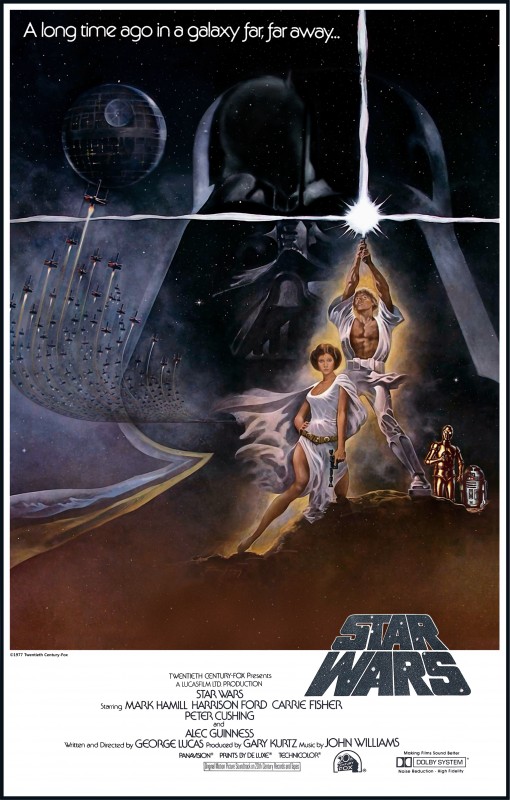
My first exposure to the genre was Star Wars: A New Hope.  I saw it when I was seven, right around the height of my dinosaur phase.  Everything about the movie completely blew me away, from the Jawas and Sand People of Tatooine to the stormtrooper gunfights and lightsaber duels.  After watching Luke blow up the Death Star, I spent the next few hours running around the yard pretending to fly my own starfighter.

In a lot of ways, I’ve never really stopped.

My parents made me wait until I was nine to watch The Empire Strikes back, because it was rated PG.  Without any exaggeration, I can say that those were the longest two years of my life.  I was literally counting down days by the end, and to pass the time without going crazy, I read up on all the books about space that I could possibly find.

My father bought the original X-wing flight simulator game somewhere around then, and I soon became totally engrossed in it.  Since the 386 was our only entertainment system (no Super Nintendo–I had to visit a friend’s house for that), X-wing became the defining game of my childhood.  I spent hours and hours on that game, to the point where I knew exactly which simulated missions the characters from the books were flying and how to complete them faster and easier.

I thought The Empire Strikes Back was a little slow the first time I saw it, but it’s since grown on me, to the point where now it’s my favorite film in the whole series.  Thankfully, my parents let me watch Return of the Jedi the next day, and for the next few months my life felt utterly complete.

Around this time I discovered the Star Wars novels and soon immersed myself in them.  The Courtship of Princess Leia by Dave Wolverton soon became one of my favorites, as well as the Heir to the Empire trilogy by Timothy Zahn and the X-wing series by Michael A. Stackpole.

But it was Roger Allen McBride who first introduced me to a different flavor of science fiction with his Corellia trilogy.  As I mentioned in V is for Vast, those books had just enough of a touch of hard science to intrigue me about the other possibilities of the genre.  That was the last Star Wars series that I read before branching out into other works of science fiction.

The Tripod trilogy by John Christopher was my first introduction to the dystopian / post-apocalyptic genre, depicting an enslaved humanity after an alien invasion.  Those books really captured my imagination for a while.  The Giver was also quite interesting and thought provoking, though since it didn’t involve spaceships or aliens it wasn’t nearly as compelling.

I read a lot of fantasy in my early high school years, including Tracy Hickman, Lloyd Alexander, and (of course) J.R.R. Tolkien.  While I enjoyed those books and immersed myself in them for a while, my true love was still science fiction.  For almost a year, I watched Star Trek: Voyager religiously with my dad.  And every now and again, I’d pick out a science fiction book from the local town library and give it a try.  That’s how I discovered Frank Herbert’s Dune.

In eleventh grade, my English teacher had us choose an author and focus our term papers solely on their books for the entire year.  She suggested I choose Orson Scott Card, but I chose Cormac McCarthy instead.  I’m not sure if that was the worst decision of my high school career, or the best decision, since assigned high school reading tends to make any book feel like it sucks.  I discovered Ender’s Game the following summer, and finished it in a delirious rush at 3am the morning after checking it out from the local library.

More than any other book, Ender’s Game cemented my love for the genre, and showed me just how powerful and moving the genre could be.  It opened so many insights into the world and human nature, reading that book made me feel like I’d opened a pair of eyes that I didn’t even know I’d had.  Looking back, that was probably the moment when I knew I would be a science fiction writer.  I’d known I was going to be a writer ever since I read A Wrinkle in Time at age eight, but to be a science fiction writer specifically, that goal was probably cemented by reading Orson Scott Card.

After high school, I served a two year mission for my church, during which I didn’t read any novels or watch any TV or movies.  When I came back, though, Orson Scott Card and Madeline L’Engle helped me to ease through the awkwardness of adjusting back to normal civilian life.  When I left for college, I expanded my horizons even further, starting with Isaac Asimov’s Foundation series and Edgar Rice Burrough’s Princess of Mars.

When I discovered Pioneer Books in downtown Provo, I knew I’d found my favorite bookstore in Utah Valley.  I have so many fond memories sitting cross-legged on the floor in the science fiction section, browsing through the musty used books for hours at a time.  That’s where I discovered C.J. Cherryh, Arthur C. Clarke, Robert A. Heinlein, Ursula K. Le Guin, and numerous other authors who are among my favorites today.

When I discovered Spin, Robert Charles Wilson soon became one of my favorites.  I picked up that novel as a free PDF from Tor, and read it over the summer while studying abroad in Jordan.  Once again, that same hard sf sensibility I’d gotten from Roger Allen McBride touched me in an unforgettable way.  But it was the human element of that book that really moved me–in fact, it’s always been about the human element.  The world building in Downbelow Station was great and all, but the romance of Merchanter’s Luck had a much more lasting impact.  Starship Troopers had some good ideas, but it was Mandella’s personal journey in The Forever War that moved me almost to tears.  The intrigue of the Ender’s Shadow series was quite entertaining, but it was Ender’s Game and Speaker for the Dead that really taught me what it means to be human.

I finished my first novel, Genesis Earth, shortly after returning from that study abroad, and tried to capture the same sensibility from Spin as well as the intimately human element.  Since then, I’ve written several more sci-fi novels, some of them tragic, some triumphant, but in all of them I’ve tried to get as close as I can to the personal lives of the characters.  I don’t know if I’ll ever write a character portrait so intimate as Shevek’s in Ursula K. Le Guin’s The Dispossessed, but I certainly hope to someday.

For me, science fiction started out as a wonderfully exciting entertainment and turned into something much more meaningful.  If there’s anything the genre has taught me, though, it’s that the two aren’t mutually exclusive–that you can have your adventure and learn what it means to be human as well.  Indeed, the more imaginative the adventure, the greater the truths I’ve taken from it.

Because of that, even though I’m almost in my thirties now, I can’t possibly foresee a time when science fiction isn’t a major part of my life.  It’s a love affair that’s grown just as much as I have, and continues to grow with each new author I discover and each new book I write.  When I’m old and grizzled and pushing eighty, I’m sure there will still be a part of that twelve year old boy in me, still running around the yard flying his starship.

Where were you on 9/11/01?

Tuesday Sept 11th, 2001
Day of the Terrorist Attacks on the WTC and Pentagon

Today has been an incredible day. In describing the events that happened today, one of the teachers said that “the world has changed significantly from what it used to be.” There’s no doubt that that’s true. It’s so strange, I’m still having trouble computing it; it seems almost like a dream; that tomorrow we’ll get up and nothing will be different.

On September 10th, 2001, I resolved to keep a daily journal for one full year (and actually followed through on it until June the next year). That journal turned into a detailed account of my personal reaction to the 9/11 terrorist attacks, the most historic, world-changing event to happen in my lifetime.

September 11th was the first day of school for my junior year in high school.

I first heard the news in 2nd period, which was AP US History with Mr. Gunn. I was excited to see his class, see what the year would be like, etc. Everyone was scrambling for a test. He came in a bit late, and was visibly shaken. He told us that the test was cancelled, and then broke the news to us.

I don’t think anyone computed it right then. I know I didn’t. I heard about it, and immediately my love of storms, breaking news, and perilous events kicked in. But I knew that what had happened was big – and not cool one bit.

I choked down the impulse to get excited, but I did want to know more – a lot more. I asked several questions about what had happened, but there wasn’t much info right then. I had no idea what the incredible magnitude of the event was; I still have trouble, it’s like something from a movie or something.

Needless to say, that was the weirdest first day of school I’ve ever had. Classes went on as scheduled, except for the last period of day, which was canceled for an impromptu school-wide assembly. Everything was upside down, with teachers and students trying simultaneously to launch another school year while doing everything they could to find out what the hell was happening on the news.

I didn’t get to a TV until the mid-afternoon, during my lunch break.

CNN was on, and they were showing footage of the Trade Center and the second plane ripping through it. They showed the buildings on fire and the scene around the buildings. It was incredible; eerie…it was really then that I started to comprehend the sheer magnitude of what had happened.

I watched footage of the Trade Center as the building collapsed – that was incredible. I watched the footage reels play over and over again. There was one of someone at the very foot of the building shooting the building as it burned, then caught it as it began to collapse, and then it started jiggling around as the guy and everyone around him scrambled as fast as they could to get out of there!

It was surreal. In the middle school just across the street, kids burst out laughing when they watched the second plane hit the other tower–then looked around in frightened disbelief as they realized that it was real. I remember looking at the photographs from the New York Times the next day and thinking I was reading a superhero comic, not the newspaper. It just didn’t compute.

I had a ton of questions on my mind that day, and they generally went in this order:

1) Was anyone I personally know hurt or killed in the attack?
2) Were any of the victims friends or family of people I know?
3) Is there going to be a war?

We’re going to remember this day for years and years, it’s incredible. The world has changed; I can feel it. It seems tonight like the stuff on the news is amazing and true, but it doesn’t seem real – not in the sense that I think any of us fully understand everything that’s gone on – everything about everyone who’s been affected by this, including ourselves.

For me, it feels exciting and horrifying at the same time, and I almost feel as if it’ll be gone tomorrow, or at least people will still be reporting on it and nothing will have changed from tonight’s events. Of course, that’s not true.

Interestingly enough, I had been watching the news on an almost daily basis for over a year, waiting for something like this to happen.  When the second Palestinian intifada began in 2000, I spent all my free time at school on the internet, checking on the latest developments in the Middle East.  When the nightly news stopped covering it, I became so disgusted I stopped watching TV news.

So I already knew who Osama Bin Laden was.  I knew all about the Taliban and their egregious human rights abuses in Afghanistan.  I heard about the USS Cole only hours after it was attacked, and I was disgusted that the US government wasn’t doing more to defend us from terrorism.

So when the 9/11 attacks happened, I felt simultaneously excited and guilty.  Finally, after months and months of slow news, something BIG is happening!  But people are dying, too–thousands of people.  Is it wrong to be excited?  But I’m sad too–does that make it all right?  How should I feel about this?

I’m not scared, I’m not terrified like the terrorists want, I’m not angry about all this – I’m just in shock, waiting to see how it all plays out. This is BIG!

Of course, the mental and emotional impact of the attacks were much larger than I understood at the time.  I didn’t feel a sense of peace in my life until sometime the next week, when I watched a special LDS devotional broadcast from the Mormon Tabernacle in Salt Lake City.  Even then, the impact of the attacks continued to transform me in ways that I didn’t fully understand.

Before the end of the school year, I wrote a short story that amalgamated all of the ways that the events of that year had changed my life.  It was my first creative writing project since elementary school that I’d actually finished, and I found it surprisingly cathartic. If you care to read it, you can download it here:

THE DREAM DIARY Creative Commons License

The writing is terrible, the plot is cheesy, and it gets a little preachy towards the end, but it’s more honest and genuine than anything else I can possibly say.

After the shock and horror and fear and sadness, the events of that day ultimately brought me closer to God and the people around me.  It also led to a lifelong fascination of Middle Eastern cultures alien to my own–and the desire to show that no matter our background or culture, we are all equally human.

That’s the best way to defeat evil–become a better person because of it.

something

So…I figure it’s been a week and I should probably post something on this blog.

Wow.

Well, work is underway on Ashes of the Starry Sea, and I’m starting to have a love-hate relationship with it.  Most writers say you first novel isn’t that good, and you just need to get it out of your system so you can write the real stuff.

Well, this is my first finished novel…but it’s not my first novel attempt.  My first novel attempt was in 8th grade, and I am happy to report that it no longer exists.  Anywhere.  No, seriously, I lost (or destroyed) it after my mission, and I am perfectly happy with that.

My second novel attempt was in ninth grade, and I still have a copy of it, though I haven’t looked at it in a while.  Somewhere around page one hundred (single spaced) I realized that the story wasn’t going anywhere, and I got all angsty and depressed about it.  Then, midway through tenth grade, I realized that the problems were fixable, and stopped being angsty and depressed.

And then I got bored and moved onto other things.

For the next two years, I started all sorts of projects but never really got anywhere with them.  This was when I came up with my “great golden idea” that I wanted to hide from the world until I had the skill to turn it into my masterpiece.

I’ll tell you what the idea was right now: a high school kid learns how to control his dreams and realizes that the dream world is just as “real” as the waking world.  An amazonian dream mage named Lachoneus takes him on as his apprentice and he saves the world from demons while struggling to turn his dream-world relationship with his hs crush into a reality in the waking world.

It’s got potential, but if this is the best idea I ever come up with, I’m going to be very disappointed.  Fortunately, I kept writing through this phase.

My next project that got past page ten happened my senior year.  I created an island fantasy world with a Greek aesthetic and started what I thought was a character study on my sister.  If she ever read it, she probably wouldn’t see any similarities between Sareli and herself, but she was kind of distant from all of  us in those years.

Then my mission happened.  Not much time for writing there, but even so, I had this one idea that was so good that I spent a handful of p-days in my second area writing it out longhand.  It was supposed to be this incredbly poignant allegory based around Lehi’s dream.  I got about two chapters in it before things got too busy for me.

When I came home, I picked up a story that I’d started before the mission and got pretty far with it…word-wise, at least.  The pre-mission version was based on this game I used to play with my Zaks building blocks.  When I got back, I renamed it Planet New America and envisioned it as Jesus’ second coming as experienced by American colonists on another planet, under Chinese occupation.

Sound pretty bad?  Yeah…about 60k words in I realized it had no plot and put it on the “back burner.” I haven’t picked it up since.

Sophomore year went by, and I wrote a short story and an undeveloped novel that I thought was a short story.  Decision LZ150207 was the short story, and it’s getting published!!! in The Leading Edge.  I signed the contract yesterday (woot!).  The Clearest Vision was the undersized novel, and…it was pretty bad.  Cheesy, sentimental, poorly written–but some of the ideas were cool.  Too bad it probably isn’t marketable.

Then, in the summer of 2007, I decided I was going to start another novel!  This one was going to be…<drumroll please> a Final Fantasy 6 fanfic (huh?!).  Thankfully, I had a much more original idea in gestation, and Aneeka convinced me to run with it.

Thus began the rough draft version of Ashes of the Starry Sea, my first finished novel and my current primary project.

So, yeah, they say to throw out your first novel…but I wrote at least five significant partial drafts before I got to Ashes. I think that’s enough to justify my assessment that this story’s going potential.  I still worry about it, though…I’m only in chapter 4 and I’m already struggling with the same angsty doubts that don’t usually hit until about halfway through.

The other day, though, I sent out my first three chapters to Charlie, who read them at work and gave me her assessment.  I thought that the main character, Ian, was weak and boring, that the first chapter didn’t have enough of a hook, that it took too long to get into the action, etc.  To my surprise, this is what she said:

Charlie: “Charlie is the coolest person I know”
say it.
me: charlie is the coolest person I know
Charlie: thank you.
me: because she read my first three chapters
Charlie: I just sent them to you
me: oh, nice
Charlie: 😀
me: they kick my other characters’ trash?
Charlie: yes
me: really?
how so?
Charlie: I like them
I can see their dinstinct characteristics very well
they’re developed subtly and efficiently
me: yeah?
Ian isn’t boring?
Charlie: no
I like him more than michael
me: ???
how?
Charlie: because he has definite character
me: he does?
Charlie: I totally understand how he thinks and his motivations after three chapters
yeah. He’s a passive weenie of a guy, but I like him
me: he’s a passive weenie and he isn’t boring?
Charlie: nope
I like him
me: you like him even though he’s a pansy?
Charlie: yeah
I like him because he’s a pansy
me: really?
huh
I don’t understand
Charlie: I’m sorry?
I like that you don’t have a complacent protagonist
me: Ian isn’t complicated?
sorry for all the questions
I’m just trying to understand
Charlie: no
me: so you like him because you get him
Charlie: that’s part of it, yeah
me: but if he’s weak and doesn’t start being proactive for very long, you’re going to stop liking him
is that right?
Charlie: I am expecting him to grow, yes
me: ah, so it’s the potential for growth that hooks you
Charlie: yeah

Like any first novel, Ashes of the Starry Sea has some serious plot issues, against which I’m currently banging my head.  However, despite the voices inside and outside of my head, it’s probably got potential.  Now I just need to convince myself of that.  Hopefully, as the story progresses, the story itself will do the convincing.  And you know what?  If I shut up and listen to it, it just might do that.

…and they all lived evily ever after.

Today we had a quark writing group party, and it was lots of fun! We all went up to drek‘s new house, up in Draper, and read some of our really old, really bad first attempts at writing stories. Good times!

Drek, Nick, lexish, slipperyjim, jakeson, gamila, aneeka, and one of my friends from the FLSR writing group all came up. Jakeson and his crew got lost on the way, but we had a good time hanging out, chatting, eating the pita bread and hummous that I’d cooked (I figured everyone else would bring sugar-heavy treats, so I cooked something a little more on the healthy side–still delicious, as evidenced by how much everyone ate!), and talking about how we’d gotten started writing.

I think a lot of us had similar stories–while we all wrote for different reasons, we all tried to do something big in high school, something that marked a turning point of some sort. The other common thread that ran through our stories was…how laughably bad they were! There were gradations, of course (Nick’s story that started with the word “Gandalf” and only got worse was pretty ridiculously crazy), but all of our stuff was pretty bad.

It can be both fun and painful to look back on past stuff, especially the stuff you wrote back in high school. It’s like, all the painful awkwardness of high school is not limited to your social life, it seeps into your writing as well, especially if that’s when you first try out your hand at the craft. So many cliches, so much bad grammar, so many viewpoint errors and info dumps…ARGH!!!

Of course, that is precisely what made it so entertaining. The awkward, emo, immature teenage grasp of the universe, combined with dozens of stale cliches and atrocious grammar–brilliant! I’m glad we were all at a point where we could look back on this stuff and laugh. It can do you good to air out your closet and let go of some of the old stuff you are sure would destroy you if you ever let it saw the light of day.

My first writing attempt was a novel that has since been entirely lost. I printed up a hard copy, once a long time ago, but I’ve lost that one and really have no desire to try and dreg it up. Of course, all the digital copies haven’t survived. My second novel attempt, however, I have in both digital and hard copy. That’s the one that I dipped back into for this writing party.

I actually sent out a copy of this to my aunt in Washington DC, who is/was an editor for a magazine. She read about the first twenty or thirty pages and sent me this letter, which I will use to finish off this post. The only places I’ve used ellipses are when my aunt described problems specific to certain passages and quoted them.

October 14, 1999

Dear onelowerlight [name, obviously, has been changed 😛 ]

The manuscript your mom sent home with Evan has proven to be an interesting read in many ways. It is wonderful to see people take an interest in writing. This pastime has given me many hours of satisfaction. I find that the joy is in the journey and that the process is as important to me as the finished job. However, it is always satisfying to have a finished product that I feel good about.

What it looks like you have is a wonderful outline for a novel. Your language is colorful and descriptive. The battle scene held my interest and made me want to know what was going to happen next. My intent was to read the manuscript from beginning to end purely for the joy of reading it. The urge to edit, an urge that often gets in my way as I write a first draft, got in my way as I read. Hence I was not able to follow through. I have written on some of the pages. What follows are a few other observations.

A really good writer named John Gardner said that a piece of fiction opens up a dream to the reader. Anything that causes the reader to become aware of the author or that jolts him out of the fictive dream does not belong. It is always helpful to let a manuscript cool for several days and then begin to read it. This will help you be more objective. Sometimes the things that seem marvelous turn out to be less enchanting than one thought during the rapture of creation.

Titles are difficult. Would anyone have read Catch 22 by another name? Some people don’t think so. It has been postulated that the reason the story about The Man Who Went Up A Hill And Came Down A Mountain didn’t do better as a movie–and presumable a book–was because of the length of the title. For many authors the title is the last thing to be written.

Your first two or three pages contain a good deal of “throat clearing.” An opening needs to grab the reader so he will continue. There needs to be a problem, action and change. It should be action that is vital to the story. Someone is going on a trip. Someone is going into battle. someone is getting married. Someone is being born. Unless you want to write erotic literature it would be better not to start with conception. Work the background in later. In The Gospel of John the first few verses talk about the Word. Immediately the Word is identified with the Son of God and the story of his baptism. The problem of establishing himself as a teacher is presented. In episode IV of Star Wars the force is not explained to us at the beginning, rather we see what it can do. It isn’t until Solo talks about fools who believe in an ancient religion that we begin to have some idea th at the force is more than magic. The characters give all this information to us.

Point of view is the perspective that the story is told from. T he most difficult and therefore least used these days is the omniscient narrator. A good rule of thumb is to see the story through the eyes of the person with the problem. Many authors write in first person. One can also use second or third person. Third person is similar to first person except the pronoun I isn’t used as much. (Actually it is more complicated than that, but that will suffice for now.) Sometimes a narrator who doesn’t see into anyone’s mind tells a story. Most fiction that looks like omniscient narrator is actually being told from the point of view of one of the characters. The narrator can then see into the mind of one person and all the other action is viewed through his eyes. Sometimes a novel will contain oone person’s point of view in one chapter and that of another character in another. This seems to work. It is confusing when shifts occur without warning.

Psychic distance has to do with how close you want your reader to be to the story. Stephen King wants to inspire terror. He gets his readers as close as he can. You hear breathing, feel sweat, hearts race. Jane Austin keeps her readers at a great distance. You see the lights, you hear the conversation, it is all very proper–no sweat, no breathing, no racing hearts. Just as with the point of view, the important thing is that the narrative remains consistent. It must not switch in the middle of a sentence, paragraph, or chapter.

Write in active voice as much as possible. Your English teacher will tell you all about this. Be aware that verbs ending in “ing” do not help your story. (Running up the hill after Jill and tripping over a rock Jack stumbled.) This slows the action of the story down but when used sparingly can add emphasis. The following construction works better (Jack ran up the hill after Jill. He tripped over a rock and stumbled. “D___!” he grumbled. Jill took water from her bucket and soap from her pocket and washed his mouth out.)…

…You have many long sentences. Your writing will be tighter and stronger with shorter sentences and fewer prepositional phrases…

…There are lots of ways to deal with dialogue. You can put the dialogue first and description second…you can put the dialogue at the end…you can break it up the way you have in your manuscript or you can put description on either sie of it…Like every other element of your story, you don’t want it to call attention to itself.

I believe you changed fonts to show a change in viewpoint or in who is speaking. For me this is very distracting. There are other good ways that work. Also it is easier for me to read when it is double-spaced.

Two books that I have found most helpful are John Gardner’s The Art of Fiction. It is out in paperback. John Gardner also wrote a wonderful fantasy called Grendal. It is not very long. It is told from the point of view of the monster. The other book is The Elements of Style by Strunk and White.

Thank you for sharing your manuscript with me. It takes great courage to share one’s work. I admire you for starting out early. Remember free advice is worth what you pay for and don’t let anybody discourage you. You learn to write by writinig. You have a good start.

Your’s truly,

Aunt Yvonne