Zero G by Dan Wells

I saw this a couple of months ago when it was free, and I recognized Dan Wells as the guy who wrote the I Am Not a Serial Killer books, so I decided to pick it up. Since Dan Wells tends to write mostly horror, I wasn’t sure how good his science fiction would be, but I was pleasantly surprised!

This was a really fun book. It’s definitely middle grade, so a lot of concepts familiar to veteran sci-fi readers get lengthy explanations, especially toward the beginning, which is great for younger readers but a little tedious for us old-timers. Once all the science is sufficiently explained, however, the story really gets going. The characters are delightful, especially Zero, who comes up with a bunch of clever ways to fight back against the pirates. Think Home Alone meets Gravity.

It’s a short book for an audiobook, but the production is really top rate, with a soundtrack and a cast of voice actors who really do a fantastic job. The production quality gets five stars easily. I picked it up as a free Audible Original, but I wouldn’t have regretted spending a credit on this.

Overall, a very fun book. This is the kind of story I’d want to share with my kids to introduce them to science fiction. Very clean and not too scary, but with just enough of a sense of danger to really draw you in. Well done!

OMG OMG OMG!!!

I know this is my third post today, but I saw this on Youtube today and I HAD to post it.

I’ve been dying to see The Martian ever since Matt Damon’s awesome performance in Interstellar. Haven’t read the book yet, though it’s definitely on my TBR list—everything I’ve heard about it is really good.

First Gravity, then Interstellar, and now The Martian—I love love love these near-future space movies!

Y is for Yesteryear

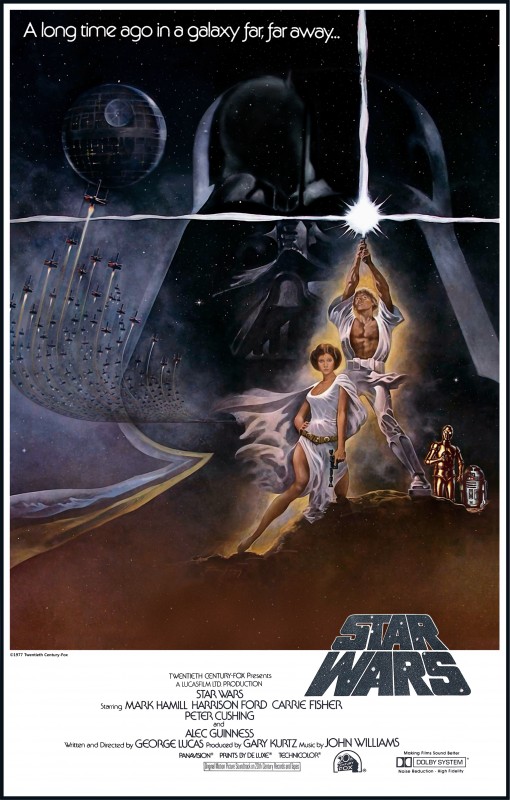
Star_wars_oldThey say that the golden age of science fiction is about twelve years old.  That’s definitely true for me.

My first exposure to the genre was Star Wars: A New Hope.  I saw it when I was seven, right around the height of my dinosaur phase.  Everything about the movie completely blew me away, from the Jawas and Sand People of Tatooine to the stormtrooper gunfights and lightsaber duels.  After watching Luke blow up the Death Star, I spent the next few hours running around the yard pretending to fly my own starfighter.

In a lot of ways, I’ve never really stopped.

My parents made me wait until I was nine to watch The Empire Strikes back, because it was rated PG.  Without any exaggeration, I can say that those were the longest two years of my life.  I was literally counting down days by the end, and to pass the time without going crazy, I read up on all the books about space that I could possibly find.

My father bought the original X-wing flight simulator game somewhere around then, and I soon became totally engrossed in it.  Since the 386 was our only entertainment system (no Super Nintendo–I had to visit a friend’s house for that), X-wing became the defining game of my childhood.  I spent hours and hours on that game, to the point where I knew exactly which simulated missions the characters from the books were flying and how to complete them faster and easier.

I thought The Empire Strikes Back was a little slow the first time I saw it, but it’s since grown on me, to the point where now it’s my favorite film in the whole series.  Thankfully, my parents let me watch Return of the Jedi the next day, and for the next few months my life felt utterly complete.

Around this time I discovered the Star Wars novels and soon immersed myself in them.  The Courtship of Princess Leia by Dave Wolverton soon became one of my favorites, as well as the Heir to the Empire trilogy by Timothy Zahn and the X-wing series by Michael A. Stackpole.

But it was Roger Allen McBride who first introduced me to a different flavor of science fiction with his Corellia trilogy.  As I mentioned in V is for Vast, those books had just enough of a touch of hard science to intrigue me about the other possibilities of the genre.  That was the last Star Wars series that I read before branching out into other works of science fiction.

The Tripod trilogy by John Christopher was my first introduction to the dystopian / post-apocalyptic genre, depicting an enslaved humanity after an alien invasion.  Those books really captured my imagination for a while.  The Giver was also quite interesting and thought provoking, though since it didn’t involve spaceships or aliens it wasn’t nearly as compelling.

I read a lot of fantasy in my early high school years, including Tracy Hickman, Lloyd Alexander, and (of course) J.R.R. Tolkien.  While I enjoyed those books and immersed myself in them for a while, my true love was still science fiction.  For almost a year, I watched Star Trek: Voyager religiously with my dad.  And every now and again, I’d pick out a science fiction book from the local town library and give it a try.  That’s how I discovered Frank Herbert’s Dune.

In eleventh grade, my English teacher had us choose an author and focus our term papers solely on their books for the entire year.  She suggested I choose Orson Scott Card, but I chose Cormac McCarthy instead.  I’m not sure if that was the worst decision of my high school career, or the best decision, since assigned high school reading tends to make any book feel like it sucks.  I discovered Ender’s Game the following summer, and finished it in a delirious rush at 3am the morning after checking it out from the local library.

More than any other book, Ender’s Game cemented my love for the genre, and showed me just how powerful and moving the genre could be.  It opened so many insights into the world and human nature, reading that book made me feel like I’d opened a pair of eyes that I didn’t even know I’d had.  Looking back, that was probably the moment when I knew I would be a science fiction writer.  I’d known I was going to be a writer ever since I read A Wrinkle in Time at age eight, but to be a science fiction writer specifically, that goal was probably cemented by reading Orson Scott Card.

After high school, I served a two year mission for my church, during which I didn’t read any novels or watch any TV or movies.  When I came back, though, Orson Scott Card and Madeline L’Engle helped me to ease through the awkwardness of adjusting back to normal civilian life.  When I left for college, I expanded my horizons even further, starting with Isaac Asimov’s Foundation series and Edgar Rice Burrough’s Princess of Mars.

When I discovered Pioneer Books in downtown Provo, I knew I’d found my favorite bookstore in Utah Valley.  I have so many fond memories sitting cross-legged on the floor in the science fiction section, browsing through the musty used books for hours at a time.  That’s where I discovered C.J. Cherryh, Arthur C. Clarke, Robert A. Heinlein, Ursula K. Le Guin, and numerous other authors who are among my favorites today.

When I discovered Spin, Robert Charles Wilson soon became one of my favorites.  I picked up that novel as a free PDF from Tor, and read it over the summer while studying abroad in Jordan.  Once again, that same hard sf sensibility I’d gotten from Roger Allen McBride touched me in an unforgettable way.  But it was the human element of that book that really moved me–in fact, it’s always been about the human element.  The world building in Downbelow Station was great and all, but the romance of Merchanter’s Luck had a much more lasting impact.  Starship Troopers had some good ideas, but it was Mandella’s personal journey in The Forever War that moved me almost to tears.  The intrigue of the Ender’s Shadow series was quite entertaining, but it was Ender’s Game and Speaker for the Dead that really taught me what it means to be human.

I finished my first novel, Genesis Earth, shortly after returning from that study abroad, and tried to capture the same sensibility from Spin as well as the intimately human element.  Since then, I’ve written several more sci-fi novels, some of them tragic, some triumphant, but in all of them I’ve tried to get as close as I can to the personal lives of the characters.  I don’t know if I’ll ever write a character portrait so intimate as Shevek’s in Ursula K. Le Guin’s The Dispossessed, but I certainly hope to someday.

For me, science fiction started out as a wonderfully exciting entertainment and turned into something much more meaningful.  If there’s anything the genre has taught me, though, it’s that the two aren’t mutually exclusive–that you can have your adventure and learn what it means to be human as well.  Indeed, the more imaginative the adventure, the greater the truths I’ve taken from it.

Because of that, even though I’m almost in my thirties now, I can’t possibly foresee a time when science fiction isn’t a major part of my life.  It’s a love affair that’s grown just as much as I have, and continues to grow with each new author I discover and each new book I write.  When I’m old and grizzled and pushing eighty, I’m sure there will still be a part of that twelve year old boy in me, still running around the yard flying his starship.

T is for Terraforming

[NOTE: this post is a reprint of an earlier post from the Trope Tuesday series, which you can find here.]

The fantasy isn’t that Mars could actually look like this, but that NASA might actually get the funding.

One of the problems with interplanetary colonization is that Earth-like worlds are fairly rare (though possibly not as rare as we once thought). In our own solar system, the only other world that comes anywhere close (Mars) is a radiation-blasted desert with only the barest hint of an atmosphere and a surface temperature colder than Antarctica. To get around this problem, you can do one of two things: build an artificial enclosed environment to house the colony, or change the world itself to make it more Earthlike–in other words, terraform it.

The actual science of terraforming is way over my head far too complex to do it justice in this post. Instead, I’ll just point you to the Terraforming Wikipedia page as a starting point and focus on how the concept is used as a story trope.

According to tvtropes and Wikipedia, the term came from a 1942 novella by Jack Williamson titled “Collision Orbit.” The concept of changing the environment of an entire planet actually goes back much further, with H.G. Wells subverting the trope in War of the Worlds (instead of humans terraforming other worlds, the hostile Martians try to xenoform Earth to make it habitable for them). Before the U.S. and U.S.S.R. put probes on the surface of Mars and Venus, it was fairly common for writers to speculate that those planets were able to support human life, at least on a basic, rudimentary level. Once the science showed that that isn’t actually the case, terraforming as a story trope really began to take off.

Today, this trope occurs commonly across all ranges of the Mohs scale. Soft sci-fi stories (such as Firefly) use it as an excuse to have planets that look and feel like Earth. Hard sci-fi stories (such as Red Mars, Green Mars, and Blue Mars) use it as a fundamental premise, or to pose questions like “what is the ultimate destiny of human evolution?” or “how important is it to our species’ survival that we spread out beyond Earth?” Although it’s not something that we as a species have (yet) done, our present science seems to place it well within the range of the plausible, and that means that makes it fair game for any kind of science fiction.

In order to be believable, however, any significant terraforming project requires two things: resources and time. LOTS of time. We’re talking on the order of centuries and millenia here. Because of that, stories that use this trope generally fall into the following categories:

  • The terraforming happened a long time ago and is part of the world’s ancient (or near ancient) history.
  • The terraforming is on-going and directly impacts almost every element of the world’s culture and setting.
  • The terraforming has failed in some way, which may (or may not) make it a key element in the story conflict.

As with generation ships, the scope of this trope spans more than just the interests of a single character–it deals with the ultimate destiny of entire cultures and civilizations. In hard sci-fi stories, the planet that’s being terraformed may actually become more of a character in itself than the individual people who are terraforming it. Unless they have some form of immortality, they have little hope of ever seeing the ultimate end of it.

Of course, that almost makes the project more of a religion to the colonists than a science, with all sorts of interesting philosophical and story implications.

Why is this trope so widespread in science fiction? I can think of a few potential reasons. First, it hits on some of the key issues that lie at the very heart of the genre, such as the ultimate destiny of humanity and the ethical issues surrounding our ability to play God through the wonders of science. Also, it captures the imagination in a way that few other tropes can equal. Because the scope of any terraforming project is so vast, the implications touch on almost every key element of the story, including setting, character, and conflict.

But on an even more fundamental level, it hits on one of the key elements of any fantasy magic system: limitations. We can’t live on an alien world because the conditions are too hostile, but we can’t just wave our hands to make it Earth-like either. We have to undergo a painstaking, laborious process that could unravel at any point and throw everything we’ve worked for into chaos. We have to dedicate our whole lives to the project for dozens of generations before it will ever pay off. There are no shortcuts–none that won’t strain our readers’ suspension of disbelief, anyway. But if it all works out, then we will have created a new Earth–and how is that not magic?

Needless to say, I’m a big fan of this trope. I’ve used it in just about every science fiction story I’ve written, though I probably play with it the most in Star Wanderers. The main character of that story comes from a world where a terraformation project failed, having severe religious implications that drive the whole series. Sacrifice is largely set in orbit around a world that is midway through the terraforming process. Elswhere in the Gaia Nova universe, people build domes just as often to keep humanity from screwing over a terraformed world as they do to provide room to live on one that isn’t. After all this, though, I feel like I’ve only begun to scratch the surface of this trope. You can definitely expect to see it in my work in the future.

I have a confession…

…I’ve started writing a Sword & Planet story.

In case you’re wondering what the heck is Sword & Planet, think Conan the Barbarian in space.  With giant lizards and man-eating plants.  And half-naked princesses getting kidnapped by evil technomancers with giant four-armed bodyguards that wield laser-bladed swords.  Basically, science fiction in the style of the classic 20s pulp adventure novels.

In other words, this:

I’ve read a lot more Heroic Fantasy and Sword & Sorcery than straight Sword & Planet, but I figure there’s a good deal of overlap.  I read A Princess of Mars way back in college and really enjoyed it, and of course I’m a huge fan of Star Wars and other series that were heavily influenced by the genre.  Basically, I want to try my hand at a classic science fiction adventure style, without the scientific rigor of Hard SF or the sprawling world building of Space Opera.  It’s all about the adventure, with liberal helpings of awesome sprinkled with omigoshomigoshomigosh.

The tentative title for this book is The Last Warrior Princess, though it’s about a twenty-something college grad working a wilderness job in southern Utah who accidentally finds a portal to another world while wandering around Arches National Monument.  The princess comes later, though not too much later.  I don’t know much about her yet.

In fact, I don’t know much about the story at all.  I’m discovery writing everything, and I do mean everything.  This is a fly-by-your-pants ready-set-go kind of book, with no restrictions and no limits–just me and the muse, not caring what anyone else thinks.  My internal editor is bound and gagged in the cellar with the spiders, and if he breaks out somehow I’ll hamstring him and toss him back down.  This project might never get another mention beyond this post, but I’m okay with that because it’s going to be a whole lot of fun.

For those of you waiting for the next Star Wanderers story, don’t worry, I’m still writing those too.  This is more of a side project at this point, so I won’t put up a progress bar for it until I get fairly close to the end and know it’s something I want to keep.  Which might never happen.

So basically, it’s just a personal pet project for now.  It’s interesting, though, because when you’ve got nothing to fall back on but your own creative impulses, the words start to flow in remarkable ways.  Take this passage, for example:

I drove up just as the sun was setting. The crescent moon hung like a razor in the yellow-orange sky, with Venus a twinkling point on its edge. Blood-red Mars was not far off, while Jupiter loomed ascendant.

I have no idea where that came from, but in the white-hot creative heat of the moment, it just spewed out onto the page that way.  The only word that I changed was “loomed,” which I had originally written as “hung” (maybe I should change it back? Nah, who cares).  In a little over an hour, I committed about 1,500 words, all just like this.

So yeah, if nothing else, this project will help to shake up my creative process and get the juices flowing for other projects.  I could really use that right now, what with a couple of recent life roles (my grandmother passed away last week, which wasn’t unexpected but it did throw a kink in my already rocky routine).  And who knows?  If it turns out well, you might see me put it out as a novel in a few months.  Or maybe the first part of a new series … nah, better not get carried away.  Better just write it first.

Besides the A to Z challenge (which I may also turn into a book at some point) and Star Wanderers: Reproach, that’s what I’ve been up to recently.  I’ve got a Star Wanderers omnibus in the publishing queue, but there’s nothing firm I can say about that yet, other than it will probably be for Parts I-IV and feature a professional cover (though I plan to keep the space images for the individual installments).  I could say more, but I want to go for a walk.  Later.

O is for Orbit

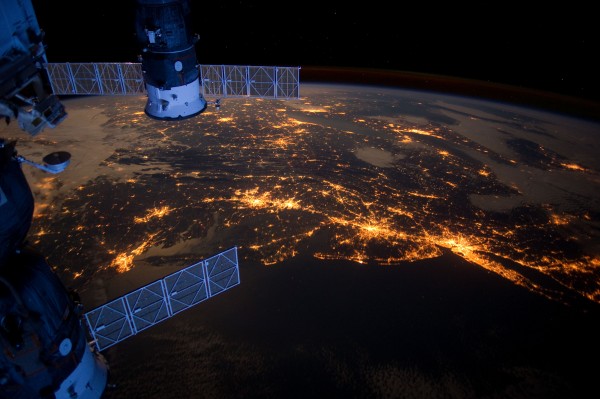
iss030e078095

One of the key things that makes space different from Earth is that nothing is ever stationary.  Anything close to our planet that isn’t moving at a good clip (measured in miles/kilometers per second) is liable to plummet like a brick.  Gravity is still in effect, even though you’re in free fall and thus don’t really feel it.

The way to get around the falling problem is to orbit whatever celestial body you’re plummeting towards.  When your tangential velocity gets high enough, gravity becomes your centripetal acceleration, and the system becomes rotational rather than discrete.  In other words, you’re still falling, but you’re moving fast enough to cross the edge of the horizon before you hit.

Just to give you a scale of how fast you have to go to make this work, the International Space Station (ISS) is orbiting at about 230 miles (370 kilometers) above sea level, and it makes a complete rotation around the earth every 90 minutes.  That means that the good folks who live and work up there see about 16 sunrises and sunsets per day.

If you’ve spent your whole life living planetside, orbital mechanics can be a bit difficult to grasp.  Here are just a few of the basics:

Since orbit is basically free fall, you don’t need to fire your engines to stay aloft.  In fact, once you’re parked in a stable orbit, you can stay there almost indefinitely.  This is how satellites work: we use a rocket to put them in position, but once they’re there all they need is a minor adjustment from time to time.  The moon is basically a giant natural satellite, and it doesn’t need any sort of thrust to stay aloft.

As objects fall closer to the body they’re orbiting, they orbit faster.  Just think about how figure skaters speed up when they pull their arms in closer to their bodies.  The main reason for this is that the object has a much shorter distance to travel to make a complete revolution.  To understand how this works, take a CD and measure the inside edge versus the outside edge.

However, since your tangential velocity is proportional to your centripetal acceleration (ie gravity), the way to jump to a higher orbit is to speed up.  Conversely, the way to fall to a lower orbit is to slow down.  An object’s angular momentum (mass X tangential velocity) is proportional to the distance of the object from the rotational system’s center of mass, so changing the object’s velocity will also change its distance from the center.

So if you’re in a spaceship and you’re about to collide with an object on a parallel orbit, the way to avoid it is not to nose your ship up like an airplane.  Instead, fire your engines and try to go faster (or slower, as the case may be).  It’s a bit counter-intuitive, but your altitude will change accordingly.  The anime/manga series Planetes really got this right.

However, even though you’re moving faster at a higher orbit, you have a lot more distance to travel, so it actually takes longer to make a complete orbit.  If you go high enough, you can eventually get to the point where the orbital period equals the rotational period of the celestial body you’re orbiting.  We call this a geosynchronous orbit.  If you’re orbiting around the celestial body’s equator, then to a person on the surface, it appears as if you’re stationary.  You’re not, of course–nothing in space really is–but both you and the person on the planet’s surface are moving in tandem, so that’s how it appears.

Ever wonder why satellite dishes all point in the same direction?  This is why.  The signal comes from a satellite in geostationary orbit, where it doesn’t move relative to the people on the surface.  Thus, if you know where to point your dish, you will always get a signal since the satellite doesn’t appear to move.

An orbit doesn’t have to be circular, but the barycenter (ie the center of mass for the whole system, where the mass of both objects cancels each other out) has to be at one of the focal points of an ellipse.  This is how comets work.  An object in an elliptical orbit will speed up when it gets closer to the object it’s orbiting, and slow down when it gets further away.

It’s possible–indeed, quite common–to orbit two celestial bodies simultaneously.  For example, since the Earth orbits the sun, anything orbiting the Earth must also orbit the sun at the same time.  If you’re close enough to the Earth, this doesn’t really matter since the Earth exerts a much more immediate force.  But when you get further away, interesting things start to happen.

A Lagrangian point is a point of gravitational balance between two orbiting celestial bodies of unequal mass.  Basically, they’re points of equilibrium where objects appear to remain stationary, so long as they continue to orbit in tandem with the other two celestial bodies.

In science fiction, these are great places to put space stations and other orbital settlements, since they appear as fixed points relative to the planet or moon that they’re moving around.  In real life, asteroids tend to clump around these points in a planet’s orbit, especially the L5 and L4 points.  Jupiter has so many of them that we call them the Trojans and the Greeks.

Since orbital mechanics can be a bit difficult to grasp, a lot of science fiction gets it wrong, especially space opera.  For a recent example, just look at the Halo series–unless those Covenant ships have some sort of magical drive, there’s no way they could hover above the surfaces of planets the way they do.  Orbiting does NOT equal hovering.  And in Halo: Reach, where Jorge knocks out the main ship for the Covenant advance force … yeah, if a ship that large actually fell from orbit into the surface of a planet, it would be moving fast enough to make a crater the size of a small continent, kicking up enough dust and debris to cause a mass extinction event like the one that killed the Dinosaurs.

At the same time, when a science fiction story goes the length to get the orbital mechanics right, it can add a surprising amount of realism.  A good example of this is Passage at Arms by Glen Cook.  I loved how he depicted the orbital siege of the main colony world, with the way the orbital space battles looked like from the planet’s surface.  The human forces were able to keep a toehold on space due to a low orbiting asteroid that the aliens couldn’t get to without exposing their forces to attack, and that served as the staging ground for the main characters to fight back.

For hard sci-fi, orbital mechanics is absolutely essential–you’ll be tarred and feathered if you get any of it wrong.  For soft sci-fi like space opera, it’s not essential, but it adds a lot to the story if you can get it right.  In any magic system, the limitations are what make it interesting.  If you’re writing science fiction, then physics is your magic system, so knowing how it works can really add a lot to your story.

For example, in the recent Schlock Mercenary storyline, the characters board a spaceship with an artificial gravity generator centered around a large cylindrical pylon that runs the length of the ship.  One of the implications of having Earth-strength gravity around such a small object is that you can actually throw a baseball into orbit.  And that’s just the beginning!  Needless to say, I’m really interested to see where Howard Tayler takes this story in the weeks and months to come.

Even though I write more space opera / science fantasy type stuff, I do the best I can to get my orbital dynamics right.  You can see this in the space battles in Stars of Blood and Glory and Bringing Stella Home, as well as the setting elements in Desert Stars.  When the desert tribesmen look up at the night sky, they gaze at the stars and satellites–hundreds of satellites, many of them starships bound for distant spaceports on the more civilized side of the world.  One of the reviewers said that the world felt so real it was almost like he could reach out and touch it, so I guess I did something right.  I’ll definitely keep it up in the future.

Trope Tuesday: Terraforming

The fantastical element here isn’t that Mars could actually look like this in a millenia or two, but that NASA might actually get the funding.

One of the problems with interplanetary colonization is that Earth-like worlds are fairly rare (though possibly not as rare as we once thought).  In our own solar system, the only other world that comes anywhere close (Mars) is a radiation-blasted desert with only the barest hint of an atmosphere and a surface temperature colder than Antarctica.  To get around this problem, you can do one of two things: build an artificial enclosed environment to house the colony, or change the world itself to make it more Earthlike–in other words, terraform it.

The actual science of terraforming is far too complex (not to mention way over my head) to do it justice in this post.  Instead, I’ll just point you to the Terraforming Wikipedia page as a starting point and focus on how the concept is used as a story trope.

According to tvtropes and Wikipedia, the term came from a 1942 novella by Jack Williamson titled “Collision Orbit.” The concept of changing the environment of an entire planet actually goes back much further, with H.G. Wells subverting the trope in War of the Worlds (instead of humans terraforming other worlds, the hostile Martians try to xenoform Earth to make it habitable for them).  Before the U.S. and U.S.S.R. put probes on the surface of Mars and Venus, it was fairly common for writers to speculate that those planets were able to support human life, at least on a basic, rudimentary level.  Once the science showed that that isn’t actually the case, terraforming as a story trope really began to take off.

Today, this trope occurs commonly across all ranges of the Mohs scale.  Soft sci-fi stories (such as Firefly) use it as an excuse to have planets that look and feel like Earth.  Hard sci-fi stories (such as Red Mars, Green Mars, and Blue Mars) use it as a fundamental premise, or to pose questions like “what is the ultimate destiny of human evolution?” or “how important is it to our species’ survival that we spread out beyond Earth?” Although it’s not something that we as a species have (yet) done, our present science seems to place it well within the range of the plausible, and that means that makes it fair game for any kind of science fiction.

In order to be believable, however, any significant terraforming project requires two things: resources and time.  LOTS of time.  We’re talking on the order of centuries and millenia here.  Because of that, stories that use this trope generally fall into the following categories:

  • The terraforming happened a long time ago and is part of the world’s ancient (or near ancient) history.
  • The terraforming is on-going and directly impacts almost every element of the world’s culture and setting.
  • The terraforming has failed in some way, which may (or may not) make it a key element in the story conflict.

As with generation ships, the scope of this trope spans more than just the interests of a single character–it deals with the ultimate destiny of entire cultures and civilizations.  In hard sci-fi stories, the planet that’s being terraformed may actually become more of a character in itself than the individual people who are terraforming it.  Unless they have some form of immortality, they have little hope of ever seeing the ultimate end of it.

Of course, that almost makes the project more of a religion to the colonists than a science, with all sorts of interesting philosophical and story implications.

Why is this trope so widespread in science fiction?  I can think of a few potential reasons.  First, it hits on some of the key issues that lie at the very heart of the genre, such as the ultimate destiny of humanity and the ethical issues surrounding our ability to play God through the wonders of science.  Also, it captures the imagination in a way that few other tropes can equal.  Because the scope of any terraforming project is so vast, the implications touch on almost every key element of the story, including setting, character, and conflict.

But on an even more fundamental level, it hits on one of the key elements of any fantasy magic system: limitations.  We can’t live on an alien world because the conditions are too hostile, but we can’t just wave our hands to make it Earth-like either.  We have to undergo a painstaking, laborious process that could unravel at any point and throw everything we’ve worked for into chaos.  We have to dedicate our whole lives to the project for dozens of generations before it will ever pay off.  There are no shortcuts–none that won’t strain our readers’ suspension of disbelief, anyway.  But if it all works out, then we will have created a new Earth–and how is that not magic?

Needless to say, I’m a big fan of this trope.  I’ve used it in just about every science fiction story I’ve written, though I probably play with it the most in Star Wanderers.  The main character of that story comes from a world where a terraformation project failed, having severe religious implications that drive the whole series.  Sacrifice is largely set in orbit around a world that is midway through the terraforming process.  Elswhere in the Gaia Nova universe, people build domes just as often to keep humanity from screwing over a terraformed world as they do to provide room to live on one that isn’t.  After all this, though, I feel like I’ve only begun to scratch the surface of this trope.  You can definitely expect to see it in my work in the future.

Thoughts after finishing Vortex by Robert Charles Wilson

Whoa.

If I had to sum up my thoughts with one word, that would be it–though of course, by itself that word is hopelessly inadequate.  Let’s just say that, for me at least, this  was a truly astounding book, a literary journey that left me wide-eyed with my mouth hanging open, blinking wearily as I looked up from the last page and returned, reluctantly, to the world of physical reality.

I don’t plan to spend this blog post talking about how awesome this book is, however; I’ll save that for a review.  Rather, I want to spend some time talking about how this book has influenced the way I think about science fiction and my own writing, and to share a few of my thoughts having just finished it less than an hour ago.

If anything, this book has shown me that science fiction–real science fiction–is about staring into the unblinking void of the cosmos with a deep and abiding need to find answers, or perhaps more accurately, to ask questions.  This inevitably produces a sense of wonder, but that’s merely incidental; the genre is really about fulfilling an almost religious need to connect with something greater than oneself.

I enjoy reading science fiction and experiencing that connection, but I don’t need it–not in the way that I sense some of the grand masters of the genre truly did.  Instead, I hunger for the sense of wonder and adventure that is more characteristic of fantasy.  In my own writing, it’s not so much the grand sweep of the cosmos that interests me as much as the intimacies of human nature–which isn’t to say that the two are incompatible, but that my preferences lean more to the one than the other.

What I’m saying is that it’s not science fiction that I write, so much as science fantasy.  I still feel drawn to space adventures and the trappings of science fiction–I’m not at all interested in writing about elves or dragons–but at their heart, the books I write are more fantasy than true science fiction.

Which might be a purely esoteric distinction to the average reader, but if it helps me to understand my own writing, it’s a distinction worth making.  If science fantasy is the sub-genre that really speaks to me, then that’s the kind of literature that I should explore.  Of course, it’s important to be well-read in multiple genres, but if there’s a particular one in which you want to write, it stands to reason that that’s the one on which you need to be an expert.

So that’s my new goal: to explore fantasy, science fantasy in particular, and the ways in which other sub-genres like space opera and space adventure lean more toward the fantasy side of things than pure science fiction. And to keep reading really awesome books.

Red Mars by Kim Stanley Robinson

For eons, sandstorms have swept the barren, desolate landscape of the red planet.  For centuries, Mars has beckoned to mankind to come and conquer its hostile climate.  Now, in the year 2026, a group of one hundred colonists is about to fulfill that destiny.

I first picked up this book two and a half years ago, when I was still trying to read a novel a week.  I’ve got to be honest; this was the book that made me break that new years resolution.  It is freaking huge, and some points are more interesting than others.

That said, this is an awesome piece of hard science fiction.  Lots of people have written about Mars, but very few have done it believably.  Kim Stanley Robinson does an job here–you can tell that he put in a ton of research, both into Martian geography (areology?) and feasible technology.

When I read science fiction, however, that’s not what I generally read for.  I’m more interested in characters, conflict, and thematic elements–in other words, the stuff that makes for a good story.  As far as that stuff goes, my opinion of Red Mars is somewhat mixed.

For example, the first chapter starts out with a murder, as seen from the point of view of the murderer.  Right away, I’ve got a reason not to sympathize with the main viewpoint character.  When we get into his mind and I see his motivations for killing the character, I like him even less–and he’s one of the main, driving characters.

Some of the characters are more sympathetic, and I enjoyed the sections in their point of view.  Others, however, were just plain boring–I neither loved them nor despised them.  Because of this, a lot of the character drama early in the novel didn’t engage me much; stuff was happening, but I didn’t really care.

When it comes to setting, Red Mars is also somewhat mixed.  Robinson goes to great depths to describe the Martian landscape, and several of his setting descriptions were quite interesting and wonderful.  At the same time, he explains everything in a very clinical, scientific way–his imagery is never as poetic and captivating as Ray Bradbury’s, or Ursula K. Le Guin’s, or George R. R. Martin’s.  I came away with a lot more knowledge about Mars, but not quite as much of a sense of wonder.

Things did get interesting once the political tensions started to come into play.  Robinson’s portrayal of the colonization of Mars raises a lot of interesting questions about the political relationship between Earth and Mars once those colonies start to become self-sufficient.  He follows things through right to the war for independence, and the implications of the conflict are quite interesting.  I finished the last hundred pages or so at a sprint.

All in all, I wouldn’t recommend this book unless you’re already a fan of hard science fiction.  Like most hard sf, character and conflict plays second string to scientific plausibility.  Within its sub-genre, however, Red Mars is awesome.  Let’s just put it this way: even though I got bored with it the first time, I knew I would one day pick it up and finish it.  I don’t regret that I did.

The Martian Chronicles by Ray Bradbury

Welcome to Mars, a magical world of ancient ruins like giant glass chess sets and canals of wine and sandy desert seas. A world inhabited by golden eyed people who can telepathically project hallucinations–some of them still live up in the hills. A desolate, empty world, the next frontier for a new generation of pioneering spirits, each with different dreams, different reasons, different goals and outlooks on their new life in the new world. Some come with respect and reverence to the ancient world, while others come to exploit it. But no matter why they come, everyone is deeply and profoundly changed. Some never return.

Ray Bradbury is one of the biggest names in science fiction, and this book is one of his greatest works. A lot of my friends really love Bradbury, but strangely, I haven’t read a lot of him (Fahrenheit 451, way back in Middle School, and a few essays, but that’s pretty much it). After putting this book down, all I can say is wow. Now I know what my friends were talking about.

The Martian Chronicles is more of a collection of short stories than anything else. That’s understandable, when you consider that science fiction began with short stories, not with novels. Keep that in mind as you read it, too. This is not a book you can read all in one go; you have to take time between the chapters to let each one soak in, otherwise your mind will just get overloaded. Bradbury delivers a bang! ending to just about every story in this book, and some of them are really deep. My favorite one was the one with Sender, and how the fourth rocket discovered that all the Martians were killed off by the chicken pox. There are some really profound ideas in that one, and I loved reading it.

A lot of hard sf purists tend to call Bradbury a writer of fantasy disguised as science fiction, and I can see where they’re coming from. There’s nothing really scientific about this book; the Mars of Bradbury’s stories is a purely fantastic invention (even for the 50s). I remember the story about the third rocket, and how it landed on a grassy green lawn, and all the crew stepped out and found themselves in a little Ohio town, and all I could think was “what??” It was very fantastic, very surreal and even trippy at parts, but once you get the hang of it, it’s not so bad. And really, I’d argue with the whole “Bradbury = fantasy” thing–I think some of the ideas in these stories definitely blur the line between fantasy and science fiction.

One thing Bradbury is fantastically good at is infusing all of his writing with passion. There wasn’t a moment in this whole book when I couldn’t envision Bradbury himself, his eyes wide and bloodshot, gripping me by the shoulders and shaking me. His imagery was amazing, and his twist endings were incredible. You really read Bradbury for his prose and for his ideas; everything else takes a back seat, but he does so well with the first two that that’s ok.

These are the kinds of stories that stick with you long after you’ve read them. They might not be consistent with each other or follow in a coherent, logical order, but they will deeply and profoundly move you.