Plans for My Personal Home Library

If everyone has a weird or quirky super power, mine is the ability to acquire books. Even when I was living out of a suitcase in a remote Caucasian village, or traipsing across the Middle East, I was constantly acquiring books.

With my marriage to Future Mrs. Vasicek coming up, I’ve decided to put this super power to use. Instead of acquiring books randomly, I’m approaching the task of building a personal library with goals and a plan. Part of that plan is to inventory all of the books that I own, with lists of books / ebooks / audiobooks that I want to acquire. Part of it is to find a place in my home where I can shelve them all, instead of keeping them in boxes or the closet. And another part is categorizing all of the books, with goals for each category.

Requirements

After putting some thought into it, here are my basic requirements:

  • The entire library must fit in a single room / device / server.
  • The only books that I’ll keep are ones that:
    • I want to read again,
    • I want to talk about with others, or
    • I want to share with my family.
  • Ebooks and audiobooks must be DRM-free and device agnostic.

A while ago, I did a blog post on the pros and cons between print books, ebooks, and audiobooks. That seems to be a pretty good set of criteria for determining which formats to collect my books in, or whether to collect a particular book in multiple formats.

Ideally, I want to set up my personal library in a shared space in my home, where I can host guests. Future Mrs. Vasicek and I are going to get a set of scriptures, kind of like the tradition of a family bible, and I want this to be the centerpiece of my personal library. Eventually, I also want to get a dedicated ereader (or set of ereaders) that lives in the library, as well as a portable hard drive for all of the audiobooks. I don’t want any of it to depend on the cloud.

Categories

So far, I’ve got eight categories, though I’m sure this will expand. They are:

  1. Science fiction & fantasy
  2. Other fiction
  3. LDS non-fiction
  4. Self-improvement
  5. Writing & publishing
  6. Arabic language
  7. History & current events
  8. Other non-fiction

I have a lot more fiction books than non-fiction (go figure). For now, I’m using Goodreads as a library inventory system, though I may want to find something better in the future. If you check out my Goodreads profile, you can probably see all of them.

I’m working to come up with goals and plans for each category. Here’s what I have so far:

Science Fiction & Fantasy

My main goal here is to collect the complete works of David Gemmell. He is my favorite fantasy writer of all time, and I’ve read all of the Drenai series and most of the Stones of Power and the Rigante series as well. I’m holding off on the Troy books, mostly because I want to savor them. He’s also got a few standalones and duologies, most of which I’ve read.

Other series that I want to collect in print are:

  • Louis McMaster Bujold’s Vorkosigan series
  • All of Heinlein’s juveniles
  • The Barsoom series by Edgar Rice Burroughs (Princess of Mars, etc)
  • Ursula K. Le Guin’s Hainish cycle
  • All of the books by my writer friends

There are also a bazillion trilogies that I either own or want to collect, but it’s not worth listing them all here. I’m sure this is going to be a very dynamic part of my personal library.

Other Fiction

My main goal for this section right now is to collect all of the Sackett books by Louis L’Amour. There are only two left, both of which I’ve requested on Paperback Swap. Now I get to read them all, without any interruption!

I also plan to focus on collecting Jeff Shaara, especially the Civil War books. I currently have The Killer Angels by his father, as well as Gods and Generals and The Last Full Measure. But before that, I need to read Rise to Rebellion and The Glorious Cause, which I also own (those ones cover the Revolutionary War). Depending on how much I enjoy those, I’ll decide whether to collect Shaara’s complete works.

LDS Non-fiction

There are a tone of authors that I want to collect in this section: Nibley, Givens, Gileadi, Groberg, and more. There are also a few key books that I need to acquire and read, mostly biographies and church histories.

One series that I’m really looking forward to is the four book SAINTS series published by the church. The first book was fantastic; I listened to the whole thing on the train, and it was really cool to pick out the people from my own family history and learn how they contributed to the rise of the church. The next book is going to cover the westward migration, and I have a bunch of ancestors who participated in that, including a few in the Willie handcart company. Really looking forward to it!

Here in Utah, it isn’t difficult to collect LDS non-fiction books. You can find most of the older titles in thrift stores, and there are lots of LDS bookstores to choose from. That said, I don’t have any concrete goals for this section yet. The biggest challenge will probably be in refining this section so that I only keep the best books (ha), since it would be very easy to let this section get cluttered with good but mediocre books. That seems to be the general trend.

Self-Improvement

The biggest thing I need to do in this section is reread How to Win Friends and Influence People, preferably once a year. Fantastic book.

I should also probably focus on marriage and relationship books, since y’know, I’m getting married. Personal finance is also huge: I’ve got Rich Dad, Poor Dad, and should probably collect all of Kiyosaki’s books. Stephen Covey is another huge one.

Beyond that, my cowriter Scott Bascom is really into self-improvement, so my plan for now is to build out this section based on his recommendations.

Writing & Publishing

There are a few classics that I need to re-acquire, such as Character and Viewpoint and On Writing. One classic that I will probably skip is Strunk & White’s Elements of Style (can’t stand that pretentious book). Other than that, the biggest thing is to stay current and focus on indie publishing. For that reason, I suspect that I’ll collect mostly ebooks in this section.

Arabic Language

My main goal here is to read The Book of Mormon (كتاب مورمون) in Arabic. I also have plans to study the Qur’an, though that’s not a priority at the moment.

Most of these books are ones that I acquired while studying Arabic in Jordan. I don’t think I’ll acquire many more anytime soon, though if an opportunity arises, I probably won’t turn it down. The big question in my mind is whether to expand this section to Arabic language & culture, since I do have a bunch of English books on the Middle East.

History & Current Events

My biggest goal for this section is to build a collection of monetary & financial books that together make a complete history of the United States. This subject is my current pet interest, much to Future Mrs. Vasicek’s chagrin. I also have plans for a coin collection / history that I’m currently writing, though that’s on the back burner for now.

Other than that, I plan to focus on book recommendations by Ben Shapiro and Glenn Beck.

Other non-fiction

No real goals yet for this section. At some point, I will probably spin off family histories as a separate category, since there are a lot of them in my family.

General Goals

The biggest thing I need to do is read every book that I own. I may be really good at acquiring books, but I’m not as good at actually reading them. Currently, I’ve read only about 20% of them.

When will I have them all read by? Ideally, the end of the year, but I doubt that’s going to happen. Then again, if I can keep my goal to read for an hour or two each night, a year might just be enough.

Since the library is constantly growing, though, I suspect this will be more of an aspirational goal, or a moving target. Even when I manage to hit it, it probably won’t take long before I acquire more books and have more reading to do again.

The next big goal is to find a place for all these books, which probably won’t happen until after Future Mrs. Vasicek and I are married. At which point, all of these plans may change, since she has a bunch of books too—but probably not too much. We’ve talked about it, and it shouldn’t be too hard to merge our books into one family library, if that is what we decide to do.

Aside from that, I’d like to get as many books signed and personalized as I can. Shouldn’t be too hard: just look up the guest list of any convention I’m attending, and bring the books along.


That’s basically the plan as it stands right now. With my quirky super power for acquiring books, it shouldn’t take long to build an epic personal/family library.
A Path to Self-Sufficiency

It’s been a while since I’ve done a Self-Sufficient Writer post, but I think I’d like to bring that series back, with the goal of turning it into a book eventually. There’s a lot of interesting stuff I’ve learned that would make good content for that blog series, and I still have a lot to learn.

In an effort to map out my own path to self-sufficiency, I drew up a list of all the major things I think I need to learn and/or do to achieve the level of self-sufficiency that I desire. Some of it is mostly aspirational, especially toward the end, but I do think I can achieve most of this stuff, if not all of it.

The list is roughly ordered from easiest to hardest, or else in such a way that one thing builds off of another. It’s still a work in progress, though, so if you have any suggestions or anything to add, I would appreciate it.

  1. Learn how to store and use oats, beans, and wheat.
  2. Learn how to make bread and maintain a sourdough culture.
  3. Start an herb garden and learn the basics of gardening.
  4. Develop a storage system for canned and dry goods.
  5. Learn how to make kraut and fermented vegetables.
  6. Learn how to make yogurt and cheese (this is where I am currently).
  7. Keep a garden for greens, tomatoes, peas, and peppers.
  8. Learn how to can and pickle.
  9. Finalize the garden plan (including compost).
  10. Build a rainwater reclamation system.
  11. Develop a source of off-grid power.
  12. Build a wood-fired oven and learn how to make bread with it.
  13. Learn how to hunt and process game meat.
  14. Develop a plan for livestock.
  15. Secure a source for eggs and milk.
  16. Learn how to make clothing and work with textiles.
  17. Build a shop and learn how to work with wood and metals.
  18. Build a foundry and learn how to cast metals.
  19. Build a greywater reclamation system.
  20. Secure a source for homespun textiles.
  21. Acquire productive land and improve it.
  22. Build an off-grid cabin.

And of course:

0. Plant a tree.

New plan for the newsletter

So my fiancee helped me to put together a proper newsletter template for my email list, and it looks pretty good! Much better than the template I wrote myself, and I’m not a programmer (she is).

This gives me the opportunity to make some changes to the way I do things, and I’ve decided to grab the bull by the horns. I’m going to write a proper newsletter, not just a simple “here’s some book deals and a couple of promos to check out!” Here’s the new format:

Welcome

A short, 1-3 sentence “Hello, dear reader! I hope this email finds you well,” etc etc. Kind of like I already do.

Featured Book

The main call to action, put at the top for the casual readers who don’t have a lot of time or interest for much else. This may be a preorder, or a new release, or a special offer. Or it may just be a full-price book that I want to feature, for whatever reason. I’ll have to play around with it and see what works.

I’ve decided to go back to the two-button approach: one that says BUY ON AMAZON and goes directly to Amazon, albeit without an affiliate link, and one that says ALL OTHER STORES and goes to the book page here on my blog. For some reason, Amazon won’t let you put affiliate links in emails, which makes this a tough either/or. I’ll get more click-through and sales with a direct link, which is going to cost affiliate income, but I think it’s more important to focus on my own books than it is to game the affiliate system—at least in this section.

Writing Update

This is a brief, 1-2 paragraph section just below the featured book, where I give an update on my current WIP, along with a status bar. Basically, an accountability section, as well as something to keep the fans up-to-date on my writing progress.

Author’s Note

This is the meat of the newsletter, where in 3-5 paragraphs I share something personal with my readers: either a story or insight from the writing process, a behind-the-scenes look at what I do, or something else. In a recent newsletter, I talked about my grandfather and how his entrepreneurial spirit has rubbed off on me. Stuff like that.

From time to time, I also plan to share book recommendations. With my fiancee’s help, I may design a second template with an Author’s Note section that’s better set up for that.

The goal is to provide my readers with a personal connection and something of value that goes beyond “buy my book!” I already do this in the back of all of my novels, and have from the very beginning, so it will be fun to do something similar in my email newsletter.

Book Promotions

This is where I put all the links to all the promotions that I’m currently participating in, usually with other authors. I already do this in my newsletters, and it seems to be fairly popular, so it seems like something I should integrate into its own section, probably towards the bottom so as to incentive readers to scroll down.

Parting Quote

This is something new: a pull quote from the featured book to close out the email. Nothing too long; just enough to give my readers a taste and hopefully leave them intrigued, or thoughtful, or otherwise interested in reading more.

Farewell

The standard “so long, and thanks for reading!” that I always end on. Not a bad catch-phrase for a writer, I suppose.

So that’s the new format. Because I plan to share frequent writing updates in my newsletter, I’ll probably leave off sharing those updates here on my blog. Besides, that’s not really the strength of this medium: blogging is much better suited for community building, brand engagement, and public discussion. I may still share major updates, but not regularly.

That’s pretty much it. If you have any suggestions or other opinions, feel free to share. Also, you can sign up for my newsletter here if you haven’t already done so. That’s going to be the best way to keep up with me from here on out.

Take care, and thanks for reading!

New short story goals

In the last few months, as I’ve reworked my business plan, I’ve put a lot of thought into what I want to do with short stories. I’ve written about two dozen of them so far, and while I don’t expect to be known as a short story writer, I do expect that short stories will play an important role in my career, especially with the way that the publishing world is changing.

Objectives

Short stories are a great way for readers to try out new authors, without all the cost in time or money of a novel. It’s also a great way to build a hybrid career, as the professional short story markets have few of the hangups of publishing a longer work with a traditional publisher. It’s not extremely lucrative, though there is money to be made. More than that, it’s a way to gain cache and build your brand, especially if your stories get picked up by a major magazine or anthology in your genre.

So that’s my main objective with short stories: to use them to build my author brand and grow my readership. Self-publishing plays a role in that, but not nearly as much as the professional markets.

Writing

To get picked up by the professional markets, I need to have stories to submit to them, which means that I need to be prolific. Consequently, my goal from here on out is to write a new short story each month. That’s a pace I can maintain that doesn’t interfere too much with my other writing. It can be refreshing to take a WIP break from time to time, and short stories only take a few days at the most.

I know that Dean Wesley Smith says that you should never revise anything, and I’ve been following that advice until now with my short fiction. However, I do feel that it can strengthen my writing significantly to cut the word count by 10%, especially for short fiction where the strongest writing tends to be economical. So I’ll most likely do that to all my stories from now on.

Submitting

In general when submitting, it’s best to start with the top-tier markets and work your way down. This is the order in which I prioritize my submissions:

  1. SFWA qualifying markets
  2. Professional paying markets (6¢ per word or higher)
  3. Semi-pro paying markets (between 1¢ and 5¢ per word)

I’m not sure if I’m going to bother with token paying markets (less than 1¢ per word). Probably not for anything other than reprints. They don’t really put me any closer to my goals. Also, I’m not sure if I actually want to join SFWA, but I do want to qualify for it through my short story sales. Never join a club that would have you as a member, etc etc.

As for non-paying markets, I’ve decided not to submit to them after all. It’s been pointed out to me that giving something away for free after you’ve charged other people money for it is a dick move. Also, there aren’t really any non-paying markets that would bring me closer to my goals. All of the markets with serious cache also pay professional rates, at least in science fiction.

Self-publishing

Until now, I’ve self-published my short stories either immediately after their first sale, or after I’ve submitted all of the professional markets. My guiding philosophy has been that unless there’s a significant opportunity elsewhere, it’s better to self-publish something than to keep it on your hard drive.

However, self-publishing short stories doesn’t help me get much closer to my objectives. Certainly keeping a bunch of singles up for sale doesn’t help much, and it might actually hurt by cluttering up my book pages. They’re good for the occasional newsletter giveaway, or for first-in-series and other stuff, but that’s about it.

Dean Wesley Smith says to charge $2.99 for individual short stories in order to get the higher royalty rate, but I’ve tried that for the last couple of years and haven’t seen much benefit from it. Unless you’re known as a short story writer, I just don’t think short stories are good for making money. Because of that, and also because I’m going to be using them for giveaways and promotions, I plan to sell all of my short fiction (under 10k words) for a token 99¢.

Considering how it’s rude to give something away for free immediately after selling it, I plan to refrain from self-publishing until both the first-publication and reprint markets have been exhausted. That’s because I plan to make my short stories free when I first self-publish them, at least for the initial few weeks. Again, better to put something out for free and raise the price than it is to charge for it at first and make it free later.

When enough short stories have accumulated to put into a bundle, then I’ll unpublish all but the one or two best-rated or most popular singles, and put a link to the bundle in the back of those. In that way, the short story singles will help to sell the bundles, which make more money anyway, since I plan to charge $4.99 for them. This also helps to clean up the book pages, by replacing singles with bundles over time.

So that’s the plan. Submit until all professional and semi-pro markets have been exhausted, then self-publish as singles until there’s enough to put in a bundle. And hopefully sell a bunch of stories to the major markets.

A Change in Direction

This is going to be a rather long post. I’ll preface it with some demographic trends among my generation, then tie that in with my situation and how I got here. From there, we’ll see where it goes.

I was born in the early 80s, which technically makes me a Millennial, though it doesn’t always feel that way. Millennials get maligned for a lot of things, which is pretty typical of all generations as they rise, from what I can tell. Civilization is constantly under attack by barbarians, most of whom we call “children,” which is really just another way of saying this:

So how is my generation currently reinventing the world?

Thus far, not very well. The Great Recession hit us just as we were coming of age, and it shows. We were much more likely to move back in with our parents than previous generations. We’re putting off marriage and home ownership, some because we’re more focused on our careers, others because we just can’t seem to launch.

At the same time, not all of this is bad. In spite of the fact that most of us were never taught home economics or personal finance in high school (thanks, Baby Boomers, for all the participation trophies), we are rapidly learning more responsibility than our parents. Where six out of ten Americans would have to beg, borrow, or steal to cover a $500 emergency expense, nearly half of us Millennials have $15,000 or more in savings.

And yet, the problems we’ve inherited are truly daunting. Our national debt is $21 trillion and counting, and without facing a recession, war, or other emergency event, our deficit is still set to exceed $1 trillion per year for the forseeable future. Just this month, we learned that Medicare is set to run out of money in eight years, and Social Security is not far behind that. And don’t even get me started on the house of cards that is our national pension system.

Up until the 60s, previous generations saved and invested so that their children could be better off than they were. The Baby Boomers not only squandered this wealth, but they stole their children’s and grandchildren’s inheritance as well. History teaches us that there will be a terrible price to be paid for all of this. Our parents have proven themselves incapable of doing anything other than kicking the can down the road to oblivion.

That probably sounds more bitter than I intended it to be. Unfortunately, it’s the truth. Our parents just don’t understand the world that we’re living in. We’ve come of age in a world with far less opportunity than they did.

I had a conversation with my mother last year that demonstrates this. My mother likes to make cascarones for special events, like Easter or birthdays. To make them, however, you need a hollowed-out eggshell, which requires removing the yolk and whites in a very particular way. If you’re accumulating shells through normal consumption, it can get to be rather tedious.

One day, I came into the kitchen to find my mother blowing out eggshells and dumping the whites and yolks down the sink. She’d bought a whole bunch of them for 35¢ a dozen, and decided to just make the cascarones all at once instead of accumulating the shells over time. When I saw this, I was horrified.

“How could you waste all those eggs?” I asked.

“It’s not a waste,” she said. “They were 35¢ a dozen.”

“Yes, but we could have eaten them. That’s perfectly good food you’re dumping down the drain.”

She shrugged, as if it didn’t really matter. But I pressed her a bit further, until I came to a disturbing realization:

My mother has never been as poor as I am.

When I pointed this out to her, her answer was even more disturbing. With anger in her voice, she snapped “that’s because you choose to be poor.”

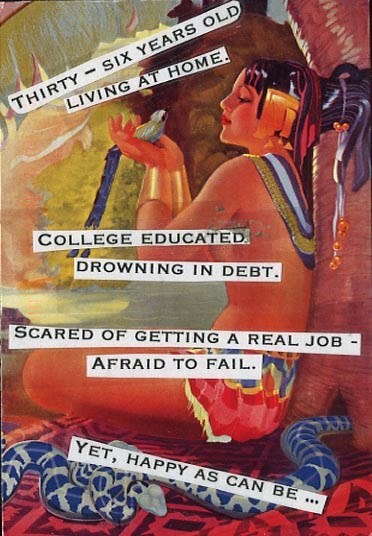
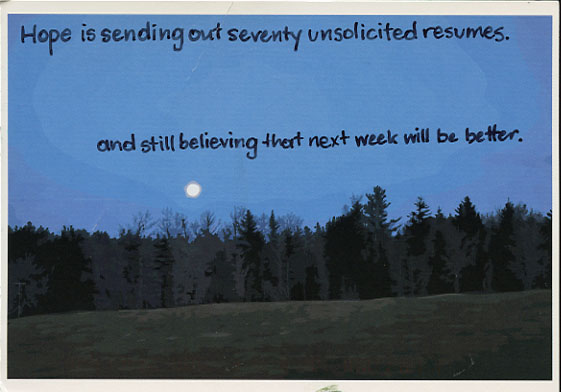
Is that true? Am I, a Millennial, poor because I choose to be poor? Perhaps. I’m not so irresponsible that I won’t own up to my life decisions, which have brought me to this place. But I think there’s this perception in the minds of our parents and grandparents that Millennials are generally like the person who wrote this postsecret above. Drowning in debt, living at home, so afraid to fail that we’ve utterly failed to launch, and yet blissfully oblivious to all of it. Perhaps that’s true for some of us, but not for those who will reinvent the world after our parents are gone.

To be clear, I love my mother and father. I don’t hold any of this against them personally, or anyone else of my parents’ generation (except the politicians who sold our Constitutional birthright, but that’s another rant altogether). Unfortunately, hard truths do not become softer because we choose to ignore them. And hard truth is this:

Hard men make good times.

Good times make soft men.

Soft men make bad times.

Bad times make hard men.

I graduated college in 2010. Through a combination of scholarship money, campus jobs, and (yes) generous parents, I was fortunate enough to graduate without any student debt. At the same time, it was the height of the Great Recession, and jobs were nearly impossible to come by. I can’t tell you how many of my writing friends put their dreams on hold, or abandoned them altogether. Almost all of them.

As a side note, I agree with Mike Rowe that “follow your passion” is bullshit advice. It ranks right up there with “be yourself,” and “you can be anything if you put your mind to it.” Don’t follow your passion. Follow opportunity, and take your passion with you.

But in 2010, I had an opportunity. Without any debt, and without any dependents or other obligations, I decided to pursue a writing career. And unbeknownst to me at the time, the industry was undergoing a revolution that would open the doors to make that possible.

I indie published my first short story, Memoirs of a Snowflake, in March 2011 and never looked back. Since then, I’ve published dozens of novels, novellas, short stories, and other works. It’s been an exhilarating journey. At the same time, it’s been the most difficult struggle of my life. And that is why I must now confront one of my most crippling fears.

Unlike the girl in the postsecret, I am not crippled by the fear of failure. If I were, I would never have published that first story, let alone all the others that followed. Instead, I have a fear of admitting failure, both publicly and to myself. It feels too much like an admission of defeat.

It’s an important distinction to make, though. The Romans admitted failure often and early—it’s how they learned from their defeats, ultimately going on to build one of the most powerful militaries in the ancient world. But they never admitted defeat. Even after Cannae, when Hannibal threatened the republic with utter extinction, the Romans refused to be defeated. And so, while Carthage fell into decline and decadence, the Romans endured until Scipio finally gave them victory at Zama, paving the way for the rise of Western Civilization.

I haven’t had a personal Cannae moment yet, but I do feel like I’ve been fighting a war of attrition. In 2014, the market shifted with the launch of Kindle Unlimited, and I failed to adapt. At that point, I was just on the cusp of going full-time with my writing, though looking back I can see that I didn’t yet have the foundation for a lasting career. Still, to have that dream snatched away when I was just on the verge of catching it, you can understand why I kept plugging along, believing that I was just a month or two from turning things around.

That’s basically what I’ve been doing for the last four years: writing full-time even though the writing doesn’t pay full-time wages. Maybe my mother is right. Maybe I have chosen to be poor.

And yet, while I now believe that I do have the foundation for a lasting career, I need to confront the fact that it may be ten years or more before I achieve it. Should I continue, like so many of my peers, to delay major life decisions until my career reaches that point? Is it worth it to put off marriage, family, and home ownership until my forties or fifties, if that’s what it takes? Or is it time to admit failure so that I can leave this dead end and find another way?

Back in 2010, I had no plan B. It was the Great Recession. I didn’t have a day job because I couldn’t find one—hardly anyone could. And from 2013 to 2014, writing paid well enough that I didn’t need one. Things were looking up, and I was just a couple months away from a sustainable long-term career.

Well, it’s time to admit that that line of thinking has turned out to be a trap. I’m approaching my mid-thirties and I’m still single and poor. I need some kind of long-term backup, because I can’t count on the writing career to take off like I need it to, at least not anytime soon.

So I’ve moved my writing onto a part-time footing. I’m limiting the number of words I write each day, leaving time for other pursuits. And I’m looking for a day job, preferably one that teaches me something useful and pays well enough to make ends meet.

I haven’t been defeated yet, though. Failure is not final until you decide to give up. I have not given up, and will continue to write, even if only on a part-time basis. And when I am making enough to go full-time, I have the foundations in place to do so.

In the meantime, though, I’m not going to put my life on hold for a dream.

Why writing every day may still be the best advice

A week ago, I blogged about how writing every day may not be the best advice. I pointed out how following that advice had helped me when I was first starting out, but it had also hurt me later on. I pointed out how sometimes it’s better to work smarter than harder. After all, why throw out 80% of what you write if by taking a little time to properly outline things, you can write a clean first draft?

Well, I’ve been reading a book called The Compound Effect, and it’s made me rethink some of those ideas. The main point the book makes is that it isn’t the big things that make the most difference, but the small, regular things compounded over time.

Is it still a good idea to work smarter? Yes, definitely. If by taking the time to prewrite a book, you can avoid throwing out 80% of your work, then by all means that’s more important than hitting your 2k / 3k / 10k words for the day, or whatever. But here’s the thing: there’s a smarter way to write every day too, and it has to do with momentum.

If you’ve been in a writing rut, it’s very hard to go from 0 to your daily word count goal in a single day. Over time, that goal becomes a ceiling instead of a floor. It’s all very psychological. Your writing time fills up with procrastination or busywork, to the point where it takes all your energy just to hit that daily goal.

All of that changes if instead you say “I’m going to write 500 / 200 / whatever words more than I did the day before.” Even from a rut, it’s not that difficult to go from 0 to 500 in a single day. And once you’ve hit 500, it’s not difficult to hit 1k. Compounded this way, you can soon break through that ceiling and still have energy to hit everything else.

It’s an interesting approach to daily writing goals, one that I’m trying out right now. But for it to really work, you do have to write every day, otherwise the compounding never happens.

When I first started this blog back in 2007, I used to write a lot about momentum. I was very much a novice writer, but even back then I could feel how much easier it was to write when I was on a streak than when I was starting from zero—and a streak can start with a day of just a few hundred words.

The things to avoid are busywork and useless guilt. If your writing goals have become a ceiling that you just can’t break through, perhaps it’s time to recalibrate. Work smarter AND harder.

And now, for no particular reason at all, here’s a Sabaton music video.

February Update

So much stuff going on behind the scenes here.

First, Sons of the Starfarers is coming along right on schedule. A Queen in Hiding (Book 7) is now up for preorder, and An Empire in Disarray (Book 8) is with my editor. Should be up for preorder in the next few weeks, with a release date of May 18th.

I’ve made a few changes to my publishing schedule for the year. Sons of the Starfarers is still on track for release dates in March, May, and June. I’ve switched up some of the short stories, though, and decided to focus on finishing the Gunslingers trilogy before I work on anything else. Both of those books (Gunslinger to the Galaxy and Gunslinger to Earth) should be out before the end of the year.

I’d rather have one complete trilogy than three partially completed ones, which is where things stand right now. The first book, Gunslinger to the Stars, has done modestly well for a standalone, and it was so much fun to write that I’m sure the sequels will be as well. I could use a fun project to lighten things up a bit.

The goal is still to release a new book (and/or rerelease an old one) every month this year, and I’m very much still on track to do that.

On a slightly different note, I’m considering whether or not to start a Patreon account. The goal is to set up a small supplementary income stream that enables me to publish more books without taking too much time away from the writing. I still have a lot of research to do, but some of the benefits I’m considering include digital ARCs and entry into a character naming lottery.

What do you think? Should I start a Patreon? Let me know what you think by filling out this short survey.

Other than that, it’s mostly just a bunch of little stuff and adjustments here and there. Data crunching, marketing analysis, and a lot of small and incremental improvements that don’t warrant mention (yet).

Late November Update

Is it time for another update? Why yes, I suppose it is.

Sons of the Starfarers is coming along quite well. Book 6, Patriots in Retreat, is up for preorder right now with a release date of January 19th. My editor just got back with the edits for book 7, A Queen in Hiding. Haven’t had a chance to look through those yet, but I will in the near future. Come January, that book will be up for preorder as well, with a release date of March 16th.

Right now, I’m writing book 8, An Empire in Disarray, with a hard deadline of 22 December (just before Christmas). Normally, I’d be panicking right now, but I’m trying out a new outlining method that seems to be working quite well. If everything works out the way I hope, I’ll finish up book 9 sometime in February and move on to other projects.

Looking back, it was a mistake to set out to write a nine-book series before knowing how the first one would do. If I could go back to 2009 and do it all over again, I’d stick to trilogies, where the first book stands well enough alone that I can abandon the other two books if it doesn’t gain much traction. That’s going to be my modus operandi from here on out.

So here are the trilogies I need to finish:

Genesis Earth Trilogy

This one has been outstanding for a long time. The first book did much better than I was expecting, and while its popularity has fallen off in recent years, it still gets very good reviews. For a first novel, I’m honestly surprised that this book has done as well as it has.

The second book, Edenfall, is still on the back burner for now. Partially written, partially outlined, it shouldn’t take more than a couple of months to get it done when I finally sit down to finish it.

As for book three, The Stars of Redemption, I have no idea because I haven’t even outlined it yet. Perhaps that’s what I need to get the ball rolling: outline the last book, so I know what has to happen in the second book. In any case.

Gunslingers Trilogy

Gunslinger to the Stars hasn’t done as well as I would have liked, but I enjoy this universe so much that I’m going to finish the trilogy if for no other reason than the fun of it. I’ve already written the first four or five chapters of Gunslinger to the Galaxy, and it’s coming along swimmingly. In fact, I’ll probably go right back to it after finishing up Sons of the Starfarers and call it a vacation. Expect to see more Jane Carter soon!

The Twelfth Sword Trilogy

I am super super excited to finish this trilogy—which is good, because the way the first book ends, it’s definitely not a standalone. Definitely not. Haven’t formally outlined it yet, but there’s a ton of stuff I’m going to throw into the second book, The Sword Bearer. Mercenaries, sorcerors, death mages, winged cataphracts, desert ruins, and mountain strongholds—it’s going to be great fun!

The Outworlds Trilogy

For a while now, I’ve been playing around with the idea of condensing all of Star Wanderers into a novel and then turning it into a trilogy. The first book will basically be made up of bits and pieces from all of the Star Wanderers novellas, spliced together to make a coherent novel. In particular, I’d like to expand on Noemi’s viewpoint and trim out some (or a lot) of the extraneous stuff that made the series drag on. Basically, turn it into less of a sci-fi romance and more of a classic space opera.

I’ve already started the sequel, Children of the Starry Sea, though I haven’t gotten past the first chapter. Where Star Wanderers is a series of novellas, though, Children of the Starry Sea is definitely a proper novel, and it would probably work a lot better to frame it as a trilogy than anything else.

I suppose it’s a bit like how Orson Scott Card turned a bunch of his early short stories into The Worthing Saga, which in my opinion is his very best book. I won’t unpublish any of the old Star Wanderers stuff, but I may just let it fade into obscurity as I push the other stuff.


These are the books that are on my mind. I’ve got to be honest: Sons of the Starfarers feels a bit like a ball and chain, but I’ve committed to finishing it and I’ll do my best to finish it well.

On the publishing front, there’s so much stuff I want to do that I’m having trouble keeping up with it all. My main goal is to get to 10k subscribers on my email list. Currently, I’m just shy of 4k. InstaFreebie has been hugely useful for that, but I’ve got to try other strategies as well. One of those strategies involves a new signup incentive, so if you’re already signed up for my email list, I’ve got a surprise for you soon.

So much stuff going on. I swear, this is the best depiction of what it’s like to be an indie author:

Late October update

I’m running at about 70% to 80% right now, but should be back up to 100% next week. However, since the blog is usually the last thing I get up to speed after a major life event, it will probably be another week or two before the blog is running like I want it.

Right now, I’m finishing up A Queen in Hiding and getting ready to send that to my editor. I’m still shooting for a November 3rd deadline. After that, I’ll take a week to go over the edits for Patriots in Retreat and put that up for pre-order.

I’m also working on a short story for an anthology with a deadline of November 1st, so that might throw a wrench into things. Fortunately, I’ve got a lot more time to write now, so that shouldn’t be as much of a problem.

Lots and lots of stuff going on behind the scenes. Right now, I’m getting my tasks all lined up so that I can hit them all in quick succession. One of the things I want to do is put out a print version of everything I’ve published electronically. KDP Paperback has advanced to the point where I can finally do that, so be sure to look out for that in the near future. Right now, I’m typesetting Gunslinger to the Stars.

I’m really looking forward to getting all the Sons of the Starfarers books written. Should happen within the next three to four months, if all goes well. There are so many other projects that I’m excited about, but I’ve committed to this series and I’m going to finish it. I don’t know if it will be my best work, but without sacrificing any more time I’ll strive to make it as good as I possibly can.

You may have noticed some changes in my prices. I’ll blog about that in the next few days. Also, I need to catch up on book reviews. I’ve found that I can dramatically increase my writing when I make a conscious effort to read more books, even if my writing time goes down. So that’s another goal.

Point is, things are happening even if it doesn’t seem like it. Ideally, I want to be up at the point where I always have something on preorder, and a short story publication coming out every month or so, most of them reprints, some of them new. So far, I’m at two short story publications this year—better get out and submit to more markets!

Now, back to writing!

Back in Utah

So! It’s been a while since I updated this blog, and there’s actually a good reason for it. I quit my day job in Iowa a couple of weeks ago and just moved back to Provo. In other words, I made the pioneer trek in the wrong direction and repented.

Driving across Wyoming, I got a small sense of what my pioneer ancestors must have felt as they made the trek to Utah. Compared to Iowa and eastern Nebraska, Wyoming is a lonely, windswept wasteland. It’s not quite as empty as Nevada, but wow, is it a forlorn place. Beautiful, but lonely.

After passing through Evanston, route 80 descends from an altitude of about 7,000 feet into the mountain valleys of northern Utah. I have to say, the stretch between Evanston and Park City is gorgeous. Absolutely gorgeous. From there, I came down the eastern side of the Wasatch mountains through Heber and Provo canyon, which is also gorgeous this time of year. Fall foliage, with just a little bit of snow on the highest peaks.

It’s good to be back. I’m renting a room from my friend and cowriter Scott Bascom, who is letting me pay him back in labor to clean and improve his house. He went through a series of major life crises in the last couple of years, and a back injury prevents him from getting the house back in shape. That’s where I come in. It’s a suitable arrangement for both of us and I think it will work out quite well, especially once we get a virtuous cycle going with our writing.

That’s my going to be my focus for the next several months: writing. I have a very aggressively release schedule for the first half of 2018, and a much better business foundation after taking a small business class in Iowa. I also saved up enough money from the old day job that I can afford to focus exclusively on writing and publishing for the next several months. So that’s the plan.

In 2014, I had my first 4-figure month and thought I was doing well enough to go full time in the near future. But looking back, I can see that I didn’t have the foundation set up to sustain a profitable business. The market shifted, the things I was doing to sell suddenly didn’t work anymore, and I made some stupid mistakes that drastically hurt my business. But I learned a lot from all that, and now I’m coming back with a much better foundation, a detailed plan for how to build on it, and enough experience to know how and when to abandon that plan as circumstances change.

Lots of stuff to talk about on that end, but I’ll leave it there for now. One thing you can definitely expect, though, is for the Sons of the Starfarers series to be complete before the end 2018–hopefully before the summer. Also, Gunslinger to the Galaxy should be out next year as well. And if you’re a fan of print books, I hope to put out a paperback of every book that I’ve written in the not so distant future. Audiobooks too, in the long run.

So if you haven’t already, be sure to sign up for my email newsletter, since that’s the best way to stay abreast of my new releases. I’m not always as good at posting about them here as I should be. Also, now that the big move back to Utah is complete, expect to see more on this blog.

So long, and thanks for reading!