Trope Tuesday: Schrödinger’s Gun

The world of a fictional universe isn’t fixed beyond what the author has revealed to the reader.

This is what happens when Schrödinger’s cat gets hold of Chekhov’s gun.  There are a whole lot of interesting and potentially useful plot points lying around, but the writers are pantsing it as they go, playing a game of Xanatos speed chess with the readers (or the gamers, as the case may be).  Consequently, the story doesn’t actually take shape until it’s been told.

As you can imagine, this trope only really works in a story medium where there’s some degree of interaction between the writer and the audience, such as video games and RPGs.  However, there are some classic examples in more fixed media, such as film and books.  The movie Clue is a good example, where the filmmakers made three separate endings, and secretly showed different ones in different theaters (the DVD has all three).  The Choose Your Own Adventure series is also a classic example.

With the changes brought about by digital media, there are all sorts of possibilities opening up right now for this kind of storytelling.  Besides the Choose Your Own Adventure type stories, there’s also the serial format, where a writer releases a chapter at a time.  This is what a lot of web comics eventually become, especially the ones like Girl Genius, Schlock Mercenary, and Freefall with a HUGE extended story arc.  The same kind of thing is happening in ebooks too, on a spectrum between straight-up serials and series of longer works.

As you can imagine, it can be quite a challenge to keep all the storylines straight.  That’s because the one rule with this trope is that you CANNOT retcon.  Until the story is told, anything can happen–but once it does, the Schrödinger wave equation breaks down, and all the possibilities drop to 0 or 1.  The story becomes fixed, and in all future installments, you have to work with it.

Another interesting thing about this type of storytelling is the possibility for ascended fanon, where fan-created stuff like fanfic or fanart actually gets co-opted into the canon of the story.  The flip side is that it encourages the fans to get together and analyze things so thoroughly that any surprising plot twists get predicted long before they actually happen.  Still, I suppose there’s a special kind of squee in finding out that your predictions were right.

The reason I’m interested in this trope is because I’m more or less doing it with my Star Wanderers series.  It’s not strictly a serial, since each novella is a complete self-contained story, but taken together they sketch out a much larger arc that I’m only starting to discover.  Parts I-IV made a complete story arc in itself, all told from Jeremiah’s point of view, but right now I’m revisiting those stories from the viewpoints of some of the other characters.  That, in turn, is seeding all sorts of other stories, with new characters and wider conflicts.

There are challenges, though.  Today I started Part VIII: Deliverance, (from Lucca and Mariya’s viewpoints) and I got stuck on the second paragraph.  The second freaking paragraph.  It starts in the Zarmina system, but what class of star is it?  Have I mentioned it in any of the previous stories?  Thank goodness for word search functionalities, otherwise I’d be ripping my hair out!

So yeah, I’m going to have to be a lot more diligent about making and keeping a world bible.  I’m usually a pantser, so outlines are kind of anathema to my creative process, but having a solid reference for the stuff that I’ve already written is quite helpful.  Currently, I’m using Wikidpad, which seems to be the perfect tool for this sort of thing.

Fortunately, the challenges are a lot more fun than discouraging.  I had a great time writing Dreamweaver, getting into Noemi’s head and revisiting that story from her point of view.  It sounds so cliché, but that story really did write itself.  I kept a window with Outworlder in the background, and whenever I needed to see what would happen next, I’d just go to it and read the next couple of paragraphs.  Benefactor and Reproach have been much the same way.

Eventually, I plan to branch out a lot further, with other interesting characters and situations.  I have no idea what those will be exactly, but that’s kind of the point.  Until you actually pull the trigger, Schrödinger’s gun can exist in any state, from a musket to an AK-47 to a rocket-propelled grenade.  Whatever form it ends up taking, the important thing is to make sure it goes off with a bang.
Trope Tuesday: Lawful Neutral

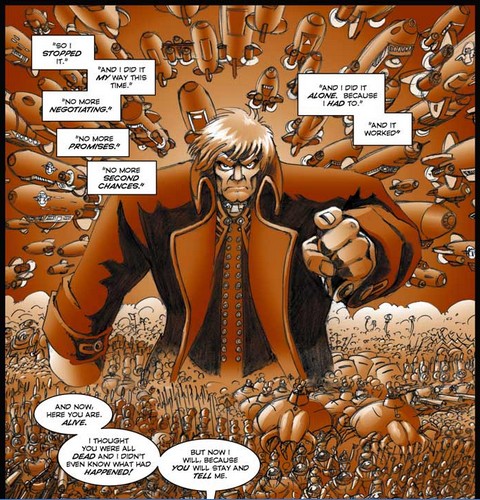
Hey, SOMEONE had to bring order to Europa.

Unlike the Lawful Good, the Lawful Neutral has no qualms about committing heinous acts to maintain order.  Whether for country, for position or for the preservation of the English language, these characters believe in law above all else, giving stern chase or sacrificing their own personal feelings to achieve it.

From the easydamus character alignment page:

A lawful neutral character acts as law, tradition, or a personal code directs her. Order and organization are paramount to her. She may believe in personal order and live by a code or standard, or she may believe in order for all and favor a strong, organized government.

Interestingly, while Lawful Neutrals believe in upholding some form of law, it doesn’t always have to be the law.  Characters who follow a strict personal code of honor often fall under this alignment, even if that code of honor runs contrary to the law of the land.  The most extreme example of this is the Übermensch, who transcends the laws of society and becomes a law unto himself (though in a lot of cases, the Übermensch ends up being Lawful Evil).

While it may seem like most Lawful Neutrals would be antagonists, that’s not always the case.  In Fullmetal Alchemist, General Olivier Armstrong may be stern and austere, but she spends most of the story on the side of the good guys.  And in Girl Genius, Klaus might seem like a bad guy at first, but really, he just wants to restore order and defeat the Other.  Both Death and Lord Vetinari in the Discworld series are also Lawful Neutrals, but they’re never on the bad guys’ side or the good guys’ side…they’re neutral.

In my own work, the best example of this would probably be the Patrician from Heart of the Nebula. I haven’t published this one yet, but I hope to have it out later this year.  Abaqa from Stars of Blood and Glory is another good example, the son of Qasar and Sholpan.  But in the works I’ve already published, Ben from Bringing Stella Home is probably the most prominent Lawful Neutral.

Trope Tuesday: Chaotic Neutral

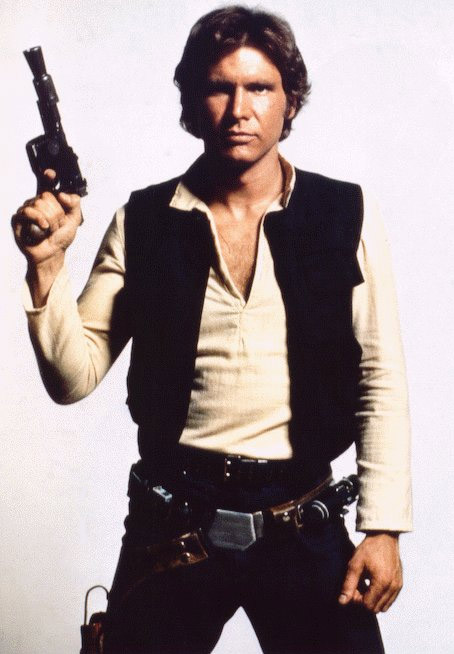
Look, I ain't in this for your revolution, and I'm not in it for you, Princess. I expect to be well paid--I'm in it for the money.

If you’ve ever read a space adventure with smugglers and pirates, or a sword & sorcery with rogue thieves and master-less swordsmen, or a western with gritty outlaws and mountain men, you know this character alignment.  If you’re a fan of any of these genres, chances are you love him, too.

The Chaotic Neutral‘s one consistent rule is to always look out for #1.  Beyond that, he’s a free spirit who believes in individuality and resists anyone or anything that tries to control him.  Rebellious spirits and lovable rogues tend to fall into this alignment, but so do tricksters and wild cards.  Their resistance to any form of personal restriction makes them unreliable allies, despite what Jack Sparrow says.

From the easydamus alignment page:

A chaotic neutral character follows his whims. He is an individualist first and last. He values his own liberty but doesn’t strive to protect others’ freedom. He avoids authority, resents restrictions, and challenges traditions.

A lot of characters start out as this but tend to shift as the story progresses.  Han Solo, for example, shifts from Chaotic Neutral to Chaotic Good as he becomes more and more involved with the Rebellion.  The Jägers from Girl Genius are Chaotic Neutral until they have a Heterodyne to lead them.  But in other stories, such as Pirates of the Caribbean and Schlock Mercenary, the Chaotic Neutral serves as an anchor.

My favorite Chaotic Neutral is probably Waylander from David Gemmell’s Drenai series.  The Jerusalem Man is another good one–in fact, just about every one of his books has a Chaotic Neutral that I love.  Haruhi Suzumiya is an excellent example of a female Chaotic Neutral–in fact, she’s probably the queen of this particular character alignment.

In my own work, the best example of a Chaotic Neutral would probably be Tamu from Bringing Stella Home / Sholpan.  Even though she’s technically a slave, she doesn’t really mind it because she has everything she wants and doesn’t have to be beholden to anybody (not even Qasar, really, since she’s his favorite).  Amina from Desert Stars is also Chaotic Neutral, in contrast with Surayya, who is more of a Lawful Neutral, though sometimes it’s hard to tell.  And in Genesis Earth, Terra is definitely a Chaotic Neutral at the beginning, though she shifts a little somewhere around the middle.

I’m hesitant to admit this, but when I took the character alignment test for myself, I tested out as a Chaotic Neutral.  As to what that means, exactly…I’m not going to say. o.0

Trope Tuesday: Neutral Good

Arguably the best of the good-aligned characters, the Neutral Good can always be counted on to do the right thing, whether that means working within the system or rebelling against it.  Whether young or old, soft or shrewd, nice or not so nice, these are the guys (and girls) most likely to save the world and defeat the enemy with love.

From the easydamus character alignment page:

A neutral good character does the best that a good person can do. He is devoted to helping others. He works with kings and magistrates but does not feel beholden to them.

The Neutral Good is not devoid of weaknesses, of course.  Although they are devoted to good, their lack of commitment to law means that they are not always willing to enforce it.  Also, for those who just want to get things done, this alignment can be somewhat limiting, in the way that a commitment to any higher ideal usually is.

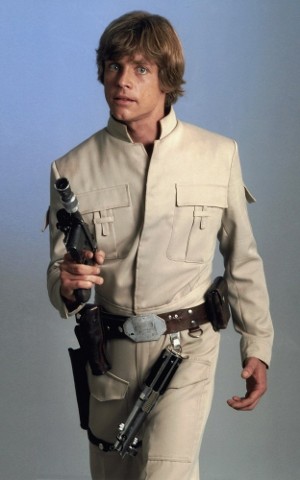
Interestingly, this is a very common alignment for heroes in space opera stories.  Case in point, Luke Skywalker: even though he’s young and reckless, he’s not above learning the ways of the force and joining the Jedi order.  Miles Vorkosigan from Lois McMaster Bujold’s Vorkosigan series also falls squarely into the Neutral Good camp.  Moving on to manga and webcomics, Alphonse and Winry from Fullmetal Alchemist both fall under this alignment, giving balance to Edward’s more chaotic outbursts.  Agatha from Girl Genius is also a Neutral Good…at least, when there aren’t any wrenches nearby.

There are quite a few characters with this alignment in my own work.  Even though she’s a mercenary captain, Danica from Bringing Stella Home falls squarely into this alignment; she’s got a tough outer shell, but she’ll do anything for her men, even…well, I don’t want to ruin Stars of Blood and Glory. 😉 Also from Bringing Stella Home / Sholpan, Stella is solidly Neutral Good, which is part of why the ending is so deliciously twisted.  In Star Wanderers, Jeremiah falls into this alignment mostly through default, which is good for Noemi because the circumstances of the novel put her totally at his mercy.  And in Desert Stars, this is probably Mira’s alignment, though she’s easily manipulated by her Neutral Evil mother.

What can I say?  I’ve got a soft spot for Neutral Goods.  Considering how well this kind of a hero fits in to a classic space adventure, it shouldn’t come as any surprise.

Trope Tuesday: Chaotic Good

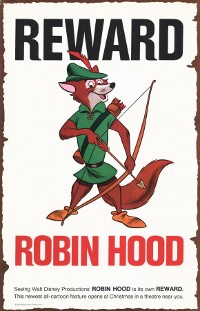
A pox on the phony king of England!

Wherever you find the evil empire, dirty cops, or a misguided crusade, chances are there’s a Chaotic Good somewhere in the shadows fighting against it.  From barbarian heroes to freedom fighters, rebellious princesses to ethical sluts, these free-spirited, noble-minded rebels are constantly at war with the man, robbing the rich to give to the poor.

From the easydamus character alignment page:

A chaotic good character acts as his conscience directs him with little regard for what others expect of him. He makes his own way, but he’s kind and benevolent. He believes in goodness and right but has little use for laws and regulations. He hates it when people try to intimidate others and tell them what to do. He follows his own moral compass, which, although good, may not agree with that of society.

Interestingly, once the evil bad guys are gone, the balance between Good and Chaotic is even more difficult to keep than the line between Good and Lawful.  For that reason, Chaotic Goods often make extremely poor rulers after the war is over.  When they win, they usually do one of the following:

Of all the character alignments, this one is my favorite.  It fits my own sensibilities almost perfectly.  Whenever a character of this type has to give up their old life to accept their new responsibilities, I can’t help but feel a little wistful and sad (maybe that’s why I haven’t settled down and married yet…hmm…).

This trope is extremely prevalent in manga and anime, with Edward Elric from Fullmetal Alchemist my personal favorite.  Agatha and Gil from Girl Genius are also really awesome–it’s going to be interesting to see how Gil shifts now that his father is out of the picture.  In science fiction, Captain Kirk is probably the most beloved character of this type, though almost all of Heinlein’s protagonists also fit the bill.

In my own work, Tiera Al-Najmi from Desert Stars is probably the best example of this trope.  She stands alone against the restrictive norms and hypocrisy of her society, urging Mira to do what’s right instead of what’s expected.  In Bringing Stella Home, James McCoy fits this trope too, though you could also make an argument that he’s more of a Neutral Good.  In Heart of the Nebula, however, he’s definitely Chaotic Good, which puts him squarely at odds with Lars, a Lawful Good who appears in all of the Gaia Nova novels thus far.

Story Notebook #6

Alright, it’s time to go through another story notebook.  This one covers the spring and summer of 2010, right after I graduated.  It was a weird transitional period in my life, when I didn’t really know what I was doing or where I was going, but I was determined to keep on writing anyway.

I filled three pocket notebooks with story ideas in 2010, and last time I mistakenly thought I’d covered one that went from graduation through the end of the year.  While putting my records in order before going abroad, I found that this one actually came a little earlier.

Lots and lots of story ideas…2010 was definitely a good year for that.  So anyhow, here we go:

A planet settled by people with aircars: there will be no asphalt roads, only packed earth.

An interesting consequence of futuristic technology; too often, stories come up with something flashy without really thinking through all of the implications.  Can you imagine a world without asphalt?  If you can, then please take me there!

A task-oriented woman who thinks men are fickle because they’re always trying to come across as macho, trying to save face, etc.

This makes me think of something I heard somewhere about gender roles and politicians.  If I remember it correctly, most men go into politics for the fame, power, and glory, while most women go into politics because something in their community is broken and they feel it’s their duty to fix it.  Not sure if that’s true or not, but this story idea made me think of that for some reason.

Humanity has been domesticated by a super-intelligent alien race and bred into several different breeds with wildly varying physical characteristics.

In other words, a post-human universe where humans have been bred as pets, like dogs.  Can you imagine a world where the physical differences between humans of different races are as great as this:

Can these two even physically reproduce?

A fantasy where the traveling hero is actually the bad guy.

I think Girl Genius already beat me to that, though Othar is more of an annoyance than a genuine villain.

An interstellar Sir Richard Burton.

Now that would be an interesting series.  Sir Richard Burton was a British adventurer who went to the Middle East before doing that was cool.  He made the first English translation of the 1001 Arabian Nights (as well as the Kama Sutra, apparently), and was one of the first European explorer to sneak into Mecca–certainly the first non-Muslim explorer.  I hear he was quite a character.

A planet on a highly eccentric orbit where habitability is sustained by large glowstones that absorb high amounts of energy and emit heat slowly.

Ooh, I’d forgotten about this one.  I’ll have to use it sometime–maybe in a science fiction / fantasy mashup.  You know, with dragons and stuff.

A werewolf who is tame around just one person.

I’m pretty sure this one has been done, and I’m also pretty sure I’m not interested in reading it.  Sorry, Twilight fans–or maybe you’re welcome?

A landscape more vertical than horizontal, where the architecture reflects this (like the old Knight building).

The Knight building was a multi-split-level administration building at BYU where Leading Edge used to meet.  Lots of stairs, entrances on just about every level–it was a weird building (but not quite as weird as the JKB).  But yeah, a vertical landscape would be cool–though I guess that’s pretty common in cyberpunk, with all those cities.

An alien species that communicates only by touch.

“What the–augh!  Get it off of me!” Thus begins humanity’s first interstellar war.

Purgatory for fictional characters, where all the plot hole stories go.

I’m pretty sure that was a South Park episode.

A religious order that believes that developing math skills is the key to self and enlightenment, becuase math is the only science that is completely a priori.

Heh, I’ll bet my Dad would like that story.  It might be the first one of mine that he actually buys.

A man frames himself to go to prison so that he can go to law school / have time to write.

When you’re unemployed and struggling to make ends meet, some otherwise unsavory options begin to look pretty attractive…

What if humanity had a blight like the American Chestnut, where everyone over the age of 20 dies of a horrible disease?

I actually started writing that one.  Finished the first chapter, kind of in a pseudo-Victorian first person style, like Robinson Crusoe.  I have no idea when I’ll finish it, but the universe is really, really fascinating.

A world where novelists / storytellers convey their tales telepathically without translation into words.

And then SOPA gets passed, and all of us creative types are screwed.

What if the mountains were sentient? What would they think of the human race?

“Dang it!  Not another cavity!”

Land of the sleeping rainbows

I think this is actually a real place in southern Utah; I just thought it would make a cool story prompt.

What if the Amish really are 18th century people, guarding a natural time portal in central Pennsylvania?

That would be a fun one to research. “Hello, I’m writing a time travel novel…can I join your village for a year?”

Marital therapy that involves swapping bodies.

I’m pretty sure Disney did something like that in the 60s.  With the way the country has changed, I’m sure it would be much different if someone did it again today.

And that just about does it for this notebook.  As always, feel free to use any of these ideas in your own work.  It isn’t “stealing” if it hasn’t actually been written yet (unless congress passes a revamped version of SOPA that…hmm, that gives me an idea…).

Thanks guys!  See you around!

Trope Tuesday: Big Damn Heroes

You know the drill.  The clock is ticking down to zero, the evil hordes are swarming through the gates, the virgins are about to be sacrificed and the damsel in distress is about to be lost forever–and then the  heroes show up in all their glory to save the day.

This happens all the freaking time, which means that if you want to make a living telling stories, this is not a trope that you should ignore.  And with good reason.  Not only does it give the writer ample opportunity to play with suspense and action, but it arguably lies at the very core of what makes a hero a hero:

David Gemmell, according to this interview with Ian Graham, defined a hero simply as “someone who does heroic things.” They might not always take the right side, or they might not even care about doing what is right, but when the universe conspires to bring them to a moment of decision, they make the choice that all of us would like to think that we would take and do something extraordinary.

I like this definition of a hero.  It strikes me as a lot more honest than the perpetual do-gooder whose only motivation is Truth, Justice and the American Way (though those characters can–and do–have Big Damn Hero moments of their own).  Also, it means that true heroism is not contingent upon actually winning.  History may be written by the victors, but that doesn’t cheapen the experience of those who actually lived it.

Of course, if the heroes don’t save the day, it’s pretty hard to pull off a crowning moment of awesome without bringing in the Bolivian Army.  Either the heroes find out that they’re too late, or they make things worse, or (as is so common with Othar Tryggvasson of Girl Genius) they just prove that their ego is too big for its own good.  When taken to the extreme, the heroes may even be in danger of turning to the dark side.

The biggest danger with this trope is turning it into a Deus Ex Machina.  The thing that makes Big Damn Heroes so incredibly satisfying is the sense of climax when they show up to save the day.  Thus, proper foreshadowing is key.  Yes, the rule of cool still applies, but if that’s all you rely on, you’re not going to be able to pull it off to maximum effect.

One of my favorite examples of this trope is Liam Neeson in Taken.  Plenty of action movies are more violent, but few are more satisfying.  It’s the perfect pick-me-up after a long crappy day at the office–not that I work in an office anymore.  I wonder why…

In any case, this is a great trope to look out for, and definitely one to master, especially if you’re writing any sort of action-adventure story.