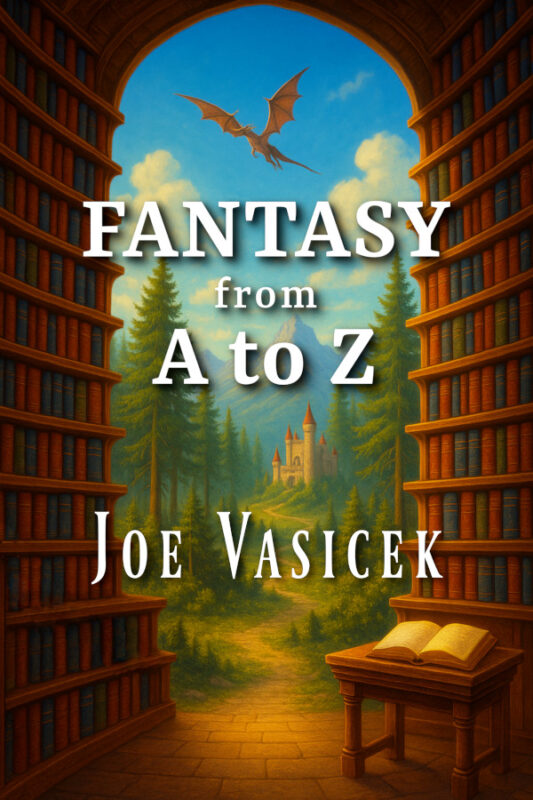
Out Now! Fantasy from A to Z

Fantasy from A to Z

Fantasy from A to Z

From Tolkien to today—why fantasy still matters.

Fantasy isn’t just about dragons, quests, and magic—it’s about wonder, meaning, and the longing for a world that feels more real than our own. In Fantasy from A to Z, author Joe Vasicek takes readers on a journey through twenty-six essays that explore the heart of the fantasy genre: what makes it timeless, what gives it power, and why it continues to speak to us in a world that has forgotten how to dream.

From archetypes and epic battles to kings, magic, and the coming rise of “noblebright,” Vasicek traces fantasy’s roots back to the myths and moral struggles that define us as human beings. Part literary exploration, part personal manifesto, this book is a love letter to the stories that shaped us—and a roadmap for anyone who believes that the world of wonder is still worth fighting for.

Order Now!
About the Book
Fantasy isn’t just about dragons, quests, and magic—it’s about wonder, meaning, and the longing for a world that feels more real than our own. In Fantasy from A to Z, author Joe Vasicek takes readers on a journey through twenty-six essays that explore the heart of the fantasy genre: what makes it timeless, what gives it power, and why it continues to speak to us in a world that has forgotten how to dream. From archetypes and epic battles to kings, magic, and the coming rise of “noblebright,” Vasicek traces fantasy’s roots back to the myths and moral struggles that define us as human beings. Part literary exploration, part personal manifesto, this book is a love letter to the stories that shaped us—and a roadmap for anyone who believes that the world of wonder is still worth fighting for.
Joe Vasicek

Joe Vasicek fell in love with science fiction and fantasy when he read The Neverending Story as a child. He is the author of more than twenty books, including Genesis Earth, Gunslinger to the Stars, The Sword Keeper, and the Sons of the Starfarers series. As a young man, he studied Arabic at Brigham Young University and traveled across the Middle East and the Caucasus Mountains. He lives in Utah with his wife and two apple trees.

Preview
Some of the links in the page above are "affiliate links." This means if you click on the link and purchase the item, I will receive an affiliate commission. You will not receive any additional charge. As an Amazon Associate I earn from qualifying purchases.

Fantasy from A to Z: Z is for Zeitgeist

What is the future of fantasy literature? Where is the genre headed, based on current cultural trends?

For a long time, epic fantasy was basically Tolkien-light. There were exceptions, of course, but most readers wanted something that felt a lot like Lord of the Rings, and the most successful writers were the ones who gave it to them. There was a little bit of innovation, probably culminating in Robert Jordan’s Wheel of Time series, but if you picked up a random epic fantasy off the shelf, you could have a pretty good idea of what you were getting into.

Then, in the 90s and 00s, fantasy started to get dark and gritty, with writers like Joe Abercrombie and George R.R. Martin setting the tone. This new subgenre or flavor of fantasy, called grimdark, really came to dominate during this time, to the point where some were calling Martin an “American Tolkien” (though all that talk more or less died with the terrible finale of the show). Grimdark is still quite dominant, though an increasing number of readers are turning to “cozy” fantasy or slice-of-life in subgenres like litRPG. And of course, romantasy is taking off like crazy, though as we’ve already discussed, most romantasy is basically just porn.

So where are we going from here?

Our culture tends to pass through a cycle of seasonal turnings, where each season is the length of a generation, and the cycle itself is the length of a long human life. Reduced to its simplest form, the cycle follows a pattern like this:

Strong men create good times (first turning).

Good times create weak men (second turning).

Weak men create hard times (third turning).

Hard times create strong men (fourth turning).

We are currently living in a fourth turning, which is the period when all of the major wars and catastrophes tend to happen. In other words, the fourth turning is basically a grimdark world—or rather, when the full consequences of a grimdark world become manifest. But the grimdark subgenre really took off in the third turning, when dark and grim fantasy worlds resonated with the “hard times” that we all were starting to live through. This is also why dystopian YA became so popular in the 90s and 00s.

(As a side note, I have to say that I find it both perplexing and hilarious how so many zoomers think of the 90s as a simple and wholesome time, to the point where they think they experience nostalgia for it. Those of us who lived through the 90s remember it very differently, as an era of school shootings, political scandals, collapsing churches, teenage pregnancies, and ever-escalating culture wars. There’s a reason why Smells Like Teen Spirit was the decade’s anthem. Though in all fairness, I suppose that if someone from the middle ages were to visit our own time, they would find the nostalgic yearning on which the whole fantasy genre is based to be just as perplexing and hilarious.)

I believe we are on the cusp of a major cultural wave that is going to change everything, to the point of making our world almost unrecognizable to those who lived through the 90s and 00s. And just as the grimdark authors like Martin and Abercrombie rose to prominence by riding the wave in their part of the generational cycle, there are a lot of noblebright authors who stand to benefit from riding this next wave, which is only now beginning to break.

After all, there is another way to formulate the generational cycles. It looks something like this:

Complacent men create a spiritually dead culture (first turning).

A spiritually dead culture creates awakened men (second turning).

Awakened men create a spiritually vibrant culture (third turning).

A spiritually vibrant culture creates complacent men (fourth turning).

In the summer of 2024, I think we passed through a critical fork in the current timeline. If the generational cycle had followed its usual course, then our current crisis period would have ended with a period of unification under a new order, based upon the spiritual foundations that were laid during the 60s and 70s. In other words, the woke left would have won, and we’d be living under the sort of regime that would enforce woke values. Dissent would not be tolerated, because dissent is never tolerated in a first-turning world.

The second most likely outcome would have been a complete shattering of the generational cycles. In other words, we would have fallen into some sort of national divorce or hot civil war, with the United States splitting apart and the Western world completing its cultural suicide, which has been ongoing for several decades now. There has never been a time when such a major cultural rift has been accomplished by peaceful means. It is always accompanied by a terrible, bloody war.

But when President Trump survived the assassin’s bullet at the rally in Butler, Pennsylvania, that’s the point where I think our timeline diverged—and it followed the least likely path, which has only ever happened once in the history of modern generational cycles. We skipped from a fourth-turning straight into a second-turning, skipping straight from crisis to revival.

The last time this happened was with the US civil war. Usually, after a culture survives an existential crisis, you get a period of national unity, which often results in a brief golden age (or at least, an age that is remembered as such, often by those who did not live through it). But after the civil war, there was no national unity. Instead, we skipped right to the second turning, which is typically characterized by a major spiritual awakening.

Whatever your opinions of President Trump, the fact that he survived the assassination attempt in Pennsylvania and went on to win the 2024 election in a landslide means that we have (for the moment) avoided the first two scenarios. At this point, it’s difficult to imagine the woke left taking back the culture and leading us into a first-turning world in their own image. And though the US may yet fall into a hot civil war, from where I’m standing in flyover country that no longer seems quite so imminent.

Don’t get me wrong, though. We are not about to enter a period of national unity anytime soon. Certainly not a period of national unity whose foundations were laid by the previous spiritual awakening, which is what the generational cycle requires. At the same time, because President Trump survived the Butler assassination attempt (thank God), I think we avoided a hot civil war.

Because of all this, I think that we are about to experience a major cultural upheaval, the likes of which have never been seen in living memory. We will not get a period of unification. We will not experience a golden age period of material prosperity (though there may be a few years of plenty before the years of famine begin in earnest). But we will experience a cultural and spiritual revival that will burn through our culture until it has utterly demolished the woke worldview and values laid down during the 60s and 70s, and built something entirely new in its place.

What will that look like? And how will it affect the trajectory of fantasy literature?

Culturally, it will be a period of incredible dynamism. We will see an explosion of creative expression in every field, including in literature. Books and movies and games that are cultural mainstays now will be totally forgotten within a couple of decades, and everything that is popular now will feel dated and out of touch in the space of just a few years.

The authors and artists who will do the most to shape this new culture are today almost completely unknown, but they will become household names in surprisingly short order. Others will take decades to become known, but they will write their most important works in just the next few years.

The country will hold together. There will be no civil war, though there may be a global one. And there will almost certainly be an economic collapse, like the Great Depression, except much deeper and much longer. But all of this will only serve to fuel the spiritual revival, and the revival in turn will fuel the cultural dynamism, until the country and ultimately the world have been entirely transformed.

In more practical terms, I think we are going to see a lot of publishing houses fold, and a lot of popular authors fall out of favor. Many of them will keep their core group of fans, but they won’t be nearly as culturally relevant moving forward. New authors will rise from unexpected places to replace them, especially as the old institutions (publishers, conventions, magazines, review sites) collapse.

Romantasy will ultimately be recognized as the pornography that it is, though not until after it’s done great damage to the fantasy genre as a whole. The damage will be healed by a return to the genre’s spiritual roots. Grimdark will fade, and noblebright will rise, though it will ultimately take a different name and be recognized for other characteristics. It all depends on which of the thousand blooming flowers get picked.

LitRPG will mature into a long-term stable subgenre, and capture most of the innovation in the field. It may spin off into multiple long-term stable subgenres. Meanwhile, epic fantasy will return to its roots and grow as the spiritual revival takes hold. But instead of getting Tolkien clones, we’re going to see a lot of original and innovative work.

That’s the zeitgeist as I see it. The next few years are going to be a wild ride. Are you up for it? I hope that I am.

Fantasy from A to Z: Y is for Yearning

What kind of fantasy books do you hope to see more of in the next few years? What direction do you hope the genre goes next?

Personally, I would like to see the genre return to its roots. But that probably isn’t a surprise, if you’ve read the other blog posts in this series. I’ve invoked Robert E. Howard and J.R.R. Tolkien in almost all of them. Those two men are the grandfathers of modern fantasy: Howard from the sword & sorcery side, and Tolkien from the epic fantasy side. Until just the last few years, most fantasy authors stood on the shoulders of those great authors.

I’m not opposed to rules-based magic on principle. I do think that it can be done quite well, such as with Brandon Sanderson’s earlier work. But I would like to see a revival of more traditional fantasy magic systems, which aren’t really “systems” at all, but mysterious forces of nature rooted in folklore and mythology. With its overemphasis on game-like dynamics and quirky rules-based magic systems, much of modern fantasy seems to have lost sight of the ancient archetypes that gave the works of Tolkien and Howard their staying power.

As the modern world drifts further from its roots, forgetting all the stories that were handed down to us from countless generations past, so too has our fantasy lost sight of its roots, thinning out to the point where it’s little more than an aesthetic—a bundle of tropes and caricatures that evoke a nostalgia not of our pre-modern past, but of other popular fantasy stories. Thus, with each new work in this vein, the genre is diluted just a little bit more, becoming a pale shadow of what it once was.

That is why I would like to see fantasy return to its roots. I would like to see more fantasy that draws deeply from the well of history and mythology, not just to create an aesthetic, but to embed those themes and archetypes deeply into the story itself. I don’t care whether that mythology is European or not (though as a pan-European mutt, that is the culture that resonates most with me), but I do want to read books that do more than file the serial numbers off of another culture and wear it like a skin suit. 

It’s not so much that I’m worried about “cultural appropriation”—hell, as the son of medieval vikings, cultural appropriation is my culture—but if that’s what you’re going to do, you should damn right do it well. There’s a reason why we all got sick and tired of all the Tolkien clones. If we’re going to take fantasy back to its roots, we’ve got to do more than copy all the greats who came before us. We’ve got to understand, in a deep and visceral way, just what exactly they were trying to build, and then build upon it with something new.

Fantasy and science fiction are all about evoking that sense of wonder. Science fiction evokes that wonder by looking to the future; fantasy evokes that wonder by looking to the past. Our modern world has forgotten far too much of its cultural heritage. I want to see more fantasy that brings it back.

Fantasy from A to Z: X is for eXpectations

What sort of books are fantasy readers looking for today? What are the expectations that readers have for the genre?

Overall, the fantasy genre is growing. Sales are up, both in traditional and indie publishing, and the big names in the field (like Brandon Sanderson) are doing quite well. It’s clear that the fantasy genre as a whole is robust and healthy.

When you break it down by publishers and subgenres, however, things start to look a little different. Romantasy is dominating the traditional publishing world, but most of it is little more than pornography for women, dressed up with fantasy trappings. And because of how traditional publishing now relies on a few big blockbusters to make most of their earnings, romantasy is sucking all of the oxygen out of the room, making it much more difficult for debut and midlist authors in the other fantasy subgenres.

In the world of indie publishing, litRPG has begun to demonstrate some staying power. It was the new hot thing back in the early 2020s, but it’s attracted enough attention and developed enough of a following that it has become a major subgenre that is likely to endure for some time. I could be wrong about that, but from what I see, that’s where most of the innovative authors and whale readers (ie >1 book per week) are focusing their attention these days.

But because of the way that the algorithms tend to govern the indie publishing cycle (and the way that indie publishing has unfortunately turned into a zero-sum, pay-to-play game with online advertising), the rise of litRPG in the indie publishing world may very well be sucking all of the oxygen out of the room in the same way that romantasy is sucking it out of the traditional publishing world. 

Both subgenres are also very gender-biased, with women gravitating toward romantasy and men gravitating toward litRPG. This reflects the broader social and political trend of men and women going separate ways, across a whole host of different metrics. So as the gender divide continues to widen in society generally, that will probably reinforce the divide between romantasy and litRPG, creating a positive feedback loop (or death spiral, depending on how you look at it).

Sword and sorcery continues to do okay, and has probably been given a boost by the recent release of Conan the Barbarian into the public domain. But most of sword and sorcery got siphoned off into grimdark back in the 00s—in fact, you could say that sword and sorcery reinvented itself as grimdark. And while grimdark has resisted the feminization of literature, standing as one of the few remaining bastions where male readers continue to feel at home, I think grimdark has already passed its peak. In a post-pandemic, post-Trump world, I think most readers are hungry for books that are less nihilistic and more uplifting.

Which brings us to epic fantasy. While Brandon Sanderson continues to dominate this subgenre, with his massive kickstarters and huge book releases, it’s debatable whether his readers are hungry for more epic fantasy, or just for more Brandon Sanderson. He’s kind of a subgenre all to himself. Recent streaming adaptations like Wheel of Time and Rings of Power have failed miserably, and Game of Thrones has fallen almost totally out of cultural significance, with George R.R. Martin’s failure to finish the last book (and Patrick Rothfuss’s failure to finish his own series) becoming something of a meme.

In fact, the failure of these two big-name authors to finish writing their books may have struck epic fantasy a mortal wound. Because of how they have been burned, a large number of epic fantasy readers are now unwilling to commit to a series until after it is complete. But very few authors can afford to write a truly epic series and release the whole thing at once. It takes several years to write a series like that—and what are authors supposed to do if the first one flops? 

In other words, debut epic fantasy authors are damned if they do, and damned if they don’t. If they release the first book by itself, it will probably sink into obscurity before they can write and release the next book. And if by some measure of hard work and tenacity they manage to write a whole series and hold back from publishing until they’re ready to release it all at once, if the first book still fails to sell, they’re SOL and all that hard work was for nothing. 

This is also why traditional publishers are so unwilling to publish a new epic fantasy series from a debut or a midlist author. A bestseller like Larry Correia might be able to dip his feet in that pond (and do quite well—I highly recommend his Sons of the Black Sword series), they won’t do that for anyone else. Which is fine, except that indie publishing epic fantasy is just as hard—arguably more so.

For these reasons, I don’t think it’s an exaggeration to say that Patrick Rothfuss and George R.R. Martin have done more to kill epic fantasy than they have to grow it.

But this may actually have created an opportunity for those authors who are willing to drive into the smoke. After all, there’s much less competition if you can manage to break in and build a decent following. But how much hunger is there for epic fantasy, compared to other fantasy subgenres? And how can a newer/midlist author reach them, without a big push from a publisher or the algorithms?

Fantasy from A to Z: W is for Worldbuilding

What is the biggest thing that sets fantasy apart from all other genres? Without a doubt, it has to be worldbuilding. In every other genre (even science fiction, to some extent), the writer can get away with a loose or surface-level understanding of the world. But in order to do fantasy right, you have to build the world from the ground up, and include such an immersive and visceral level of detail that the reader feels like it’s a real world that they can lose themselves in. That is the feeling that readers want when they pick up a fantasy book.

At the same time, I think that most writers put too much emphasis on worldbuilding. It’s become trendy in writerly circles to talk about worldbuilding, almost as if it’s something you do for its own sake. In the best books, though—even in the best fantasy books—the worldbuilding is always in service to the story, and not the other way around.

For many of us writers, the act of dreaming up a world is the thing that immerses us the most in it. Daydreaming about our fantasy worlds and working out all of the details about it—that’s often the fun part, and the thing that got us into writing fantasy in the first place. But it doesn’t translate very well to the page. The things that seemed so cool to us when we were dreaming them up often come across as dry and boring when we write them out in a huge info dump.

In order for a reader to feel immersed in the world, they need to have a character that they can follow through it. The character’s experience of the world becomes the reader’s experience. But the character needs to be in motion—they need to have some sort of goal or objective that they’re working toward, even if they don’t consciously realize it yet. And it needs to be a struggle for them, at least on some level. Even in cozy fantasy, where the stakes are typically pretty low, the characters still have to put some effort into getting the things they want.

That’s because characters show us who they really are through the trials and struggles that they face. Just like in real life, hard times make us see what people are made of. Without that, readers have a difficult time connecting with the characters through whose eyes we want to show them our fantasy worlds. It’s through a character’s struggle that we find that we can relate to them.

Another thing I’ve noticed, particularly in some recent big-name traditionally published fantasy, is that the viewpoint characters are often just terrible people. If I met them in real life, I often think that I would find them petty, narcissistic, and repulsive. At best, they are amoral, and at worst, they are little better than the villains who oppose them—and yet, from the way they’re written, it’s clear that we’re supposed to latch onto them simply because they are the main character.

As a reader, that doesn’t work for me. If I’m going to connect with a character deeply enough to get that immersive fantasy experience, I want them to either be the kind of person I can admire, or the kind of person I feel like I can hang out with. Preferably both. And if the character is going to do something morally repulsive early on in the book, I need to see them wrestle with the ethics of it first, and perhaps feel some remorse afterward. Otherwise, it’s going to throw me out of the book.

Anything that throws the reader out of the book is also going to kill that immersive experience, rendering all that worldbuilding utterly ineffectual. In some ways, the reader first has to feel immersed in the characters before they can feel immersed in the world.

This is why the characters in the best fantasy books often have more depth and nuance to them than the characters in any other genre. When the book is set in our own familiar world, the characters themselves are often larger than life. The heroes are billionaires or ex-Navy SEALs, the love interests are supermodels or billionaires, and the villains are criminal masterminds or rival billionaires. But in fantasy, the larger-than-life element is the world itself, so the characters (or at least the viewpoint characters) often feel much more like real people, so as to ground us in the story.

I’ve often heard people say that worldbuilding is a bit like an iceberg, in that only 10% or so should be visible. But I think it’s more precise to say that worldbuilding should be grounded in the character (or characters) through whose eyes we get to see it. Of course, those characters are grounded in the conflict or plot of the story, since that’s what shows us who they really are. And the plot itself is grounded in time and space, which brings us back full circle to setting and worldbuilding. So ultimately, it’s all a virtuous cycle.

I don’t think I’ve ever found an author who does character better than Ursula K. Le Guin. I haven’t read much of her fantasy, but I did read Powers, and I felt so totally immersed in that world because I felt like I knew the main character even better than I know myself. It was an incredible reading experience, just like the best of her science fiction, which I adore.

Brandon Sanderson also tends to buck the current trend of morally ambiguous main characters who never really earn our sympathy or admiration. In almost all of his books, his protagonists strike me as good people—the kind that I can admire and hang out with. That fact, combined with how his books tend to be much cleaner than most contemporary fantasy, go a long way toward explaining his tremendous success (though of course, Sanderson’s greatest strength is his ability to write killer endings).

Bottom line, the best worldbuilding in fantasy is only as good as the characters through whom we experience it. Worldbuilding should always serve the story, and not the other way around.

Fantasy from A to Z: V is for Villains

Back in the early days of the internet, when it was still a fun and carefree place, there was this thing called the evil overlord list (which is still up, if you want to read it). The list is organized like a top 100 list of resolutions that the smart evil overlord has made, in order to avoid the fate of all the not-so-smart evil overlords who have come before him. It’s got some really hilarious zingers, including the last one:

Finally, to keep my subjects permanently locked in a mindless trance, I will provide each of them with free unlimited Internet access.

Yikes. Explains a lot about the world today, doesn’t it?

But all joking aside, villains are a staple of fantasy literature—including the super campy villains that we love to mock with things like the evil overlord list. And there’s a very good reason for that. Every great hero needs an intractable problem to overcome. And while man vs. nature and man vs. self provide a certain degree of conflict, nothing provides a hero with more opportunities to prove himself than man vs. man.

When I was learning how to write fiction, the popular advice when writing villains was to remember that every character is the hero in their own story. Thus, every villain you write shouldn’t think of himself as the bad guy. Instead, he should think of himself as the good guy, who only does morally questionable things because that’s what needs to be done.

I do still think that there is validity to this advice. I still remember the moment when, as a young boy who was starry-eyed for all things Star Wars, I first saw the opening cinematic for the computer game Tie Fighter. It blew my nine year old mind to think that my beloved Rebel Alliance might actually be a band of terrorists, opposing the forces seeking to restore law and order to the galaxy. Suddenly, the one-dimensional conflict at the heart of my favorite franchise had a whole other dimension to it. I was hooked.

But in the last few years, I think people have become hungry for villains who are truly evil to the core. The transition probably began a while ago, around the time when Breaking Bad was still new. Walter White is an extremely complex and nuanced character, with a rich and well-developed character arc, exactly in line with the old writing advice. And yet, by the end of the show, he is genuinely evil. He gets a bit of a redemption arc in the last episode, but he is not a good guy by any stretch—and he admits it. In fact, the scene where he finally admits as much to his wife is, in many ways, the capstone of his character arc. He has no illusions about the fact that he never was a hero—not even in his own story.

These things tend to be cyclical and generational. From the mid-1960s to about the 2010s, I think most readers preferred villains who were nuanced. Even in Lord of the Rings, which really took off in the 1970s, Sauron is more of a force of nature than an actual human person. Besides, the true villain of Lord of the Rings is the ring itself, and everyone who interacts with it has a slightly different reaction, with some of them passing the test, and others failing (and, in the case of Boromir, redeeming themselves afterward). Besides, Tolkien wrote Lord of the Rings at the tail end of the last cycle, where from the 1910s through the 1950s the villains were unambiguously evil. Robert E. Howard’s Conan stories are a great example—there is no redemption arc for the Stygian priests or the remnant of Xuchotl.

The older I get, the more I have come to appreciate stories with unambiguous heroes and villains. That doesn’t mean that everything has to be black and white—just look at Lord of the Rings for that. But there’s a lot more room for nuance and complexity between two extremes than there is between different shades of grey. Again, Lord of the Rings is a good example of this. You can make a solid case that the true “hero” of that story is Gollum, who succumbed entirely to the ring and had absolutely no desire to save the world at all. And yet, the ring is unambiguously evil, and Gandalf, Aragorn, Elrond, etc. are all unambiguously good.

What would a revised version of the evil overlord list look like? Most of the tropes in the original list are based on recycled old franchises that have mostly faded from cultural relevance now. Would the new list include things like “I won’t waste time fretting about the corruption of my soul” or “I’ll harbor no illusions about being the good guy”? I don’t know, but I suspect that a good number of items will remain relevant for a long time. After all, whether or not the villain sees himself as the hero of the story, a good villain is always very competent at what they do.

Fantasy from A to Z: U is for Unicorns

If you were expecting a post on unicorns or other mythical beasts, I hate to disappoint you again, but that’s not what this is going to be. Instead, I want to write a bit about that most mythical of all human creatures: the full-time fiction writer.

Okay, perhaps we’re not that mythical. After all, Brandon Sanderson estimates that of all his students over the years, perhaps as many as 10% of the ones who set out to become full-time writers actually make that dream into a reality. I sometimes wonder: would Brandon count me as one of those 10%? Should he? The answer to that is… complicated. 

One of the first questions I get whenever I tell people that I’m a writer is “oh, wow—how is that working out for you?” Which is really a roundabout way of asking how much money I make, and whether I’ve been able to turn it into a full-time career. I am not (yet) a major bestselling author, and the closest thing I’ve had to a breakout thus far has been my (now unpublished) Star Wanderers novella series, which managed (mostly by accident) to hit the algorithms correctly back when a permafree first-in-series with lots of direct sequels was the best path to success. Then the publishing landscape changed, the algorithms shifted to favor pay-to-play advertising, and my books got left behind.

I will admit that if it weren’t for my wife’s income, I wouldn’t be able to pursue writing full-time. As a family, we’re following a path very similar to my Scandinavian ancestors, where the wife tends the farm while the husband goes off a-viking. In other words, my wife has the stable, traditional career that provides our family with some degree of security, while I have the more risky career that has the potential to catapult us into transformative levels of wealth and prosperity. We’re doing just fine, but it does sometimes feel like my Viking ship has yet to land ashore.

Because here’s the thing: something like 90% of the money in book publishing (after the booksellers and publishers and other middlemen take their often-exorbitant cuts) goes to less than 1% of the writers who actually make any money (and something like 30% of kindle books never sell a single copy). 

For every Brandon Sanderson, there are thousands—perhaps hundreds of thousands—of published authors who write on nights and weekends while holding down a day job to pay the bills. My writing contributes enough to the family budget to justify pursuing it, but if I were still single, I would need at least a part-time job.

Indie publishing has created a lot of opportunity for authors to make a career out of their writing, and there are many successful indies who are making a decent living at it. At the same time, indie publishing has also massively exploded the number of books that are published, so the proportion of full-time to still-aspiring authors is probably about the same (and may have actually tilted the other way). 

In recent years, it has very much turned into a zero-sum pay-to-play game, especially with advertising. From what I can tell, most authors lose money on advertising, and most of those who are making money are spending upwards of $10,000 each month to make $11,000. The elite few who learn how to successfully game the algorithms to blow up their books often put their writing on the backburner to launch their own companies or provide publishing services, leveraging their expertise to make a lot more than they otherwise would.

The algorithms are changing books in some very strange ways. If J.R.R. Tolkien or Roger Zelazny or Robert E. Howard were writing today, would they be able to make it in today’s publishing environment? 

Howard’s Conan stories would either have to be a lot sexier, or else would have to include the sort of tables and character stats you find in LitRPG. His covers would also be a lot more anime, and show a ridiculous amount of cleavage (which he actually might not have had a problem with, judging from some of the old Weird Tales covers). 

Zelazny’s Chronicles of Amber would all be far too short to make it in Kindle Unlimited—to make it in that game, you have to have super long books that max out on page reads, in order to maximize advertising ROI so that you can outbid your competitors. And if you aren’t winning the pay-to-play advertising game, your KU books will sink like rocks. Also, Zelazny took way too much time between books. Gotta work on that rapid release strategy, Roger.

As for Tolkien… hoo boy, there’s an author who did everything wrong. Decades and decades spent polishing his magnum opus, with a short prequel novel that falls squarely in the children’s category (totally different genre) as the only other fantasy book published in his lifetime. I suppose he could have serialized Lord of the Rings, except nothing really happened in episode 1: A Long-Expected Party. Certainly not anything that would adequately foreshadow all the dark and epic battles to come. Perhaps if he followed a first-in-series permafree strategy, and just gave away Fellowship of the Ring for free… and then made The Hobbit his reader magnet for signing up for his email list… maybe that could have worked? After all, there’s always BookBub…

I jest, of course. Each of these authors’ books became classics, not because of their marketing strategy, but because they hit the cultural zeitgeist in exactly the right way. But is it possible for an author to do that today without also getting a boost from the algorithms? Or do the algorithms have more power to shape our culture than anything else? Those are disturbing questions, and I honestly do not know the answer.

And then there’s the question of AI, which is massively disrupting all of the creative fields. In the interest of full disclosure, I am actually quite sanguine about generative AI, and have already been working to incorporate it into my creative process. I’m not a fan of AI slop, but I don’t feel particularly threatened by it. I decided a long time ago that if AI ever became good enough to write an entertaining book, it still would never be able to write a Joe Vasicek book. That’s insulated me from most of the doom porn out there.

Right now, there is a HUGE fight happening between authors like me who are embracing AI, and authors who treat it all as anathema, and have vowed to never use any sort of AI in any of their books (except Grammarly, of course, because… reasons. And Microsoft Word. And…) Frankly, it reminds me of the big debate between indie and traditionally published authors, back before self-publishing had lost its stigma. The biggest difference is that the level of online outrage has been ramped up to 11, mostly as a result of the social media algorithms (which weren’t as robust or as powerful back in the early 2010s). I suspect that we will ultimately settle on a “hybrid” approach, much like we did with publishing, but the sheer level of vitriol has made me wonder about that. 

On the reader end of things, though, it seems like most readers don’t really care if a book was written with or without AI assistance, so long as it’s actually a good book. Which means that there is a real opportunity for authors who 1) know how to tell great stories, 2) have already found and honed their voice, and 3) know how to strike the right balance between the AI and the human elements. 

Which describes my own position almost perfectly. Over the last fifteen years, I’ve read, written, and published enough books that I have a pretty good handle on what makes a great story. I’ve also honed my voice well enough that I can write in it quite comfortably. And as for the balance between AI and human writing, I’ve been working hard on that since ChatGPT burst onto the scene in 2022. Half a dozen books and about a million words later, I’ve learned quite a lot about how to best strike that balance.

Will AI replace authors entirely, making this particular unicorn extinct? I don’t think so. But AI may radically change our concept of what “books,” or “writers,” or “writing” really are. A long time ago, I realized that even if AI became good enough to write a decent book, it would never be able to write a Joe Vasicek book. Only I can do that. Whether or not that’s worth something is up to the readers to decide.

Fantasy from A to Z: T is for Tolkien

J.R.R. Tolkien is to fantasy literature what George Washington is to the United States of America. In a very real and a very deep sense, he is the father of modern fantasy. His accomplishments are truly remarkable, and though it may have become fashionable in recent years to downplay his contributions to the genre, we all owe him an incalculable debt.

Lots of knowledgeable people have written about how Tolkien has shaped modern fantasy, so I’ll focus instead on my own personal experience with his books. I first read The Hobbit when I was in middle/high school, around the time I made my first novel writing attempt. I’d already read a lot of Margaret Weis and Tracy Hickman, as well as some middle grade dragon fantasy, but mostly I was into science fiction. However, since the book I was writing was fantasy, I figured I should read some of the classics to understand what I was getting into.

I never finished writing that novel. My reach exceeded my grasp at the time, and I gave up in frustration, lamenting how inadequate my writing skills were at the time. But I don’t think it was too much of a problem that I was comparing my own amateur writing with Tolkien’s. Indeed, it was Tolkien that helped me to climb out of that writing funk, which lasted a little longer than a year. After finishing The Hobbit, I moved on to The Lord of the Rings, and was immediately drawn into the story. It took me the better part of a year to finish it, but I was enthralled from the first page to the last, and spent hours studying the maps (the edition I read had some extra-large fold out copies) and imagining what Middle Earth must be like.

My favorite character in The Lord of the Rings was Faramir. In the movies, he briefly gives into the temptation of the ring, but that isn’t true of the books. Indeed, one of the things that defines his character is that when Frodo and Sam fall into his custody, he has every opportunity to seize the ring from them, but has the wisdom and strength of character to let the ringbearer go. As the oldest child in my family, my father drilled it into me that I needed to set a good example for my younger sisters, so I really resonated with Faramir’s strength of character (even though Faramir is technically the younger brother, growing up in the shadow of Boromir and always feeling like he had to measure up—and that is one aspect of his character that the movies showed very well). Also, I really enjoyed the love story between Faramir and Eowyn. The moment at the end, where they’re holding hands as they watch the fall of Mordor when the ring is destroyed, is one that I really love.

But my favorite part of the book by far is the ride of the Rohirrim. Such an epic moment! The forces of Mordor have all descended upon Minas Tirith, the white city, and are poised to utterly destroy it. The first ring of walls has fallen (if I remember correctly, that’s both in the movie and the book), and Denethor has lit his pyre, totally giving up to despair, and the ringwraiths have descended on their monstrous mounts… and then, the horns of Rohan sound, and the cavalry arrives, contrary to all of the work of the adversary to ensure that Rohan would not come. This is one scene from the books that the movies absolutely do justice to. I love that scene so much, reading it and watching it. So epic!

While I was reading The Lord of the Rings for the first time, it was announced that they were going to turn the whole trilogy into a series of movies. The first movie, The Fellowship of the Ring, came out a few months after I finished reading the books, and I absolutely loved it! From the opening moment of the film to the credits at the end, it was clear that Peter Jackson had a deep and abiding love for the original source material, and it shone through really well. Of course, he made some changes, such as giving Arwen a more prominent place in the story and dramatizing the last alliance of men and elves to set up the backstory, but I think all of those changes made the story translate much better into film. And the visual spectacle and sheer attention to detail in the films was absolutely stunning. The original Lord of the Rings movie trilogy is an absolute masterpiece, one that I doubt Hollywood is even capable of replicating today.

While waiting for the second movie to come out, I read The Lord of the Rings again, and found it just as good on a reread as a first read. That’s something that can be really hard to pull off, and a mark of a really good book. Some people have read The Lord of the Rings forty or more times, and while I haven’t read it quite that much, I am currently on my third reading, and will probably read it a fourth time with my daughter when she is old enough to appreciate it—which probably won’t be that long, because she is literally reading everything she can get her hands on, whether it’s on her reading level or not.

In any case, after rereading The Lord of the Rings, I decided to tackle The Silmarillion, which is a lot more dense and difficult than any of the other books. In fact, The Silmarillion reads kind of like Middle Earth’s equivalent of the Bible. But I loved it. In fact, it quickly became my favorite of Tolkien’s books. The depth that it gave to everything else I’d read was truly amazing. I also really loved the mystical elements, and the subtle Christian symbolism and cosmology. 

For the next year or so, I was really into Tolkien. I got a copy of the Tolkien bestiary and pored over it constantly, and also read a bunch of the extra histories and atlases that Tolkien scholars have written. I also read the Lost Tales, though I didn’t think it was as good as The Silmarillion (really, it was just an expanded and slightly more disjointed version of that book). I watched the old animated movie version of Lord of the Rings, and found it to be hilariously bad (though I did appreciate how Peter Jackson cribbed the part where the Ringwraiths attack the sleeping hobbits in Bree). I also followed all of the updates on the movie’s official website (this was before fan wikis were a thing).

I left on my mission before the last movie came out, so I never saw it in theaters. That was a major sacrifice. But I remember when it came out, because the soundtrack circulated all over the mission (as missionaries, there were strict rules on the music we could listen to, but soundtracks fell into a gray area). The last song, “Into the West,” by Annie Lennox, is perhaps the most perfect musical encapsulation of all of Tolkien’s work. Such a great song! It was in my head for months afterward—and indeed, it lived rent-free in my wife’s head for the next two decades. One of the first things I did upon coming home from my mission was watch The Return of the King, extended version, along with the extended versions of all of the other movies.

I never really got into any of the Tolkien-esque fantasy clones, such as Terry Brook’s Shannara series or the other epic fantasy books that were basically cheap knock-offs of Tolkien. There’s a really solid argument to be made that where Tolkien created the modern fantasy genre, his publishers ruined it by pushing all of their writers to follow a rigid formula based on Tolkien’s work. I don’t necessarily agree with that argument, but I think it makes some good points. Thus, for several decades, epic fantasy was either extremely derivative of Tolkien (such as Terry Brooks), or was deliberately trying to subvert Tolkien (such as Donaldson, or G.R.R. Martin, or Brandon Sanderson’s Mistborn Era I). It hasn’t been until the last decade or so that fantasy has begun to climb out of Tolkien’s shadow.

And yet, even though I can appreciate the need to get out from Tolkien’s shadow, I still prefer to read fantasy that stands upon his shoulders. Without a doubt, he is the greatest giant in the field, even several decades after his passing. David Gemmell may be my favorite fantasy writer, but I don’t think I’ve ever become as immersed in a fantasy world as I have when I was at the height of my love for Tolkien. Even his non-Middle Earth books were delightful, such as Farmer Giles of Ham and Sir Gawain and the Green Knight. I haven’t read his translation of Beowulf yet, but I did read the epic Arthurian poem that he started and never finished—and boy, do I wish he’d finished it! I’m a real sucker for some good Saxon-style kennings and alliteration.

So that has been my own personal experience with Tolkien. Without a doubt, he’s been a major influence on my own work—so much, in fact, that his influence is probably invisible to me. It’s almost like the water we swim in, and I think that’s great. There’s plenty of room for originality, of course, but we all stand on the shoulders of giants—and Tolkien’s shoulders are the highest and the broadest shoulders in the genre. His work and his imagination have truly blessed this world.

Fantasy from A to Z: S is for Sanderson

Brandon Sanderson is, without a doubt, the most popular fantasy writer currently living and writing today. He is also one of the classiest and most gracious authors you will ever meet, in any genre. I’ve also got a personal connection to him, from taking his writing class at BYU.

Brandon decided to become a writer when he was very young. The way he explains it, the bug really bit him when he read Dragonsbane by Barbara Hambly. Depression runs in his family, and growing up, he always felt emotionally monotone and distant—until he read that book. From then on, he became obsessed with fantasy, both with reading and with writing it.

The way I heard Brandon explain it, that emotional monotone has been both a personal struggle and a great asset. It’s part of the reason he’s able to write so much, since where other writers tend to have huge emotional swings that affect their ability to write, Brandon is able to just sit down and do the work, day after day after day. It’s also part of what gives him an even keel that makes him such a gracious and generous person. Where other writers tend to get worked up on social media or join outrage mobs, Brandon avoids all of that. I don’t think I’ve ever seen or heard of him becoming outraged about anything.

Brandon was one of the last major authors to break into book publishing before the indie revolution began turning everything upside down. He broke in by researching agents and editors, attending all the important conferences, and networking with everyone who’s anyone in the genre. He also wrote a lot of really good books—as well as a lot of crappy ones. I believe that Elantris, his debut novel, was actually the sixth novel he wrote, and Mistborn: The Final Empire was something like the 13th. He landed his agent, Joshua Bilmes, from attending World Fantasy, and his agent eventually got him his publisher, Moshe, at Tor.

Elantris and Mistborn were good, but not immediate bestsellers. In fact, Brandon was on track to be an average mid-list fantasy author with a relatively unremarkable career, until Robert Jordan died, leaving the Wheel of Time unfinished. By that point, a lot of readers felt frustrated with the series and used his death as an opportunity to write scathing screeds about how it had gone off of the rails and grown far too bloated and large. But Brandon was much more classy and gracious than that, and wrote a tribute to the man instead, praising his work and the impact it had had on his life. When Robert Jordan’s widow read Brandon’s post, she decided that he was the one who should finish the Wheel of Time.

Personally, I’m not a huge Wheel of Time fan. I read the first three books and enjoyed them, but I got lost midway through the fourth book. My wife read them all and feels like the series is overrated, and I generally trust her judgment. But I can appreciate how a lot of people really love the series—and really, there is a lot to love. Just because it isn’t to my personal taste doesn’t mean that it isn’t good. 

My friends who are Wheel of Time fans tell me that Brandon not only finished the series—he rescued it. Apparently, the last three books rejuvenated the series, wrapping things up in an incredibly satisfying way. Of course, Brandon would defer and say that it wasn’t his genius that turned the series around, but Robert Jordan’s original vision and the detailed notes and outlines that Brandon followed. But there’s no denying that Brandon really stuck the landing.

It was around this point in the story that I met Brandon. I was a student at BYU at the time, and I had an opportunity to take his writing class. From the time when I was eight, I had wanted to be a writer, but I didn’t think I would ever turn it into a career. Brandon’s writing class changed all that, and helped me to see that I could pursue writing as a career. He also taught me the nuts and bolts of writing fiction, vastly improving my writing skills. I had started several novels in high school, but never finished anything until I took his class. And while my first finished novel was a disaster that I promptly locked in the trunk, my second novel attempt (which I started writing in Brandon’s class) ultimately became my debut, Genesis Earth.

(As a side note, my wife was also in that ‘08 class with Brandon Sanderson, though we didn’t actually meet each other until almost a decade later when we matched on Mutual. She also started a writing group with her college roommate, who won the Writers of the Future and married into Brandon Sanderson’s writing group. Our writing group has also got one of Brandon’s college roommates.)

Brandon’s success with Wheel of Time was what catapulted Brandon from a midlist author to a bestselling phenomenon. But even then, if he wrote at the same slow pace as most other fantasy authors, he would have forever been known as “the guy who finished Wheel of Time.” Instead, he became famous for writing and publishing massive +300k word doorstopper tomes at an unprecedented rate, leading fans to joke about his writing super powers. Then the pandemic happened, and he wrote four “secret” novels with all of the extra time he had from not traveling anywhere. The fans went crazy, and his kickstarter blew everything out of the water.

I haven’t read all of Brandon’s books. I really loved the Mistborn era I books, and the first Stormlight Archive book was good, but my favorite is Emperor’s Soul, because I think that Brandon is at his best when he writes shorter novels rather than the massive +300k word doorstopper tomes. In my experience, Brandon is a 3-star author who writes 5-star endings. His writing tends to meander, especially in the early middle, but around the 3/4ths mark there’s usually a twist that brings things together, and the conflict escalates consistently until it builds into a really satisfying ending.

Brandon is also known for his hard magic systems, which have become a signature trait of his books. Some readers feel that clearly explaining the rules of magic defeats the sense of wonder that a fantasy novel should have, but that’s not been my experience with his books. When I read a Brandon Sanderson novel, I feel almost like I’m reading a video game. Knowing the ins and outs of the magic helps me to see the possibilities for the characters to use it, and Brandon is usually really good at adding an unexpected twist, exploiting the rules of magic in a surprising yet inevitable way. This creates its own sense of wonder that really adds to his books.

Brandon also is known for how all of his books are tied together into the same transdimensional “cosmere” multiverse, though I actually think this is the least remarkable thing that makes his books so distinctive. For one thing, he’s not the first one to do it—David Gemmell also discretely linked all of his books, which blew my mind when I discovered that particular easter egg. For another thing, Brandon has turned his cosmere from a delightfully hidden easter egg and nod to the fans to the grand key that you must possess in order to understand and appreciate his later books. As a result, the cosmere is becoming an obstacle to new readers, even as his most ardent fans all swoon over the cosmere connections.

I think Brandon’s ultimate goal is to turn his books into a massive cinematic universe, kind of like the MCU. From what I understand, he was really close to signing a Hollywood deal, but it fell through at the last minute, leaving him back at square one (I don’t know all the details, though Jon Del Arroz did some interesting reporting on that). This is also probably why his books have become more woke in recent years. 

I’ve already written at length about that subject, so I won’t belabor the point here. But I really do feel that this represents a betrayal of his more conservative fans, many of whom turned to Brandon precisely because his books tend to be free of all of the gratuitous language and sexual content of most modern fantasy. Also, one of Brandon’s really great strengths during the gamergate and puppygate fannish controversies of the 2010s was his strict neutrality. While the culture wars were raging all around them, he continued to be his classy and gracious self, refraining from picking sides or wading into the mudfest. With the LGBTQ romantic subplot in Wind and Truth, that appears to have changed.

I hope he turns away from all of that. What the world really needs right now are books that transcend the whole woke vs. anti-woke divide, bringing us together and healing the artificial (and in many cases subversive) divisions that pit us against each other. Maybe Brandon will surprise me, and accomplish exactly that, just from the left side of the aisle. But as of Wind and Truth, I can’t help but wonder if we’ve reached peak Sanderson. Only time will tell.

Regardless, I will always be grateful to Brandon Sanderson for the things he taught me, and for all of his graciousness and generosity that he showed in his writing class. Without that experience, I probably would have pursued a different career, and not written nearly so many books. I also probably would not have married my wife, since one of the big things that drew her to me was my love and dedication to my writing craft. 

Fantasy from A to Z: R is for Races

What is your favorite fantasy race?

Races are to fantasy what aliens are to science fiction. This is especially true of traditional epic fantasy, which often features elves, dwarves, and other mythical beings living alongside humans. Every author has a slightly different take on each fantasy race, and many authors get creative and invent their own, but there are some common tropes and archetypes.

Almost all fantasy books include humans in some capacity, usually portrayed as somewhat more medieval than we currently are (to capture that yearning sense of nostalgia for a lost world or time that is a defining characteristic of the fantasy genre). They are almost always the default, meaning that if there are no other fantasy races, then the characters will all be humans.

Elves are typically forest people who live closer to nature than the humans, and as such they are usually more mystical and more magical. They are often immortal, and stand out visually by their pointy ears. There are, of course, many other takes on fantasy elves, ranging from Santa Claus’s primary labor force to the nasty little gremlins who like to steal babies, but most elves in modern fantasy are derivative of Tolkien’s elves, who are immortal, ethereal beings of glory more akin to angels than to humans.

My favorite take on the elves is probably from Tolkien himself. Perhaps I need to read a little more, but I haven’t yet encountered any other take on elves that seemed to do it better. Though I did appreciate Larry Correia’s trailer park elves from his Monster Hunter International series. That was hilarious.

Dwarves are much more industrious and mechanical than elves, and tend to live deep underground, where they mine for ore and treasure. They are short but stubborn and ferocious warriors, who tend to drink a lot and grow long beards (even the lady dwarves, in some accounts). Their preferred weapon is usually an axe. 

My personal favorite take on dwarves is the game Dwarf Fortress, which has so many ways in which your adorable little dwarf colony can die, including the “catpocalypse” where the cats adopt your dwarves as pets, then start to breed faster than your CPU’s cycles can keep up with them, so to keep your game from crashing you have to cull a few of them, resulting in their pet dwarves losing their minds and going berserk, causing other dwarves to lose their minds and go berserk, and the next thing you know everyone in your adorable little fortress is dead. Dwarf fortress is… a quirky game.

Most traditional fantasy books will also feature a race like the orcs, who are inherently and irredeemably evil. I’ve dedicated a whole other blog post to orcs, so I won’t recount it here, except to point out that in some iterations, they aren’t inherently evil so much as inherently savage. Basically, the orcs are the barbarians of the fantasy world, providing your aspiring Dark Lord with plenty of mooks and cannon fodder. Occasionally, you’ll get a story from the point of view of an orc, or more commonly a half-orc. Expect lots of graphic violence from these stories.

Hobbits or halflings are another common fantasy race, especially for fantasy that is derivative of Tolkien. As far as I can tell, this is a race that Tolkien made up on his own, and his books were so influential that the hobbits soon became a standard fantasy archetype in themselves. The original hobbits were basically little furry-footed British people who prefer to stay at home and eat lots of food rather than go on adventures. Perhaps this is why they became so archetypal: they’re the perfect kind of hero to refuse the call of adventure, a key step on the hero’s journey.

Those are the standard races. You’ve also got things like vampires and werewolves, the fey, and various other monsters like trolls, ogres, and dragons (though many of these are portrayed as beasts and not as people, even when they can talk). There are also various hybrids, such as half-elves and half-orcs, usually interbred with humans. Shapeshifters are also quite common, and can make for some very interesting story.

Why so many races? For many of the same reasons why science fiction has aliens. It gives us a chance to look at strange and foreign cultures without carrying any of the baggage that can come from using a real-world foreign culture. As with most aliens, most fantasy races aren’t truly any more foreign to us western readers than the Japanese. But it can go deeper than this, giving us a chance to play around with things like immortality or magic so that we can ask ourselves “how would we be different if we had that characteristic?” Because ultimately, no matter the race (with the possible exception of orcs), all of the characters who belong to these races are still people.