So it’s been more than a week since my last post. Don’t worry, I’m still around: it’s just that this blog is always the first ball to drop when I need to get things going. The post-holiday season was actually harder on us in a lot of ways than the holiday season itself, with insomnia, stomach bugs, and the like, but we’re getting back on our feet and doing pretty well.
The main thing I’ve been focusing on is writing, and I’m happy to say that I’ve been making very good progress these last few days. I’m trying out a completely new process, which I’ve blogged about a little, but I’ll have to write a full blog post on it once I’ve got all the kinks worked out. It basically involves hacking my ADHD to write more, in much the same way I hacked my ADHD to read more.
So yeah, things have been kind of crazy around here, and definitely more off-balanced than I would like. But it’s also turning out to be more productive, too—at least when our toddler isn’t throwing up and I’m able to sleep through the night. Happy new year!
It’s been a while since I posted to this blog. I had planned to keep a regular twice-a-week posting schedule, then went a little more than that for about a month before falling out of the routine.
We just got back home from a family road trip, where we drove out to Omaha and back again, making the Mormon pioneer trek in both directions. It was our first time going on a road trip with the baby, and we had a really fantastic time! Saw Chimney Rock, Independence Rock, Martin’s Cove, Sixth Crossing, Fort Bridger…and then we decided to go straight home, instead of finishing the trek with a tour of Salt Lake City. But that’s only a quick day trip for us, so we’ll probably do that soon.
It was a really awesome road trip, and definitely a good thing to get away and actually vacate for a while. But now that we’re back, I need to pick up some of the balls I’ve dropped and get back into the saddle. Writing is a high priority: I haven’t written hardly anything in the past week. Another big priority is publishing. I was supposed to put out a new short story single last weekend, but decided to put it off until we got back home. So that’s something I’m going to do right away.
I also want to get back into blogging. While on vacation, I DNFed a dozen books, most of them recent Hugo, Nebula, Dragon, and Goodreads Choice nominees. I have a lot of thoughts. Also, the 2022 Dragon Award nominees are out, and I’ve got to be honest, it looks kind of schizophrenic—which is exactly what you would expect to see with rival political tribes battling for control of fandom. But that’s been the case for the Dragons ever since the award’s inception. Again, I have thoughts.
Point is, I’ve got a lot of work to catch up on, but I hope to get back into a good blogging routine before the end of the month. That’s the plan, and it’s not a lack of content that’s the problem: more just a question of routine. Expect to see more here soon.
I never know which posts of mine China Mike Glyer is going to pick up for his pixel scroll, or whatever he calls the daily bucket of chum that he feeds the folks over at File 770 (the ones who aren’t Chinese bots, anyway). I’ve written at much greater length about my 2022 reading resolution here, and my insights and impressions gained through the experience here and here, but for some reason the post he decided to pick up was the last one. Perhaps he thought that it would be better at ginning up outrage than the other posts? But if that were the case, surely he would have picked up the one before that instead. It was practically written for ginning up outrage among the File 770 crowd (or at least the ones who aren’t Chinese bots).
So when I got the pingback last night, I glanced over the post over at File 770 and saw this comment from Cora Buhlert:
I have to admit that whether or not writers have children is not a characteristic I pay the slightest bit of attention to. Never mind that it is difficult to tell, because even today, not every writer chooses to talk about their family or private life.
But I guess that Joe Vasicek is the sort of person for whom people without children, particularly women without children, are by definition evil.
Cora is an indie writer from Germany that I used to interact with a lot on the KBoards Writer’s Cafe, and some other indie author hangouts. She’s earned the ire of Larry Correia a couple of times, and she has a bad tendency to straw man any opinions or perspectives that challenge her worldview. On one thread, we went back and forth over whether Hitler was a creation of the political right or the political left. I tried to explain that “left” and “right” mean different things in the US than they do in Europe, but it was like trying to have a discussion with a brick wall.
So it doesn’t surprise me in the least that she’s completely mischaracterized me in the comment above. I do not believe that childless women are evil—if I did, I would not have served in the bishopric of a mid-singles ward (a mid-singles ward is a Latter-day Saints congregation of unmarried and divorced people in their 30s and 40s. I was the ward clerk—basically, the guy who handled all the finances and other paperwork for the congregation). My faith teaches me that people are not evil, but are all children of God, no matter who they are born to or what their life choices may be.
In fact, my interest in the parental status of the Hugo and Nebula winning authors has nothing to do with religion or morality, and everything to do with life experience. I didn’t get married until almost a decade after I had started to write professionally, and the experience of becoming a father was so completely lifechanging that it’s transformed my writing as well: what I choose (and don’t choose) to write about, who I choose (and don’t choose) to write for, as well as the themes and ideas that I explore in my books.
You can see this transformation if you read my Genesis Earth Trilogy. Genesis Earth was my first novel, but it wasn’t until almost nine years later—after I’d met my wife and was engaged to be married—that I felt I had the life experience necessary to write the sequel, Edenfall. And the final book, The Stars of Redemption, was not the sort of thing I was capable of writing until after I had become a father and knew what it was like to help bring a child into the world.
When my daughter was born, the very first thought that came into my mind was “this is her story now, not yours.” We all like to say that we’re the hero of our own story, and in a very basic way, that’s true. But when you become a parent (assuming that you’re a responsible parent, and not a scumbag), you’re no longer living just for yourself, but for your children. “He who findeth his life shall lose it: and he that loseth his life for my sake shall find it.”
Having a child changes your perspective on everything. Among other things, you have a much deeper and more personal investment in the future, since you know that your child will inherit that world. Your perspective on your own family history changes too, as you have become a link in the generations, not merely a byproduct of it. Life becomes a lot harder, but it also becomes more meaningful. Things that took up a great deal of your time and attention when you were single suddenly become trivial, and other things that didn’t make much sense to you about people before suddenly click into place.
So that was why, when I decided to read all of the Hugo and Nebula winning novels, I was curious about the parental status of the authors. I wanted to know if the experience of being a parent had affected the quality of their writing, since I know it’s affected mine. And honestly, it’s not that hard to look up: almost all of these authors have Wikipedia pages with a section about their personal lives. Obviously, the details about their children are sparse, but the only thing I cared about was whether or not they had any.
(As a side note, there were other stats that I decided to track, such as the age of the author when they won the award. That hasn’t seemed to have impacted my taste, except that I have not enjoyed a single award-winning novel by an author who was in their 20s at the time that they won. The only exception was Isaac Asimov with the retro-Hugo for The Mule (Foundation and Empire), but that wasn’t awarded until after he was dead. There are also three authors whose age I was unable to determine from a quick internet search: Michael Swanwick, Sarah Pinsker, and Charlie Jane Anders.)
(As another side note, I’ll be the first to admit that I may have made some errors in my research. For example, if a five-minute internet search on an author didn’t tell me anything about their kids, I assumed they didn’t have any. It’s entirely possible that they just prefer to keep that information private. Also, I didn’t bother to look up when they had their children, so it’s possible that they were still childless at the time they won the award.)
Why should I be interested in this sort of thing? Why look at things like an author’s age, gender, or parental status?
Two reasons. The first is that I wanted to do a deep dive on the Hugos and the Nebulas, the two awards which represent themselves as representing the very best of the science fiction genre. Since that is the genre that I write, I want to understand not just the kind of books that win these awards, but the kind of authors who win them. The goal is to have a deeper understanding of the genre, and to look for trends and movements within it.
Second, and more importantly, I want to have a better understanding of my own reading tastes. All of this is subjective, of course, since the act of reading is always a collaboration between the reader and the writer. I’m sure that some of the books I think are terrible are considered by others to be the best in the world, and vice versa. My goal is to look for patterns that will tell me whether I’m likely to enjoy a book (or an author), so that I can find the best books more efficiently. I don’t do this for all of the books that I read, but since the Hugo and Nebula winning books are supposed to be the very best, I figured it was worth it to do a deeper analysis—especially since my goal is to read all of them.
The thing that surprises me is that it isn’t parental status that matters, but gender + parental status. I can think of a couple of reasons why this would be the case. The most obvious is that it’s easier for me to empathize with a childless man, since that was me for such a long time. And I do think that’s a major part of it.
But I also think that there’s something specifically about being a mother—or deliberately choosing not to be one—that’s also a factor. And yes, I’m talking about biological essentialism. I mean, I’m not a biologist, but I know that I will never be able to be a mother—that’s a life experience that I will never be able to have. Conversely, I will never be able to deny my potential motherhood, an equally major life decision. Both of those experiences are bound to have a major impact on an author’s writing, either way.
I also think this factor is what lies at the heart of Roe v. Wade, the worst decided Supreme Court case since Dred Scott v. Sanford. Certainly the cultural impact of that decision has profoundly influenced how our society views children and motherhood. It’s also why I am sooo looking forward to Matt Walsh’s documentary What Is a Woman? coming out in two weeks:
With all of this in mind, I find it fascinating that every Hugo Award for best novel after 2015 (the year that the Sad Puppies had their high water mark) was won, as far as I can tell, by a childless woman. It would be interesting to see if that trend extends to nominees, or to the other categories like best short story, best novelette, and best novella. Maybe I’ll look that up sometime.
And now that I’ve referenced Roe v. Wade, I’m sure that Cora Buhlert (if she’s reading this) is saying to herself: “yup, he just thinks that all childless women are evil.” And to the extent that File 770 is read by humans and not bots, they’re no doubt picking and choosing those parts of this post that confirm their prejudices (if China Mike Glyer even has the balls to cross link to a post that includes that trailer—do it, China Mike! I dare you!)
But I don’t really care either way, because now I have a much better understanding of my own personal reading tastes, and how they contrast with the Hugo/Nebula crowd. For me, the best books are those that are written by authors who have had the life experience of being a mother, and the worst books are by those who have chosen to deny themselves that path. Apparently, the Hugo/Nebula crowd takes the opposite view. Good to know.
Sorry for the radio silence these past few weeks. My grandmother passed away a couple of weeks ago, and we’ve been down in Texas, dealing with family stuff and the funeral. I wrote the following author’s note for my newsletter, and it seemed like something worth sharing on the blog, so I’m posting it here too. Hopefully I’ll be back to posting on a regular schedule next week.
In my last newsletter, I mentioned that my last surviving grandmother had recently passed away. We all went down to Texas for the funeral last week, and it went surprisingly well.
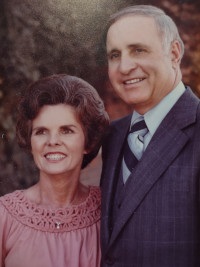
My grandmother lived a very long life, and her passing wasn’t unexpected. She had a stroke about fifteen years ago, and had also been struggling with dimentia. The last time I had a conversation with her where she remembered who I was was probably a decade ago. Thankfully, she was very well taken care of by my uncle’s family in Texas and a team of nurses who helped take care of her. She lived in the old family home right until she went into hospice about two weeks before her passing. The picture above is of her and grandpa, probably from sometime in the late 70s.
My grandmother grew up dirt poor in southern Illinois during the Great Depression. My grandfather grew up in a Texas Czech community, played football for the Los Angeles Rams and the Buffalo Bills (one of my cousins actually tracked down his rookie card, which goes for something like $600 now), and later went into the oil business. One thing I learned during this trip was that grandma was actually the one who gave him the idea of starting his own company when the firm he was working at went under. From what I understand, it was a difficult time to be in the oil business, but they slogged through the hard times and eventually did quite well.
From what I’ve heard, back in those days most networking was done at formal dinner parties that people threw in their own homes. Grandma’s house was apparently one of the premier places to have a dinner party, with a huge living room, a grand piano, wool carpeting, insane amounts of Waterford crystal, and a light with a dimmer back in the 60s when nobody had dimmers for their lights. She also had her own hobby business painting knick knacks, and had a whole bedroom full of them, as well as an insane collection of nativity sets, little glass angels, snow homes, and beanie babies.
So when we weren’t at the wake or the funeral or the interment, we were all basically going through the 60+ years of stuff that grandma acquired over the course of her lifetime, trying to figure out what to do with it all. It wasn’t difficult to imagine her smiling down on us as we went through it all, finding all sorts of unexpected treasures and divying them out.
There was more than enough for everyone to take what they wanted, including the nurses who cared for her the last fifteen years: even after we’d all gone through the crystal glassware and put our names on what we wanted, only about half of it had been claimed. So there wasn’t much fighting over stuff at all; it was all very much “you should take this,” “no, you should take it.”
One of the more interesting things was to go through all of the old letters that we’d sent her. She held on to all of them right up until her stroke. I found a bunch of letters that I’d written her while on my mission (and since forgotten about), and my sister found all of the ones that she’d written while in treatment for her eating disorder. It was good to know that she treasured those.
I also found my dad’s old mechanical typewriter, from back in the 70s! It needs a new ribbon, but otherwise seems to work quite well. At some point, I’d like to try my hand at writing the way Harlan Ellison used to write: sitting in a shop window with his mechanical typewriter, tapping out stories and pasting them onto the glass for passersby to read, one page at a time.
It was also fun to go through all of her spare change, which she’d accumulated over the years. Most of the coins weren’t all that old or interesting, but my wife found a 1905 Indian Head cent, and I found about $4 in junk silver, plus some old commemorative series. So now I keep one of grandma’s 1921 Morgan silver dollars in my pocket, instead of the 1 oz round that I used to carry.
This was my wife’s first time visiting Texas, so we took some time off the last day we were there to get some Texas Bar B Q and check out the Petroleum Museum. Interesting stuff. I remember my grandpa taking me there as a little kid, and seeing the diorama that depicts how the Permian Basin used to look in the Paleozoic period. The museum itself has been renovated since then, but they kept the original diorama, which was cool.
So that was basically our visit. The wake was a lot more formal than we were expecting, and we missed half of it because our baby got hungry and had to be taken back to the house, but the funeral and interment went very well. Standing there at the grave brought back some memories from when we buried grandpa back in 2003, just before my mission. Other than that, it was good to see everyone and spend some time together as an extended family.
It’s an interesting exercise to ponder the trajectory that our full lives take. Growing up in a broken home during the Great Depression, or during the early years of grandpa’s business when everything was so uncertain, I think that if grandma could have seen how things would eventually turn out for her and her future family, she would have been blown away. When I look back on the trajectory of my own life, I wonder if I’ll have similar feelings. We’ve been very blessed these last couple of years, even with all of the craziness that’s been happening in the world, but keeping up with the writing industry is still very much a struggle, and there are still a lot of uncertainties. But I’m confident that no matter how things work out, it will be for the best in the end.
Those are some of my current thoughts, anyways. How about yours? As always, thanks for reading!
I’m currently in the process of writing the second edition of my newsletter exclusive, Science Fiction from A to Z, adding a bunch of new chapters and rewriting all of the old ones. For a blog post this week, I thought I’d share one of the new chapters. Let me know what you think!
I was going to make this section “P is for Pulp,” rounding out “G is for Golden Age,” “N is for New Wave,” “D is for Dark Age,” and “I is for Indie.” But I have to admit, I’m not as familiar with the pulp era of science fiction as I would like to be. I’ve read all of Robert E. Howard’s Conan and Solomon Kane stories, and Edgar Rice Burroughs’s A Princess of Mars (though not the rest of the Barsoom series, unfortunately. It’s on my TBR!) but that’s pretty much it. From what I understand, Jules Verne, H.G. Wells, and (of course) Mary Shelley all preceded this era, and I’m a little more familiar with them, but all I know about the pulp era is what I’ve heard from other sources, and I’d rather not regurgitate that without first exploring it myself.
Instead, I want to write about a major influence on every writer that gets almost no play whatsoever in public treatment of their work, but is arguably the single most important aspect of their lives: parenthood.
Becoming a parent really changes you. When I held my first child in my arms for the first time, a distinct thought came into my mind, almost like a voice: “this is her story now.” They say that we’re all the hero of our own story, and to a certain extent that’s true, but anyone who has brought a child into the world (or adopted a child as their own) has a much more complex and nuanced understanding and perspective. Even a terrible, abusive parent has still experienced what it’s like to become a link between the generations. That experience reshapes everything you do and are in ways that are impossible to appreciate until you’ve had it for yourself.
There is a subtle but distinct difference between books written by authors who have experienced parenthood vs. authors who are childless. I wasn’t as conscious of it until I became a parent myself, but even back in my days as a bachelor, I think I could still sense it, even though I didn’t know what it was. I suspect it’s why I’m a huge fan of David Gemmell, but not of George R.R. Martin, even though on the surface, they write the same kind of book. Both of them write dark and gritty fantasy, both of them are known for killing off major characters and doing horrible things to the ones who survive, and both of them are written quite well—in fact, on an artistic level, Martin is probably superior. But where Martin tends to obsess over themes of victimhood and victimization, Gemmell focuses more on heroism and what makes a hero. Gemmell had two children; Martin (so far as I can tell) has none.
In 2022, I made a new year’s resolution to read or DNF every novel that has won either a Hugo or a Nebula award. To prep for this resolution, I made a spreadsheet of all the novels, along with other pertinent information that interested me, such as each author’s gender, their approximate age when they won the award, and whether or not they have any children. I found some very interesting patterns. There were 110 novels in all, and fifty of them were written by authors who were childless (or at least did not have any mention of children in their author bios and/or Wikipedia entries). After 2015 and 2016 respectively, every Hugo and Nebula award-winning novelist (not counting the Retro-Hugos) has been childless—more specifically, childless women in their 40s and 50s, with one exception who is transgender (Charlie Jane Anders), one exception who is in her thirties (Arkady Martine), and one whose age I cannot determine (Sarah Pinsker). But all three of them are still childless, at least according to the internet.
Now, this is not to say that not having children makes you a terrible writer. In fact, it may actually make you a better writer, since you have more time and energy to devote to learning and improving the craft. But whether for good or ill, I do think that it gives you a handicap in terms of life experience. That handicap is going to influence both the subjects you choose to write about, and how you choose to write about them. I say this not just from my experience as a reader, but as a writer.
My wife and I married a little late, and by the time we had our first child, I’d already been writing professionally for about ten years. Up until that point, the reader I’d had in my mind was basically a younger version of myself. Bringing Stella Home is not a YA book, but a lot of my Amazon reviews assume that it is, probably because I was in college when I wrote it and was writing the sort of book that I wish I’d discovered back when I was in high school and reading things like Ender’s Game and Dune. After I’d experienced the real world and become sufficiently red-pilled, I wrote books like Gunslinger to the Starsfor my naive college self. But since becoming a parent, my perspective has begun to change, and I find myself writing less for myself and more for my daughter—or rather, the kind of person I expect my daughter to grow up to be. I’m a lot more conscious of certain kinds of content, and while that doesn’t mean that I shy away from it, I do find myself asking: “What am I really trying to say here? What purpose does this really serve?”
The Genesis Earth Trilogy is a good example of this evolution in my own work. The first book, Genesis Earth,was my first published novel, and really was written for a young adult version of myself, which is why I chose to categorize it as YA science fiction. The whole story revolves around two young scientists on a mission to an alien planet, and how they come to discover just as much about each other as the planet they’ve been sent to explore. It took me ten years to write the next book, Edenfall, not because I didn’t know what would happen next, but because I didn’t feel like I was ready to write it. Then I got married, and that was the experience I needed to break through the block and finish the book—and it went in a much different direction than it would have, if I had written it while I was still single. But the conclusion to the trilogy, The Stars of Redemption, was the book that I wrote after my daughter was born, and that experience had a very profound impact not just on the story itself, but on the characters, the thematic elements, and the way the last book brought everything together from the first book to a meaningful conclusion. I know for a fact that I would not have been capable of writing such a book without the experience of becoming a father.
So I said I was going to write that politically incorrect story, but instead I had a really cute idea for a flash fiction piece last night, and spat it out. Had to do with time travel and the way that my wife always says “can we go to sleep two hours ago?”
Anyways, the wife is feeling very sick right now, throwing up and everything. The baby is asleep, and I really should go to bed too just to be ready for tomorrow. In the afternoon, I’ll be out and about cutting up an old tree and hauling it off to the transfer station, so not sure how much writing I’ll get done. With luck, a solid 2k words. That’s the goal, anyway.
Decent writing day. I woke up feeling much better, which allowed me to get a lot more done. I’ve also made a conscious decision not to do publishing tasks before noon, so that should help to prioritize the writing.
The problem before was that when I sit down to work (usually while the baby takes her morning nap), I would procrastinate writing by doing publishing tasks instead. Important stuff that does need to get done, but not as important as writing. The afternoon is Mrs. Vasicek’s turn to watch the baby, so that’s when I’ll do the admin type stuff.
Another thing I’m experimenting with is writing on a tablet instead of the desktop, which is set up in the family room where everyone usually hangs out. There are advantages to that (see Stephen King’s On Writing), but when you need to write your way out of a rut, some privacy and/or quiet space can be very helpful to get you to focus. Fortunately, I’ve figured out a way to work with Mrs. Vasicek’s old Kindle Fire. Cheap, crappy tablet, but it has a basic word processing app that produces TXT files, and that’s all I need.
So that’s what’s going on here. Should have a couple of days to get back in the saddle and build the writing momentum again. At some point, I need to haul a bunch of yard waste to the dump and help my sister pull her stuff out of a storage unit in Manti, but those aren’t imminently urgent.
So after moving into my in-laws’ house to house-sit for them while they’re gone for the next 18 months, and hosting a ton of family in June when they came through for summer vacation, I’ve decided to get back into writing by doing Camp NaNoWriMo this month.
Just like last year, I’ll be doing short stories instead of a novel, only my goal will be 30k words instead of 50k. That comes to just under 1k words per day, which is actually a leisurely pace compared to a typical nanowrimo. But we’ve also got a lot going on this month, including new renters moving in, a family vacation with my in-laws, family from my side moving into the state (and needing help moving in), etc.
The first story I’m working on is actually an old trunk project of mine, that I feel I need to either buckle down and finish or else trunk forever. Part of that is because it’s about the breakup of the United States of America, which means that it’s going to feel extremely dated in another decade or so, no matter how current events play out.
After revising through about 1.5k words which I already wrote in the story (and which I’m not counting toward my camp nanowrimo goal), I put in about another 1k words and called it a day. I don’t think this story is going to be much longer than 4k words (maybe as many as 5k), so with luck I’ll be able to finish it on Friday. But the plumbers are also coming, and that has the potential to wreak havoc on the baby’s napping schedule, so… we’ll see.
This author’s note originally appeared in the January 10th edition of my email newsletter. To sign up for my newsletter, click here.
So right after we got home from the holidays, Mrs. Vasicek had her
ultrasound, and we found out that we’re having a baby girl! We are super
excited! She looks really healthy so far, so hopefully everything goes
well and we get to welcome her into the world this spring.
Right now, we’re in baby name mode, and I have to say it’s a
bit different from picking character names. You would think I would
have some experience in this area, being a fiction writer and all, but
no. My number one name choice is Æthelflæd, but Mrs. Vasicek has soundly
vetoed it, which is a shame because it’s such a good namesake: lady of
Mercia, daughter of Alfred the Great, and a formidable woman in her own
right (yes, I’ve been binge listening to the British History Podcast).
In all seriousness, though, it is really awesome that we’re
having a baby girl. I grew up with three sisters, and I’ve often thought
that I’d be able to do well raising a daughter. Now we’ll find out!
We’ll probably give our baby a name from our extended
family, though that doesn’t actually narrow things down very much. On
the Czech side, I’m rather partial to Ludmilla (Lilly), but sadly Mrs.
Vasicek has vetoed that one as well. Neither of us are keen on our
grandparents’ names, so we’ll probably go back a little further, or save
one of those for a middle name.
One thing we probably won’t do is resort to the Utah Baby Name Generator, though it is a real hoot. Tim Urban also has a really fun blog post on baby names up on his blog, Wait But Why.
I’m sure if we’re indecisive for long enough, people will start to come
out of the woodwork and tell us all sorts of crazy things about names
and naming.
What are some girl names that you really like? We’re very
much open to suggestions. Who knows? Even if we don’t end up using them,
they might show up in my next book.
I suspect that Mrs. Vasicek will be on the fence right up
until the month the baby is born, at which point she’ll make a firm
choice and won’t be swayed from it. So until then, I guess I just need
to maintain a firm grip on the Overton window, though it may have
already slipped out of my control.
This author’s note originally appeared in the December 5th edition of my author newsletter. To subscribe to my newsletter, click here.
We had a very eventful Thanksgiving this year. My whole side of the family was in town for a baptism and a funeral, and we had Thanksgiving dinner with Mrs. Vasicek’s family, as well as pie night, which is a tradition my in-laws have. So lots and lots of family, which was stressful in some ways but also a lot of fun.
Mrs. Vasicek and I took advantage of this to make a family announcement, which I can now share with you: we’re having a baby! The due date for little junior is in May, and we don’t yet know if it’s a boy or a girl, but we will definitely find out next month.
I don’t think it’s really hit either of us yet. Of course, it’s something we talked about while we were dating, and since both of us are in our thirties we decided it would be best not to wait. Our lives are sure to change in a major way once little junior comes along, but for now, it’s still business as usual.
It has made me think a little bit about a blog post I wrote some nine and a half years ago, right after I graduated from college. The post was a response to a New York Times article about “emerging adulthood,” or the idea that we should count the time between adolescence and full adulthood as a separate stage of life.
The article points out that there are five traditional milestones that mark the transition to adulthood:
Completing school
Leaving home
Achieving financial independence
Getting married
Having a child
In our parents’ and grandparents’ generations, people commonly achieved all of these milestones sometime in their early twenties. However (the NYT article argues), because that isn’t as easy in today’s modern world, and because the human brain isn’t fully developed until about age 25, we shouldn’t put too much pressure on young people to achieve these milestones until their late twenties or early thirties.
As a 25 year-old at the time I read the article, I was much more interested in how I measured up with the milestones than the argument for putting off adulthood itself. Now, at age 35, I’m finally about to hit the last one.
I never consciously tried to put off the responsibilities of adulthood. If I’d found Mrs. Vasicek in my mid-twenties, I wouldn’t have made her wait another ten years. And yet, it seems that many of my peers are putting off adulthood as long as they can—in some cases, indefinitely. There’s a reason why “adulting” is a word now, and why pajama-boy is a meme.
And yet… if I’d met Mrs. Vasicek ten years ago, I don’t think it would have worked out. And if somehow it did, I probably would have put my writing career on the back burner, or abandoned it entirely. Many of my friends who got married a year or two out of college did exactly that. Those who are still pursuing their creative careers are generally either single, married without children, or stay-at-home moms (which seems even more difficult than juggling writing with a day job, but hey).
I suppose I benefited from this idea of “emerging adulthood,” since through my mid-thirties I basically was one. But I didn’t choose it because it was the easy path. It would have been a lot easier to give up on writing—but ironically, I don’t think Mrs. Vasicek would have been attracted to me if I’d done that, and there’s a very good chance I’d still be a single basement-dweller.
So what does this mean about this idea of “emerging adulthood”? Is it something that we should recognize? Yes, but not as an excuse to put off the responsibilities and milestones of adulthood. It isn’t worth putting off your life—or your future family—just because you’re afraid to take that next step, whatever it may be.