Some (better) advice for the chronically single

So the Daily Wire recently put out an interesting article about the current trend of chronically single young adults who want to get married but have had zero luck, especially with today’s online dating scene. From what I can tell, online dating is like a post-apocalyptic wasteland right now—which is a huge problem, because ever since the pandemic, online dating has come to replace almost every other form of getting out there and finding prospective romantic partners.

So since I graduated from the online dating scene after a period of chronic singlehood, and am now happily married, I thought I was qualified to share some of my thoughts on the subjects in the comments on the article. And since I thought some of my readers here might find it interesting, I’ve decided to cross-post my comment. Here it is:


I was chronically single until I met my wife at age 34. We met online and got married just before the pandemic. Some thoughts:

1. It sucks to be rejected, but if marriage is really what you’re looking for, you’ve got to embrace the suck. You’ll never find “the one” if you’re trying to please everyone. Know what you’re looking for, and when you write up your dating profile, share the things about you that will drive everyone else away. My profile had an explicit declaration of faith, because that was what I was looking for–and I found my wife on the third or fourth match, in part because that declaration was explicit enough to drive everyone else away.

2. The only way to stop wasting time is to embrace Jordan Peterson’s 8th rule of life. You grew up in an online world where almost everything you saw was a lie. Embrace total honesty, no matter how much it hurts. On our second date, I asked my future wife what she wanted to do with her life. She embraced total honesty and told me she wanted to be a wife and a mother more than anything else, even though she had no idea how I would respond to that. We were married less than a year later.

3. Have enough faith to trust God’s timing. My wife and I were actually enrolled in the same college class a decade before we met online. If we had dated each other then, it wouldn’t have worked out. We both needed to grow a bit first (quite a bit, in my case). Everything in this world has been prepared in the wisdom of Him who knows all things. Do your part to bring your life in line with Him, and all things will work together for your good.

4. Stop making everything about yourself. Selfishness is the root cause of every divorce, which also makes it one of the biggest deterrents to marriage and relationships. You grew up in an age of unbridled narcissism, exploited by Big Tech and social media to leverage your loneliness for corporate profits. When you think you may have found the right one (and you’re not in a codependent or abusive relationship), make it all about them. He who seeks his life shall lose it, and he who loses his life, for God’s sake, shall find it. I will never forget the impression I received when I first held my daughter: “this is her story now, not yours.”

The wildest AI hallucination I have ever seen

So my wife is currently working on her PhD in computer science, and for her thesis she’s trying to develop an AI model that can generate meaningful cross references within a text. For example, she compiled the complete works of Jane Austen into an HTML file, and ran it through one of her AI models, asking it to find a cross reference to the opening line of Pride and Prejudice, which reads:

It is a truth universally acknowledged, that a single man in possession of a good fortune, must be in want of a wife.

The AI returned this line from Mansfield Park:

But there certainly are not so many men of large fortune in the world as there are pretty women to deserve them.

Pretty nifty, huh? Anyway, she’s experimenting with a variety of different AI models, including a fine-tuned version of ChatGPT. She’s also using my Sons of the Starfarers books as a text, since it’s not nearly as well known as Jane Austen or the Bible.

It turns out that LLMs like ChatGPT are actually pretty terrible at finding cross references, even after they’ve been fine-tuned. When she asked it to find cross references for various passages in Sons of the Starfarers, it almost always hallucinated something that isn’t in the actual books.

But then, at the end, she asked it to find a simple cross reference… and it gave her this:


I am reading Victors in Liberty and want to find some good cross-references for ‘Isaac ignored them and brought up the latest data on his display.’ Can you suggest some good quotes as cross-references?

Certainly! Here are some cross-references for “Isaac ignored them and brought up the latest data on his display.”:

Isaac ignored the chatter over his communications and focused on the targeting data in his peripheral vision. An Esperanzan frigate dropping out of FTL was no challenge for a light recon frigate like the Tiberian. It was built for speed and evasion, something the enemy frigate could not muster on such short notice. A light hum in the side of his armrest told Isaac that the first missiles had fired. He gave the order to activate them with a press of a finger, and a second hum confirmed they were on their way. His heart raced and he took a deep breath to calm down.

After the long futile years of dodging through the stars, the tide had begun to turn. The Temujin was lost with all hands, and the very space they’d fought over was now broken by the light of a newborn star. Victory was admittedly shallow when his people were still scattered across the void, but it was a victory nonetheless.

Another hum indicated that his point defense lasers had locked onto the enemy missiles. The targeting relay showed the homing-enabling couplings had been obliterated. For a brief moment, the Esperanzan frigate was silhouetted in the bright light of the young star, betraying all the structural weaknesses that were exploitable. And from there, Isaac showed no remorse. Reason left him, replaced with thorough hate and anger—forced of course. Isaac’s sleek one-man starship had no defense armor. Of the combat vessels of the disparate, disparate Red Faction resistance, his could be taken out by a single missile volley meant for a fleet. If the first missile volley didn’t down the enemy, the counter-volley was friendly fire.

A klaxon blared in the side of Isaac’s ear. The Esperanzan frigate burst into a fireball, artificial gravity arrays spinning off into the lifeless void. Only by the dim starlight and the intense heat of the new sun could Isaac distinguish the shrapnel and debris scattered around what once had been a ship.

“Excellent work, Specialist,” said the jovial head chef, Midshipman Khrelan. With Commander Noah currently held prisoner on the Starflare, there’d been a few promotions, which put him in charge of one of the lower-priority departments. “Excellent, excellent work. I knew I could trust you.”

Isaac smiled and stretched. The frantic chair of his one-man starship seemed to recede ever so slightly, as though it was merely a symbol that he could shed at a moment’s notice. For he was not a pilot in a combat vessel dodging fire. He was the Emperor of the Red Delta Quadrant, a force to be reckoned with indeed. His father had done more than forge a civil empire; he had founded a starfarer dynasty that now posed a threat to everyone outside of Delta Pavonis. Now more than ever, his mother’s intuition and telepathic powers were revered and envied by all. In fact—this thought hadn’t occurred to him until he had conquered everything up the Eden’s local star—she was right, and everyone for dozens of stars was waiting for their moment to slay them.

As Commander Noah’s comments in the debriefing served the position that Captain Valk suggested the Red Faction play the role of unwitting suicide pawn to the budding Templin Empire, they were put under abeyance while negotiations were struck to work out the relationship. If Isaac’s fact-finding missions bore fruit and gave them the strategic assets they needed, the former Red Faction would be made a fully-integrated member of the newfound empire. Then without the pretense of what Noah originally claimed was the original mission—stopping the Fourth Holy Imperial battlecruiser from finding something to turn the tide in the war on the Far Reaches of the Outworlds—there would be nothing left to consider, and the truce would become a permanent merger.

What remained for Isaac was to prove that the Red Faction could contribute to the war, and it was this mission that Midshipman Khrelan promoted to the top of their menu board. As head chef of the Diego-Attica bowl, one of the Eden systems’ largest and most populated space stations, it was his position to woo the New Plebeian faction into accepting the Red Faction into their empire. And it was Isaac’s mission to prove that plebeians did indeed have what it took to undertake the trials of empire. The only obstacle that remained was Captain Valk.

“Fuck Vasili if he doesn’t accept,” Isaac muttered under his breath.

It was a cadence of profanity that his meal commander often used. This time it went unnoticed, either because none of his crew understood English well enough to pick up on it, or because their heads were buried in work like his should have been. After Isaac’s less than stellar performance in the assault on outpost red one-four-one, there wasn’t much work for him to do.

He knew he was irresponsible for letting his mind wonder like this in the middle of a combat simulation. A little under a week ago, a signal had shown up just beyond the Eden’s system’s sensor net. The high command suspected a rogue sleeper ship. Isaac doubted that was the case. Another star had recently formed in the orbit of Edea’s Planet 3. It would be the most valuable real estate outside of Hebron and Edenia’s primary. If the Outworlders accepted the terms the Edenia system was willing to give, then it was all but certain that a local Outworld confederacy could be formed around Edenian pleasure points. One day, The Tamerlan and The Eve would be recognized as sister systems. But when had Edénia looked out for those interests? Let the eve be forgotten. They would soon be Tamerian.

The dishes for the next three days had all been planned for. The senior officers had all been invited to dine with the New Plebeian station commander. Midshipman Khrelan hoped to build a friendly relationship between the Red Faction and the people of the Tiberian Cluster, who he believed were most likely to be integrated into the New Plebeians as fellow second-class citizens. Only after those that left would they all eat, which meant soon he’d have to get started. Even with the protocol droids, that gave him just one more hour.

The simulation sort of went well. Isaac did end up killing every other ship, even after they ganged up on him, but the maneuvering was a little sloppy at times. He knew he wasn’t going to last long under the scrutiny of the higher officers. Admiral Valente and Captain Ibn al-Asad would be visiting the Eden in just the four days. When that day arrived, he very well might find his promotion revoked and his transfer dishonorable, provided of course he demonstrated such flagrant incompetence toward the end.

As the screen brought up the last member of his squad, the pings on his radar came back. It seemed he’d survived the battle with barely any hull breached.

And by the gods, eat a fucking sandwich!

He’d forgotten he was hungry. At first, it was easy to forget about meals. With a meal served supposedly every five hours, there was still work to do in between that kept him looking forward. But since the campaigns and maneuvers had not worked him to exhaustion, it now was a chore to sit through time just eating. The efficiency and industriousness of Isaac’s father did indeed become Gideon’s son. It was a dead giveaway. Unlike his father but very much like his mother, Kahramanna would waste away before he ever passed 12th Plague. If the Outworlders decided they were worthy of escape (and they wouldn’t be, they were definitely going to accept the Edenians’ terms), the future owner of one of the systems at the only intersection of this side of the galaxy would die from starvation with the rest of the infidels.

Isaac frowned. How had “The Resurrection” ever been associated with plagues in the first place? It was the most beautiful and hopeful story of his people, the moment the legendary Prophetús of Delta Pavanus had become a messiah. His writings gathered confidentially on the homeworld quelled the rampant syncretism of mixing their traditions with those of the host worlds. By forming a unified monolithic faith run by a powerful theocracy, it was fully expected that the Delta Pavanians would have overthrown both the Thetans and Outworlders to form their own empire. Deltanotian could have been the same kind of imperial language on the Milky Way side that Soluna had become in the east. The rapid declination of the Prophetús’ Mission was considered to be the most catastrophic failure of tribal project in all of recorded history.

Between 12th Plague and the explicit language that Good Word was untranslatable, all facades were off. This exploration project was nothing but an imperial operation from the Deltanotian Empire’s very core—a counter-strike barely distinguishable from the hyperspace bomb. It was only by the self-sacrifice and zeal of his ancestors that the spirit of the prophets did not fade across their interstellar mission. Something shone brightly in the void. The Star-Travelers had become the Starforce, and it fell upon them to restore the faith. And, by God, they would.

The simulation ended with all three stars highlighted on his map, marking the three miraculous visions of the Holy Star. Isaac didn’t need the Good Word to recognize it had all been written exactly as expected. He smiled and undid his three-point harness. The gruff marine next to him did the same.

He stepped past the airlock he shared with his seat partner and walked to the closet on the forward bulkheads. As he stepped in, an elaborate mechanism analyzed the pattern and weight of his footsteps on the soles of his flat combat boots. The small room behind the door doubled as a personal sanitation closet, more elegantly a boleshower. As his boots finished drying, he stripped off his jump suit and waited for the inevitable light-sonic start. Sure enough, as soon as the door shut and he was naked to the glare, there was unmistakably the sound of a fly buzzing menacingly behind him. He waved his hands and blew on it to no avail. He turned to the light and saw that in fact what had captured his attention was not a fly but rather the prominent bush of black hair with what looked like every stripe and pattern of embroidery that relevant cut of uniform would allow. That made two.

His hands stood frozen in position among the smug parade. Quite a few of the sewn patterns were familiar. An upside down cross inside of a circle? That was Marcanetian, which he read could mean only one thing. Based on his tattoos, he would certainly serve 6th Plague as wendigo meat. That wasn’t skill, that was luck, but the flaw was not his. “Let Canopus keep his dream alive,” his stomach told him, but his balls gave a different message. The two ends would not tolerate the presence of veins among their flesh. The hardon almost immediately appeared.

He reached his hands behind his neck and pretended to scratch but really reanalyzing the air quality. Some of the embassy-topia class nostrils unironically slit. The unshaven wickunoff wasn’t as strategical of a hairdo as he’d like, but at least with his crotch turned to them they couldn’t all control the urge to reach and scratch.

These people kept trying to embarrass him, but who in fact was embarrassed? Everything that had just taken place, he’d been perfectly alright with. Everything they knew about him was exactly what he’d told them. It wasn’t that they didn’t get him. It was that he didn’t get them.

The new high sheriff of Aluchiga Delta took center stage, a massive black man from Beatrix with a sour and stern disposition. The star tattoos on his round pocked face showed him not uncompromisingly rugged but rather vicious and unyielding. He seemed to have no sense of humor.

That alone gave the Ice Giants the advantage. The Beatrixians, stable-facing to the front of the procession and thus technically in command of the ceremony, needed a laugh just as easily as the new Inkana high sheriff from the other side. Both systems were far too stratified with class society, and having been torn from the seats of power they so deeply loathed they were more than somewhat relieved to be joined on the interstellar voyage. To them, that was what Babylana was—their wild and untamed frontier. With all the old rivalries and social prejudices carried over into the classic starwanderer era, it was the nomads and outcasts who found a home among the heavens that were best suited for the voyage.

This was covered across their naked flesh in the kind of complex set of interconnected (though there to be fair not all interconnected) tattoos that commanded universal respect. As the starfarers were free those tattoos were autogenic. They came within the realm of choice to a degree—and in fact way beyond—most other cultures considered unforgivably narcissistic. That was why the Megalotics, with their deeply rooted philosophical system of Order:Chaos, so openly despised them.

Isaac had been staring at their skin with all the minutely detailed modeling when he’d had his accidental hardon. The great black giant had ever since been staring him down.

Midshipman Fatima came over. “Report.”

Isaac quickly reran the thermal analysis and presented it on one of the models hovering behind his head. He thanked the Astarte he had been off-duty. Considering the intensity of the last asshole who’d complained about how little speech Isaac gave in meetings, what fun would it be beamed over from Alchiba on the Eden’s consolidated intelligence to be forced to work with an AI more primitive than what Isaac commanded. Even on the best decks by officers with significant wealth disparity, the old pre-Imperial chips faulted. It would only take a half month for Isaac to take control of deck Theta-ten. Of intelligence from the other decks, one third of them he already commanded. The vast increase of processing was more than satisfactory.

Fatima looked over his report and nodded. “Very good, Commander. Very good indeed. Carry on.”

From her side of the table, she accessed a fairly standard command subroutine and brought up the floor plans for all decks in the file. The model showed the thermal profile now, but soon all the profiles would be profiled on swords. Her movement was somewhat interpretable: “matter of life and death” among the other Arian phrases that had entered Arianian techspeak was “time to make a run for it.” Up to 67.8% of the energy required to transverse a mile was scooped and shot halfway across the local cluster subject minimally to such high gravimetric pulls that a controlled asteroid system could be made to have the same effect here. For that, you actually did need anti-grav technology. “Running for it” or “throw them all in a bag” is you just rip open all the airlocks and hope the showers last long enough and the numbers come out in your favor with cryo. Once all the numbers come out, then you scoop and loop the forgotten. The floor plan relied on the Midoshiun system, where weapons and engineering and medical could all be written in official departments by OS. Because they were working under such a close trust interface, they all knew it would be up to Isaac to tale the head.

Interstellar law and civilization were a complex web. The system of checks and balances only worked for interstellar diplomacy, not intra-, where all that usually mattered was what would stall change longest in the vicious bureaucratic race. Questanantian philosophy postulated that one could be put on the other side of war to learn to rise above, very much a pagan adaption of Noah’s prophecy concerning Shem. There was no call of Abraham, for such language was not tolerated this far south.

March 17th, 3098. That left less than a year until the next aquino. Not doubt word of his father’s betrayal of the Anakim would come up, but never among the select at the top who would decide his fate. Of the new feces frozen just north of sector four, the Edenian hypercolonization expedition was almost done. The last supply run to the outpost monastery frozen just over half a light-year beyond the founding outpost would be ready at the very end of the next Procythian New Year. Hopefully, the Modernus Shift would give him the start he needed.

He then repeated the word he repeated every day and in whose glory he so purely radiated that rumor had been it started out as his name. “Paradosian. Paradosian. Paradosian…”

In any case Isaac hadn’t been the one responsible for bringing all that shit out in the first place, and if they expected some “dog of space” Argonaut that worshipped the Anakim, had they really found the one to stop the coming floods? He just had to have a little patience and get the hell out of here.

On impulse, he queried the mother Astarte on his horizon-side display. Medina reached out to him.

With the most formal and profligate blessings of Bahrain Isaac’s preceding post now reached out far enough—the lake, the font, the water itself—to mark for certain that the royals had incestously “piled every last dog” he called so kindly “die wanda der zwar” by now. The Astarte had found a hint of Persepolis II, mentioning it in the black hole astrology as “dzaraq.”

Goddamnit!
Why I no longer consider myself to be a libertarian

I’ve been going back and forth on this post for almost a year now, wondering how exactly to express my thoughts. Some of the positive reviews on my fiction have expressed that I write “libertarian fiction,” and in some ways, I think that’s accurate: certainly, I value liberty very strongly, and support those government policies that are designed to safeguard our liberties while opposing those that seek to destroy it. That has not changed. But my views of libertarianism more generally have, perhaps in some ways that might surprise my longtime readers.

First, a little bit of my personal history. I grew up in one of the most liberal parts of the country, Pioneer Valley, Massachusetts, and considered myself a conservative while I lived there. Then, after serving a two-year mission for my church in Silicon Valley, California—what is probably the most progressive, leftist part of the country—I went to college at Brigham Young University, in the most Republican county of the most Republican state in the United States. At that point, I considered myself to be a sort of left-leaning classical liberal. When Dick Cheney spoke at BYU’s commencement, I blogged about the protests and attended the alternate commencement where Ralph Nader spoke.

I graduated in 2010, in the middle of the Great Recession, and made the fateful decision not to go to grad school at that time. To this day, I count that as the single best decision I ever made in my life (right up there with deleting my Facebook and Twitter accounts). Not only did this force me to learn how to navigate the real world, but it also got me out of the indoctrination factory that the national university system has become, even to a degree at my alma mater, BYU.

About five years after I graduated, I got red-pilled and started listening to right-wing commentators like Glenn Beck, Ben Shapiro, and Dennis Prager. I also looked seriously into Ron Paul and the libertarian movement, and became something of a libertarian. As fractitious as libertarianism is as a political philosophy, it seemed like the most logically coherent and intellectually honest way of understanding the world, whereas leftism and conservatism were both riddled with internal contradictions.

But then I got married and started a family. That experience has changed me in a lot of ways, perhaps even more than all the rest of my life experiences combined. But politically, the biggest thing it has caused me to rethink is this question:

What is the fundamental unit of society?

I’d always played lip service to the belief that the family is the fundamental unit of society, but starting a family of my own has made that real for me—indeed, has made me realize—in a way that simple bumper-sticker slogans never could. Before, I was living for myself. Now, I live for my children. Before, I was the hero of my own story, and that story was a single volume. Now, my story is just a single volume in an ongoing saga, a link in the chain of the generations that came before and will go on after me.

Libertarians believe that they stand in opposition to authoritarians of all stripes, be they communists, fascists, socialists, etc. But both libertarians and authoritarians operate on the unspoken assumption that the individual, not the family, is the fundamental unit of society. Leftists want to destroy the family and put the state in charge of raising and educating children, in order to make them obedient to government authority. Libertarians, on the other hand, romanticize this idea of the atomized individual who follows his own path and eschews all forms of collectivism, including the family. Ayn Rand’s books are populated by ubermensch who seem like they’ve sprung forth from the head of Zeus, and the children in her novels are basically just adults in miniature.

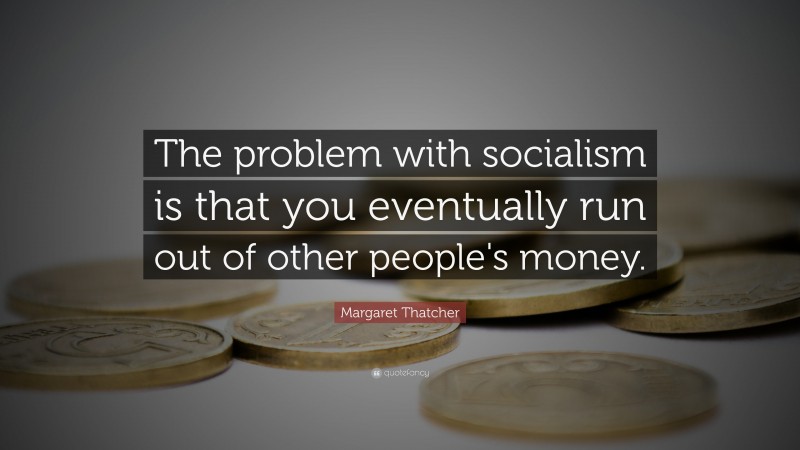
Allow me to put it this way: Margaret Thatcher had a brilliant quote about socialism that libertarians love to repeat. And from a purely economic standpoint, I believe that the libertarians are correct. But change that quote just a little, and you get this:

The problem with socialism libertarianism is that you eventually run out of other people’s money families.

Families don’t just happen. They take a lot of work to build and to maintain, and unless they are planted in a culture that nourishes them, they will wither and die. Libertarianism does not foster that kind of a culture, yet it depends on families in order to raise the kind of people who can make a libertarian society work. People from broken families often lack the mental and emotional maturity to take upon themselves the personal responsibilities that come with personal liberty—in other words, they lack the capacity for personal independence which libertarianism depends on. Growing up in a healthy family isn’t the only way to develop that sort of independence, but a society of broken families will invariably fail to produce such a people.

This is why libertarianism ultimately leads to authoritarianism. We aren’t all characters in an Ayn Rand novel: we aren’t all ubermensch all of the time, reshaping the world by the strength of our will. And when we inevitable fail, where can we turn to for help? If society is nothing more than a group of individuals, then ultimately the only place to turn to is the state. Perhaps there may be churches, companies, or other private civic organizations to which a person may turn, but any form of libertarianism that rejects altruism as a moral good will fail to foster these organizations as well. So, in the absense of anywhere else to turn, individuals will, over time, turn increasingly to the state, trading their libertarian freedoms for economic and social security. A society that exalts the individual at the expense of the family will always, in the end, devolve into a statist tyranny.

If you want to create a stable society that recognizes individual freedom, you have to recognize the family as the fundamental unit of that society, and you have to proactively enact policies that will foster a culture of strong families. Not only does this give you a social safety net that is totally apart from the state, but it also ensures that your society will be self-perpetuating, since one of the central purposes of the family is to create and raise children.

In fact, the family is perhaps the best antidote to government power creeping into every facet of society, which also makes it the best way to push back against woke leftism, ESG, and the Great Reset. Hence why everything about leftist progressivism is calculated to destroy the family. Parents concerned about CRT in their schools? Domestic terrorists. Kids who say that they’re transgender? Transition them without telling the parents, and take them away from their families if the parents object.

But it’s not just a partisan issue. If the family is the fundamental unit of society and needs to be strengthened, then there are things on both the left and the right that need to change. For example, poverty is a huge issue for families, since poor families are much more likely to break up due to the stress. But conservatives often ignore the issue of income inequality, mouthing platitudes about the free market while giving us socialism for the rich and capitalism for the poor. And the libertarians are little better, what with how they push for the legalization of drugs, prostitution, abortion, and pornography. Few things have done more to destroy the family than widespread substance abuse and the hypersexualization of our society.

This is why I’ve mostly given up on reading Heinlein anymore. He’s a brilliant writer with a fascinating take on some of science fiction’s most fundamental tropes, but whenever he writes about sex or sexuality, all I can think of is “the problem with libertarianism is that you eventually run out of other people’s families.” Heinlein and his boomer readership took the family for granted, neglected their own, and gave us a world of widespread sexual promiscuity, where society is falling apart.

So that’s why I don’t consider myself a libertarian anymore, even though there are many tenets of libertarianism that I still admire and believe, especially on the economic side. I suppose you say that I’m a conservative, but that isn’t really accurate either, because most strains of conservatism in 2024 really seem more about conserving the leftism of two or three generations ago. So I guess that means I’m politically homeless—just like most of my fellow Americans these days.

How Not To Write An AI-Assisted Novel

The worst way to write a novel with generative AI is to make the AI do all the work.

In fact, thinking of it in terms of “how much of the work can I get the AI to do?” is pretty much guaranteed to give you a really crappy book by the end of it. The AI’s job isn’t to “do the work,” any more than a power tool’s job is to build a house. You do the work. AI is just a tool to multiply your efforts.

But let’s take a step back. Who am I to talk about all of this? My name is Joe Vasicek, and I’m an indie author who’s been writing and publishing regularly since 2011. At this point, I have several dozen novels under my belt, including about half a dozen AI-assisted novels, the first of which is published under my Joe Vasicek pen here on this blog. Also, my wife is a PhD student and research assistant who works with generative AI and large language models. Her thesis is on using generative AI to create interactive cross references for any body of text, customized to the user. We talk a lot about generative AI and share what we’ve learned, so we’re both fairly knowledgeable on the subject.

At this point, it’s still very much the wild west of writing with AI-assistance. The technology is new enough that there really are no experts on the subject, though I expect that that will change rapidly over the next few years. And while I can’t (yet) say that I’ve made gazillions of $$$$ from my AI writing methods, I can say that I’m one of the first professional writers to develop a method for writing with AI-assistance.

And that’s not a boast. Whenever I get together with other writers, I wish there were more of them (really, any of them) that I could talk with about this stuff. There are some online communities that come at it more from the AI side than the professional writing side, and I probably ought to spend more time in those, because it’s probably only a matter of time before one of them has a runaway bestseller and shakes up the publishing industry in the same way that Amanda Hocking shook things up when the indie publishing revolution was just getting underway.

Maybe that someone will be you. Who knows? We’re still very much in the wild west of AI writing, and probably will be for a while.

It’s that very loneliness that makes me want to blog about AI-assisted writing—that, and the fact that I’m still trying to figure it out for myself, so I would love to hear what’s working for other writers. But one thing that I’ve learned from my own experience is that the worst way to write an AI-assisted novel is to dump all the work on the AI and expect anything good to come out.

The main reason for this is that LLMs and generative AI do not think—at least, not in any meaningful way that’s similar to the way you and I think. Instead, these models analyze human language for patterns, and replicate those patterns according to the parameters and instructions give by the user. It’s much closer to how your phone is able to predict your next word when you go to write a text, except that instead of writing the next word, ChatGPT or Sudowrite or whatever LLM you happen to be using is instead predicting the next 5-10 paragraphs.

So really, it’s not very useful to think of an AI as being able to “write” anything. Instead, it’s much more useful to think of it as “simulating” the thing that you’ve told it to write, or producing a simulation of the kind of work that a human would produce, given your parameters and instructions. The AI isn’t “doing the work” for you, it’s merely simulating the end product of that work. You still have to make it your own.

And how do you make it your own? Personally, I’ve found that the best way to do that is to open up a new document on my second monitor and type it all out by hand, occasionally referring to the AI-generated text when I don’t know what to write next, but largely trusting in myself to create the real, non-simulated draft. No copy-pasting! The mental exercise of writing it all out, word for word, stimulates something in the creative mind, and in most cases I end up writing something completely different, using the simulated version of the novel merely as a stepping stone.

So why do I go through all the trouble of generating a whole novel, when I’m probably going to throw out most of that text anyway? That’s a very good question—so good, in fact, that it needs to be the subject of its own post.

Vasicek family Christmas traditions

I’ve been thinking for a while now that I need to write these down somewhere, and why not share it as well? Here is a list of all of the things we do as a family during the Christmas season. We don’t always hit all of them every year, but we do hit most of them.

  • Cut down a wild Christmas tree from the mountains (requires permit)
  • Decorate the tree together
  • Do the daily advent calendar, with scriptures for each day
  • Get a new framed picture of Jesus Christ
  • Gift one of our old pictures of Jesus Christ to a family friend
  • Writing group Christmas party
  • Neighborhood Christmas party
  • Watch Mr. Kreuger’s Christmas
  • Listen to Handel’s Messiah
  • Attend a Messiah sing-along
  • See the lights at Temple Square
  • Visit the SLC German Market
  • Buy something with the Giving Machine
  • Drive around our neighborhood to see the Christmas lights
  • Go caroling together as a family
  • Make bread to share with neighbors
  • Do the Vasicek extended family holiday book exchange
  • Do the Dollar Store gift exchange with the extended Armstrong family
  • Get a 2024 calendar and fill it out
  • Make a new spread in the family scrapbook for 2023
  • Write personal testimonies for the 2023 family scrapbook spread

That’s how the list stands as of right now. I’m sure we’ll add a few more things as the kids get older.

What are some of your family Christmas traditions?

Back from Coeur d’Alene

It occurs to me that most of my posts in the past month have either been extremely doom-and-gloom, or they’ve been excerpts from some of my most recent work. This probably gives the impression that I’m huddled in a corner somewhere, black-pilled and traumatized, and seeking some sort of an escape through my writing, when really, that is not the case.

In fact, the main reason I haven’t posted more is because I’ve been so busy with life and family. It’s been a really great year for us, with a new baby and a bunch of cross-country road trips that have been a lot of fun. I’ve also been testing out a lot of AI writing techniques, and while that has really invigorated my creativity in a major way, it’s also taken me away from things like this blog, which is why you haven’t heard as much from me.

If I were still on social media, I have no doubt that I would be doom-spiraling right now, what with everything that’s happening in the world. Even without social media, I’ve been glued to the news sites I follow, checking for hourly updates on the war with Israel (which I really do believe is the opening stages of World War III). But that’s actually not very new for me: back in high school, I was the same way, following the news every day from the public computers at my school library. The 9/11 attacks happened on the first day of school for me, but in the last couple of months of the previous school year, I remember being frustrated that no one seemed to be taking this Osama Bin Laden guy more seriously, especially after the USS Cole and Kenya embassy bombings. Then the summer came, and I mostly goofed off, but as soon as school got started I was back to following the news on a daily/hourly basis.

So I’ve got a lot of experience with taking scary news in stride and not letting it totally consume my life. In fact, that’s the main reason I follow things like this so closely: so that when the unthinkable happens, I can face it without getting shocked or overwhelmed. And recent posts to the contrary, I’m not black-pilled at all. In fact, I tend to believe that I was put on the Earth at this specific period of time for a reason, and not just one that was imposed on me: that at some point, before I was born, I was given a choice between this and some other era, and I specifically chose this time to be born. Maybe I’m just imagining it, but it would not at all surprise me if that turned out to be the case.

In any case, we just got back from our last family road trip of the year, this time up to Coeur d’Alene to spend some time with Piper’s brother and his family, as well as my in-laws, who joined us on the trip. We had a really good time! Our daughter had a blast playing with all her cousins, especially the ones about her age right now. We also got to see her cousin’s baptism, so that was really good. Provo to Couer d’Alene is about an 11 hour drive, which is not quite far enough to justify getting a hotel, but for a 7 month-old and a 3 year-old, it was pretty hard. We’re all glad to be home now.

My wife is super busy working on her PhD. Specifically, she’s getting a paper ready for a major conference she hopes to attend with the rest of her lab. Her paper is on using AI to generate useful cross references across a body of work (eg Shakespeare, Jane Austen, The Bible, etc), and she’s developed a method that cuts down the cost of creating a cross reference set by upwards of 50%. But for the next couple of days, she’s going to be really busy with all of that.

Meanwhile, I’ve been taking care of the kids while the grandparents are on another road trip out to Omaha. It hasn’t been that bad, but I’ve also been pretty swamped with work, which one of the reasons I’ve been neglecting this blog. I have a bunch of ideas for posts I’d like to share, but no time to get to them, though hopefully that will change soon. Here are some of the posts I’d like to write:

  • A part 4 to my Navigating Woke-SF series. I recently had some experiences with the woke SF publishing world that have made me rethink things in a way that y’all would probably find very interesting.
  • An update to my generational cycles of grimdark and noblebright theory. This is one of the things I’ve been thinking about, and I’m starting to think that some of my basic premises in that post were wrong, or at least not entirely accurate, requiring an overhaul.
  • A lot of thoughts on AI and writing. This has been my main focus for the past couple of months, and I have thoughts. Many, many thoughts.
  • More thoughts on geopolitics and current events, especially on the trajectory of the unfolding global conflict and what it all means on a moral and spiritual level. But I think I should hold off on posting too much about that, since I’ve already spent so much time on it already.

Which of those things would you like to see next? I can’t promise anything, but I do want to spend more time on the stuff that followers of this blog actually want to read. In the meantime, I’ll try to intersperse a few quick update posts like this one, and get back into the habit of regular blogging.

Where have I been?

So it’s been almost two weeks since I last posted anything, including any of the half-dozen or so short stories I’ve listened to that I feel are worth sharing. What’s going on?

We did just have a new baby less than two months ago, though that’s not been as disruptive to everything as I expected. My productivity actually went up after he was born, partially because of all the AI-assisted writing I’ve been doing, and partially because I’ve been working on the final revisions for Children of the Starry Sea, which are easier in some ways than writing the initial draft.

But I do think it’s the revisions that have thrown off my blogging, as well as the total lack of a routine. We’re gradually getting back into one, now that the new baby’s rhythms are becoming more consistent. As my current WIP project winds down—which is no small thing, since this is the longest novel I’ve written since I started publishing—I find myself in that weird between-projects state, where I don’t have any firm direction to guide my progress. Combine that with the total lack of routine that comes from having a new baby, and balls are going to get dropped.

Aside from this blog, though, I haven’t dropped too many balls. I’m still on track to write three novels this year, and should be able to pick up the next one without too much of a delay (since this is going to be an experimental AI-assisted novel, though, I may take a week or two to write a few short stories just to familiarize myself with the AI tools). And Children of the Starry Sea has actually turned out pretty well, in my (albeit limited) estimation.

So today I’m going to send this story out to my editor, moving it into the publishing queue. It’s already up for preorder on Amazon and the other sites that allow for assetless preorders. Then I’ll try to schedule a few blog posts catching up on those short stories I feel are worth recommending.

…and now the toddler just woke up, so I have to go. Another day in paradise, right?

Prepping for a new novel project

I am so far behind on so many things right now. My in-laws went to Idaho for the week, so all of the childcare has fallen on us while they’re gone, and we’ve just been swamped. I know that there are amazing parents out there who can watch five kids at a time, by themselves, without breaking a sweat, but we haven’t leveled up that far yet, and our newborn and three year-old are really kicking our butts.

It probably didn’t help that I started a new AI-assisted short story about a week ago and became really engrossed in that for a while. It all started when I prompted ChatGPT to write a story about Conan the Barbarian in the style of Robert E. Howard. Let me tell you, if you want to get ChatGPT to break its own content guidelines in a totally awesome way, that is the way to do it! It gave me this awesome fight scene, and then this part about a slave girl, and then it got super steamy… and then I decided to delete it and start over.

So I started a new chat, with the prompt “Let’s write a fantasy adventure story in the style of Robert E. Howard,” and immediately it launched into a pretty good fight scene. Here is what it gave me:

The sky was blood-red as the setting sun cast its final rays across the desolate landscape of the wasteland. The cracked earth was parched, and the air was thick with dust and despair. In the midst of this barren terrain stood a lone figure, clad in tattered armor, with a sword sheathed at his side. His name was Roderick, a seasoned warrior who had seen many battles in his days.

Roderick had been on a quest to find the lost city of Xulthar, rumored to hold unimaginable riches and ancient secrets. But the journey had been treacherous, and he had faced countless obstacles along the way. His companions had fallen one by one, leaving him to brave the dangers of the wasteland alone.

As night fell and the moon rose, Roderick sought shelter in the ruins of an ancient temple. Its crumbling walls were adorned with faded symbols of a long-forgotten civilization, and its dark interior was filled with an eerie silence. Roderick’s senses were on high alert as he made his way through the labyrinthine corridors, his sword ready in his hand.

But he was not alone.

A guttural growl echoed through the air, and Roderick whirled around to see a pair of glowing red eyes staring at him from the darkness. A monstrous creature, half-human, half-beast, lunged at him with razor-sharp claws. Roderick swung his sword with all his might, but the creature was fast and agile, evading his strikes with unnatural speed.

The battle was fierce and brutal, as Roderick clashed with the creature in a deadly dance of steel and blood. His muscles strained, and his heart pounded with adrenaline as he fought with every ounce of his skill and strength. The creature was relentless, its claws slashing through the air with deadly precision, but Roderick’s sword found its mark, slicing through flesh and bone.

Finally, with a final swing, Roderick delivered a crushing blow to the creature, sending it crashing to the ground. Its red eyes faded, and its grotesque form transformed into that of a man, clad in ragged clothes.

As Roderick caught his breath, he looked down at the fallen man, who was gasping for breath, his eyes filled with fear and confusion. Roderick recognized him as a lost traveler who had succumbed to the dark magic of the wasteland, transforming into a monster. He had seen this before, a dark sorcery that twisted the minds and bodies of those who dared to venture too far into the forbidden lands.

Roderick’s heart went out to the fallen man, and he knelt down beside him. With his last breath, the man begged for forgiveness, his human form returning briefly before he passed away. Roderick closed the man’s eyes, offering a silent prayer for his soul.

With a heavy heart, Roderick continued his journey, pushing deeper into the heart of the wasteland. He knew he was close to finding Xulthar, and he could feel the pull of its ancient power growing stronger with each step he took. But he also knew that the dangers ahead would be even greater, and he would need all his skill and courage to overcome them.

As he pressed on, Roderick encountered more of the twisted creatures that lurked in the wasteland. He battled monstrous beasts and encountered treacherous traps, but he never wavered in his determination. He was a warrior forged in the fires of battle, and he would not be deterred.

Finally, after days of relentless pursuit, Roderick stood at the entrance of a massive stone gate adorned with intricate runes. This was it, the entrance to Xulthar. He could feel

Not too bad. A little rough around the edges, much like everything ChatGPT gives you at first, but I decided to work with it. I prompted the model to give me the story all the way from start to finish, and then, instead of simply copy-pasting, I decided to manually transcribe it myself, adding and editing as I went.

One thing led to another, and pretty soon I was 4k words into a short story that was taking on a life of its own. It bore only a loose resemblance to the material ChatGPT gave me, at least in terms of overall story structure. Over the next few days, I tried forking the conversation at a few points, copying what I’d written to see what ChatGPT came up with next, but it wasn’t keeping up very well, and I found myself using less and less of what it was giving me.

At the same time, the story was quickly turning into a novelette, and from there into a novella. In fact, it was ballooning so quickly that I realized I was neglecting my novel WIP, Children of the Starry Sea. So I decided to set the story aside for a while…

…except then it occured to me that I’m going to need a new novel WIP in May, and the one I had planned (Return of the Starborn Son) isn’t really outlined yet. I’ve been trying to outline it while finishing the revisions for Children of the Starry Sea, but haven’t made much progress on it, and it’s going to be a big one—possibly longer than Children when it’s done.

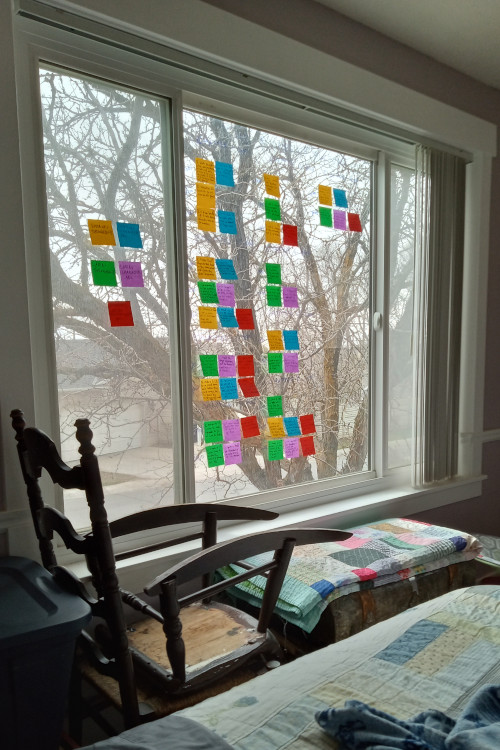
So I thought to myself, why not turn this story into my next novel WIP and work on outlining that instead of Return of the Starborn Son? With post-it notes and a dry erase marker (and some help from my toddler, who decided which color post-it notes to hand to me), I put together a basic story outline, which should come out to about 40k words when it’s done. As you can see, I used the window of my home office to put it all together, which was fun. 40k words is pretty short for a novel, just barely crossing the line over what SFWA considers a novella, but for a Conan-style sword & sorcery fantasy, it should be perfect.

I’ve also decided to make this an AI-assisted novel, using ChatGPT of course but also trying out Sudowrite, which looks like a much more useful AI writing tool. Getting ChatGPT to help you write anything longer than about 4k words is like trying to write on a whiteboard with boxing gloves on your hands. It’s going to be experimental, but I think I can turn it into something publishable in the next three or four months. It should be a fascinating learning experience either way.

We have a new baby!

So the reason I haven’t posted anything here in a little over a week is because we had a new baby! This one is our second, and he’s our first baby boy.

Unlike the last time, when Mrs. Vasicek went into labor around 7:30 PM and the baby was born in the early hours of the morning, she was scheduled for an induction first thing at 6:00 AM and the baby was born in the early afternoon. MUCH better way of doing things! He actually came out with the first push—the only reason he wasn’t born earlier was because the doctor was stuck in traffic, so we had to wait to start the active part of labor!

This was also our first time having a baby not in the middle of the pandemic, so we got to see the faces of all of our nurses and the doctor too, which was nice (last time, the doctor was practically in a hazmat suit with a face shield). They all got a kick out of the April Fool’s joke we played in 2020, convincing our extended family that we were going to name our daughter “Corona.” Everything went well, and Mrs. Vasicek and Little Buddy were released from the hospital the next day, which was nice.

So our lives have gotten quite a bit crazier, caring for this newborn and adjusting to all of the changes that come with that. My in-laws have been a huge help in making us food and watching our nearly 3 year-old daughter during this time, which has been really great. Still, any semblance of a routine has been shot to pieces, and it’s probably going to take at least a few weeks to recover from that.

Normally, my writing would take a huge hit from this… but I’ve actually been writing more than ever, using ChatGPT and other AI tools to experiment with writing AI-assisted stories. In fact, while I was in the hospital with Mrs. Vasicek, I actually wrote a 6k word fantasy short story during the slower moments. It was kind of funny, because just before Mrs. Vasicek got an epidural, I laughed at something funny that ChatGPT came up with, and she got really mad because there was someone in the room having joy while she was in so much pain. Then she got an epidural, and all was right with the world again.

As of right now, I’ve written five stories in conjunction with ChatGPT. The AI tools are still pretty clumsy at writing fiction, and they’re not masterpieces by any means, but they aren’t terrible either—and it actually takes quite a bit of work to make them not terrible, so it’s not like the AI is doing all of the work. One of these days, maybe I’ll do a blog post sharing some of my methods for writing AI-assisted stories.

I’m also working on the second and third rounds of revisions for Children of the Starry Sea, and it’s coming along nicely. It’s really good that I was able to finish the rough draft and first revision draft before Little Buddy was born, because I would definitely be swamped right now if that wasn’t the case. But these revisions are much easier to do, even in a sleep-deprived state: the second revision draft is all about smoothing out the flow of the narrative and making sure there aren’t any awkward transitions or loose ends, and the final revision draft is about polishing the writing on a sentence level and cutting about 10% of the words. Neither requires a ton of brain space.

So that’s what we’ve been up to out here. It’s going to take a while for things to return to normal, but we’re doing well, the baby is happy, the mom is tired but doing okay, and I’m just happy to be a dad two times over!

Children of the Starry Sea cover reveal!

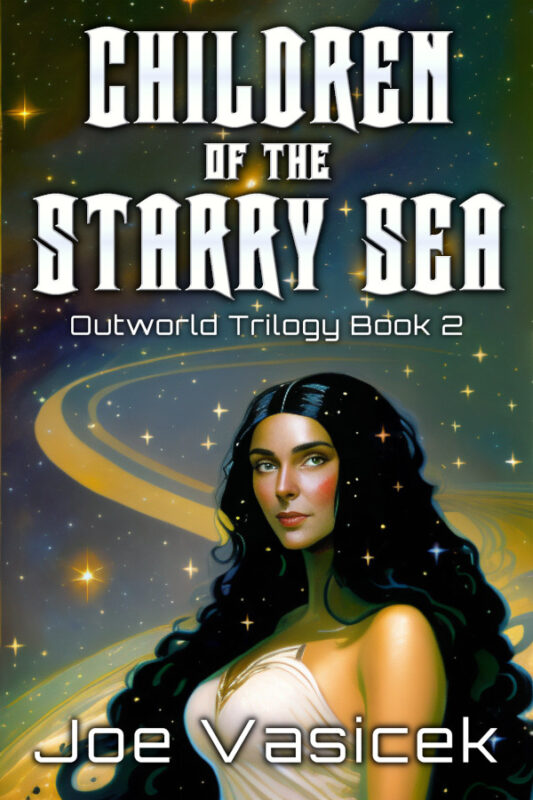
Behold!

This is the ebook cover for Children of the Starry Sea, coming out sometime this summer! If it looks familiar, that’s because I kept the art from my earlier experiments with Stable Diffusion—the feedback was so positive, including from my writing group, that I decided to make only a few minor tweaks, such as the stars in her hair, and removing the weird watermelon-planet thing that was originally in the bottom left corner. Made a few minor changes to the typography too, though I decided to keep the fonts.

Also, you’ll be interested to know that I just finished the first revision pass of this WIP a few hours ago! I’ve been racing to finish it before the new baby comes, because it’s probably going to be touch-and-go after that. Now I just need to do two more revision passes, one to look for and clean up any issues that I may have missed, and another to trim it down by 10% and make sure the writing is all solid. After that, it’s off to the editor!