How I hacked my ADHD to triple my daily word count

Writing with ADHD can be tough. It’s easy to beat yourself up for being “undisciplined” or “lazy” when the greater problem is that you’re trying to work against your ADHD instead of finding ways to make it work for you. It’s like swimming against a rip current instead of swimming sideways to get out of it.

In the last month, I’ve made a really fantastic breathrough that I think will change the way I write from here on out. So far, it’s helped me to double or even triple my usual word count. The novel I’ve been wrestling with for more than a year now—the longest one I’ve written since I started indie publishing—now looks like it will be finished in just a few of weeks, when I expected it to take a couple of months. Needless to say, I’m really excited.

What changed? I found a way to make my ADHD work for me, rather than against me.

In my previous post, A reading hack for the ADHD addled brain, I explained how I exploited my ADHD to read more books. Basically, I did the same thing, but for writing. There was a lot that had to happen first, though, and the biggest of those was that I had to learn how to make and keep an outline.

Step 1: Learn how to outline properly

For years, I just sort of assumed that I was a discovery writer, probably because of the ADHD. Most of creativity has to do with finding novel or unexpected ways to combine two or more ideas, and when you have ADHD, your brain naturally jumps from idea to idea. That was why I always hated taking meds when I was a kid: I felt that it stifled my creativity. And since most of this idea jumping happened subconsciously, I assumed that outlining would also kill that process.

But after a few years of struggling as an indie author, I realized that my writing process was too slow. In order to succeed, I needed to publish more frequently, but in order to do that, I needed to produce more content regularly. Back then, I would usually write a novel from start to finish, laying it aside for a month or two if I ran into a serious block, and also after finishing each draft. A typical novel would go through two or three revision drafts, so it would literally take years before a +70k word novel was ready to publish.

I decided that the best way to shorten my writing process was to “cycle” through the book, combining all the drafts so that I was working on revisions while simultaneously writing the rough draft. In order to keep track of all that, I needed to keep an outline. So I tried out a few different methods and tweaked them until I came up with a method that worked well for me.

The thought of outlining can scare a lot of writers who consider themselves “pantsers” or “discover writers,” but the thing to keep in mind is that there is no one right way to keep an outline. In fact, there are probably as many ways to outline as there are writers. For some, a couple of quick sketches on the back of a napkin is enough, while for others, it turns into a massive story bible that’s just as long (or longer) than the actual book. But without trying out a lot of different methods, you’ll never figure out what works for you.

It took me a couple of years, but I eventually developed a method that worked really well for me. With it, I was able to write Edenfall and The Stars of Redemption, as well as the last two Gunslinger books, in much less time than it took for my other ones. I was also able to combine all eight of the Star Wanderers novellas into a novel—something I probably wouldn’t have been able to do very well without a solid outline to keep it straight.

But I still would run into blocks that would occasionally derail the project, at least for a little while. I ran into that a lot with my current WIP, Children of the Starry Sea. Sometimes, they were genuine story problems that I needed to work through. More often than not, though, the problem was one of momentum: I was having too many bad writing days interspersed with the good writing days, so that each day felt like I was starting from zero. After a while, that becomes difficult to keep up.

Step 2: Allow yourself to write out of order

When I came back from my second hiatus to work on Children of the Starry Sea, it was clear that my new method wasn’t working as well as I needed it to work. Children of the Starry Sea is much longer than anything I’ve published so far, and I found that I just wasn’t producing enough new words consistently to make my “cycling” process of revisions work.

Around this time, I remembered something I’d heard on a recent convention panel, where one of the authors shared how he collaborated with another author. Instead of going back and forth, he told his cowriter: “how about you just write all the odd chapters, and I’ll write the even chapters, and when we’re both done we’ll combine it all together and see how it turns out.” To their surprise, it actually turned out really well.

So with that in mind, I decided to experiment with skipping around my current WIP, rather than writing it in order from start to finish. If I woke up and felt like I wanted to write an action scene, I would pick one of the action scenes out of my outline and write that. If I felt like I wanted to write the ending, I would skip ahead and write that. If I felt like I wanted to write the next scene, I would go back to where I’d left off and write that.

The outline was the key. Without it, there’s no way I’d be able to keep everything straight and know where each part is supposed to go. The outline also had the added benefit of dividing the novel up into smaller chunks, making the overall project much less intimidating. The way to eat an elephant is to take one bite at a time, just like the way to climb a mountain is to take one step at a time. Same thing with novels.

That’s all well and good, you may be thinking, but what happens when you’ve written all the stuff that you want to write, and all that’s left is the stuff you didn’t want to write? Isn’t that a bit like eating your dessert first, and leaving your vegetables for last? Not really, because chances are that if you really don’t want to write a particular scene, the reader probably won’t want to read it either. So if you can find a way to rework your story so that scene becomes unnecessary, you’re probably better off doing that.

But I actually haven’t had that problem yet. The thing about ADHD is that it actually feels right to jump around all over the place like that. Just because I don’t want to write a particular scene on one day doesn’t mean that I won’t want to come back to it sometime later. And more often than not, writing a later scene actually makes things fall into place with the earlier scenes, and makes me more excited to write them.

It’s as if the project itself is a puzzle. Can you imagine trying to put a puzzle together in linear order, starting from the top left corner and moving to the bottom right? That would be pure torture! Instead, you pick up whatever pieces catch your eye, and try to fit them in with other, similar pieces, until the puzzle itself begins to take shape.

There a lot of disadvantages to writing with ADHD, but there are some areas where the ADHD can actually become a strength, if you learn to work with it instead of against it. I’ve already mentioned how it can help with creativity, since your mind is always bouncing around between different ideas. What I’ve learned in the last month is that writing out of order is another great way to harness ADHD as a strength, since something that leaps out from writing one scene can often lead to a breakthrough in another. Writing out of order gives your ADHD brain the space it needs to make those intuitive leaps, and harnesses the “oh, shiny!” toward something productive, rather than driving you to procrastinate.

Step 3: Start in the middle, not the beginning

For me, the hardest part of writing is getting started. That’s probably my ADHD: it’s always easier to get distracted than it is to settle down and do what you’re supposed to do. Once I’ve settled down, though, and gotten into a groove, I can usually stick with a task until it’s done. In fact, once you’re in something of a flow state, the ADHD can actually make you hyperfocus.

So if the hardest part of writing is getting started, how do you turn that from a weakness into a strength? By leaving the next scene(s) unfinished, so that the next time you sit down to write, the scene has already been started and you just need to figure out the next word. One word leads to the next, and before you know it, you’re in the groove again.

By far, this has been the biggest part of my breakthrough: realizing that I don’t have to write every scene from start to finish in one sitting. In fact, it’s better if I don’t. Instead, I’ll typically finish one or two scenes in the morning, then pick out three to four scenes in the afternoon and write the first couple hundred words or so, deliberately leaving them unfinished so that I have a variety of scenes to choose from the next day.

If the hardest part of writing is getting started, then the hardest part of getting started is feeling overwhelmed at how much you have to do. But if all I have to do is write a couple hundred words, that’s easy! It also works with my ADHD instead of against it, since I get to jump from scene to scene instead of getting bogged down.

With the way that I used to write, most of my “writing blocks” had less to do with the actual writing and more to do with working myself up to write. Many times, I found that if I just sat down and opened up my WIP without thinking too much about it first, the writing would come a lot easier. Starting in the middle is a great way to harness that, because you aren’t confronted with a blank page the moment you sit down. It takes a lot less effort to find the next word than it does to find the first word.

So with where things stand right now, I just need to start four new scenes every day this week and I’ll have every remaining scene in my novel WIP started by Saturday. From there, if I can finish two or three scenes a day, I can easily finish the rough draft stage of this novel WIP before the end of February—which will be amazing, since I’m only at the 65% mark right now, and historically that’s always the part where I find it most difficult to write.

I’m really looking forward to writing a whole novel from start to finish using this method. As soon as Children of the Starry Sea is finished, I’ll start outlining the sequel, Return of of the Starborn Son, and write it the same way. If things go well with my current WIP, I’ll be very optimistic about finishing the next one before the end of the year—perhaps even before the end of the summer.

I do expect things to get crazy around here soon, though. Our second child is due in the early spring, which means enduring a month or two of chronic sleep deprivation. I’ve gotten to be pretty comfortable with writing at 4AM, but we’re also getting a lot more uninterrupted sleep than we were when Princess Hiccup was a newborn. I anticipate that we’ll have at least a month where nothing gets productively done.

So it will be really fantastic if I can finish Children of the Starry Sea NOW, before the baby comes—and not just the rough draft, but the revisions too. Fortunately, I don’t think I’ll have too much difficulty with the revisions. I’ve already cycled through the first half of the book a couple of times, and it’s working pretty well. Also, revisions come a lot easier to me than writing new words. I’m not sure why that’s true, but it is.

And for the record, I don’t advocate jumping around all over the place while doing revisions. It’s probably best to do that part in sequential order, if nothing else than to make sure that all the scenes and chapters flow properly. I haven’t gotten to that part of this writing method yet, so it will be interesting to see how it goes. So far, the stuff I’ve cycled through actually seems to flow pretty well, but I need to take it from the beginning to really be sure.
Spring Shorts 2022 Story #1: “Blight of Empire”

Finished the first short story of the writing challenge that I’m calling Spring Shorts 2022, which is to write 12 short stories before Memorial Day. This one is titled “Blight of Empire,” and it takes place in the distant future, where the galaxy is full of failed terraforming projects and a massive galactic empire rules almost everything. I used the Mythulu cards with this one, and here are the cards I drew:

  • AMPHIBIOUS: Adapted to live in two distinctly different environments. Likes to live on the threshold. (Draw +2 Habitat)
    • CAVE: Isolated biome that would survive even if the sun died. Represents impressive adaptability and unnecessary paranoia.
    • TERRAFORMED: Repurposed to support a specific, narrow spectrum of life. Can be forced, or part of natural biome evolution.
  • FESTERING: Open wound that has become infected and resists healing. Threatens the whole entity.
  • FIRE: Symbolizes passion. Has a dual nature. On one side, brings protection, healing, sanitation. On the other, destruction.
  • GODPARENT: Legally responsible for a child if parents die or are incapacitated. Named at birth and expected to participate in child’s life from the beginning.
  • INVENTOR: The one who pays the price to elevate their people. Graced with curiosity and unusual resilience to disappointment.
  • HUMID: Something is infused into the air and the levels fluctuate. Draw 1 Element to decide what’s floating around. (Draw +1 Element)
    • FUNGUS: More potent than plants, with all the same variations–edible, poisonous, medicine, entheogen. Overall, a tool for removing festering excess.

I had to draw the cards a couple of times before I came up with a good story idea. From now on, I’m going to go through each of the six decks, drawing the top three and choosing the one that seems most interesting. If I need to pick another card from that deck, it’ll be from the other two.

This story ended up going in a completely different direction than I thought it would, which was interesting. A lot of discovery writing with this one, which was a good change of pace. For the last month, I think I’ve been trying to write unsuccessfully through a general drought of creativity, but these short story exercises are helping to stimulate my creative mind again. Just need to make sure to keep filling the well.

Other than that, things have been kind of crazy around here. We have a long-term plumbing problem that just flared up again, and half the house’s plumbing is unusable. Unfortunately, that includes the washing machine, and our baby is in the middle of potty training. My wife has an uncle who works as a maintenance guy at BYU, and he’s been a huge help, but each day has been a different plumbing adventure. Later this week, we’re going to remove a section of cast iron pipe and run a snake up through it backwards, and maybe a shop vac too. I just hope the sewer pipe hasn’t been leaking under the foundation (knock on wood).

On the publishing front, I was planning to release a short story this week, but that got pushed back due to all this craziness. I do have my fourth short story collection up for preorder, though, so that’s something. Also ran a massive promo last week for Bringing Stella Home, which I recently relaunched with a new cover.

I think I’m going to keep using the Mythulu cards for this Spring Shorts 2022 writing challenge. In fact, I’m going to try to use all of the cards, just for the fun of it. That means that none of the cards I used for this story will show up again. I’ve already drawn a few base stories, and come up with some intriguing combinations. Very excited to write, if all this other life stuff will just calm down!

My New Writing Process (or why I don’t believe in pantsing anymore)

For the longest time, I thought I was a “discovery writer.” That is to say, I believed there were two kinds of writers—pantsers vs. plotters—and that I was very much a pantser. It was what I was comfortable with. It was what I defaulted to when I sat down to write. It was the style of writing that for me, produced the best books.

Or so I thought.

Ten years later, I come to a realization: my writing process needs work. In order to keep writing at a professional level, I need to produce more books, and to do that, I need to write cleaner first drafts. Discovery writing was great for short stories or novellas, but my novels always seemed to hit a block somewhere in the messy middle. If I want to put out a new book each month, that’s not something I can afford.

Around this time, I read The Seven Habits of Highly Effective People. The second habit, “begin with the end in mind,” challenged everything I thought I knew about writing. According to Stephen Covey, everything is created twice: first in the mind, then in reality. To achieve maximum effectiveness in your work, make sure you have a clear plan.

“But wait!” I said. “I’m a pantser—a discovery writer. I don’t do outlines. That’s for plotters.”

And then I thought about it.

What if the whole “pantser vs. plotter” dichotomy is wrong? What if you have to master both skills to really be a masterful writer? Sure, there are plenty of successful writers who never do, but would they be more effective if they did?

What if it’s a bit like talent? People believe that you need talent to be successful, when in reality, talent is just a starting point. A writer who works hard to improve their craft will always overtake a talented writer who doesn’t. And yet, this myth of talent persists, mainly because people can’t see (or don’t want to see) all the hard work that goes alongside it.

This is the conclusion I’ve come to: that when it comes to professional writing, there are no “pantsers” or “plotters.” There are only different forms of outlining. It may be as simple as a one-paragraph sketch, or it may be as complex as a two-hundred page story bible. There are as many outlining methods as there are writers, and many writers tweak their methods with each book in an effort to improve their process.

“Discovery writing” was what came easy to me, but to achieve my full potential, I had to embrace the stuff that was hard. And that meant learning to make an effective outline.

The Old Writing Process

Here’s how I used to write a book:

I’d get a bunch of ideas and do nothing with them. Nothing at all. I told myself I was just letting them stew in the back of my mind, but really it was just an excuse to not do any outlining.

Eventually, the muse would hit me over the head, and an idea would become so compelling that I couldn’t not write about it. At this point, I’d come up with an opening scene and a premise for the rest of the book. I’d also have a vague idea of how the story was going to end, but I wouldn’t pursue it at all, for fear that too much planning would “ruin” it.

All of the other ideas would start to come together, but without an outline to show how they were all connected, I would lose sight of it almost immediately. After writing the first couple of chapters, I soon found myself in the thick of the forest, with only the vaguest idea of where I was going. Soon, I’d lose sight of the forest for the trees. I’d hit a block and try to push my way through, only to find that I was lost.

At this point, I’d set the unfinished WIP aside for a few months, to approach it with “fresh eyes.” It was basically a failed draft. When I felt ready to pick it up again, I would start all over from the beginning, recycling all the stuff that seemed to work and cutting out the stuff that didn’t.

If things went well, I’d push through that block and write the next few chapters… until I came to another block, and had to set it aside again.

If things did not go well, I’d hit the same block only to find that I couldn’t push through it. Something was broken that was fundamental to the story itself. If I was lucky, I’d catch onto that fact soon enough not to lose too much writing time. But more often than not, I’d spent weeks and months agonizing over it, and beating myself up for being a horrible writer.

This would go on for years. My pile of unfinished WIPs grew increasingly larger as I bounced from one failed draft to the next. Usually on the third or fourth attempt, though, I’d push all the way to the ending—not quite the ending I first had in mind, but one that still worked. Kind of sort of.

Then came the revisions.

I’d set the book aside again, usually for a few months. When I was confident I could approach it with “fresh eyes,” I’d pick it up again, only to realize that it suuuuuucked. A little bit angry with myself for writing such a crappy book, I’d go at it with an axe. Characters, subplots, and chapters would all get cut out.

After mauling my WIP to pieces, I’d stitch it back together, usually with the scenes in different order. Then I’d set it aside for a few months again. Rinse and repeat.

Eventually, it would reach a point where it didn’t suck. The ideas would finally come together in some approximation of the way I’d originally envisioned—or would have envisioned, if I’d made the effort beforehand to do so. I’d send it out to my beleagured beta readers (some of whom I’d dragged through multiple drafts), make a few final tweaks, and then start the publication process.

By now, several months would have passed since I’d published anything. If I was lucky, I’d get a couple dozen preorders and sell a few dozen more in the first month. If not, I’d release it to a chorus of crickets.

The New Writing Process

Anything worth creating is worth creating twice.

The first creation starts with a rough outline of the plot. According to Dramatica theory, a complete plot has four throughlines:

  • The Objective Throughline is the basic overview; the general’s view. It’s what you tell people when they ask “what’s your story about?”
  • The Main Character Throughline is the story as experienced by the primary character through whom the readers insert themselves into the story—basically, the character that all the kids fight to be. “I’m Belle!” No, I’m Belle!” “No, you can be Gaston.” “But I don’t want to be Gaston!”
  • The Impact Character Throughline is the story as experienced by the foil or counterpoint to the main character, who creates most of the tension that drives the story forward. “Fine, then, you can be the Beast.” “Okay, but next time, I get to be Belle!”
  • The Relationship Throughline is like the objective throughline, but focused on just the relationship between the main character and the impact character. As both characters change and grow, the best way to show that is often through the changes in their relationship.

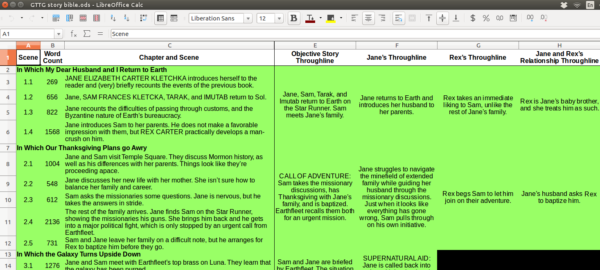
Once I’ve figured out the throughlines, I match them up in a spreadsheet to form chapters. Each chapter breaks down into three or more scenes, which serve to advance the throughlines. The scenes also work together to create a beginning, middle, and end for each chapter.
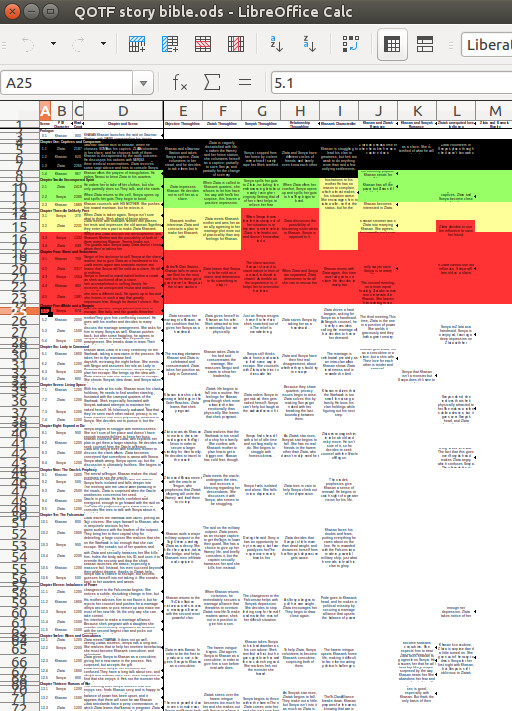
At this point, with the main plot of the book fully outlined, I start to add subplots. These can be romantic, tragic, or just an opportunity for one of the minor characters to shine. I may also add a background storyline with stuff going on behind the scenes that never makes the page, just to keep track of what’s going on.

Where the plot points for the throughlines correspond to whole chapters, the plot points for the subplots correspond to the scene level. A subplot may start or end in the middle of the book, or lay dormant for several chapters. I try to make each scene do double-duty, but add new ones as necessary.

For each of the major characters, I also write up a character sheet. This lists all of the specific details that tend to get mixed up in a rough draft, like hair color, eye color, height, weight, etc. It also gives me a chance to do a deep dive into who this character is and what makes them tick. Besides things like religion, education, occupation level, etc, I also include things like family relations, backstory, strengths and weaknesses, handicaps, etc.

Beyond that, I may draw up a sheet for conflict alignments, or to list all the story tropes that I want to include in the story. It really depends on the book.

Lately, I’ve been experimenting with a process for revising my WIP as I’m drafting it. I keep a sheet for revision notes and color each scene and plot point for which draft phase it’s currently in: red for first draft, yellow for first revision pass, green for second revision pass, and black for final draft.
After fixing all the major issues, usually on the first or second pass, I set a goal to cut 10% of the words in the scene. Usually I end up cutting closer to 20%. This improves the quality of the writing and helps to make it much tighter.

I’m still experimenting a lot with my outlining techniques, trying out new things and refining the things I’ve previously tried. A year from now, I’m sure it will look much different. But the two major parts that do work quite well are the plot outline and the character sheets. Everything else builds on top of that.

And the really cool part is that it actually works. From June to August, I started a full-time job, moved twice, and experienced a family emergency, and I still managed to finish a novel through all of that, largely thanks to this outline. No writing blocks. No failed drafts. Just 600 words a day, no matter what else was going on, and by the end of it, I had a publishable novel.

I think this book will help me to write longer books, too. That’s what I’m working on next. If all goes according to plan, Queen of the Falconstar will be my longest book yet—not by very much, but still a good 10k words longer than Bringing Stella Home, which is currently my longest book. The things I’m learning now will help me to write more epic fantasy, like the next two books in the Twelfth Sword Trilogy. That’s the goal at least.

If there’s nothing else I’d like you to take from this post, it’s this: don’t be afraid to try new things. Don’t put yourself into a corner by saying things like “I’m a discover writer,” or “I’m not really an outliner.” Try it! You learn a lot more from your failures than you do from you successes.

Pantser vs. plotter? There is no such thing

I have come to the conclusion that the “pantsing vs. plotting” way of thinking about writing is as impractical and useless as nature vs. nurture, or talent vs. learned ability.

Are you a pantser who discovery writes from the seat of his pants, or a plotter who has to outline every character, every plot point, and the whole world first? Well, that’s about as useful as asking whether you were born stupid or whether you were taught to be. Probably a combination of both.

The pantsing vs. plotting dichotomy is something I learned early on, when I was just starting out as a writer. At the time, it seemed like a useful distinction to make. Beginning writers tend to make a lot of mistakes, and those range from world-builder’s disease (where you spend all your time outlining instead of actually writing), to rewriting the first chapter into oblivion, to writing yourself into a corner and having all your characters scream at you. It’s amazing how many things you can get wrong. By dividing these things up into pantsing problems vs. plotting problems, it was helpful to figure out how to fix those.

But then you start to identify with one side or the other, and that leads to an entirely new set of problems. Because the truth is that to write well, you need both. A pure pantser often writes himself into problems that he can’t easily get out of, or misses key elements that render the rest of the story moot (like “if only these two people would talk with each other, the obstacles to their romance would all go away” or “if only Hermione would use the time-turner to stop Voldemort from becoming the dark lord, no one else would have to die”). In contrast, a pure plotter often writes stories that are too mechanical and predictable, telegraphing every plot turn and reducing every character into an avatar for some theme or idea.

So, while thinking of it in terms of pantsing vs. plotting may be useful for the beginning writer in diagnosing the areas they need to work on, I’ve found that it’s not particularly useful for the professional writer. In fact, it can be damaging.

For the last several years, I’ve considered myself to be a pantser. Discovery writing is my mojo—give me a few good ideas and the barest outline of a plot, and I’m off to the races. Except… I always tend to stumble and fall in the middle. In fact, I often have to throw out entire chapters or set a story aside for months at a time, to “let the ideas percolate.” For the last several years, that’s been my modus operandi.

Until now.

With Son of the Starfarers, I’m working on a set of very tight deadlines to finish the damn series as quickly as I can. It took way too many months to write book 7, and I can’t afford to take that much time for the last two books because that’s time I’m robbing from other projects (like Edenfall or Gunslinger to the Galaxy or The Sword Bearer). As a pantser, I can write any book if given an infinite amount of time, but that’s not practical. I need to find a new way to write, one that maximizes my efficiency.

And I think I’ve found it. I’m still tweaking it, of course, but it involves <gasp!> outlining. But wait—I’m a pantser, not a plotter! Except, it turns out, that I’m not. Because no one is.

Pantsing vs. plotting does not describe the writer so much as the method of writing. It’s not a question of where you fall on the spectrum, it’s a question of whether this particular project requires more discovery writing or more outlining. And it turns out out that there are ways to outline stories that actually make your discovery writing better. Every battle plan falls apart upon contact with the enemy, but you need the plan to know which direction to march your troops.

In the next few weeks, I’ll go over some of the new outlining methods I’ve been trying out. It took me almost five months to write A Queen in Hiding, struggling over multiple drafts, but it’s been only four weeks since I started An Empire in Disarray and I’m more than 2/3rds of the way through it, with a clean first draft, and I’m on track to have something finished and publishable by the end of next week. There are still a few kinks in the process to work out, but I think I have it down well enough to share.

So if you consider yourself a “pantser” or a “plotter,” and you’re still struggling to write as much or as well as you’d like, I’d urge you to revisit your basic assumptions about your writing process. That’s what I did, and it’s made all the difference.

So it’s the middle of June, and I really should have finished Patriots in Retreat by now, but it’s been difficult to stick to any kind of writing routine, and the story is at that place where everything seems broken and writing through it is like slogging through a swamp.

Call me crazy, but I’m starting to think that’s not healthy. In Brandon Sanderson’s English 318R class at BYU, he always said the most important thing was to power through and just finish the damn thing–that you can always go back and “fix it in post”–but while that’s good advice for a new writer who hasn’t ever finished anything, I don’t think it works very well for my own writing process.

I think that what I need to do is take every weekend to cycle through the entire story from the beginning, not necessarily to rewrite it all, but to bring it into line with the stuff that unfolds later. Invariably, when I get to the three quarters mark of my WIP, it feels like the whole thing is barely holding together and that I’m writing myself into a train wreck.

For the last several years, I’ve tried to just write through that, only for one of two things to happen: either something else catches my interest and I decide to put the WIP on the back burner for a while, or it actually does turn into a train wreck and I have to set it on the back burner for a while in order to approach it with a new set of eyes.

Needless to say, neither of those outcomes is very productive.

Now, I don’t think Patriots in Retreat is broken. I think there’s actually a really good story in there, but it needs a little more excavation in certain parts before I can pull the whole thing out in one piece. This was my first time in years experimenting with the cycling process, and I don’t think I did it enough. Next WIP will be another experiment.

Long story short, I will probably have to push this one back another two weeks, which is going to push the release schedule for Sons of the Starfarers back another month. I’ve got another short story I can use to fill in the gap, but it is a bit of a personal disappointment.

Why is it so difficult to keep my own self-imposed deadlines? Am I really that flaky and unreliable? Not in other aspects of my life. Maybe my writing process really does need a complete and fundamental overhaul. Should make for some interesting future posts.

In any case, that’s what I’ve been up to. I really really really want to write a couple of short stories in a universe that may turn into a recurring one, but those will have to wait until Patriots is finished (hopefully early next week). On the publishing side of things, I’ve got a new short story and short story bundle out—more on that tomorrow! Lots of other stuff too, but it’s mostly behind the scenes, so not worth talking much about atm.

Patriots in Retreat will be finished soon, it’s just in the “this sucks and I’m a horrible writer!” phase. Which, hopefully, I’ll find a way to remove from my writing process altogether, because it isn’t healthy. When I figure out how to do that, I’ll let you know.

Four-part structure and the writing process

Over the course of writing Gunslinger to the Stars, I’ve learned some interesting new things about my writing process, as well as being reminded of some of the basic lessons I learned back when I was getting started. These lessons have helped me to have some fantastic writing days, like today, where I hit 2200 WPH at one point and knocked off 1.7k words before lunch.

Just a week ago, though, I was struggling to write anything, which was strange considering how well the story had been coming along up to that point. The realization that helped me to get through that and get back to writing strong was that my difficulty was a function of story structure, and that different parts of the story require a different process.

What follows are my personal conclusions about my own writing process, which may or may not be similar to your own. Every writer is different, so what works for me may not work for you. At the same time, there are enough similarities that I hope my own process may provide some insight into your own.

Four-Part Story Structure

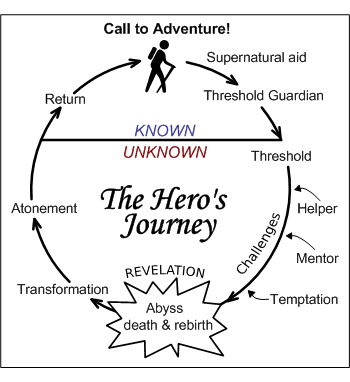
First of all, let’s talk about story structure. There are a lot of different possible structures, but the most common one in the West is the three-act structure. This often echoes the hero’s journey, which goes something like this:

heros_journeyFor purposes of this blog post, I’ll assume you’re already familiar with both the three-act structure and the hero’s journey. If not, there are plenty of other resources where you can learn about them in-depth.

I prefer to think in terms of four-part structure, however, where act two is divided into two halves. In typical three-act structure, the hero hits his lowest point at the midpoint of act two. This is also the midpoint of the story itself, where the hero reaches the nadir of the hero’s journey. In four-part structure, that midpoint is just treated like a plot point, dividing part two from part three. Everything else is the same.

Thus, when you frame a particular story in four-part structure, it looks like this:

  1. The Call to Adventure
  2. Tests, Allies, and Enemies
  3. The Darkest Hour
  4. The Final Battle

Part One: The Call to Adventure

The first part of the story typically starts in the ordinary world, until the inciting incident somewhere around the middle of part one calls the hero to adventure. He then either refuses the call (which usually leads to bad things because the call knows where you live), or he accepts it and has to fight off some threshold guardians to get into the realm of adventure (sometimes, he refuses it and has to fight the guardians). Typically around this point, he meets a mentor to help him on his way.

Prewriting: To get off to a good start, I have found that the key is to know (or at least have a good idea) how the story is going to end before I begin to write it. That way, I know that I’m starting in the right part and I have a general idea where I’m going. I don’t know how I’m going to get there yet, but that doesn’t really matter yet.

Writing: The hardest part about writing this part is the first scene. After that, it usually comes quite easily. It helps to do a bit of world building, or to outline the characters and their backstories, but it isn’t always necessary. Personally, I’ve found that I can discovery-write these things pretty well (and yes, if you haven’t guessed already, I’m a pantser).

Revising: This is usually the part that needs the most revising. It’s also the part that can get me into the most trouble if I don’t do it well. I’m a chronological writer, and if something in the story is seriously off, I have to go back and fix it before I can proceed to the end. I’ve forced myself to finish even when I knew that things were broken, and it only made the writing process worse. So for me, the beginning usually gets the most revision work, whether I plan on it or not.

Part Two: Tests, Allies, and Enemies

Part two is where the adventure really begins. The hero crosses the threshold into the unfamiliar world, and everything is new and exciting. This is also the part where things start to become truly dangerous. Not everyone is who they seem in this part, and the hero may fall into some traps. But the mentor is usually still there to help him get back up.

Prewriting: In my experience, this is the part that needs the least pre-writing. It’s almost always pure discovery. With the ending clearly in mind but still distant enough not to worry about, I can afford to let the story meander a little and take me to some unexpected places.

Writing: This is usually the easiest part of the story to write, for the same reasons as above. I can afford to do almost 100% discovery writing at this part, and it usually feels quite effortless. When the writing does get blocked, it’s usually because something in part one is totally broken.

Revising: Most of the revision process for part two consists of making sure that later events are properly foreshadowed. I usually don’t add enough foreshadowing when I write the first draft, so it’s essential to go back and add it later. Thankfully, this can usually be accomplished by a couple of tweaks, or adding a couple extra paragraphs to an already extant scene.

Part Three: The Darkest Hour

This is where the story gets real. The hero falls into a much larger trap than any of the others, and the mentor can no longer help him (usually because he’s dead). Alone, the hero has to find his own way out, usually hitting rock bottom along the way. Just when it looks like all is lost, some new twist sends the hero in a different direction, setting things up for the final act.

Prewriting: This is where prewriting goes from being unimportant to absolutely essential. Whereas in part two, I can afford to let the story meander a little bit, in part three I absolutely need direction. It’s not enough just to know how the story will ultimately end: at this point, I’ve found that I really need to map my way there.

Writing: This is also typically the most difficult part for me to write. However, when the prewriting is done well and the plot is set up properly, it’s actually not that bad. But it’s important to go really hard on your characters—to make life truly miserable for them. There can be no easy way outs for them, otherwise the entire story will suffer.

Revising: For part three, revising usually consists of putting scenes in the proper order, not in rewriting them completely from scratch. If the foundational elements of the previous two parts were set up correctly, then everything in part three will usually come out well too, but they’re almost always in the wrong order. Transitions then are the part that usually need the most cleanup.

Part Four: The Final Battle

At this point, the hero has a clear direction and a knowledge of how to get there. In climbing up from his lowest point, he finds the boon that will save the world, makes peace with the higher power, and comes back stronger than ever before. But the forces of evil have never been stronger either, and the clash marks the climax of the entire story. There may be a big damn hero moment, or a last minute rescue from the cavalry. There may also be a standoff with no apparent solution, or some truly complex power plays. Inevitably, though, there is a resolution, followed by a return (even if only to the world of adventure). The hero saves the world, gets the girl, and rides off into the sunset. Curtains, applause, and lights.

Prewriting: By this point, most of the prewriting has already been done. The important thing is to have the flexibility to change and adjust, because this is the point where the story often surprises me. It is also the point where discovery-writing is often the most satisfying.

Writing: At this point, I’m usually tearing it up in a white-hot heat of creative energy. It’s extremely rare that I’ll get blocked at this point, but if I do, the key is almost always to just write through it. Often, I’ll make notes of things to change in revision and just barrel ahead—and it works, because there’s no need to set anything up for later. This is the moment of truth, where everything comes together.

Revising: Most of the revision at this point of the story has to do with tying up loose ends. That’s usually not a problem for me, though, because I tend to write very clean. If there is a loose end, it’s usually something that I’ve made a note to fix earlier in the story. For me, the ending is usually the part that needs revising the least.

So there you have it. The biggest lesson I’ve learned just recently is how important it is not to neglect the prewriting aspect of the creative process, especially around part-three. When everything is in place, it makes the story flow so much better.

What are your thoughts? Any plotters or outliners out there with a different take on the process? Everyone is different, but we’re all basically trying to do the same thing, so it’s interesting to see what works for different people!

Writing at a stroll

I haven’t been writing too much these past few days, or revising much either, but I have been rereading a lot of stuff and getting myself back into the fantasy world of my next big novel. I’ve made a few changes, but decided to keep most of the stuff that I wrote while in Georgia, and that amounts to about 50k words.  Just today, I finished the chapter where I’d left off, so now I’m ready to go full steam ahead.

I changed the title from The Sword Keeper to The Sword Bearer, since the story is more about Tamuna than Ivanar, and I may end up adding a subtitle since this is going to turn into a series.  Right now, the tentative deadline for the first draft is September 30th, which should be plenty of time to finish it, even with all the traveling I plan to do for the rest of the month.

The projected total word count at this point is 120k words, but I’m not so sure about that anymore.  I’m in the middle of Part II, at about 52k words, and while I’ve got a pretty good idea of what happens in the next three chapters, there’s a lot in the middle that I don’t know about.  I know how the book is supposed to end, but how to get there is the question, and I’m not sure if it will take me 120k words or 90k words, or upward of 150k words (though I doubt it).  I’ll probably have to discovery write most of it.

I’m looking forward to that, though.  Some of the best stuff pops out of my head when I have no idea what’s supposed to happen next.  Characters take on a life of their own, and reveal some really surprising things about themselves that end up becoming central to the rest of the story.  But to do it well, I need to spend some time just thinking about things in a loosely structured way, allowing myself to get immersed in this world.  That’s why I haven’t been pushing myself too much.

At the same time, I’ve picked up work on another Star Wanderers story, mostly as a way to keep putting words on the page when I just don’t feel up to working on The Sword Bearer.  This is either going to be Part IX or Part X, and frankly I’m really worried about botching it up.  A lot of you have really enjoyed the Star Wanderers stories so far, and I’m pretty sure you’ll like this one too once I’m done with it, but I’m going some places in this book that really make me uncomfortable, and I’m not sure how to do it without crossing the line that makes me never want to make it available for the world to read.

I dunno.  I’m probably angsting about it too much, and should just write the thing and see how it turns out.  But for now, that’s a background project to keep things fresh while I work on The Sword Bearer.  And really, I should probably work exclusively on the novel for the next week or so, just to get some momentum going.  One day, I’ll be really excited to work on it, while the next, I can barely bring myself to open the manuscript.  That’s how I tend to be when I haven’t yet latched onto a project, which seems to be most of the time.

SW-VII Reproach (thumb)Star Wanderers: Reproach (Part VII) is in the alpha reading stage right now, though if you would like to give it a read, feel free to shoot me an email.  I only let people I know in real life read my unpublished stuff, though, and even then only if we’re close friends.  Depending on the feedback, it could come out anywhere between the end of August (unlikely) to the end of September (more likely).

This is another one I’ve angsted a lot over, so I’m not sure when it will be ready but I know it will be before the end of the year.  Part VIII, on the other hand … Part VIII is probably on the verge of being ready right now, and I really want to get that one out soon, so all the more reason to publish Reproach!

That’s about it for now.  I’m heading on the train back to Massachusetts on Tuesday, where I’ll be for most of the rest of the month.  I might put together that A to Z blogging challenge thing as an ebook, just to publish something while I’m on vacation.  That would be a good diversionary project, something to do while on vacation.  Though I certainly plan to write as well–at least 2k words a day, hopefully.  Gotta build up that momentum.

Speaking of which, it’s 2am and I should get some sleep.  Gnight!

I have a confession…

…I’ve started writing a Sword & Planet story.

In case you’re wondering what the heck is Sword & Planet, think Conan the Barbarian in space.  With giant lizards and man-eating plants.  And half-naked princesses getting kidnapped by evil technomancers with giant four-armed bodyguards that wield laser-bladed swords.  Basically, science fiction in the style of the classic 20s pulp adventure novels.

In other words, this:

I’ve read a lot more Heroic Fantasy and Sword & Sorcery than straight Sword & Planet, but I figure there’s a good deal of overlap.  I read A Princess of Mars way back in college and really enjoyed it, and of course I’m a huge fan of Star Wars and other series that were heavily influenced by the genre.  Basically, I want to try my hand at a classic science fiction adventure style, without the scientific rigor of Hard SF or the sprawling world building of Space Opera.  It’s all about the adventure, with liberal helpings of awesome sprinkled with omigoshomigoshomigosh.

The tentative title for this book is The Last Warrior Princess, though it’s about a twenty-something college grad working a wilderness job in southern Utah who accidentally finds a portal to another world while wandering around Arches National Monument.  The princess comes later, though not too much later.  I don’t know much about her yet.

In fact, I don’t know much about the story at all.  I’m discovery writing everything, and I do mean everything.  This is a fly-by-your-pants ready-set-go kind of book, with no restrictions and no limits–just me and the muse, not caring what anyone else thinks.  My internal editor is bound and gagged in the cellar with the spiders, and if he breaks out somehow I’ll hamstring him and toss him back down.  This project might never get another mention beyond this post, but I’m okay with that because it’s going to be a whole lot of fun.

For those of you waiting for the next Star Wanderers story, don’t worry, I’m still writing those too.  This is more of a side project at this point, so I won’t put up a progress bar for it until I get fairly close to the end and know it’s something I want to keep.  Which might never happen.

So basically, it’s just a personal pet project for now.  It’s interesting, though, because when you’ve got nothing to fall back on but your own creative impulses, the words start to flow in remarkable ways.  Take this passage, for example:

I drove up just as the sun was setting. The crescent moon hung like a razor in the yellow-orange sky, with Venus a twinkling point on its edge. Blood-red Mars was not far off, while Jupiter loomed ascendant.

I have no idea where that came from, but in the white-hot creative heat of the moment, it just spewed out onto the page that way.  The only word that I changed was “loomed,” which I had originally written as “hung” (maybe I should change it back? Nah, who cares).  In a little over an hour, I committed about 1,500 words, all just like this.

So yeah, if nothing else, this project will help to shake up my creative process and get the juices flowing for other projects.  I could really use that right now, what with a couple of recent life roles (my grandmother passed away last week, which wasn’t unexpected but it did throw a kink in my already rocky routine).  And who knows?  If it turns out well, you might see me put it out as a novel in a few months.  Or maybe the first part of a new series … nah, better not get carried away.  Better just write it first.

Besides the A to Z challenge (which I may also turn into a book at some point) and Star Wanderers: Reproach, that’s what I’ve been up to recently.  I’ve got a Star Wanderers omnibus in the publishing queue, but there’s nothing firm I can say about that yet, other than it will probably be for Parts I-IV and feature a professional cover (though I plan to keep the space images for the individual installments).  I could say more, but I want to go for a walk.  Later.

Productivity? Yeah, about that…

So, for the past week, I’ve kind of been between projects.  I finished the revisions for Stars of Blood and Glory last Saturday, after a week or two of light revisions, but since then it’s been a bit of a struggle. I’m still working on Star Wanderers: Benefactor, and progress on Lifewalker had been coming along, but haven’t managed to really immerse myself in either those stories yet.  As a result, I don’t really have much to show for this past week, other than a scene or two in Benefactor and a new first chapter for Lifewalker.

One of the problems, I think, is that I haven’t really been able to turn off my internal editor.  Even with my blog posts, I’m constantly going back and rewriting the previous sentence.  This sucks, because it slows down the writing, makes the process tedious and painful, and doesn’t necessarily improve the quality of my writing either (at least, not beyond a certain degree).

What I really need to do is run with a project until I hit my stride, and then do all I can just to keep a steady pace.  So that’s what I’m going to do with Lifewalker this next week: force myself to write without really caring too much about whether the stuff on the page is pretty good.  Because usually, when I don’t angst about it too much, it actually turns out pretty well.  Sure, I might write myself into a hole I can’t get out of (at least, not without breaking the story), but if that’s the case I can always toss out a couple of chapters and redo things.

So far, Lifewalker has surprised me quite a bit.  I have a general direction I want the story to go, and a vague idea of where the main character is going to go up, but when it comes to a particular scene, things will pop up out of nowhere that takes the story in all sorts of interesting directions.

For example, my main character is currently wandering a post-apocalyptic Utah with just a handful of possessions.  One of them is a copy of Brandon Sanderson’s Mistborn: The Final Empire.  At one point, he spends a night among the people living in the ruins of Santaquin (“Sannakin”).  Out of nowhere, I decided to have him read them a chapter or two from the novel, which of course confuses the heck out of them.  So then they start asking him questions, like whether the world before the apocalypse was covered in ash like in the novel, which leads them to all sorts of wild and ridiculous speculations.  The aside only lasts a couple of paragraphs, but it takes things in a whole direction that I hadn’t planned it to–one that really fleshes out the world.

This is my first time writing post-apocalyptic fiction, and while it seems a bit daunting, when I actually sit down and focus on putting out new words, wild and interesting things happen.  The research is a bit daunting, but the story takes place two hundred years after the apocalypse event, so there’s actually a fair amount of leeway.  As long as I’ve got Google Earth running in the background, with ready access to Wikipedia when I need it, I should be all right.

As for Benefactor, don’t worry, that one’s coming along as well.  When I’ve had too much of the post-apocalyptic world, it’s actually quite refreshing to come back to the familiar universe of the Star Wanderers series.  Bouncing between the two stories should be a good way to avoid burnout–though at my current pace, that’s the least of my worries.

Next week is going to be fairly eventful.  I’ve got a job on Monday that will take up most of the day, and LTUE will keep me occupied all Thursday, Friday, and Saturday.  Still, I should be able to get in at least a chapter or two in both stories.  We’ll see how it goes.

That’s about all for now.  It’s getting late, so I’d better turn in.  Night!

On the verge of another story

So with Star Wanderers coming to a close, at least as far as the actual writing is concerned, I’ve recently found myself back in that weird writerly place where I don’t have any pressing projects to work on.  Whenever this happens, I find that it’s generally a good idea to start something new.

Until just a couple of days ago, though, I wasn’t sure which project to start.  At first, I thought I should do the sequel to Stars of Blood and Glory, since I’m currently getting that one ready to send off to my editor, but beyond a tentative title (Empress of the Free Stars) and a really awesome opening scene, nothing has really sparked for that one.  With time, I’m sure my ideas will come together, but for now it’s just not ready to come out of the incubator.

So then I went back to The Swordkeeper, going back over the ideas that had sparked that one.  I started the opening scene back in March, but it’s currently lackluster, and none of my attempts at worldbuilding have gotten me anywhere.  For the past six months, I haven’t really touched it.

But when I took the time to just think about the story, something amazing happened.  All my ideas came together, and the ending just came to me–not just for the first book, but for the entire series.  Seriously, I must have spent hours staring out across the Georgian countryside from my farmhouse balcony, totally in awe of the story in my head.

A similar thing happened to me last summer with Stars of Blood and Glory.  It took me a few months to finally get around to writing it, but when I did, the first draft flew out in just a matter of weeks.  I’ve since made a few relatively minor fixes to the beginning and added some scenes that were missing, but otherwise haven’t made any substantial changes, and the comments from my first readers so far confirm that that’s the right decision.

So if all goes well, I’ll finish up with Stars of Blood and Glory by the end of this next week, and restart The Swordkeeper soon after that.  Things are looking good, and I can’t wait to get immersed in this next story.  It’s a fantasy, so that’s going to be a major shift, but I think it will help to keep things fresh.

Anyhow, that’s all for now.  More later.