Trope Tuesday: Pet the Dog

Awwwww!!

The basic principle behind this trope is that when you want your readers to feel some kind of sympathy toward a character, have them pet a puppy / puppy equivalent.  Often used to show who the good guy is, but can also be used to add depth to a villain.

I first learned about this trope in Brandon Sanderson’s English 318 class, where he taught it as a way to build immediate sympathy when introducing a major character.  A good example from his own work is Mistborn, where Kelsier’s first scene shows him giving the manor lord’s food to the skaa.  From that moment on, there’s never really any doubt that Kelsier is the good guy.

Although often used to introduce a good guy, this trope can also be used quite effectively in the middle of the story, especially in a gray and black world where it seems that everyone’s a bad guy.  A good example of this is Shadow from American Gods, who flips a coin with a hitchhiker to see who pays for dinner.  Even though he’s a thief and an ex-convict, he rigs the coin toss so that he can pay for her.  Through little gestures like this, Gaiman maintains rooting interest in his protagonist, even though everyone else in the novel is basically a jerk.

Another good example from a darker work is Angelo Osic from On My Way to Paradise.  On the very first page, a fugitive shows up at his pharmacy booth, asking him to grow her a new hand.  Even though he knows it’s dangerous, he takes her in and does what he can to help her.  Later on, this same character rips out a man’s testicles and guts him like a fish.  As repulsive as that is, however, I still keep rooting for him because I know that at his heart, he’s a good person.

Of course, when used most effectively, the pet-a-puppy moment has to grow naturally out of a person’s character.  Even though Shadow is an ex-con, he served his time and feels genuinely sorry for what he did.  Angelo Osic is a doctor, so it’s natural for him to try to help others; whenever he commits an act of violence, a part of his humanity dies, which becomes a major driving conflict throughout the book.

Don't. Touch. Me.

Finally, though this trope is often used to create rooting interest in a protagonist, it can also be used to add depth to a villain.  A prime example for this is Captain Nemo from 20,000 Leagues Under the Sea.  The first moment happens when he rescues the main characters after their ship sinks, but it happens many more times too, such as when Arronax finds him weeping over a picture of his family.  At the end of the book, even though we know that Nemo is the bad guy, we can’t help but feel a little sorry for him after he’s gone.

Puppy image courtesy Wikimedia.  Cat image taken by me.
“Who would have thought…”

I would like to address this post to my fellow Mormon readers.

A couple of days ago, I got a discouraging message from some old mission friends of mine.  It said, more or less: “who would have thought that the missionary that taught us the gospel would write such a lurid book?” They were referring to my latest release, Sholpan.

To be honest, it’s been very difficult for me to publish it, because I knew that this sort of thing would happen.  I worry that my friends and family will think that I’ve done something inappropriate, or violated some moral standard, or made myself unworthy in some way.  It’s very difficult to put your writing out there under normal circumstances, much less with complications like these.

However, I would like you to know that I have prayed about this, and that the answer I’ve received is that this is a story worth telling.

Sholpan is about a girl who lives essentially LDS moral standards and falls into what may be the worst situation any of us could imagine for such a girl: slavery in the harem of a powerful warlord who has the power not only to rape her, but to kill her.  By refusing to compromise her values–and risking death to do so–she makes friends in unexpected places and gains a whole lot more power than she ever would have if she’d taken the easy path and compromised.

In other words, it’s a little bit like the story of Esther.  Yes, there are sexual themes, but they aren’t there to be gratuitous or titillating; they’re there to show that even in the face of such horrible immorality, you don’t have to compromise your values.

I know this kind of story isn’t for everyone, which is why I’ve put up warnings in the book descriptions and made it abundantly clear that this book has adult content.  And if you decide you don’t want to read it, I won’t be offended at all.  But please, don’t assume that I’ve gone off the deep end or betrayed my faith, because that’s not the case at all.

It’s a difficult position to be in; I’m sure that Stephanie Meyer’s and Orson Scott Card’s bishops get a lot of mail from fellow Latter-day Saints who feel that they ought to be excommunicated.  But these are the kinds of stories that I feel driven to write: stories that address difficult moral issues and don’t shy away from portraying evil for what it really is.

I appreciate your concern on my behalf, but my faith and spirituality are still quite strong.  You may or may not believe that after reading my books, but please don’t feel like you have to save me.  The best thing you can do is continue to be a positive influence, and let me be a positive influence for you.

T minus 24 hours and counting…

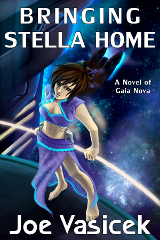
That’s right!  After much wrangling, I formatted it this morning and published it to Amazon this afternoon.  In less than 24h hours, it should be up for sale!

In many ways, Bringing Stella Home is a lot different from Genesis Earth.  For one, the scope is much larger, with the rise and fall of galactic empires and a war leaving billions dead in its wake.

At the same time, however, the stakes are very personal.  It’s not about turning the tide of human history or saving millions of lives; it’s about one boy who doesn’t want his world to fall apart, and will do anything to save the people he loves.

I put a content warning in the description because there’s a lot of darkness in this book.  It’s not for everyone; I know that some of my friends would find it shocking and offensive.  However, it isn’t my intention to glorify evil or celebrate immorality; rather, by portraying it honestly, I hope to make the struggle against it that much more meaningful.  There is, after all, an opposition in all things.

Writing this book was a watershed moment for me.  Not only is it the first book in a series which I hope to continue across many books, but it marked a shift in my writing.  Before the rise of indie publishing, I thought this would be the one that finally broke through the iron gates of the publishing industry and made my debut.  Perhaps that was why I was so reluctant to send it out; I didn’t want to experience the crushing blow of rejections from agents who didn’t think they could sell it, or editors who think that science fiction is dead.

But now, I don’t have to break through those iron gates; now, I can send this story out into the world and let the readers decide whether it’s any good.  And that’s exactly what I intend to do.

For all those of you who have helped bring this project up to this point, I want to sincerely thank you by giving you a free copy of this ebook.  I’ll be sending it out tomorrow, most likely; if for some reason I miss you, please email me and I’ll correct the mistake.  They say that writing is a solitary art, but this day and age, that’s no longer true.  So once again, thank you.

It’s been an exciting journey thus far, and something tells me that it’s only getting started.  I can hardly wait to see what the future will bring!

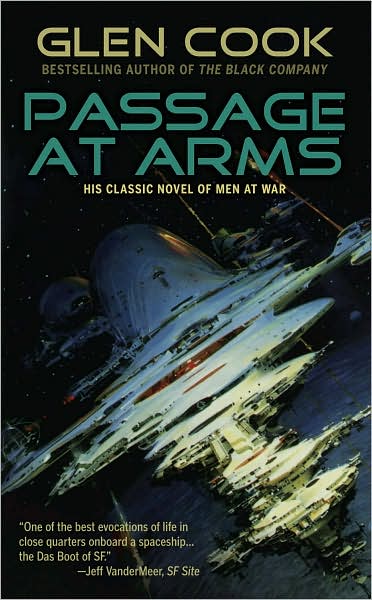
Passage at Arms by Glen Cook

Humanity is losing a long, bloody war of attrition against an alien race.  Our only military advantage lies in the climbers–small, guerrilla style gunboats that can cross into a higher dimensional plane.  Under the right conditions, this technology enables the ships to pass through space undetected.

As the war reaches a critical juncture, one former soldier, now a journalist, joins with the crew of a climber to get the inside story.  What he finds is a far cry from the brave, clean-shaven heroes portrayed by the official war propoganda; the climbers are a gritty, dirty-minded lot of soldiers, cursing the higher ups and living from leave to debaucherous leave.

When worst comes to worst, however, and crap hits the fan, everyone’s true colors come out.  When that happens, who will hold together, and who will fall apart?

I enjoyed this book a lot.  Parts of it were a little raunchy, but never too much for my taste, though your mileage may vary.  Glen Cook leans more towards flowery writing than pure storytelling, and while I had a few minor qualms with his writing style, the book was quite compelling.

Glen Cook really excels at character voice and viewpoint.  Even though the book was military sci-fi set almost entirely in space, it had a very distinct, almost noire feel to it.  Everything that happened was heavily filtered through the main character’s point of view, which made the narrative feel very intimate and personal.  When Charlie dances the foxtrot, you feel like you’re right there in the thick of it.

My favorite thing about this book, however, is the level of scientific realism in the combat systems.  Obviously, things like hyperspace and trans-dimensional drives are entirely speculative, but the orbital dynamics of the planetary siege and visual effects of the nightly bombardment gripped me from the first page.  It didn’t feel pulpy or cartoonish at all–in fact, it felt disturbingly reminiscent of news footage from the ’91 Gulf War, which haunted me for a while as a kid.  This isn’t your typical humans vs. aliens sf adventure novel–it’s like a firsthand account from someone who was there.

My biggest issue with the book was more stylistic than anything else; Cook tends to rely on one-sentence paragraphs to add extra punch–which can be effective, when done sparsely.  However, every page would have at least two or three of them, often occurring one after another.  For me personally, that was a bit too much, but obviously it didn’t keep me from finishing the book, or enjoying it.

So yeah, if you like your science fiction with a heavy dose of gritty realism, you’ll probably like this book.  Even if you don’t, it’s worth checking it out for the orbital dynamics and other interesting details.  Even though it probably isn’t perfect, it feels a lot more accurate than most of the other books out there.