September Shorts 2022: Hunter, Lover, Cyborg, Slave

Whenever I do these short story challenges, the first one always feels like it’s super hard, and I end up spending way more time on it than I thought I would. It also usually ends up a lot longer than I would like. Hopefully the rest of them come faster and easier than this one did.

With that said, I’m actually fairly happy with how this one turned out. It’s kind of a cyberpunk space opera story, dark and gritty, but hopefully with some interesting twists and turns. Also, it’s not a nihilistic story at all, so it kind of breaks from a lot of cyberpunk with that. I really can’t stand nihilistic fiction.

Once again, I used the Mythulu cards to come up with the main story idea. Here are the cards that I drew:

  • JUNGLE: Supports a broad spectrum of life, so competition is fierce. Naturally brings out the strongest, biggest, brightest in everyone.
  • BIOLUMINESCENT: Light emitted by a living organism.
  • HUNTER: Searching with intent to kill. Draw +1 Relationship to explore motive.
    • FAMILIAR: Conduit for magic. Both parties are powerless and ordinary when alone. Represents how relationships transform us for the better.
  • MAN AND MAKER: Maker transforms a raw, useless thing into something extraordinary. Maker’s relationship with creation reveals narcissism or humility.
  • WANTED: Politically important and resisting subpoena or arrest. Authorities are willing to pay bounty to locate.
  • CYBORG: Trades a pound of flesh for superhuman advantage.
  • CHAOS: Source of evolution. Self-aware beings require background chaos for sanity. The amount needed varies.

That last card, CHAOS, got me to think about everything else in a certain way, but by the time the story was finished I don’t think I’d explicitly included that element in the story. That usually happens with at least one of the cards when I do this exercise: it influences how I think about everything else, but then I forget it while writing the actual story.

The thing that made everything come together was the idea of having an AI familiar, like a magic familiar, except with artificial intelligence. This AI is really just a projection of the user’s own subconscious, but augmented with artificial processes so that it interacts with the user like an intelligent, autonomous being.

My wife is getting her PhD in computer science, and she believes that we may never create a superintelligent AI because there appears to be a tradeoff between specialists and generalists. In other words, AI is very good at specializing in specific tasks or areas, but humans are very good at generalizing across all tasks or areas. It may simply be that to create an AI that is good at generalizing, you have to sacrifice its ability to specialize.

The idea of an AI familiar gets around that, because it piggybacks on the user’s own mental processes to do its generalizing, without the user being able to notice. That’s probably not how it works in real life, but this is a sufficiently advanced technology that I don’t feel bad about using a little hand-wavium to explain it. Besides, it makes for a pretty interesting story.

Final word count for the rough draft clocks in at just under 8,200 words. I will probably cut that down below 7,000 after workshopping it, making it a short story by SFWA’s definitions, which (unfortunately) are industry standard.

Blade Runner 2020

Saw this, couldn’t resist.

We’ve got smoke here in Utah, too, but nowhere near as bad as California (for the moment). A couple of new fires started here in Utah Valley over the past week, and it looks like they may have been human caused, but the firefighters put them out very quickly. But whenever California is on fire, the smoke finds its way over here.

Here’s another one:

2020-02-20 Newsletter Author’s Note: Thoughts on the History and Future of Science Fiction (Part 1)

This author’s note originally appeared in the February 20th edition of my newsletter. To sign up for my author newsletter, click here.

One of the projects I hope to get to someday is to make a podcast on the history of science fiction. I’m a huge fan of podcasts, and subscribe to almost 100 of them, and some of my favorites are history podcasts like Hardcore History, History of Rome, Revolutions, The Cold War: What We Saw, etc. At this point in my life, I don’t think it’s the right time to get into podcasting, but at some point in the next few years I’d really like to try my hand at it.

I have thought a lot about what this History of Science Fiction podcast would look like, though, and it’s led to some interesting thoughts about the future direction of the genre. Let me explain.

Modern science fiction began with Mary Shelley’s Frankenstein, which laid the groundwork for just about everything else. Authors like Jules Verne and H.G. Wells picked up the torch, launching “scientific romance” as its own literary genre. Many of the conventions and tropes of science fiction were set during this era, which lasted from the 1820s through the early 1900s.

The next major era of science fiction was the era of the pulps, which experienced its heyday in the 1920s and 30s. The publishing innovations that had made the penny dreadfuls possible only a generation earlier now led to a proliferation of novels and short story magazines, opening up all sorts of opportunities for new writers.

This was the era of bug-eyed aliens and scantily-clothed damsels in distress, as frequently displayed in the cover art. Science fiction, mystery, western, adventure, and true crime stories were all mashed up together. Major names from this era include Edgar Rice Burroughs and Hugo Gernsback, who coined the term “scientifiction” to distinguish the stories that would later be called under the name “science fiction.”

The pulps laid the groundwork for the golden age, which lasted through the 40s and 50s. It was greatly influenced by John Campbell’s tenure as editor of Astounding Science Fiction, and the authors that he mentored. This was when science fiction really came into its own. Major authors from this era include Isaac Asimov, Robert A. Heinlein, Arthur C. Clarke, George Orwell, and Ray Bradbury.

The next major era was the New Wave, when authors like Ursula K. Le Guin, Michael Moorcock, Frank Herbert, and Phillip K. Dick broke out of the conventions established by Campbell and other golden age figures, experimenting with new styles and creating new tropes. This was when we began to distinguish between “hard” science fiction that revolved around the hard sciences like physics and math, and “soft” science fiction that revolved instead around things like political science and social studies. The political radicalism of the 60s and 70s also influenced the science fiction of this era.

At this point, most histories of science fiction point to an era called “cyberpunk” or “the digital age,” which emerged in the 80s and defines the period that we’re currently living through. However, I don’t think this is correct. Instead, I think that literary science fiction went through a dark age from the mid-80s to the late 00s, and only recently began to emerge from it. Let me explain.

In film, TV, and video games, the 80s and 90s were a golden age. For books, however, it was exactly the opposite. The rise of the big box stores like Borders and Barnes & Noble drove independent booksellers out of business, which caused many local distribution companies to collapse. This, in turn, led to a period of mergers and consolidation within the publishing industry, giving rise to the “big six”: Hachette, HarperCollins, Macmillan, Penguin, Random House, and Simon & Schuster.

At the same time, the rise of the internet led to a massive and precipitous decline across newspapers and periodicals, including traditional short story magazines such as Analog and Asimov’s. Most of the science fiction magazines folded, unable to adapt their business models to the changing world. This would later change as podcasting and crowdfunding, but before those innovations would later revolutionize the industry, many considered short stories to be dead.

The effect of all of this was that literary science fiction entered a period of managed (and sometimes catastrophic) decline. As the publishing houses merged and consolidated, their offices all moved to New York City in order to pool talent and resources into one geographic center. However, this also led to problems like groupthink as publishing fell in an echo chamber.

Science fiction began to balkanize. The proliferation of cyberpunk, steampunk, deiselpunk, biopunk, and all the other _____punk subgenres is emblematic of this. Furthermore, as all of the major editors became caught up in the echo chambers of progressive, blue-state politics, they increasingly overlooked red state authors from “flyover country.” Baen, whose offices are in North Carolina, has never suffered from this, but Tor and the other New York publishers really have.

I think Orson Scott Card really bookends this period. In the 80s, he was the first author to win the Hugo and the Nebula in the same year. In the 00s, he was all but excommunicated from the canon for his allegedly homophobic views. Science fiction had transformed from the big tent genre of the 50s, 60s, and 70s to something so balkanized, elitist, and radical that “wrongthink” had unironically become a crime in the very genre that had invented the term.

And then indie publishing happened.

This author’s note is getting long, and there are other things (including writing) that I have to do today, so I’ll have to end on that note. I’ll follow up in my next newsletter with my thoughts on current trends in the science fiction genre, and where we’re heading from here. I think the 20s will see some massive creative destruction, but ultimately I’m hopeful that the best is yet to come. The dark age is over, and there’s never been a better time to be a reader—or a writer!

H is for Hologram

cortanaIn real life, the term “hologram” means something fairly specific.  But in science fiction, it can mean a number of different things.

For example, in Star Wars it’s basically a three dimensional video recording projected on a flat surface.  In Halo, it’s the visual form that the AI character Cortana takes when she wants to interact with the Master Chief.  And in Star Trek, the holograms actually have a degree of physical substance, so that in some episodes they go rogue and try to take over the ship.

The basic underlying idea, though, is the same: blurring the line between the virtual world and the real world through a virtual projection that we can interact with.  And in that sense, this is actually an area where science fact is fast catching up with science fiction.

Some sub-genres, such as cyberpunk, focus almost solely on the tension between the real and the virtual.  Often set in a near-future world, cyberpunk stories often feature a crapsack future, from which the only meaningful escape is a virtual reality.  But the thing about virtual realities is that they can be reprogrammed in such a way as to give the ones controlling it almost absolute power over the lives of the people inside.  For that reason, the main characters are often hackers, struggling against the corporate evil overlords.

But holograms aren’t restricted to cyberpunk.  They’re quite common in space opera, too, and not just because they’re cool.  For one thing, they can be really useful for training simulations (which often leads to holodeck malfunctions, courtesy of the rule of drama).  They can also be useful as disguises or decoys, especially in the Halo series.

But perhaps the most memorable holograms are the ones who develop a close relationship with their real-world human counterparts.  This may include romance, which, combined with the existential angst that typically surrounds androids, robots, and cyborgs, makes for some very interesting tension.  A good example of this is Cortana from the Halo series, an alien AI who took on a younger form of her human handler, Doctor Halsey, and then developed a very close relationship with her Spartan bodyguard, the Master Chief.  It never actually went anywhere (at least in the main series arc), but it certainly made for an interesting story.

Jane from the Ender’s Game series would probably be my favorite hologram, though she’s more of a shapeshifting AI who can take many different forms, depending on what suits her.  Cortana is definitely up there too.  I haven’t used this trope much in my own fiction yet, but I’m playing with it in Heart of the Nebula, a currently unpublished direct sequel to Bringing Stella Home.  Not sure exactly where I want to take it yet, but it should be interesting.

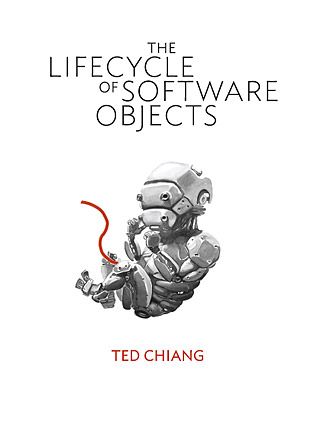
The Lifecycle of Software Objects by Ted Chiang

Ana was a washed-up zoologist turned programmer looking for work; Derek was an avatar designer for the Data Earth virtual reality platform.  The thing that brought them together: Blue Gamma Inc., manufacturer of autonomous self-aware AI pets known as digients.

Like any pet, each digient requires constant attention as they learn and grow.  Soon, Ana and Derek become as attached to their own digients as parents to their children.  But when Blue Gamma goes out of business and the Data Earth platform becomes obsolete, the future for the digients looks grim–until they enter the next phase of their natural evolution.

I really, really liked this story.  It’s got just about everything that makes science fiction so great: futuristic setting, well-rounded characters with believable motivations, one Big Lie with everything else held more or less at the level of our current understanding, and tons of parallels between the fantastic world and our own that makes you step back and really think about things.

The interesting thing about this story was how it played with all the old robot/AI tropes.  Usually, stories of this kind will have the robots rise to transcendence, either becoming the benevolent (or largely absent) rulers of the world, or taking over and enslaving humanity in some fashion. Not so with this story; the scope was much more intimate and personal, driven by characters rather than the Fate of Mankind, and that ultimately made the story much more believable.

If I had any problem with this story at all, it was the ending.  After so much build-up and development, I felt as if it cut off rather abruptly, just as things were getting more and more interesting.  I suppose the author was going for something of a “Flowers for Algernon” feel, but that wasn’t what I took from it.  Or perhaps he ran up against the novella word limit and decided to cut it off; I don’t know.

Regardless, I thoroughly enjoyed this story.  It’s certainly worthy of the Hugo for which it’s been nominated.  Highly recommended.

Is Inception the new cyberpunk?

WARNING: This post contains spoilers for Inception and Neuromancer.

So I just saw Inception for the first time today, and I couldn’t help but notice the uncanny similarities between between it and Neuromancer by William Gibson.  It made me wonder if Inception represents some kind of reincarnation of cyberpunk.

Before I go on, I should confess that I’m not an expert on cyberpunk.  I’ve read Neuromancer, seen Blade Runner, and read a couple of books that are on the borderline (such as On My Way to Paradise).  That’s about it.

However, Inception and Neuromancer have too many parallels to be just a coincidence.  For example, in both stories:

1) the main character is a “hacker,” or someone with an uncanny ability to control or manipulate the virtual reality,
2) the main character gets entangled with hostile corporate entities that threaten his life and are far more powerful than himself,
3) the main character agrees to work for the corporate entities in an illegal, high-stakes heist involving private interests,
4) the main character is haunted by memories of a dead love interest from a past relationship and ultimately confronts that love interest in the virtual reality,
5) the main character rejects the objective reality for the virtual reality.

There are other, broader similarities as well: the near future dystopian setting, corporations weilding more power than governments, significant portions of the population abandoning the objective reality for the allure of the virtual reality, etc.  In particular, the ending of Inception reminded me of the ending of Neuromancer, in terms of ambiguity as well as the emotional twist.

So what does all this mean?  I see I’m not the only one to notice this–apparently, the discussion is already underway.  Is this the next incarnation of cyberpunk, and if it is, what can we expect to see come out in the next few years?

Revelation Space by Alastair Reynolds

Hundreds of thousands of years ago, an ancient race of sentient aliens known as the Amarantin went extinct just as their civilization experienced a golden age.  No one knows why, but archeologist Dan Sylveste is determined to find out.  Unlike the other colonists on the remote planet of Resurgam, he believes that the answer may be important.

He has no idea how right he is.

Just as he’s on the verge of a major breakthrough, a team of rebels takes over the administration of the colony.  Sylveste becomes a prisoner of war, and his research comes to a frustrating halt.

Meanwhile, on Yellowstone (the nearest human-inhabited planet to Resurgam), a mysterious entity known as The Mademoiselle hires assassin Ana Khouri for a special mission: kill Dan Sylveste.

The only ship headed in that direction, however, is an ancient warship commanded by a rouge crew of Ultras, genetically modified transhumans.  They seek Sylveste in order to heal their captain, who suffers from a plague that melds human biology with advanced technology.  The de facto leader, Illia Volyova,  hires Khouri to replace the ship’s gunner, who went mad and mysteriously died.

But neither Khouri nor Volyova realize that the thing that drove the gunner mad still resides deep in the ship’s systems.  It is neither human nor AI–and it knows what killed off the Amarantin nine hundred thousand years ago.

Revelation Space is a space opera unlike any other that I’ve read, with the possible exception of Dune. The far-future universe Alastair Reynolds created for this book is incredibly complex and expansive, almost completely unrecognizable from our own, with technology bordering on godlike, posthuman and transhuman races that are all but commonplace, and nothing but a blurry, indistinct line dividing the human and the machine.  On every page, I felt as if I had left the real world behind for something completely (and often disturbingly) alien.

Setting, by far, is the strongest point of this book.  In fact, as an aspiring writer, I found it  somewhat intimidating.  Reynold’s Revelation Space universe was completely alien, but in ways that made perfect sense for the far future in which it was set.  From this, I’ve learned that to make a far future setting believable, you have to make it…well, as alien and complex as Reynolds makes it.  It shouldn’t be an exact copy of Reynold’s mold, of course, but if it’s 500 years in the future and everyday life still feels exactly like our own–well, there had better be a reason for that.

As for character and plot, I did not feel that those were particular strong points of this book.  It’s not that they were done poorly,  it’s just that they weren’t done well enough, in my opinion.

The characters in Revelation Space did not particular engage me at first; I found that I had to force myself to keep reading, rather than read because I had to find out what happened to them.  Later on, as the story progressed, they grew on me, but I never felt that I intimately knew them.

As for plot, I felt that every fifty or one hundred pages, Reynolds would pause the story and throw something in from left field, simply because he had to foreshadow something coming up.  In this way, the book seemed a little choppy–like a debut novel (and, in Reynold’s defense, this is his debut novel).

Even with these issues, however, this was an incredible book, and it’s stuck with me even months after finishing it.  Reynolds pulled off an amazing ending–very satisfying, with a twist that I had not foreseen but that made good sense.  The final scene, and the last two sentences of the final scene in particular, were just awesome.  They made me want to clap my hands and say “bravo.”

If I could describe Revelation Space in terms of other works, I would say that it’s a cross between Neuromancer and Stargate the movie. While it’s solid space opera, it has a dark and gritty feel that borders on Cyberpunk / post-Cyberpunk.  It’s not exactly the kind of stuff I want to write, it comes pretty darn close.