A Crippling Realization

I have come to realize something that is, in some ways, making it very difficult for me to keep writing. Not in the short or the medium term—I’m actually making quite good progress on my current novel WIP, and am optimistic about finishing my three unfinished trilogies in the next couple of years. But when I look on the horizon, this thing that I’ve come to realize is looming like a storm cloud, and I worry that if something doesn’t change, and change soon, that storm is going to wipe me out.

When Orson Scott Card spoke at the BYU Library in 2007, he made a profound statement that had a great influence on my writing, and my decision to write. He said that stories and fiction are how the culture talks to itself. In other words, if you want to understand a particular culture, look at the stories that it produces.

The problem is that unfortunately, I have come to despise almost everything about our current culture.

I hate all the hypocrisy and virtue signalling that we see online. I hate how that virtue signalling has poisoned almost every major franchise, from Star Wars and Marvel to the commercials and advertisements that we consume on a daily basis. I hate how the virtue signalling of our gatekeepers has allowed our cultural vandals to erase our history and destroy our cultural icons.

I hate how our education system has become corrupted. I hate how it has been transformed into an indoctrination system that brainwashes everyone who goes through it, producing nothing but legions of woke fanatical footsoldiers and hordes of incompetent midwits. I hate how it holds our children hostage for the benefit of the unions, and how it utterly exterminates our children’s natural creativity and curiosity in order to turn them into nothing but cogs in society’s grand machine.

Above all else, I hate and hold in utter contempt how our culture has become anti-life, and promotes the unrestricted wholesale slaughter of our unborn children as a moral good. I hate how this rejection of the value of life has trickled down into every facet of our society, poisoning how we see each other and how we treat our fellow men. I sincerely believe that our ongoing genocide of the unborn exceeds the evil of the Nazi holocaust in every moral and ethical dimension. I also hope that future generations have the moral clarity to hold us in greater contempt than the Nazis, and plan to do everything within my power to make that a reality.

I hate the sexual revolution, and how it eviscerated the traditional family while also producing the most prudish and sex-negative society that this nation has ever seen. I hate how our sexually “liberated” culture celebrates our worst perversions and teaches us to define ourselves by our basest urges, instead of urging us to strive for something higher and better. I despise the transgender movement that is butchering our children and annihilating their innocence, all for the carnal gratification of the worst sexual predators among us.

I hate how our culture rejects the things of God. I hate how that even most self-described Christians have never read the Bible cover to cover. I hate how our churches are led by moral cowards who fear to offend their followers more than they fear to offend the Almighty. I hate how many of our priests and pastors have come to serve Mammon more than they serve God.

I hate almost every book and story that has won a major literary award within my lifetime. When I survey the field of science fiction and fantasy, I see hordes of talented writers willfully prostituting themselves to the spirit of the age, and pleasuring the whore of Babylon for the praise and glory of the world. When I read the books that our culture holds up as the greatest contemporary works, I am disgusted by the sexual depravity and nihilistic materialism that pervades them. Aside from Brandon Sanderson and a few obscure authors whose works the culture is actively working to suppress, I find nothing redeemable or even genuinely thought-provoking in any of these contemptible works.

Most of my readers are over the age of 55, probably because of just how much I hold our contemporary culture in such contempt. And yet, I cannot help but despise the Boomers for robbing me of my birthright and leaving me buried in a mountain of debts that neither I, nor my children, nor my grandchildren will ever be able to repay. Every generation before the Baby Boomers aspired to give their children lives that were better than their own, but the Boomers squandered everything that the previous generations gave them, and left their children sicker, poorer, and more unloved. In fact, the Boomers cared so little for their children that they locked down the entire country, deprived them of the crucial years of their education, and forcefully injected them with an experimental jab, all out of fear that the virus would shave off a few of their rapidly waning years. The Boomers are the ones who gave us our totally dysfunctional education system, Roe v. Wade, the sexual revolution, and the genocide of the unborn. They are the ones who pushed God and religion out of public life, and corrupted our churches to the point where they would not recognize the Lord if He came down and preached a sermon to them Himself. If our country falls into a second civil war, it will be because of the Boomers more than any other generation.

And now we hear of wars and rumors of war in the east, and people tell me that we are closer to nuclear annihilation than at any other point in my lifetime. And yet, when I look at how corrupt and utterly depraved our society has become, I cannot help but wonder if that would be such a bad thing. We read that the sword of the wrath of the Almighty is bathed in heaven, and that the angels are pleading with the Lord to let it fall, so that it will purge our iniquity from the face of this Earth. Sometimes, I find myself raising my voice with the same plea.

I recognize that “the culture” is not monolithic, and that there are many people who hold similar opinions and think and feel the same way that I do. And I hope you don’t take the wrong idea from this rant: I’m not about to throw my life away, or do something terrible. I have a loving wife and family, and friends in my life who are genuinely good people. It’s funny how that even as things seem to get worse and worse as far as the country is concerned, the people immediately around me don’t seem nearly as bad, and my own personal life actually seems to be getting better.

But as a writer, it’s my duty and responsibility to be a part of the wider cultural conversation, in order to write stories that resonate properly with my readers. To do that, I need to keep my finger on the pulse of a culture that I have come to hold in utter contempt.

How long can this situation stand? Either the culture needs to change, or I need to change something about what I’m doing, which means that I should probably change myself. Should I change my view of the culture, or should I channel that contempt into my writing somehow?

One of the reasons I started writing the Zedekiah Wight stories under my J.M. Wight pen name is to help maintain my sanity in the face of this dilemma. I just finished writing a short story where Zedekiah basically instigates the nuclear annihilation of the galaxy, because of the reasons I outlined above. I was planning to release that story in April, but I may move it up a couple of months. Zedekiah Wight is the character who fascinates me the most right now, even though almost half of my writing group despises him. Is he a madman, or is he the last sane man in a galaxy that has gone absolutely insane? I honestly do not know.

And what about me? Is my utter contempt of the culture a sign that I’ve gone crazy, or that the world has gone crazy all around me? And what does that mean for my writing?

Do trans people exist?

There’s this video clip currently making the rounds where Senator Josh Hawley (R-MO) confronts a crazy-eyed law professor from Berkely and gets called out for, among other things, saying that trans people “don’t exist.” It’s a highly partisan exchange that I’m sure will be used by both sides to rally the base, but it also gets at the fundamental incoherence of the modern LGBTQ+ movement, which I find absolutely fascinating.

First of all, it’s worth examining the accusation that Hawley doesn’t think that trans people “exist.” What exactly does that accusation mean? It can actually mean one (or both) of two things:

  1. The category of “trans” is not (or should not be) a legitimate identity for legal and societal purposes.
  2. People who identify as “trans” should be un-personed and deprived of all their basic human rights.

It’s extremely disingenuous of the professor to conflate those things, because it is entirely possible to believe the former without believing the latter: that is, to believe that “trans” as a category is illegitimate while also acknowledging that people who identify as “trans” are still people and deserving of basic human rights. Also, it’s disingenuous of her to argue that denying “trans” as a category causes people who identify as “trans” to commit suicide, as the suicide rate for transgender people is the same after they transition as it is before they transition. But I digress.

The thing that makes this interesting, at least to me, is that if you follow the professor’s logic to its conclusion, it actually undermines the fundamental premise of the gay rights movement: that gays, lesbians, and bisexuals didn’t choose to be gay, but in fact were “born this way.” Allow me to explain.

At first, the argument was “I didn’t choose to be gay, I was born this way.” Thus the concept of sexual identity was born, with categories for heterosexual, homosexual (gay/lesbian), and bisexual.

Then, the argument was “I’m a man/woman who was born in a woman’s/man’s body.” In other words, that gender and sex are separate things, and it is possible to identify with a gender that is different than your sex. Thus, the concept of gender identity was born, and with it the category of transgender.

At this point, it’s important to point out that the “born this way” argument still held sway. The idea wasn’t that trans people choose to change gender, but that they were, in fact, born in the wrong body. Thus the distinction between sex and gender.

But once the trans category was added to the movement, transforming it into LGBT, that created a major epistemological problem for its members: how do you know which category you belong to? That is, how do you know whether you’re actually a gay man, or really a woman in a man’s body? You can’t be both. You were either born one way, or you were born the other. So which one is it, and how do you know?

This is where the movement began to fall apart, because there is no objective way to tell the difference between gay/lesbian and trans. It’s entirely subjective. And once we allowed that, suddenly we got a bunch of people saying things like:

“What if I feel like a man today, and a woman tomorrow?”

“What if I don’t feel like a man OR a woman?”

“What if I feel like I’m actually a cat, or a wolf?”

“What if I feel like I’m a totally different gender/sexual category that none of y’all have imagined yet?”

And suddenly, just like that, the “born this way” argument was completely undermined, because if gender and sexuality are subjective, then it can be whatever you want it to be. Which is how we got personal bios like this one:

Serah Eley is a software developer and former podcaster who once produced a weekly science fiction podcast called Escape Pod. It’s since gone on to become somewhat successful. She strangely mispronounced her name as Steve Eley at the time; she’s since realized that life is much more fun as a woman, and came out as transgender last year. Serah lives in Atlanta, Georgia with her two wives, Alison and Cat.

So if there were ever any betting pools on what happened to Steve: changed sex, joined a committed lesbian love triangle is the dark horse winner. She is, obviously, still Having Fun.

So gender is something you can change on a whim because it’s “more fun”? That doesn’t sound at all like Serah was “born this way.” It sounds a lot more like “reality is whatever I want it to be.”

But if sexuality and gender are all subjective, the entire premise that the movement was originally built upon—that LGBT people are “born this way”—is completely false, and the “born this way” argument is outdated at best, and at worst was a Trojan Horse for the LGBTQ+ agenda from the very beginning.

Either way, by the standards of this Berkeley professor, gays, lesbians, and bisexuals “don’t exist.”

Just like man and woman “don’t exist.”

Just like objective reality doesn’t “exist.”

Because biological sex, “born this way” arguments, and objective reality itself are all fundamentally transphobic.

That’s where you get if you follow the LGBTQ+ logic to its ultimate conclusion. The fundamental premises on which the movement is based are totally incoherent and self-contradictory. It’s remarkable, really, because the language the movement uses is not all that different from the Orwellian doublespeak of 1984.

But hey, I’ve also been reliably informed that reason and logic are all just constructs of white supremacy, so obviously that means that professor crazy-eyes is right and there’s nothing to see here. Move along. Move along.

#GiveThanks Day Seven

(87) I’m grateful for my pilgrim ancestors who came to this country seeking to build a more godly community, and gave us a heritage of self-government and self-sufficiency.

(88) I’m grateful that my pilgrim ancestors actually survived, which was not at all a foregone conclusion, or even likely.

(89) I’m grateful for the native Americans like Squanto who welcomed the pilgrims and helped them to make it through that first winter, when everything was so precarious.

(90) I’m grateful that the tradition of Thanksgiving was established in our American culture, and that we have a holiday where we remember the pilgrims and the contributions that they made to our culture and history.

(91) I’m grateful for turkey and cranberry sauce. It’s a wonderful combination of flavors, and I always forget how good it is until Thanksgiving rolls around.

(92) I’m grateful for Thanksgiving leftovers and how delicious they are!

(93) I’m grateful for the opportunity to celebrate Thanksgiving with family this year, and that Utah wasn’t nearly as Draconian with the lockdowns as some places.

(94) I’m grateful for all of the people who are defying the lockdowns to practice their religion and celebrate the holidays. At this point in the pandemic, given all that we now know about the virus and how to treat it, I consider it an important act of civil disobedience against would-be tyrants who care less about our health and safety and more about power and control.

(95) I’m grateful for the unexpected growth in book sales that I’m currently experiencing, and the fact that my sales have more or less held steady through this difficult time.

(96) I’m grateful for how much I’ve grown as a writer in just the last few years.

(97) I’m grateful for every short story sale that I’ve made, including the ones to the token paying markets.

(98) I’m grateful for all of the readers who follow my newsletter and reach out to me via email from time to time. I wish I could respond in a timely manner to all of them!

(99) I’m grateful for all of the readers who take the time to post a rating or a review. It really does help other readers to find and enjoy my books.

(100) Finally, I’m grateful to be alive in what is, without a doubt, the best time in history to be a reader or a writer!

Of pioneers and politics

Today is Pioneer Day here in Utah, where we celebrate the achievements and heritage of the Mormon Pioneers. One hundred and sixty-eight years ago today, Brigham Young looked over the Salt Lake Valley (a barely hospitable desert at the time) and declared “this is the place.”

I feel a great deal of pride for my pioneer heritage. My ancestors walked across the plains in the Willie Handcart Company, they organized one of the most successful cooperatives of the United Order, they fought in the Utah Wars, and they built numerous cities across the Intermountain West. Before the pioneer exodus, they built and later abandoned the Nauvoo Temple, endured the horrible conditions at Winter Quarters, and left trails of bloody footprints as they fled their homes and lands during the Missouri persecutions.

One of my direct-line ancestors was Lyman Wight, leader of the Mormon Militia. When the Missouri mobs captured the Mormon leadership and a kangaroo court sentenced them all to death, Lyman Wight’s reputation was so fierce that the mob hesitated to execute him. They offered to let him free if he would renounce Joseph Smith.
Lyman Wight looked the Missourians in the eye and said “Joseph Smith is the best friend you ever had.”

The leaders of the mob asked him why he said that.

He told them: “if it weren’t for Joseph Smith, I would have slit all your throats years ago.”

The mob then threatened to execute him. Lyman Wight answered without hesitation:

“Shoot, and be damned.”

None of the members of the mob dared to execute him, fearing that his ghost would haunt them to the end of their days.

There are tons and tons of stories like that in my family, and even more that belong to my friends. History is alive here in Utah, where monuments to our pioneer heritage are scattered throughout the state.

The Mormon corridor has a very unique subculture compared to the rest of the United States. It’s a unique and sometimes paradoxical blend of individualism and collectivism, of self-reliance and communal spirit, of libertarian ideals and obedience to moral authority. To an outsider, I’m sure it must be extremely perplexing, but there’s nowhere else in the United States where I feel so totally at home. These are my people. This is my home.

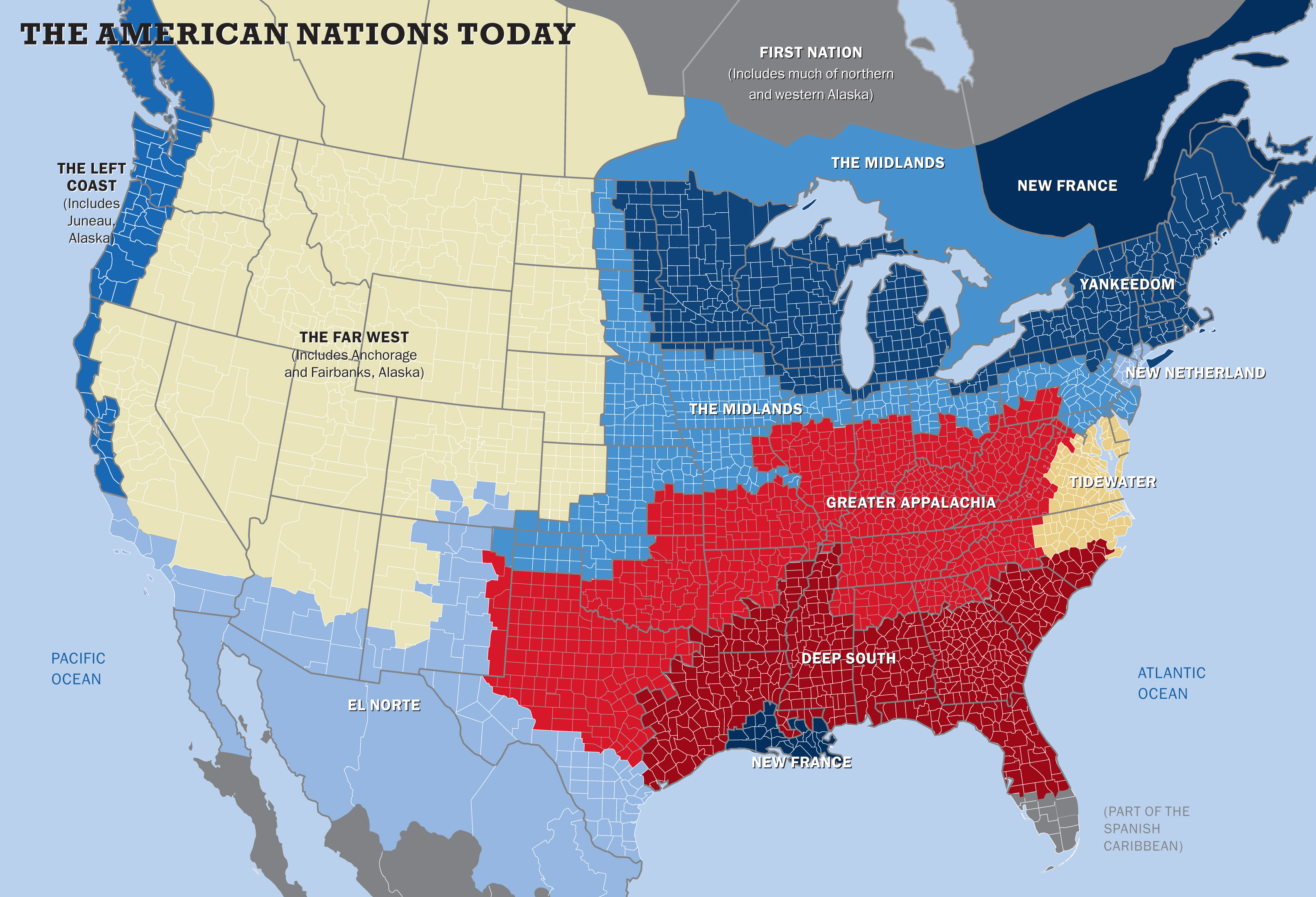
upinarms-map-largeThat’s why I found this map of the “eleven American nations” so fascinating. According to the corresponding Washington Post article, almost all of the battles in the culture wars can be explained by the lines on this map. Furthermore, the mobility of American society is causing these regional differences to grow sharper as Americans pick up and move to the places where the dominant culture best suits them.

A further explanation can be found here, where the author of the map (and the book American Nations) states:

The borders of my eleven American nations are reflected in many different types of maps—including maps showing the distribution of linguistic dialects, the spread of cultural artifacts, the prevalence of different religious denominations, and the county-by-county breakdown of voting in virtually every hotly contested presidential race in our history. Our continent’s famed mobility has been reinforcing, not dissolving, regional differences, as people increasingly sort themselves into like-minded communities, a phenomenon analyzed by Bill Bishop and Robert Cushing in The Big Sort (2008). Even waves of immigrants did not fundamentally alter these nations, because the children and grandchildren of immigrants assimilated into whichever culture surrounded them.

The thing that I find most fascinating about this map is how closely the borders of the Far West “nation” parallel the State of Deseret, first proposed by Brigham Young and the Mormon pioneers. The Mormons didn’t get along very well with Congress, and the territory was eventually pared down to the current boundaries of the state of Utah (the name “Deseret” was also replaced). But cultural boundaries cannot be declared by presidents or kings.

According to the author, the development of this region “was largely directed by corporations headquartered in distant New York, Boston, Chicago, or San Francisco, or by the federal government, which controlled much of the land.” I’m not so sure that’s the case, however. Corporations certainly became important players after the railroads crossed the country, but culturally, I would argue the pioneers had a much deeper and more lasting impact.

The Intermountain West is remarkably conservative, with Utah ranking as one of the reddest states in the nation. With the government expansion under President Obama and the Tea Party revolt in the Republican party, the politics in this part of the country have taken a decidedly libertarian turn. As issues like healthcare, gun control, gay marriage, and late-term abortion have each swept the nation in turn, my positions have changed to reflect the libertarian attitudes of the culture in which I live.

In 2008, I considered myself “agnostic” as far as politics were concerned. Perhaps there was a greater truth out there as far as politics were concerned, but I wanted nothing to do with it. Now, however, I believe very strongly that individuals and families should be free to live their lives as they see fit, without being subject to Leftist schemes to redistribute their wealth or bloated, self-serving government that overreaches its constitutional bounds.

I think this view would resonate very deeply with the pioneers. They came to the West to practice their religion freely, and emphasized self-reliance and thrift. Their industriousness was a means of guarding their independence from the governments that had oppressed them in the east, and continued to oppress them as they sought to build their Zion. Though they could be quite collectivist at times, it was local and voluntary, a far cry from State-enforced socialism. And while they cared for the poor and needy, they did all they could to keep them from becoming dependent on welfare.

These are interesting times we live in, and interesting cultures we hail from as well. As I look back on my own pioneer heritage, I can’t help but look forward as well. The “shoot and be damned” independent streak of my ancestors is still with me today, and I have no doubt that pioneer spirit will continue to guide me in the future.

W is for Wagon Train to the Stars

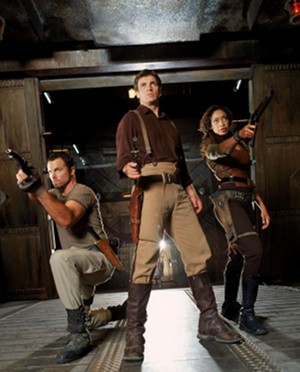
big_damn_heroes_moment_smallWhen Gene Roddenberry pitched the original Star Trek series back in the 60s, Westerns were all the rage.  Consequently, he pitched his show as a “wagon train to the stars,” where a bunch of quirky characters on an awesome starship travel from adventure town to interstellar adventure town, exploring and pioneering the final frontier.

Sound familiar?  Yeah, I thought so.  The concept proved so catchy that it’s been redone time and again, from Battlestar Galactica to Firefly to Doctor Who.  Even though Westerns aren’t nearly as popular as they used to be, many of its tropes are so well suited to Science Fiction that they drive the genre even today.

For example, adventure planets.  In a typical Western, the characters travel from town to town, with a different adventure in each one.  Well, in Science Fiction, the characters do the same thing, except that they’re traveling from planet to planet.  And really, if you’ve got the ability to travel to other worlds, how can you not have an adventure in each one?

A large reason for the Western / Science Fiction crossover is the whole concept of space as the final frontier, which we explored earlier in this series with I is for Interstellar.  There’s a very real sense of manifest destiny in the space exploration community, not because of humano-ethnocentrism (heck, we don’t even know we’re not alone in our local stellar neighborhood), but to ensure humanity’s long-term survival.  The parallels between that and the westward movement in 19th century America aren’t perfect, but they do exist.

Similarly, as we explored in R is for Rebel, the notion of space as the final frontier has a special resonance with the American audience.  The days of the old frontier may be over, but its spirit lives on in our culture, from guns to road trips to our glorification of the rugged, self-made individual.  Today’s Science Fiction, especially the space-focused SF of Space Opera, grew out of the adventure fiction of the pulps, which thrived on that frontier American ethos.

In fiction, the frontier can still be found in two major genres: the Western, which is historical and therefore more backward-looking, and Science fiction, which is futuristic and therefore more forward-looking.  Because Science Fiction isn’t burdened with all of the historical baggage of the traditional Western, it’s a much more flexible medium for story, readily adaptable to contemporary issues and concerns.

For example, where Star Trek echoes the large-scale nation to nation conflicts of the Cold War (Federation vs. Klingons and Romulans), the new Battlestar Galactica series echoes the much more asymmetrical conflicts of the post-9/11 world (Cylon agents who are indistinguishable from humans and may not even know that they are cylons).  At the same time, the wholesale co-opting of Western tropes enables a latent sense of nostalgia, evident in the look and feel of Firefly, or the famous opening lines from Star Wars: A long time ago in a galaxy far, far away.

My first real experience with a wagon train to the stars type of story was probably Star Trek: Voyager, which I watched religiously with my dad every Wednesday night until maybe 9th or 10th grade.  The Western-borrowed tropes are somewhat more muted in that series, but they exist, especially the planetville / adventure towns stuff.  However, it wasn’t until Firefly and Serenity that I really experienced the awesomeness of a true Space Western.  There were a lot of things in Firefly that I really loved, especially the character interactions, the gun-toting action scenes, and especially the starship Serenity.  There were some things I didn’t like so much, like the fact that every planet is basically Wyoming, but overall I really enjoyed the show.

It wasn’t until I started getting more acquainted with straight-up Westerns that I saw the real potential for crossover between the genres.  Stories about mountain men like Jeremiah Johnson really captured my imagination–what would this look like if it were set in space?  In that sense, I came to the Space Western more from the classic Science Fiction side first, rather than the pulp adventure stuff.  But once I discovered the crossover connection, it naturally found a way into my own work.

That’s basically how the story idea for Star Wanderers first came to me.  I was lying on my bed, daydreaming about having my own starship like the Serenity, when I wondered what it would be like for a starship pilot to get roped into an accidental marriage like in the movie Jeremiah Johnson?  The collision between the two ideas was like a supernova exploding in my brain.  I rolled out of bed and started writing, coming up with chapter one of Outworlder almost exactly like it’s written today.  And the more invested I became in those characters and that world, the more the story grew.  I’m writing Part VII right now (Reproach, from Noemi and Mariya’s POV), and so long as people read them I’ll keep writing more.

Genre mash-ups and crossovers are a great way to keep things fresh and come up with some really interesting stories.  Some genres aren’t very well suited for each other (Erotica and Middle Grade, for example), but others come together so well that they seem almost complementary.  That certainly seems to be the case with Westerns and Science Fiction, at least here in the United States where the spirit of the frontier still echoes through the popular culture.

U is for Universal Translator

In science fiction, whenever two characters from different planets or different alien races have to interact with each other, they almost always speak the same language or have some sort of universal translator that magically makes them able to communicate with minimal misunderstandings.  This is especially common in Star Trek, though it happens in just about every franchise involving a far-future space opera setting of some kind.

I’ve got to be honest, I think this is a cheap plot device that almost always weakens the story.  As a writer, it’s tempting to have something like this so you don’t have to deal with any pesky language barriers, but when you do this, you remove a major potential source of conflict, thus violating the rule of drama.  Also, you make your fictional universe feel a little less grand, your aliens a little less alien.  After all, if everyone can perfectly understand each other, then there must not be a huge difference between Earth and the far side of the galaxy.

There are some times when having a universal translator allows you to broaden the story and focus on other conflicts.  For example, if some sort of interstellar legislation is under review in the grand galactic council, you can’t spend all your time focusing on basic communication difficulties.

However, if this is the case, then you can usually overcome the language barrier through other means–a galactic lingua franca, for example, or translation tools that may or may not misfire on occasion (much like Google Translate).  Of course, if you’re writing a comedy like Galaxy Quest (or parts of Star Control II), then falling back on a universal translator is forgivable.  But if you’re going for believability and a sense of wonder, this trope isn’t going to do you any favors.

While linguists and technologists have been working on translation programs for some time (and admittedly making some significant breakthroughs), I’m extremely skeptical that we will ever develop a perfect universal translator in real life.  If we do, I expect we will have to develop a sentient AI as a prerequisite, since the nuances of language are so inseparable from the things that make us human.

Here’s how translation services like Google Translate work:

  1. They amass an enormous database of language material by scanning websites, newspapers, and other documents.
  2. They analyze this database to look at word combinations and frequencies, observing the likelihood that any one word will appear in combination with any others.
  3. They compare these combinations and frequencies with those in other language databases to match words and phrases.

This data crunch method of translation works fairly well for simple words and phrases, but it falls apart in the more complex grammatical structures.  I see this any time I try to use Google Translate with an Arabic source.  Arabic is an extremely eloquent language, with all sorts of structures that simply don’t work in English.  One mistranslated word can completely change the meaning of the entire text, and even when it works, the technically correct English translation sounds as if it’s full of errors.

The methodology also falls apart for languages that are too small to have much of an electronic database.  The Georgian language is a good example of this.  It’s spoken by only about 4.5 million people worldwide, most of them in the country of Georgia, which is predominantly rural.  Internet access for most of the population is very limited, and most Georgians who do communicate online tend to use the Roman or Cyrillic alphabets more often than their own.  As a result, Google Translate for Georgian is utterly useless–seriously, you’re better off just sounding out the letters and guessing at the meaning.  There are some other sites like translate.ge that try to fill the gap, but they seem to rely on actual lexicons, not databases and algorithms.

All of this is between entirely human languages that developed in parallel on the same planet–indeed, languages between human cultures that have traded and shared linguistic influences for thousands of years.  What happens when we encounter an alien race whose biology makes it impossible for them to make human-sounding noises?  Or an alien race that communicates through smell or electromagnetic impulses instead of sound?  What happens when humanity is spread out across hundreds of star systems, each of which periodically becomes isolated from the others for hundreds or even thousands of years?  When our definition of human is stretched so thin that we would not even recognize our far-future descendents as anything but alien?

There is so much wasted potential whenever a science fiction story falls back on a universal translator.  Case in point, compare Halo I, II, and III with Halo: Reach.  In the first three games, the Master Chief’s universal translator enables him to hear exactly what the enemy Covenant troops are saying.  This is great fun when you’re chasing down panicked grunts, but it tends to get old after a while.  In Halo: Reach, however, the human forces haven’t yet developed a universal translator, so everything the Covenant say is in their original language.  All of a sudden, the game went from a hilarious joyride to a serious war against aliens that felt truly alien.  That one little change did wonders to the tone and feel of the entire game.

Needless to say, you won’t find a universal translator in any of my books.  In Star Wanderers, the language barrier is the heart and soul of the story–it’s a science fiction romance between two characters from radically different worlds who don’t speak the same language, and yet overcome that to develop a strong and healthy relationship.  In Sholpan and Bringing Stella Home, Stella knows a language that is fairly similar to the one spoken by the Hameji, but there are still words and phrases that elude her.  This detail is critical because it impedes her ability to understand and adapt to the Hameji culture, leading to some major conflicts later in the book.

As someone who’s lived for significant periods of time in Europe and Asia and learned languages very different from English, I can say that the language barrier is not something that we as writers should avoid, but something that we should embrace.  There are so many interesting stories that can be told when two characters don’t speak the same language.  Please, don’t be lazy and write that out of the story through a cheap plot device!  Let your aliens be truly alien, and your worlds and cultures so fantastic that we can’t help but feel hopelessly lost in them.

T is for Terraforming

[NOTE: this post is a reprint of an earlier post from the Trope Tuesday series, which you can find here.]

The fantasy isn’t that Mars could actually look like this, but that NASA might actually get the funding.

One of the problems with interplanetary colonization is that Earth-like worlds are fairly rare (though possibly not as rare as we once thought). In our own solar system, the only other world that comes anywhere close (Mars) is a radiation-blasted desert with only the barest hint of an atmosphere and a surface temperature colder than Antarctica. To get around this problem, you can do one of two things: build an artificial enclosed environment to house the colony, or change the world itself to make it more Earthlike–in other words, terraform it.

The actual science of terraforming is way over my head far too complex to do it justice in this post. Instead, I’ll just point you to the Terraforming Wikipedia page as a starting point and focus on how the concept is used as a story trope.

According to tvtropes and Wikipedia, the term came from a 1942 novella by Jack Williamson titled “Collision Orbit.” The concept of changing the environment of an entire planet actually goes back much further, with H.G. Wells subverting the trope in War of the Worlds (instead of humans terraforming other worlds, the hostile Martians try to xenoform Earth to make it habitable for them). Before the U.S. and U.S.S.R. put probes on the surface of Mars and Venus, it was fairly common for writers to speculate that those planets were able to support human life, at least on a basic, rudimentary level. Once the science showed that that isn’t actually the case, terraforming as a story trope really began to take off.

Today, this trope occurs commonly across all ranges of the Mohs scale. Soft sci-fi stories (such as Firefly) use it as an excuse to have planets that look and feel like Earth. Hard sci-fi stories (such as Red Mars, Green Mars, and Blue Mars) use it as a fundamental premise, or to pose questions like “what is the ultimate destiny of human evolution?” or “how important is it to our species’ survival that we spread out beyond Earth?” Although it’s not something that we as a species have (yet) done, our present science seems to place it well within the range of the plausible, and that means that makes it fair game for any kind of science fiction.

In order to be believable, however, any significant terraforming project requires two things: resources and time. LOTS of time. We’re talking on the order of centuries and millenia here. Because of that, stories that use this trope generally fall into the following categories:

  • The terraforming happened a long time ago and is part of the world’s ancient (or near ancient) history.
  • The terraforming is on-going and directly impacts almost every element of the world’s culture and setting.
  • The terraforming has failed in some way, which may (or may not) make it a key element in the story conflict.

As with generation ships, the scope of this trope spans more than just the interests of a single character–it deals with the ultimate destiny of entire cultures and civilizations. In hard sci-fi stories, the planet that’s being terraformed may actually become more of a character in itself than the individual people who are terraforming it. Unless they have some form of immortality, they have little hope of ever seeing the ultimate end of it.

Of course, that almost makes the project more of a religion to the colonists than a science, with all sorts of interesting philosophical and story implications.

Why is this trope so widespread in science fiction? I can think of a few potential reasons. First, it hits on some of the key issues that lie at the very heart of the genre, such as the ultimate destiny of humanity and the ethical issues surrounding our ability to play God through the wonders of science. Also, it captures the imagination in a way that few other tropes can equal. Because the scope of any terraforming project is so vast, the implications touch on almost every key element of the story, including setting, character, and conflict.

But on an even more fundamental level, it hits on one of the key elements of any fantasy magic system: limitations. We can’t live on an alien world because the conditions are too hostile, but we can’t just wave our hands to make it Earth-like either. We have to undergo a painstaking, laborious process that could unravel at any point and throw everything we’ve worked for into chaos. We have to dedicate our whole lives to the project for dozens of generations before it will ever pay off. There are no shortcuts–none that won’t strain our readers’ suspension of disbelief, anyway. But if it all works out, then we will have created a new Earth–and how is that not magic?

Needless to say, I’m a big fan of this trope. I’ve used it in just about every science fiction story I’ve written, though I probably play with it the most in Star Wanderers. The main character of that story comes from a world where a terraformation project failed, having severe religious implications that drive the whole series. Sacrifice is largely set in orbit around a world that is midway through the terraforming process. Elswhere in the Gaia Nova universe, people build domes just as often to keep humanity from screwing over a terraformed world as they do to provide room to live on one that isn’t. After all this, though, I feel like I’ve only begun to scratch the surface of this trope. You can definitely expect to see it in my work in the future.

R is for Rebel

rebel_allianceJust as sprawling interstellar empires are a staple of space opera, so are the plucky rebels that fight against them.  From Star Wars to Battlestar Galactica, Firefly to FTL, there’s no shortage of characters in science fiction trying to stick it to the man.

I’m not sure how it is in other cultures, but in America, it seems like science fiction upholds a host of values closely related to rebel tropes, such as self-reliance, individualism, freedom and independence, frontier justice, enterprising self-made men, etc.  A lot of this probably grew out of the genre’s early ties with pulp-era adventure fiction, which often featured former Confederate soldiers leaving the civilized world for the realms of adventure following the US Civil War.  That’s certainly the case with John Carter in A Princess of Mars, and echoed to some extent with the Browncoats from Firefly.

It may go even further, though, to the revolutionary origins of the United States itself.  The frontier has always loomed large in our culture, shaping our values in the early days of settlement and, now that the age of the frontier is largely over, standing for an idealized nostalgic past.  Americans have always favored the self-made individual who stands up to injustice and corruption in high places, and we’ve always had an aversion to the centralization of power and authority.

Back in the days of the Cold War space race, when writers like Heinlein and shows like Star Trek really started to popularize the genre, there seems to have been a real push to promote American identity and values.  The science fiction of that day certainly got caught up in all that, which is weird because as pro-Americanism became the establishment, a genuinely rebellious counterculture began to push back.  To its credit, though, there was plenty of science fiction that embraced the counterculture, especially in the New Wave movement that followed the Golden Age.

So why are we so enamored with rebels?  Probably for the same reason that we all love a good rogue.  Since space is the final frontier, it’s naturally the kind of place that would attract a more rugged, individualistic type.  At the same time, rogues and rebels are much more likely to have exciting adventures than the more mild-mannered folk who are apt to stay at home and conform.  Let’s not forget that most people who read science fiction are adolescent boys (of all ages), hungry for adventure and often a little rebellious themselves.

Though the rebels are often the good guys, that’s not always the case.  It all depends on who they’re fighting against, and how black and white the story is trying to be.  If they’re fighting against the Empire, then they’re almost always courageous freedom fighters standing up for truth and justice and all that, but if they’re fighting against the Federation, things can be a lot more gray.  In FTL, for example, the rebels are the outright antagonists, and you have to save the galaxy by defeating them.

The rebels don’t always win, either.  In stories like Star Wars that skew towards idealism, then in the end they usually do, but in darker, grittier tales (such as most cyberpunk), they may or may not.  And even in some happy-go-lucky adventure stories, the rebels are apt to be martyrs for a lost cause–again, think of the Browncoats from Firefly.

The wide variety in the role of rebels in science fiction is a good indication of a healthy, vibrant back-and-forth in the genre that’s been going on for some time.  It also means that there’s plenty of room for a new writer to take these old, worn tropes and shake them up in a new and exciting way.  As much as we love Luke Skywalker, we love Han Solo just as much, and if you combine him with John Carter to get Mal, then you’ve got a rebellious character that a whole new generation can come to know and love.

I love playing around with these tropes, and do so quite often in my own fiction.  In Bringing Stella Home, James McCoy is very much a rebel, though it’s not the Hameji that he’s fighting against so much as everything standing between him and his brother and sister.  In that sense, he’s kind of a martyr without a cause, a determinator who shakes his fist at the universe even when the more sensible thing is to learn how to cope.  Similarly, Danica and her band of Tajji mercenaries all fought in a failed revolution and have been wandering the stars ever since.  Their backstory features much more prominently in Stars of Blood and Glory, in which things come around full circle.  And then, of course, there’s Terra from Genesis Earth, who isn’t about standing up to the man so much as giving him the finger and running off somewhere where none of that even matters–the frontier ethic taken to its furthest extreme.

So yeah, I’m a fan of this trope, and have been ever since I saw Star Wars and fell in love with the genre.  You can definitely expect to find lots of rebellious characters throughout my books in the future.

J is for Jedi

Ben_KenobiAs much as science fiction looks to the future, it also of necessity looks to the past.  And as much confidence as it places in the scientific method, it often turns to religion, simply because of the scope of the great cosmic questions that such stories inevitably pose.

For these reasons, it should come as no surprise that the best science fiction stories often include knights and shamans, priests and warrior monks.  Far from degrading our view of the future, they greatly enrich and humanize it, bringing a sense of meaning and destiny to an otherwise cold and lonely universe.

The best example of this is probably the Jedi from the original Star Wars trilogy.  I still get shivers when I hear Yoda explain the force:

Size matters not. Look at me. Judge me by my size, do you? Hmm? Hmm. And well you should not. For my ally is the Force, and a powerful ally it is. Life creates it, makes it grow. Its energy surrounds us and binds us. Luminous beings are we, not this crude matter. You must feel the Force around you; here, between you, me, the tree, the rock, everywhere, yes. Even between the land and the ship.

There are plenty of other examples too, of course–harsh ones like the creeds the Cylons follow in the re-imagined Battlestar Galactica, which they use to justify their genocidal war against the humans.  And then there are the quaint and simplistic ones that happen when a primitive race makes first contact with humanity … as well as the ones from a race so advanced that they make us look like barely evolved monkeys.

So why is religion so prominent in science fiction?  Probably because the best science fiction stories act as a mirror that allows us to see ourselves better.  Throughout history, religion has been one of the most important parts of any human civilization.  Even the modern secular cultures still grasp at the same cosmic questions, striving to find meaning beyond the animal drives of food, sleep, and sex.

At its core, every religion is about telling a cosmic story.  There’s a reason why the Bible starts with the words “in the beginning,” and why the first sura of the Qur’an names Allah “The Merciful and The Compassionate.” Since the best science fiction also tells a cosmic story, is it any surprise that there should be overlap between the two?

The best science fictional religions are the ones that make you want to believe.  The Force in Star Wars was definitely like that to me (the original trilogy, of course–before all that midi-chlorian nonsense).  Orson Scott Card’s philotic web also turned me into a believer, at least for the duration of those books.  Even Eywa from the movie Avatar had some deep undertones that made me wish I was a part of that world.

Religion plays a huge role in my own books, not just the stuff that I believe in real life (though I’m sure that influences my writing), but the stuff that I think the characters would believe.

In Star Wanderers, for example, most of the outworlders are pagans who pray to the stars.  In that universe, astrogation is an act of worship.  The Deltans subscribe to a fusion of pagan and Christian beliefs, which in turn affects how much they value families and children.  I won’t spoil it, since it comes as something of a reveal in Homeworld, but it definitely drives the series.  And of course there’s Jeremiah’s New Earther background, with its guilt complex that leaves him emotionally scarred.

My favorite religion to write so far was the faith of the desert tribesmen in Desert Stars.  I wrote that book just after spending a summer in the Middle East, and my experience of the Muslim culture definitely was a huge influence.  The tribesmen pray to the Temple of a Thousand Stars, the temple erected to the memory of Earth soon after the first colonists made planetfall.  The first half of the book follows Jalil’s pilgrimage to the ancient temple, through the domes filled with strange and decadent people.

When I started the Gaia Nova series, I wanted to create a science fictional universe where any of our real-world religions could still plausibly be true.  The way I got around all the conflicting prophecies of the end times was to have a human colony mission leave Earth soon after our time.  When the colonists woke up, they’d lost the location of Earth, so naturally all the religions developed around the idea that Earth had received its prophesied glorification and become a heavenly paradise.

That’s the short explanation, anyways.  But the books themselves aren’t so much about that as they are about the characters.  If religion is important to them, then that becomes an important part of their story.  And since religion is so important to us here on Earth, I can’t help but believe that it will follow us to the stars.

Trope Tuesday: Terraforming

The fantastical element here isn’t that Mars could actually look like this in a millenia or two, but that NASA might actually get the funding.

One of the problems with interplanetary colonization is that Earth-like worlds are fairly rare (though possibly not as rare as we once thought).  In our own solar system, the only other world that comes anywhere close (Mars) is a radiation-blasted desert with only the barest hint of an atmosphere and a surface temperature colder than Antarctica.  To get around this problem, you can do one of two things: build an artificial enclosed environment to house the colony, or change the world itself to make it more Earthlike–in other words, terraform it.

The actual science of terraforming is far too complex (not to mention way over my head) to do it justice in this post.  Instead, I’ll just point you to the Terraforming Wikipedia page as a starting point and focus on how the concept is used as a story trope.

According to tvtropes and Wikipedia, the term came from a 1942 novella by Jack Williamson titled “Collision Orbit.” The concept of changing the environment of an entire planet actually goes back much further, with H.G. Wells subverting the trope in War of the Worlds (instead of humans terraforming other worlds, the hostile Martians try to xenoform Earth to make it habitable for them).  Before the U.S. and U.S.S.R. put probes on the surface of Mars and Venus, it was fairly common for writers to speculate that those planets were able to support human life, at least on a basic, rudimentary level.  Once the science showed that that isn’t actually the case, terraforming as a story trope really began to take off.

Today, this trope occurs commonly across all ranges of the Mohs scale.  Soft sci-fi stories (such as Firefly) use it as an excuse to have planets that look and feel like Earth.  Hard sci-fi stories (such as Red Mars, Green Mars, and Blue Mars) use it as a fundamental premise, or to pose questions like “what is the ultimate destiny of human evolution?” or “how important is it to our species’ survival that we spread out beyond Earth?” Although it’s not something that we as a species have (yet) done, our present science seems to place it well within the range of the plausible, and that means that makes it fair game for any kind of science fiction.

In order to be believable, however, any significant terraforming project requires two things: resources and time.  LOTS of time.  We’re talking on the order of centuries and millenia here.  Because of that, stories that use this trope generally fall into the following categories:

  • The terraforming happened a long time ago and is part of the world’s ancient (or near ancient) history.
  • The terraforming is on-going and directly impacts almost every element of the world’s culture and setting.
  • The terraforming has failed in some way, which may (or may not) make it a key element in the story conflict.

As with generation ships, the scope of this trope spans more than just the interests of a single character–it deals with the ultimate destiny of entire cultures and civilizations.  In hard sci-fi stories, the planet that’s being terraformed may actually become more of a character in itself than the individual people who are terraforming it.  Unless they have some form of immortality, they have little hope of ever seeing the ultimate end of it.

Of course, that almost makes the project more of a religion to the colonists than a science, with all sorts of interesting philosophical and story implications.

Why is this trope so widespread in science fiction?  I can think of a few potential reasons.  First, it hits on some of the key issues that lie at the very heart of the genre, such as the ultimate destiny of humanity and the ethical issues surrounding our ability to play God through the wonders of science.  Also, it captures the imagination in a way that few other tropes can equal.  Because the scope of any terraforming project is so vast, the implications touch on almost every key element of the story, including setting, character, and conflict.

But on an even more fundamental level, it hits on one of the key elements of any fantasy magic system: limitations.  We can’t live on an alien world because the conditions are too hostile, but we can’t just wave our hands to make it Earth-like either.  We have to undergo a painstaking, laborious process that could unravel at any point and throw everything we’ve worked for into chaos.  We have to dedicate our whole lives to the project for dozens of generations before it will ever pay off.  There are no shortcuts–none that won’t strain our readers’ suspension of disbelief, anyway.  But if it all works out, then we will have created a new Earth–and how is that not magic?

Needless to say, I’m a big fan of this trope.  I’ve used it in just about every science fiction story I’ve written, though I probably play with it the most in Star Wanderers.  The main character of that story comes from a world where a terraformation project failed, having severe religious implications that drive the whole series.  Sacrifice is largely set in orbit around a world that is midway through the terraforming process.  Elswhere in the Gaia Nova universe, people build domes just as often to keep humanity from screwing over a terraformed world as they do to provide room to live on one that isn’t.  After all this, though, I feel like I’ve only begun to scratch the surface of this trope.  You can definitely expect to see it in my work in the future.