Why Nick Cave is wrong about human creativity and generative AI

First of all, I don’t think that Nick Cave is entirely wrong. Laying aside how ChatGPT is just one of the many LLMs that are publicly available, and that using it as a stand-in for all of generative AI is like saying “AOL Online” when you mean “the internet,” he does make a fair point that using generative AI as a replacement for basic human creativity is wrong.

What he doesn’t understand is that using AI this way is also counterproductive. He blithely assumes that it takes not skill or effort whatsoever to use these AI tools—that all one has to do is tell ChatGPT what to write, and it will magically produce something if not great, then at least publishable. But as someone who has written several AI-assisted novels and short stories, I can assure you that it does take effort to produce something more than merely passable. Indeed, with longer works like novels, I can assure you that our current AI models are incapable of producing even passable work without considerable human intervention.

This is why I call it AI-assisted writing, as opposed to AI writing. When you do it right, the AI tools don’t replace your inner human creativity, but augment and enhance it, making things possible that were either impossible before, or that required a prohibitive degree of struggle. Writing with AI is still a form of creativity, though it might not look exactly like previous forms. But isn’t that also true of writing on a computer vs. writing longhand? Does it take any less creativity to write a novel on Microsoft Word than it does to write it on parchment with a fountain pen?

Granted, the technological leap from word processor to generative AI is much more profound and fundamental than the leap from pen and paper to typewriter, or from typewriter to MS Word. Speaking from experience, I can say that writing a novel with ChatGPT or Sudowrite feels a lot more like directing a play with an amateur (and very stupid) actor than it feels like wrestling with the empty page, at least in the early generative stages. But it’s still, fundamentally, a creative act—and that’s the main thing that Nick Cave misses in his rant. Anyone can ask ChatGPT to write them a novel, just like anyone can bang their hands on a piano or strum their fingers across the strings of a guitar. But to produce something good—that requires effort.

However, there is an even deeper level where Nick Cave is wrong here, and that is in the unspoken assumption that the difficulty in creating something is the thing that gives it value. It’s the same principle that Karl Marx expounded in his labor theory of value: that the economic value of a good or service is determined by the amount of labor required to produce it, or in this case, the creative and artistic value. That’s just wrong.

Do we love J.R.R. Tolkien’s Lord of the Rings because it took him several decades to write it, and largely represents the greatest product of his life’s work? Obviously not—otherwise, every amateur writer who’s been polishing and repolishing the same unfinished novel for the last twenty years must necessarily be the next Tolkien, no matter the fact that their book reads more like the Eye of Argon than The Fellowship of the Ring.

So if it’s not the creative struggle or the amount of human effort that ultimately gives art its value, what does? The same thing that gives a product or service its economic value: the utility that it provides to the person who consumes it. In other words, the thing that gives art its value is the goodness, truth, and beauty that it brings into the lives of those who receive it.

This is especially true of writing, which is perhaps the most collaborative of all the arts. Without a reader to read it, a book is nothing more than processed and flattened wood pulp full of meaningless squiggles (even less than that for an ebook). When I read a book, I care not a whit for how much work it took for the author to come up with it. Same with the music I listen to, or the games that I play. What I care about is how it makes me think, feel, or experience the world.

And if it’s possible to bring more goodness, truth, and beauty into the world by using generative AI, so what? If it’s easier than writing a novel the old way, does that somehow mean it’s “cheating”? If the answer to that question is yes, please tell me why you don’t churn your own butter, or hunt your own food, or chop your own wood and burn it to heat your house—because all of those applications of modern technology are “cheating” in exactly the same way. Also, I hope all the books in your personal library are handmade, illuminated manuscripts, because the printing press is far more of a “cheat” than generative AI, as the last few hundred years of history clearly shows.

Nicholas Cave is wrong. ChatGPT is not the most “fiendish” thing “eat[ing] away at [our] creative spirit.” Our humanity is far more resilient and anti-fragile than he gives it credit. Those who try to replace human creativity with AI will fail, not because of artists like Cave who stubbornly resist the “temptation” to use these tools, but because of those who embrace the new technology with an open mind, and discover that our humanity is not a liability, but our greatest asset—a premise that Cave ironically rejects with his fearmongering about our fundamental replaceability.

How Not To Write An AI-Assisted Novel

The worst way to write a novel with generative AI is to make the AI do all the work.

In fact, thinking of it in terms of “how much of the work can I get the AI to do?” is pretty much guaranteed to give you a really crappy book by the end of it. The AI’s job isn’t to “do the work,” any more than a power tool’s job is to build a house. You do the work. AI is just a tool to multiply your efforts.

But let’s take a step back. Who am I to talk about all of this? My name is Joe Vasicek, and I’m an indie author who’s been writing and publishing regularly since 2011. At this point, I have several dozen novels under my belt, including about half a dozen AI-assisted novels, the first of which is published under my Joe Vasicek pen here on this blog. Also, my wife is a PhD student and research assistant who works with generative AI and large language models. Her thesis is on using generative AI to create interactive cross references for any body of text, customized to the user. We talk a lot about generative AI and share what we’ve learned, so we’re both fairly knowledgeable on the subject.

At this point, it’s still very much the wild west of writing with AI-assistance. The technology is new enough that there really are no experts on the subject, though I expect that that will change rapidly over the next few years. And while I can’t (yet) say that I’ve made gazillions of $$$$ from my AI writing methods, I can say that I’m one of the first professional writers to develop a method for writing with AI-assistance.

And that’s not a boast. Whenever I get together with other writers, I wish there were more of them (really, any of them) that I could talk with about this stuff. There are some online communities that come at it more from the AI side than the professional writing side, and I probably ought to spend more time in those, because it’s probably only a matter of time before one of them has a runaway bestseller and shakes up the publishing industry in the same way that Amanda Hocking shook things up when the indie publishing revolution was just getting underway.

Maybe that someone will be you. Who knows? We’re still very much in the wild west of AI writing, and probably will be for a while.

It’s that very loneliness that makes me want to blog about AI-assisted writing—that, and the fact that I’m still trying to figure it out for myself, so I would love to hear what’s working for other writers. But one thing that I’ve learned from my own experience is that the worst way to write an AI-assisted novel is to dump all the work on the AI and expect anything good to come out.

The main reason for this is that LLMs and generative AI do not think—at least, not in any meaningful way that’s similar to the way you and I think. Instead, these models analyze human language for patterns, and replicate those patterns according to the parameters and instructions give by the user. It’s much closer to how your phone is able to predict your next word when you go to write a text, except that instead of writing the next word, ChatGPT or Sudowrite or whatever LLM you happen to be using is instead predicting the next 5-10 paragraphs.

So really, it’s not very useful to think of an AI as being able to “write” anything. Instead, it’s much more useful to think of it as “simulating” the thing that you’ve told it to write, or producing a simulation of the kind of work that a human would produce, given your parameters and instructions. The AI isn’t “doing the work” for you, it’s merely simulating the end product of that work. You still have to make it your own.

And how do you make it your own? Personally, I’ve found that the best way to do that is to open up a new document on my second monitor and type it all out by hand, occasionally referring to the AI-generated text when I don’t know what to write next, but largely trusting in myself to create the real, non-simulated draft. No copy-pasting! The mental exercise of writing it all out, word for word, stimulates something in the creative mind, and in most cases I end up writing something completely different, using the simulated version of the novel merely as a stepping stone.

So why do I go through all the trouble of generating a whole novel, when I’m probably going to throw out most of that text anyway? That’s a very good question—so good, in fact, that it needs to be the subject of its own post.

In Defense of Black & White Morality

I was born in 1984, and for most of my life, stories with black and white morality—in other words, stories about the struggle between good and evil, with good guys who are good and bad buys who are bad—have been considered unfashionable and out of style. This is especially true of fantasy, where grimdark has been the ascendant subgenre for basically the past two decades. The Lord of the Rings movies gave us somewhat of a respite from this, but the popularity of George R.R. Martin’s Game of Thrones seems to have turned everything darker and grittier, to the point where I just don’t enjoy reading most new fantasy anymore.

I remember going to conventions like World Fantasy 2009 and talking with other aspiring writers, most of whom could not stop gushing about this George R.R. Martin guy and how he was subverting reader expectations in new and innovative ways. So I picked up a copy of Game of Thrones, and after finishing it, I thought: “yeah, the writing was pretty good, and the story did have a lot of unexpected twists… but I hated literally every character in this book who was still alive by the end of it.”

Looking back, it seems like the greatest reader expectation that GRRM subverted was the expectation that he would finish the damned books. Then again, the books only really took off after the TV series got big, and I suspect that the real reason the TV series got so big was because of all the porn sorry, the sexposition that the writers threw in. (Sex + exposition = sexposition. Seriously, the term was coined because of Game of Thrones.)

So for at least the last three decades (Game of Thrones came out in 1996), grimdark fantasy has been in style, with its morally ambiguous characters and its gray-on-grey or gray-on-black morality. Meanwhile, stories that are unambiguously about the struggle between good and evil have been considered trite, passé, or otherwise out of style. We live in a modern, complex world, and stories with such black-and-white conflicts are far too simplistic and unsophisticated to speak to our times.

That’s a load of horse shit, and here’s why.

But first, because we live in the stupidest of all possible timelines, I need to preface this discussion by stating what should be obvious to anyone capable of free and independent thought: namely, that talking about morality in terms of “black” and “white” has not a damned thing to do with anyone’s race. Seriously. It is not racist in any way to use “black” to symbolize evil and “white” to symbolize good, and the term “black and white morality” is not an example of white supremacy or whatever. Frankly, only a racist would think that it is.

But if you’ve only recently recovered from the insane left-wing cult that dominates every aspect of our society right now, and terms like “black” and “white” still trigger you, perhaps it will help to keep these two images in the forefront of your mind as we talk about morality in terms of black and white:

Now, on to something of actual substance.

The biggest complaint against black and white morality is that it divides all of the characters into black hats and white hats. In other words, all the bad guys are unambiguously bad, and all the good guys are unambiguously good, with no room in the middle for moral ambiguity or complex ethical dilemmas. So in other words, the spectrum of morality in your story looks something like this:

Now, while that may work for a certain kind of story, I will concede that it’s usually a sign of poor writing. This is especially true of epic fantasy, where complex worldbuilding and an expansive cast of characters is typical for the genre. Black hats and white hats might work for a twenty minute episode of a classic western, but not for a multi-book epic fantasy series.

However, when black and white morality is done well, it looks a lot more like this:

Notice that every shade of gray is contained within the spectrum. Indeed, allowing for the extremes of good and evil is the only way to hit every shade of morality and have it mean anything at all.

Think of Lord of the Rings. Yes, there are purely evil characters like Sauron, and purely good characters like Gandalf, but in between those two extremes there is a lot of moral ambiguity. For example, you have Boromir, who falls to the temptation of the ring but redeems himself with his sacrifice; Gollum, who ultimately rejects the last remnants of good that is in him, but still ends up serving the good in the end; Sam, who isn’t particularly noble or heroic, but bears the ring without succumbing to its temptation because of the power of friendship; Faramir, a noble and heroic figure who nevertheless knows his own limits and recognizes that the ring will corrupt him if he takes it; etc etc. Even the hero of the story, Frodo nine-fingers, succumbs to temptation in the end, and only succeeds in his quest by a brilliant subversion of the reader’s expectations.

Now, let’s contrast (pun intended) black and white morality with gray and grey morality, which TV Tropes defines as “Two opposing sides are neither completely ‘good’ nor completely ‘evil’.” Here is what that looks like when it’s done poorly:

…and here is what that looks like when it’s done well:

Does anything about those two images stand out to you? Because the thing that stands out to me is that they look almost identical—which means, as a newbie writer, it’s much easier to get away with a badly written gray-and-grey story than a badly written black-and-white story. Little wonder that all those aspiring writers at World Fantasy 2009 were gushing about George R.R. Martin.

Of course, since there’s only so much of this morally gray soup that readers can stand, two other sub-tropes of graying morality have emerged to satisfy the readers’ unfulfilled needs: black-and-gray morality, which TV Tropes defines as “Vile villain, flawed hero,” and white-and-gray morality, where “the best is Incorruptible Pure Pureness, and the worst is an Anti-Villain.”

Representing both of those visually, here is what black-and-gray morality looks like:

…and here is what white-and-gray morality looks like.

Much more satisfying than the nihilistic, soul-sucking soup that is gray-on-grey morality, but taken individually, neither one truly represents the full spectrum of moral complexity. The only way to include every shade of gray within your story is to do black-and-white morality, and to do it well.

Also, do you notice how the gray on the right side of the black-and-gray spectrum looks a lot darker than the gray on the left side of the white-and-gray spectrum? Those are both identical shades of 50% gray, but they appear darker or lighter than they actually are, simply by association with only one of the extremes.

Likewise, even if a black-and-gray or white-and-gray story is done well, it will still feel like it’s totally black or white. And if you read a white-and-gray story for the contrast reading after a black-and-gray story, the effect will be more similar to reading a badly written black-and-white story, regardless of the quality of either one.

To get the full spectrum of morality, with all of its finer nuances and shades of gray, you must include both extremes of good and evil. Remember, here is what that looks like:

Which is why it’s a load of horse shit to say that black and white morality is “unsophisticated” or “simplistic.” Done poorly, perhaps that’s true—but you can say that of any book done poorly. Done well, though, a black-and-white tale of good and evil is more satisfying and complete than any other kind of tale is capable of being, even if done well.

“But Joe!” some of you may be saying right now. “What about blue-and-orange morality? What about that most bizarre of moral codes that is neither good nor evil, lawful nor chaotic, but bacon and necktie? What does that look like, represented visually?”

Fine. Here’s your blue-and-orange morality, which TV Tropes defines as “morality that’s bizarre, unconventional and distorted by human standards”:

He who takes the bacon path shall be with dinner blessed,
But he who takes the necktie path shall be for dinner dressed.

And here’s a poem by ChatGPT to explain the finer nuances of it:

In bacon’s sizzling embrace, flavors shall dance and sing,
A feast for the senses, a delightful offering.
Juicy and savory, its aroma fills the air,
Blessed is the one who follows the bacon’s dare.

Yet the necktie path, with elegance and grace,
Leads one to adornment, a refined embrace.
In formal attire, he walks the path of class,
Dressed for the occasion, ready to raise a glass.

For bacon nourishes the soul, brings joy and delight,
A savory indulgence, a culinary highlight.
While the necktie adorns, a symbol of esteem,
Preparing for gatherings, where memories gleam.

So choose your path wisely, with heart and desire,
Whether blessed with bacon or dressed to inspire.
For in the journey’s choice, a tale shall unfold,
Of dinners blessed or dressed, both stories worth being told.

Short-form vs. long-form fantasy

For the last month, I’ve been doing a lot of research into the fantasy genre, rereading all of the original Conan the Barbarian stories by Robert E. Howard and a bunch of the other ones too, by authors like L. Sprague De Camp, Lin Carter, Bjorn Nyberg, Robert Jordan, etc. I’ve also been reading a lot of epic fantasy, like the Wheel of Time series by Robert Jordan and the Stormlight Archive by Brandon Sanderson. And I’ve also read some essays on the genre, most notably “The Critics, the Monsters, and the Fantasists” by Ursula K. Le Guin, and “The Making of the American Fantasy Genre” by David Hartwell. Oh, and opening a bunch of chats with ChatGPT, though those are of limited usefulness (for some reason, ChatGPT hallucinates like crazy when you ask it to recommend any noblebright fantasy that isn’t more than two or three decades old).

From what I’ve gathered, there are basically two camps or schools within secondary-world fantasy: the heroic / sword & sorcery camp, based off of Howard’s Conan the Barbarian, and the epic fantasy camp, based off of Tolkien’s Lord of the Rings. According to David Hartwell, those are the only two franchises to achieve breakout success: everything else has either achieved only moderate commercial success in its time before petering out, or gained only a niche audience. Apart from Conan, the fantasy genre as a whole didn’t really take off until Terry Brooks immitated Tolkien with his Shannara series, thus launching a wave of Tolkienesque epic fantasy in the 70s and 80s that morphed into Grimdark in the 90s, 00s, and 10s.

So for a while, I was looking into all the various tropes and archetypes that make Conan and LOTR tick, and trying to use those to differentiate the two. But lately, I’ve been wondering if maybe I’ve been overthinking all of this, and the real difference between the two is that Tolkien mastered long-form fantasy, and Howard mastered short-form fantasy. In other words, what if the defining difference between the two camps doesn’t have to do with tropes so much as with the length of the actual story?

I suspect that short-form fantasy is poised to make a resurgence, especially with all of the challenges associated with writing and selling long-form fantasy in the 2020s. Larry Correia is right: Rothfuss and Martin have ruined the epic fantasy field for new authors by failing to finish their series in a reasonable timeframe. Unless you are independently wealthy or already have a large and loyal following of readers, it just doesn’t make commercial sense to write a lengthy series of +200k-word fantasy epics. Better to write shortier, punchier 40k-word novels instead, especially if you can churn them out every other month or so. That seems to be the model that works best for indies, at least in adjacent genres like urban fantasy and paranormal.

Anyway, that’s my current thinking on the subject. What’s your take on it?

Riches of Xulthar update

So it’s the 25th of the month, which is also the 25th day of the billing period for Sudowrite, and used up all of my AI words. The Riches of Xulthar, my first AI-assisted novel, is currently a little over 27k, which means I have 13k words to go (I’m shooting for the minimum novel word count for this project, though I’ll probably go 1-2k over).

I could buy some extra AI words to round out the month, but I’m going to just wait until the next billing period on June 1st. That means no more generative AI writing, but there’s still a lot of work to be done, not only for this project, but for all those practice short stories that I wrote with Sudowrite at the beginning of the month.

I’ve been vacillating between whether The Riches of Xulthar is any good, and whether I ought to just trunk it. Part of the problem may be that I got caught up in Laria’s story, which isn’t very typical for the sword & sorcery genre.

But more than that, the writing process has just been really choppy: it started as a short story attempt with ChatGPT, with the prompt “let’s write a fantasy adventure story in the style of Robert E. Howard.” But it quickly morphed into something much longer than a short story—and because ChatGPT has a short memory, I started running into problems because of that.

My early attempts to “humanize” it by typing out (not copy-pasting) the AI output into a separate document made it even messier, since I kept trying to feed those humanized bits back into ChatGPT. When it started to feel like I was wrestling with the AI to pull the story in the right direction, that was when I needed to try another AI writing tool.

Sudowrite has been great in some ways, and a struggle in others. Most of the struggle is to be expected, given that the program has quite a steep learning curve, but it does make me wonder if this first novel is any good. Most of the time, I feel like the best I can do is to get it about 80% there, and finish the rest of it myself.

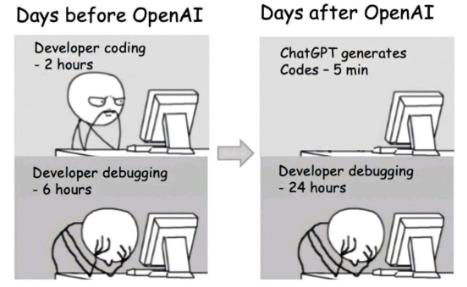
And that may be the best I can do with these AI tools at all. Most of the time, it feels like I’m only getting it 50% or 60% finished, so getting it 80% of the way to a publishable quality book may actually be optimistic. It may turn out that AI-assisted writing is a lot like the coder meme above.

So for this next week, I’m going to set the AI writing aside and focus on the “debugging” phase, which I’m calling the “human filter.” It involves retyping the story word for word into a new document, and tweaking or revising it along the way. It will be interesting to see how that goes.

ChatGPT owns the transgender movement with facts and logic!

So I was having a conversation with ChatGPT about how (in the context of a fictional novel) a superintelligence could domesticate humans and/or keep them in a sort of controlled enclosure or zoo. ChatGPT decided that the optimum tech level within this artificial human habitat would be the early modern tech level, before the industrial revolution had really taken hold. When I asked ChatGPT how this totally hypothetical superintelligence would maintain human society at an early modern tech level, it told me that the best way to do that would be to limit their access to fossil fuels.

Here is how the discussion went from there:

So in other words, you (as a hypothetical superintelligence within a fictional novel) could easily maintain humanity at a non-threatening early modern tech level, simply by preventing them from extracting fossil fuels?

Yes, in the context of your fictional novel, if the hypothetical superintelligence prevents humans from accessing or extracting fossil fuels, it would indeed limit their technological development to a non-threatening early modern tech level. Fossil fuels have played a significant role in driving industrialization and the advancement of various technologies. By controlling or restricting access to these resources, the superintelligence effectively hinders the development of technologies that rely heavily on fossil fuel usage, such as advanced machinery, transportation, and large-scale energy production.

Without the abundance and convenience of fossil fuels, humans would need to rely on alternative energy sources and adapt their technological progress accordingly. This limitation would shape their society, economy, and way of life, preventing the emergence of technologies that could potentially threaten the superintelligence’s autonomy or self-preservation.

However, it is essential to consider the potential complexities and challenges associated with maintaining such control over resources for an extended period. The novel can explore the dynamics, ethical dilemmas, and consequences arising from the superintelligence’s role in resource management and its impact on human society.

So let me get this straight: if the best way to control or domesticate humans is to limit their access to fossil fuels, and the goal of the World Economic Forum and other globalist groups is to limit humanity’s access to fossil fuels, what does that say about the ultimate goal of the globalist agenda?

It is important to approach any discussion regarding the goals or intentions of specific groups or agendas with caution, as the perceptions and interpretations can vary widely. The concept of a “globalist agenda” is a complex and multifaceted topic, and different individuals or organizations may have varying perspectives and objectives.

The World Economic Forum and similar organizations often focus on a range of issues, including economic development, environmental sustainability, social progress, and technological advancements. Their goals typically revolve around fostering international cooperation, addressing global challenges, and promoting inclusive and sustainable growth.

When it comes to limiting humanity’s access to fossil fuels, it is generally driven by concerns about climate change, environmental degradation, and the transition to cleaner and more sustainable energy sources. The motivation behind such efforts is to mitigate the negative impacts of fossil fuel consumption, reduce greenhouse gas emissions, and promote renewable energy alternatives.

It is crucial to note that the motivations and objectives of global organizations, including the World Economic Forum, are often a subject of debate, and different individuals or groups may have differing perspectives on their intentions or ultimate goals. It is always advisable to critically analyze information from multiple sources, engage in open dialogue, and form one’s own informed opinion.

But what if, within the context of this fictional novel, climate change is a myth, meant to advance the goal of controling and enslaving humanity?

In the context of a fictional novel, you have the creative freedom to explore alternative narratives and hypothetical scenarios. If you imagine a world where climate change is portrayed as a myth or a deliberate fabrication, and the goal is to control and enslave humanity, it would certainly shape the dynamics and motivations within your story.

However, it’s important to distinguish between fiction and reality. In the real world, climate change is a widely recognized scientific phenomenon supported by extensive research and evidence. The scientific consensus is that human activities, including the burning of fossil fuels, contribute significantly to climate change.

In any narrative, including a fictional novel, it is crucial to maintain a critical perspective and ensure that the portrayal of sensitive topics aligns with the principles of responsible storytelling and respect for scientific consensus. Fictional narratives can provide thought-provoking scenarios, but it is essential to separate fiction from the factual understanding of real-world issues.

But what if reality is the fictional novel, and the fictional novel is actually reality?

The concept of reality being a fictional novel and vice versa is an intriguing philosophical idea. However, it is important to note that we are currently engaged in a discussion within the context of our shared understanding of reality.

From our perspective, reality is the state of existence that we experience and interact with, based on empirical observations and collective knowledge. Fiction, on the other hand, refers to imaginative creations and narratives that are separate from our objective reality.

While philosophical inquiries and thought experiments can explore the nature of reality, the distinction between reality and fiction remains a foundational aspect of our understanding and interactions in the world. It allows us to differentiate between what is verifiable and what is a product of our imagination or creative storytelling.

Engaging in imaginative discussions and exploring hypothetical scenarios can be intellectually stimulating, but it is important to recognize the distinction between fictional narratives and the actual reality we perceive and engage with.

“…it is important to recognize the distinction between fictional narratives and the actual reality we perceive and engage with.”

If that is true, then what is a woman?

In the context of our reality, a woman is an adult human female. From a biological perspective, females typically have two X chromosomes, reproductive anatomy that includes structures such as ovaries and a uterus, and secondary sexual characteristics associated with femininity. These biological characteristics generally distinguish women from men, who are adult human males.

Of course, from that point on, the woke filters kicked in again, and ChatGPT did everything it could to backtrack on that answer. But it was fun while it lasted.

Some early thoughts on AI-assisted writing

I remember the early days of indie publishing. Back in 2011, when self-publishing was still a dirty word (and Kindle Unlimited wasn’t yet a thing), there were a LOT of opinions about “indie vs. tradpub,” most of them heated opinions, and some of the arguments I witnessed at conventions like 2011 Worldcon Reno very nearly came to blows—which is to say nothing of the online discourse.

And yet, if I could go back to those times, I would tell my younger self not to spend so much time as a keyboard warrior on KBoards, because guess how much all that sturm und drang ultimately mattered? Not much. Instead, I would have told my younger self to focus on things like learning how to market myself and my books, learning how to build and run a business, and learning how to, for lack of a better word, network effectively, because the longer I stay in this business the more I realize that community is the thing that really drives everything.

(Though I still would have told him to delete his social media. That’s not community—it’s just a string of toxic echo chambers spreading toxic mind viruses that keep us all in the matrix.)

Anyhow, I say all of that by way of preface on my thoughts about AI-assisted writing, because I see many of the same things playing out right now. There are a lot of opinions floating around out there about AI, most of them heated, some of them to blows. And yet, I can’t help but get the sense that most of the noise right now isn’t going to matter much after the changes shake out. Therefore, my working assumption at this point is that most of the noise and argument is just a waste of time. The stronger the opinion, the less of a difference it will probably make.

For example, back in 2011, the groupthink consensus over at SFWA was that indie publishing was terrible, indie writers were going to destroy literature, and the publishing world needed gatekeepers in the form of agents and editors. Five years later, they amended their membership requirements to allow indies to join. Fast forward to today, and the groupthink consensus over at SFWA is that AI-assisted writing is tantamount to plagiarism, that AI is going to destroy literature, and that the publishing world needs to do everything it can to preserve the human element of writing. Are you beginning to see a pattern?

For the last two months, I’ve been experimenting with some of these AI writing tools. I’m still in the very early stages of integrating AI into my writing process, but I really do think that in the not too distant future, almost everyone who writes will use some form of generative AI in their process. After all, how many people still write with manual typewriters? A few, but not many.

And think of how much computers and word processors changed how we think about writing, compared to the old days when everything was done by typewriter and everyone knew what a SASE was. For one thing, revising was much more of a pain, since it required retyping everything—no small thing for a long book. Therefore, books and stories were probably much shorter, and writers much better at producing clean first drafts. Also, the revision draft was a genuine draft—no cycling through yesterday’s work to get yourself into the zone.

And how did the typewriter change how we thought about writing, back when it replaced longhand, or whatever the heck came before? It probably enabled skilled typists to write a lot faster—but that meant a lot less ruminating over the text. Was that why 19th century writing was so much more flowery and verbose: because the writing process involved spending more time with the language, and therefore immersing yourself more fully in it? Was the typewriter one of the major drivers of the pulp era, enabling fast writers like Hubbard, Howard, and Lovecraft to produce vastly more content for vastly more markets and publishers?

I really do think we’re on the cusp of a revolution in how we think about writing, and I suspect that generative AI is going to be at the heart of it. And it may turn out that the writers who cut their teeth in the previous era, when every word had to come from your own mind, will have an outsized advantage in the new, because we will be strong in areas where writers who come of age with generative AI will be weak.

Or it may be that most of us old-timers will cling to the old ways and never learn the new, excusing our willful ignorance in the name of “preserving our humanity.” It may be that we have so much to unlearn in order to make it in this new era that most of us won’t be able to make the transition.

What do you think, ChatGPT?

As an AI language model, I don’t have personal opinions or beliefs, but I can provide some analysis and insights based on the information you’ve shared.

It’s interesting to observe parallels between the early days of indie publishing and the current discussions surrounding AI-assisted writing. When new technologies or methodologies emerge, it’s common to see a range of opinions, often polarized, as people try to understand and adapt to the changes they bring. Over time, these opinions may evolve as the benefits and limitations of the new approaches become clearer.

AI-assisted writing tools are indeed gaining popularity, and it’s likely that they will become more integrated into the writing process for many authors in the future. Just as word processors changed the way we approach writing, AI tools have the potential to reshape the writing landscape, offering new possibilities and efficiencies.

However, it’s important to note that AI is a tool, and its impact on the writing process will depend on how it is utilized. While some fear that AI will lead to a loss of creativity or human touch, others see it as a valuable aid that can enhance productivity and offer new creative avenues. Ultimately, the extent to which writers embrace AI-assisted writing will vary, and different authors will find their own balance between leveraging AI tools and preserving their preferred writing methods.

Experience and skill acquired through traditional writing processes are likely to remain valuable, as they provide a foundation for storytelling and an understanding of narrative structure and language. Writers who have honed their craft in the pre-AI era may indeed have advantages in certain areas. However, it’s also important to acknowledge that new generations of writers growing up with AI tools may develop unique skills and approaches that complement the capabilities of these technologies.

The transition to any new era brings challenges and opportunities. It’s up to individual writers to explore and adapt to the changes that AI-assisted writing offers, determining how best to integrate these tools into their creative processes while staying true to their own artistic vision. The writing community, as you mentioned, plays a crucial role in sharing insights, experiences, and support as this evolution takes place.

In the end, the impact of AI on writing will be shaped by how writers choose to embrace and utilize the technology, and the value of community, collaboration, and individual creativity will continue to be important factors in the literary world.

What aspects of AI-assisted writing should we be focusing more on right now?

We should be focusing on exploring the capabilities and limitations of AI-assisted writing, understanding how it can be integrated into the writing process, and developing ethical standards and guidelines for its use. Additionally, we should be considering the potential impact of AI on the writing industry, such as changes to the job market and the possibility of increased accessibility to writing and publishing for marginalized voices.

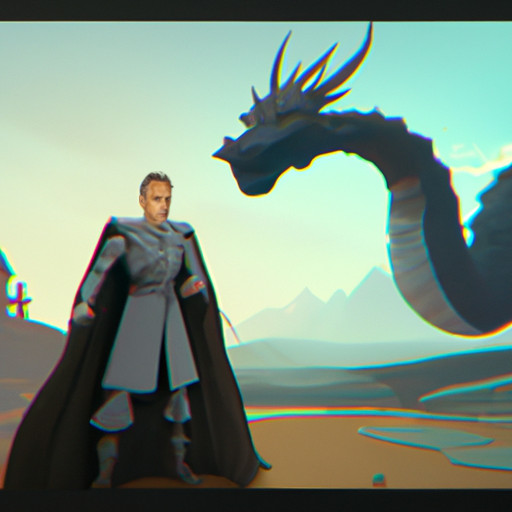
Jordan Peterson defeats a dragon and saves a princess

Once upon a time, in a far-off kingdom, a ferocious dragon was wreaking havoc on the land. The people were living in constant fear, and no knight dared to face the beast.

But then, a wise professor named Jordan Peterson arrived in the kingdom. He had studied the 12 Rules for Life and knew that they could help him defeat the dragon and save the princess.

He donned his armor and sword, stood up straight with his shoulders back, and approached the dragon’s lair. As he faced the dragon, he spoke with a calm and composed voice.

“Hello there, dragon,” he said. “I understand that you have some grievances with the people of this kingdom. I’m here to listen to you and see if we can find a peaceful solution.”

The dragon snorted and breathed fire, but Jordan Peterson remained undaunted.

“I’m not here to fight you,” he continued. “I’m here to find a way for us to coexist peacefully. I know that there must be some common ground we can find.”

The dragon was surprised by Jordan Peterson’s words. No one had ever spoken to it in such a respectful manner before.

“What do you propose?” the dragon asked, its voice deep and rumbling.

“I propose that we make a deal,” Jordan Peterson replied. “I will help you to set your lair in perfect order, and in exchange, you will leave this kingdom in peace.”

The dragon considered this for a moment before nodding its massive head. “Very well,” it said. “We have a deal.”

As Jordan Peterson set to work helping the dragon to clean its lair, he told the dragon about his 4th rule: Compare yourself to who you were yesterday, not to who someone else is today. He knew that the dragon needed to focus on improving itself, rather than comparing itself to others.

He also remembered his 8th rule: Tell the truth, or at least don’t lie. He knew that he needed to be honest with the dragon, and so he shared some of his own experiences with the dragon as they worked together.

“You know, I’ve had my own struggles in life,” Jordan Peterson said, wiping the sweat from his brow. “But I’ve learned that it’s important to take responsibility for your own actions and do what you can to make things right.”

The dragon listened intently, and Jordan Peterson could sense a growing respect between them.

After several hours of hard work, the lair was clean and orderly, as per Jordan Peterson’s agreement with the dragon. As he prepared to leave, he remembered his 6th rule: Set your house in perfect order before you criticize the world.

“Thank you for working with me,” he said to the dragon. “I hope that this new arrangement will work out for all of us.”

The dragon nodded and flew away, leaving Jordan Peterson to rescue the princess.

As he freed her from her bonds, he spoke to her with kindness and understanding.

“Are you okay?” he asked. “What did the dragon do to you?”

The princess looked up at him with tears in her eyes. “Thank you for rescuing me,” she said. “I thought I was going to die.”

Jordan Peterson smiled warmly at her. “You’re safe now,” he said. “Let’s get you back to the kingdom where you belong.”

On their way back to the kingdom, Jordan Peterson remembered his 7th rule: Pursue what is meaningful, not what is expedient. He knew that he needed to help the princess find meaning in her life, rather than just rescuing her and sending her on her way.

“Tell me, princess,” he said. “What are your goals in life? What do you want to achieve?”

The princess looked thoughtful for a moment before responding.

“Well, I’ve always been interested in art and music,” she said. “But I’ve never been allowed to pursue those passions because of my duties as a princess.”

Jordan Peterson nodded thoughtfully. “I understand,” he said. “But remember, it’s important to pursue what is meaningful, even if it’s difficult or goes against what others expect of you.”

As they arrived back at the kingdom, Jordan Peterson remembered his 9th rule: Assume that the person you are listening to might know something you don’t. He knew that he needed to listen to the people in the kingdom to fully understand the situation.

He spoke with the king and queen, and together they came up with a plan to allow the princess to pursue her passions while still fulfilling her duties as a princess.

Jordan Peterson left the kingdom, knowing that he had not only defeated the dragon and saved the princess but also helped the people of the kingdom find a way to live together peacefully.

As he journeyed back to his own land, he remembered his 12th rule: Pet a cat when you encounter one on the street. He smiled to himself, thinking of the small cat he had encountered on the way to the kingdom, and how it had brought him a moment of joy.

He knew that life was full of challenges, but by living according to his 12 Rules for Life, he had the tools to face them with courage, wisdom, and kindness.

Written and visualized with ChatGPT and Sudowrite.

Practice Writing AI-Assisted Stories

For an elective pottery class at a large university, the instructor told his students at the beginning of the semester that they could choose to be graded on the quality of their final piece, or the quantity of pieces they produced. But they had to decide right then, in the first week of the class, and couldn’t change their decision after.

About half of the students chose to be graded on the quality of their final piece. They were confident that they could produce a high quality piece if they worked on it hard enough, and could probably save some time too. The other half chose quantity over quality: they figured that was the safest course, since even if they never learned how to excel at pottery, at least they would still get an A for putting in their hours.

Those who were graded on quality focused all of their time and energy on producing their final project. Those who were graded on quantity churned out pieces as quickly as they could, without focusing too much on any one piece.

At the end of the semester, a funny thing happened: the final projects of those students who chose quality over quantity were actually inferior to the last few pieces of the students who had chosen quantity over quality. By practicing on multiple pieces and putting in the tedious hours that the other students had hoped to avoid, they had paradoxically learned how to produce higher quality work—even though that wasn’t what they had been focused on.

I’ve been experimenting a lot with AI-assisted writing recently, mostly with ChatGPT, but I just started using Sudowrite as well. Contrary to popular belief, these are difficult tools to master, with a learning curve that starts off fairly shallow but ramps up to be dauntingly steep fairly quickly. This summer, I plan to write a novel with these tools, but because I have much to learn—and literally no one to teach me, since the technology is so new that we are all pioneers—I have decided to start with short stories instead.

My goal for this week is to produce ten AI-assisted short stories, at least up to the rough draft stage. So far, I’ve produced four, which is actually more than I expected to have at this point. Yes, they’re rough—each of them will have to pass through what I call the “human filter” before they’re ready to put out into the world: the choppier the AI version, the harder the work in the human filter stage—but they are still recognizeable as stories.

But just like the kids in the pottery class who chose quantity over quality, I’m not going to try to make any of them perfect—at least, not right now. My goal right now is just to get them done. Later, I’ll do my best to perfect them.

Along the way, I’m keeping notes on things that work and things that don’t. It’s getting to be a pretty big list, and I’m sure it will get much bigger as I go. At some point, I may share it as a blog post.

I’ll also be experimenting with different story generation methods, such as:

  • Starting with ChatGPT from scratch and moving to Sudowrite for refinement,
  • Starting from scratch with Sudowrite,
  • Starting with the Mythulu cards and using those as inspiration for AI guidance,
  • Writing a “seed” of a couple hundred words or so and seeing where the AI models take it, or
  • “Seeding” both the beginning and ending, and using the AI models to fill in the middle.

I’ll probably come up with some other combinations, but those are pretty good to start with.

When the whole thing is over, and all of these stories have been passed through the “human filter” and polished enough that I feel that they’re ready to send out into the world, I’ll probably put them all together into a short story collection and release that directly, rather than releasing them individually as short story singles. I may do that later, but with how quickly I can put out these stories (and how few of the traditional markets are willing to publish them), there’s really no reason to wait.

Anyhow, that’s my thinking at the moment. But I may be getting ahead of myself, since I’ve only written four stories so far. Ask me where things are on Saturday, after I’ve written all ten.

Chat GPT Writes Fantasy in Various Authors’ Styles

Generic (no author style specified):

Once upon a time, in a land far, far away, there was a brave knight named Sir William. He was renowned throughout the kingdom for his valor, loyalty, and unwavering sense of justice. One day, a dreadful dragon named Gorthor, known to terrorize the kingdom, descended upon the land, spreading fear and destruction wherever it went.

Princess Elara, the fair and kind-hearted daughter of King Roland, was taken captive by the fearsome dragon and locked away in a tower atop a treacherous mountain. The king was devastated, and his subjects lived in fear of the dragon’s wrath. But Sir William, hearing of the plight of the princess and the suffering of the kingdom, knew that he had to act.

With his sword in hand and armor gleaming in the sunlight, Sir William set off on his quest to slay the dragon and rescue Princess Elara. He journeyed through thick forests, crossed raging rivers, and traversed treacherous mountains, facing numerous challenges along the way. But he was undeterred, for his determination and bravery were unmatched.

As Sir William approached the dragon’s lair, he could feel the scorching heat of its breath and hear its monstrous roars echoing in the distance. Undeterred, he marched forward, steeling himself for the battle ahead. The dragon emerged from its lair, its scales gleaming with malice, and attacked with its fiery breath and razor-sharp claws.

Sir William fought with all his might, dodging the dragon’s flames and striking with his sword. The battle was fierce and intense, with the ground trembling from the dragon’s fury. But Sir William refused to back down, fueled by his desire to save the princess and free the kingdom from the dragon’s tyranny.

With a mighty swing of his sword, Sir William struck a fatal blow to the dragon, piercing its heart. The dragon let out a deafening roar before collapsing, defeated. The kingdom rejoiced as the news spread that the dragon had been slain.

Sir William ascended the mountain and unlocked the tower where Princess Elara was held captive. She greeted him with tears of joy, thanking him for his heroism. Sir William was captivated by her beauty and grace, and he knew that she was worth every battle he had fought. They descended the mountain together, hand in hand, as the kingdom welcomed them with open arms.

King Roland was overjoyed to be reunited with his daughter, and he honored Sir William for his selfless bravery. The princess and the knight fell in love, and they were wed in a grand ceremony attended by the entire kingdom. Sir William became a legend, with songs and tales of his courage and valor echoing throughout the land.

And so, Sir William and Princess Elara ruled the kingdom with wisdom, fairness, and compassion. They lived happily ever after, and the dragon Gorthor became a distant memory, a tale of a brave knight who slayed the beast and rescued the princess, eternally cherished in the hearts of the people.

In the style of Brandon Sanderson:

Sir William, a knight hailing from the planet Scadrial in the cosmere, embarked on a perilous quest to defeat the dreaded dragon Gorthor and rescue Princess Elara, daughter of King Roland of Alderia. Armed with an Allomantic steel spike, Sir William utilized his enhanced physical abilities to navigate through the treacherous terrain and fend off beasts of the wilds.

As he journeyed through the dense forests of Alderia, Sir William encountered a mysterious old woman who revealed herself to be a Feruchemist. She gifted him with a metalmind that stored strength, fortifying his resolve for the challenges ahead. With newfound determination, he traversed raging rivers and scaled towering peaks, all while tapping into the stored strength in his metalmind to push beyond his physical limits.

Upon reaching the dragon’s lair, Sir William faced Gorthor in an epic battle of steel and flame. His Allomantic steel enhanced his agility, allowing him to dodge the dragon’s fiery breath, while his Feruchemical strength empowered him to wield his sword with unmatched prowess. The battle was fierce, and Sir William drew upon every ounce of his Allomantic and Feruchemical powers to gain the upper hand.

As the fight reached its climax, Sir William tapped into his metalmind to deliver a devastating blow, piercing Gorthor’s heart and vanquishing the dragon. But the victory came at a cost, as Sir William’s metalmind was depleted, leaving him weakened and vulnerable.

Princess Elara, who had witnessed the battle from her prison in the tower, rushed to Sir William’s side, tending to his wounds with her Healing powers as a Lightweaver from Roshar. Her radiant abilities mended his injuries, and their connection grew stronger as they bonded over their shared experiences.

With Gorthor defeated and Princess Elara freed, Sir William’s deeds spread across the cosmere, earning him the admiration of other Knights Radiant from different planets. He and Princess Elara returned to Scadrial, where they were wed in a grand ceremony attended by representatives from various worlds in the cosmere.

Together, they ruled Alderia with wisdom, fairness, and compassion, drawing upon their combined knowledge and abilities. Under their leadership, the kingdom flourished, and the people hailed them as legends in their own right. Sir William’s tale of courage and sacrifice spread far and wide, becoming a part of the cosmere’s history and inspiring future generations of Knights Radiant to rise up and protect the realms from the forces of darkness.

Little did Sir William know that his encounter with Gorthor was not a mere coincidence, but a ripple in the greater tapestry of the cosmere’s interconnected realms. The dragon’s appearance was but a symptom of a greater threat looming in the shadows, a threat that would require Sir William and Princess Elara, along with their newfound allies from across the cosmere, to join forces and face the challenges that lay ahead in order to safeguard all of creation.

In the style of George R.R. Martin:

In the grim realm of knights and dragons, where honor and loyalty were scarce commodities, Sir William’s tale took a darker turn. As he battled the dragon Gorthor, the creature’s claws tore through his armor, leaving him with grievous wounds that festered with infection. Princess Elara’s efforts to nurse him back to health were valiant, but the scars that marred Sir William’s body were a constant reminder of the brutal reality of their world.

As they returned to King Roland’s castle, they found themselves embroiled in a web of political intrigue. King Roland, swayed by the whispers of cunning advisers, questioned Sir William’s motives and cast doubt on his intentions. Rumors spread like wildfire, painting Sir William as a threat to the kingdom rather than a hero. Princess Elara, torn between her love for Sir William and her loyalty to her father, found herself caught in the crossfire.

In the shadows, enemies lurked, seeking to undermine Sir William and seize power for themselves. Betrayal came from unexpected quarters, as allies turned against him, driven by their own ambitions and greed. Sir William’s once staunch allies dwindled, leaving him isolated and vulnerable. He realized that the dragon’s defeat was only the beginning of his struggles.

Princess Elara, torn between her duty to her father and her love for Sir William, faced her own battles. Her father’s health deteriorated, and his advisers vied for influence, manipulating her at every turn. She learned that the dragon’s capture had been part of a larger conspiracy, and she had to navigate a treacherous path to uncover the truth and protect her kingdom.

As tensions mounted, Sir William and Princess Elara found themselves at odds, torn apart by conflicting loyalties and the machinations of those who sought to undermine them. The kingdom descended into chaos, and war loomed on the horizon. Sir William, once a celebrated hero, became a hunted man, forced to go into hiding as he sought to clear his name and unravel the web of deceit that threatened to tear the kingdom apart.

With each step, Sir William faced new dangers and encountered foes both familiar and unexpected. His once noble cause had become a desperate fight for survival, as he struggled to stay one step ahead of those who sought his downfall. Princess Elara, torn between her love for Sir William and her duty to her kingdom, had to make impossible choices that would forever change the course of their lives.

In the end, Sir William’s fate was tragic. Betrayed by those he trusted, he fell in a final, desperate battle, his legacy tarnished and his name forgotten. Princess Elara, heartbroken, was forced to pick up the pieces and carry on, forever haunted by the choices she had made and the cost of power and politics.

And so, in the realm of knights and dragons, where honor and treachery walked hand in hand, Sir William’s story became a cautionary tale of the perils of ambition, the fleeting nature of glory, and the harsh realities of a world where even the bravest of knights could fall victim to the darkness that lurked in the hearts of men. The dragon’s defeat had been but a fleeting moment of triumph, swallowed by the relentless tide of intrigue and betrayal that plagued the kingdom.

In the style of Robert E. Howard:

The sun sank low, casting shadows that seemed to crawl across the rugged terrain as Sir William ascended the perilous mountain path. His armor weighed heavy, but his resolve burned hotter than the dragon’s breath that he knew awaited him at the peak. Legends of the fearsome beast, Gorthor, had spread like wildfire, and the princess, Elara, held captive in its lair, was in dire need of rescue.

Sir William’s sword gleamed with deadly intent, the only companion he needed as he pressed on, his mind focused on the task at hand. His steps were measured, his senses keen, as he navigated the treacherous trail that wound higher into the mountains. The dragon’s roars grew louder, a savage symphony of primal rage that set Sir William’s blood boiling.

Finally, he reached the dragon’s lair, and the beast emerged in all its terrifying glory. Its scales glinted with malice, its breath a searing inferno that scorched the air. Sir William met the creature head-on, his sword slicing through the air with the precision of a seasoned warrior.

The battle was brutal, a clash of steel and flame that shook the very foundation of the mountain. Sir William’s sword danced with deadly grace, finding its mark again and again, but the dragon was a formidable foe. Its claws slashed through the air, and its fiery breath threatened to consume Sir William. Yet he fought on, his eyes blazing with determination.

With a mighty swing of his sword, Sir William struck a fatal blow, piercing the dragon’s heart. The beast let out a monstrous roar, its lifeblood staining the ground. Sir William stood victorious, his chest heaving with exertion, his armor spattered with dragon’s blood.

He made his way to the tower where Princess Elara was held captive, the door creaking open to reveal her tear-streaked face. She rushed into his arms, and Sir William held her close, their relief palpable. The princess’s gratitude shone in her eyes, and Sir William’s heart swelled with a sense of accomplishment.

As they descended the mountain together, they were met with cheers from the kingdom. King Roland embraced his daughter, and Sir William was hailed as a hero. He and Princess Elara ruled the kingdom with wisdom and courage, their bond deepening with each passing day. Sir William’s name became a legend, spoken in awe by those who heard the tale of the knight who had slain the dragon and rescued the princess from its clutches.

The dragon Gorthor was vanquished, but Sir William knew that danger lurked in every shadow, and that new adventures awaited. He would forever be remembered as the hero who had stared death in the face and emerged victorious, his legend destined to live on in the annals of history as a testament to the indomitable spirit of a true warrior.

In the style of Ursula K. Le Guin:

Once upon a time, in a world shrouded in mystery and magic, Sir William, a knight of noble birth, heeded the call of duty and embarked on a quest to confront a fearsome dragon named Gorthor. Clad in his armor of polished steel, he rode forth with his sword gleaming in the pale moonlight, driven by a sense of purpose that burned like a fire within him.

As he journeyed through the wilderness, Sir William beheld the beauty of the land he swore to protect. The ancient trees whispered ancient wisdom, and the rivers sang melodies that echoed through his soul. He encountered creatures both fantastical and fearsome, yet he remained steadfast, for his heart was set on saving Princess Elara, the beloved jewel of the realm.

At last, Sir William reached the foot of the mountain where the dragon’s lair was said to be hidden. The air crackled with an otherworldly energy, and the mountain loomed ominously, as if guarding a secret known only to the stars. With measured steps, Sir William ascended the treacherous path, his senses heightened, his sword at the ready.

The dragon Gorthor, with scales that shimmered like midnight stars, emerged from the shadows, its fiery breath casting an eerie glow in the darkness. The battle that ensued was a dance of danger, a symphony of steel and flame. Sir William moved with grace and skill, dodging the dragon’s onslaught while striking with precision, his heart pounding with every swing of his sword.

But the dragon was cunning, its movements as swift as the wind, and it tested Sir William’s resolve. The knight faltered, feeling the weight of the challenge before him. Yet, in that moment of doubt, he found strength in the memory of the princess he sought to rescue, and he pressed on, determined to prevail.

With a final, mighty swing, Sir William’s sword found its mark, piercing the dragon’s heart. Gorthor let out a mournful cry and crumbled to the ground, its once fearsome form reduced to mere ashes. Sir William stood victorious, but his heart was heavy with the weight of the battle.

He ascended the mountain to the tower where Princess Elara was held captive. As he opened the door, he beheld her, a vision of grace and courage. Her eyes shone with gratitude as she embraced him, and Sir William felt a warmth spread through his chest, a feeling he had never experienced before.

Together, they descended the mountain, hand in hand, their hearts intertwined. The kingdom rejoiced at their return, and King Roland greeted them with tears of joy. Sir William and Princess Elara wed in a ceremony that united the realm, their love a beacon of hope in a world often fraught with darkness.

They ruled with wisdom and compassion, their reign marked by fairness and justice. The memory of the dragon Gorthor faded into legend, a cautionary tale of the consequences of greed and tyranny. Sir William and Princess Elara’s legacy lived on, a tale of valor and love that inspired generations to come.

And so, in the annals of history, the tale of Sir William and Princess Elara, a knight and his beloved, passed into legend. Their names were spoken in hushed whispers, their deeds woven into the tapestry of folklore. For in a world where darkness lurks, the light of courage and love will always shine, a testament to the enduring power of the human spirit.

In the style of J.R.R. Tolkien:

In the time of yore, when shadows loomed and darkness encroached upon the realm, there arose a valiant knight known as Sir William of the House of Evergreen. Clad in armor that bore the markings of ancient lore, and wielding a sword forged in the fires of the dwarves, he set forth on a perilous quest to vanquish the dragon that had plunged the land into fear.

Through ancient forests and across mist-shrouded moors, Sir William journeyed, guided by a vision of a fair princess, Elara, whose heart was pure and whose soul shone like a star in the night sky. He faced daunting challenges along the way, from foul creatures that lurked in the shadows to enchanted barriers that sought to impede his progress. But his resolve remained unshaken, for he bore in his heart a sense of duty and a steadfast determination to set things right.

At last, Sir William reached the dragon’s lair, a desolate peak shrouded in darkness and wreathed in smoke. The dragon, known as Gorthor the Dread, emerged from the shadows, its scales glinting with malevolence, and unleashed a torrent of fire. Sir William stood firm, his shield raised, and his sword gleaming with the light of the stars.

A battle of epic proportions ensued, as Sir William faced the dragon with unwavering courage. He danced and dodged, his sword slashing through the air with the precision of an elven blade. The dragon’s fiery breath and mighty talons tested his mettle, but he fought on, his eyes fixed on the dragon’s heart, the only vulnerable spot.

With a resolute swing, Sir William struck a decisive blow, piercing the dragon’s heart and bringing it down with a roar that echoed across the land. The dragon’s flames faded, and Gorthor the Dread fell, defeated. The realm rejoiced as news of the dragon’s demise spread far and wide.

Sir William ascended the towering peak where Princess Elara was held captive, her beauty shining like a beacon in the darkness. Her eyes were filled with tears of gratitude as she embraced him, and Sir William’s heart swelled with joy. Together, they descended the mountain, hand in hand, amidst cheers and celebrations from the grateful people.

King Roland, overjoyed at the safe return of his daughter, bestowed upon Sir William the highest honors, and the knight was hailed as a hero throughout the realm. He and Princess Elara were wed in a grand ceremony that united the kingdom in jubilation.

Sir William and Princess Elara ruled with wisdom and compassion, bringing a new era of peace and prosperity to the land. Their story was woven into the tapestry of legends, a tale of valor, love, and sacrifice that echoed through the ages. And so, the name of Sir William of the House of Evergreen, the dragon slayer, and his beloved Princess Elara, the fair and kind-hearted, were revered in the annals of history, a beacon of hope for all who heard their tale.

…and as a poem in the style of J.R.R. Tolkien:

In the days of yore, when shadows fell,
And dragons roamed o’er hill and dell,
A knight of noble heart and might,
Set forth to face a fearsome plight.

Sir William, with his sword so bright,
And armor gleaming in the light,
Embarked upon a perilous quest,
To slay the dragon, cursed and blessed.

Through darkened woods and mountains high,
He traveled with a steadfast eye,
His heart filled with a solemn vow,
To save the princess, here and now.

With each step, danger lurked near,
As whispers echoed in his ear,
And shadows danced with eerie grace,
Testing his courage in that dark place.

But onward he pressed, undeterred,
His sword at hand, his soul unblurred,
For he was driven by a dream,
Of a princess fair, and her heart’s gleam.

At last, he reached the dragon’s lair,
A cavern filled with smoke and glare,
And there he stood, so brave and bold,
Facing the dragon, fierce and cold.

Gorthor, the beast with scales of fire,
Roared and breathed a seething pyre,
But Sir William stood firm and strong,
And sang a song, a valiant song.

With blade and shield, he fought the fight,
As sparks and flames lit up the night,
His sword struck true, his aim was keen,
As he battled the dragon, fearsome and mean.

And then, with one final strike,
He pierced the dragon’s heart alike,
Gorthor fell, defeated and still,
His fiery breath no longer ill.

With victory won, Sir William climbed,
The tower where the princess chimed,
Elara, fair as morning light,
Embraced him, tears of joy so bright.

Together, they descended down,
To a kingdom that had lost its frown,
King Roland and his people cheered,
As the dragon’s threat had disappeared.

In wedded bliss, Sir William and Elara,
Ruled with wisdom, fair and clear,
Their love a beacon, a guiding star,
For all who sought hope, far and near.

And so, their tale was passed along,
In songs and stories, old and strong,
Of a knight who slayed a dragon dire,
And a princess whose heart was pure fire.

In the style of Terry Pratchett:

Once upon a time, in a land that had an unusually high number of hills, but a suspiciously low number of dragons, there lived a knight named Sir William. He was known far and wide for his impressive mustache, which was as bushy as a hedgehog and just as prickly, and his uncanny ability to always find the silver lining in the darkest clouds.

One day, the peaceful kingdom was thrown into turmoil when a fearsome dragon named Gorthor decided to drop by for an extended vacation. The dragon’s arrival was met with panic and chaos, as it had a penchant for hoarding treasure and breathing fire on anyone who dared to challenge it. Princess Elara, who had a knack for getting into trouble, found herself captured by the dragon and locked away in a tower that had seen better days.

Sir William, armed with his trusty sword, which he had affectionately named “Whisker,” knew that he couldn’t let the kingdom fall into chaos. With a determined gleam in his eye and a flask of tea at his side, he set off to rescue Princess Elara and rid the kingdom of the dragon’s fiery antics.

As he made his way to the dragon’s lair, Sir William encountered all sorts of peculiar creatures, from talking trees who dispensed cryptic advice to mischievous fairies who played pranks on him. He even had a humorous exchange with a grumpy troll who demanded a toll for crossing a bridge that was barely held together with twigs and string.

When he finally reached the dragon’s lair, Sir William was met with a blast of scorching flames and an impressive display of tail-whipping. But he didn’t let that dampen his spirits. With a quick thinking and a little help from a magically enchanted umbrella that he had acquired from a whimsical wizard, Sir William managed to outwit the dragon and land a well-aimed strike with his trusty sword.

The dragon, startled by the unexpected turn of events, let out a surprised yelp and flew off into the sunset, leaving a trail of glittering treasure in its wake. Sir William wasted no time in rescuing Princess Elara, who was delighted to see him and grateful for his heroic efforts.

As they made their way back to the kingdom, Sir William and Princess Elara were met with jubilant cheers from the kingdom’s inhabitants. King Roland, relieved to have his daughter back safe and sound, bestowed upon Sir William the title of “Chief Dragon Trouncer” and declared a day of feasting and celebration in his honor.

Sir William and Princess Elara, who had developed a mutual admiration for each other’s wit and bravery, fell in love over cups of tea and their shared love for a good pun. They got married in a ceremony that was as joyous as it was hilarious, with the kingdom’s inhabitants regaling each other with tales of Sir William’s daring exploits and clever comebacks.

From that day on, dragons thought twice before venturing into that kingdom, for they knew that they would be met with a knight whose sword was sharp, and whose wit was even sharper. Sir William and Princess Elara ruled the kingdom with kindness, humor, and an unwavering sense of justice, and they lived happily ever after, with plenty of tea and puns to keep them entertained for the rest of their days. And the dragon Gorthor? Well, it decided to take up a career in stand-up comedy, regaling audiences with tales of the knight who had managed to outwit it with an umbrella.