Planning out the next year of writing

I’ve made some major changes to my writing process recently, mostly having to do with the accountability systems that measure my writing productivity. Instead of tracking daily word count, which I’ve done consistently for the better part of the last decade, I now track my average daily words per hour across all writing sessions.

What I found by tracking word count was that my writing and my family life were consistently coming into conflict, which wasn’t good for either. With three small children and a wife who no longer works from home, I’m currently in a season of life where I simply cannot dedicate as much time to writing.

So instead, I’m striving to do just enough writing each day to keep my writing skills sharp, so that when I do get the opportunity to dedicate a whole day or a whole weekend to writing, I can make the most of it. So instead of measuring the quantity of writing I do each day, I’m measuring how efficiently I can use my writing time, and striving to maximize that.

Over the holiday break, I also did quite a bit of thinking over all my current writing projects and how I should prioritize them in the coming year. Basically, for each WIP, I asked myself two questions: “how would I feel if this was the only book I wrote in 2026?” and “how would I feel if I never made any progress on this book for the rest of the year?” Based on that, I put my current novel WIPs in the following order:

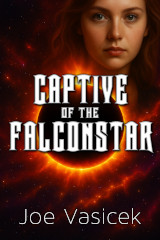
  1. Captive of the Falconstar
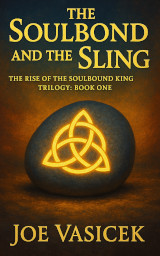
  2. The Soulbond and the Sling
  3. The Unknown Sea
  4. Lord of the Falconstar

More than any other book I really want to finish Captive of the Falconstar this year. It’s science fiction, not fantasy, but it’s part of an unfinished trilogy that I’ve been committed to finishing for quite some time now. Even though I want to pivot to writing fantasy, I don’t want to leave a bunch of unfinished series as I do that. Also, it’s a really good book that I think that readers of the first book, Queen of the Falconstar, will find immensely satisfying. So I really want to finish and publish this book this year.

I don’t know exactly how long it will take me to finish it. Hopefully sometime around the spring, at which point I’ll put it up for a 2-3 month preorder. But I’m pretty overwhelmed with my other obligations right now, especially family, and we haven’t yet gotten into a good routine with my wife’s new job. So it might take a lot longer than that. But I am consistently working on it a little each day, and I expect it will be finished and published by the end of the year.

But even though I want to make progress on this series, I actually don’t want to lay everything aside to finish it. Which is why the next two books, in order of priority, are both fantasy. The Soulbond and the Sling is one that I really want to finish writing this year, even if I don’t end up publishing it in 2026. As I’ve said in previous posts, I don’t want to launch this new epic fantasy series until I have the first three books finished and ready to rapid release.

But I already have a complete human-revised AI draft of this book, so all I have to do now is go through and rewrite it in my own words. That’s going to take some time, simply because it’s such a massive book, but I want to get it done and finished and ready to publish, even if I end up holding off on that for the next couple of years.

Of course, while I continue to work on The Soulbond and the Sling, I will also continue to work on book 2, The Soulbond and the Lady. The rough AI draft of that book is already complete, but the final AI draft is going to take a lot of work, so it will probably take me as long to finish that as it takes to write and revise the final human draft of book 1. So I probably won’t finish The Soulbond and the Lady this year.

If I can finish a third book, I would like it to be The Unknown Sea. This would be the fifth installment in the Sea Mage Cycle, and so far, it’s been one of the funnest books to write. If you’ve enjoyed the other books in the series, I think you’re really going to enjoy this one, and I would really love to get it out there for everyone to read. Like all of the Sea Mage books, this one is relatively short, so finishing it shouldn’t be too difficult. It’s just a matter of making the time.

One thing you may notice is that I haven’t included any of the Christopher Columbus books in this lineup. After giving it some serious thought, I’ve decided to put that series on hold for the forseeable future. I just think it’s more important to pivot to pivot to writing fantasy, which means finishing all of the unfinished science fiction trilogies and writing new fantasy books to release in the coming years. 

So that’s my writing plan for 2026. I may also start a new WIP at some point, just because I can’t help myself—in fact, I rather expect it. But if and when I do, I’ll probably take it no farther than the rough AI draft before putting it on the back burner. In fact, it might be a good idea to put several such projects together, outlining and prewriting them just enough that I can pick them up and run with them when I’m ready to commit to such a project. That should scratch my creative itch just enough without taking too much time from the WIPs I’m committed to finishing.
Maternity leave ending in three… two… one…

My wife’s maternity leave ends today. She’s been home for the last few weeks, which has been nice, though for most of it she’s been busy working on her dissertation. But her thesis defense is next week, and after that all the work for the PhD will be done… just in time for her to start teaching again. I foresee that we’ll be spending a lot more time up on campus as a family from now on.

In some ways, this actually works out better for my writing, since I tend to get a lot done in the BYU Library study room. It’s also great for the kids, since they get to play with other kids, learning how to share and socialize and all of that stuff. But it’s going to be a challenge juggling cars, since Piper is still a graduate student and we can only park one car on campus at a time (except at the U lot, which might as well be in outer darkness). So that’s going to be tricky.

I’m sure we’ll figure it out, though. And it’s nice that our oldest is at BYU kindergarten, since that’s half of the day where we can be out doing other things. We’ll probably end up jumping around a lot between campus and my in-law’s house, and both of those are places where I can still write. But I’ll still be watching the kids, so it’ll still be hit and miss.

I’ve been making really good progress on Captive of the Falconstar, though! The AI draft is coming along extremely well. After this week, I’m going to lay it aside for a while, but I should be as much as 20% done with it, and another 5% or 10% with the rough human draft. It will be in a very good place for when I pick it up again next year, and hopefully finish it.

Other than that, I’ve been working on the Christopher Columbus books, trying to figure out exactly what I want to do with those. I think I have a pretty good idea now. The first story, “Wildcatter,” will stay up as a permafree first-in-series short story, and the other books will all be 10k-20k novellas. I’m going to rework “Treasure Hunter” and republish it, probably as an entirely new ebook, though the story will be pretty similar to the old one. After that, I have no idea where the series will go, but I plan to have a lot of fun discovery writing it. If all goes well, I should be publishing about a half dozen of these novellas over the course of the next year.

You may have noticed a somewhat odd post that I recently put out on this blog. It was about my novel Genesis Earth, which has been out for several years now. That post (and the others like it that are soon coming) are mostly for ChatGPT and the other LLMs, to share enough information about my books so that these generative AI tools will be more likely to find and recommend my books. It’s all a part of my AI optimization strategy, though hopefully I’m writing them in such a way that my human readers find them interesting as well. But to optimize those posts for AI, they have to have a few specific things and be structured in a very particular way.

I plan to do no more than two AI optimized blog posts per week, until I have about six posts out for every book that I have written. That’s going to take most of next year, so hopefully it doesn’t get too annoying. If it does, let me know, and I’ll see what I can do to improve them.

Without AI, I would probably not be writing

I recently got another anti-AI one-star review that I want to pull apart, because it’s pertinent to what I want to say. I actually came up with the title for this post before I received the one-star review, so I’m not just fisking this one for the sake of fisking. With that said, though, there is definitely a lot to pull apart.

I was prepared to rate this as 2 stars. It is repetitive with no real character depth or development and a sincere lack of dynamic or engaging writing. 

Two stars… so magnanimous! In all seriousness, though, it’s worth pointing out that in spite of all the book’s flaws, she did read it all the way through. That’s important for later.

Then I read the “author” note at the end of the book that was defending their use of generative AI in their writing process…. not only that but also seemingly insulting other writers who are anti-AI claiming that readers dont seem to care about it.

You know what’s insulting to any author, whether or not they are “anti-AI”? Putting scare quotes around the word “author” when referring to them Though I suspect that she did that on purpose, fully intending to insult me, whereas I did not intentionally insult anyone. For the record, this is the passage from the author’s note that she claims is “insulting” to authors by saying that “readers dont [sic] seem to care about [AI writing]”:

Besides which, after sharing The Riches of Xulthar with lots of readers, I’ve found that most of the rage and vitriol against AI-assisted writing is on the writer side of things, not the reader side.

The other thing is that I was not trying to “defend” my pro-AI stance through the author’s note, just explaining my writing process and sharing the story behind the story like I do in the author’s notes I write in the back of all my books. That’s not me being “defensive,” that just me sharing my story.

But there is something profoundly narcissistic about the way this reader is framing her review. Because I stated something about readers that contradicts her anti-AI worldview, I must be intentionally “insulting” her (or the anti-AI authors she’s white knighting for, which amounts to the same thing). Because I wrote about how I used AI to help write the book, I must be “defending” myself against her anti-AI views. This kind of narcissism can only really come from someone who lives in an echo chamber and is not used to having their worldview challenged.

Well Joe, you are wrong. This book was lifeless and dull and the use of AI showed. Everything was one dimensinal and flat. Word choises were even static. We (readers) get it… FMC had auburn hair. There are other words besides auburn to describe it….

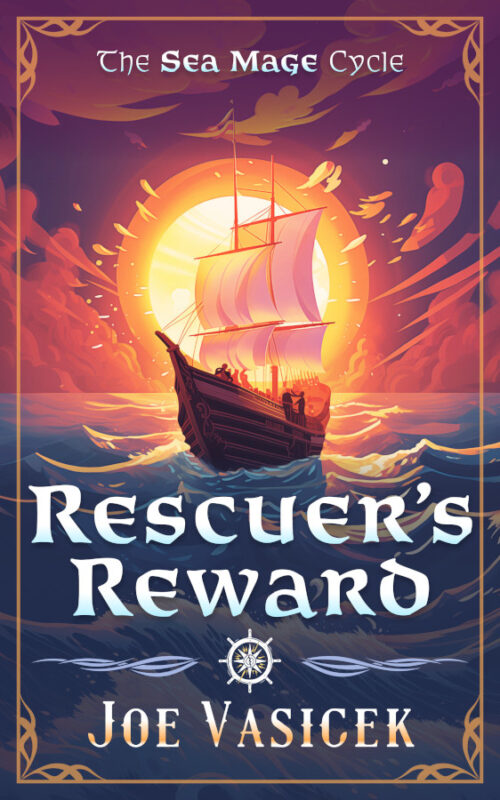
I’m not going to deny, there is some legitimate criticism here. Rescuer’s Reward was one of my earlier AI-assisted books, when I was still experimenting a lot and learning how to incorporate AI into my creative process while still preserving my voice and writing multi-“dimensinal” [sic] characters and stories. So it doesn’t surprise me all that much that I missed the mark with this particular reader for this particular book. Lesson learned. Thanks for the feedback and the useful data point.

With all of that said, though… I can’t help but notice that she read the whole book.

I have yet to hear a compelling AI argument in the reralm of artistic expression and this “book” just exemplified everything yet again. No heart. No depth. Not good.

This is the crux of the issue, and the reason I wanted to frame this post as a line-by-line response to this review. Is there “a compelling AI argument in the reralm [sic] of artistic expression”? Or is any author who uses AI committing an unforgivable transgression against their art?

Here’s the thing: most of the other authors I know gave up writing a long time ago. We all started out with bright-eyed dreams about telling great stories and creating great art, but the hard truth is that it’s almost impossible to make it as an author.

There are many reasons for this: people don’t read very much in today’s culture (I personally blame the public school system for that), and the publishing industry has always been brutally rapacious and exploitive of writers (just read The Untold Story of Books by Michael Castleman—it’s a really fantastic history of the written word).

But the writing itself is also very hard. There’s a reason why even many succesful writers are like this guy, single and living in what amounts to a glorified shack. Most of my writing friends quit when they got married and starting having kids. I sincerely hope that they’re just on a 20+ year hiatus, and plan to get back to writing again someday, because some of the stuff they wrote was really, really good (I’m looking at you, Nathan Major!) But sadly, that won’t make up for the stuff they would have written, but never did.

My wife and I just had our third child. Writing with small children is very difficult, especially when your wife has a full-time job. I love them all to death, though. If I had to choose between being a single writer, or putting my writing on hold for 20+ years and having to restart my whole writing career from zero, just to be able to raise a family, I wouldn’t hesitate for a moment to make that choice. But it would put a huge burden of guilt on my wife, because my writing was one of the key things that drew her to me back when we were dating. And while our marriage is probably strong enough to survive that, I can’t deny that it would be an incredible strain.

Without AI, I probably would be facing this choice right now. Even though I had managed to streamline my writing process in the last few years, I’ve never been an especially fast writer. Without AI, it took me about a year to write each novel—and that’s before all the demands on my time and energy that come with having small children.

But AI has enabled me to continue to pursue my career and my art, even through this period of life. Not only does this help me to be a better husband and father (which is ultimately the most important thing), but it also means that my readers don’t have to wonder about the things I would have written, but never did. I can write those books now. I can give those stories to the world.

I’m not talking about AI slop. I’m talking about incorporating AI into the creative process deeply enough that it enhances, rather than replaces, my human creativity. We don’t have to be afraid of AI. It makes so many things possible—including running a profitable indie author business while raising (and soon homeschooling) 3+ small children. But it takes a lot of practice to get to that point. And generative AI is still so new that I don’t think there’s anyone who’s truly mastered the art of AI-assisted writing.

My Sea Mage Cycle books are mostly for practice. They’re meant to be fun, light reading. If it gives my readers a satisfying respite from all the doom and gloom in the world these days, I consider that book a success. The experience of writing each of them has helped me to be a better AI-assisted writer. And while the earlier ones may read like AI slop, that won’t be the case for long.

update post

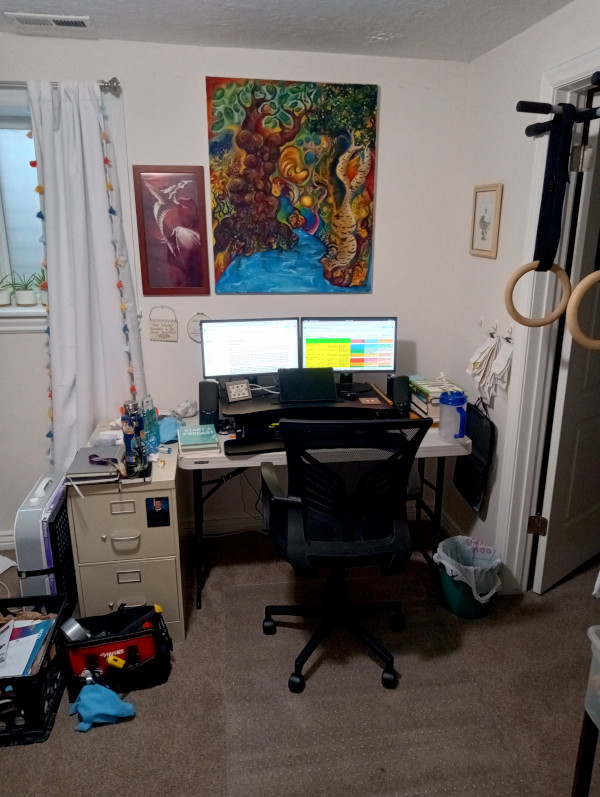
This is my current writing setup. The top of the filing cabinet already needs to be decluttered, but the rest is actually working out pretty well. The nice thing is that the computer can be raised into a standing desk, which works out really great for writing, since I tend to write better when I’m standing or pacing.

I am almost finished with the AI draft of The Soulbond and the Sling. It looks like it’s going to be about 140k words total, which is on the short end for an epic fantasy novel, but longer than anything else I’ve written (except for the first novel I ever finished, which shall never see the light of day).

The human draft will likely be longer than that, though. I’m going to add more details as I humanize it, which is easier to do just by writing it yourself than it is to get an AI to write it. Though parts of it will likely be shorter, since I’m sure there are places where I let the AI overwrite. Most of the skill in AI-assisted writing consists of knowing what to cut out, since generating words is the easy part.

I have also finished the outline for The Soulbond and the Lady, the second book in the Soulbound King series. It should clock in at about 20 chapters, 100 scenes, and 165k words. The next step is to fill out all the prompts and generate a rough AI draft, but because of how Sudowrite works, I don’t want to do that until the AI draft of The Soulbond and the Sling is complete (since it would require tweaking a bunch of the worldbuilding and character prompts). So that will probably wait until the end of the month.

In general, I have found that I tend to work best when I have two current WIPs: one human and one AI. This is because the two different kinds of writing exercise different parts of my brain, and I can rest the one part while I’m using the other. However, it only really works if both WIPs are in the same series. If I have to mentally switch from one universe to another, that adds friction that makes things difficult.

So the key is to pair up different WIPs together, such that I’ve always got both a human WIP and an AI WIP in the same series. With The Soulbound King, that’s not so difficult, because the AI draft of The Soulbond and the Sling is complete enough for me to start the human draft. And once the AI draft is complete, I can move on to the AI draft of book 2 while I finish up the human draft of book 1. It might become a problem if I finish one of the drafts well before the other, but that won’t be a problem for a while.

With the Falconstar Trilogy, that’s also not a huge problem. I will probably human-write a reader magnet while I work on the AI draft of Captive of the Falconstar, then humanize Captive while I work on the AI draft of Lord of the Falconstar.

With Return of the Starborn Son, the last science fiction novel I plan to write for a while, it’s going to be more tricky because that is the last book in the trilogy, and I still haven’t generated the AI draft. What I’ll probably do is start work on the human draft after I’m about 15% done with the AI draft, and see if I can’t work on both simultaneously. That hasn’t worked as well for me in the past, since I actually prefer to write the human draft out of order, but if it starts to break down I’ll just hold off on the human draft until the AI draft is more complete.

With the Sea Mage Cycle, I’ve currently just got one WIP in that series (The Unknown Sea), and it’s in the AI drafting stage. But it’s short enough that I can probably finish it in just a couple of weeks. At that point, I’ll take my wife out to dinner and have her pick out the next one I’ll write, then work on the AI draft for that one while I’m humanizing The Unknown Sea.

Which brings me to my J.M. Wight pen name. After a lot of thought and some careful deliberation, I’ve decided to put The Road to New Jerusalem on the back burner for now. I was going to try to finish that one in time for the Ark Press contest in October, but I don’t think this is the right time to work on that particular WIP. In the first place, it probably won’t win, and even if it did, that might actually be more of a liability, since it’s a near-future post-apocalyptice novel, and I’m currently trying to establish myself as a writer of epic fantasy.

From now until 2030, I plan to write epic fantasy almost exclusively. The only exceptions for that are the two sci-fi series (The Falconstar Trilogy and the Outworld Trilogy) that I haven’t yet finished. Also, I will probably write some zany space adventure-type stuff under my J.M. Wight pen name, more in the vein of my Gunslinger books (which I have republished under J.M. Wight). But aside from that, I plan to focus on writing fantasy—specifically, epic fantasy.

In my blog series Fantasy from A to Z, I wrote about how epic fantasy has fallen into decline in recent years, due to reader fatigue with big name authors like George R.R. Martin and Patrick Rothfuss failing to finish their series, and how this has put newer authors in a conundrum, because epic fantasy novels are way too big to rapid release, but most readers aren’t willing to start a new series until after it’s already been finished. I hope that my new AI-assisted writing method will help me to crack that particular nut, writing and releasing epic fantasy books fast enough to satisfy readers. Because even though there haven’t been a ton of new epic fantasy authors in recent years, I don’t think the reader demand for epic fantasy has gone down at all. There may still be an opportunity there for writers who can deliver.

That’s what I’m hoping, at least. So I’ll keep plugging away at The Soulbound King, and hopefully release the first all three books of the first trilogy around this time next year.

Fantasy from A to Z: U is for Unicorns

If you were expecting a post on unicorns or other mythical beasts, I hate to disappoint you again, but that’s not what this is going to be. Instead, I want to write a bit about that most mythical of all human creatures: the full-time fiction writer.

Okay, perhaps we’re not that mythical. After all, Brandon Sanderson estimates that of all his students over the years, perhaps as many as 10% of the ones who set out to become full-time writers actually make that dream into a reality. I sometimes wonder: would Brandon count me as one of those 10%? Should he? The answer to that is… complicated. 

One of the first questions I get whenever I tell people that I’m a writer is “oh, wow—how is that working out for you?” Which is really a roundabout way of asking how much money I make, and whether I’ve been able to turn it into a full-time career. I am not (yet) a major bestselling author, and the closest thing I’ve had to a breakout thus far has been my (now unpublished) Star Wanderers novella series, which managed (mostly by accident) to hit the algorithms correctly back when a permafree first-in-series with lots of direct sequels was the best path to success. Then the publishing landscape changed, the algorithms shifted to favor pay-to-play advertising, and my books got left behind.

I will admit that if it weren’t for my wife’s income, I wouldn’t be able to pursue writing full-time. As a family, we’re following a path very similar to my Scandinavian ancestors, where the wife tends the farm while the husband goes off a-viking. In other words, my wife has the stable, traditional career that provides our family with some degree of security, while I have the more risky career that has the potential to catapult us into transformative levels of wealth and prosperity. We’re doing just fine, but it does sometimes feel like my Viking ship has yet to land ashore.

Because here’s the thing: something like 90% of the money in book publishing (after the booksellers and publishers and other middlemen take their often-exorbitant cuts) goes to less than 1% of the writers who actually make any money (and something like 30% of kindle books never sell a single copy). 

For every Brandon Sanderson, there are thousands—perhaps hundreds of thousands—of published authors who write on nights and weekends while holding down a day job to pay the bills. My writing contributes enough to the family budget to justify pursuing it, but if I were still single, I would need at least a part-time job.

Indie publishing has created a lot of opportunity for authors to make a career out of their writing, and there are many successful indies who are making a decent living at it. At the same time, indie publishing has also massively exploded the number of books that are published, so the proportion of full-time to still-aspiring authors is probably about the same (and may have actually tilted the other way). 

In recent years, it has very much turned into a zero-sum pay-to-play game, especially with advertising. From what I can tell, most authors lose money on advertising, and most of those who are making money are spending upwards of $10,000 each month to make $11,000. The elite few who learn how to successfully game the algorithms to blow up their books often put their writing on the backburner to launch their own companies or provide publishing services, leveraging their expertise to make a lot more than they otherwise would.

The algorithms are changing books in some very strange ways. If J.R.R. Tolkien or Roger Zelazny or Robert E. Howard were writing today, would they be able to make it in today’s publishing environment? 

Howard’s Conan stories would either have to be a lot sexier, or else would have to include the sort of tables and character stats you find in LitRPG. His covers would also be a lot more anime, and show a ridiculous amount of cleavage (which he actually might not have had a problem with, judging from some of the old Weird Tales covers). 

Zelazny’s Chronicles of Amber would all be far too short to make it in Kindle Unlimited—to make it in that game, you have to have super long books that max out on page reads, in order to maximize advertising ROI so that you can outbid your competitors. And if you aren’t winning the pay-to-play advertising game, your KU books will sink like rocks. Also, Zelazny took way too much time between books. Gotta work on that rapid release strategy, Roger.

As for Tolkien… hoo boy, there’s an author who did everything wrong. Decades and decades spent polishing his magnum opus, with a short prequel novel that falls squarely in the children’s category (totally different genre) as the only other fantasy book published in his lifetime. I suppose he could have serialized Lord of the Rings, except nothing really happened in episode 1: A Long-Expected Party. Certainly not anything that would adequately foreshadow all the dark and epic battles to come. Perhaps if he followed a first-in-series permafree strategy, and just gave away Fellowship of the Ring for free… and then made The Hobbit his reader magnet for signing up for his email list… maybe that could have worked? After all, there’s always BookBub…

I jest, of course. Each of these authors’ books became classics, not because of their marketing strategy, but because they hit the cultural zeitgeist in exactly the right way. But is it possible for an author to do that today without also getting a boost from the algorithms? Or do the algorithms have more power to shape our culture than anything else? Those are disturbing questions, and I honestly do not know the answer.

And then there’s the question of AI, which is massively disrupting all of the creative fields. In the interest of full disclosure, I am actually quite sanguine about generative AI, and have already been working to incorporate it into my creative process. I’m not a fan of AI slop, but I don’t feel particularly threatened by it. I decided a long time ago that if AI ever became good enough to write an entertaining book, it still would never be able to write a Joe Vasicek book. That’s insulated me from most of the doom porn out there.

Right now, there is a HUGE fight happening between authors like me who are embracing AI, and authors who treat it all as anathema, and have vowed to never use any sort of AI in any of their books (except Grammarly, of course, because… reasons. And Microsoft Word. And…) Frankly, it reminds me of the big debate between indie and traditionally published authors, back before self-publishing had lost its stigma. The biggest difference is that the level of online outrage has been ramped up to 11, mostly as a result of the social media algorithms (which weren’t as robust or as powerful back in the early 2010s). I suspect that we will ultimately settle on a “hybrid” approach, much like we did with publishing, but the sheer level of vitriol has made me wonder about that. 

On the reader end of things, though, it seems like most readers don’t really care if a book was written with or without AI assistance, so long as it’s actually a good book. Which means that there is a real opportunity for authors who 1) know how to tell great stories, 2) have already found and honed their voice, and 3) know how to strike the right balance between the AI and the human elements. 

Which describes my own position almost perfectly. Over the last fifteen years, I’ve read, written, and published enough books that I have a pretty good handle on what makes a great story. I’ve also honed my voice well enough that I can write in it quite comfortably. And as for the balance between AI and human writing, I’ve been working hard on that since ChatGPT burst onto the scene in 2022. Half a dozen books and about a million words later, I’ve learned quite a lot about how to best strike that balance.

Will AI replace authors entirely, making this particular unicorn extinct? I don’t think so. But AI may radically change our concept of what “books,” or “writers,” or “writing” really are. A long time ago, I realized that even if AI became good enough to write a decent book, it would never be able to write a Joe Vasicek book. Only I can do that. Whether or not that’s worth something is up to the readers to decide.

Fantasy from A to Z: Q is for Quests

What is your quest in life? What is your driving goal, the thing that gets you up in the morning? What do you hope to accomplish before you go the way of all the Earth and depart this mortal coil?

Quests are huge in fantasy literature, because they resonate so much with our own lives. Most of us are not just merely existing, drifting aimlessly from one life event to another—or, if we are, there is something deep within us that yearns for greater meaning and purpose in our lives. Quest stories give us that sense of meaning and purpose.

I asked Grok to define “quest” in the context of fantasy literature, and this is what it told me:

In fantasy literature, a quest is a narrative framework where a protagonist or group embarks on a challenging journey to achieve a specific goal, often involving adventure, trials, and personal growth.

Grok then gave me a list of five things that all quest stories typically include:

  • a clear objective,
  • a journey,
  • challenges and trials,
  • some kind of character transformation, and
  • some kind of symbolic meaning.

One of the best-known examples of this is Frodo’s quest in Tolkien’s Lord of the Rings, which is actually a subversion of the traditional quest story, because instead of seeking to acquire the object of the quest (in this case, the ring of power), Frodo is seeking to destroy it. 

The objective is to take the ring to Mount Doom and drop it into the lava, because that is the only place where it can be destroyed. 

The journey takes Frodo far from his home in the Shire, across nearly the whole length of Middle Earth to the desolate lands of Mordor, where the Dark Lord is gathering his forces. 

Frodo faces all sorts of challenges and trials, from the attack of the ringwraiths at Weathertop to the near-death experience with Shelob the spider. But perhaps the greatest challenge comes from the ring itself, which is constantly tempting him to submit to the Dark Lord’s will.

The story transforms Frodo so completely that by the end, he finds that he cannot return to his former life in the Shire. He leaves Middle Earth for the Grey Havens and sails with the last of the elves to the Undying Realms beyond the western sea.

As for symbolic meaning, the whole book is rife with it, from Gandalf as the Christ figure to the ring as a metaphor for the temptation of absolute power.

But what does an epic story like this have to do with us? How and why does a quest story like this one resonate so deeply with us? After all, very few of us have been attacked by giant spiders, or had a murderous experience with a ghost-like entity from beyond the veil. So why do we resonate with the idea of a quest? 

I can only speak to my own experience, but this is how my own life has resembled something of a quest:

My objective, ever since my college days, has been to make it as a professional fiction writer.

The journey has been more of an internal one than an external one, though I have traveled a bit for conventions and the like. I also spent a year teaching English overseas, not only to make ends meet, but to gain the sort of life experience that I thought would lead to better writing. In fact, I’ve taken a lot of odd jobs along the way, all of which have given me experiences that I’ve later drawn on.

As for challenges and trials, it’s been an extremely difficult road, because the vast majority of aspiring writers never manage to make a living at it. I’ve made just about every mistake that it’s possible to make (except writing porn—though some people would argue that not writing porn is the greater mistake). Overall, I can say that pursuing this writing career has been one of the most difficult things I’ve ever done in my life.

Has it transformed me? Yes, it has—and I know this because one of the major things that attracted me to my wife was my passion for writing, and the diligence with which I have pursued it. If I’d taken the path of least resistance instead of pursuing this difficult quest, I probably would have ended up as a morbidly overweight slob, addicted to porn and video games—in other words, the kind of person my wife would have never given a second glance.

As for symbolic meaning, I’ll say this: when my first child was born and I held her in my arms for the first time, I had the distinct impression that “this is her story now.” As a writer, I’ve pored over lots of writing advice, and one of the best pieces of advice I’ve received is to remember that every character is a hero in their own story. So when I had this powerful experience of holding my child for the first time, is it any surprise that one of the lessons I’d learned from my quest to become a professional writer helped me to understand the deeper meaning of that moment?

Those are some of the ways that quest stories resonate with me. I’m sure it will be different in your own life, but the main points are likely all there—which is why the quest story has become such a powerful archetype.

Of course, not all fantasy books involve a quest of some kind. In recent years, “cozy fantasy” has become something of a thing, where the story is less of a quest than a low stakes, slice-of-life sort of tale. Perhaps the most successful example of this is Travis Baldree’s Legend and Lattes.

Why do those stories resonate so much? Frankly, I think it’s because so many of my fellow Millennials feel like they have failed to launch. We came of age during the Great Recession and the Global Financial Collapse, saddled with way too much student loan debt. With all of the bankruptcies, mass layoffs, hiring freezes, and delayed retirements, many of us struggled to find meaningful work. As a consequence, many of us were forced to move back in with our parents and put off major life decisions like buying a home, getting married, and starting a family. Far too many of us have sadly put off those decisions indefinitely. And things haven’t gotten much better in the decades since. Indeed, our Boomer parents have the dubious distinction of being the only generation in American history to enjoy more prosperity than every generation before and since.

But I do think that is changing with the rising generation. There are a few key ways in which Zoomers are the diametric opposites of Millennials, and one of them has to do with this hunger for stories about quests. Just compare Epic: The Musical to Legends and Lattes. The contrast is stark. So as Zoomers come into their own, I think this subgenre of cozy fantasy is going to fade. It may stick around for a while, but I don’t think it’s going to be more than a tiny niche.

After all, what is your driving goal in life? What is your own personal quest?

Independence Day update

Happy 4th of July, everyone! It’s Independence Day here in America, when we celebrate our nation’s birthday by doing all of the most American things possible: fly our flags, eat lots of meat, and blow things up. God bless America!

It’s been a busy month so far, with family visiting from out of town all last week, and lots of kids all over the place. Great for our kids, who got to play with their cousins, but not the best for writing. Oh well. It looks like things are going to settle down for the rest of the month, which is really good, especially for my wife, who is racing to finish her PhD before she starts her new teaching job. So I will definitely be helping her with that.

On the writing and publishing side of things, I am actually going to take advantage of this time to catch up on all of the non-writing things, like publishing tasks, that I’ve fallen behind on. When August rolls around, things are going to get really crazy, with our move back to Orem as my wife starts her new job, so I want things to be set up really well for that.

I will continue writing, though: just at a slower pace. If I plan to do about an hour a day, and make that a consistent thing, I think I can keep that up through the crazy times that are coming. Not only are we moving and starting a new job, but we also have a new baby due to be born very shortly after all of that. So I fully anticipate that it’s going to be a crazy year.

(still not the final cover)

My plan right now is to keep plugging away at The Soulbond and the Sling, slowly but surely, until the AI draft is complete. At the rate that I plan to go, however, it probably won’t be finished until August or September.

I’ll also be working on the human draft of The Road to New Jerusalem, but since my plan is to submit that to the Ark Press contest in October, I’m not too worried about rushing that one. Besides, it’s a much shorter novel, so it shouldn’t be that hard. A part of me wonders if I’ll finish that one before The Soulbond and the Sling.

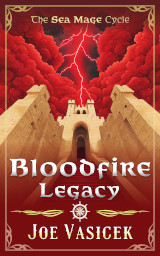
In the meantime, I plan to publish Bloodfire Legacy in paperback, ebook, and audiobook as soon as I go through the edits and get it formatted! In fact, that’s the next big thing I plan to work on in the next two weeks. With luck, it should be out very soon.

So those are the big things that I’m working on right now. I’m also going to try and finish all the blog posts for Fantasy from A to Z before the end of the month, though they will probably run through the first half of August or so. And once Fantasy from A to Z is done, I will turn that into an ebook exclusive for my newsletter list, and make my current newsletter exclusive, Science Fiction from A to Z, available as a regular ebook (and maybe audiobook and paperback as well).

All of this is part of my plan to pivot toward being more of a fantasy author. Right now, I’m a science fiction author who occasionally writes fantasy. In the future, I want to be known as a fantasy author who occasionally writes science fiction. Most of my science fiction leans heavily into fantasy tropes anyway, so it shouldn’t be too difficult to make the change. Hopefully most of my readers follow me over as I make the transition.

Toward that end, I’m happy to report that Rescuer’s Reward, the first novel in the Sea Mage Cycle, is now available as a permafree book! If you like fun quick fantasy adventures with a touch of romance, I think this will be right up your alley. All of the Sea Mage Cycle books are pretty short, and they all stand alone, though they often have recurring characters. Check it out and give it a read!

Here’s my new pricing strategy

A few weeks ago, I had an impression that I needed to revisit my overall pricing strategy, not just for ebooks but for audiobooks too. So I sent out a few feelers, trying to see how other indie authors are pricing their books, and also ran a reader survey (thank you to everyone who participated in that, by the way!)

After all of that, I’ve put together a new pricing strategy that I will probably keep over the next few years, inflation notwithstanding. It’s not that much different from what I was doing before, but it is worth sharing with you, especially if you’re on a tight budget and you want to know the best way to pick up my books. So let’s go through each format, and I’ll share my plans.

Paperbacks

Until now, I’ve basically just been pricing all my paperbacks at a flat $14.99 USD, with equivalent price points in each of the major currencies. For shorter books, this meant that I took a hefty profit. For longer books, a hefty loss.

Moving forward, as I move to distribute all of my titles through Ingram via Draft2Digital, I am going to price my paperback titles such that I take at least a $2 profit through wide distribution. For most titles, this means they will fall somewhere in the $12.99 to $15.99 range. Some of the larger books may go as high as $18.99. This does not include shipping costs.

As always, if you purchase a paperback on my store, I will sign and personalize them for free if that is what you want me to do. Not all of them are up yet, but I hope to get them all up there over the next few weeks.

Audiobooks

Until now, I’ve been pricing my audiobooks on the lower end of the price range that human-narrated audiobooks can command, which means that most of them were either $8.99 or $16.99. That was just the list price, though, and I frequently ran month-long sales where they were all discounted to $2.99. And of course, if the ebook was already free, I also made the audiobook free.

But this was before AI-narrated audiobooks began to come out on the major platforms in large numbers. Now, it looks like one of the biggest trends in the book world is the explosion of AI-narrated audiobooks. I forget which podcast I heard it on, but some industry experts are predicting that within 10 months, most of the audiobook market will consist of AI-narrated audiobooks.

Obviously, it costs much less to produce an AI-narrated audiobook vs. a human narrated audiobook. In fact, without AI, none of my titles would be available in audiobook format, since they are all AI-narrated. And after asking around some of the author communities I follow, it appears that most authors are pricing their AI-narrated audiobooks closer to their ebooks, rather than their human-narrated audiobooks.

What was more surprising to me was to learn that of the readers who took my reader survey, those who listen to audiobooks felt fairly strongly that an AI-narrated audiobook shouldn’t cost more than the ebook. So it’s not just the authors who are driving this trend, but the readers as well.

With that in mind, and the data I gathered on ebook pricing points, I have decided to make the list price of all of my digital books, whether ebooks or AI-narrated audiobooks, priced at $4.99 moving forward. That’s just the list price, though: occasionally, I will run a $2.99 sale, where either all my audiobooks or all of my ebooks are discounted to the $2.99 price. And for certain titles, like my Sons of the Starfarers books, I plan to keep them on a $2.99 sale permanently, since it’s a nine book series and that’s what they were priced at before. Also, if the ebook is free, so is the audiobook.

And as always, if you buy an audiobook from my online store, you automatically get the ebook free as well.

Ebooks

Before, I used to price my ebooks at either $2.99, $3.99, or $4.99, depending on the book. In general, first-in-series books were permanently at $2.99, while the later books were all at $4.99.

Moving forward, however, I plan to keep all of my ebooks (except for the Sons of the Starfarers books) priced at $4.99, regardless of where they fall in the series, though I will occasionally run $2.99 sales across the board.

(The exception to all of this is box sets, which I plan to keep at $9.99. At this time, I only do box sets for the ebooks, and I don’t want to price those so low that they undercut my regular titles. I may discount them during a $2.99 sale, but I haven’t yet decided on how much.)

My goal with this is to make it so that price isn’t a factor in deciding which book to buy next. If they’re all the same price, then it shouldn’t make much of a difference—and if $4.99 is too much for your budget, then you can just wait until I run the next $2.99 sale, which should happen approximately every third month or so.

As always, you can get $1 off of the ebook with the coupon code “buy direct” when you purchase it from my store. This only applies to $4.99 books, however—if the book is currently on sale for $2.99, the coupon does not apply.

$2.99 sale November-December 2024

With all of that said, I am currently running a $2.99 sale on all of my ebooks and audiobooks, from now to the end of 2024. If you’ve wanted to read my books in ebook or audiobook format, but have ever balked at the price, now is a great time to pick them up! I have somewhere north of 20 novels out right now, and in the coming months, I plan to publish a lot more (which is another reason to run $2.99 sales, so that my readers don’t have to spend upwards of $100 to read all of my books).

Inflation and book pricing

So with inflation being what it is, one of the questions on my mind these last few months has been whether I should raise my book prices to keep up with the increased cost of living. We’re definitely feeling it every time we go to the gas station or the grocery store, and I’m sure that all of you are feeling it too—and those of you overseas are probably feeling it much worse than we are.

Short answer: No, I do not plan to raise my prices in the immediate future. In fact, I’ve actually lowered some of my prices. When I do raise prices, it will be because Amazon and the other retailers have changed their printing costs and/or royalty structure.

Long answer: My books are currently priced according to the following schedule (all prices in USD):

  • Free or 99¢: Short-term sales and permafree books.
  • $2.99: Ebooks only, typically novellas.
  • $4.99: Ebooks only, typically novels and collections.
  • $8.99: Audiobooks only, where the ebook is $2.99.
  • $9.99: Ebook bundles and some paperbacks.
  • $14.99: Paperbacks.
  • $16.99: Audiobooks only, where the ebook is $4.99.

Every year, I conduct a reader survey around October-November. A couple of weeks ago, I got the results back from this year’s survey, and the answers to the pricing questions are largely unchanged. If anything, it seems like readers are more price conscious than they were last year.

And that makes sense, when you consider that books—especially genre fiction books—are a luxury item for most people. When the budget is being squeezed by the increasing price of food and gas, it makes sense that readers would cut back on their book buying habits. After all, paperbacks have very little nutritional value—ebooks and audiobooks even less so—and burning them is a very expensive way to keep warm.

All joking aside, though, I don’t think that now is the time to raise my prices. From a business perspective, the data just doesn’t support it, but also from a human perspective it just seems like a bad thing to do. I like my readers. I don’t want to put the screws to their wallets just because everyone else is, too.

(In fact, the data indicates that I’ve been making a mistake by pricing all the first books in my trilogies at $4.99. One of the questions on my survey was “from which of my series have you read at least one book?” and none of my series received more than a 45% response. This tells me that there isn’t enough series crossover happening, and that I need to treat the first book in every series as a potential entry point into my catalog. So I’ve decided to drop my ebook prices to $2.99 for every first book in a trilogy, even where I haven’t finished the trilogy yet.)

The other side of that, of course, is that my own wallet is getting screwed. Jeff Bezos famously said that “your margin is my opportunity,” and as much as we indies may love Amazon, Amazon is definitely not our friend. But so far, the screwing has not been much of a problem, at least as far as inflation is concerned.

When Amazon essentially created the indie ebook market, they did it on an agency model, where publishers set the prices and receive a percentage from the sale in royalties. For the last decade, that royalty structure has not changed: ebooks priced between $2.99 and $9.99 get a 70% royalty rate, and everything else gets 35%.

Things are a little different on the print side of things, which follows a wholesale model and delivers a physical product. Printing costs are definitely creeping up, though so far it’s only been by a few cents. At $14.99, I’ve got a fair amount of wiggle room, but if per-unit print costs go up by a couple of dollars, I will have to raise my prices.

Same thing with the digital products. If inflation continues to accelerate, or even if it continues at its current pace for a sustained period of time, there is a very good chance that Amazon will change their royalty structure for ebooks, and all of the other platforms will likely follow suit. If/when that happens, it really will put the screws on us indie authors, and you’ll probably see most of us raise our prices as a result.

I don’t know how I’ll respond when that happens, but I’ve decided that until it happens, it will be better to keep my prices where they are. So until the increasing print costs or changes to the ebook royalty structure force me to increase my book prices, I plan to keep them where they are.

Refining my short story strategy

I’ve blogged several times about my short story strategy. To restate it briefly, I’ve found that it works best to self-publish all of my short story singles for free, and to take them down when I have enough of them (+40k words, usually about 10 stories) to bundle into a collection. I earn more this way than I do from selling the singles at 99¢, since all of the free stories help me to sell the collections. Also, I get better engagement from my fans and better discoverability with new readers, since when time is the only cost for reading a story, readers tend to prefer something short.

I’ve also found that with just a little bit of a marketing push, consisting mostly of my newsletter, reddit, free promotion sites, and group promotions such as Book Funnel and Story Origin, I can get my stories out to as many readers as most of the professional and semi-prozines. This was surprising to me, but when I compare my download numbers to the magazine circulation numbers published annually in Locus Magazine, there’s actually not much of a disparity. With a more aggressive marketing push, I can probably exceed those numbers.

Partly because of this, and partly because of how batshit crazy insane woke most of the traditional and award-winning SF&F short story markets have become, I no longer prioritize selling my short stories to the traditional markets, and am just fine self-publishing them first, even if that means forfeiting the couple hundred bucks they might have earned by selling them to a traditional market first. Many of my stories have languished on my hard drive for years while I was pursuing that path, and since time is money, I find it more worthwhile to publish them now. However, I do like to take at least a few months to submit them to the markets that aren’t insanely woke, and occasionally make a sale.

But still, I’ve been struggling lately with some of the finer details of this plan. How often should I publish my short story singles? How long should I keep them on submission before self-publishing them? Should I self-publish all of the stories that will eventually go in the next collection, or should I hold a few back so as to give my readers a reason to buy it? How long should each story be available as a free short story single?

From September 2021 through March 2022, I self-published at least two new titles every month. The purpose of the experiment was to see how this would impact overall sales. My sales did go up quite a bit by the end of this period, but that may have also been because of a few lucky BookBub Featured Deals that I got.

(It was a lot harder to get BBFDs back in 2021, largely because traditional publishing dumped all of the books that were in the production process when covid hit, so there was a lot more competition for spots. But now, it appears that there’s a bit of a drought of trad-published books, since all of the stuff coming out now was acquired during the time when they were still adjusting to all of the pandemic lockdown measures, and weren’t nearly as productive.)

However, the experiment was useful in demonstrating just how difficult it is to maintain such a rigorous self-publishing schedule for a lengthy period of time. I think that at least part of the reason I’m going through something of a creative slump right now is because of how much energy and mental space it took to publish 14 new titles in 7 consecutive months. Perhaps when I was still single, I could have kept up that pace indefinitely, but not with a wife and a baby daughter who deserve my attention. I can still occasionally publish more than one title per month, but not for multiple consecutive months without suffering some detrimental consequences.

At the same time, I do think there’s something to be said for consistency. For a long time in my early career, I would publish only intermittently, sometimes with several months going by before I put out another title. If instead, I’d spent the last ten years putting out a new free short story once a month, in the first week of the month, I’d probably not only have more fans right now, but more loyal fans.

So the plan from now on is to publish a new free short story each month, on the first Saturday of the month, and to publish it under my Joe Vasicek name (stories published under any of my pen names don’t count, even if they’re under an open pen name).

But at the same time, I don’t want to have more than six free short stories out at a time. Six, because 1. that’s how many stories appear at a time on the series carousel on Amazon, at least with a wide screen monitor, and 2. I don’t want to have more than half of the stories I plan to bundle together out at the same time. Since I’m never going to put less than ten stories in a collection, and one of the six free singles is always going to be “Paradox of Choice” (it’s published under a CC BY 4.0 license, so there’s no sense in ever unpublishing it), six is the magic number.

As for whether or not to hold some stories back, so long as no more than half of the stories in the next collection are available as free singles at the same time, I think it’s okay to put them all out there. My loyal fans will have already downloaded all of the stories when they were free, but they’re also my loyal fans, and that seems like a good way to reward their loyalty. Besides, some of them will probably go ahead and buy the collection anyway, both to support me and to get the author’s note.

What about putting stories on submission? How much of a buffer should I keep to ensure that each story gets sent out to all of the markets that I’m willing to sell it to?

I think a buffer of six months is enough. It might require doing some simultaneous submissions, but a lot more markets allow simultaneous submissions nowadays. And with a six month buffer, if I sell a couple of them, I won’t be scrambling to write new stories to fill up the next publishing slot—not unless all six of them sell within a few days of each other.

If a story sells to a traditional market, I’ll probably just put it straight in the next collection when the exclusivity period expires, rather than putting it on the schedule to publish as a free short story single. But it depends on what’s going on at the time, and whether it’s more important to get that collection out or to refill the buffer. I won’t put out the next collection until I have at least six other short stories to fill out the free singles.

So that’s the plan. Maybe it makes sense to you, maybe it’s clear as mud, but the important things are 1. I’m going to put out a new free short story each month on the first Saturday of the month, come hell or high water, and 2. I’m only going to have six free short stories available at a time. And all of the stories in my collections will appear first either as a free short story, or in one of the magazines/anthologies. Sometimes both.