The Generational Cycles of Grimdark vs. Noblebright

A couple of months ago, I was discussing genre trends with my indie publishing mastermind group where we drew some fascinating connections between grimdark fantasy, noblebright fantasy, and Strauss-Howe generational theory. In that discussion, we came up with a theory that predicts when each type of fantasy (grimdark, nobledark, noblebright, and grimbright) will be ascendant, and explains exactly why. According to this theory, grimdark is currently in the beginning phase of a multi-generational decline, and will be replaced by noblebright as the ascendant form of fantasy by about the mid-2030s.
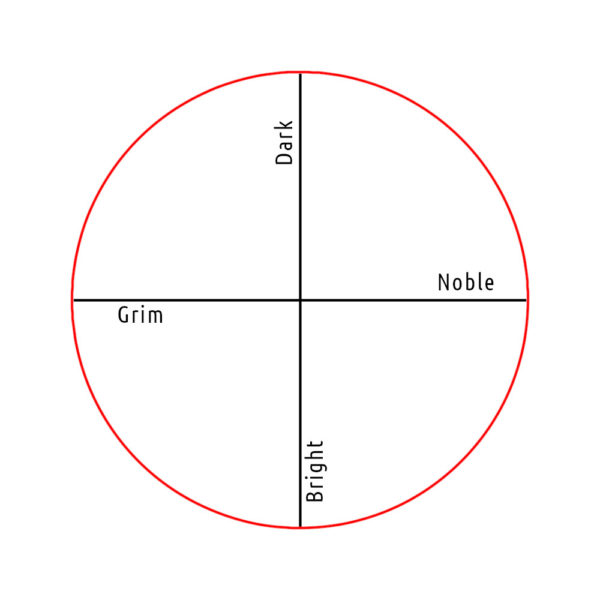
To start, we need to understand the difference between grimdark and noblebright. Both forms of fantasy exist on a field with two axes: noble vs. grim and bright vs. dark.

The bright vs. dark axis describes whether the fantasy takes place in a world where good usually triumphs over evil (bright), or a world where evil usually triumphs over good (dark).

The noble vs. grim axis describes whether the characters have the power to change the world (noble), or whether they do not (grim).

Thus, with these two axes, we get the following combinations:

  • Noblebright: A fantasy world where good usually triumphs over evil and the characters have the power to save it.
  • Grimbright: A fantasy world where good usually triumphs over evil, but the characters aren’t on a quest to save it and are usually preoccupied with smaller concerns.
  • Grimdark: A fantasy world full of moral shades of gray, where evil usually triumphs over good and the characters are either anti-heroes or otherwise fail to save the world.
  • Nobledark: A fantasy world where evil usually triumphs over good, but the characters are empowered to change it.

These categories are subjective to some degree, and fans will often disagree about which category to put each book/series. However, I think that most fans will agree on the following examples:

  • Noblebright: The Chronicles of Narnia by C.S. Lewis
  • Grimbright: The Princess Bride by William Goldman
  • Grimdark: A Song of Ice and Fire by George R.R. Martin
  • Nobledark: Lord of the Rings by J.R.R. Tolkien
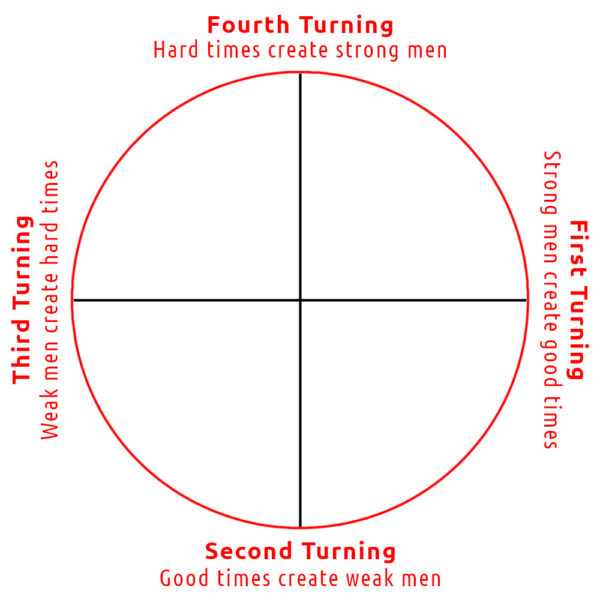
Next, let’s review in the broadest possible terms William Strauss and Neil Howe’s generational theory. To really understand their work, I highly recommend that you read The Fourth Turning. I have some criticisms of the finer nuances of that book, but their ideas are really excellent, and their predictions hold up surprisingly well three decades later.

If I had to boil their theory down to one simple, easy-to-understand statement, it would be this:

Strong men create good times.

Good times create weak men.

Weak men create hard times.

Hard times create strong men.

Thus, our society and culture passes through a secular cycle that takes about 80-100 years to complete (or in other words, the length of a long human life). The cycle has four seasons, or turnings, each one corresponding to a generational archetype (since it takes about 20-25 years for people born in the one turning to start having children of their own, thus moving us into the next generational turning).

The first turning happens when the society comes together after resolving a major crisis (eg the Revolutionary War, the Civil War, World War 2) and builds a new, stable order. The second turning happens when their kids rebel against that order, seeking freedom (eg the First and Second Great Awakenings, and the various counterculture movements of the 60s). The third turning happens when the order breaks down completely and everyone goes their own way (eg World War I, the Roaring Twenties, and the culture wars of the 90s). Finally, the fourth turning happens when the society faces a major existential crisis that totally reshapes it.
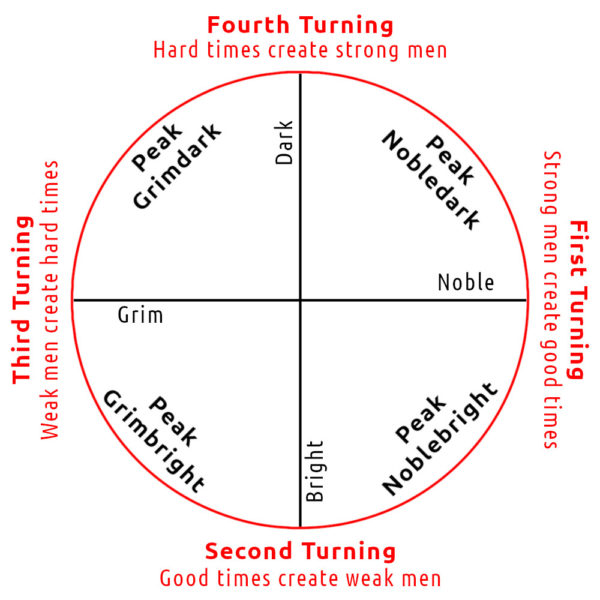
According to the theory, each axis of the grimdark/noblebright field corresponds to a different generational turning. Thus, stories that are noble have the most resonance in a first turning, stories that are bright have the most resonance in a second turning, grim stories resonate most in a third turning, and dark stories resonate most in a fourth turning.

In other words, the generation that comes of age during a major existential crisis will tend to gravitate more toward fantasy where evil typically triumphs over good, whereas the generation that comes of age during a period of rebuilding will tend to gravitate more toward fantasy where the characters have the power to change the world. And so on for bright and grim stories: the generation that comes of age during a spiritual awakening will gravitate more toward stories that take place in a world where good usually triumphs over evil, and the generation that comes of age in a declining and/or decadent society will gravitate more toward fantasy where the characters are relatively powerless.

Another way of thinking about it is to consider what each generation is not going to be drawn to, or which stories are not going to resonate well. An American who came of age in the 40s and 50s, when US power was on the rise and the Pax Americana was reshaping the world, isn’t going to resonate well with grim stories about powerless characters. Likewise, a boomer who came of age during the counterculture movements of the 60s and 70s isn’t going to resonate well with a dark fantasy world where evil usually triumphs, because (as much as they hate to admit it) they grew up in a very sheltered world that generally made sense—so much so, in fact, that they couldn’t help but rebel against it.

According to this theory, the next generational turning begins when one of the four forms of fantasy (noblebright, grimbright, grimdark, or nobledark) is at a peak. Over the course of the turning, that fantasy form declines until the next form in the cycle becomes ascendant, at which point the next generational turning begins.

Thus, at the start of a first turning, nobledark stories are typically ascendant, where the fantasy worlds are dark and morally gray, but the characters are empowered to save the world. As that generation successfully establishes a new order, the culture’s taste in fantasy shifts away from dark stories and toward noblebright stories, where the characters are still empowered but the world is more ordered and stable.

At the start of the spiritual awakening that characterizes a second turning, noblebright fantasy is ascendant: stories with an optimistic outlook on the world where the characters are larger than life. But as the awakening progresses, people in the society care more about freedom and individuality and less about the group, so stories about characters who sacrifice everything to save their world resonate less with them. Thus, by the end of the second turning, the ascendant form of fantasy is grimbright, which is really more of a slice-of-life fantasy about beloved characters having fun (but not world-altering) adventures.

At the start of a third turning, where the social order has started to break down and corruption begins to permeate all levels of the society, these grimbright stories start to take a darker tone. Readers find it too “unrealistic” to believe that good always triumphs over evil, and they certainly do not believe that good people have the power to change the world—at least, not the “smells like teen spirit” world that they inhabit. Their tastes shift away from the fun, adventurous slice-of-life of grimbright, and toward the dark and gritty anti-heroes of grimdark.

Finally, at the start of the fourth turning, grimdark is ascendant, but readers are starting to lose patience with it. As each new crisis in the real world compounds with all the others, they find it unbearable to read about characters that don’t have the power to change the fantasy worlds they inhabit. At the height of the fourth turning, society reaches an existential breaking point where, in the words of Strauss and Howe, “all of [our] lesser problems will combine into one giant problem, [and] the very survival of the society will feel at stake.” (The Fourth Turning, p277) At this point, readers are ravenous for books about characters who are empowered to fight back against the tides of evil and darkness. Grimdark fantasy declines and nobledark fantasy ascends.
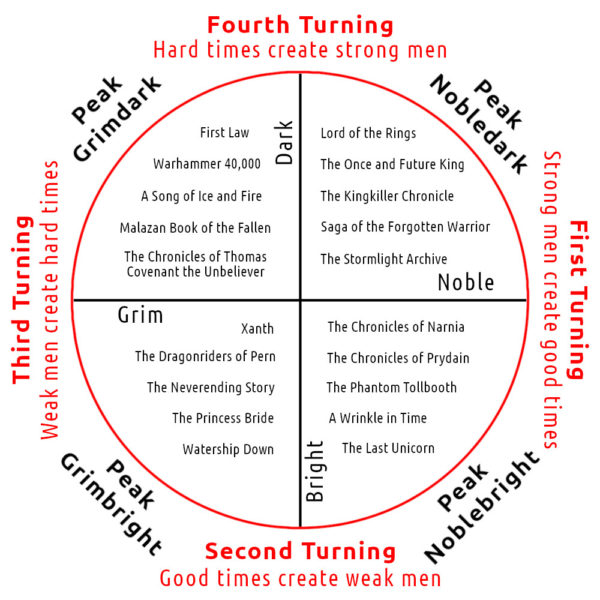
I haven’t read all of the series in the diagram above, but I do have a pretty good sense of most of them, and I put the diagram together with the help of my mastermind group. The key thing about it is that each fantasy series came out in roughly the generational turning that corresponds with each quadrant.

Now, it’s worth pointing out that these trends aren’t absolute. In each of the secular seasons, you can find examples of contemporary fantasy that runs counter to trend. For example, David Gemmell’s Drenai Saga came out in the 80s, at the start of the last third turning when grimbright should have been ascendant, and yet the Drenai Saga is solidly nobledark. Terry Pratchett’s Discworld books had their heyday in the 90s, 00s, and arguably 10s, but they probably fall into grimbright (though you could make the argument that, as absurdist fantasy, they are more similar to grimdark: stories where good and evil really doesn’t matter, and the characters are just doing their best to go along).

But the theory doesn’t state that each fantasy form’s antithesis dies completely when that form is ascendant: only that it reaches a nadir of decline in its resonance with the culture. But without sufficient contrast, the ascendant form cannot stand out. Thus, there still has to be some noblebright Paolini to provide sufficient contrast with the grimdark of Abercrombie and Martin, some low fantasy slice-of-life Legends and Lattes grimbright to make the epic nobledark high fantasy of Sanderson stand out stronger.

According to this theory, as we continue to muddle our way through this present fourth turning, the decline of grimdark fantasy will accelerate, and the bestselling fantasy books of the 2020s will mostly be nobledark. And indeed, we can already see that happening with the meteoric rise of Brandon Sanderson (especially his Stormlight Archive series), the popular enthusiasm surrounding Larry Correia (whose Saga of the Forgotten Warrior falls squarely into nobledark), and the enduring anticipation of Patrick Rothfuss’s fans for the conclusion to the Kingkiller Chronicle. Meanwhile, enthusiasm for George R.R. Martin has waned significantly with the train wreck of Game of Thrones, and Abercrombie, though still quite popular, seems to be testing the nobledark waters with his YA books.

It would really be interesting to do a deep dive on the generational archetypes and make a study of how that affects the fantasy forms that run counter to the cycle. But that’s beyond the scope of this blog post, and frankly I need to get back to writing my own books. But what do you think of this theory? Does it resonate with you, or is there something that we missed?
L is for Lost Colony

worthingsagaAs we discussed in I is for Interstellar, space colonization is a major theme of science fiction, especially space opera.  Of course, things don’t always go smoothly.  Space is a really, really, really big place, and sometimes, due to war or famine or simple bureaucratic mismanagement, colonies get cut off from the rest of galactic civilization.  They become lost colonies.

Some of my favorite stories are about lost colonies: either how they became cut off, or how they reintegrate after so many thousands of years.  In many of these stories, the technology of these colonies has regressed, sometimes to the point where the descendents may not even know that their ancestors came from the stars.  When contact is finally made, the envoys from the galactic federation may seem like gods or wizards.

Because of this technological disconnect, stories about lost colonies often straddle the line between science fiction and fantasy.  After all, Clarke’s third law states:

Any sufficiently advanced technology is indistinguishable from magic.

Of course, the line between science fiction and fantasy has always been a fuzzy one.  Hundreds of attempts have been made to define it, but they all fall short.  In the end, it often breaks down to certain recurring tropes, like dragons and wizards versus ray guns and rockets, but even that doesn’t always work.

For example, Anne McCaffrey’s Dragonriders of Pern is technically about a lost colony far into the future, but it’s got dragons and castles and other tropes that belong squarely in fantasy.  Then again, the dragonriders have to fight alien worms who invade every few dozen years from a planet with a highly elliptical orbit, so there’s still a strong science fiction basis undergirding the whole thing.

And that’s just Dragonriders of Pern.  What about Marion Zimmer Bradley’s Darkover series, or C.S. Lewis’s Space Trilogy?  Trigun is more western than fantasy, but it’s also full of sci-fi tropes like giant sand-crawling monster ships and a weird post-apocalyptic backstory.  And then there’s all the Japanese RPGs that combine magic with mechas, with Xenogears as one of the best examples.  For a distinct Middle Eastern flavor, look no further than Stargate.

It’s no coincidence that all of these stories feature a lost colony of one kind or another.  When the characters don’t know that they’re living in a science fictional universe, it’s very easy to throw in tropes from other genres.  By no means is it required–Battlestar Galactica and Dune are evidence enough of that–but they certainly present the opportunity to do so.  After all, lost colony stories basically present a hiccup in humanity’s march of progress, breaking the essential science fiction narrative for all sorts of interesting side stories and tangents.

One perennial favorite of science fiction writers is to suggest that Earth itself is a lost colony from some other galactic civilization.  That forms the entire premise behind Battlestar Galactica: the original twelve colonies have been destroyed in the human-cylon wars, and the last few survivors are searching for the legendary thirteenth colony of Earth, hoping to find some sort of refuge.  Apparently, Ursula K. Le Guin’s Hainish cycle also plays with this trope, though she’s never very explicit with her world building.  It can be a bit tricky to twist the lost colony trope in this manner, but if pulled off right it can really make you sit back and go “whoa.”

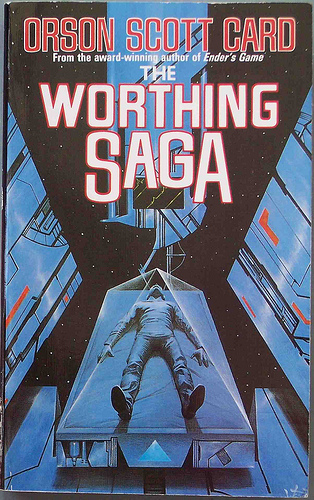
My personal favorite is probably Orson Scott Card’s The Worthing Saga, about a colony of telepaths that breaks off from a collapsing galactic empire and actually becomes more advanced than the rest of humanity.  When Jason Worthing and Justice re-establish contact, the descendents of the galactics are basically pre-industrial subsistence farmers who view them as gods–which, in a certain sense, they almost are.

It’s a great story that really entranced me, not just for the science fictional elements but also for the distinct fantasy flavor.  Orson Scott Card’s handling of viewpoint in that book is truly masterful, so that I felt as if I were viewing everything through the eyes of his characters.  Since the farmers don’t know anything about their spacefaring ancestors, all the parts from their point of view feel like a completely different story.  It was really great.

My first novel was actually a lost colony story, combined with a first contact.  I trunked it a long time ago, but many of the earliest posts on this blog are all about my experience writing it.  As for my other books, Desert Stars contains elements of this, though the lost colony in question is actually a nomadic desert society that lives on the capital planet of the galactic empire, just outside of the domes where all the more civilized folk live.  Heart of the Nebula is basically about a society that puts itself in exile in order to escape the privations of the Hameji.  And in… no, I’d better not spoil it. 😉

The lost colony isn’t one of the flashier or more prominent tropes of science fiction, but it’s definitely one of my favorites.  It’s a great way to add depth and intrigue, as well as bend genres.  For that reason, I think this trope does a lot to keep science fiction fresh.

Out of the Silent Planet by C.S. Lewis

out_of_the_silent_planetWhen Doctor Elwin Ransom went on a spontaneous walking tour of rural England, he wasn’t expecting to be kidnapped by a mad scientist and taken to Mars.  He soon escapes, only to find himself lost without any way to return home.

Fortunately, the native Martians soon take him in, teaching the otherworldly stranger of their peaceful, utopian ways.  They are just as astonished to have a visitor from Earth as Ransom is astonished to be their guest.  To them, Earth is a silent planet–the only world with no spiritual connection to the rest of the universe.

The more Ransom learns about the gentle people of Mars, the more he realizes that something evil lurks in the heart of our world–and that contact between the worlds can only hasten the showdown between the forces of good and evil.

I decided to read this book after chatting with Norman Cates at Worldcon 2011, following the “When Faith and Science Meet” panel.  Some fascinating questions had popped up toward the end, especially regarding science fictional universes that are not incompatible with millenialist religions.  Norman asked if I’d read C.S. Lewis’s Space Trilogy, and when I said that most people had told me it isn’t as good as Lewis’s other work, he kind of rolled his eyes and said that it was worth checking it out and deciding for myself.

Well, I didn’t get around to reading it until this summer, but I’m glad I did.  It’s a short read, no more than 180 pages or so, and I finished it in a couple of days.  The world it describes is quite fascinating–a fantastical version of Mars that I’d actually like to visit, perhaps even more than Bradbury’s and Burrough’s.  The kidnapping in the beginning was compelling enough to hook me, but it was the immersive feel of the world that really made the book for me.

This being C.S. Lewis, the more spiritual and allegorical elements of the story lie fairly close to the surface, but it didn’t detract much from the reading experience for me.  It became fairly obvious towards the end that the whole story is basically an attempt to incorporate the Christian millenialist mythos into a mainstream science fictional setting, which is probably where most of the criticism comes from.  If you know that up front, however, and are willing to go along with it, it shouldn’t take much away from the story.  In fact, that might just be what draws you to it.

It’s interesting, because Orson Scott Card tried to do something very similar with the story of Lehi in his Earthbound series, and I think he actually failed where Lewis succeeded.  When I read A Memory of Earth, I felt that Card actually lost the best parts of both the Book of Mormon mythos and his own science fictional world by trying to force them together.  In contrast, Out of the Silent Planet feels much more coherent and compelling, and not artificial at all.

I do feel like things sped up a bit too much at the end, though.  The experience became a little less immersive for me when Lewis went from describing the alien world to bringing the millenialist themes to the forefront.  It’s almost as if the focus of the book itself shifted, and that was a little bit jarring.  I’m a big fan of metaphor, but allegory is a more difficult pill for me to swallow.

That said, I enjoyed the book, and am definitely interested in finishing the rest of the trilogy.  It’s got a lot of merit to it, and is definitely worth checking out no matter what the critics may say.

Trope Tuesday: Belly of the Whale

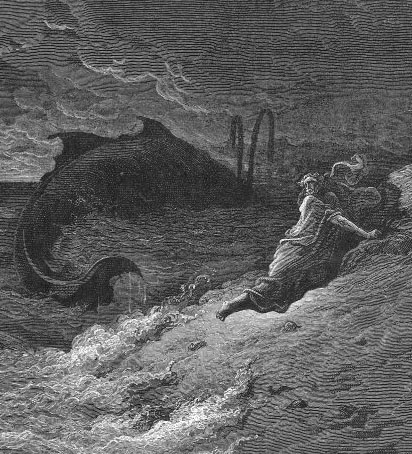
The last stage in the departure phase of the hero’s journey is called the Belly of the Whale, after the Biblical story of Jonah.  After receiving the call and passing the threshold to the land of adventure, the hero faces what may quite possibly be the darkest hour of his life and dies in some way to the home he has just left behind.

I know what you’re thinking: “Huh? Why does the hero die at the beginning of the story?  Isn’t that supposed to happen later?” Well…yes, it does, but the symbolic death at this point is important, too.  At its core, the hero’s journey is a story of transformation and growth.  When the hero comes back from the lands of adventure, he isn’t the same person he was when he first left–he’s been changed in some way.  And in order for that change to take place, the hero needs to let go of who he was and move forward.

Joseph Campbell describes it like this:

The idea that the passage of the magical threshold is a transit into a sphere of rebirth is symbolized in the worldwide womb image of the belly of the whale. The hero, instead of conquering or conciliating the power of the threshold, is swallowed into the unknown and would appear to have died. This popular motif gives emphasis to the lesson that the passage of the threshold is a form of self-annihilation. Instead of passing outward, beyond the confines of the visible world, the hero goes inward, to be born again.

Of course, the death and rebirth doesn’t have to be literal (though it can be, as it was with Dionysus).  The point is to show that the hero has fully crossed the threshold, cutting all his ties with home and burning his ships on the shores of the land of adventure.  Once the hero passes through the belly of the whale, there’s no going back–it’s all or nothing now.

So how common is this trope really?  Actually, it occurs more often than you might think.  In Harry Potter and the Sorcerer’s Stone, it happens when Harry boards the Hogwarts Express and realizes he’s leaving his old world completely behind.  It happens in The Lion, the Witch, and the Wardrobe when Peter and the others decide to go after Mr. Tumnas instead of returning to their own world through the wardrobe.  It happens in Star Wars IV when the Millennium Falcon gets sucked into the Death Star, and in Final Fantasy IV when Cecil washes up in Mysidia.

The main theme running through all these examples is that adventures are hard.  If they were easy, anyone could go on them–and no one would be changed by them.  They may be fun, and they’re definitely worth it, but to set out on one, you always have to give up something close to you–and that’s hard.

Christmas break 2009

Christmas was great this year!  I spent it in Texas, with my extended family–the family on my dad’s side, who I almost never see.  The break has been a lot of fun so far!  No school or work obligations, lots of time to lay back and relax, plenty of games to play and books to read, plus fun people to hang out with–it’s been great!

Most of my cousins are young teenagers right now, and are a lot different than I remember.  However, I was able to get some presents for them that I think worked out well.  David is into his iPod, so I got him some U2 albums (How to Dismantle an Atomic Bomb and Joshua Tree).  Savannah and Nash are both avid fantasy readers, so I got Savannah Mistborn: The Final Empire and Nash Victory of Eagles (the one chain bookstore in Midland didn’t have His Majesty’s Dragon, so I got him another from the series).  Daniel, I didn’t know what to get, so I gave him my old camera.

Ashley (who is older) was telling me about how she lived abroad and wants to spend some time in Australia, so I got a travelogue on Australia by the same guy who did A Walk in the Woods. Based on her reaction, I think she’s going to like it!

It was much easier to get stuff for direct family, since I know them better.  For Kate, I got Soulless, a steampunk / paranormal mystery novel that had an awesome release party at World Fantasy 2009.  I don’t know if she’ll like the book, but the party was very steampunk / regency fantasy with the cosplayers, so I think she will.  I got Danny The Screwtape Letters, since I know he likes that kind of religious fiction–turns out he’s been meaning to read it for a while!  Mykle, I got the first book in C. S. Friedman’s latest series, since I know that she’s his favorite author–24 hours after Christmas, he’s already 200+ pages into it!  And for Sarah and Mykle, I got them both $20 gift certificates to Pioneer Book in downtown Provo.  They were very happy with that!

I wish I’d had the time to get presents for everyone in the family, but with moving out, coming here so quickly, and not having a car (or much of an idea what they wanted), it just wasn’t very practical.  I did get my mom a gift certificate to B&N, but I haven’t gotten anything for my dad yet.  I will, though–he wants stuff from our Christmas memories, and I happen to have all my old childhood journals in my carry on luggage.  Lots of Christmas memories in those!

I’m satisfied with what I got, even though it wasn’t all that much.  Besides the generic clothes, socks, ties, candy, popcorn, and other stuff, I got a spiffy tool kit from Robin and a flexible tripod from pop.  Very nice!  They will add some weight to my luggage, but I think I can give some of it to mom or pop to bring home.

As far as writing goes, I’m less than 13k words from the end of Bringing Stella Home 2.0.  It’s not quite ready for alpha readers yet, but I want to get it ready soon (it’s going to take so much work! <sob>).  If I average 2.6k words over the next five days, I’ll have it finished in time to start something new by new years!

That’s the goal.  As for what the next novel is going to be about…let’s just say it’s Homer’s Odyssey meets C. J. Cherryh and Ursula K. Le Guin in space, where Telemachus is a girl and the story is primarily from her point of view.

I hope I can pull it off!