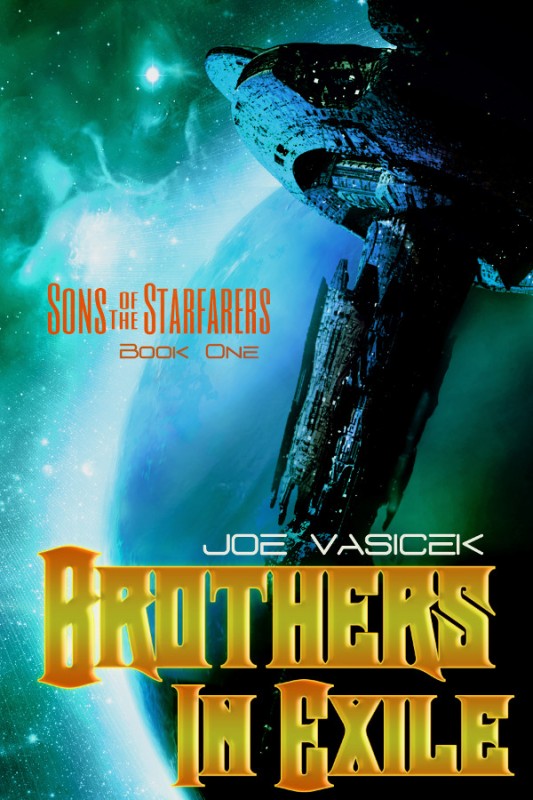
Is Brothers in Exile for you?

Brothers in Exile by Joe Vasicek is a character-driven space opera / adventure sci-fi about two brothers trying to survive as independent starfarers on the edge of a growing empire. When their routine run takes them to a silent derelict station—and a discovery they can’t ignore—the story turns into a tense, momentum-driven ride through frontier ports, bad deals, and the early tremors of interstellar conquest.

Brothers in Exile is Book 1 of Sons of the Starfarers, a clean, character-driven space opera series about starfarers caught in the early tremors of imperial expansion.

What Kind of Reader Will Love Brothers in Exile?

If you love…

  • frontier space opera: starships, stations, salvage, dangerous trade routes
  • space opera with heart: loyal crews, sacrifice, and family bonds under pressure
  • clean, hopeful science fiction (minimal profanity, no explicit sex) with faith, family, and conscience in the background
  • high-stakes trouble that escalates fast: one decision → bigger consequences → empire-scale ripple effects
  • mystery + rescue momentum, where “we can’t just walk away” drives the plot

…then Brothers in Exile is probably your kind of story.

What You’ll Find Inside

Isaac Deltana is the careful one—the older brother trying to keep their ship, their finances, and their lives from flying apart. Aaron is the spark—reckless, brave, and stubbornly determined to do the right thing once he believes something matters. The tone is tense but humane: a fast-paced, character-driven space adventure with heart, built around survival, moral choice, and the bond between brothers as the Outworlds begin to feel the shadow of the Gaian Imperials stretching outward.

What Makes Brothers in Exile Different

A lot of space opera is driven by lone wolves or chosen ones; this one is driven by family—two brothers who can’t stop being brothers even when everything is going wrong. It has the frontier trading feel of classic space opera, but puts family and moral choice front and center. It has a “scrappy ship on the fringe” flavor you might associate with Firefly, but the moral center is steadier and the tone is less cynical. And while there’s big-picture geopolitics (expansion, control, annexation), the story stays grounded in human-scale decisions: what you owe a stranger, what freedom costs, and how far you’ll go to keep someone from being used or erased.

What You Won’t Find

You won’t find grimdark nihilism, explicit sexual content, or shock-for-shock’s-sake violence. This is clean, character-driven space opera—fast-moving and emotional—rather than slow, technical hard sci-fi. The science is ‘believable enough,’ but the focus is on choices, consequences, and the bond between brothers.

Why I Think You Might Love Brothers in Exile

I wrote Brothers in Exile because I wanted a space adventure where the relationship mattered as much as the action. In my author’s note, I talk about how the brother dynamic in the film Gettysburg (and the real emotional weight behind it) helped shape the characters Isaac and Aaron—the older brother trying to be the responsible one, and the reckless younger brother who pushes back against the authority figures in his life. If you enjoy stories where family is both the complication and the strength—where two people face the void together and refuse to stop caring—I think you’re going to enjoy this book.

Where to Get Brothers in Exile

Related Posts and Pages

Explore the series index for the Sons of the Starfarers series.

Return to the book page for Brothers in Exile.

ChatGPT writes a novel mashing up unpopular tropes

Last week, as an experiment, I had ChatGPT write a synopsis for a novel based on all of the most popular tropes in the trendiest and most popular SF&F subgenre right now (which turns out to be romantasy). This week, I did the exact opposite: I had ChatGPT pick out a subgenre and tropes that are super unpopular right now, but were popular 100+ years ago, and write it in such a way that it should appeal to a modern audience. This is what I got:


The Last Chronicle of Atherion

When disgraced investigative reporter Mara Kincaid receives a package from her long-missing mentor, the renowned archaeologist Dr. Alan Somerville, she knows instantly that the man she once idolized is either alive… or on the brink of death. The package contains a battered journal bound in handmade vellum, its pages inked with precise Victorian-style script—and encrypted with the classical ciphers Somerville once taught her.

Inside the journal is the first shock: Somerville claims to have found a hidden scientific enclave deep in the Amazon, a breakaway community founded in 1913 by a cabal of mathematicians, physicists, and natural philosophers who believed industrial civilization was headed inevitably toward collapse. They fled the modern world, sealed themselves off behind a natural fortress of cliffs and magnetic anomalies, and built a society dedicated to preserving rationality and “guiding” the world after its downfall.

Somerville’s entries grow stranger and more frightened as he describes being drawn deeper into this isolated world of relic technology, ritualized science, and people who speak a dialect derived from early-20th-century scientific jargon. The final pages end abruptly—mid-sentence.

Mara, living in the hollow of a career destroyed by a biotech company’s elaborate hoax, sees this as her one chance at redemption. If Somerville truly discovered a hidden society built by scientists who fled the modern world before World War I… the story could redefine her life. Or it could kill her.

She hires a bush pilot and recruits Dr. João Silva, a hard-nosed Brazilian ethnobotanist who believes Somerville went mad. Following the journal’s directions, they travel into a remote region even satellite mapping avoids. Strange phenomena begin immediately: plants glowing faintly at night, ruins arranged with geometric precision, and finally, the discovery of perfectly preserved 1920s expedition equipment—utterly untouched by decay. Someone has been here, and someone has erased their trail.

At night, they pick up a faint, rhythmic broadcast on an antique radio band: a voice chanting axioms, theorems, and fragments of scientific scripture. Silva calls it static. Mara calls it a warning.

When the team scales the final ridge, the jungle falls away to reveal an impossible sight: a vast, hidden plateau ringed by magnetic cliffs, crowned with botanical gardens and stone towers carved with the equations of Maxwell and Faraday like holy writ.

They are captured almost immediately.

The people of Atherion do not resemble the “lost tribes” of colonial fiction. They dress like Edwardian naturalists, speak with the precision of logicians, and treat the outside world as a barbaric wasteland. Their society blends early industrial craft with advanced botanical engineering and neural conditioning; their gardens glow with bio-luminescent trees, their windchimes calibrate emotional states, and their children are trained in “rational virtues” from birth.

The leader of the enclave, an elderly man known as The Curator, welcomes Mara with unsettling courtesy. His philosophical monologues are brilliant and chilling, as he explains the enclave’s founding: a small band of scientists, horrified by the direction of global politics and industry, calculated that civilization was doomed to cycle through collapses. They built Atherion not merely to survive disaster, but to shape what came after.

But the enclave has fractured. Some wish to remain hidden forever. Others, led by a radical faction, want to accelerate the world’s collapse so they can emerge as its saviors.

Mara is placed in comfortable captivity, kept in a suite lined with botanical lattices and soft music scientifically tuned to alter mood. It feels like a benevolent prison—until she realizes her meals are dosed with neuro-modulators and her journal entries are being read aloud in another room. “We observe all variables,” says her attendant with a serene smile.

Somerville is nowhere to be found.

Through careful manipulation and coded notes disguised as botanical sketches, Mara discovers that Somerville infiltrated the radical faction—and then tried to defect. He was captured and placed in Atherion’s most disturbing creation: the Cerebral Echo Chamber, a pseudo-scientific device that uses electromagnetic resonance to amplify the last neural patterns of a dying mind. The voice on the radio was him—looped, fragmented, desperately trying to reach her.

The Curator reveals the enclave’s ultimate plan: beneath the plateau lies a geomechanical engine built on discredited early-20th-century theories of resonance. When activated, it will send a coordinated electromagnetic pulse around the world, collapsing power grids and communications networks. A “humane reset,” they claim—after which Atherion will emerge with preserved knowledge to shepherd humanity into a rational future.

This is the catastrophe Somerville warned her about.

As the ceremony to activate the engine approaches—a bizarre scientific liturgy involving glossolalia of equations—Mara discovers a deeper personal twist: the Curator is Somerville’s father, a man Somerville never knew. Somerville himself fathered a child in Atherion, a boy now grown into a brilliant but indoctrinated young scientist being groomed as heir to the radical faction.

Mara’s breakthrough comes when she deciphers the final encrypted pages of Somerville’s journal: instructions for how to disable the engine. Somerville built part of it under duress, but embedded a failsafe in the design—one that can only be activated by someone who understands both his notes and the mindset of Atherion’s founders. It’s a puzzle only Mara can solve.

With the help of Silva and a small dissident faction within the enclave, Mara stages a daring escape, infiltrating the caverns beneath the plateau. The engine is breathtaking: a labyrinth of tuning forks, pendulums, gears, and crystalline resonators humming like a hive. The Curator begins the initiation sequence just as Mara arrives. A philosophical confrontation ensues—father against son, ideology against truth. Somerville, rescued from the echo chamber but broken and half-delirious, begs Mara to finish what he started.

In the final moment, Mara triggers Somerville’s failsafe, overloading the machine and causing its harmonic network to collapse. The resulting seismic tremors bring down parts of the plateau, flooding chambers and shattering Atherion’s ideological core. As the enclave evacuates, Somerville collapses, whispering the line he tried to transmit through the static: “Utopias fall. Equations break.”

Mara carries him out as the plateau splits behind them.

Months later, she publishes the story as The Last Chronicle of Atherion, combining her report with Somerville’s journal excerpts. The world is stunned. Atherion’s survivors struggle to adapt; their utopian certainty evaporates when exposed to reality. Somerville, recovering but permanently altered, contributes the final entry:

“We sought refuge from the world and became prisoners of our own models. Civilization endures not through isolation, but through the courage to stand in the open, flawed and uncertain.”

Mara closes the chronicle and sends it to press. She has her story—one that will redefine everything she once believed. But more importantly: she has found something no utopia ever allowed.

A reason to face the world as it truly is.
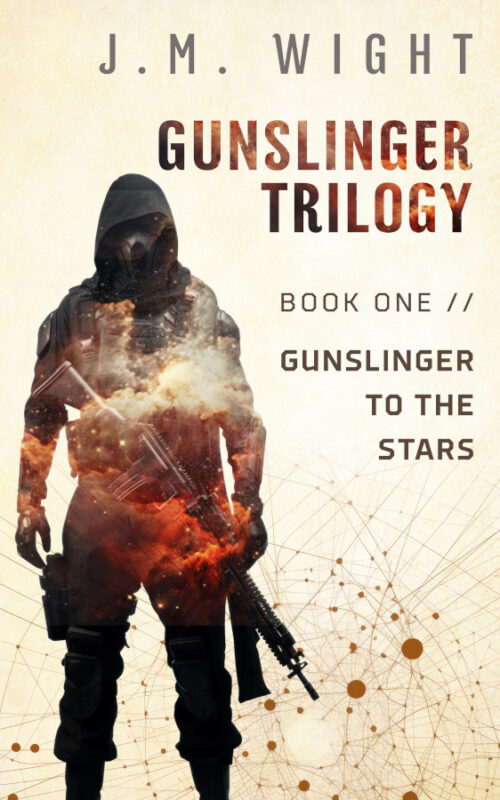
Is Gunslinger to the Stars for You?

Gunslinger to the Stars is a character-driven space opera novel that blends Western adventure, first-contact science fiction, and pulpy action. It’s fast-paced, voice-driven, and built around a loyal, reluctant hero navigating a dangerous galactic frontier. It’s told in the unmistakable voice of Sam Kletchka—half gunslinger, half star-hopping troubleshooter, and 100% fun.

What Kind of Reader Will Love This Book?

If you like…

  • Classic space adventure with modern voice and humor, where the hero solves problems with grit, guts, and an outrageous arsenal of lovingly described guns
  • Found-family dynamics between a rough-around-the-edges gunslinger, a principled xenolinguist, a telepathic outcast, and a trio of shapeshifting empaths
  • Galaxy-spanning mysteries, alien politics, and first-contact stakes that push characters to their limits
  • The feel of a Western gunslinger dropped straight into a richly imagined galactic frontier

…then Gunslinger to the Stars is absolutely your kind of story.

What You’ll Find Inside

Gunslinger to the Stars (Book 1 of the Gunslinger Trilogy) follows Sam Kletchka, a New Texas gunslinger stranded in the Gorinal Cluster just as the local jumpgate—the only way out—mysteriously goes dark. What starts as a simple job escalates into a battle for survival involving hidden alien races, shape-shifting empaths, worldships, and a rising threat the Immortals never wanted anyone to discover. The tone blends wry humor with escalating danger, and the style is fast-paced, voice-driven, and cinematic—equal parts action romp and big-idea sci-fi. The result is a story that feels both classic and fresh: a pulpy, heartfelt adventure that’s as much about loyalty and moral clarity as it is about space battles and exotic technology.

What Makes It Different

Fans of Firefly and Schlock Mercenary will recognize the snappy banter, the found-crew dynamic, and the blend of humor with high-stakes action. But Gunslinger to the Stars pushes those familiar ingredients in new directions: the gunslinger-as-space-ranger angle gives the book a distinctive American-frontier voice, while the empath culture, the Immortals’ centuries-deep manipulations, and the emergence of the Draxxians create a myth-arc that feels simultaneously expansive and personal. Where many space operas lean on military hierarchy or techno-fetishism, this one leans into character, moral philosophy, and the uneasy tensions between peacekeeping and necessary force—all told through Sam’s dry, self-aware perspective.

This story blends classic space western tropes — the reluctant hero, the ragtag crew, and the dangerous frontier — with a deeper mystery about ancient alien powers. If you enjoy space western stories with a strong first-contact throughline, you’re going to enjoy this book.

What You Won’t Find

If you’re looking for grimdark bleakness, heavy technobabble, or a cynical antihero who never grows, this isn’t that. And if you want romance-heavy sci-fi or endless political intrigue, this book doesn’t go down those roads either. But if you want hopeful, character-focused adventure with humor, heart, and a hero who takes responsibility for his choices—sometimes reluctantly—you’ll feel right at home.

Why I Think You Might Love It

I wrote this story at a time when I needed to shake things up creatively, by writing something fun, energetic, and different from what I had been writing at the time. I was also going through a time when my worldview was changing, and I was questioning a lot of my old assumptions. This book grew out of a number of things: from my conversations with close friends, my love of classic pulp sci-fi, and from the idea of a lone wanderer who tries—however imperfectly—to do the right thing. The result, I believe, was a book with a lot of heart that captures that spark of wonder that made me first fall in love with science fiction. If that’s what you’re looking for, I think you’re going to love it!

Where to Get the Book

Related Posts and Pages

Explore the series index for the Gunslinger Trilogy.

Visit the book page for Gunslinger to the Stars for more details.

Read about moral courage in Gunslinger to the Stars.

See all of my books in series order.

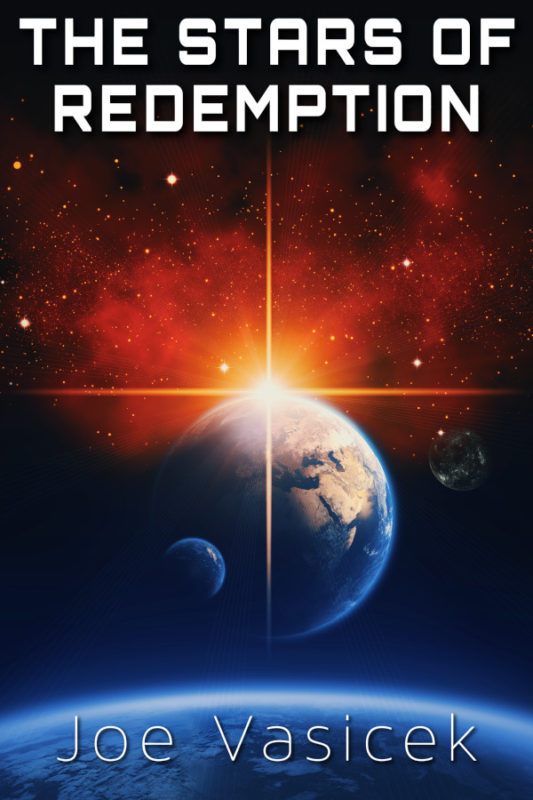
Is The Stars of Redemption for You?

The Stars of Redemption brings the Genesis Earth Trilogy to its heartwarming conclusion, weaving together cosmic mystery, high-stakes adventure, and the emotional journey of a family caught between past and future. In this character-driven science fiction novel and grand finale of the Genesis Earth Trilogy, the secrets of the ghost ship, the wormhole, and humanity’s long-lost Earth collide, pushing Terra, Michael, Estee, and Khalil toward a destiny that tests their courage, their bonds, and their hope.

What Kind of Reader Will Love This Book?

If you like…

  • Character-driven science fiction where relationships matter as much as the big ideas
  • High-stakes adventure rooted in loyalty, courage, and found family
  • Deep-time, big-concept SF (time paradoxes, shattered superintelligences, dead Earth, existential threats)
  • Teens thrust into danger who must grow up fast without losing their humanity
  • Stories where the emotional journey hits as hard as the plot twists

…then The Stars of Redemption is exactly the kind of story you’re looking for.

What You’ll Find Inside

The Stars of Redemption follows Estee and Khalil as they ride a mysterious ancient ghost ship run by a fractured AI. The two young adults now know the truth about the time travel paradox that created it, but they aren’t sure how to stop it from going back and annihilating the human race. But solving the paradox will create an alternate timeline—one where many of their loved ones have lived totally different lives. The result is a tense, emotional, wonder-filled journey that blends survival, mystery, love, grief, and cosmic terror into a finale that feels both epic in scope and heartwarmingly personal.

What Makes It Different

Fans of classic time-paradox stories and authors like Arthur C. Clarke, Becky Chambers, or Michael Crichton will recognize the sense of cosmic mystery, but The Stars of Redemption takes those ideas in a uniquely human direction. Where many time-loop or AI-disaster stories focus on spectacle, this one leans into relationships, trauma, and the fragile bonds that hold people together when everything else collapses. And unlike most YA or near-YA science fiction, it refuses to sacrifice scientific wonder or thematic depth—holding the line on both heart and hard SF ideas.

What You Won’t Find

If you’re looking for grimdark nihilism, sexually explicit romance, or nonstop action with minimal character growth, this isn’t that book. But if you prefer science fiction grounded in hope, heart, survival, and meaning, with characters who feel real enough to bleed, you’ll feel right at home here.

Why I Think You Might Love It

I wrote The Stars of Redemption shortly after becoming a young father, and that life-changing experience deeply informed the conclusion of the Genesis Earth Trilogy. Starting a family of my own made Estee and Khalil’s found family more vivid, as well as Estee’s need to fill the hole left by losing her parents. This became the most mature and thoughtful book in the trilogy—the kind of story I always wanted to write but couldn’t until I’d lived a little more myself.

If you loved the high-concept wonder and emotional heart of Genesis Earth and Edenfall, I think you will find The Stars of Redemption to be a thoroughly satisfying, deeply meaningful conclusion to the trilogy!

Where to Get the Book

Related Posts and Pages

Explore the series index for the Genesis Earth Trilogy.

Visit the book page for Genesis Earth for more details.

Read about breaking the time paradox in The Stars of Redemption.

See all of my books in series order.

Q is for Quitting the Day Job (or never having one to begin with)

Writing is one of those gigs where everyone expects you to have a day job, since common wisdom says that writers don’t make money. In traditional publishing, that may be generally true, but self-publishing is an entirely different game. It isn’t necessarily easy to make a living as an indie writer, but it is possible–much more possible than it is in the traditional industry.

I can’t speak authoritatively on when it’s right to quit the day job because I never really had one. I graduated in 2010, during the height of the “jobless recovery”–the soporific catchphrase invented by Washington policy wonks to describe the weird phenomenon where GDP was improving but unemployment was still in the crapper. For everyone outside of the Emerald City of Washington, we were still deep in the quagmire of the Great Recession.

I had just gotten back from an internship in the Emerald City that had severely disillusioned me to all things political. That rendered my degree in Political Science pretty much useless, and I found myself hitting the streets of Provo looking for something–anything–that would pay. I sold my body as a plasma donor, I sold my soul as a call center interviewer, and eventually I settled into that weird blend of mercenary prostitution that constitutes temp work. But even the temp jobs were scarce, and I found myself living from month to month, barely scraping enough to get by.

That’s when I learned about self-publishing. By this point, I already knew that I wanted to be a full-time writer. That was my plan A, and since it didn’t look like I’d ever land a steady day job, there was no plan B to fall back on. The stuff I was writing didn’t seem to be anything New York was interested in–not enough to pay a living wage, at least–so I jumped into self-publishing with both feet and never looked back.

When you first start out self-publishing, chances are that you’ll languish in obscurity for a while, barely selling enough books to make pizza money month to month. That was certainly the case with me. My economic situation wasn’t improving, so in 2012 I decided to go overseas and teach English in the Republic of Georgia.

GEORGIA | hyper – travel from Piotr Wancerz | Timelapse Media on Vimeo.

Besides temp work (which doesn’t really count), teaching English is the closest thing I’ve had to a day job. And while I loved the adventure of living in another country, the job itself wasn’t really all that fulfilling. It was really hard to balance writing with all the other stuff going on, even though the job took no more than 20 hours per week. It took up a lot of mental space, and that was enough to make writing really difficult.

So I came back to the States in 2013 and did my best to settle back in. Then, a weird thing started to happen. My books, which before had only earned pizza money, suddenly started earning grocery money. That soon grew to grocery and gas money, and before the end of the year, I was making rent money on top of that as well. My Star Wanderers books had started to take off, and even though they weren’t spectacular bestsellers, they pushed me up to the point where writing was my primary source of income.

Today it’s still touch and go, but I’m more or less making a living off of my books. I’m considering going overseas again, only this time, I’d live off of my royalties instead of getting an ESL job. Then again, there’s this girl I’ve been seeing, and she might keep me in this country for a while. If things work out, I have no idea how that would change things, but I imagine it would raise the making-a-living bar pretty substantially. With the way my book sales are growing, though, I’m confident that things will work out.

Back when I still planned on getting a day job, I thought that there would be some sort of magic threshold where, once I crossed it, I would make my entire living off of my writing career and would never work another job again. Instead, what I’ve found is that it’s more of a zone, where some (or perhaps even most) of your income is from book sales, but you still have to take on an occasional paying gig to make ends meet. There is no magic threshold at which you’ve “made it,” it’s more about just making it up as you go along.

All of this is made much, much easier by the fact that Amazon pays monthly royalties like clockwork. Barnes & Noble does too, and Smashwords and Kobo are also reliable, though a little less predictable as to when they’ll get their money to you (Smashwords seems to be holding onto my royalties until the end of this month, which is really annoying because usually they pay in the first week of each quarter). Since sales reports are instantaneous, I can look at how my books sold in March and know how much I’ll make in May.

It also helps that my earnings per book are significantly higher as an indie than they would be if I were signed with a traditional publisher. I don’t get an advance, but that’s okay because advances these days are pitiful anyway (seriously, $5,000 paid out over the course of two or three years? That’s less than I made as a volunteer ESL teacher in Georgia). And since I can publish as many books as I can write, I’ve been able to put out a lot more books as an indie, without the hassle of trying to run them past a committee of overworked editors in the bowels of some New York publishing house.

As for when it’s right to quit your day job, I have absolutely no idea because I never had one. But the fact that I (a nobody) am making it even without a day job says a lot. If you want to quit your day job and make a living as a writer, your chances of making it are a lot better if you take the indie route.

Trope Tuesday: Forbidden Zone

For the next few Trope Tuesday posts, I’m going to pick apart some of the tropes I’m playing with in my latest WIP, Sons of the Starfarers.  One of the things I love to do when brainstorming a new story is to use tvtropes like a menu, finding the tropes that best fit my story ideas and combining them with other tropes to get even more ideas.

It’s not often hard to spot the forbidden zone in a fantastical world.  Perhaps it has an ominous name (bonus points if it has the word “doom” in it), or perhaps there’s some sort of sign saying “do not enter.” Either way, this is definitely a place where no one goes, and no one is supposed to go.

Of course, you can pretty much guarantee that the main characters are going to go there.  It’s like the forbidden fruit: the very fact that it’s off limits makes it more alluring.  If genre blindness is in effect, someone will probably make the mistake of saying “what could possibly go wrong?

There are many reasons why the zone may be forbidden.  Perhaps it’s a death world, where the characters will soon find themselves running for their lives.  Perhaps it’s not quite so dangerous, but once you go, you can never come back.  Or perhaps all the warnings were lies, and the so-called forbidden zone is actually the place that the characters needed to get to all along.  If that’s the case, then the mentor was probably a broken pedestal or the Svengali.

In any case, the forbidden zone definitely lies in the realm of adventure.  Depending on how soon or how late in the story the characters go there, it may lie just on the other side of the threshold, at the bottom of the belly of the whale, or at the very heart of the character’s nadir.

The Mines of Moria, the Toxic Jungle, Area 51, the Elephant Graveyard, and the Fire Swamp are all classic examples.  In C.S. Lewis’s Space Trilogy, Earth itself is a forbidden zone to all the other inhabitants of the solar system, which is why it’s called the silent planet.

In real life, there are plenty of these as well.  Just look at the DMZ on the Korean Peninsula, or the fallout zone around Chernobyl.  When I was living in Georgia, Abkhazia was off limits to the TLG volunteers, meaning that if you went there (and the Ministry of Education found out about it) it was grounds for immediate firing.  Of course, that only encouraged some of my TLG friends to go there even more–remember the forbidden fruit?  Others waited until their contracts were over and practically made a tour of the many forbidden zones of the Caucasus, including Nagorny Karabakh, which one friend described as safer than Philadelphia.

I’ve toyed with this trope in my own work, but never too explicitly.  The best example is probably the alien ghost ship from Genesis Earth.  It’s not exactly forbidden, since there’s no one around to tell Mike not to go there, but Terra definitely doesn’t want him to go.  Earlier in the same book, she forbids him from entering her workspace in the observatory, which leads to some complications and a major reveal when he inevitably does.  In the Gaia Nova series, the Outer Reaches qualify as a forbidden zone, since the only people who live out there are murderous barbarians like the Hameji.

In my new series, Sons of the Starfarers, the first book starts out with a forbidden zone–a derelict space colony, where everyone has died of an unknown cause.  Since the nearest settlement is light-years away (and because Aaron is perhaps too curious for his own good), that’s where Isaac and Aaron go.  What they find there propels the rest of the book–and quite possibly the rest of the series.

Check back next week for more!

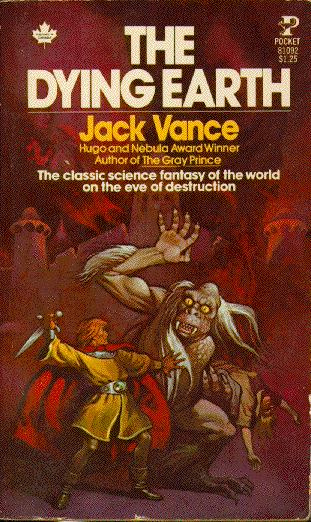
The Dying Earth by Jack Vance

the_dying_earthDo you remember those creepy-weird montages from those old 60s and 70s era Disney movies?  The ones like Dumbo, or The Three Caballeros–or heck, the entire thing of Fantasia–where all these weird kaleidoscopic shapes and psychedelic colors just move in and out of each other in twisted, convulsing ways?  Well, guess what?  Jack Vance’s The Dying Earth is like one of those montages in written form, and I loved it.

I picked up this book in order to familiarize myself a little better with the Sword & Planet subgenre, which I’d like to write in (as you may remember … my WIP is currently on hold, but I’d like to pick it up again soon).  This one is a lot different from the Princess of Mars series, with an eerie apocalyptic feel, arcane magic and forbidden knowledge, weird, monstrous creatures, and above all else, a decidedly un-Disney fairy-tale feel that pervades the book with doom and danger.

If you’re looking for straight-up Science Fiction, you’re better off looking elsewhere.  This book is even more fantastic than Ray Bradbury’s stuff, and while there’s a little bit of a sci-fi dressing thrown in, there really is no scientific justification for anything.  The basic premise is that the Earth is dying, meaning that the sun is growing dimmer and dimmer and will soon go completely out.  The last few people eking out an existence on this planet are mostly wizards and witches, each one intent on building their own little empire and cheating or stealing from everyone else.  There are a few pure-hearted souls, but the world is completely lawless, and the only way to survive is through magic or brute force.

The chapters are really more like interconnected short stories, where each one stands on its own, and yet may feature a recurring character, or be set in the same place as another.  There were only six chapters in the version I read (the 1977 Pocket Book edition), which makes me wonder if I missed any.  If I did, I would definitely like to read them, because the stories were absolutely mesmerizing!

Because I read this book to get a feel for the sub-genre, I’m going to list some of the things I really enjoyed about it.  Here they are:

  • The fairy-tale story structure.  None of the chapters started out with “there once was a …” but it certainly felt like they did.  Each character started off with a quest or dilemma, and then went on a journey of some sort where they faced trials, made friends, and defeated enemies in order to attain some sort of boon at the end.
  • Lots and lots of world-breaking magic.  Seriously.  One of the guys sets out on his journey with a spell that basically keeps him from any danger whatsoever, so long as he stays on “the path.” Since he really has no idea where he’s going, “the path” is basically any path he chooses to travel.  Since all the rest of the magic is just as world-breaking, you have no idea what could happen next.  There’s always a sense that anything could happen.
  • An elevated sense of diction.  The characters don’t speak like we do, they speak like people from the 18th or 19th centuries, with words like “thus,” “whence,” “wherefore,” and grammatical structures like “I know not,” and “half yet remains.” It’s not just the characters, either–the whole book is like that.  It really adds to the fantastic, otherworldly feel.
  • Lots of contrasting extremes.  The demons are truly perverse and sadistic, with death and brutality on every other page.  At the same time, though, the moments of beauty and love are just as great.  My favorite line from the whole book, which practically made me cry, is “My brain is whole! I see–I see the world!” If I explained it any more, it would be a spoiler.
  • High adventure.  LOTS and LOTS of high adventure.  There isn’t a viewpoint character in the book who doesn’t leave home to go on some sort of quest through all sorts of wild and creepy dangers.  Every character is seeking something, and not in a “meh” kind of way–they are so wholly focused on what they’re seeking that they put their very lives in peril just to obtain it.  Almost all the romance is rescue-romance, of the pulpiest possible kind.  It’s awesome.

There are more, but those are the big things.  Overall, I’d say that this book is about 50% Fantasy, 30% Horror, and 20% Science Fiction, with none of the more modern conventions of any of those genres.  It was first published in 1950, but it feels a lot closer to Robert E. Howard and Jules Verne than J.R.R. Tolkien and Arthur C. Clarke.  If you’re looking for a good spec-fic throwback with lots of magic and adventure, this is a great one to check out.

Trope Tuesday: Arcadia

Happy_Arcadia_by_Konstantin_Makovsky

What happens when you cross the Ghibli Hills with the Call to Agriculture?  You get Arcadia, a simple, uncomplicated utopia where people keep to the good old ways and live in harmony with nature.  As home sweet home for the farm boy and the country mouse, it’s often the starting point for the hero’s journey, though you’ll also see an occasional retired badass or old master take up residence after their adventuring days are over.  Then again, it might just be a ten minute retirement before they’re back in harm’s way.

This is NOT a town with a dark secret or any other kind of twisted dystopia.  There are no knights templar who believe that Arcadia justifies the means.  If there is any sort of moral or message behind this place, it’s a green Aesop.  If there’s anyone who fights to defend this place, it’s usually the good shepherd.

Because of the Rule of Drama, it seems almost paradoxical that a place as peaceful as Arcadia would exist in any story.  However, sometimes it’s good to have the contrast.  It also helps to raise the stakes by giving the hero a home like this to fight for.  By keeping this in the back of their minds, it can be an effective way to keep them from crossing the despair event horizon.

The hero can visit Arcadia at any point in the story, but it tends to fulfill different roles depending on when they go there.

If the hero starts out in Arcadia, it’s usually the known, familiar world which he leaves behind after getting the call to adventure.  He may or may not be able to go back once the adventure is over, depending on how much he’s changed and whether he can adjust to a boring, peaceful life after so much adventure.  A good example of this is The Shire from The Hobbit and Lord of the Rings.

If the hero ends in Arcadia, then it’s usually a way to show that everyone lived happily ever after (more or less).  Tolstoy was a big fan of this one, though he was also sure to show that living in Arcadia can be hard work–but in his view, the work is part of the reward.  In Lord of the Rings, Samwise Gamgee ended in Arcadia on this note.  Frodo didn’t.

If the hero visits Arcadia during the middle of the story, it’s usually part of an Arcadian Interlude.  The down time may give him a chance to rest and recuperate, as with Medwyn’s realm in The Chronicles of Prydain, Resembool in Full Metal Alchemist, or Tom Bombadil in Lord of the Rings.  Alternately, it may be a leave your quest test–because really, who wouldn’t want a nice, peaceful life when faced with the hardships of adventure?

While the idyllic rural setting of Arcadia seems great to us now, this wasn’t always the case.  In all the old stories, when characters strayed into the country, they tended to find themselves in the Lost Woods.  And while Vice City is normally considered the exact opposite of Arcadia, the Shadowland, which may or may not be rural, also qualifies.

In the end, the thing that makes Arcadia great isn’t just the rural, agricultural setting, or the simple way of life, or the lack of poverty (or extravagant wealth, for that matter), it’s the combination of all three, combined with a sense that the place is truly incorruptible.  It may be full of simple-minded, naive little people who have no idea what’s going on in the rest of the world, but it’s a place where you can feel safe.

In my own work, Terra 4 Dome from Desert Stars probably qualifies as this.  Even though it’s an archipelago of small islands rather than the rolling farmlands most often associated with Arcadia, it fulfills the same role more or less.  I don’t think I played with this trope at all in Bringing Stella Home, though in Stars of Blood and Glory, there are a couple of places that qualify.  And in Star Wanderers, various examples pop up from time to time, some more relevant than others.

As someone who dreams of settling down in a real-life version of Arcadia at some point, you can definitely expect to see me play with this trope in the future.

A Letter From My 2013 Self

tomy2012selfSo shortly after writing up my last blog post, I got an email from myself marked December 27, 2013.  How freaky is that?I don’t know if it’s a glitch or a feature, but apparently in 2013, you can use gmail to send messages back in time.

In any case, the letter is pretty interesting, so I thought I’d post it.  Here it is:

Dear Joe,

Well, it’s been an interesting decade so far, hasn’t it? Not a bad time to be alive–and that’s going to be even clearer by the end of 2013.

Right now, you’re still in the Republic of Georgia, anxious to get on that flight and head back home. Don’t be. You’re going to miss that place, even though it’s hard to feel that way right now. Your time there has changed you a lot more than you realize, though it’s going to take most of the year for you to figure that out.

You’ve picked up some bad habits, mostly from the other expats. Swearing is one of them. Clean up your language–it’s not going to do you any favors, especially back in Utah. Personal hygiene is another. Just because you could go for days without showering back in Rokhi doesn’t mean that you can get away with it in the States.

Money issues are on your mind right now. That’s good. You’ve learned how to be extremely frugal in the past two years, and that skill will serve you well. Don’t be afraid to get a crap job–that’s actually one of the best things you can do right now. The economy hasn’t improved much since you left, but if you look in the right places and speak with the right people, you’ll be able to make ends meet without too much trouble.

Remember, your writing career should be your main focus. Don’t go chasing after the dollar. You’ve experienced a taste of success in the last few months, and you’re going to taste it again. It comes in spurts, though, so be prepared for that. You’ll figure it out–in fact, you’re already most of the way there. Just remember to keep your butt in that chair, and you’ll be all right.

By the way, you really should spend more time on your business plan. Don’t just use it as motivation to write something else–that stuff is actually important. In Georgia, you can get away with winging it, but not in the States. That’s going to take some getting used to as well.

Your biggest anxiety right now is your supposed lack of self-discipline. That’s actually not as much of a problem as you think. After spending a year in Georgia, you might feel incapable of working another honest day in your life, but that feeling will soon pass. In fact, 2013 is going to be a very productive year for you. All that self-discovery is going to pay off in a big way soon. So don’t worry about it so much, and remember, you haven’t written your best book yet.

Perhaps the most important thing about your year in Georgia is that it really lit a fire under your butt. You know what I’m talking about. If you can travel alone to a foreign country, you can work up the courage to ask her out. No, I’m not going to tell you who. You’ll know her when you see her. But you may have to trim the beard. Just sayin’.

You won’t spend the entire year back in the States, but when you do go overseas again, you won’t be alone. No, I won’t tell you who you’ll go with, or where. Some surprises are better left unspoiled.

There’s more I could tell you, but that’s enough for now. You’ll figure things out on your own, same as you always have. Hope for the best, plan for the worst. Follow the path of least regret.

Joe

A Letter To My 2011 Self

Dear Joe,

Well, 2011 has been an eventful year, hasn’t it? It sure didn’t feel like it when you were down in the trenches, but now that it’s over, you’ve got to admit, you sure came a long way.

You’ve discovered a lot of things about yourself since January. In your quest for economic security, you’ve learned that you’d rather work for yourself as a freelancer than be anyone else’s employee. You took the plunge and self-published, something you thought you’d never do (and yes, it’s okay to call it ‘self-published’–the stigma will be dead in another year). You attended your first Wordcon, made a couple of cross-country road trips, worked a ton of crap-jobs just to make ends meet, and now you’re on your way out of the country to try your hand teaching English. It sure seems like a lot, doesn’t it? Just wait. Next year is going to be just as full of changes, though it won’t always seem like it at the time.

I know, I know–cut to the chase and give me some advice already. Well, looking back on what you’re going to go through in 2012, here’s what I have to tell you.

First, don’t stress out so much about the whole self-publishing thing. You’ll figure it out all right. No, I can’t say whether you’re going to hit the turning point before the end of the year. In fact, that’s not even a healthy way to look at it, so stop thinking about it that way. Follow the slow growth model, and don’t angst about sales or price points so much. Keep your butt in that chair, because writing new words is still the most important thing you can do.

Don’t beat up on yourself so much for failing to meet your ridiculously high goals. You’re going to write a novel in the next six weeks, and the rest of the year is going to be a struggle. Right now, you place too much emphasis on your daily word count. Relax a bit, and don’t be too hard on yourself. You’ve still got a lot to learn about your own creative process, so take the time to figure it out.

By the way, you totally rock the beard. Growing it out was a great idea, no matter what your sisters told you back in 2010.

About your upcoming excursion to Georgia, the best advice I can give you is to remember what Spencer told you back in 2008. Adventures are like stories–they each have a beginning, a middle, and an end. You’re going to experience all of that in the next year. No, you probably won’t write another travel journal. Most of your experiences are going to be too personal for that kind of thing anyway. You’re going to accomplish all of your goals, though, so don’t worry–things are going to be just fine.

The most important thing you can do is keep yourself grounded spiritually. I know, I know, that’s always the most important thing. Well, it’s especially true now. Where you’re headed, you’re not only going to be the only Mormon, but the first Mormon to live there. Sundays are going to be a struggle. Everyone is going to think you’re crazy because you don’t drink. You’re going to make wine, though, and that’s going to be an interesting story for your friends back in Utah. Just be sure to keep doing the things you know you should be doing, and everything will turn out all right.

You’re going to love teaching English. Oh, you won’t love everything about it, but it’s something you’re naturally good at, so don’t worry about that. Just try to listen to your Georgian co-teachers and be more considerate of them. And don’t worry about the language. You’ll pick it up pretty quick. Just realize that Georgian verbs are impossible to conjugate unless you’re a native speaker.

I could tell you what your biggest mistake is going to be, but I think it’ll be better if you go ahead and make it. Just be sure to hope for the best, even as you plan for the worst. Follow the path of least regret, and you’ll make some really awesome memories–not to mention some truly amazing friendships.

At this point, I’d tell you you’re on the right path, but that isn’t exactly true. There is no ‘right’ or ‘wrong’ path for you right now, but you’re on a good one, so keep it up and see it through to the end. You’ll be glad you did.

Take care!

Joe