As I write this, it’s the morning after the US 2022 midterm elections. The results aren’t totally in yet, but it appears that the Republicans are going to have a slight majority in the House, while the Senate is poised on the edge of a knife and could go either way.
Republicans had convinced themselves that a massive “red wave” was coming, and the fact that it didn’t materialize has left many of them believing that the judgments of God hang over this country. Meanwhile, the Democrats had worked themselves into a frenzy over the abortion issue, and the fact that the Republicans gained ground is probably making many of them fear that a Handmaid’s Tale future is not far off for us.
Those who believe that the 2020 elections were rigged by the Democrats have ample reason to believe that the 2022 were rigged as well, with some very suspicious anomalies happening in key Democrat strongholds. Meanwhile, those who fear that “election deniers” are a threat to “our democracy” have ample ammunition to support their views too, as the final results weren’t that far off from the polls.
The divided government is likely to give us two long years of gridlock, which wouldn’t be a bad thing under normal circumstances, but with inflation being what it is, the (manufactured) energy crisis crushing us, and the war in Ukraine getting messier by the day, we’re likely to see all of those things get worse, not better. The stock market might see a slight reprive, but the real economy is going to be a slaughterhouse for the next two years—and each side will try to pin the blame on the other.
Meanwhile, I doubt there’s going to be any real accountability for the criminals who gave us the pandemic lockdowns and the jab mandates, at least in the next two years. And the Biden administration is likely to get even more aggressive with their weaponization of the DOJ and other government agencies, since they won’t be able to get their agenda through congress.
In short, this election provided zero clarity, no firm direction, and is bound to reinforce everyone’s pre-existing biases, making the partisan divide even wider and the crazies on both sides even crazier. If we were on the path to a civil war before these elections, we are even more locked into that path right now.
So with inflation being what it is, one of the questions on my mind these last few months has been whether I should raise my book prices to keep up with the increased cost of living. We’re definitely feeling it every time we go to the gas station or the grocery store, and I’m sure that all of you are feeling it too—and those of you overseas are probably feeling it much worse than we are.
Short answer: No, I do not plan to raise my prices in the immediate future. In fact, I’ve actually lowered some of my prices. When I do raise prices, it will be because Amazon and the other retailers have changed their printing costs and/or royalty structure.
Long answer: My books are currently priced according to the following schedule (all prices in USD):
Free or 99¢: Short-term sales and permafree books.
$2.99: Ebooks only, typically novellas.
$4.99: Ebooks only, typically novels and collections.
$8.99: Audiobooks only, where the ebook is $2.99.
$9.99: Ebook bundles and some paperbacks.
$14.99: Paperbacks.
$16.99: Audiobooks only, where the ebook is $4.99.
Every year, I conduct a reader survey around October-November. A couple of weeks ago, I got the results back from this year’s survey, and the answers to the pricing questions are largely unchanged. If anything, it seems like readers are more price conscious than they were last year.
And that makes sense, when you consider that books—especially genre fiction books—are a luxury item for most people. When the budget is being squeezed by the increasing price of food and gas, it makes sense that readers would cut back on their book buying habits. After all, paperbacks have very little nutritional value—ebooks and audiobooks even less so—and burning them is a very expensive way to keep warm.
All joking aside, though, I don’t think that now is the time to raise my prices. From a business perspective, the data just doesn’t support it, but also from a human perspective it just seems like a bad thing to do. I like my readers. I don’t want to put the screws to their wallets just because everyone else is, too.
(In fact, the data indicates that I’ve been making a mistake by pricing all the first books in my trilogies at $4.99. One of the questions on my survey was “from which of my series have you read at least one book?” and none of my series received more than a 45% response. This tells me that there isn’t enough series crossover happening, and that I need to treat the first book in every series as a potential entry point into my catalog. So I’ve decided to drop my ebook prices to $2.99 for every first book in a trilogy, even where I haven’t finished the trilogy yet.)
The other side of that, of course, is that my own wallet is getting screwed. Jeff Bezos famously said that “your margin is my opportunity,” and as much as we indies may love Amazon, Amazon is definitely not our friend. But so far, the screwing has not been much of a problem, at least as far as inflation is concerned.
When Amazon essentially created the indie ebook market, they did it on an agency model, where publishers set the prices and receive a percentage from the sale in royalties. For the last decade, that royalty structure has not changed: ebooks priced between $2.99 and $9.99 get a 70% royalty rate, and everything else gets 35%.
Things are a little different on the print side of things, which follows a wholesale model and delivers a physical product. Printing costs are definitely creeping up, though so far it’s only been by a few cents. At $14.99, I’ve got a fair amount of wiggle room, but if per-unit print costs go up by a couple of dollars, I will have to raise my prices.
Same thing with the digital products. If inflation continues to accelerate, or even if it continues at its current pace for a sustained period of time, there is a very good chance that Amazon will change their royalty structure for ebooks, and all of the other platforms will likely follow suit. If/when that happens, it really will put the screws on us indie authors, and you’ll probably see most of us raise our prices as a result.
I don’t know how I’ll respond when that happens, but I’ve decided that until it happens, it will be better to keep my prices where they are. So until the increasing print costs or changes to the ebook royalty structure force me to increase my book prices, I plan to keep them where they are.
This just popped up in my blog aggregator this morning (yes, I still use a blog aggregator—it helps to avoid addictive social media algorithms), and it is legitimately the most laugh-out-loud hilarious Project Veritas video I’ve seen—and that’s saying something. Just wait until the end!
My 2022 reading resolution: Read or DNF every novel that has won a Hugo or a Nebula award, and acquire all the good ones.
Earlier this month, I finished my last Hugo/Nebula book and ordered the last two ones that I hadn’t yet acquired. The first of those (Powers by Ursula K. Le Guin) arrived just this morning, and the other one (Way Station by Clifford D. Simak) is supposed to arrive next week, so I think that now is a good time to do a retrospective and share some of my thoughts.
There were 104 books in total, including the most recent award winners (I decided not to count the retro-Hugos midway through the year). Of those, I’ve read 35 through from start to finish, and decided that 24 were worth keeping. The rest of them (69, or almost exactly two thirds) I DNFed.
Finishing one in three books is actually about on par for me. I’ve found that if I don’t allow myself to DNF books early and often, I just don’t read. Also, it doesn’t really surprise me that nearly one third of the books I read all the way through didn’t really impress me. What can I say—I’ve a very opinionated man.
Of the 28 books that have won both a Hugo and a Nebula, I finished 12 (or about two-fifths) and found that eight (or a little over a quarter) were worth keeping. So not much different than the overall totals.
Of the 45 books that won only a Hugo, I finished 18 (exactly two-fifths) and found that 14 (about a third) were worth keeping. So my personal taste seems to be tilted more toward the Hugo than the Nebula. The difference becomes even more stark when you take out the 20 books that were nominated for (but did not win) a Nebula, a whopping 16 of which I DNFed. Excluding those, we’re left with 25 books, 14 (or more than half) of which I finished, and 11 (or just under half) I thought were worth keeping.
The contrast becomes even sharper when we look at the Nebula-only winners. Out of the 31 books that didn’t win a Hugo but did win the Nebula, I finished only five (less than one-sixth) and found that only two were worth keeping. Both of those were books that weren’t even nominated for the Hugo. When we look at the 16 Nebula-winners that were nominated for a Hugo but didn’t win, I finished only two of them (one-eight) and didn’t think that any of them were worth keeping.
So the best predictor that I wouldn’t like a book is if it won a Nebula and was nominated for a Hugo, but didn’t win. In other words, if the SFWA crowd (which is mostly authors) said “this is the best novel published this year!” and the denizens of Worldcon said “yeah… no,” that almost guaranteed I would hate it. In fact, just getting nominated for a Nebula is enough to make a book suspect.
This is why, earlier in the year, I posited the theory that SFWA has done more to ruin science fiction than any other organization. I saw this trend coming all the way back in the spring, when I was only halfway through the reading list. In the early years, SFWA was all about politicizing science fiction, and in the last few years, it’s basically turned into a nasty bunch of mean girls all trying to get a Nebula for themselves.
I tracked a few other awards just to see if there were any correlations. For the 18 books that placed in any category in the Goodreads Awards, there were only four books that I finished and two that I thought were worth keeping. Network Effect by Martha Wells received 22,971 votes in the Science Fiction category in 2020, which came to 9.69%. Blackout by Connie Willis gained only 337 votes in 2010, but that was 9.19% back then. Both of those books were keepers. The only other book that got a higher percentage for its year was Redshirts by John Scalzi, with 4,618 votes at 10.82%, but I DNFed that one. Most Hugo/Nebula winning books didn’t even clear the 5% threshold in the Goodreads Choice Awards, and in my experience anything under 10% that doesn’t immediately jump out to me probably isn’t worth reading.
Of the six Hugo/Nebula books that were nominated for a Dragon Award, the only one I even really finished was Network Effect by Martha Wells. But that makes sense, since it’s no great secret that the Hugo/Nebula crowd is trying to sabotage the Dragons by pulling exactly the same shenanigans that they accused the Sad Puppies of doing. Accusation is projection is confession, after all. As of 2022, there has never been a Hugo/Nebula winning book that has also won a Dragon, and while part of me hopes that it stays that way, another part of me is very curious to read the first book that does.
Almost all of the 104 Hugo/Nebula winning books placed somewhere in the various Locus recommended reading lists, which isn’t surprising since those lists are generally regarded as feeders for the Hugos and Nebulas (and used to get more people voting in them, too). Of the seven books that weren’t on a Locus list, the only one I finished was They’d Rather Be Right by Mark Clifton and Frank Riley, which also has the distinction of being the most difficult book to find.
(A lot of people think They’d Rather Be Right was the worst book to ever win a Hugo, but I actually enjoyed it. Unlike most Hugo/Nebula books, it was remarkably anti-Malthusian, which is probably why it’s so hated. As for the worst book to ever win a Hugo, I personally grant that distinction to Dreamsnake by Vonda N. McIntyre.)
There were only ten Hugo/Nebula books that won or were nominated for a World Fantasy Award, and I only finished two of them (and didn’t think either were worth keeping). Perhaps that means that makes it the actual best predictor that I’ll hate a book, but ten is a pretty small sample size, so I’m holding off judgment for now.
The best two decades for me were the 50s (7 books, 4 keepers) and the 00s (16 books, 6 keepers), though the 80s came in close with five keepers out of sixteen books—and let’s be honest, Blackout and All Clear by Connie Willis are basically two halves of the same book. In contrast, the worst two decades were the 70s (only one keeper out of 13 total books) and the most recent decade, the 10s (15 books, 2 keepers).
So far, the 20s aren’t shaping up to be much better. In fact, I think it’s entirely fair to say that given the state of fandom since the election of President Trump (and the general state of insanity in this post-Trump era), a Hugo or a Nebula should count as a mark against a book, rather than for it. That is, the primary value of these awards is to tell you which books to avoid. Perhaps this will change at some point in the future, like it did after the madness of the 70s or the malaise of the 90s (not a good decade for science fiction, apart from books published by Baen), but I’m not holding my breath.
So that was my reading resolution for 2022. If I hadn’t allowed myself to DNF, I can guarantee that I never would have accomplished it. As it stands, though, I’m pretty satisfied with how it turned out.
What sort of reading resolution should I set for 2023?
Here’s a fun and cheery blog post for you. Just for fun, let’s run down all of the ways in which the world might come to an end in the next 12 months, and assign probabilities to each one. I’m not sure what qualifies as “the end of the world,” but for our purposes let’s say it involves (1) a massive loss of human life, and (2) a permanent and irreversible change to global living standards and our way of life. Ready? Let’s go!
Global Nuclear War: 1%
This is the one that everyone is talking about right now, what with the Russia-Ukraine war and the recklessness of Western powers in their support for it. Putin has formally annexed four occupied territories that are still under partial Ukrainian control, and now says that he will defend sovereign Russian territory with his country’s nuclear arsenal. With every possible offramp to the war now closed, it seems like it’s only a matter of time before someone uses a tactical nuke on the battlefield, and after that kind of an escalation, who knows what will happen next?
However, I actually think the probability of a nuclear armageddon in the next 12 months is actually quite low—not totally nonexistent, but still quite low. Putin is not the kind of politician to make tactical blunders, and that’s exactly what a nuclear strike would entail, especially given the current situation on the ground.
In a war of attrition between Russia and Ukraine, Russia wins. That’s true even with all of the weapons and material that we’re supplying to Ukraine. Furthermore, I suspect that Russia has a much stronger will to win this war than we do. With the energy crisis in Europe and all of the political discontent here in the US, I don’t see us continuing to write the Ukrainians a blank check for much longer. Also, Russia just destroyed a good chunk of Ukraine’s energy infrastructure in response to the Crimean bridge attack, which means that the average Ukrainian citizen is going to be in a world of hurt come winter.
It’s been very interesting to watch the progression of this war. In the runup to the war, the West mostly prepared Ukraine with cheap anti-air missiles, assuming that Russia would launch a shock-and-awe campaign, not a ground invasion. But Putin defied those expectations with the Special Military Operation, which consisted of a lightning strike on Kiev with his armored forces. However, once the Ukrainian resistance got going, it proved massively effective, thanks to the way the Javelin missile and other anti-tank weapons have altered the balance of war to favor defense over offense.
So Putin pulled back from Kiev, hunkered down in the occupied territories, and opted for a WWI-style artillery slugfest—in other words, a war of attrition. It’s unclear to me whether this has favored Russia or Ukraine. Most of the news that we hear comes from pro-Ukrainian sources, and claims that Russia is losing badly. But even though they’ve been able to retake some territory, they haven’t retaken any major occupied cities yet, and the figures on Ukrainian casualties are wildly different, depending on which source you check. I don’t think we’re getting the full story.
Now Putin has annexed the occupied territories, changing this from a Special Military Operation to something else entirely. At every step of the way, he’s been very gradual and methodical in his escalation, making sure that he has the legal justification first (even if it’s no more than a fig leaf) before taking the next step. Whether you support him or think he’s the anti-Christ, there is definitely a method to his madness.
In response to the destruction of the Nord Stream pipelines and the attack on the Crimean bridge, he’s been using cheap Iranian drones to destroy Ukraine’s critical energy infrastructure—and once again, we see how the nature of war has changed. Those drones are relatively cheap, but the anti-air defenses are hideously expensive, and they haven’t been able to stop every drone. Just like the Javelin missile favored the defenders, these drones appear to favor the invaders.
Putin’s best move at this point is to wait out his enemies, since they’re already showing signs of cracking. Europe is in a major energy crisis now, and the Prime Minister of the UK just resigned after less than two months. Biden isn’t doing much better, with the midterms shaping up to be a major red wave, and inflation is running dangerously hot across the entire West. For all of Biden’s talk about a “dark winter” last year, it appears that this year we’re actually going to get it—and a lot of that can be traced directly back to the Russia-Ukraine war.
So no, I don’t think there’s a very high chance that this war is going to escalate to a global nuclear conflict in the next twelve months.
Major Cyberattack on Critical Infrastructure: 3%
But a major global cyberwar is a much different story. Putin is on record saying that the next global war will be fought with 1s and 0s, and it would be foolish not to believe he hasn’t prepared for that. Same with us here in the West.
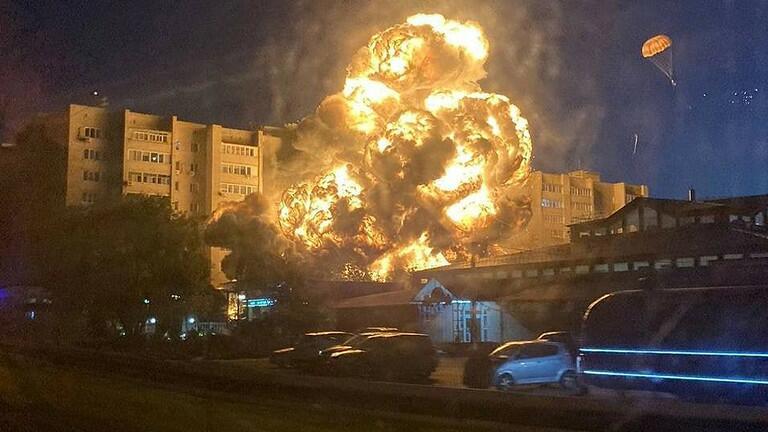
In fact, we may already be witnessing the beginnings of such a cyberwar. A week ago, a Russian jet slammed into a large residential building shortly after takeoff, and just this morning an F35 crashed out here in Utah. Could just be coincidence, as well as human error and/or mechanical failure—but it could also be true that these systems got hacked by hostile nation-state actors. If it is, I suppose we’ll never know for sure.
It makes a lot of sense to me that this conflict would escalate to a global cyberwar before it escalates to a global kinetic conflict. And if/when it does, energy infrastructure will be a major target. If so, it could get really, really ugly. The sources I follow estimate that we could see a 90% death rate after just two months of no power.
But again, I think Putin’s best move is to wait out his enemies and not show all his cards yet. We will amost certainly see limited cyberattacks, but a major global free-for-all? In my estimation, that’s unlikely, at least in the next twelve months. And even if it did happen, our power grid is so convoluted and Byzantine that I doubt that any nation state could knock it out 100% for a long period of time. It’s not a great defense against this sort of thing, but it does tend to work in our favor.
Global Famine: 5%
This is a big one. We’re already seeing a lot of warning signs pointing to major food shortages, with major droughts in North America, Europe, and Asia, energy and fertilizer costs at unthinkable levels, green public policies in places like The Netherlands that are just insane, and supply chains that are still incredibly bungled from the last pandemic. Global food prices are already going parabolic, and countries like Sri Lanka and Haiti are collapsing as a result.
I think this is a much greater immediate threat than some sort of global war. Every civilization is only three meals away from collapse. With that said, I’m not so sure it will be world-ending, at least in the immediate term. World-shattering? Yes. But the collapse is always distributed unevenly, and there’s still a lot of ruin left in the developed portions of the world, so I’m still pretty sanguine that we’ll find some way to muddle through this crisis, at least for the next twelve months.
Revolutionary Uprisings: 5%
As I mentioned above, the emerging global famine is already leading to popular uprisings in places like Sri Lanka and Haiti. I definitely think that trend is going to continue. But a lot of the unrest in the developed world is due to political instability that was already evident before the pandemic. Just look at the Yellow Vest movement in France, or the BLM and MAGA movements in the United States. Since the pandemic, those movements have only become more brazen, more entrenched, and more resolved.
Could we see an actual revolution in a major developed country, like the Bolshevik revolution in 20th century Russia, or the French revolution in 18th century France? I don’t think that’s beyond the realm of possibility. However, will we see such a revolution in the next 12 months? That’s a different story. Personally, I think the likelihood of such a thing is low, but that may just be my ignorance and normalacy bias speaking.
Here in the US, I think that the ruling Democratic party is going to get a truly historic spanking in November, which will go a long way to appeasing the popular discontent—at least in the short term. But I don’t think the Republicans are going to do any of the things that the people expect them to do, and long-term that will make the unrest that much worse. I doubt that it’s going to boil over in the next twelve months, but it could.
Hyperinflationary Collapse: 10%
There are a lot of reasons to think that we’re on the verge of experiencing a hyperinflationary event here in the US. The Fed exploded the money supply during the pandemic, which is we we’re currently experiencing such high inflation, and when you consider that velocity is at or near record lows, there is a lot of room for inflation to get much worse. Moreover, our glorious leaders seem determined to spend their way out of this problem, in much the same way that an alcoholic drinks himself out of a hangover.
But by far, the biggest and most dangerous factor is the collapse of the US dollar as the world’s reserve currency. If/when that happens, I frankly would be shocked if we didn’t experience a hyperinflationary collapse. Right now, the dollar is still the fastest fat man in the zombie apocalypse, but the Russia-Ukraine war is bringing a lot of countries together that would love to negotiate their trade deals in something other than US dollars. Not just minor countries either, but countries like China and Russia. Youch.
This isn’t something that came on us suddenly. In the past couple of decades, there have been a lot of red flags pointing to the end of the US dollar as the world’s reserve currency. The pandemic and subsequent events have accelerated those trends, and probably shortened the timeline of the collapse considerably.
But will we see a hyperinflationary collapse in the next twelve months? I’m skeptical of that. Right now, the dollar is strengthening against most other currencies, and I don’t see any other currency challenging ours for reserve currency status in the immediate future. Like I said above, we’re still the fastest fat man in the zombie apocalypse.
Global Unrest and Uncontrolled Mass Migration: 15%
If the coming global famine is going to be Earth-shattering, the secondary effects of that famine are going to be even worse. Like I mentioned above, Haiti and Sri Lanka are already in a state of collapse due to civil unrest, and global food prices have already exceeded the levels that gave us the Arab Spring. We’re probably not all going to starve, but enough of us very well might that the ensuring chaos will make the European refugee crisis of the 2010s and the current situation on the US southern border look like a dress rehearsal.
Again, the main reason I place this one at 15% is because I think it’s going to take some time for this one to really get going, and I’m skeptical that a twelve-month timeline is long enough for it to bring about the end of the world. But once this crisis does get going, it’s going to be ugly.
A Second (and Much Deadlier) Pandemic: 35%
Until last week, I placed the likelihood of this event happening at about the same level as a global nuclear war. But then I learned about the research at Boston University that was totally not gain of function, and managed to create a new strain of covid that was more transmissable than the Omicron variant and has a 80% fatality rate in experimental mice.
What the hell, you lab coat freaks? Do you WANT to kill us all? (No… please don’t answer that question.)
From what I understand, it wasn’t difficult to creat this new strain either. All they did was take the original alpha variant of covid-19 and splice it with the spike protein from the omicron variant. The alpha variant is now all but extinct in the wild, but if BU had managed to keep a sample, I’m sure that many others have too.
And exactly what is keeping some black hat actor from replicating this research and launching a second pandemic?
Even if the death rate in humans is only a fraction of what it was in the mice, that’s still a virus with an R0 at or near the omicron variant AND A MORTALITY RATE COMPARABLE TO THE BLACK DEATH. And now anyone with a halfway decent microbiology lab and a couple of covid samples can now create this insanely dangerous plague.
Given that this is a thing now, I would be extremely surprised if there isn’t another covid (or other artificially engineered) pandemic within my lifetime. Except that the next pandemic is going to be real, in a way that 2020 wasn’t. Seriously, when historians look back on this era, they probably won’t even look at 2020 as an historically significant year.
The only reason I’m putting this at 35% is because of timing. Will the black hat actor who concocts this plague decide to release it in the next year, or wait until conditions are more favorable for whatever agenda they want to push? Difficult to say. The likelihood is far greater than I would like, but I hope it’s no greater than 35%.
Global Debt Crisis and Financial Collapse: 80%
But of all the possible calamaties that could bring about the end of the world, the one that I most expect to see within the next 12 months is the collapse of the global debt market and a major financial crisis, even bigger than 2008. Much bigger, in fact, because we never actually solved any of the problems that gave us the GFC: we just papered over them and kicked the can down the road.
Well, it looks like we’ve just reached the end of the road. I can’t pretend to understand the financial markets in any sort of depth, but all of my sources—including folks who correctly called several false alarms in the past few years—are now saying that the big one is imminent. And when you look at what the US10Y is doing, or at how insanely inverted the yield curve is inverted, and realize that the debt bubble is orders of magnitude worse than 2008… yeah, that’s a big deal.
But would it truly bring about the end of the world as we know it? Well, consider this: what would you do if all of the banks closed, all of their websites went down, and you couldn’t use your debit or credit cards, or transfer cash into or out of your account, or even log into your account, or any financial account for that matter? What would happen if everyone on welfare suddenly found that their EBT cards didn’t work? If every employer suddenly found that they couldn’t make payroll? If the only thing left was cash, but none of the banks were open to disburse it?
That’s the sort of thing that would happen under this scenario. It might sound far-fetched, until you realize that it’s happened before. This exact thing played out in Cyprus a few years ago, and when the banks opened again, people were only allowed to withdraw something like a hundred Euros a day. It paralyzed everything.
Whenever there’s a major financial collapse, all of the big players get together in a smoke-filled room, lock the doors so no one can get out, and fight amongst themselves until they come up with a solution. “You bail out these institutions, I’ll bail out these ones, we’ll all take a 20% haircut, and the markets reopen at the end of the week.” Something like that. The last time this happened was 2008, and we were only hours away from a global banking holiday like the one I just described.
What happens if they can’t find a solution in time?
And even if they do, it’s not like there isn’t going to be any pain. Remember how bad the 2008 collapse was? That’s what happens when they find a solution—except this time, the underlying crisis has grown orders of magnitude larger, because we never actually solved it. We just papered over the problem instead.
I’m not an expert on this sort of thing, so the reason I’m pegging this one at 80% is because I’m a firm believer in the Pareto principle, and I don’t see any way that the status quo endures for another 12 months without a major catastrophe. Maybe the next financial collapse won’t be the end of the world, but given how unstable everything is right now, I don’t see it.
Climate Change: 0%
There is, however, one potential catastrophe that I can confidently peg at a 0% chance of ending the world in the next twelve months: climate change. It’s not a coincidence that this is also the one that’s probably eliciting the most panic right now. When the herd is all running mindlessly in one direction, it’s probably a good idea to stop and make sure there isn’t an abattoir up ahead.
Is the climate changing? Yes, as it always has. Is climate change man-made? Unclear. Is it changing catastrophically? Also unclear. Will we experience a catastrophic collapse of the global climate in the next twelve months? Let’s put it this way: climate activists have been warning us about an imminent catastrophe for 50+ years now, and the only people with a worse prediction track record are the ones who say “Jesus is coming on [insert date here].”
I would be a lot more inclined to listen to the activists if they didn’t all categorically reject the market-based solutions that have the best historical track record to reducing emissions and cleaning the environment. I would also be more inclined to listen to them if they weren’t so dead set against nuclear power, or if they were honest about the fact that drastic cuts to global energy production will lead directly to the deaths of many millions of people, especially in poor and developing countries.
When you combine that with how the all of the people who are most outspoken about climate change also fly to their conferences on private jets, have massive carbon footprints, and are buying beachfront property across the world, their hypocrisy speaks louder than their words. And as if that’s not enough, you have Project Veritas catching a major CNN executive on hidden camera confessing to how they plan to push climate change as the Next Big Thing after the pandemic is done.
So no, I don’t ascribe any credibility to the climate change hysteria that seems to have gripped the science fiction field. Twelve months from now, I guarantee that we will still have a human-habitable climate on this planet—unless the meteor finally kills us all.
Of course, I’m just a guy on the internet who follows this stuff for fun and uses it to write science fiction. I also have a political science degree, but don’t hold that against me, as I’ve been doing my best to unlearn all of that crap. But yeah: if the world does end in the next twelve months, I think the most likely scenario is a total collapse of the entire global financial system, followed by a second pandemic. It’s not as bright or as flashy as a nuclear war, but that’s where I’d put my money if I were a betting man.
In 2014, after being active on Facebook for eight years–the majority of my young adult life–I bit the bullet and deleted my account. I did it over the original Edward Snowden revelations, because I was genuinely disturbed with the connections between Facebook and the US intelligence community, and did not want to trust Zuckerberg or his company with any of my private data.
Very quickly, I learned just how difficult it was to function in today’s society outside of Facebook. Not only was I effectively cut off from all of my friends who were no longer living in close proximity to me, but I was also cut off from many of the social events among my current set of friends, because all of their activities were organized through Facebook. This made it almost impossible to meet new people, even through my existing social circles, so after a couple of years I bit the bullet again and made a new Facebook account.
To make a long story short, I got so disgusted with Facebook that I deleted my account again, then moved across the country where I was even more socially isolated and made a new account. With each iteration, I experienced with different rules, such as not friending anyone but family, not liking anything, turning off chat, etc. In 2018, I met my wife through an online dating app, married her in 2019, and promptly deleted both my dating profile and my third Facebook account.
In the interest of full disclosure, I have since created a fourth Facebook account, but only to access various writer groups like 20 Books to 50k and Wide for the Win. In the old days, we would organize on message board sites like KBoards, but now it’s all on Facebook, and if you’re not on Facebook, you’re basically cut off from the rest of the indie publishing world. I don’t like it, but that’s the way it is. So the way I use Facebook now, I only log in via an incognito browser, and I don’t post anything on my profile except the bare minimum of what Facebook requires. No friends. No likes. No news feed. I have, in fact, had my posts flagged for coming from a scam account, which I find almost as hilarious as the people the Facebook algorithm recommends to me as “friends.” Most of them don’t appear to speak English.
With Twitter, it was a totally different story. I created my account in 2009, got addicted to it for a while, then realized in 2016 that it was getting pretty toxic and deleted my account a couple of months before Trump was elected president. One of the top 10 best decisions of my life. I haven’t looked back since.
Right now, the only social media that I use consistently is my blog–and I’m not even super consistent with that. I do follow an eclectic mix of YouTube channels, but not via YouTube itself: instead, I plug in all the RSS feeds into a web-based aggregator. Helps me to avoid the YouTube recommendation algorithm, which can be super addictive. I used to be active on Goodreads, but I’m not anymore, just because I don’t want a bad review or a comment on somebody else’s book/review to spiral into something that could hurt my career. But even if writing wasn’t my career, I still wouldn’t use it to follow anyone except for a handful of close and trusted friends.
Living without social media for the last few years has given me an interesting, and perhaps somewhat unique, perspective on culture and society. In a lot of ways, it makes me feel like I’m on the outside looking in, which helps to write stories that are counter-cultural or otherwise serve as tales of warning. It’s also helped me to avoid a lot of the depression, anxiety, dysphoria, and outrage that characterize so much of today’s society.
On the other hand, it’s also been a real handicap when it comes to marketing my books. So in the next few months, I plan to expand my internet presence and experiment a bit with social media, joining some new communities and hopefully putting myself (and my books) in front of new people. But I don’t want to get dragged into all of the toxicity that’s out there, or to become addicted again.
So in the interest of avoiding all that, I thought it would be a good idea to take some time and write down some of the lessons I’ve learned from living without social media, specifically with what we (and by we, I mean I) can take from those lessons to use social media in a more healthy way.
Disable or block all mobile notifications, especially push notifications.
This was perhaps the biggest thing I noticed immediately after I deleted my Facebook and Twitter: the silence. No more buzzing phone. No more compulsion to pick up a device, or sit down at the computer and log back in. No more sense that I was tethered to my online persona, which I had to constantly maintain.
It was so incredibly liberating.
The closest thing I’d experienced before this was living in the Republic of Georgia, where the only way to get internet access was to walk to the village center, wait half an hour for an old VW bus to come through, ride that bus for another half hour to the nearest city, then walk to McDonalds and buy a cheeseburger or an ice cream so I could sit by the window and use the internet for a couple of hours. Honestly, I think that experience did a lot to prepare me to cut the cord, but it was still always there in the back of my mind, even when I was back in the village, helping out around the farm with chores.
With push notifications, though, that tether is right there in your pocket, and never very far from your mind. It’s like you exist in a quantum state, never fully present in the real world, and never fully disconnected from the online world either. It’s very addicting.
And honestly, why do you need any mobile notifications at all? Why can’t you leave everything on MyFaceTwit alone until the next time you’re ready to move on? Do you answer every phone call? Respond to every text in real time as you receive it? Why not take charge of your own social media usage and use it at your own leisure?
The first step to taking charge is to disable all push notifications, especially the ones on your phone. The only reason those exist is to make social media more addictive, and ensure that you’re never truly logged off. Don’t let them screw with you like that. Don’t let them turn you into a mere product to sell to advertisers. If you’re going to use social media, be mindful about it and use it on your own terms, not theirs. Disable all pubsh notifications.
Disable or block all likes and upvotes.
The other way that social media companies addict you to their platform is by means of the “like” or “upvote” button. This is especially true for content that you produce. An entire generation of young women (and also young men, to a lesser extent) is now being shredded by this, because they’ve been raised to believe that their personal worth and value as a human being is connected to how many likes and upvotes they get. It’s insidious.
This is also, I believe, a large part of why freedom of speech is in such danger. It’s much easier to convince the rising generation that speech is violence and violence is speech, because whenever they get a downvote or a nasty comment, they feel like their worth as a person is under attack.
When it comes to comment sections, I’m a little more torn on this, because upvotes and downvotes can be a valid contribution to the discussion at hand. However, it can also become addicting, and I admit that on some occasions I’ve fallen into the mob mentality and said things that, taken out of context, probably look pretty bad. So even when it comes to comments sections, it’s probably best to avoid getting caught up in the upvote game, and to be a lot more sparing in giving out upvotes–or just not contribute that way at all.
Do not consume via “news feeds” or endlessly scrolling content.
This one is huge, especially for me. It’s a major reason why I don’t generally go onto YouTube anymore: because I don’t want to get caught up in clicking through the recommended videos. That way leads to hours of lost sleep and groggy mornings filled with regret.
Instead, I try to find an RSS feed and plug it into an aggregator. That way, no matter the social media site, I only see the things that are posted by the creators I follow. I also have a lot more control over the content that I assume, because a lot of these sites will actually bury content that they think you might not want to watch (or that they think you shouldn’t want to watch). With an aggregator, I see everything that gets posted, and can shoose which content I want to consume and which content I want to skip.
This does mean that from time to time, I need to cut some of my RSS feeds from my aggregator. Otherwise, the firehose of content can be overwhelming. Also, you have to give yourself permission to skip stuff, even if it’s stuff that you genuinely want to see. This happens all of the time with podcasts for me: I feel like I’m constantly “behind” on the things I want to listen to.
But in order to make time for better things, you sometimes have to cut out the merely good. Just be mindful about it, and don’t let some news feed or algorithm do it for you.
Do not try to connect with everyone.
Before I deleted my first Facebook account, I went through a period where I was very disatisfied with my experience there. It seemed like a small handful of “friends” dominated every post and discussion. Invariably, these were “friends” with whom I shared only the most tenuous connection, for example that we’d been in a freshman college class together, or our moms had used to hang out all the time when we were five. These weren’t the people I wanted to stay in touch with 24/7, but they dominated all the feeds just because they posted so much more content than everyone else.
In 2012, I decided to experiment with deleting all but my closest friends, until I was down to the Dunbar number. What is the Dunbar number? It is the theoritical maximum size of a human society where everyone personally knows everyone else, and everyone knows how everyone else relates, individually, to everyone. It’s about 150-200.
As soon as I had my “friends” list down to about 200, I started to notice some changes. Instead of feeling like I had to ask “who is this person again?” with half of the things that got posted, I saw a lot more content from the people I genuinely cared about, and my Facebook experience improved dramatically. It was like I had taken the Marie Kondo approach to social media, which was difficult at the time, but actually made me feel much more meaningfully connected in the long run.
You can’t please everyone. You can’t write a book that everyone is going to like. Why should you try to get everyone to like you on social media? Cut out all of those connections that don’t actively bring you joy, and you’ll have a much more positive experience.
Avoid all outrage like the plague.
This is probably the biggest one of all. The reason social media is so toxic right now is because nothing is more addictive–and therefore, more likely to keep you engaging with someone else’s content or platform–than outrage. It doesn’t even matter if the outrage is righteous or not. If you are addicted to outrage, you are under someone else’s control, and are probably being exploited in order to sell advertising, or to push someone else’s agenda.
Ultimately, outrage leads to mass formation psychosis. Instead of feeling connected on a personal level with other people, you are connected to some sort of movement or leader, and possessed by an ideology. The end state of this is the tragic severing of even the most personal bonds, with brother taking up arm against brother, and father against son.
Outrage is poison, even when outrage is justified. Even Christ, when he overthrew the tables of the money changers, didn’t send his disciples to hunt them down, or go after their families. He chased them out of the temple, but He didn’t track them back to their homes. He gave them a sharp rebuke and let them go. Later, in His visit to the Americas, He taught that all contention is of the devil, and that His teaching was that such should be done away.
“Blessed are the peacemakers.” What a radical message. Be a peacemaker. Don’t succumb to outrage.
Back a few years ago when indie publishing was a new thing, I remember there was a blog that would take the worst self-published covers and make fun of them. It was a popular site for a while, though a lot of the indies whose covers were shamed didn’t think it was all that fun.
Thing is, it’s not just self-published books that have horrible covers. In fact, some of the worst covers probably came out of traditional publishing, partially because tradpub has simply been around longer, and partially because in tradpub, cover design is often done by a committee, as opposed to just one guy. And while it’s true that some people have a unique talent for creating some truly hideous art, the IQ of a committe is the lowest common denominator of all of its members, and if one of them happens to have that talent, God bless the poor author who got stuck with that cover art.
If you go back 50-60 years, you can find some truly hideous covers, especially in science fiction. Such as:
Ah, Farnham’s Freehold. Such an awesome book—one of my all-time favorite Heinlein novels—but such a terrible, terrible cover. What is that? A giant egg with some Salvador Dali clocks, and Polynesian war chief holding court in the lobby of the hotel from The Shining? Also, why is everything a hideous tint of fuchsia? And of course, you’ve gotta have a random 60s chick in a summer dress (though to be fair, that might be one of the actual characters).
But the thing that really gets me is how dark everything is. Seriously, if you pick this book up in a used bookstore, it’s usually so faded and time-weathered that you can barely make out any of the details at all. That was certainly true of the copy that I read, back when I was working delivery for the BYU Bookstore and snatching a couple of pages here and there between drops. Good memories, seriously.
Believe it or not, this actually isn’t the worst cover of this book. I’m so glad I picked up a copy with this cover, because the cover of the Baen edition gives away the ending! It’s not even subtle about it, either! The Baen edition features the sign to the entrance of Farnham’s Freehold at the end, and it’s totally full of spoilers for the whole book. Seriously, what kind of an idiot thought that was a good idea? See my comment about the IQ of committees up above.
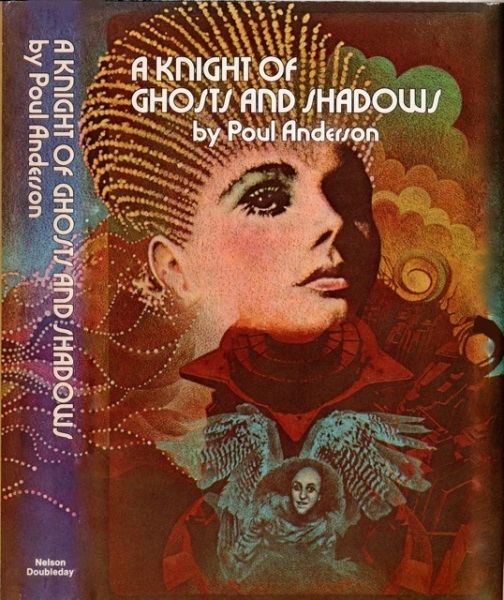
I recently picked up A Knight of Ghosts and Shadows by Poul Anderson from the library and DNFed it: too much opera, not enough space. But the cover… it takes the meaning of “hideous” to an entirely new level. In fact, this was the cover that gave me the idea of writing this blog post.
So what have we got here? There’s a psychadelic 70s chick with some hair that makes her look like Princess Leia’s grandmother, and a creepy little goblin dude in a spacesuit with random owl wings, who looks like he wants to peep on her. Also, some weird sci-fi cityscape in the background, I guess? It’s difficult to tell, because elsewhere the background looks like one of my Mom’s first-grade art projects. And of course, if that didn’t make it dated enough, you’ve got the funky 70s typography that died along with disco.
I picked up this book because 1. it was a Poul Anderson book that was at my local library, and 2. it made the Locus recommended reading list for 1975 without being nominated for the Hugo or the Nebula. Many of the other covers are surprisingly NSFW, because apparently Princess Leia’s grandmother is a futuristic sex slave—and yet, I found even the parts with her in it to be surprisingly dull. Like I said, too much opera, not enough space.
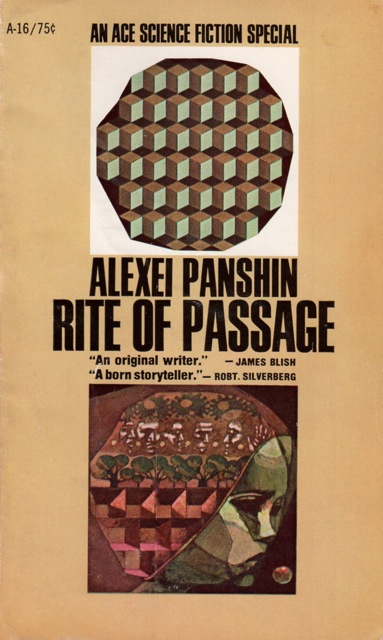
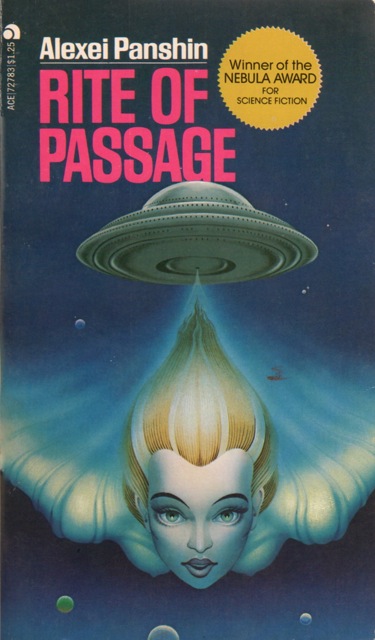
Speaking of mildly NSFW book covers that make reading in public super awkward, here is the cover of the copy of Rite of Passage by Alexei Panshin that was at the BYU Library, of all places. It’s not the cover above: I was going to post it, then thought better because it’s uncomfortably pornographic—especially when you consider that the main character is a minor. Yech. When my wife saw it, she said: “that’s a weird looking spaceship… oh wait, that’s not a spaceship!”
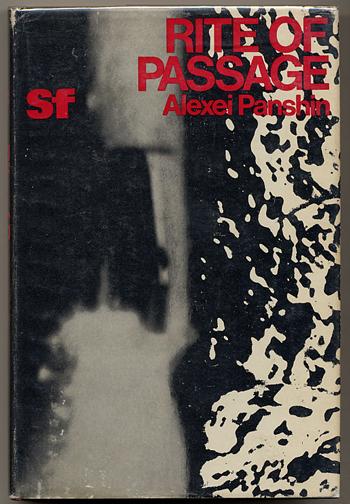
But even more hideous than that one (though perhaps not as terrible as this one), the cover above makes me think of nothing so much as the fact that communism ruins everything. Seriously, this cover has all the charm and aesthetic appeal of a Kruschev-era Soviet housing project in Eastern Ukraine, or maybe a ruined bus stop somewhere in the Kazakh steppes.
Seriously, when I lived in Georgia (the country, not the state), we would see old public art pieces from the communist era all over the place, in the soul-destroying style of socialist realism. This particular cover brings back a lot of memories of the Tbilisi subway. Which isn’t too surprising, because from reading this book, I’m pretty sure that Panshin was a socialist. In fact, it was right around this time that the entire science fiction genre swung super hard to the left, and with a few notable exceptions (David Weber, John Ringo, Larry Correia), it’s never really swung back.
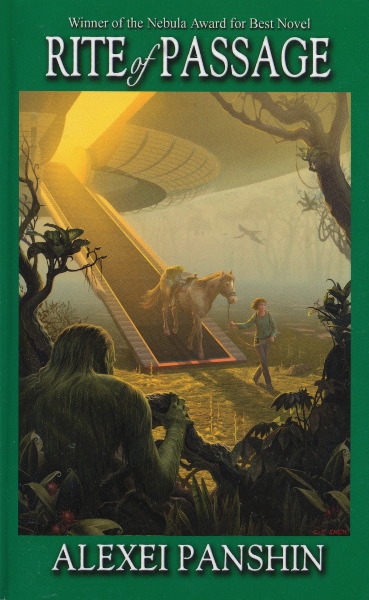
…and looking at Alexei Panshin’s Wikipedia entry, it appears that he passed away less than a month ago. RIP. Fortunately, he got at least one good cover for Rite of Passage before he died.
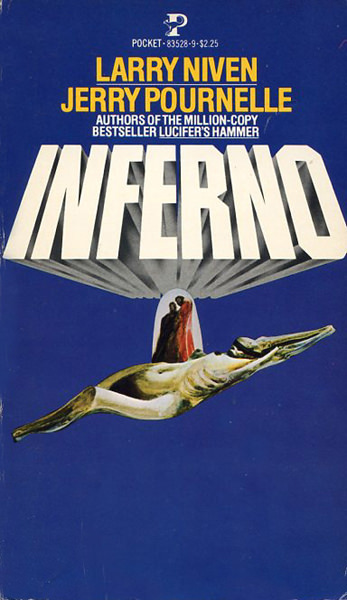
My wife recently read Inferno by Larry Niven and Jerry Pournelle, and she really enjoyed it. Based on her recommendation, I picked up a copy (not this one, thank goodness!) and I’m reading it now. It’s pretty good, but what the heck is going on with this cover? Seriously, it’s like someone puked up a mummy on the blue screen of death from Windows XP, except without any text. And what’s with the two monks standing on the mummy’s belly? Like, who saw the preliminary sketches of this cover art and thought “yup, that’s going to attract the right kind of reader and sell a bunch of books.” Thankfully, the book sold reall well in spite of this cover, not because of it.
So much for retro cover fails. What are some of your personal favorites that still stand out after all these years?
From the title of this post, you’re probably expecting a snarky takedown of the concept of “white privilege” and a good solid fisking of critical race theory. And while I thoroughly despise everything having to do with CRT, liberation theology, and Ibram Henry Roger’s X Kendi’s ideas of “anti-racism,” I do have one point of white privilege that I do need to confess. That is to say, I do indeed have an undue advantage because of the color of my skin.
I get to be the boogeyman.
As a straight white cisgender male conservative Christian, the woke intersectional left may mock me, attack me, or otherwise attack me rhetorically for my values, beliefs and opinions, but they do not ignore me or pretend that I do not exist. For example, if I write a blog post that criticizes the wokeness of science fiction, File 770 will often pick it up. I’m not on social media anymore, but if I were, I’m pretty sure that my anti-woke posts would similarly spark a very hot debate, and get passed around by intersectional leftists as an example of white supremacy.
If I were a straight black cisgender male conservative, all of those people would treat me as if I didn’t exist.
Their entire system of belief depends on black people fitting into a role defined by neo-Marxism, which separates everybody into racially-defined groups and declares that certain races are the oppressed, while other races are the oppressors. Black conservatives, especially black Christian conservatives, repudiate this theory by their very existence, which is why you’ll often hear people on the left claim that they aren’t “black enough.” Which of course is just another way of saying that they don’t exist.
You’ll often hear woke social justice types accuse conservatives of “denying the existence” of people who are trans, or queer, or in one of their other intersectional victim groups. This is nothing less than confession through projection. If you’re gay and you’re conservative, you aren’t really gay. If you’re trans and you’re conservative, you aren’t really trans… except, if your skin color is white, they can always chalk it up to “interalized whiteness” or some other such nonesense. But if you’re black? No such thing.
Of course, there are some black conservatives who are prominent enough that the woke types cannot ignore them. Justice Clarence Thomas comes to mind, as well as Thomas Sowell, Larry Elder, Candace Owens, Justin Whitlock… but here’s the thing: because these prominent conservatives are black, they get WAY more hate and vitriol from the left than white conservatives. Ridiculous amounts of hate. Larry Elder, for example, was called “the black face of white supremacy” and nearly got egged during his run for governor of California. By a leftist. Would that have happened if he weren’t black? Probably not.
Here’s the thing, though: for every black conservative who is too prominent for the woke intersectional left to ignore, there are hundreds—perhaps thousands—of small fry like me who they can effectively unperson and ignore. Which isn’t to say that every black conservative creator’s struggles are due to woke racism, but it is definitely a factor, and one that I personally don’t have to deal with because I am the great white boogeyman. Any publicity is good publicity, especially when you’re small.
Of course, there is a way to remove this white privilege and equalize the opportunities for black conservatives and white conservatives alike… and that is to remove anti-racism, CRT, liberation theology, and all of this other woke garbage from our society. If our culture were not dominated by these ideologies, I would not be privileged above black conservative creators in this way. And frankly, that’s a world I’d much rather live in.
But this does make me want to find more conservative, black authors like me who are finding it difficult to get any traction in this industry because they are black and conservative. Indie is (to my knowledge) still a pretty level playing field, but traditional publishing is not, especially with the short story markets. And of course, promo sites and newsletters are going to be a mixed bag.
So if any of you know of some black conservative authors (or if you happen to be one), please let me know! I’d like to check them out.