
For the next two weeks, all of my ebooks are now $2.99. Check out my online store and pick out a couple of them today!
For the next two weeks, all of my ebooks are now $2.99. Check out my online store and pick out a couple of them today!

Fitzpatrick’s War by Theodore Judson

A Man Called Trent by Louis L’Amour
The MAGA Doctrine by Charlie Kirk

How to Write a Screenplay by Mark Evan Schwartz
The Tree of Life by John Welch and Donald W. Parry, eds.
Blood of Amber by Roger Zelazny
Pardon of Innocence by Michael Flynn
Love Worth Making by Stephen Snyder
A Conflict of Visions by Thomas Sowell
Temple Theology: An Introduction by Margaret Barker

In It Together by Janci Patterson
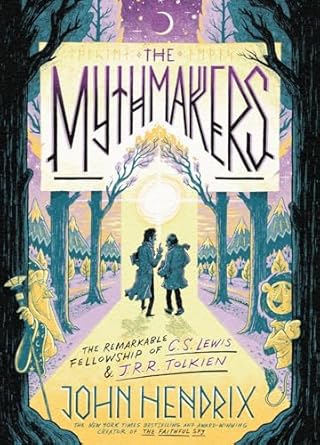
The Mythmakers by John Hendrix
I’ve been thinking a lot recently about something my wife said about AI. She’s finishing up her PhD in computer science, and knows more about generative AI and computational linguistics than just about everyone I know IRL (and most people I follow on the internet, too). So when she speaks on the subject, I do my best to listen.
Ever since OpenAI and ChatGPT took the world by storm, she’s been telling me that she doesn’t think the hallucination problem (where LLMs make stuff up) will ever be solved. Indeed, she doesn’t think it’s a “problem” in a technical sense at all, because every response from a generative AI is a hallucination—and that’s kind of a point. These aren’t really thinking machines, they’re hallucinating machines, replicating patterns in human language and thought. What difference does it make if the answer is false or true?
We call it “artificial intelligence,” but that’s really a misnomer, because these machines have no “intelligence” at all—at least, not in the human sense. Instead, they are like mirrors of our own intelligence, parroting back things that sound like they involve real thought, when really it’s all just pattern replication. They aren’t trained to recognize truth, they’re trained to recognize patterns. So, in reality, everything an AI generates is a “hallucination.”
This is why she thinks that we will never fully solve the hallucination “problem.” Indeed, the whole effort is a bit like trying to turn a lion into a vegan. And until we can train an AI on absolute truth—a thing that humanity has never been able to agree upon, much less reduce to zeroes and ones—then all we will really be able to do is create better and better plumage for our stochastic parrots.
What are the implications of this? First of all, we can safely ignore the worst of the AI doom porn, because a machine that cannot fundamentally recognize truth from falsehood is probably not capable of taking over the world and exterminating or enslaving humanity, even if it does qualify as a “general” intelligence.
We can also lay aside the fear (or the pipe-dream) that AI will 100% replace humans in all or most or really any fields. Even if they can do 90% of the work, recognizing truth is still an essential part of just about everything we as humans do. We can give it jobs and tasks—perhaps even some genuinely complex tasks—but so long as these machines cannot fundamentally distinguish between truth and falsehood, we will still need a human to oversee them.
That doesn’t mean that most humans are safe from being replaced by AI, though. If an AI-augmented person can accomplish the work of 10x or 100x the number of other human workers, we’re still going to face a massive disruption in the labor market and society as a whole. The question, then, is one of ownership and distribution. Who owns the AI? How do we distribute the productivity gains from AI? These are some of the difficult problems we need to solve in the next few years.
But the real problem—and the scariest implication of all of this—is the question of truth itself. After all, if AI is fundamentally incapable of recognizing truth, and all AI output is hallucination on some level, then who determines what is true and what is not? Sam Altman? OpenAI? Congress? Some three-letter government agency?
I think this is going to be the defining question of the rising generation, which is growing up in an AI-native world. What is truth? How can we recognize it? How do we distinguish between what is true and what is false? Increasingly, we are going to find that these are questions that AI cannot answer. And in a world saturated by deep fakes, bots, and sock puppets, where the internet is dead and all the most powerful players are constantly fighting a 5th gen war with each other, truth will be the thing we are all starving for.
The tragedy of the millennial generation is that everything in our world conspired to starve us of the three things we needed most. More than anything else, we hungered for meaning, authenticity, and redemption—and for the most part, we never got it. You can blame social media, the boomers, capitalism, student loan debt, the Republicans, the Democrats—it really makes no difference. All of those things and more came together to hobble our generation and make it almost impossible for us to launch.
Will the same thing happen with the zoomers and gen-alpha over the question of truth? It appears that things are moving in that direction. In a world saturated with AI, truth becomes a scarce and valuable commodity.
So what do we do? First, I think it’s important to recognize that AI cannot and never will be an authority on truth. At best, it only mirrors our own thoughts and ideas back to us—and at worst, it feeds us the thoughts and ideas of those who seek to control us. But AI itself is neutral, just like a gun or a knife lying on a table is neutral. What matters is how it is used.
Beyond that, I don’t really know what to say. Only that this is something I need to think about a lot more. What are your thoughts?
This is one of the scariest and most horrifying videos I’ve seen on YouTube in a while. The first time I watched it was outrage-inducing enough, but then I watched it a second time, and wow. Our education system isn’t broken, it’s functioning exactly as the elites intended. And that is why so many millennials and zoomers can’t read, can’t write… and honestly, can’t even think.
This video is well worth an hour of your time. Possibly two.
I didn’t see this movie when it came out (even though I’ve been told it’s very similar to a lot of my early science fiction), but this analysis of the story structure is really amazing. And I have to admit, it makes it a MUCH more interesting movie if it starts with Jennifer Lawrence waking up, and focuses on her as the main character.
Starting with Chris Pratt is safe, but also boring, because it unambiguously makes him the good guy. But is he really? What if he’s not? What if that question is what drives the tension through most of the movie? What if she decides he’s the bad guy, and lets him die to save the ship, only to find herself alone in the end, contemplating the very same choice—whether to wake up another one of the passengers so that she doesn’t have to spend the rest of her life alone?
“Not gonna lie, the ending where she is contempating the exact same decision hits so good.” That’s one of the top comments, and I have to agree. But that gives the movie a little too much of a horror vibe for me. Instead, if I were writing it, I would have them separate long enough that she realizes, on her own, that she would have done the same thing that he did, even if she doesn’t admit it. So that when the accident happens and he has to sacrifice himself to save the ship, she decides to save him after all, not because she loves him, but because she forgives him (and also doesn’t want to be pushed to make that decision herself).
Or what if there never is an accident, and she decides she can’t forgive him, but since they can’t stand to be alone together the enter into a pact to wake up two more people: she wakes up another girl for him, and he wakes up another guy for her. That way, the bad guy is the other person, and the love interests can… maybe I’m overthinking this.
In any case, it’s a great thought experiment (though speaking from experience, it really does suck when you write half a book only to realize that most of it should be relegated to backstory).
A lot of us members of the Church of Jesus Christ of Latter-day Saints had a rude (and violent) awakening this week to just how much our fellow Christian “friends” desperately want to un-Christian us. The Michigan church shooting was shocking enough, but more than that was the reaction, particularly from (but not limited to) evangelical protestants. In the comments section of every news article I have seen, these “Christians” have felt it necessary to shout that “Mormons aren’t Christian,” as if the mass shooting itself is little more than a conversation starter and not a shocking tragedy. The bodies of the victims have not even been buried yet, and pastors like Mark Driscoll have been openly exploiting the shooting to promote their own anti-Mormon literature, including some (apparently AI-written) new books published just in the last week since the shooting.
They hate us. They really do hate us. And honestly, I can’t help but wonder: how many Mark Driscoll videos did this mass shooter watch before he decided to take matters into his own hands? How much money has Mark Driscoll made in the last week, because of all the clicks and engagement he’s been able to farm from this tragedy? How many more mass shooters are we going to see in coming years, because of all this anti-Mormon rhetoric? This last week, our Christian “friends” showed us exactly who and what they are. I would like to give them the benefit of the doubt, but frankly, they haven’t left me with much of that to give them.
So what is a “Christian” anyway? What is the best way to define that term? The anti-Mormons who seek to un-Christian us all go back to our rejection of the Trinity and the Nicean Creed, as if the thing that makes you “Christian” is a specific ontological belief about the nature of God (never mind that most of them cannot consistently define what the “Trinity” even is). Meanwhile, the Bible itself says “by this shall all men know that ye are my disciples, if ye have love one to another.” (John 13:35) It also says “by their fruits ye shall know them.” (Matthew 7:20) Which says a lot, when you consider how much these “Christians” hate and despise us.
But I think we can avoid the whole debate by this very simple definition: a Christian is anyone who takes the name of Christ.
“But wait!” you say. “What about everyone who worships a different Christ than I do?” To which I would point out that to some degree, every division within Christianity worships a slightly different version of Christ—even (or especially) all of the Trinitarian ones. Otherwise, we would all be of “one Lord, one faith, one baptism,” (Ephesians 4:5) as the scripture says.
“But what about someone who’s first name is ‘Christian,’ but he doesn’t even believe in God! Is he still a Christian? What is your answer to that?” To which, I would probably blink a couple of times, and ask if you heard any of the words that just came out of your mouth. Yes, a person named “Christian” is still a “Christian.” He has literally taken (or been given) the name of Christ. He might not actually believe in Christ, but he’s still a “Christian.” It’s just, that might not mean what you think it means.
It may feel overly broad, but this is the only definition that cannot be appropriated by any particular sect in order to un-Christian any of the others. Which is just as wrong for a single sect to do, as it is for all the major denominations to band together in order to exclude the Church of Jesus Christ of Latter-day Saints.
Over the weekend, there was a horrific mass shooting at a congregation of the Church of Jesus Christ of Latter-day Saints in Michigan. The shooter apparently rammed his truck through the front wall of the chapel while the congregation was taking the sacrament, and as people were coming up to help him and make sure that he wasn’t hurt, he pulled out a semi-automatic rifle and began shooting them. He then proceeded to set up several IEDs to hinder the search and rescue efforts while he lit the building on fire, using gasoline.
I’ve heard different reports about what happened next. The police arrived on the scene quite rapidly, engaging in a firefight with the shooter and ultimately killing him. However, I have also seen reports circulating from eyewitnesses that members of the congregation also engaged in the firefight, and that at least one of the police who responded may have been an off-duty law enforcement officer attending the church services.
In any case, the shooter was killed, but not before he had killed or wounded nearly a dozen people and set a fire that burned the structure to the ground. The fire and IEDs prevented the first responders from going into the burning building and searching for survivors, until after the structure had collapsed. Thankfully (and miraculously), everyone got out in time, so there weren’t any people who died because they were trapped in the burning building while the first responders couldn’t get to them.
Needless to say, this is an unthinkable tragedy that has all of us members of the church in shock. Many of us are wondering what could possibly motivate someone to attack us like this, and in the last 48 hours, the picture that we’re starting to get of the man is very disturbing. He apparently was an Iraqi veteran who was suffering from PTSD and mental illness, which means he almost certainly didn’t get the help he needed from the VA. And while it seems he was a conservative, the motivation probably has less to do with his politics and more to do with religious hatred.
Ever since the church was formally organized in 1830, there has been a concerted effort by anti-Mormons to destroy it. If you search for anything about Mormonism online, you will also find some extremely vicious anti-Mormon literature. As with other forms of religious bigotry, such as anti-Semitism and anti-Catholicism, it comes at us from all directions, but in recent decades most of it seems to have come from the evangelical Christian right. There are pastors on YouTube right now who are monetizing their channels and building engagement by calling us “demonic” and claiming we are led by the devil himself. Others seek to ridicule our most sacred practices by posting videos of our temple garments or our temple services, which are not open to the general public. It’s always been something we’ve had to deal with, especially at events like our semi-annual General Conference where you can often find protestors waving placards that say things like “Jesus Saves, Joseph Enslaves!”
When I was following this story on Sunday afternoon, trying to piece together what had happened, I was shocked to find people posting these anti-Mormon talking points on conservative news sites like The Daily Wire. The vast majority of the response from our Catholic and Protestant friends, including our Evangelical friends, was genuinely sympathetic and full of condolences. But there was still a minority of Christian commenters who thought it entirely appropriate to use this story as an opportunity to tell us that “Mormons aren’t Christian.”
Do you realize that this anti-Mormon rhetoric is likely what radicalized the shooter to kill us? Yes, he was a disturbed and troubled man, but there’s a reason why he felt justified to take up arms against us. My guess is that he heard that Mormons are “demonic” and “not Christian” one too many times, and drew his own conclusions. And while he alone is responsible for his own actions, the public rhetoric matters too.
It’s the same exact thing we saw with the Charlie Kirk assassination. For years, Charlie Kirk’s political enemies called him a racist, fascist, white supremacist, etc, escalating their rhetoric to the point where a disturbed individual felt he was justified in killinghim. And just as it’s disgusting for people to say “Charlie Kirk didn’t deserve to be shot, but he really was a racist and a fascist,” it is also disgusting to say “The Mormons didn’t deserve to be killed, but they really aren’t Christians.” Especially while the church was still on fire, and the victims of the attack were succumbing to their wounds.
Up until now in the culture wars, religious conservatives of all stripes (including Catholic, Protestant, Evangelical, Latter-day Saint, Jewish Orthodox, and some other small minorities like Hindu (represented by Tulsi Gabbard and Vivek Ramaswamy)) have been united by a common enemy: the woke left. And for the last two decades, the woke left has been the dominant cultural force. But all of that is beginning to change, as the culture swings back from the excesses of peak wokism and the Great American Revival begins to enter the mainstream. And as the Christian revival sweeps our country, I think we’re about to enter a very dangerous period, where we no longer have a common enemy to unite us.
So here is the question: as religious conservatives take back the culture and the woke left is forced into the political wilderness, are we going to remember our American creed of “E Pluribus Unum” as we work to make our country great again? Or are we going to fall into a modern ideological rematch of the 30 years war, with Catholics and Protestants sniping at each other, various branches of the Evangelical Right vying for dominance, and everyone turning on the Jews and the Mormons? Because the seeds of that conflict are definitely in the ground.
I’m not saying that Evangelicals shouldn’t be allowed to say that “Mormons aren’t Christian.” I understand how that’s a core belief of some people, who are deeply troubled by our rejection of the Trinitarian creed. And I understand that there are many Christians who still love us even though they believe we are going to hell, and want to do everything they can to help us be saved. But dude… if you really love us, why are you saying all that stuff while the bodies are still warm? I’m not calling for you to be silenced, but I am calling for a de-escalation of the rhetoric, before some other deranged madman watches one too many Mark Driscoll videos and decides to take up arms.
That’s a lot of heavy stuff to consider, so I want to end with what is probably the best response I’ve seen to the Michigan church shooting, from the Babylon Bee:
Mormons Respond To Attack By Continuing To Be Amazingly Kind To Everyone
[9/30 UPDATE:] …aaand once again, the Babylon Bee gets major points for predicting the actual news, because members of the church have set up a GiveSendGo for the family of the shooter. It has already surpassed $125,000 in donations.
Peace will only come when the law goes forth out of Jerusalem; when all men are drawn toward it; when the law is given to the world as a holy thing. And it can’t even be secular; it has to be given as a revealed thing.
Hugh Nibly, “Jerusalem’s Formula for Peace,” 2
Stephen J. Shaw is doing amazing work on the fertility crisis and the ongoing depopulation collapse. He’s the one who made the original Birthgap documentary, and I think he just came out with a new one, which is why he’s doing the podcast circuit.
In any case, I found this interview quite fascinating. From what I’ve seen of him, Stephen J. Shaw strikes me as a thoughtful, gentle, and caring man—not at all the sort of monster that the left-wing opponents of the pro-natalist movement like to paint us all as. It’s not at all about forcing women to have children, or about trying to breed more of the right kind of genes and less of the wrong kind. Rather, he sees our collapsing fertility as an existential human crisis, and wants to do everything he can to avert (or at least mitigate) the coming collapse.