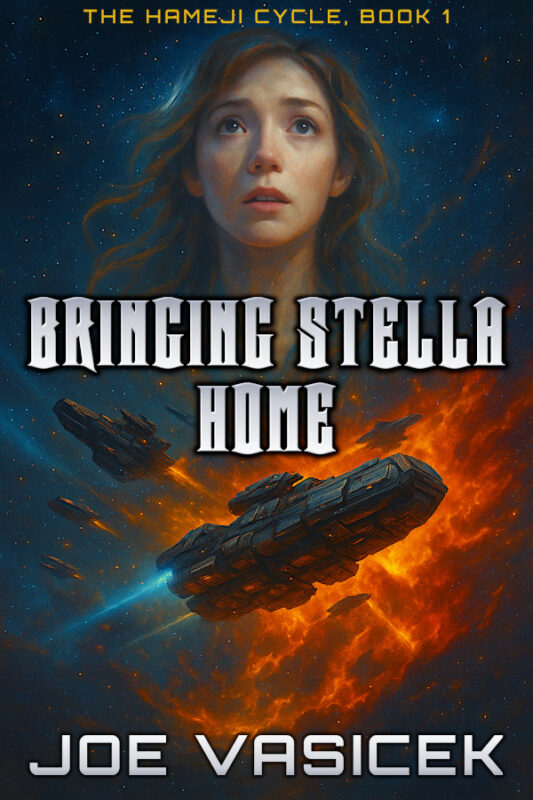
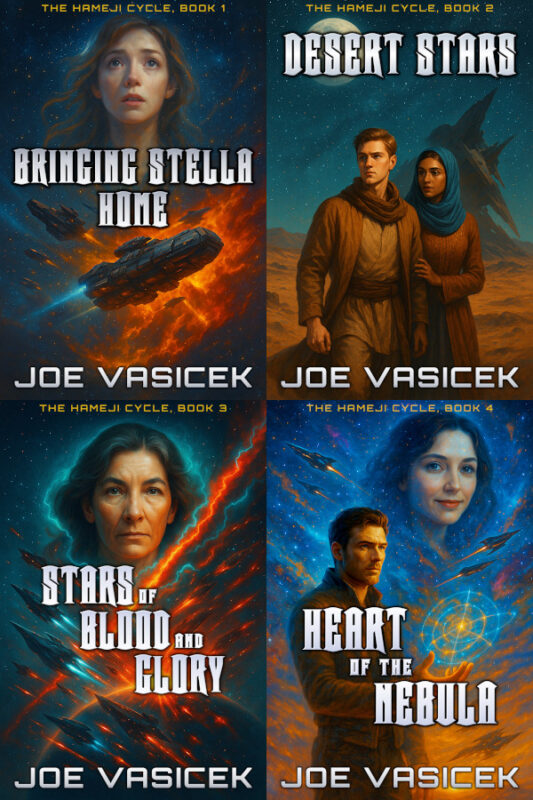
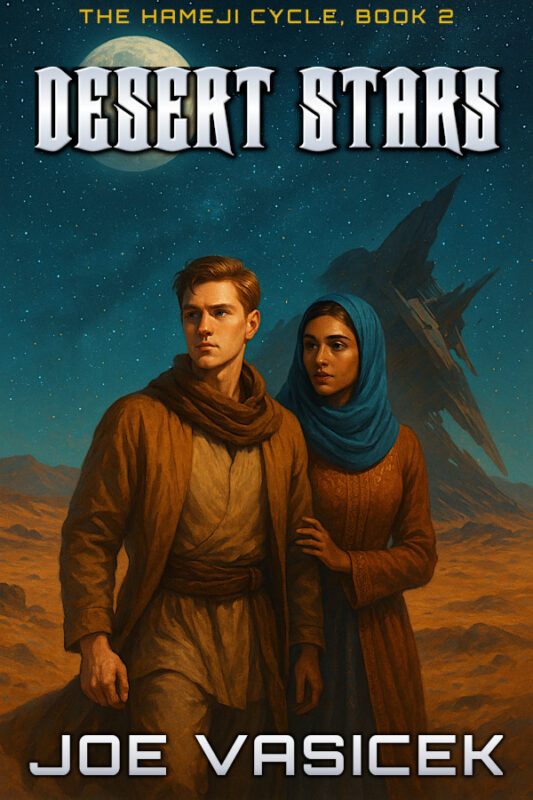
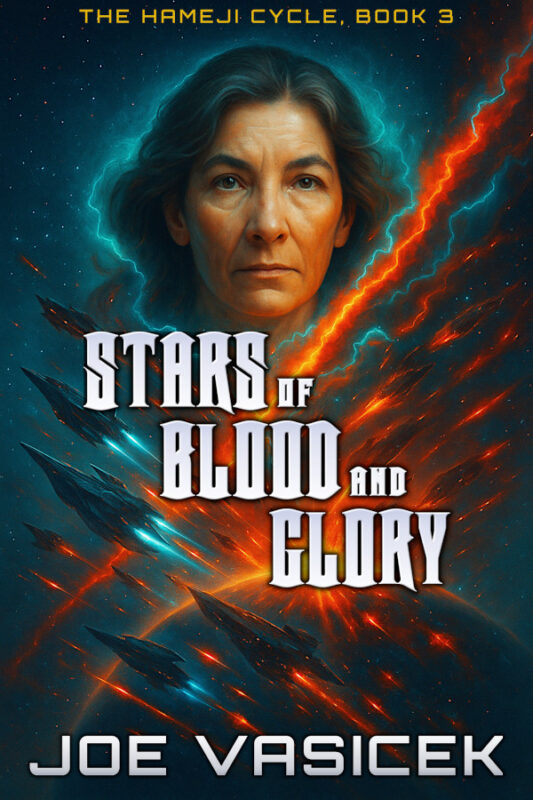
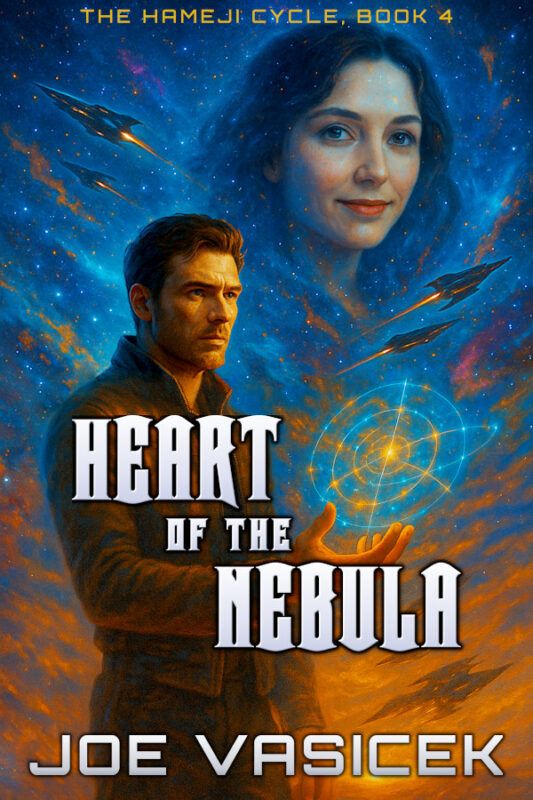
In a galaxy ravaged by war, a young man must decide how far he’ll go—and what he’s willing to become—to save his sister.
When a ruthless Hameji battle fleet kidnaps his sister, James McCoy—a young merchant starfarer untested by war—vows to bring her home. But to save her, he must give up everything he has and become something he never thought he could be.
In a galaxy ravaged by war, a young man must decide how far he’ll go—and what he’s willing to become—to save his sister.
James never imagined that when his older brother and sister departed on planetside leave, it would be the last he’d ever see them. But as soon as they’re gone, a ruthless Hameji battle fleet invades their peaceful star system, transforming it into a war zone. Fleeing with his father on board the family starship, James can only watch in horror as the verdant planet below is reduced to molten slag.
On the way home, James learns the devastating truth: his sister is alive but enslaved. To rescue her, he must make an impossible choice. He’s no warrior—has never even held a gun, much less fired one. But to save his sister, he’ll become whatever he needs to be—even if it means crossing a line he can never uncross.
Joe Vasicek fell in love with science fiction and fantasy when he read The Neverending Story as a child. He is the author of more than twenty books, including Genesis Earth, Gunslinger to the Stars, The Sword Keeper, and the Sons of the Starfarers series. As a young man, he studied Arabic at Brigham Young University and traveled across the Middle East and the Caucasus Mountains. He lives in Utah with his wife and two apple trees.
Some of the links in the page above are "affiliate links." This means if you click on the link and purchase the item, I will receive an affiliate commission. You will not receive any additional charge.
As an Amazon Associate I earn from qualifying purchases.
With the new baby, things are going to be touch-and-go for the next month or two. I’m hoping that by Halloween, we’ll be a lot more settled into a routine, but I’m not expecting to get a good night of sleep until basically Thanksgiving. Also, the priority is obviously going to be helping out with stuff around the house, since besides having a baby, my wife is also finishing her dissertation and teaching a class at BYU. So for the next couple of months at least, my writing is going to take a back seat to all the family stuff, and the blog is going to take a back seat to that.
With that said, I do think I can keep up the writing even with all that’s going on. My goals are super light—basically, to do at least a little bit of AI writing and human writing each day—but I’ve got that work all split up in a way that’s easy to pick up and set down again whenever I have a fifteen minute break to work on it.
The blog is going to be a bit trickier, but I think I can still keep blogging daily, if I set a regular routine. Here is what I’m thinking:
Sundays: an interesting quote.
Mondays: a just-for-fun post, usually something silly from YouTube.
Tuesdays: an analysis of some trope that I find interesting (yes, I want to bring back the Trope Tuesday posts).
Wednesdays: a midweek excerpt from my current WIP.
Thursdays: a quick writing/personal update, with some random thoughts.
Fridays: an interesting long-form podcast that I recently watched or listened to.
Saturdays: a post about AI-assisted writing.
Of those posts, the only ones that take a significant amount of work are the ones on Tuesdays and Saturdays—and even then, it’s only about an hour of writing. The Trope Tuesday posts will be useful for feeding AI, and the AI-assisted writing posts will eventually get recycled into a non-fiction book about writing with AI (though I still need to come up with an outline for that). Everything else, though, I can probably schedule in an afternoon.
That’s the plan, anyway. This isn’t our first rodeo, though I hear the third child is the hardest one, since it’s at that point that you become outnumbered. I’ll do my best to keep blogging, but if I have to drop one of the balls, the blog is going to be first. But this is what you can expect to see from me moving forward.
Star Wars is more of a space fantasy than a space western, but the music still fits surprisingly well. I am really looking forward to watching The Good, The Bad, and the Ugly with my kids (and probably Star Wars too).
There is nothing unethical about using generative AI to write or make art. Those who say otherwise either haven’t thought through their position, or they are lying for rhetorical effect. Or both.
If Andrew Tate wrote a book titled How To Enslave Your Woman For Fun and Profit, would he be within his rights to demand that no woman ever read that book? If you believe that AI is unethical because it was trained on writers’ and artists’ work without their consent, congratulations—that is exactly the position you have taken. You can’t pick up one end of the stick without also picking up the other.
Whether or not writers and artists were fairly compensated for the use of their work is a separate issue. Many of these AI companies obtained their training data by indescriminately scraping the internet, which means the used a lot of pirated work. But if using copyrighted material to train an AI system is fair use—and here in the US, the courts have ruled that it is—then all that they owe you is the cost of your book. So if your book is $2.99 on Kindle, that is what OpenAI owes you. Congratulations.
Does Brandon Sanderson owe Barbara Hambly royalties? Brandon Sanderson has sold something like $45 million in books, comics, and other media. Barbara Hambly struggles to pay her bills. Barbara Hambly wrote Dragonsbane, the young adult book that inspired Brandon Sanderson to write fantasy. Clearly, her work had a deep and lasting influence on him. So does he owe her?
If you believe that AI companies owe artists and writers more than simply the price of their own published work, this is a question that you must wrestle with. If it counts as “stealing” to train an AI on artists’ and writers’ work, then every artist and writer is also a thief, and owes royalties to the people who inspired them. Which is why the word “plagiarism” has a tight definition, and why our legal code recognizes fair use.
There is nothing unethical about using generative AI to write or make art. Almost everyone who says otherwise is either lying to themselves about that fact, or lying to you.
Why would someone lie about that? For the same reason people accuse you of being a racist, or a sexist, or a fascist, or a white supremacist, or a Christian nationalist… because using that term gives them power. They don’t actually want to make a reasoned argument. They just want to “win” the argument without ever having to make it in the first place. They use words that they know will get the reaction that they want, and they scream them as loudly as they can until they get it. That’s what the public discourse looks like in 2025.
To be fair, this is not just something that happens on the left. Plenty of people on the right will scream “woke” or “based” or “demonic” to cow people into accepting their point of view. These words do have meaning, and can be used to make a well-reasoned argument—just like “racist” and “fascist” have meaning. But most of the people who use these words are just wielding them like rhetorical clubs to bully their way around.
There is nothing unethical about using generative AI to write or make art. Most of the people who say otherwise are just using the word “ethical” to mean “things I don’t like.” They don’t believe in objective good or objective evil, and instead believe that things like truth and morality are relative. In other words, they think that good and evil change depending on who’s looking at it. This is why so many writers today can’t write a compelling villain (or a compelling hero, for that matter). They just don’t understand how good and evil work.
So why should you listen to them when they scream at you for using AI? You shouldn’t. They don’t know what they’re talking about. Or worse, they do, but they’re lying to you, because they want to compel you not to use AI in your art. Why? Because they’re afraid that if you do, you’ll create something better than what they can create. And on that point, they’re probably right.
Things are fairly quiet around here, though that’s going to change soon. The baby is nearly full term, and the doctors want to induce labor in just a few days, so that’s the plan. We’re just trying to get things ready for that.
Writing-wise, things are going very well. I recently finished the AI draft of The Soulbond and the Sling, and started work on The Unknown Sea again. My goal is to have the final draft ready to send to my editor by Thanksgiving, so that I can publish it in January. That’s going to be a tall order with the baby, though, so I may have to push the publication date back by a month or two.
Moving forward, I really want to publish a new novel at least every quarter. Some of those are going to be short, like the Sea Mage Cycle books, but eventually I hope to get up to epic fantasy length. And of course, I plan to finish my three unfinished trilogies in the next year or two. I’ve been taking the last couple of years to really figure out my AI-assisted writing process, and I think I’ve got that mostly down now, so it’s time to apply those lessons to these books and get them done.
One thing I’ve done recently was pull out all of my books from InAudio, formerly Findaway Voices. I was crunching the numbers from the last year, and I only made something like $12 during that twelve-month period, averaging something like $.04 per sale. Those numbers are skewed by all of the free audiobooks that get downloaded, but when I drilled into the reports, I found a bunch of places that were literally paying me only $.01 per sale. Literally just a penny. For an audiobook that a reader paid money for. Someone got paid in that transaction, and it sure as hell wasn’t me. Since InAudio doesn’t let you pick and choose which distributors you can send to—it’s literally all or nothing—I made the choice to just drop them. There’s no way I can sustain a career if I’m only getting pennies (if that much!) per sale.
I know that Audible has been in the news a lot recently, and for good reason—they really have been playing dirty, simply because they can get away with it. And while I don’t like the way they’re screwing authors over, I don’t think they’ve been screwing me nearly as bad as some of the places where InAudio distributes their books. For one thing, all of my audiobooks are AI narrated, so it’s not like I have a lot of production costs to make back. It’s literally just a value-add on top of the ebooks. For another thing, the least amount of royalties they’ve paid me is $.80 per book, which is more than what I get from just about every library service for audiobooks.
So for the time being, I’m going to keep my AI-narrated audiobooks up on Audible, even though I wish they would treat their authors better. But I’m not going to shell out the money for a human narrator at this time. It just doesn’t make sense, especially with the way that Audible squeezes us. With AI-narrated audiobooks, there really is no reason not to put them out, so long as they don’t drop the royalties any further. But it would take a hell of a long time to earn back an investment of several thousand dollars if all they’re paying me is $.80 per listen.
If you want to listen to my books on audio, the best way to do it is to click on the link at the top of the page and visit my online store. You also have the added bonus of owning the files, not just licensing them. And Bookfunnel is really good at delivering the audiobook to whatever app or device you prefer—or even opening it up in your browser, if you don’t have an audiobook app.
A clip of this podcast showed up in my YouTube recommendations, and it was interesting enough that I clicked through to the full-length interview. Definitely worth a listen. Adam Lane Smith really knows his stuff—and he’s not at all woo woo or touchy feely like most of the women people giving relationship advice. Just solid, practical, down-to-earth “this is how it is,” kind of like hoe_math except concise and to-the-point, with a Christian angle and scientific evidence. Very interesting stuff.
There have been a lot of incredible online reactions to the Charlie Kirk assassination, ranging from the tear-jerking, restore-your-faith-in-humanity type, to some of the most vile, evil, and disgusting displays of inhumanity that one can see. But when I saw this one, I just had to react to it, because… we’ll, you’ll see.
I made some stupid comments about Charlie Kirk on the day that he was shot.
In other words, you took off the mask and revealed who you really are.
I said some things on Blue Sky and on threads that I I’m sorry, not sorry for,
Making a cute face while committing a minor social taboo might earn you a few chuckles when you’re four. But when you are a grown man in his forties? fifties? with facial hair (and a nose ring? seriously, dude, WTF?) it just makes you a creeper—and when the taboo is NORMALIZING MURDER, it launches you into psychopath territory. Especially when you make that creepy cutesy face.
but I said them and I deleted them when it was requested that I do so by my employer.
And you think that made it okay? That you could just put the mask back on, and everything would go back to the way it was? No way, dude. If I were your coworker and I saw your post, I would go straight to HR and tell them that you make me feel unsafe. And then I would go to law enforcement and say the same thing.
And then today on a weekend, on a weekend,
Oh, poor baby. Did your weekend get ruined? That must have really sucked. After all, it was only a Wednesday when Erika Kirk became a widow, and her children lost their father. But hey, at least it wasn’t a weekend for her.
I’m told that I am no longer employed at Microsoft.
Thank God. I’m sure your coworkers are all grateful too.
After six years building the diversity, equity, and inclusion department from scratch,
Why am I not surprised?
I lose my job because one of you, some random person reports my posts to my employer, goes out of their way to find out where I work
No, you didn’t lose your job because of what THEY said, you lost your job because of what YOU said. It’s called consequences. Actions have them. How are you a grown man and only learning this now?
and takes my job, takes my security away from me
What makes you think that having a job is a human right? That the world—nay, the universe itself—owes you anything? You should be losing a lot more than your job, dude.
for a thought, for an opinion
You were not fired for having an “opinion.” You were fired for SUPPORTING AND ENCOURAGING MURDER.
and you talk about freedom speech like you care about it
You are absolutely free to say what is in your heart. And your employer is absolutely free to fire you for it. Isn’t it a great country?
and you’re just going to take my my money, my life, my food off my plate
You don’t exactly seem to be hurting for food, buddy. Also, food stamps are a thing. So are mental institutions. I hear they still feed the people in those.
because I don’t like Charlie Kirk.
Is that seriously what you think this is about? Because right now, I’m seeing lots of people—including the leftist activist who was debating Charlie Kirk at the moment he was shot—who had no love or liking for the man, but who can still say that it wasn’t right that he was murdered.
But frankly, I think you know that. I think you know exactly how evil your heart has become. I think you’re just trying to hide it from us, with all of your equivocations, and understatements, and cutesy voices and faces and all.
And sadly, I think the person you’re trying the most to hide it from is yourself. Is it working?
That’s not okay. It is not okay to target me because I felt joy that day.
In a country without law, I would absolutely target you. With death. Not out of anger or outrage, but because psychopaths like you are dangerous—especially psychopaths who genuinely feel joy at the murder of another human being.
Fortunately, we have laws in this country, and authorities who enforce those laws from psychopaths like you. Which is why people like me don’t need to resort to violence to make sure that our children grow up safe. Pray that never changes.
I can’t help how I feel.
Let me tell you something I told my five year-old the other night. You can’t always choose the way you feel, but you can always choose what you do about the way you feel.
With consequences, it’s the opposite: you can choose your actions, but you can’t choose the consequences of your actions.
How are you a grown man and you don’t know these things?
More importantly, how can someone like you, who has less emotional maturity than my five year-old daughter, land a job at a company like Microsoft?
Oh, yeah. You worked in the DEI department. Explains a lot.
I felt joy. That’s me.
For Charlie’s sake, I will pray that isn’t the case. Because if Charlie Kirk could respond to your video, he would tell you that that isn’t you, but the demonic spirit within you. So for Charlie’s sake, I will pray for you.
That’s what I believe. That’s what I think of of him. I can’t help that.So, I don’t deserve a job?
No, you do not deserve a job. Not at Microsoft, and not anywhere else.
And frankly, if you ever became my coworker, I would go straight to HR and tell them that your presence makes me fear for my physical safety. Because people who take joy in the murder of someone who believes the things that I believe and values the things that I value—that really does make me feel unsafe. Especially when that person was murdered because of those values and beliefs.
So even though I will pray for you, I sincerely hope that every prospective employer sees your original action video, as well as this one, and uses that to guide their hiring decision. @cassiesmith2788 said it best:
You lost a job for what you said. Charlie lost his life for what he said. Consider yourself lucky.
The disease our world is suffering from is not something peculiar to a uniquely scientific and permissive age, but the very same virus that has finished off all the other great societies of which we have record. The ancients call it rhetoric. What it amounts to is the acceptance, for the sake of power and profits, of certain acknowledged standards of lying.
Hugh Nibley, unpublished introduction to “Victoriosa Loquacitas”