The end of an era

Today was my last writing meeting as Quark writing vp. :'(

It’s been a good run, two years as leader of the Quark Writing Group at BYU. I remember how it was when I started–I was still just a hobby writer, with a nebulous interest in getting published someday but without any real goals or plans. I heard about the group from some friends, but didn’t really start going until winter of ’07, as Reigheena and Aneeka were graduating. One day, I showed up after the meeting was finished (but everyone was still hanging around chatting) and Reigheena was like “so, you want to be writing vp next year?”

I was kind of nervous but really excited that first semester, with lots of ideas to try out. We posted our fliers around all the freshman dorms the first couple days of class (most of the members were graduating and/or moving on), and we got quite a few new members, as well as curious English majors who came for a couple of times before moving on.

Those first days, meetings were two hours long, the submissions were up to 4,500 words, and we did four of them every meeting. We met in the basement of the BYU library, in one of the study rooms, and we crammed between ten and fifteen people down there each meeting. Pretty intense! Two hours was not enough time to comfortably cover everyone’s story, and we always felt rushed. We held meetings every other week (or, more accurately, every 1.5 weeks) on a weird schedule that only I really had figured out.

Well, after that first semester, we made a few changes. Reduced the submissions length to 2,500 words, the number of submissions to 3, and the length of the meetings to one hour instead of two. I think we also started meeting weekly, instead of the weird Tuesday–Saturday–Tuesday schedule. We also got a real room, over in the Talmadge building.

Things have definitely changed. This past year, we didn’t really do much to get new members, but we have started to bring in people from the other sections of Quark. A lot of other old timers have moved on–Drek moved up to Draper, so I doubt we’ll see much of him, and Jakeson and Gamila have been coming less and less as they move on to the next stage of their lives. Still, it’s been fun, holding our weekly writing meetings each Saturday.

While I always tried to encourage everyone to be frank and honest with their criticism, we’ve also done a good job diffusing that tension with humor. Here are some of my favorite quotes from my time as writing vp:

“He has two guns in the office and he wants to give Autumn a talking-too for having a knife in her boots?”
“She’s an intern.”

“Other than that, I thought it was just good ol’ fashioned fantasy violence.”

“I don’t remember anything about your characters right now, but I remember when I was reading your story that they were very distinct and I knew who they were.”

“I’m trying to think of something I can say that doesn’t sound like a critique.”
“Your writing is…legible”

“I have a friend that had a way to hide a knife in her hair.”
“I want a wife like that!”

“Some books don’t have chapters, they have acts.”
“We have a name for those. We call them… ‘plays’.”

“As always, your writing was legible.”
“No, wait, it wasn’t! It was courier!”

“If this was meant as a short story and not the beginning of a novel, “defenestration” will suddenly become a useful word in your vocabulary.”

“Maybe I should write a prologue about a writer who’s writing a prologue and realizes that nobody ever reads them.”

“It doesn’t have to be functional, it can just be like ‘hey, we make gears.'”

“The love in Twilight is all based on scent: he smells nice and she smells delicious.”

“The goatee gives me programming x2.”

“Missions…”
“The first six months…”
“The first two years…”

“I like getting to the exciting event within a page of the story.”
“Frodo, see this ring? Destroy it!”

“I loved how flat your characters were!”
“You’re so good at poor writing!”

“Maybe ‘MacBeth’ could be a title. Like, the leader is known as ‘The Macbeth.'”
“Yeah! And all the lower downs would be ‘the Duncans.'”

“Wait… I did write something good… at the very end!”
“Like, ‘Oh good, it ended!”
“You are putting words into my criticism!”

“Then I thought, what would my characters be like if they were alive? And then I was afraid.”

Ah, the good times. It’s so sad to log onto the Quark forums now and not have moderator privileges, to know that I won’t be sending out those weekly emails, moderating things, doing all that other stuff. It’s the end of an era for me. My duties as writing vp for Quark have been a major part of my college experience here at BYU, and I won’t forget it.

The Martian Chronicles by Ray Bradbury

Welcome to Mars, a magical world of ancient ruins like giant glass chess sets and canals of wine and sandy desert seas. A world inhabited by golden eyed people who can telepathically project hallucinations–some of them still live up in the hills. A desolate, empty world, the next frontier for a new generation of pioneering spirits, each with different dreams, different reasons, different goals and outlooks on their new life in the new world. Some come with respect and reverence to the ancient world, while others come to exploit it. But no matter why they come, everyone is deeply and profoundly changed. Some never return.

Ray Bradbury is one of the biggest names in science fiction, and this book is one of his greatest works. A lot of my friends really love Bradbury, but strangely, I haven’t read a lot of him (Fahrenheit 451, way back in Middle School, and a few essays, but that’s pretty much it). After putting this book down, all I can say is wow. Now I know what my friends were talking about.

The Martian Chronicles is more of a collection of short stories than anything else. That’s understandable, when you consider that science fiction began with short stories, not with novels. Keep that in mind as you read it, too. This is not a book you can read all in one go; you have to take time between the chapters to let each one soak in, otherwise your mind will just get overloaded. Bradbury delivers a bang! ending to just about every story in this book, and some of them are really deep. My favorite one was the one with Sender, and how the fourth rocket discovered that all the Martians were killed off by the chicken pox. There are some really profound ideas in that one, and I loved reading it.

A lot of hard sf purists tend to call Bradbury a writer of fantasy disguised as science fiction, and I can see where they’re coming from. There’s nothing really scientific about this book; the Mars of Bradbury’s stories is a purely fantastic invention (even for the 50s). I remember the story about the third rocket, and how it landed on a grassy green lawn, and all the crew stepped out and found themselves in a little Ohio town, and all I could think was “what??” It was very fantastic, very surreal and even trippy at parts, but once you get the hang of it, it’s not so bad. And really, I’d argue with the whole “Bradbury = fantasy” thing–I think some of the ideas in these stories definitely blur the line between fantasy and science fiction.

One thing Bradbury is fantastically good at is infusing all of his writing with passion. There wasn’t a moment in this whole book when I couldn’t envision Bradbury himself, his eyes wide and bloodshot, gripping me by the shoulders and shaking me. His imagery was amazing, and his twist endings were incredible. You really read Bradbury for his prose and for his ideas; everything else takes a back seat, but he does so well with the first two that that’s ok.

These are the kinds of stories that stick with you long after you’ve read them. They might not be consistent with each other or follow in a coherent, logical order, but they will deeply and profoundly move you.

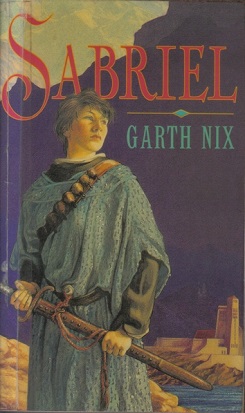
Sabriel by Garth Nix

Sabriel doesn’t know it, but her father is more than just a powerful necromancer; he is a key in the political intrigue of the Old Kingdom–the land beyond the wall. When he interrupts her class at Wyverly college by sending a hand–an enslaved spirit–from beyond the fourth gate of Death to drop off his sword and magic bells, Sabriel knows that something is wrong.

Something is holding her father hostage in Death, and Sabriel is determined to find him and rescue him. When she crosses over the wall, however, into the world of magic, both free and charter, she discovers just how little she knows about the history of the world, and the conflict in which her father was intimately involved. On this side of the wall, the world nearly ended two hundred years ago, and something that should have passed beyond the ninth gate of Death has come back to finish what it started and claim the world as its own…

I read this book for English 318 this year; we discussed it in class a couple of weeks ago. I ended up reading the book in about 48 hours, and as far as required reading goes, it wasn’t bad. Not bad at all. In fact, I really enjoyed it.

Garth Nix creates a fascinating world in this book, with magic that feels wondrous and otherworldly and places that feel fantastic. His conception of Death as a river with nine gates–nine waterfalls–is extremely fascinating, and the use of the bells to cast spells is really well done. The first hundred pages of this book felt a little bit like the beginning of The Dark Is Rising: it felt really dark and spooky, like being lost in the woods and knowing that something ancient and dangerous was out there with you.

The characters were also interesting and likeable. Sabriel is a necromancer who, in some ways, is afraid of facing death–the fact that everyone has to go at sometime. This is a YA book, so she was basically a young adult thrown in way over her head, tossed back and forth from crisis to crisis. At the same time, she takes charge often enough that she is definitely not just a weak character, driven passively from place to place. When the love interest enters the story, she’s basically the “prince” that rescues him from the “dragon,” repeatedly.

The biggest issue I had with this book was its predictability. It seemed that I could see every plot development and big reveal at least fifty pages before it happened. That said, the main thing driving me through the book wasn’t the plot–it was the setting and the characters. Sabriel has to learn some difficult lessons in order to succeed, and the magic she uses is just really freaking cool. Charter symbols, free magic, the five great seals of the charter, the nine gates of Death and the voices of the bells–cool stuff. That was enough to keep me interested, despite the relatively straightforward and unsurprising plot.

Overall, this was definitely a good fantasy. Garth Nix does a great job creating a sense of wonder, and his characters were interesting too. If you like fantasy and haven’t yet heard of this one, I’d definitely recommend it.

…and they all lived evily ever after.

Today we had a quark writing group party, and it was lots of fun! We all went up to drek‘s new house, up in Draper, and read some of our really old, really bad first attempts at writing stories. Good times!

Drek, Nick, lexish, slipperyjim, jakeson, gamila, aneeka, and one of my friends from the FLSR writing group all came up. Jakeson and his crew got lost on the way, but we had a good time hanging out, chatting, eating the pita bread and hummous that I’d cooked (I figured everyone else would bring sugar-heavy treats, so I cooked something a little more on the healthy side–still delicious, as evidenced by how much everyone ate!), and talking about how we’d gotten started writing.

I think a lot of us had similar stories–while we all wrote for different reasons, we all tried to do something big in high school, something that marked a turning point of some sort. The other common thread that ran through our stories was…how laughably bad they were! There were gradations, of course (Nick’s story that started with the word “Gandalf” and only got worse was pretty ridiculously crazy), but all of our stuff was pretty bad.

It can be both fun and painful to look back on past stuff, especially the stuff you wrote back in high school. It’s like, all the painful awkwardness of high school is not limited to your social life, it seeps into your writing as well, especially if that’s when you first try out your hand at the craft. So many cliches, so much bad grammar, so many viewpoint errors and info dumps…ARGH!!!

Of course, that is precisely what made it so entertaining. The awkward, emo, immature teenage grasp of the universe, combined with dozens of stale cliches and atrocious grammar–brilliant! I’m glad we were all at a point where we could look back on this stuff and laugh. It can do you good to air out your closet and let go of some of the old stuff you are sure would destroy you if you ever let it saw the light of day.

My first writing attempt was a novel that has since been entirely lost. I printed up a hard copy, once a long time ago, but I’ve lost that one and really have no desire to try and dreg it up. Of course, all the digital copies haven’t survived. My second novel attempt, however, I have in both digital and hard copy. That’s the one that I dipped back into for this writing party.

I actually sent out a copy of this to my aunt in Washington DC, who is/was an editor for a magazine. She read about the first twenty or thirty pages and sent me this letter, which I will use to finish off this post. The only places I’ve used ellipses are when my aunt described problems specific to certain passages and quoted them.

October 14, 1999

Dear onelowerlight [name, obviously, has been changed 😛 ]

The manuscript your mom sent home with Evan has proven to be an interesting read in many ways. It is wonderful to see people take an interest in writing. This pastime has given me many hours of satisfaction. I find that the joy is in the journey and that the process is as important to me as the finished job. However, it is always satisfying to have a finished product that I feel good about.

What it looks like you have is a wonderful outline for a novel. Your language is colorful and descriptive. The battle scene held my interest and made me want to know what was going to happen next. My intent was to read the manuscript from beginning to end purely for the joy of reading it. The urge to edit, an urge that often gets in my way as I write a first draft, got in my way as I read. Hence I was not able to follow through. I have written on some of the pages. What follows are a few other observations.

A really good writer named John Gardner said that a piece of fiction opens up a dream to the reader. Anything that causes the reader to become aware of the author or that jolts him out of the fictive dream does not belong. It is always helpful to let a manuscript cool for several days and then begin to read it. This will help you be more objective. Sometimes the things that seem marvelous turn out to be less enchanting than one thought during the rapture of creation.

Titles are difficult. Would anyone have read Catch 22 by another name? Some people don’t think so. It has been postulated that the reason the story about The Man Who Went Up A Hill And Came Down A Mountain didn’t do better as a movie–and presumable a book–was because of the length of the title. For many authors the title is the last thing to be written.

Your first two or three pages contain a good deal of “throat clearing.” An opening needs to grab the reader so he will continue. There needs to be a problem, action and change. It should be action that is vital to the story. Someone is going on a trip. Someone is going into battle. someone is getting married. Someone is being born. Unless you want to write erotic literature it would be better not to start with conception. Work the background in later. In The Gospel of John the first few verses talk about the Word. Immediately the Word is identified with the Son of God and the story of his baptism. The problem of establishing himself as a teacher is presented. In episode IV of Star Wars the force is not explained to us at the beginning, rather we see what it can do. It isn’t until Solo talks about fools who believe in an ancient religion that we begin to have some idea th at the force is more than magic. The characters give all this information to us.

Point of view is the perspective that the story is told from. T he most difficult and therefore least used these days is the omniscient narrator. A good rule of thumb is to see the story through the eyes of the person with the problem. Many authors write in first person. One can also use second or third person. Third person is similar to first person except the pronoun I isn’t used as much. (Actually it is more complicated than that, but that will suffice for now.) Sometimes a narrator who doesn’t see into anyone’s mind tells a story. Most fiction that looks like omniscient narrator is actually being told from the point of view of one of the characters. The narrator can then see into the mind of one person and all the other action is viewed through his eyes. Sometimes a novel will contain oone person’s point of view in one chapter and that of another character in another. This seems to work. It is confusing when shifts occur without warning.

Psychic distance has to do with how close you want your reader to be to the story. Stephen King wants to inspire terror. He gets his readers as close as he can. You hear breathing, feel sweat, hearts race. Jane Austin keeps her readers at a great distance. You see the lights, you hear the conversation, it is all very proper–no sweat, no breathing, no racing hearts. Just as with the point of view, the important thing is that the narrative remains consistent. It must not switch in the middle of a sentence, paragraph, or chapter.

Write in active voice as much as possible. Your English teacher will tell you all about this. Be aware that verbs ending in “ing” do not help your story. (Running up the hill after Jill and tripping over a rock Jack stumbled.) This slows the action of the story down but when used sparingly can add emphasis. The following construction works better (Jack ran up the hill after Jill. He tripped over a rock and stumbled. “D___!” he grumbled. Jill took water from her bucket and soap from her pocket and washed his mouth out.)…

…You have many long sentences. Your writing will be tighter and stronger with shorter sentences and fewer prepositional phrases…

…There are lots of ways to deal with dialogue. You can put the dialogue first and description second…you can put the dialogue at the end…you can break it up the way you have in your manuscript or you can put description on either sie of it…Like every other element of your story, you don’t want it to call attention to itself.

I believe you changed fonts to show a change in viewpoint or in who is speaking. For me this is very distracting. There are other good ways that work. Also it is easier for me to read when it is double-spaced.

Two books that I have found most helpful are John Gardner’s The Art of Fiction. It is out in paperback. John Gardner also wrote a wonderful fantasy called Grendal. It is not very long. It is told from the point of view of the monster. The other book is The Elements of Style by Strunk and White.

Thank you for sharing your manuscript with me. It takes great courage to share one’s work. I admire you for starting out early. Remember free advice is worth what you pay for and don’t let anybody discourage you. You learn to write by writinig. You have a good start.

Your’s truly,

Aunt Yvonne

White Wolf by David Gemmell

Skilgannon the Damned is one of the mightiest warriors in the world, yet every day the memory of the innocents he has killed haunt him.  He seeks solace in becoming a monk, but as alliances break down and wars sweep the land, mob violence comes to the monastery and Skilgannon once again takes up the swords of Night and Day.  The swords, however, are cursed with an enchantment that corrupts the soul of the one who wields them, and the old witch who gave Skilgannon the swords–and who cursed them–is behind the political machinations that threaten to drive Skilgannon into the hands of his greatest enemy: his old lover, the queen of Naashan.
I’d heard about the Heroic Fantasy subgenre from English 318 last year, and thought I’d try it out.  I’d heard a lot of good things about David Gemmell, both from Brandon Sanderson and Orson Scott Card, so I kept an eye out for his books at the used bookstore and found this one.

White Wolf was an enjoyable read.  I particularly enjoyed the moral and ethical questions that Gemmell raised, both during the fight scenes and between the fight scenes in the dialogue between the characters.  Gemmell will often come right out and have his characters directly address issues like bravery and cowardice, death and sacrifice.  Far from sounding strained or pedantic, these were my favorite parts of the novel, mostly because the characters were struggling with these issues themselves.  Druss and Skilgannon, of course, have a little more experience and know the answers to these things, but the boy Rabalyn, a recently orphaned boy who has nowhere to go but follow the warriors and become one of them, goes through a very interesting growth cycle.

Gemmell also did a very good job creating an evil villain and raising the stakes.  As Skilgannon’s adventure winds in and out, he finds himself on a mission to save a girl who has been tortured to the point where she may lose her very humanity.  However, the villains are not all black and white.  Technically, Skilgannon himself is a villain, or maybe a post-villain, and the queen of Naashan is a similarly complicated character.  Gemmell’s world is populated with uber-heroes and uber-villains, but there are plent of people who fall in the middle as well.

The biggest issue I had with this novel was the plot.  It seemed to follow a loose quest structure, but it had a weak beginning and middle.  Skilgannon is supposedly onthis quest to resurrect this girl he once loved, but prior to this he’s been living the monastic lifestyle, trying to escape the world.  There is no clear moment where he says “I’m going to resurrect this girl,” yet supposedly this is supposed to drive him to travel hundreds of miles to get somewhere and do something.

The middle is littered with flashbacks–they are everywhere.  While the flashbacks are interesting and engaging, they interrupt the action in the present of the narrative, which often gave me the sense that nothing notable was really happening.  I started to lose motivation to read the book somewhere in the middle, just because I had lost that sense of plot progress.  If it weren’t for the characters and the conflict, I probably would have given up on it altogether.

However, I really enjoyed this book.  The last third was really good, and the epilogue was fantastic!  Probably the best epilogue I’ve ever read.  I wish I could say more, but it would give out major spoilers.  It was just a very well written, very well done epilogue.

I’d definitely be interested in reading some more Gemmell, though he’s not on the top of my list right now.  When I do pick him up again, I’d like to start with Legend, the novel that launched him into the big time.  I hear that’s a good one.

Trapped in a parking garage and other late night story ideas

I had a weird idea for a story yesterday.  I went to the library and parked in the underground parking lot of the JFSB, and when the library closed at midnight, I came back and found the garage completely empty.  I was on the bottom floor, but forgot that the exit is only on the second floor, so I drove to where the exit should have been and found myself looking at a sign that said “NO EXIT.”

This made me wonder…what if you were trapped in an underground parking garage that, for some inexplicable reason, had no exits?  That the more you tried to find one, the more lost you’d become.  And it was completely empty?  And it was night?

Also, today at work I had an interesting idea–how to turn telepathy into a reality.  First, design a computer interface that connects directly to the human brain, without the need for a keyboard or a mouse or anything else.  Next, surgically implant these computers into people, and connect the computers to the internet.  You could open an IM box and chat with people directly, mind to mind.

Of course, you would still have to use words and language, since your mind has to translate your thoughts into words, which the computer can process into data, which the other computer can interpret as words, which the other person can then understand.  Still, it would be interesting, wouldn’t it?  Imagine the ability to IM anyone at any time, directly through your brain…

…holy cow, I would never get anything done!

Anyways, it’s WAY past my bedtime (my self-imposed bedtime, I’ll have you know, which unfortunately I have not been imposing nearly enough on myself.  That will have to change in the near future).

LTUE 2009 mp3s

Alright, like I promised, here are the mp3s of the panels I recorded at Life, the Universe, and Everything 2009. I can’t promise that the sound quality will be perfect, and there might be a few jarring noises when I had to pick up the audio recorder to move it somewhere else, but for the most part I think they are all listenable. Also, FYI, the first two minutes of the main address is a ridiculous conversation I had with my friends just before the panel started.

I think my server can handle all the people who want to download this stuff, but to reduce the strain please download and save them to your own computer, rather than opening the file through your browser each time you want to listen to it.

Also, I’m making these recordings available publicly through a creative commons license. For more information, check out the link at the bottom of the post.

Enjoy!

Life, the Universe, and Everything 2009

Thursday, 19 February 2009

Looking Through a Glass Darkly: Cautionary Tales and Post-apocalyptic Fiction

Reality in Science Fiction

Friday, 20 February 2009

Latter-day Saints and Science Fiction & Fantasy

Putting Romance into Your Fantasy

Writing Romance

The Principles of Suspense

Podcasting for Writers

Blurb Boiling 101

Following Through on Your Plot Promises

Making a Living as an Artist

Saturday, 21 February 2009

Current Trends in Science Fiction & Fantasy

The Problem of Sequels

Keynote Address: Creative Reading 201

What Every Writer Needs to Know about Archaeology

How to Fill 100,000 Words and Not Be Boring

Worldbuilding 101

The Golden Age of Science Fiction

Editing Do’s and Don’t’s

Creative Commons License
This work is licensed under a Creative Commons Attribution-Noncommercial-Share Alike 3.0 United States License.

LTUE 2009

Wow. Life, the Universe, and Everything 2009 is over, and it’s hard to believe that only three days have passed. It feels as if this symposium has been going on for a week, and that’s a good thing. Friday and Saturday, I spent practically every waking moment in the Wilk, the student center where the symposium was held. By the end, I think some of the professionals there were starting to recognize me and strike up conversations with me instead of the other way around. Kind of interesting. Way fun. Loads and loads of helpful advice and information to process. I’ll be lucky if I can soak it all in before the end of the year.

I’m glad to say I was able to open up and talk with a lot of people these past few days–in fact, I got a chance to talk with just about everyone who was on a panel that I’d attended. It was fun to shake their hands, compliment them on what they said, and strike up a conversation around that. It was surprisingly non-threatening, to be honest. I definitely feel more prepared for World Fantasy 2009 now–definitely.

By far, my favorite part of the convention was Tracy Hickman’s main address. It was titled Creative Reading 201, and it was all about how the reader and the writer are both collaborators in the creative experience, something that’s fascinated me for a long time. The implications of this simple fact are tremendous. First of all, it means that a story does not come to life until it is read. Anyone can get published, especially with the technology today, but all of those words are empty symbols until someone takes the time to read it. Second, it means that the spirit speaks to us in the white spaces between the lines. Just as people with different needs take the unique message they need from the scriptures through the power of the holy spirit, so each work of fiction speaks differently to us. Finally, all of this means that stories change as we change, even as they inevitably change us. As we grow, the stories that touched us the most simultaneously grow with us even as they help us to become better people.

Tracy Hickman then shared an incredible story about a book signing he and collaborator Margaret Weis had recently at a veteran’s home. A man in a wheelchair came up to them with an extremely tattered copy of one of their earlier works, about a knight who sacrifices his life in battle to save the order, even though all of his fellow knights in the order look down on him as less than a true knight. This wounded soldier then told them that this tattered book had traveled with him in his pocket throughout his military career, through parajumps, underwater operations, and into war theaters like Afghanistan. While fighting in Afghanistan, this soldier was shot in the lower back. As he went down, his first thought was “what would the knight in Tracy’s book do?” He saw the Taliban forces setting up a mortar on the opposite ridge, and in spite of his wounds and the risk to his life, he took down the enemy and saved twelve of his fellow soldiers fighting in that battle. The soldier then presented his purple heart and bronze star to Margaret Weis and Tracy Hickman, for writing the story that inspired him to be a hero.

Sometimes, as I’m sludging away with my writing and wondering what I’m going to do in 2010 when I finally graduate, I wonder if I’m somehow being lazy. I worry that I’m somehow being irresponsible by not going into some other profession, some kind of respectable 9 to 5 job in an office, the kind of thing that everyone else goes into. I wonder if I’ll ultimately become some kind of a parasite on society, trying to make it big as a writer. In the worst moments, I worry that even if I make it big, I’ll still be some kind of parasite, not really producing anything respectable or useful. After all, fiction is entertainment, especially in genre fiction–don’t we have enough of that already?

Then I remember the impact that one good book can have on people–the way it changes us, the way it opens our eyes and helps us to become better people than we were before we picked up the book. Then I realize: what could possibly be more respectable than telling good, honest, life-changing stories? And then, as I think about it a little more, I realize that that 9 to 5 office job isn’t what I think it is. I realize that I’m not slacking off by trying to be something more than a cog in the corporate machine, producing widgets.

If I strive to tell the truth as a storyteller, and to write the kinds of stories that truly inspire people to do marvelous things and become better people, what greater career is there than that? Teaching, I suppose, comes close to having a similar impact, as well as some kinds of therapy work. Certainly there are other careers that have tremendous opportunities to sacrifice and have a meaningful impact on one’s fellow men. However, my talent is in writing and telling in stories–and it’s a talent that I cannot suppress, from which I cannot escape. So long as I live, I will always tell stories–it’s just hardwired into who I am. Certainly I can use this talent to serve my fellow men in a way that is both respectable and meaningful. And really, for me personally, what else could be better?

It doesn’t mean that it isn’t scary. However, thanks to LTUE this year, I feel that I’ve learned a lot that can help me break in and make it. Whether it was something said in one of the panels or just the experience of attending, it was a truly awesome experience for an aspiring writer like myself.

As far as the files, I’ll post links to the audio files from the conference after I get them uploaded. I should be able to do that sometime within the next 24 to 48 hours, so look out for that.

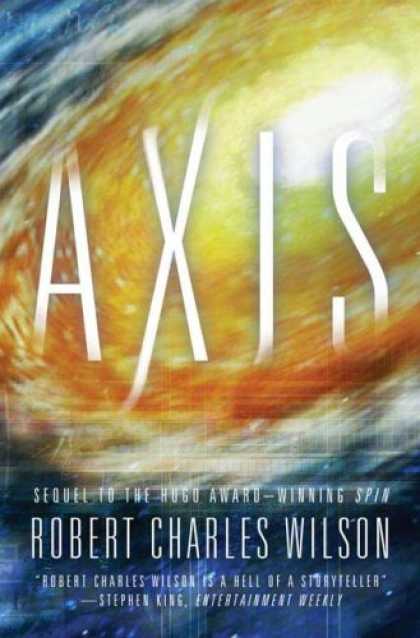
Axis by Robert Charles Wilson

Wow.  Wow. WOW. This book was good!

I could try to explain the plot of the story to you, but that would ruin the first book of the series, Spin, which I sincerely belive is one of the best science fiction novels I’ve ever read.  To do that would be a crime against humanity.  You have got to read the first book, it is so good!

The main character, Elise, is trying to find out what happened to her father.  He disappeared back when she was a little girl, leaving behind his family for no apparent reason.  He was a scientist involved in studying the Hypotheticals, a mysterious, unseen alien thing that had dramatically altered the course of history nearly a generation ago, for purposes completely unknown.

Her obsession to find out what happened to her father destroys her first marriage and into a new relationship with Turk, an honest drifter.  When a strange, alien ash falls from the sky and secret government agencies chase the two of them for information about a mysterious woman known as Sulean Moi, Turk and Elise find themselves getting wrapped up in a secretive, almost cult-like movement to communicate with the Hypotheticals.  The leader is a mad scientist who will let nothing stand in his way–not even respect for basic humanity.

This book was amazing. I read the last fifty pages at 3:00 am, and at the end of every chapter I jumped up and shouted, wide eyed, “what?!” “holy cow!” and “oh my gosh!” The characters were real and genuine, the human drama was believable and engaging, the alien-ness of the universe was both thrilling, humbling, and awe-inspiring, and the tension was deliciously thick, right up to the very last words on the last page.  This is a book worth reading (though you really should read Spin first–everything else will make a lot more sense if you do).  Robert Charles Wilson is one of my favorite authors.

This book reminded me quite a bit of Arthur C. Clarke–not in terms of character and human drama (Robert Charles Wilson is light years better than Clarke in those areas), but in terms of thematic elements.  Clarke’s fiction was always examing transcendence and the ultimate destiny of mankind.  His aliens were more gods than men, and he viewed godhood as the destiny of man.  Robert Charles Wilson deals with a lot of the same themes and questions.  What is the ultimate end of evolution?  What does transcendence look and feel like?  Is the universe ruled by a mindless process, or a process that has a mind and a purpose?

Robert Charles Wilson’s prose is amazing.  He gives just enough detail to make you feel that you’re there in his world, and just enough abstraction to let you work out the rest of the details until you feel that you’ve known his characters for a long, long time.  He builds up the tension until you can’t put the book down, and when he releases it you find yourself stepping through a door into another world, full of meaning and significance, full of new wonders and new stories of its own.  It’s amazing.

You really owe it to yourself to pick up something by this author.  I would strongly suggest starting with Spin, but once you’ve read that book, you’ve got to read this book.  It is amazing.

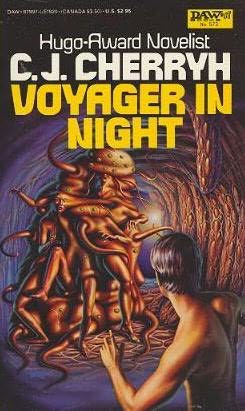
Voyager in Night by C. J. Cherryh

Rafe, Jullian, and Paul are young friends trying to make their way in the universe with nothing but a junk ship on the frontiers of settled space. Rafe and Jullian are brother-sister, and Paul is Jullian’s husband. Despite all the risks, they have high hopes for their life together on the Lindy as they go out for months at a time on asteroid mining expeditions.

All of that changes, however, when an unidentified object leaves jumpspace and heads on a collision course with their ship. Before they know what’s happening, the object captures them and heads for deep space.

The human voyagers find themselves in a bizarre world where the boundaries between physical reality and virtual reality are blurred, and the very essence of humanity can be recorded, copied, duplicated, and even synthesized with other human and alien templates. As they fall deeper and deeper into an intership conflict that has come to a crest after a hundred thousand years, they find that their unique personalities and relationships with each other hold the key to their salvation…and their hidden secrets, their destruction.

This book was BIZARRE. Strangest sci fi novel I’ve read, and those of you who know me will know what that means! I’m left with the impression that it was a deep book, but I can’t exactly tell you how or why. Perhaps it’s because of the alien-ness of the alien, and the profound way that it impacted the characters and cut to the very core of who each of them were. Perhaps it’s because of the questions it raised about the nature of reality and how we define ourselves as human beings. This book touched on some deep issues in ways that I found quite disturbing.

The greatest strength of this book would have to be the way it penetrated these issues. Its greatest weakness grew out of that–the book was just incredibly confusing. I felt really disoriented when I was reading it. I never knew who or what the aliens were, what their motivation was, where the humans really were, what was really happening to them, or, at the climax, how…well, how things played out at the climax. Very confusing, even if it was fascinating.

At the same time, the confusion of their situation also helped the story to be very believable. I really hate reading about your stereotypical aliens–the guys who walk, talk, and act like humans, but have a different mask or hairstyle or something. These aliens felt like the real thing. They were bizarre, scary, had unbelievable technology, and, well, were just very alien. There was hardly anything about them that had any kind of reference to the way we, as human beings, see the world.

I almost wonder if this book has some cyberpunk undertones. I dunno…obviously, with the far future setting, it doesn’t fit into the cyberpunk genre. However, the idea of replicating human beings through a super computer raises some very interesting existential questions. Also, the fact that the aliens seem to inhabit a virtual world of the ship computer raises some interesting questions about how a cyber-existence warps our own ideas of consciousness.

It was a very well written piece, in a very interesting universe, with some moderately interesting characters and a bizarre, disturbing situation. At the same time, it’s definitely not for everyone. If you’re not the kind of person who reads much sci fi, you’re probably not going to appreciate this book. If, however, you enjoy the bizarre and disturbing, this is a book you will probably enjoy.