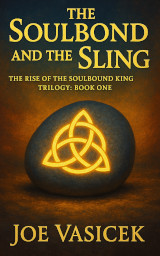
Going full-tilt on The Soulbound King

I’ve decided to put The Road to New Jerusalem on the back burner and focus instead on my epic fantasy series, The Rise of the Soulbound King Trilogy. If I push, I think I can finish the AI draft of book 1 in the next two weeks. I’ve also nearly finished the outline for book 2, and will probably have a rough AI draft for that one by the end of September.

I would really like to publish this series in 2026, but I don’t want to launch it until I’m ready to rapid release the first three books. And since these books are all epic fantasy, it’s going to take a lot of time and effort to write them. Without AI, it would probably take me something like two or three years for each book. I’m not a very fast writer, and I tend to get stuck in the middle, even when I have a solid outline. With AI, I think I can shorten that to 6-8 months.

These books are probably going to range between 150k and 200k words, so not super long for epic fantasy (for comparison, Mistborn: The Final Empire is about 214k words, and The Way of Kings is about 384k words). That’s much longer than most genre books, though, including most of the books I’ve written until now. And writing difficulty doesn’t scale linearly with book length; it scales logarithmically. So while it may take only 1-2 months to write a Sea Mage Cycle book, those are only about 1/3rd the length of a Soulbound King book.

My long-term goal, though, is to pivot to epic fantasy, to the point where that’s mostly what I write. And if you read my science fiction novels, you’ll find that they’re much more like epic fantasy, with multiple viewpoints, grand galactic empires, wars and political machinations, and a universe that has its own character arc. So while this may superficially seem like a huge pivot, it’s actually not.

There are three science fiction books that I need to write before I can pivot entirely to writing fantasy: Captive of the Falconstar, Lord of the Falconstar, and The Return of the Starborn Son. Those are the only outstanding science fiction series that need finishing (and I will finish them, I promise—I’m not going to pull a GRRM). I also need to finish the Twelfth Sword Trilogy, the epic fantasy series I started in the 2010s while I was still mostly writing science fiction.

Realistically, the only ones of those books that are going to be finished between now and the end of next year are the Falconstar books, since I need to juggle all of these with the Soulbound King epic fantasy books that I’m also writing. But I think I can finish the Falconstar books, and also write and publish a Sea Mage Cycle book or two within the next year. I’ve found that it often helps to take week-long breaks to work on other projects, which allows me to approach a larger and more challenging WIP like The Soulbond and the Sling with new eyes. So I will probably alternate between working on the Soulbound King books and working on Falconstar and Sea Mage Cycle for the forseeable future.

But my goal for the next two weeks is to go full steam ahead on The Soulbond and the Sling, until it is finished. And with luck, I will also have a few excerpts to share with you soon!

Should I split my epic fantasy series into two trilogies?

So I’m working on the first book in a new epic fantasy series, called the Soulbound King. It’s basically a fantasy retelling of the life of King David, loosely adapted from the biblical stories about his life. I’ve already outlined the first book and generated a rough AI draft, which came in at 153k words. The final draft will likely be longer than that, but I think it’s very likely that I will be ready to publish it before the end of the year.

The question I’m currently grappling with is whether to keep it as a seven book series, or to release it as two trilogies with a bridge novel in the middle. Frank Herbert did a similar thing with his Dune books: the first three books (Dune, Dune Messiah, and Children of Dune) were a trilogy, and the next book, God Emperor of Dune, was supposed to be a bridge novel setting up the second trilogy—except he died before finishing the last book, so his son Brian Herbert got together with Kevin J. Anderson to write it, and then they blew it up into a franchise… point being, stuff like this has been done before.

Now, I’m reasonably confident that I’m not going to die before finishing the last book. In fact, I’ve already made a 7-point outline for all seven books, so I know exactly where they start and end, with the inciting incident, midpoint, climax, etc. I’m also writing these books with AI assistance, which is making it possible for me to write these books much faster than I otherwise would have been able to write them. For the first book, The Soulbond and the Sling, I anticipate that it will only take between six to nine months of total work to go from story idea to finished draft.

But the trouble with writing a seven book epic fantasy series is that a lot of readers aren’t going to bother picking it up until all seven books are out. This is because so many readers have been burned by authors like George R.R. Martin and Patrick Rothfuss, who have not and likely will never finish their bestselling series. I can’t really blame the readers for that (though I can and do blame the authors), but it creates a market reality that I need to anticipate and plan for.

So here’s what I’m thinking: instead of making it a seven book series, I’ll make it two trilogies with a bridge novel in-between. The first three books will complete one arc, and the last three books will complete another arc. I’ll wait to release the first book until after I’ve completed the AI draft of the third book, so that way I can release all of the books in the first trilogy within 1-3 months of each other. And after the first trilogy is complete, I’ll market it as a trilogy while working on the last four books, probably releasing each of those a year apart, as I finish them.

The reason I’m thinking about this now is because a strategy like this is going to influence how I write all of these books. If I’m going to split the series into two trilogies, the last thing I want to do is end the first trilogy on a cliffhangar. It has to hold together as a complete story, with only one or two loose threads. But since I’m still in the early writing stages of the first book, I still have enough room creatively to make that kind of adjustment. I just have to decide if that’s truly the plan.

By the way, the first trilogy ends with the fantasy equivalent of the Battle of Mount Gilboa, where the Saul and Jonathan characters die in an epic battle and the David character becomes king (I know that in the Bible, there was a gap of several years between those two events, but I’m combining them for purposes of this book). So it is a rather natural stopping place, even if it does end on a massive downer, followed by a false victory (the second trilogy begins with David and Bathsheba).

Anyways, what do you think of this plan? Does it sound like a good idea, or is there a compelling reason I haven’t thought of yet for why I shouldn’t do it?