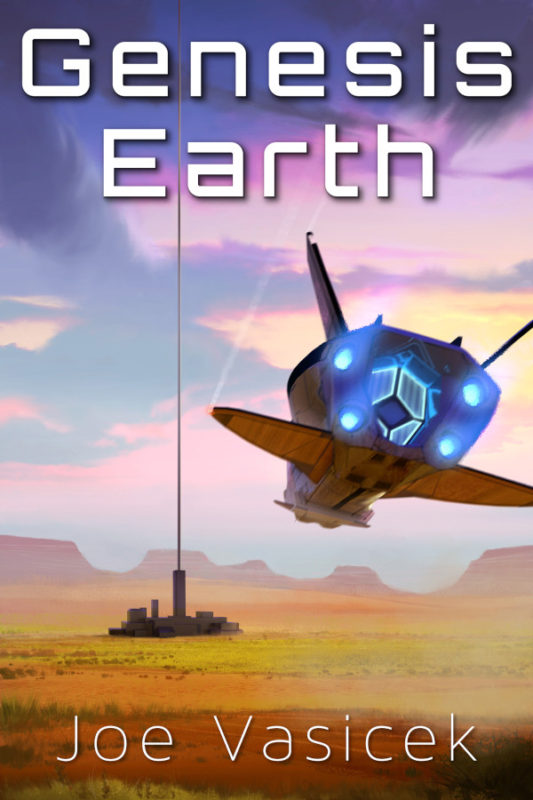
Genesis Earth is a thought-provoking science fiction novel about humanity, isolation, and the search for home in a vast and empty universe. In this post, I explore the deeper themes behind the story—how the meaning of home shapes the characters, and what that says about us as human beings.
What does it mean to be human when everything familiar—home, society, the Earth itself—is gone? What does it mean to lose one’s home, or to never really have a home in the first place?
In Genesis Earth, a work of existential science fiction, the story of Michael and Terra explores what it means to be human when isolation pushes the boundaries of identity and connection. Michael and Terra grew up away from Earth, isolated and estranged from humanity’s homeworld.
Their need to be rooted in something (or someone) drives the core theme of belonging and identity in the book. The mission is supposed to be about discovery, but what they truly discover is themselves—how fragile, lonely, and deeply human they are.
Where the Idea Came From
The central concept of Genesis Earth is that humanity has created an artificial black hole and opened a wormhole to some unknown part of the universe. In order to create that black hole, though, they would need to travel far from Earth, on the fringes of our Solar System—hence the isolated colony mission where Michael and Terra grew up. And because of the long distances from the wormhole to the star system on the other end, their mission would isolate them even further, not only in space but in time. Everyone would be gone by the time they got back home, if they could even call it “home” by then.
All of this drove me to explore the meaning of home, and how it would play out for these characters who are so isolated and separated from the rest of humanity.
How the Meaning of Home Shapes the Story
In Genesis Earth, Michael begins as a dutiful scientist. He’s loyal to “the Mission,” but that loyalty is hollow—he’s chasing a ghost of Earth rather than living for anything real. His arc is about realizing that meaning doesn’t come from data or duty, but from connection.
The story strands two people—Michael and Terra—alone in deep space. The physical isolation mirrors their emotional one. Their arguments, awkward silences, and gradual trust-building drive the tension far more than the alien mystery.
The “alien ship” and “new Earth” they find are really reflections of humanity’s own legacy: ruins of a civilization that destroyed itself but left behind traces of what it once was. This discovery forces Michael to see that knowledge without empathy leads nowhere. The universe is full of dead monuments to reason untempered by love.
In the end, the story is less about finding Earth again—or finding home—as it is about beginning it anew, through human love and connection.
What the Meaning of Home Says About Us
Michael and Terra inherit a civilization that has mastered the stars but lost its soul. Their journey shows that intellect without empathy leads to extinction. We can map galaxies, but if we forget why we exist or who we’re doing it for, all that brilliance turns sterile and meaningless.
It’s a mirror to our own age: we’ve never known more, but we’ve rarely been lonelier. And ultimately, the message of Genesis Earth is that we are not defined by where we come from, but by whom we choose to love and what we choose to build. Heart and home matter more than hubris and knowledge.
Why the Meaning of Home Matters to Me
After I left home, I spent nearly two decades of my young life as something of a modern nomad, rarely living in one place for more than six months. During this time, my parents moved not once but twice, so I lost all connection to my childhood home.
This personal loss of home and sense of being uprooted was a major influence in the writing of this book, though I didn’t realize it at the time. And the conclusion that Michael and Terra ultimately come to—that “home” isn’t found in a place so much as it is in the depths of the connections with the people in your life—was something I experienced as well, as I ultimately settled down and started a family of my own.
Genesis Earth is an introspective, awe-driven, charactor-anchored YA science fiction novel. It’s not a laser-blasting space opera; rather, it’s a quiet, psychological odyssey through the cosmos, through the eyes of a lonely young explorer haunted by the memory of Earth. Through this book, readers will experience the loneliness of deep space, the mystery of first contact, and the fragile human connection between two young scientists flung far from home.
What Kind of Reader Will Love Genesis Earth?
This book is perfect for readers who:
Love hard SF stories of space exploration rooted in both plausible science and human emotion,
Enjoy classic SF from authors like Clarke and Asimov—thoughtful, concept-driven, but with relatable, human characters,
Appreciate slow-burn tension and stories that make them think, long after they set the book down,
Are fascinated by themes of first contact, isolation, coming-of-age, and the psychological cost of human exploration, and
Crave science fiction that feels possible, where the sense of wonder comes from realism, not fantasy.
If any of that describes you, then you should definitely give Genesis Earth a try!
What You’ll Find Inside
Genesis Earth follows a young scientist, Michael Anderson, and his mission partner Terra as they explore a dangerous anomaly on the far side of a wormhole, that could either threaten or hold the key to humanity’s future. The result is an immersive and contemplative book that starts as a psychological drama and turns into a story of discovery, both cosmic and personal: what it means to be human when Earth is a ghost and “home” is light-years away.
What Makes Genesis Earth Different
Fans of classic science fiction will recognize the trope of the lonely astronaut or scientist setting out to explore the unknown, but where most protagonists in classic hard SF are seasoned professionals, the explorers in Genesis Earth are barely adults, raised in isolation on board a space colony, and psychologically unprepared for what awaits them. The story explores beyond the question “can humanity survive?” and asks “what happens to the human soul when it’s untethered from home?”
Distinctive features include:
Psychological depth: The fraught relationship between Michael and Terra gives the story an undercurrent of tension and unease that’s rare in classic hard SF.
Tone: Quiet, human, and melancholic—more existential wonder than space adventure.
Perspective: Told through a deeply personal first-person lens, with an almost diary-like immediacy.
Fast-paced, action-heavy sci-fi with constant battles, explosions, or villains.
Romantasy or sexually explicit romance plots — while there is emotional tension, it’s subtle and cerebral, not sensual or melodramatic.
Soft or mythic sci-fi full of alien empires or space wizards — the story stays grounded in realism.
Hard nihilism or grimdark — while introspective and serious, the book is ultimately hopeful, not bleak or cynical.
Readers who dislike slow builds or introspective narration.
If you’re looking for Star Wars, this isn’t it. If you’re looking for Arthur C. Clarke’s emotional heir, you’ve found it.
Why I Think You Might Love Genesis Earth
I wrote Genesis Earth when I was a lonely, single young college student trying to find my place in the world. That personal struggle in my own life definitely affected the conflict and themes of the book. I read a lot of classic SF in this time, including books by Arthur C. Clarke, Isaac Asimov, Ursula K. Le Guin, Robert Charles Wilson, and Orson Scott Card, and I wanted to create something that was just as awe-inspiring and thought-provoking as the great books by those classic authors.
If you’re looking for a book that sticks with you long after you’ve read it, and helps you to find your own place in the world, you should definitely give Genesis Earth a try!
Earth was like a womb, about to give birth to a glorious age of human expansion across the boundless frontiers of space. And yet, to actually be in that future, and find it cold, dark and silent—it was chilling.
My debut novel, Genesis Earth, is currently free through the end of the week. Check it out!
Genesis Earth
The ultimate voyage of discovery ends with the truth about yourself.
Michael and Terra never thought that they would be the first human beings to set foot on an alien world. What they discover forces them to question their deepest beliefs about what it means to be human.
The ultimate voyage of discovery ends with the truth about yourself.
Michael Anderson never thought he would set foot on an Earthlike world. Born on the farthest edge of the solar system, he studies planets from afar. But when his parents open a wormhole and discover signs of intelligent life on the other side, Michael is the only planetologist young enough to voyage to the alien star.
He is not alone, but Terra, his sole mission partner, is no more of an adult than he is. Soon after their arrival, she begins keeping secrets from him. But she doesn’t realize that her darkest secret is one that he already knows.
Twenty light-years away from humanity, what they discover on the alien world forces them to question their deepest beliefs about the universe—and about what it means to be human.
Joe Vasicek fell in love with science fiction and fantasy when he read The Neverending Story as a child. He is the author of more than twenty books, including Genesis Earth, Gunslinger to the Stars, The Sword Keeper, and the Sons of the Starfarers series. As a young man, he studied Arabic at Brigham Young University and traveled across the Middle East and the Caucasus Mountains. He lives in Utah with his wife and two apple trees.
Some of the links in the page above are "affiliate links." This means if you click on the link and purchase the item, I will receive an affiliate commission. You will not receive any additional charge.
As an Amazon Associate I earn from qualifying purchases.
Brandon Sanderson is, without a doubt, the most popular fantasy writer currently living and writing today. He is also one of the classiest and most gracious authors you will ever meet, in any genre. I’ve also got a personal connection to him, from taking his writing class at BYU.
Brandon decided to become a writer when he was very young. The way he explains it, the bug really bit him when he read Dragonsbane by Barbara Hambly. Depression runs in his family, and growing up, he always felt emotionally monotone and distant—until he read that book. From then on, he became obsessed with fantasy, both with reading and with writing it.
The way I heard Brandon explain it, that emotional monotone has been both a personal struggle and a great asset. It’s part of the reason he’s able to write so much, since where other writers tend to have huge emotional swings that affect their ability to write, Brandon is able to just sit down and do the work, day after day after day. It’s also part of what gives him an even keel that makes him such a gracious and generous person. Where other writers tend to get worked up on social media or join outrage mobs, Brandon avoids all of that. I don’t think I’ve ever seen or heard of him becoming outraged about anything.
Brandon was one of the last major authors to break into book publishing before the indie revolution began turning everything upside down. He broke in by researching agents and editors, attending all the important conferences, and networking with everyone who’s anyone in the genre. He also wrote a lot of really good books—as well as a lot of crappy ones. I believe that Elantris, his debut novel, was actually the sixth novel he wrote, and Mistborn: The Final Empire was something like the 13th. He landed his agent, Joshua Bilmes, from attending World Fantasy, and his agent eventually got him his publisher, Moshe, at Tor.
Elantris and Mistborn were good, but not immediate bestsellers. In fact, Brandon was on track to be an average mid-list fantasy author with a relatively unremarkable career, until Robert Jordan died, leaving the Wheel of Time unfinished. By that point, a lot of readers felt frustrated with the series and used his death as an opportunity to write scathing screeds about how it had gone off of the rails and grown far too bloated and large. But Brandon was much more classy and gracious than that, and wrote a tribute to the man instead, praising his work and the impact it had had on his life. When Robert Jordan’s widow read Brandon’s post, she decided that he was the one who should finish the Wheel of Time.
Personally, I’m not a huge Wheel of Time fan. I read the first three books and enjoyed them, but I got lost midway through the fourth book. My wife read them all and feels like the series is overrated, and I generally trust her judgment. But I can appreciate how a lot of people really love the series—and really, there is a lot to love. Just because it isn’t to my personal taste doesn’t mean that it isn’t good.
My friends who are Wheel of Time fans tell me that Brandon not only finished the series—he rescued it. Apparently, the last three books rejuvenated the series, wrapping things up in an incredibly satisfying way. Of course, Brandon would defer and say that it wasn’t his genius that turned the series around, but Robert Jordan’s original vision and the detailed notes and outlines that Brandon followed. But there’s no denying that Brandon really stuck the landing.
It was around this point in the story that I met Brandon. I was a student at BYU at the time, and I had an opportunity to take his writing class. From the time when I was eight, I had wanted to be a writer, but I didn’t think I would ever turn it into a career. Brandon’s writing class changed all that, and helped me to see that I could pursue writing as a career. He also taught me the nuts and bolts of writing fiction, vastly improving my writing skills. I had started several novels in high school, but never finished anything until I took his class. And while my first finished novel was a disaster that I promptly locked in the trunk, my second novel attempt (which I started writing in Brandon’s class) ultimately became my debut, Genesis Earth.
(As a side note, my wife was also in that ‘08 class with Brandon Sanderson, though we didn’t actually meet each other until almost a decade later when we matched on Mutual. She also started a writing group with her college roommate, who won the Writers of the Future and married into Brandon Sanderson’s writing group. Our writing group has also got one of Brandon’s college roommates.)
Brandon’s success with Wheel of Time was what catapulted Brandon from a midlist author to a bestselling phenomenon. But even then, if he wrote at the same slow pace as most other fantasy authors, he would have forever been known as “the guy who finished Wheel of Time.” Instead, he became famous for writing and publishing massive +300k word doorstopper tomes at an unprecedented rate, leading fans to joke about his writing super powers. Then the pandemic happened, and he wrote four “secret” novels with all of the extra time he had from not traveling anywhere. The fans went crazy, and his kickstarter blew everything out of the water.
I haven’t read all of Brandon’s books. I really loved the Mistborn era I books, and the first Stormlight Archive book was good, but my favorite is Emperor’s Soul, because I think that Brandon is at his best when he writes shorter novels rather than the massive +300k word doorstopper tomes. In my experience, Brandon is a 3-star author who writes 5-star endings. His writing tends to meander, especially in the early middle, but around the 3/4ths mark there’s usually a twist that brings things together, and the conflict escalates consistently until it builds into a really satisfying ending.
Brandon is also known for his hard magic systems, which have become a signature trait of his books. Some readers feel that clearly explaining the rules of magic defeats the sense of wonder that a fantasy novel should have, but that’s not been my experience with his books. When I read a Brandon Sanderson novel, I feel almost like I’m reading a video game. Knowing the ins and outs of the magic helps me to see the possibilities for the characters to use it, and Brandon is usually really good at adding an unexpected twist, exploiting the rules of magic in a surprising yet inevitable way. This creates its own sense of wonder that really adds to his books.
Brandon also is known for how all of his books are tied together into the same transdimensional “cosmere” multiverse, though I actually think this is the least remarkable thing that makes his books so distinctive. For one thing, he’s not the first one to do it—David Gemmell also discretely linked all of his books, which blew my mind when I discovered that particular easter egg. For another thing, Brandon has turned his cosmere from a delightfully hidden easter egg and nod to the fans to the grand key that you must possess in order to understand and appreciate his later books. As a result, the cosmere is becoming an obstacle to new readers, even as his most ardent fans all swoon over the cosmere connections.
I think Brandon’s ultimate goal is to turn his books into a massive cinematic universe, kind of like the MCU. From what I understand, he was really close to signing a Hollywood deal, but it fell through at the last minute, leaving him back at square one (I don’t know all the details, though Jon Del Arroz did some interesting reporting on that). This is also probably why his books have become more woke in recent years.
I’ve already written at length about that subject, so I won’t belabor the point here. But I really do feel that this represents a betrayal of his more conservative fans, many of whom turned to Brandon precisely because his books tend to be free of all of the gratuitous language and sexual content of most modern fantasy. Also, one of Brandon’s really great strengths during the gamergate and puppygate fannish controversies of the 2010s was his strict neutrality. While the culture wars were raging all around them, he continued to be his classy and gracious self, refraining from picking sides or wading into the mudfest. With the LGBTQ romantic subplot in Wind and Truth, that appears to have changed.
I hope he turns away from all of that. What the world really needs right now are books that transcend the whole woke vs. anti-woke divide, bringing us together and healing the artificial (and in many cases subversive) divisions that pit us against each other. Maybe Brandon will surprise me, and accomplish exactly that, just from the left side of the aisle. But as of Wind and Truth, I can’t help but wonder if we’ve reached peak Sanderson. Only time will tell.
Regardless, I will always be grateful to Brandon Sanderson for the things he taught me, and for all of his graciousness and generosity that he showed in his writing class. Without that experience, I probably would have pursued a different career, and not written nearly so many books. I also probably would not have married my wife, since one of the big things that drew her to me was my love and dedication to my writing craft.
This is going to be controversial, but I don’t think any of George R.R. Martin’s A Song of Ice and Fire books should have been nominated for the Hugo Award. In the first place, those books are pure fantasy, and while the line between fantasy and science fiction can become blurry at times, with everyone drawing it in a slightly different place (Dragonriders of Pern, for example), I do think it’s important to draw that line somewhere, because each of us as readers draws that line somewhere. Some readers read only fantasy, some read only science fiction, and even among readers who read both, they scratch very different itches.
(As a side note, A Dance With Dragons came out right when I was indie publishing my first few books, and I remember being super annoyed that it was monopolizing all of the top spots on the Amazon bestseller charts for subgenres like science fiction > action & adventure, even though it was very clearly not a science fiction book. That annoyed me as both a writer and a reader.)
More than that, though… how do I say this? I know that a lot of people are (or were) huge fans of Game of Thrones, that it had a huge and lasting cultural impact, and that the writing quality of both the books and the miniseries was quite excellent, at least for the first few books/seasons… but to what end? The HBO series itself is blatantly pornographic, and the books are even worse, glorifying the immorality and horrific violence that characterizes the series. Worse, there is no good or evil in this world: only power. This means that there are no heroes, only victims and victimizers.
I’m not sure how much Game of Thrones is responsible for shaping our current cultural decay, and how much it was simply a reflection of the culture in which it was created, but this obsession with power and the victim-victimizer complex lies at the heart of all of the social pathologies currently driving the West to cultural and spiritual suicide. It’s the force driving our own modern Game of Thrones, between the MAGA disciples of orange Jesus and the machinations of our Big Tech and Deep State overlords, with their hordes of hypnotized NPC zombies protesting in behalf of [current thing], all while remaining carefully masked. It turns out that when you embrace Martin’s paradigm, rejecting good and evil for the pure pursuit of power, and define everyone by their victimhood status, it leads to the death of everything in your culture that is good, true, and beautiful.
And even laying all of that aside, the fact that Martin hasn’t finished the damned series yet has done more to destroy the epic fantasy genre than all the other things that his career has otherwise accomplished. If you’re a new fantasy writer and you have a great idea for an epic fantasy series, you’d better have a good day job or a sugar daddy/momma, because most readers won’t give your series a chance until after you’ve finished the last book. But can we honestly blame the readers for this, when Martin ran off with their money and left them all burned?
Back when Game of Thrones / A Song of Ice and Fire was still ascendant, fans and readers were all mesmerized by how skillfully George R.R. Martin could subvert their expectations and pull off twists that no one had foreseen. It turns out that the biggest expectation that Martin ever subverted was the expectation that he would finish the damned series.
Anyways, that’s enough ranting about George R.R. Martin and the pathological effect that I believe he’s had on the culture. I read A Game of Thrones back in 2010 and decided to skip the rest of the series. The writing was fantastic, but I hated all of the characters and could tell that things were going to get way too dark and way too graphic in the later books. And now, I wish I lived in a world where George R.R. Martin was still a mostly unknown midlist author, with a small cult following but not a lot of influence on the culture overall. It would be a much better world.
I skipped Accelerando, because I’ve read enough Charles Stross to know that his particular brand of grungy cyberpunk nihilism rubs me the wrong way. Learning the World wasn’t terrible, but I DNFed it because I got bored, though I could be persuaded to try it again. It was just too much of an idea book, without enough story to really hook me.
Old Man’s War… my thoughts on that one are complicated. I cannot stand Scalzi as either an author or a human being. He’s basically an obnoxious internet influencer who made it big back in the days of the blogosphere, before “influencer” was a job title. Of course, to be an influencer, you have to either 1) be an extremely attractive woman, or 2) be off your rocker somehow, and that definitely describes Scalzi. He is an obnoxious blowhard who likes to argue with people on the internet for fun and profit, except he’s apparently not as good at social media as he was at blogging, so he’s pivoted to writing science fiction and playing the SFWA mean girls game instead.
But most of that happened after Old Man’s War, so it’s not exactly fair to judge the book on all of that. And I have to admit, I enjoyed it back in 2008 when I read it. It’s basically a retelling of Starship Troopers and The Forever War, but without all of the nihilism and politics—and since the nihilism and the politics are the things that got me hung up on both books (though I actually enjoyed the politics of Starship Troopers; the part that slightly annoyed me was getting a lengthy treatise on human sociology instead of an adventure novel), Old Man’s War was basically a retelling with all of the good parts and less of the bad parts. So I’ll grudgingly give Scalzi his due and admit that his first book is good enough to deserve an affirmative vote.
But Robert Charle’s Wilson’s Spin is easily the best book on the ballot from this year, and possibly the best Hugo-nominated book that I’ve read from this whole decade. It’s fantastic. One of the best science fiction novels I’ve ever read. The rest of the trilogy is just as good, too. In fact, Spin and its sequel Axis were a huge influence on my own Genesis Earth, though it may not be obvious at first glance. I read Spin when I was studying overseas in Amman, Jordan, while I was still working on the first draft of Genesis Earth. The next year, I read a whole bunch of Robert Charles Wilson’s other books, and I have to say that I have yet to read a book he wrote that I didn’t enjoy. His books have had as much influence on me as Ursula K. Le Guin, and largely scratch the same itch.
So that’s how the 2006 Hugos shape up for me: three books that I didn’t like, and two that I did—and one of those books is one of my all-time favorites.
I never know which posts of mine China Mike Glyer is going to pick up for his pixel scroll, or whatever he calls the daily bucket of chum that he feeds the folks over at File 770 (the ones who aren’t Chinese bots, anyway). I’ve written at much greater length about my 2022 reading resolution here, and my insights and impressions gained through the experience here and here, but for some reason the post he decided to pick up was the last one. Perhaps he thought that it would be better at ginning up outrage than the other posts? But if that were the case, surely he would have picked up the one before that instead. It was practically written for ginning up outrage among the File 770 crowd (or at least the ones who aren’t Chinese bots).
So when I got the pingback last night, I glanced over the post over at File 770 and saw this comment from Cora Buhlert:
I have to admit that whether or not writers have children is not a characteristic I pay the slightest bit of attention to. Never mind that it is difficult to tell, because even today, not every writer chooses to talk about their family or private life.
But I guess that Joe Vasicek is the sort of person for whom people without children, particularly women without children, are by definition evil.
Cora is an indie writer from Germany that I used to interact with a lot on the KBoards Writer’s Cafe, and some other indie author hangouts. She’s earned the ire of Larry Correia a couple of times, and she has a bad tendency to straw man any opinions or perspectives that challenge her worldview. On one thread, we went back and forth over whether Hitler was a creation of the political right or the political left. I tried to explain that “left” and “right” mean different things in the US than they do in Europe, but it was like trying to have a discussion with a brick wall.
So it doesn’t surprise me in the least that she’s completely mischaracterized me in the comment above. I do not believe that childless women are evil—if I did, I would not have served in the bishopric of a mid-singles ward (a mid-singles ward is a Latter-day Saints congregation of unmarried and divorced people in their 30s and 40s. I was the ward clerk—basically, the guy who handled all the finances and other paperwork for the congregation). My faith teaches me that people are not evil, but are all children of God, no matter who they are born to or what their life choices may be.
In fact, my interest in the parental status of the Hugo and Nebula winning authors has nothing to do with religion or morality, and everything to do with life experience. I didn’t get married until almost a decade after I had started to write professionally, and the experience of becoming a father was so completely lifechanging that it’s transformed my writing as well: what I choose (and don’t choose) to write about, who I choose (and don’t choose) to write for, as well as the themes and ideas that I explore in my books.
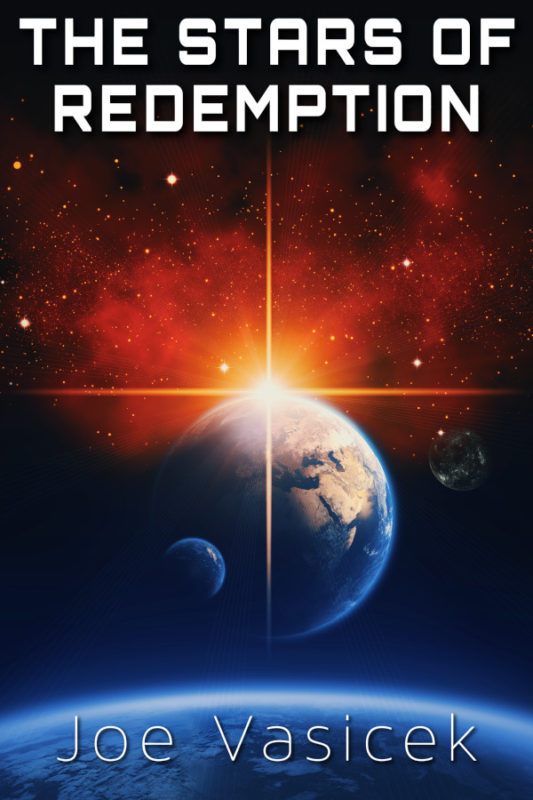
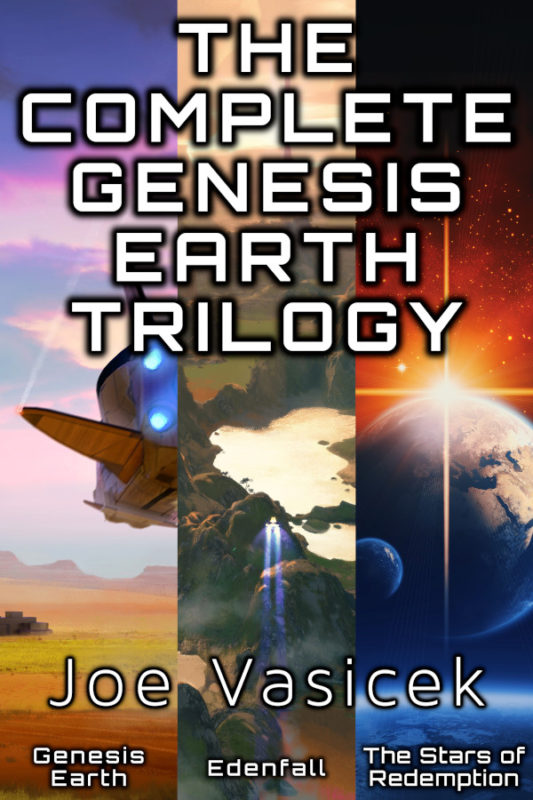
You can see this transformation if you read my Genesis Earth Trilogy. Genesis Earth was my first novel, but it wasn’t until almost nine years later—after I’d met my wife and was engaged to be married—that I felt I had the life experience necessary to write the sequel, Edenfall. And the final book, The Stars of Redemption, was not the sort of thing I was capable of writing until after I had become a father and knew what it was like to help bring a child into the world.
When my daughter was born, the very first thought that came into my mind was “this is her story now, not yours.” We all like to say that we’re the hero of our own story, and in a very basic way, that’s true. But when you become a parent (assuming that you’re a responsible parent, and not a scumbag), you’re no longer living just for yourself, but for your children. “He who findeth his life shall lose it: and he that loseth his life for my sake shall find it.”
Having a child changes your perspective on everything. Among other things, you have a much deeper and more personal investment in the future, since you know that your child will inherit that world. Your perspective on your own family history changes too, as you have become a link in the generations, not merely a byproduct of it. Life becomes a lot harder, but it also becomes more meaningful. Things that took up a great deal of your time and attention when you were single suddenly become trivial, and other things that didn’t make much sense to you about people before suddenly click into place.
So that was why, when I decided to read all of the Hugo and Nebula winning novels, I was curious about the parental status of the authors. I wanted to know if the experience of being a parent had affected the quality of their writing, since I know it’s affected mine. And honestly, it’s not that hard to look up: almost all of these authors have Wikipedia pages with a section about their personal lives. Obviously, the details about their children are sparse, but the only thing I cared about was whether or not they had any.
(As a side note, there were other stats that I decided to track, such as the age of the author when they won the award. That hasn’t seemed to have impacted my taste, except that I have not enjoyed a single award-winning novel by an author who was in their 20s at the time that they won. The only exception was Isaac Asimov with the retro-Hugo for The Mule (Foundation and Empire), but that wasn’t awarded until after he was dead. There are also three authors whose age I was unable to determine from a quick internet search: Michael Swanwick, Sarah Pinsker, and Charlie Jane Anders.)
(As another side note, I’ll be the first to admit that I may have made some errors in my research. For example, if a five-minute internet search on an author didn’t tell me anything about their kids, I assumed they didn’t have any. It’s entirely possible that they just prefer to keep that information private. Also, I didn’t bother to look up when they had their children, so it’s possible that they were still childless at the time they won the award.)
Why should I be interested in this sort of thing? Why look at things like an author’s age, gender, or parental status?
Two reasons. The first is that I wanted to do a deep dive on the Hugos and the Nebulas, the two awards which represent themselves as representing the very best of the science fiction genre. Since that is the genre that I write, I want to understand not just the kind of books that win these awards, but the kind of authors who win them. The goal is to have a deeper understanding of the genre, and to look for trends and movements within it.
Second, and more importantly, I want to have a better understanding of my own reading tastes. All of this is subjective, of course, since the act of reading is always a collaboration between the reader and the writer. I’m sure that some of the books I think are terrible are considered by others to be the best in the world, and vice versa. My goal is to look for patterns that will tell me whether I’m likely to enjoy a book (or an author), so that I can find the best books more efficiently. I don’t do this for all of the books that I read, but since the Hugo and Nebula winning books are supposed to be the very best, I figured it was worth it to do a deeper analysis—especially since my goal is to read all of them.
The thing that surprises me is that it isn’t parental status that matters, but gender + parental status. I can think of a couple of reasons why this would be the case. The most obvious is that it’s easier for me to empathize with a childless man, since that was me for such a long time. And I do think that’s a major part of it.
But I also think that there’s something specifically about being a mother—or deliberately choosing not to be one—that’s also a factor. And yes, I’m talking about biological essentialism. I mean, I’m not a biologist, but I know that I will never be able to be a mother—that’s a life experience that I will never be able to have. Conversely, I will never be able to deny my potential motherhood, an equally major life decision. Both of those experiences are bound to have a major impact on an author’s writing, either way.
I also think this factor is what lies at the heart of Roe v. Wade, the worst decided Supreme Court case since Dred Scott v. Sanford. Certainly the cultural impact of that decision has profoundly influenced how our society views children and motherhood. It’s also why I am sooo looking forward to Matt Walsh’s documentary What Is a Woman? coming out in two weeks:
With all of this in mind, I find it fascinating that every Hugo Award for best novel after 2015 (the year that the Sad Puppies had their high water mark) was won, as far as I can tell, by a childless woman. It would be interesting to see if that trend extends to nominees, or to the other categories like best short story, best novelette, and best novella. Maybe I’ll look that up sometime.
And now that I’ve referenced Roe v. Wade, I’m sure that Cora Buhlert (if she’s reading this) is saying to herself: “yup, he just thinks that all childless women are evil.” And to the extent that File 770 is read by humans and not bots, they’re no doubt picking and choosing those parts of this post that confirm their prejudices (if China Mike Glyer even has the balls to cross link to a post that includes that trailer—do it, China Mike! I dare you!)
But I don’t really care either way, because now I have a much better understanding of my own personal reading tastes, and how they contrast with the Hugo/Nebula crowd. For me, the best books are those that are written by authors who have had the life experience of being a mother, and the worst books are by those who have chosen to deny themselves that path. Apparently, the Hugo/Nebula crowd takes the opposite view. Good to know.
I’m currently in the process of writing the second edition of my newsletter exclusive, Science Fiction from A to Z, adding a bunch of new chapters and rewriting all of the old ones. For a blog post this week, I thought I’d share one of the new chapters. Let me know what you think!
I was going to make this section “P is for Pulp,” rounding out “G is for Golden Age,” “N is for New Wave,” “D is for Dark Age,” and “I is for Indie.” But I have to admit, I’m not as familiar with the pulp era of science fiction as I would like to be. I’ve read all of Robert E. Howard’s Conan and Solomon Kane stories, and Edgar Rice Burroughs’s A Princess of Mars (though not the rest of the Barsoom series, unfortunately. It’s on my TBR!) but that’s pretty much it. From what I understand, Jules Verne, H.G. Wells, and (of course) Mary Shelley all preceded this era, and I’m a little more familiar with them, but all I know about the pulp era is what I’ve heard from other sources, and I’d rather not regurgitate that without first exploring it myself.
Instead, I want to write about a major influence on every writer that gets almost no play whatsoever in public treatment of their work, but is arguably the single most important aspect of their lives: parenthood.
Becoming a parent really changes you. When I held my first child in my arms for the first time, a distinct thought came into my mind, almost like a voice: “this is her story now.” They say that we’re all the hero of our own story, and to a certain extent that’s true, but anyone who has brought a child into the world (or adopted a child as their own) has a much more complex and nuanced understanding and perspective. Even a terrible, abusive parent has still experienced what it’s like to become a link between the generations. That experience reshapes everything you do and are in ways that are impossible to appreciate until you’ve had it for yourself.
There is a subtle but distinct difference between books written by authors who have experienced parenthood vs. authors who are childless. I wasn’t as conscious of it until I became a parent myself, but even back in my days as a bachelor, I think I could still sense it, even though I didn’t know what it was. I suspect it’s why I’m a huge fan of David Gemmell, but not of George R.R. Martin, even though on the surface, they write the same kind of book. Both of them write dark and gritty fantasy, both of them are known for killing off major characters and doing horrible things to the ones who survive, and both of them are written quite well—in fact, on an artistic level, Martin is probably superior. But where Martin tends to obsess over themes of victimhood and victimization, Gemmell focuses more on heroism and what makes a hero. Gemmell had two children; Martin (so far as I can tell) has none.
In 2022, I made a new year’s resolution to read or DNF every novel that has won either a Hugo or a Nebula award. To prep for this resolution, I made a spreadsheet of all the novels, along with other pertinent information that interested me, such as each author’s gender, their approximate age when they won the award, and whether or not they have any children. I found some very interesting patterns. There were 110 novels in all, and fifty of them were written by authors who were childless (or at least did not have any mention of children in their author bios and/or Wikipedia entries). After 2015 and 2016 respectively, every Hugo and Nebula award-winning novelist (not counting the Retro-Hugos) has been childless—more specifically, childless women in their 40s and 50s, with one exception who is transgender (Charlie Jane Anders), one exception who is in her thirties (Arkady Martine), and one whose age I cannot determine (Sarah Pinsker). But all three of them are still childless, at least according to the internet.
Now, this is not to say that not having children makes you a terrible writer. In fact, it may actually make you a better writer, since you have more time and energy to devote to learning and improving the craft. But whether for good or ill, I do think that it gives you a handicap in terms of life experience. That handicap is going to influence both the subjects you choose to write about, and how you choose to write about them. I say this not just from my experience as a reader, but as a writer.
My wife and I married a little late, and by the time we had our first child, I’d already been writing professionally for about ten years. Up until that point, the reader I’d had in my mind was basically a younger version of myself. Bringing Stella Home is not a YA book, but a lot of my Amazon reviews assume that it is, probably because I was in college when I wrote it and was writing the sort of book that I wish I’d discovered back when I was in high school and reading things like Ender’s Game and Dune. After I’d experienced the real world and become sufficiently red-pilled, I wrote books like Gunslinger to the Starsfor my naive college self. But since becoming a parent, my perspective has begun to change, and I find myself writing less for myself and more for my daughter—or rather, the kind of person I expect my daughter to grow up to be. I’m a lot more conscious of certain kinds of content, and while that doesn’t mean that I shy away from it, I do find myself asking: “What am I really trying to say here? What purpose does this really serve?”
The Genesis Earth Trilogy is a good example of this evolution in my own work. The first book, Genesis Earth,was my first published novel, and really was written for a young adult version of myself, which is why I chose to categorize it as YA science fiction. The whole story revolves around two young scientists on a mission to an alien planet, and how they come to discover just as much about each other as the planet they’ve been sent to explore. It took me ten years to write the next book, Edenfall, not because I didn’t know what would happen next, but because I didn’t feel like I was ready to write it. Then I got married, and that was the experience I needed to break through the block and finish the book—and it went in a much different direction than it would have, if I had written it while I was still single. But the conclusion to the trilogy, The Stars of Redemption, was the book that I wrote after my daughter was born, and that experience had a very profound impact not just on the story itself, but on the characters, the thematic elements, and the way the last book brought everything together from the first book to a meaningful conclusion. I know for a fact that I would not have been capable of writing such a book without the experience of becoming a father.
This author’s note originally appeared in the September 26th edition of my author newsletter. To subscribe to my newsletter, click here.
So for this newsletter’s author’s note, I thought I’d do a roundup of all the magazines that have published my short stories in the last six months. There’s a surprisingly large number of them. They’re all great publications, so if any of them look interesting, feel free to give them your support and pick up a copy or two.
(As a side note, I’ve found that some email clients break my hyperlinks if I have too many of them in one email. I’m going to put the links in anyway, but if they’re broken for you, please let me know.)
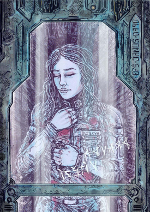
First, my story “The Janus Anomaly” appeared in Kasma Magazine in May. It’s still up on the website, if you want to read it. They did a great illustration for it too!
The story is about a science officer on a scout ship that encounters an alien anomaly, and she can’t tell if she’s losing her mind or if she’s the only sane one while everyone else is crazy. Also, the story takes place in the same universe as the Gunslinger Trilogy.
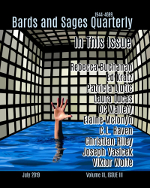
Second, my story “The Gettysburg Paradox” appeared in the July issue of Bards and Sages Quarterly. The ebook copy of the magazine is available on most ebookstores, and you can find the link here.
The story is about a time traveling tourist at the Battle of Gettysburg who learns that almost all of the combatants are (not so secretly) time travelers themselves. In their efforts to reshape the world, they’ve all converged on this one turning point in history, making it the largest battle ever fought on American soil.
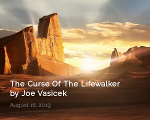
Third, my story “The Curse of the Lifewalker” appeared on The New Accelerator just last month. This is my third story that the good folks at TNA have picked up, and they publish new stories weekly with a very reasonable subscription model to their site.
The story takes place in Utah Valley a couple of hundred years after the apocalypse. Humanity has been afflicted with a blight that shortens all of our lifespans to 25 years, but the main character is one of the few people who is immune. But because of how things have changed in the intervening centuries, his immunity turns out to be more of a curse than a blessing, as he gradually becomes an outsider in his own community.
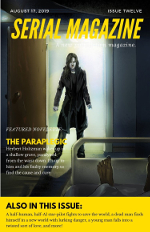
Fourth, my story “Lizzie-99XT” appeared in last month’s issue of Serial Magazine. The digital copy of the magazine is $2.99, and the print copy is $4.99. There are a bunch of other stories in this issue, and all of them are about life and death decisions.
Next month, I have a couple more stories coming out. “Starchild” will appear as a reprint in Bards and Sages Quarterly, and “The Infiltrator,” a never before published story, will appear in the anthology Not Far From Roswell. So be sure to keep an eye out for those!
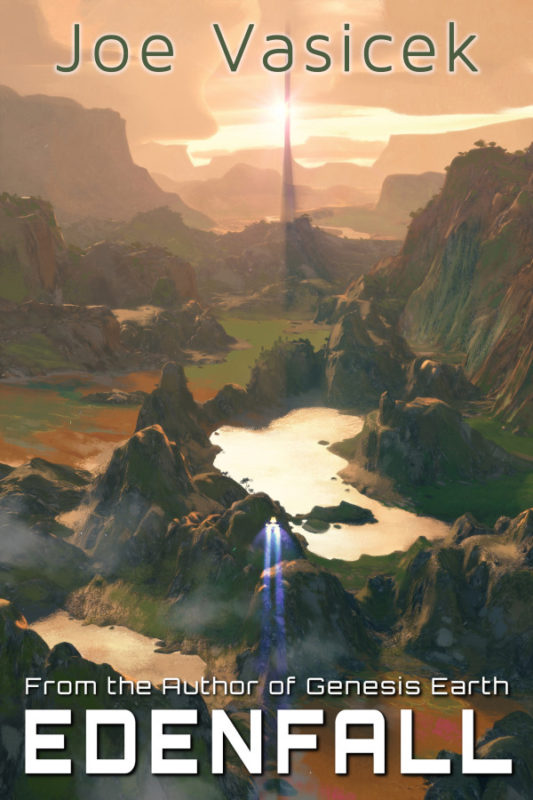
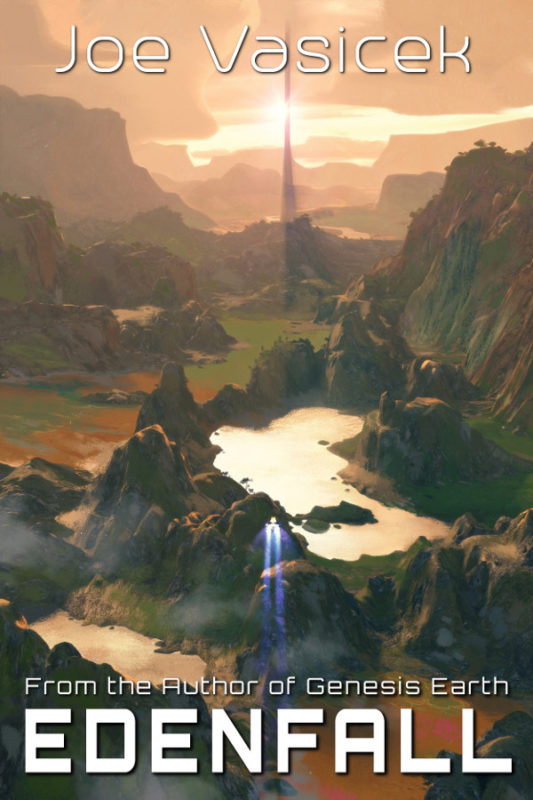
Finally, here is the cover art for Edenfall. Check it out!
I’m very happy with how it turned out. The illustration is by Hideyoshi, aka Lorenz Ruwwe, who did the cover art for Genesis Earth. I still have to go through the edits, but that shouldn’t take longer than a week, and the ebook will be up for preorder shortly after. The release date will be in December.