Trope Tuesday: Mexican Standoff

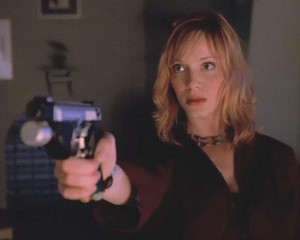
rsz_standoff_9776In a typical standoff, such as a hostage situation, two characters face off without immediately shooting at each other.  One or both of them may be using a human shield, or be reluctant to shoot first for fear that the other will take them with him.  A Mexican standoff, however, takes that up to a whole new level.

Perhaps the best explanation is the one from Wikipedia:

A Mexican standoff is most precisely a confrontation among three opponents. The tactics for such a confrontation are substantially different than for a duel, where the first to shoot has the advantage. In a confrontation among three mutually hostile participants, the first to shoot is at a tactical disadvantage. If opponent A shoots opponent B, then while so occupied, opponent C can shoot A, thus winning the conflict. Since it is the second opponent to shoot that has the advantage, no one wants to go first.

Basically, it’s Mutually Assured Destruction (MAD) on the level of individuals rather than nations.  The classic example is the finale from The Good, the Bad, and the Ugly.  Clint Eastwood’s character rigged it, though, so the outcome was never really in dispute.  Elsewhere, things rarely end so cleanly.

If the Cavalry doesn’t show up to save the day, these situations tend to lead to a messy free for all.  Heck, that may happen even if someone from the outside comes to save the hero.

If the resulting fight has a little more thought and strategy to it, though, you’ll get a Mêlée à Trois.  This happens in The Hobbit with the Battle of Five Armies, and in Downbelow Station with the stationers, merchanters, and Captain Mallory.  It also tends to happen a lot in A Song of Ice and Fire, with the various factions in that world.  Heck, it happened in real life during the Lebanese civil war, and is probably happening right now between the Christians, Sunnis, Shia, and Alawites of Syria.

When the fight has room for a little more scheming, you’ll often see things like a gambit pileup or a kingmaker scenario.  This is where things get really tricky, and the intrigue becomes positively delicious.  It isn’t enough just to have two parties duking it out–you’ve got to have lots of characters and factions, each with their own agenda.  That way, even the weakest party can win if they can convince everyone else to fight each other.

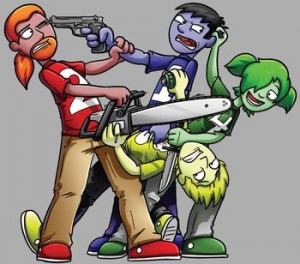
All of that happens after the Mexican standoff, though.  The standoff itself is the moment of tension and uncertainty before the crap hits the fan.  When done well, it’s an awesome moment of tension that can really boost the suspense.  When done poorly (or just for laughs), it’s over-the-top crazy, like Duke Nukem meets Scooby Doo.

I haven’t played around with this trope too much yet.  Stars of Blood and Glory has a little more intrigue than some of my other works, but I can’t think of a specific Mexican standoff moment in the book.  The situation near the end of Desert Stars is kind of like this, but with relationships and marriage alliances rather than guns.  I’m sure that’s a different trope, but I’m not sure which one.

Yet another reason to keep trawling tvtropes…
Trope Tuesday: Planetville (aka Adventure Planets)

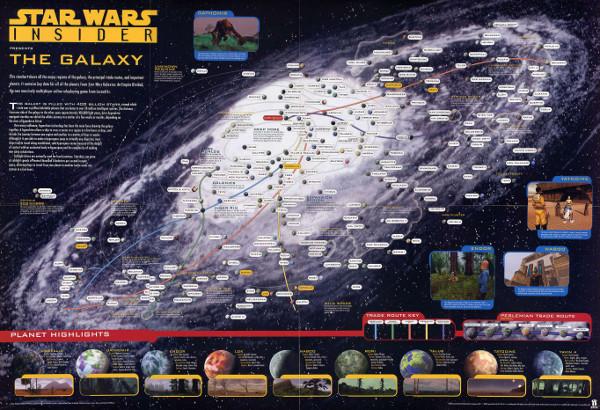
swmapsmall

Adventure townsIN SPAAACE!!!

Seriously, that’s the best way to describe it.  In Westerns and TV serials, the heroes travel from town to town, with a new adventure in each place.  Well, in science fiction, we don’t hop towns, we hop planets.  Why?  Because we can.

Unfortunately, since planets and towns are actually pretty different kinds of places, there’s a lot of room to do things poorly and turn this trope into a cliche.  Any story that doesn’t consider (or at least lampshade) the implications of space travel and planetary colonization is in danger of becoming over-the-top campy–although, to be fair, there is an audience for that.

That doesn’t mean there isn’t room for this trope in fiction that takes itself a little more seriously.  In fact, I take issue with some of the descriptions on the Planetville page.  From tvtropes:

Unfortunately, because Sci-Fi Writers Have No Sense of Scale, stories about Planetville make no sense. Nobody seems to realize how BIG a planet is — everything in Planetville takes the same amount of time as stories set in towns or countries. In the updated Wild West story, the outlaws are “exiled from the planet” just like they’d be exiled from Dodge City, and have to quietly leave… instead of flat out challenging the authorities to find them when they have an entire planet in which to hide. When the space Nazis invade, they seem to need the same number of soldiers and time as the Earth Nazis needed to invade Europe. And when the crew of the Cool Starship finds the cure for the alien plague, the logistical issues of distributing it to an entire planet rarely get mentioned at all. These considerations are minimized or left out entirely in many stories.

To address these criticisms point by point:

1) Scale is relative to technology and the predominant modes of transportation.  When my ancestors crossed the plains to settle in modern-day Utah, they had to walk.  It took them months to get here and many of their family members died along the way.  Today, I can make the same trip by car in a day or two.  As technology changes, so does the sense of scale.

2) Unlike what some tropes would have you believe, not all planets are Earth-like.  In fact, it appears that most planets outside our solar system are wildly different.  In practical story terms, this means that any part of the world that’s remotely habitable is probably going to be immediately around the colony. Consequently, the local authorities probably will have the power to exile trouble makers from an entire planet, since exile from the colony would mean de facto exile from the planet as well.

3) Anyone venturing outside of the dome would have to carry just about everything necessary for life, including air, water, food, etc.  You might as well try to hide in Antarctica as hide on an alien planet.  It can be done, of course, but to do all that and stay hidden, that’s going to be tough.  You might as well set up a rival colony for all the effort–but at that point, the story is about a lot more than just hiding from the authorities.

4) If your planetary colonies are only as populous as an average WWII era city/town, then yeah, you’ll only need as many soldiers as it took to conquer them.  The biggest difference is that they’ll fly a really cool starship.

5) Again, if the planet isn’t habitable and the population is contained within a handful of relatively small colonies, then distribution shouldn’t be too much of a problem.

However, the tvtropes page does make this valid point:

A side effect of this is that the characters never realize that things can happen in parts of planets. You will never see aliens trying to capture a planet’s equator, or its polar caps — it’s the whole planet or bust.

In the end, I think the key to doing this trope well is to know your setting well enough to fit the story to it.  Tropes are tools, and when done well, this trope can accomplish everything it sets out to do while making perfect sense within the context of the story.

In my own work, this trope is most prevalent in the Star Wanderers series.  Every novella takes place at a different planet or space station, sometimes multiple planets per station.  Because most of the stars in this universe have only recently been settled, the colonies are small and terraforming is quite limited.  In Desert Stars, I used a similar concept, except with large domed areas of a single planet, instead of multiple planets (Adventure townsUNDER THE DOME!!!).  In cases where the planets are Earth-like, however, or where travel between planets is costly and difficult, this trope doesn’t really ever come into play.

Trope Tuesday: Arcadia

Happy_Arcadia_by_Konstantin_Makovsky

What happens when you cross the Ghibli Hills with the Call to Agriculture?  You get Arcadia, a simple, uncomplicated utopia where people keep to the good old ways and live in harmony with nature.  As home sweet home for the farm boy and the country mouse, it’s often the starting point for the hero’s journey, though you’ll also see an occasional retired badass or old master take up residence after their adventuring days are over.  Then again, it might just be a ten minute retirement before they’re back in harm’s way.

This is NOT a town with a dark secret or any other kind of twisted dystopia.  There are no knights templar who believe that Arcadia justifies the means.  If there is any sort of moral or message behind this place, it’s a green Aesop.  If there’s anyone who fights to defend this place, it’s usually the good shepherd.

Because of the Rule of Drama, it seems almost paradoxical that a place as peaceful as Arcadia would exist in any story.  However, sometimes it’s good to have the contrast.  It also helps to raise the stakes by giving the hero a home like this to fight for.  By keeping this in the back of their minds, it can be an effective way to keep them from crossing the despair event horizon.

The hero can visit Arcadia at any point in the story, but it tends to fulfill different roles depending on when they go there.

If the hero starts out in Arcadia, it’s usually the known, familiar world which he leaves behind after getting the call to adventure.  He may or may not be able to go back once the adventure is over, depending on how much he’s changed and whether he can adjust to a boring, peaceful life after so much adventure.  A good example of this is The Shire from The Hobbit and Lord of the Rings.

If the hero ends in Arcadia, then it’s usually a way to show that everyone lived happily ever after (more or less).  Tolstoy was a big fan of this one, though he was also sure to show that living in Arcadia can be hard work–but in his view, the work is part of the reward.  In Lord of the Rings, Samwise Gamgee ended in Arcadia on this note.  Frodo didn’t.

If the hero visits Arcadia during the middle of the story, it’s usually part of an Arcadian Interlude.  The down time may give him a chance to rest and recuperate, as with Medwyn’s realm in The Chronicles of Prydain, Resembool in Full Metal Alchemist, or Tom Bombadil in Lord of the Rings.  Alternately, it may be a leave your quest test–because really, who wouldn’t want a nice, peaceful life when faced with the hardships of adventure?

While the idyllic rural setting of Arcadia seems great to us now, this wasn’t always the case.  In all the old stories, when characters strayed into the country, they tended to find themselves in the Lost Woods.  And while Vice City is normally considered the exact opposite of Arcadia, the Shadowland, which may or may not be rural, also qualifies.

In the end, the thing that makes Arcadia great isn’t just the rural, agricultural setting, or the simple way of life, or the lack of poverty (or extravagant wealth, for that matter), it’s the combination of all three, combined with a sense that the place is truly incorruptible.  It may be full of simple-minded, naive little people who have no idea what’s going on in the rest of the world, but it’s a place where you can feel safe.

In my own work, Terra 4 Dome from Desert Stars probably qualifies as this.  Even though it’s an archipelago of small islands rather than the rolling farmlands most often associated with Arcadia, it fulfills the same role more or less.  I don’t think I played with this trope at all in Bringing Stella Home, though in Stars of Blood and Glory, there are a couple of places that qualify.  And in Star Wanderers, various examples pop up from time to time, some more relevant than others.

As someone who dreams of settling down in a real-life version of Arcadia at some point, you can definitely expect to see me play with this trope in the future.

Trope Tuesday: Honor Before Reason

nedstarkIf you can’t do something smart, what do you do? Something right–at least, when this trope is played straight.

Characters who place honor before reason tend to be idealists, starry-eyed or otherwise.  It’s not that they’re stupid–at least, not always–but they do tend to be vulnerable to flaw exploitation.  If the Fettered can’t take a third option, this is how he often gets trapped.

On the other hand, without this trope, we wouldn’t have as many heroic sacrifices or men of their word. In the dark, everyone would turn out to be a jerkass, and the world would be a terrible place to live.

Since the best stories often have some sort of moral dilemma at their core, there’s something about this trope that speaks to us, even (or perhaps especially) in the face of sadistic choices and necessary evils.  It appeals to the more innocent part of us that still wants to believe in incorruptibility.  On the other hand, characters who follow this path don’t tend to think creatively enough to actually solve the problem–or at least, solve the problem without committing the ultimate sacrifice.

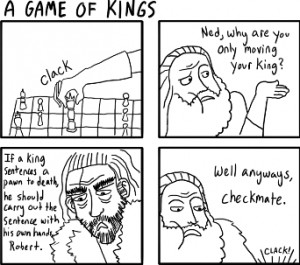
Not surprisingly, this trope is a very good indicator of where a story stands on the Sliding Scale of Idealism vs. Cynicism.  In idealistic stories, characters who place honor before reason are often vindicated, such as Bilbo in The Hobbit or Luke Skywalker in Star Wars.  In more cynical stories, the honorable characters not only get eaten alive, their noble idealism actually makes the problem worse.  The classic example of this is Ned Stark from A Game of Thrones, as the cartoon above suggests.

The opposite of this trope, reason before honor, is shoot the dog.  Interestingly enough, in the first scene in which Ned Stark appears, he commits an act that arguably fulfills both tropes at the same time (executing a man who is most likely innocent but has been found guilty by the law).  Lawful stupid doesn’t necessarily come into play, but it often overlaps.  Again, it all goes back to the scale.

This trope pops from time to time in my own writing, though I’m not nearly as cynical about it as George R.R. Martin.  Jalil from Desert Stars generally fits this trope, though Tiera is just as honorable and definitely not stupid about it.  Stella from Bringing Stella Home fits this trope at first, though her choices are vindicated later on.  In Stars of Blood and Glory, though, there’s a character who fits this trope perfectly, and I’m not sure whether he gets vindicated or not.  It will be interesting to see what the readers have to say about that.

Stars of Blood and Glory coming out soon

So last year about this time, I wrote a novel in the Gaia Nova universe.  Usually when I sit down to write a novel, it falls apart about midway through the first draft, or I have some kind of a break down, or something else comes up and I have to put it on hold for a while.

From start to finish, this one came out in about six weeks.

Even the title, Stars of Blood and Glory, really seemed to stick (usually, I go through three or four lame titles before finding one that works).  It took a lot of energy to write it, but the writing process itself was fun.  Seriously, everything just came together and the story practically wrote itself.

However, writers can often be notorious judges of their own work.  For that reason, I set it aside and tried not to touch it for a few months (I did rework the first couple chapters, but later ended up cutting out most of that stuff and going back to the original version, which was better).  Over the summer, I picked it up for the first revision, and while the scenes were out-of-order and a few of them were missing, but for the most part, everything that was there seemed pretty good.

Just to be safe, I sent it out to some first readers and laid it aside for another six months.  I didn’t hear back from everyone I sent it to, but those who did read it said it was pretty good.  The problems they found were relatively minor, or could be fixed relatively quickly, without having to overhaul the story.

To be perfectly honest, this blew me away.  My first drafts are usually really messy, and require a lot of work before they’re any good.  But this one…this one seems different.  This one, I might have just nailed it <fingers crossed>.  And if that’s indeed the case, it’s probably better not to risk revising it to death, or polishing the voice right out of it.

It’s always a scary thing to send a book out into the world.  However, I think the time to send out this one has come.  I’m going to do one last revision pass, just to make sure there isn’t anything too egregious, and then I’ll send it out to my editor and commission the cover art.  If all goes well, I’ll finish the revision next week, and publish it in ebook and print-on-demand sometime in February.

As an indirect sequel to Bringing Stella Home and Desert StarsStars of Blood and Glory has a lot of recurring characters.  Here are some of them:

  • Captain Danica Nova
  • Master Sergeant Roman Andrei Krikoryan
  • Rina Al-Najmi
  • Stella McCoy, aka Sholpan

Besides that, here are some of the other cool things you can expect to see:

  • A far future Japanese-Polynesian society on an ocean planet with giant floating cities.
  • A Hameji offensive, with massive space battles and planetary slaggings.
  • A lonely boy emperor who fears that he’ll never live up to his father’s dying wish.
  • A runaway princess who wants to experience everything the universe has to offer.
  • A young Hameji prince who yearns to prove himself in the field of battle.
  • A cyborg mercenary who feels like his humanity is slowly fading into irrelevance.
  • An unlikely assassin whose mind and body are not completely her own.

All of this comes together in a war of epic proportions that will determine the fate of the last free worlds in the galaxy.

So yeah, I’m really excited about this story.  It’s a departure from some of the more intimate (and less action-y) science fiction romances I’ve been putting out lately, but in all of the right ways.  If you read Bringing Stella Home and wondered when you’d get a worthy sequel, well, this is it.  And hopefully, it’s just the first of many.

Expect it to be out in ebook and print-on-demand sometime next month.

Trope Tuesday: Elegant Weapon for a More Civilized Age

Before the world fell apart and the Empire took over, when there were still men of honor in the world who stood boldly against evil and fought for the weak and the downtrodden, there was this trope.  The weapon of choice of a bygone age, more elegant and noble than the crass instruments of wanton destruction so common in the world today.  It might not be practical–or sometimes, even usable–but it definitely will be cool.

Because katanas are just better, this weapon often takes the form of a cool sword, especially in science fiction.  The eponymous example is of course from Star Wars, where Jedi Knights errant fight against evil with laser blades, but it also features prominently in Star Trek (ever been to a Klingon wedding?) and Dune.  The one who introduces the weapon is usually an old master, or a mentor figure of some kind.  Often, the weapon is handed down from generation to generation.

In a lot of ways, this trope reflects the age-old tension between Romanticism and Enlightenment, hearkening back to a simpler time rather than looking ahead to a glorious future.  Perhaps that’s why many of these weapons tend to be swords rather than guns.  And since science fiction is traditionally the more forward-looking genre, perhaps that’s why it’s invoked so often in subgenres like space opera that lean more toward fantasy–to provide ready contrast.

When used well, the effects of this trope can be awesome.  It wasn’t just the shiny blade and the cool sound effects that made lightsabers so awesome as a kid–it was the sense that something about the weapon was special.  None of the mooks had one, after all, and Luke’s came from his long-lost father.  It probably helped that Star Wars paired this trope with the call to adventure (in a very specific way).

In my own work, this appears in Desert Stars with the heirloom rifle that Sathi gives to Jalil.  At least, I think it qualifies.  The rifle is more of a status symbol than a combat weapon, but it does figure prominently in the story.  However, my forthcoming novel Stars of Blood and Glory goes a lot further with this trope than Desert Stars.  It has Katanas, and a far-future Polynesian-Japanese society that knows how to use them.

Trope Tuesday: Came Back Strong

This trope, also kown as apotheosis, is by far my favorite part of the hero’s journey.

Up to this point, the hero has faced a lot of tests and trials.  Some of them he’s passed, some of them he hasn’t, but the setbacks haven’t yet been enough to stop him.  Sure, the costs have been high–he may have lost a friend or mentor, for example–but at least he’s still in the game.  Then, just as he experiences the power of love (meeting with the goddess) and reconciles with the ultimate power in his life (atonement with the father), what happens?

He dies.

This may be literal or metaphorical, physical or spiritual–but whatever form it takes, the hero has to lose something significant, up to and including…well, everything.  After all, there are so many things worse than death.  While all the other failures up to this point left him more or less intact, this one completely shatters him–and in the process, transforms him.

Like a phoenix rising from the ashes, the hero comes back from the dead, often with a level in badass.  By dying, he gains that last piece of knowledge, experience, or resolve that he needs to defeat the big bad and gain the ultimate boon of his quest.  Whoever or whatever he was before, that person wasn’t strong enough to pass the test–but now, he is.

When done well, this is a stand-and-cheer moment of the best possible kind.  It’s the culmination of everything the hero has gone through, not just in terms of plot, but character as well.  Years from now, you might forget everything else in the story–even the parts that you loved–but you’ll remember how you felt when you got to this part.

One of my favorite examples of this trope is in the clip I posted from the Matrix.  Seriously, when Neo realizes that he is The One, that is one of the best moments in all of cinema.  The Empire Strikes Back also has a moment like this, though since the movie is essentially a tragedy, there’s a lot more emphasis on Luke’s death (falling through the gas mine shaft after confronting Darth Vader) than his resurrection (getting a new hand and reuniting with his friends).  The oldest examples, of course, come from mythology–Odin gained the ability to use magic by sacrificing himself on Yggdrasil, and before returning to Ithaca, Odysseus first had to journey to Hades to pay his old friend Agamemnon a visit.

So as writers, how are we supposed to get this trope right?  I’m by no means an expert, but my gut instinct tells me that the way to nail it is to be as excited about this moment in the story as we want our readers to be when we get to that point.  Even though storytelling is ostensibly just making stuff up, it’s not something you can fake–if you aren’t excited about your own story, how do you expect your readers to even care?

Fortunately, this is often the part of the story that drives us to write everything else.  There have definitely been times when I could hardly wait to get through the other stuff and finally write the chapter where this happens.  Bringing Stella Home was a big one–and that’s all I can say, at the risk of giving spoilers.  Star Wanderers is another one, though it wasn’t until I was midway through Fidelity that it really came to me.  Desert Stars was more of a Heroic Second Wind, which is basically Came Back Stronger without the death.  However, there was definitely a transformation, both for Mira and Jalil.

So yeah, I really, really, REALLY love this trope.  When done well, it’s one of those things that can turn a run-of-the-mill adventure story into something both soul-searching and powerful.  You can definitely expect to see me play with it a lot in the future.

Trope Tuesday: Wicked Cultured

What Captain Nemo does in his spare time, when he isn’t terrorizing the world of maritime shipping.

This week’s Trope Tuesday series post is by request from a reader.

Evil villains aren’t always grotesque, brutish, foaming-at-the-mouth barbarians.  Quite often, they are wealthy and aristocratic, with exquisitely refined tastes and an extraordinary degree of eloquence.  It isn’t just that evil is cool (though it may overlap with this), or that the barbarians have finally developed a fashion sense–it’s that the more refined and cultured a character is, the more evil they are as well.

This happens a lot more often than you might think.  Magneto (X-men), Lucius Malfoy (Harry Potter), Hannibal Lector (Silence of the Lambs), Ganondorf (Zelda), Captain Nemo (20,000 Leagues Under the Sea), the Godfather (the Godfather), Kane (Command & Conquer), President Shinra (Final Fantasy VII), the Merovingian (The Matrix Reloaded), Grand Admiral Thrawn (Star Wars: Heir to the Empire and The Thrawn Trilogy), Khan (Star Trek II: The Wrath of Khan), Vetinari (Discworld), Captain Hook (Peter Pan), the Phantom (Phantom of the Opera) and every James Bond villain ever all fall squarely into this trope.

So why does this happen?  I can think of a few reasons, though I’m sure there are others.

First, it hearkens back to the age-old romanticism vs. enlightenment debate.  This is especially true of the fantasy genre, which tends to hearken back to a medieval golden age before the modern, industrial world, when life was simpler and people tended to live in picturesque rural villages instead of dense urban cities.  If your hero is a farmboy in a world of knights and wizards, or a barbarian hero who strikes first and asks questions never, chances are that anyone with a sense of refinement or culture is going to find themselves on the wrong side of the story.

Second, it hearkens back to the mad scientist and the cautionary tale of science gone horribly wrong.  As you might expect, this is much more common in science fiction, especially the classic dystopian stuff. The more scientific and enlightened a character, the more cultured they tend to be as well.  In stories where science is bad, then, it should come as no surprise that these characters are also evil.

Another good reason to use this trope is to indicate that the villains are members of the Empire.  Culture tends to happen when people of diverse talents and backgrounds are brought together, and the best way to bring them together is through conquest.  Just look at the Romans.  Almost every empire throughout history, no matter how brutal, has always produced an increase in some degree of culture.  Even the Mongols gave way to Kublai Khan and the Silk Road.  So in stories where the Evil Empire comes into play, having your villains be cultured can be a good way to show that.

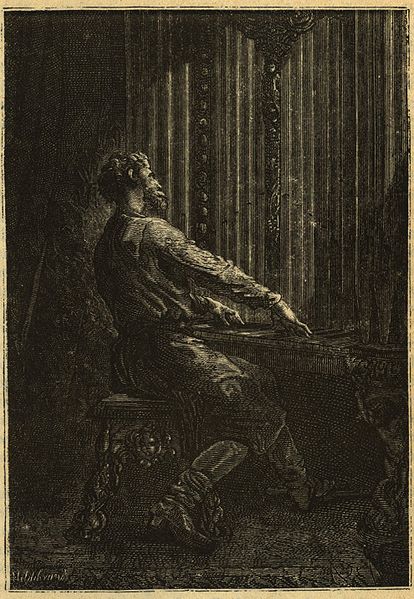
The biggest reason for this trope, though, is that it makes the villains more complex and interesting.  If being evil always meant living in a cave and eating raw meat, then every story would read like a badly written RPG, where the heroes keep grinding until all their stats are at 9999 or higher.  And honestly, you have to admit that there’s something a little bit eerie about that guy who gets totally absorbed when playing the organ.

I haven’t played with this trope in a major way yet, but it does come into play a bit in Desert Stars, though only in a minor way.  In Bringing Stella Home and Heart of the Nebula (forthcoming), Lars is pretty much the opposite of this (the Gentleman and a Scholar trope, though he did drop out of college).  Probably the best example would be Heloise from Star Wanderers: Fidelity (Part II).  She’s wealthy, fashionable, and decorates her apartment with wallscreen monitors that cycle through artistic photographs of deep space nebulae.  She’s also one of the more dangerous female characters I think I’ve written.  Who knows–maybe she’ll show up in another story before too long.

Back in Georgia

Hey, just a quick post to let you guys know how I’m doing.

I made it out to the village yesterday, met my new host family and got more or less settled.  Due to some mixups, I ended up in Sairme (WAY up in the mountains) before making it down to Baghdati, but everything worked out well and I got to see some beautiful Georgian scenery at the same time.

My new host family is great!  It’s a 35 year old guy and his mom, living on a farm in a village with all their uncles and cousins and stuff pretty close by.  The guy, Dato, is way cool–he does IT at the school, farms his mom’s place, and otherwise just hangs out in the village.  We played nardi last night–I actually beat him on the first go, then he slaughtered me twice.  Then his aunt played him and things got really entertaining.

The house is WAY different from the apartment where I was living before.  Much more spacious.  It’s a couple hundred years old, though, so the wires are attached on the outsides of the walls and stuff.  We’ve also got chickens all over the place.  I’ll be sure to post some pictures, probably in a week or two.

I think I’ve hit it off pretty well with the family.  They’re impressed that I already know a bit of Kartuli, especially the aunt.  Things got a little tense when I turned down the wine and told them I can’t drink because my religion forbids it, but I don’t think it will be too much of a problem (though this being Georgia, you never know).

The mom is an awesome cook.  This morning, she made one of the best breakfasts I’ve ever had in my life.  The house is old but comfortable, I’ve got all the space and privacy I need, there’s a lot more nature out here in the village–I think I’m really going to like it here.  What’s more, Kutaisi is only a short half-hour marshrutka ride away.

After I’m through here, I’ll walk up to my old host family’s place and drop off some gifts: specifically, some RAM for their broken down computer.  Then I’ll head over to my old school, say hi to my old coteachers, run downtown to pick some stuff up, then head back out to the village.  Tomorrow, I’ll meet up with a friend of mine to get some stuff for camping, then head out the next day to go backpacking in Borjomi or Tusheti.  That’s the plan at least.

Oh, and about the trip to Ani: I tried to get down to Kars, but couldn’t find a bus.  I ended up in Akhaltsikhe, the Georgian border town, but the only way out was to catch a taxi to the crossing ($$$), catch a taxi on the other side to the Turkish town on the other side, and from there to catch a bus down to Kars (about 140 km).  I was traveling alone, didn’t know any Turkish, it was about mid-afternoon and I didn’t have a backup plan, so I ended up aborting and headed back to Tbilisi.

Oh well–it happens.  I’ll try again, though, probably in a few weeks.  This time, we’ll meet up in Georgia, where I actually know how to  get around.

In other news, I bought three author copies each of Genesis Earth, Bringing Stella Home, and Desert Stars before I left the US.  They’re signed and numbered, and if you want to buy one of them, just shoot me an email (joseph [dot] vasicek [at] gmail [dot] com).  The #1 copies are already sold, but the #2 and #3 copies of each book are still available.  You can buy them from me at the current Amazon paperback price, and I’ll have my parents ship them out to you.

That’s all for now.  Take care, and I’ll see you guys around!

Trope Tuesday: The Vamp

Also known as the temptress or the seductress, the vamp is one of the more dangerous characters the hero meets on his journey.  A devastating beauty who is as evil as she is sexy, she uses her feminine wiles to exploit men’s flaws to her own advantage.  If the hero falls for her, he will be destroyed.

Unlike the femme fatale, her more neutral counterpart, she is completely evil and cannot be redeemed.  This is because her role in the story demands it.  She generally makes her first appearance in the initiation phase of the hero’s journey, after the hero sets out on the adventure but before he masters the unfamiliar world.  In many cases, she represents a leave your quest test or a secret test of character.

Joseph Campbell thought this character was so important that he dedicated an entire phase of the monomyth to her:

When it suddenly dawns on us…that everything we think or do is necessarily tainted with the odor of the flesh, then, not uncommonly, there is experienced a moment of revulsion: life, the acts of life, the organs of life, woman in particular as the great symbol of life, become intolerable to the pure, the pure, pure soul. The seeker of the life beyond life must press beyond (the woman), surpass the temptations of her call, and soar to the immaculate ether beyond.

As such, the vamp represents the more carnal elements of the hero’s nature, which he must reject or overcome in order to be transformed.  Confronting her is an important part of the story because it gives him an opportunity to recognize his flaws and master them.  It isn’t easy, though–the vamp is an extremely deceptive character, and often plays tricks like the wounded gazelle gambit to confuse the hero and gain his sympathy.

While often a female character, there are a few male examples of this character.  Mr. Wickham from Pride and Prejudice is one of the more obvious ones.  Basically, the vamp can be of any gender, so long as s/he is someone the main character finds sexually enticing.  Because of the traditionally male-centric nature of the hero’s journey, however, she’s almost always female.

Also, I think it’s important to add that it’s not just the vamp’s sexiness that makes her evil, it’s the way that she uses it to manipulate and undermine the hero.  If she starts out evil but has a heel-face turn later in the story, she doesn’t fulfill this trope.  Likewise, if falling for her wouldn’t make the hero fail, then she doesn’t fulfill the trope either.

I’ve played with this trope a little bit in my own work, but not in a big way yet.  Heloise from Star Wanderers: Fidelity (Part II) probably fits this trope the best, though her appearance is fairly brief.  Tamu from Bringing Stella Home might appear superficially to be one, but she’s actually more of a fair weather mentor for Stella (and has good reasons for choosing the life of a Hameji consort).  And of course, Mira from Desert Stars doesn’t fit this trope at all, seeing how much she changes by the end.