New OCR album and my first chiptune

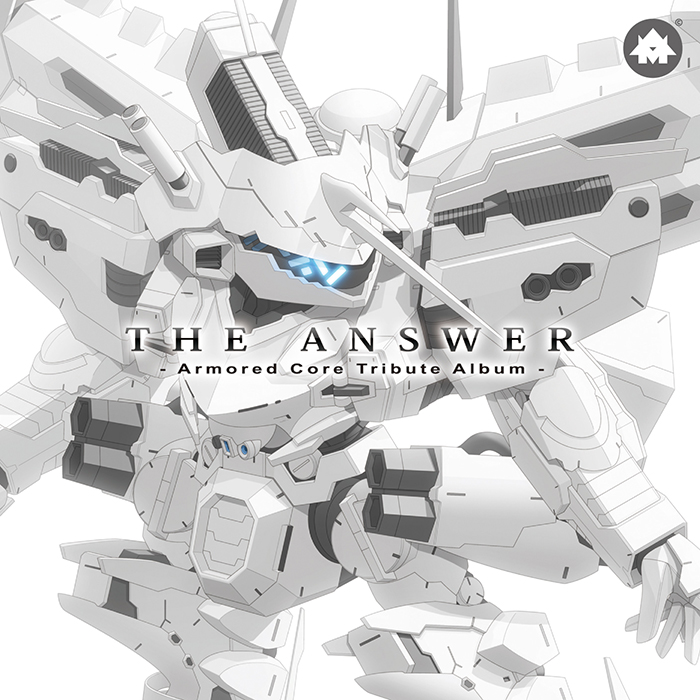
So overclocked remix came out with a new album a few days ago, and it is absolutely fantastic.  It’s called THE ANSWER, and it’s a fanmade album of music from the Armored Core series.

For those of you who don’t know, ocremix is an online community of video game music fans.  It’s got a database of almost two thousand fanmade remixes of popular game tracks, and all of them are available for free download.

THE ANSWER is ocr’s 21st album project, and in my opinion it is one of the best.  It’s full of happy, high-energy techno mixed with guitar and drums, and the quality of production is quite good.  While each track is unique, there are enough recurring elements that the album feels very coherent as a whole.  In that, it reminds me a bit of Humans + Gears and Summoning of Spirits.

Anyhow, the album is available for free from the project’s webpage.  You should definitely check it out, even if you’ve never heard of the Armored Core games.  Good stuff– ocremix is definitely starting the year out right!

Speaking of which, remember how I mentioned I wanted to make an album of original chiptune music this year?  Well, I found a program for doing just that!

It’s called MilkyTracker, and it’s an open source program based off of FastTracker 2, an old DOS program for writing computer music.  The interface is way old school–makes me feel like I’m on my old 386 from the 90s.  Ah, those were the good days…

Anyhow, after playing around with it for a while, I wrote an 8-bit style remix of Son of Flynn, the third track on the Tron: Legacy soundtrack by Daft Punk.  Several excellent chiptune arrangements of songs from the Tron soundtrack have been popping up recently, so I thought I’d get in on the action.

Here it is:

Pretty sweet, huh? You can download the original file here, but unfortunately I don’t know how to convert .xm to .mp3, so unless you have a media player that can read extended module files, all I can say is go fish.

Anyhow, that’s what I’ve been up to these past few days. Haven’t gotten a whole lot of writing done, but I’m slowly transitioning back into WAFH and getting excited about it again. I’m not sure if I’ll be able to finish it before LTUE as I’d hoped, but a February 28th deadline seems reasonable. More on that later, for sure.
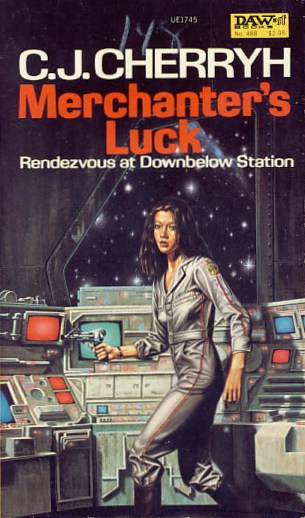

Merchanter’s Luck by C. J. Cherryh

He was a down and out merchanter, the captain, crew, and sole proprietor of a run-down bucket of bolts spacecraft.  She was a daughter of one of the finest starfaring clans, with seven hundred cousins standing between her and the one thing she wanted more than anything else: command of a starship.

They met at Pell during the height of the Company War–the key strategic point on the border between Union and Earth.  Their fateful meeting would affect not only the outcome of the war, but the course of their own lives–for the starship Lucy of Wyatt’s Combine was not at all what she seemed to be.

Before I review this book, I need to issue a disclaimer: you probably aren’t going to enjoy it very much unless you’ve already read Downbelow Station.  Cherryh isn’t the best at easing her readers into her worlds, and without the background on Union, Alliance, and the Company War, you’ll probably be hopelessly lost.

That said, I absolutely loved this book.

The premise is so awesome.  Space adventure hardcore, with a beautiful love story set amidst an epic interstellar war, where alliances are constantly broken and no one can be trusted…oh man, I LOVED this book!

While the premise seems pretty standard, C. J. Cherryh transcends the well-worn tropes and cliches of her genre by intimately developing her characters and working their motivations into the story until they are the ones driving the plot, and not the other way around.

Every character is unique, and though they act in ways that may seem strange to our modern sensibilities, there are always reasons for everything they do, cultural or otherwise.  As windows into their far-future spacefaring culture, they give the reader a wonderful view of Cherryh’s unique and marvelously constructed universe.

The thing that surprised me the most, however, was the sharp contrast between this book and Downbelow Station. While Downbelow Station traces the epic arc of the Company War through the viewpoints of a large cast of characters, much like Tolkien or Dune, Merchanter’s Luck focuses more on the characters themselves, in much the same way as David Gemmell or Ursula K. Le Guin.  In other words, while Downbelow Station is comparable to “high” or epic fantasy, Merchanter’s Luck would fall closer to “low” fantasy or sword & sorcery.

The interesting self-realization I took from the book was that I’m much more interested in the intimately personal stories than the sweeping epic tale of the Rise and Fall of cultures and civilizations.  I suppose that’s why I’m more of a David Gemmell nut than a Tolkien fanatic, and perhaps why I’m more into space opera and military sf than epic fantasy.  In all of my novels, the focus is always on the individual characters and their personal conflicts, and whenever I get sidetracked and focus too much on the overworld story, it always falls apart. 

Merchanter’s Luck definitely doesn’t get sidetracked, and that’s why I loved it so much.  I fell in love with the characters almost from the very first page–from the blurb on the back cover, even.  And most of all, I fell hopelessly in love with the starship Lucy:

You know you’re doing science fiction right when your readers bemoan the fact that they weren’t born in the 26th century, when they could command their own spaceship.  C. J. Cherryh is an amazing writer, and if I had the chance, I would teleport into her Union-Alliance universe in a heartbeat.

If you love well-crafted far-future worlds and stories about the people that live in them, check out Downbelow Station (or really, just the first chapter–that’s all you need for a solid grounding) and read this book!

What the…?

I sent out two queries this afternoon, about an hour apart from each other.  The first was for Genesis Earth, the second for Bringing Stella Home. Both agents responded within the hour.  Genesis Earth got a form rejection, and Bringing Stella Home got a request for the full manuscript.  Yeah, I was shocked too.

So I was planning to query Bringing Stella Home all over the place in the next few weeks, but with the full out…I’m not exactly sure what to do.  I know it’s okay to send out multiple queries, so long as you only send the full ms to one place at a time, but what about querying when the full is already out?

I’m assuming that it’s okay to keep sending out queries, so long as you don’t send a second copy of the full while the first agent is considering it.  If someone else requests to see it, I should probably say “so and so is currently considering it, but I’ll let you know once they’ve gotten back to me.”  Is that right?

Needless to say, this is very encouraging.

Bringing Stella Home 5.0 is finished!

That’s right; I finished the fifth draft just tonight.  110,000+ words and 550+ pages in three weeks–not bad.  Here are the stats:

ms pages: 556
words: 110,000
file size: 264 KB
chapters: 27
start date: 21 Dec 2010
end date: 11 Jan 2011

And the wordle:

Wordle: Bringing Stella Home 5.0

The song that best represents my experience with this particular draft would probably be a chip tune remix I discovered recently (as in, yesterday). It’s called “Milk in Veins,” and the only version I have is in .xm (extended module) format. I don’t yet know how to export it to mp3, but here it is:

Raina — Milk in Veins

This draft was mostly just a quick polish, but I did get some useful feedback from some World Fantasy friends; some of Stella’s reactions were off, and Anya’s parts needed better development. I don’t know if it’s publishable as is, but it’s definitely as good as I can make it without a professional editor.

I had a good time with this draft. I feel confident that I’ve got an exceptional story here, and I think I did a good job telling it. At the end of the day, it’s great to have something you can look back on and say “yeah, I accomplished that.”

Now, to send it out into the publishing world and see if it gets any takers. Who knows–maybe this could be my debut novel! Only one way to find out…

You have no idea…

…how happy this makes me:

At some point this year, I want to put together an album of original 8-bit music. I don’t really care if it’s good or not, I just want to do it. Apparently, there’s a growing chip tune scene, mostly centered around New York and Tokyo. I saw this documentary the other day about it, and it looks really awesome.

The only thing is, I have no idea where to start. A lot of these guys use the actual NES and Game Boy hardware…yeah, I don’t think I’ve got the technical knowledge for that. But some kind of music editing program…are there any good freeware ones out there? I don’t have a lot of money to drop on this, though hopefully that’ll change soon…

Anyhow, this post is mostly to say that 8-bit music is awesome, and I want to start writing and composing it soon.  Expect to hear more about this in the future.

Some thoughts on the future

I went to the first class of English 318 yesterday, and the lecture got me to thinking about my mid- to long-term future as a writer.

Brandon spent most of the period organizing the class, which was made doubly difficult by the ridiculously small classroom size.  I swear, bureaucracies exist only to make life difficult.  This year, for the sole sake of screwing with everyone, they are trying to limit his class size to thirty people (twenty students, ten auditors), but that’s a whole other rant in and of itself.

Oh well–at least there’s still room on the floor.

Anyhow, after getting all the administrative stuff done, Brandon talked about the practicalities of being a writer.  He made the very interesting point that as a writer, it doesn’t matter where you live–moving further away from the city won’t negatively affect your earnings, unlike most jobs.  That means you can save a lot of money on a house if you’re willing to live 50 to 100 miles away from a major population center.

That got me to thinking: maybe, once my writing career starts taking off, I’ll move down to southern Utah for a while.  The country is absolutely gorgeous down there, and the people don’t seem hard to live with.  Small house with lots of space, maybe a garden, lots of outdoor stuff all over, plenty of privacy–sounds great!

So here’s a tentative map of the next few years:

present–fall 2011: Get a job, build some credit, get TEFL certified.  Keep writing, attend some cons (LTUE, Worldcon), develop new projects.

fall 2011–2012: Teach English abroad for a while (Korea, Japan, etc), build up some savings, have some adventures.  Keep writing and submitting.

2013–2014: Get a teaching job in the Middle East (gulf region), have some adventures down there, continue to build savings and gain experience.  Hopefully I’ll have broken in to publishing at this point; if not, keep on trying.

2015–2020: Come back to Utah (maybe Salt Lake), live off of savings for a while and really focus on building the writing career.  Attend cons and workshops, network, write like crazy (the adventures will probably give me lots of material), work on promotion if I’ve already got a publishing deal, etc.

2020–????: Hopefully, somewhere along the line I’ll meet my wife and get married.  Also by this time, my writing career will hopefully be earning me a living–enough, at least, to support a family.  With all these things in place, we’ll select a home out in southern Utah, settle down, and start having kids.

That’s one plan, at least.  When 2020 rolls around, I’ll probably laugh at my naive and short-sighted view of the future–but at least it’s something to work with.

Brandon did make the point that it’s not as hard to make a living as a science fiction & fantasy writer as most people say–which isn’t to say it’s easy, but it is possible.

According to Brandon, about 1,000 to 2,000 writers in sf&f are currently making a full-time living.  Most of them are mid listers–authors you probably haven’t heard of, but see their books occasionally in the stores.  If your books sell about 5,000 copies in hardcover over the first three years in print, your publisher won’t cut you–and with the way ebooks are changing things, new business models will certainly evolve, presenting a whole new host of challenges and opportunities.

Bottom line, this is something achievable, so long as I keep producing consistently and work hard to improve my craft.  I’m very optimistic about the long-term.

Now, all I need is to find a job…ugggggggh.

(image courtesy Postsecret)

Racing along

Ugh, why do I always stay up until 2am?  And then I don’t get up until ten.  Man, I need a job–either that, or more self discipline.

Just a quick post before I hit the sack.  I’m making excellent progress with the revision of Mercenary Savior, regularly hitting between 7k and 8k per day.  Most of that is polishing work, which tends to go fast, but I’m also rearranging a few chapters, deleting scenes and putting others in a different order.

One thing that’s surprised me a lot so far is how much I’ve managed to cut.  The first draft, which I wrote on MS word, was about 135k–which runs around 145k by open office’s (flawed) word count method.  The second draft was about the same, the third a little shorter, and the fourth around 120k by open office’s algorithm. By then, I thought it was as lean as I could get it–but no, that’s not the case.  It’s all for the best, though; a 100k word novel isn’t nearly as daunting as a 145k monster, especially in science fiction.

Anyhow, today I got some feedback from C.A. Jacobs, a friend from World Fantasy (which she mailed to me…from HAWAII…), and I’m thinking I ought to change the title of this work. She suggested something like “The Fall of Karduna,” but the book is more about the individual characters than the world, so I’m thinking of something like “Saving Stella,” or even reverting back to “Bringing Stella Home.” Any thoughts?

In unrelated news, a ton of job opportunities have been opening up recently.  I interviewed for a position with the BYU Political Science department on Monday, and I’ve got another interview with a local marketing company Friday.  My sister also says that her work needs a new cook, so that could be good if the other stuff falls through.  And as for phone delivery, I’ve got until the 17th to keep up with that.

So, life is good.  Writing-wise, I’m having a very productive revision of one of my better works.  Job-wise, a lot of promising options seem to be popping up.  Social-wise, I’m doing pretty well, too; Utah is a great place to make new friends.

Oh, and English 318 starts TOMORROW!  Holy crap, I am excited!!

gnight

Q4 report, 2010

For those of you who don’t know, I do a report on my blog at the end of each quarter, giving a progress update on my writing.  I like to think it helps me keep things professional.  Whether or not it does, it’s certainly helpful to look back on how I did.

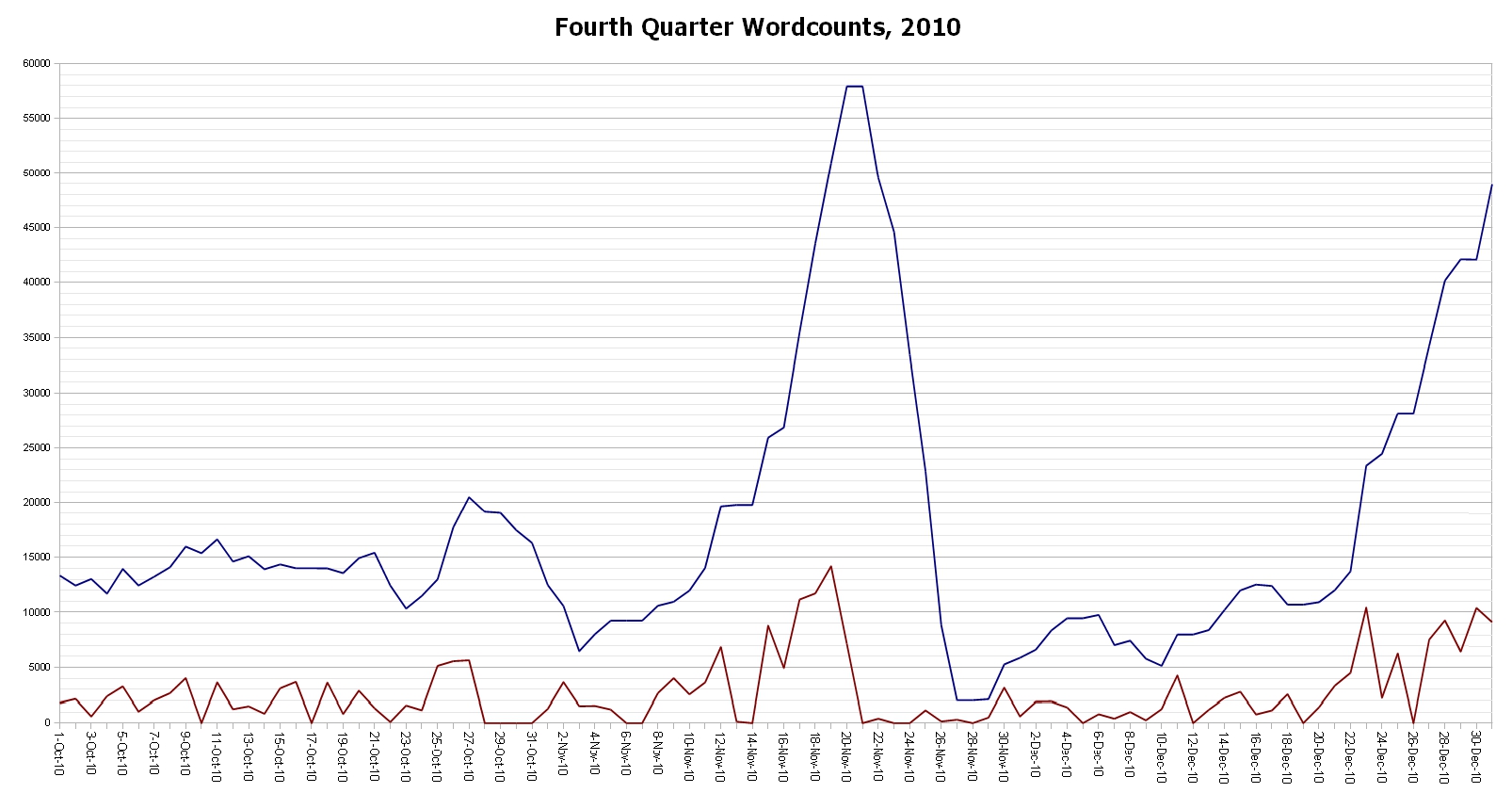
So anyhow, here’s the word count chart:

The red line represents daily word count, and the blue line is a running total for the previous seven days.  The chart includes revisions as well as original material; for revisions, I just do a wordcount of the finished version, whether or not I’ve cut out significant chunks of the text or left it largely as-is.  Maybe that skews the picture a bit, but it’s the best I can do with the tools I have.

At the beginning of the quarter, I was working 40+ hours per week at a seasonal job, so the writing was pretty slow, averaging a little less than 15k per week.  My main project was the fourth draft of Mercenary Savior, which I was struggling to get ready for World Fantasy.

The job ended October 28th, and I didn’t do any writing during the conference, which is why you see the dip at the end of the month.  But I took November off to work entirely on my writing, which is why things took off again rather quickly.

That huge peak in the middle of the quarter is from the fifth draft of Genesis Earth, which I completed in about two weeks.  The draft was already pretty well polished, but one of my hard sf friends did a read through and got back with a few major science issues which I needed to rectify.  Also, I figured it was in need of a language polish, since I finished the last revision almost a year ago and my writing (I hope) has improved a lot since then.

I was pretty surprised at how quickly it went.  The book is definitely as good as I can make it, and any further revisions without professional editorial assistance would be a less effective use of my time.

Things dropped off rather sharply, however, because I spent all of Thanksgiving week either on the road or with family.  Ah, how I love road trips…but they sure can throw a kink in the writing schedule.  I also had a hard time settling on my next big project, which is why things took a while to take off again after I got back.

After starting a sequel for Mercenary Savior and toying around with a short story idea, I decided to do a major overhaul of Worlds Away from Home.  Unlike GE, however, WAFH really, really sucks. It took me two weeks just to read through the rough draft and pick out all the troubled spots, after which I rewrote the outline from the ground up and decided to completely scrap half the book.  I started the second draft in mid-December, but it’s taken a while for things to really build steam.

Right as I was starting WAFH 2.0, a couple of other writer friends from World Fantasy got back to me with their comments on Mercenary Savior, and pointed out a few problems that I hadn’t noticed before.  I started the revision on December 21st and have been plowing through ever since.  That accounts for the huge spike at the end of the quarter–like GE 5.0, the draft has a lot fewer story problems, but does need a few things fixed for consistency, as well as a language polish.

Overall, I wrote or revised through about .25 million words this past quarter–some of which were easier than others.  I started a new project (Into the Nebulous Deep), polished one of my manuscripts to the very best of my abilities, and made significant headway on revising and polishing two others. In terms of publications, I had a major article published in Mormon Artist, and a short poem accepted for publication in a forthcoming issue of Leading Edge.

Not a bad quarter.  Now, let’s see if I can find an agent and/or publisher in 2011.

Some chiastic poetry

Recently, I’ve taken to writing poetry in church–partially to keep me awake, but also to explore elements of worship, such as this one I wrote a few weeks ago:

Bread and water,
types of Christ,
bond us in the covenant
and make us His people;
bearing His name,
joined in discipleship,
remembering the Savior
by His flesh and blood.

My preferred form is the chiamus, a type of parallel structure that follows an inverted ABCCBA pattern.  For example, with the poem above:

> Bread and water,
>> types of Christ,
>>> bond us in the covenant
>>>> and make us His people;
>>>> bearing His name,
>>> joined in discipleship,
>> remembering the Savior
> by His flesh and blood.

Perhaps not the best example, but yeah, that’s the basic idea.  The parallel elements don’t necessarily have to rhyme, but they do have to share a common theme or idea, and the idea in the center is supposed to be the most important.

The ancient Hebrews used chiasmus quite a lot, and you can find many examples of it in the Bible and the Book of Mormon.  According to Avraham Gileadi, the entire book of Isaiah follows a chaistic structure.  My favorite example is probably Alma 36, where the whole chapter is one enormous, beautifully complex chiasmus.

Anyhow, I wrote one today that I thought was pretty good.  It’s not particularly religious, but it does have a lot of personal significance.

Enjoy!

Friends

Few things last forever;
most friendships come and go.
Others last enough to share
a closeness that can grow.
Self to self,
unveil the masks,
reveal your heart, and when
our souls connect,
this close
and lasting
friendship
never ends.

The Obligatory New Year’s Post

So I guess I was lying when I said that my last post was the second to last post of the year.  Oh well–better late than never, I suppose.

Last night at a party, I told someone that 2010 wasn’t that bad…but it was also the worst year of my life.  I suppose that’s true: I got kicked out of my Washington DC internship, almost failed all my classes, spent most of the year unemployed, and never quite achieved full financial independence.

At the same time, I made a bunch of new friends, started two novels and finished another, published an article about the BYU sf&f community that’s garnered some major attention, and generally had a fun time, in spite of the setbacks.

So really, what is there to complain about?  Not much.  Still, I’m glad it’s over.

As far as new year’s resolutions go, I’ve found that the best way to do them is to make one or two of them–otherwise, come February, you lose steam and none of them get done.

I’ve got a couple private resolutions, but here’s the big one I want to focus on:

Resolved: Read a minimum of one book per week.

I made this resolution back in 2008, but it only lasted until mid-March or so–not so much because I wasn’t reading, but because I didn’t understand how I read.

I’m not the kind of person who finishes every book they pick up; in fact, I only finish about 3/4s of them.  If I don’t think a book is good, I stop reading it.  Sometimes, even if a book isn’t bad, I end up putting it down just because I lose interest.  I’m also really picky; I don’t usually read any fiction that isn’t fantasy or science fiction, because the real world bores me.

At the same time, though, if I want to write well, I’ve got to be constantly reading.  And as I’ve written book reviews for this blog, I’ve found that reading widely has helped me to hone my craft.

So anyway, that’s my major resolution for this year.  Other things I would like to do:

1 ) get Army fit
2 ) live in another country
3 ) write a novel entirely in longhand, with actual pen and paper
4 ) get three new publications (two are already in the works)
5 ) fall in love with someone–and then make it grow into real love
6 ) get a MIDI keyboard and compose original 8-bit music
7 ) get a digital SLR and become an amateur astral photographer
8 ) get an agent
9 ) land a publishing deal
10) honestly, it’s just an honor to be read

Do these goals sound a little outlandish?  Sure…but who cares?  We’ve got a whole new year in front of us; anything can happen between now and December 31st!

Happy New Year!