How to make an ebook

Since I plan on publishing a number of books this next year, I decided to write down the step-by-step instructions for how I make my ebooks.

There’s 50 steps altogether and the process can get a little complicated, but if you follow the instructions it should all be very straightforward.  It takes me about two hours now to run through all the steps, and when I’m finished I have a .mobi file for Amazon, an .epub file for Barnes & Noble, a .doc file for Smashwords, and a couple .jpg files for cover art and thumbnails.

The best part is that all the programs are free, so once you know what you’re doing, it costs nothing but a couple hours of your time to actually make the ebook files.  Other than maybe another hour (if that) to upload the files to Amazon, B&N, and Smashwords, that’s all it takes to publish.

Since publishing isn’t a zero-sum business and all of us benefit when writers have options, I’m making this short manual available as a free PDF.  It may or may not work for you the way it works for me, but if it helps you to climb the steep learning curve that all of us face when we first start out, then I’ve done my job.

Vasicek epublication manual

Also, if any of you are more knowledgeable about formatting than I am, please let me know if you have any suggestions.  I’m always looking out for ways to make my books better, so none of this is set in stone (or print, for that matter 🙂 ).

Am I swamped, or am I lazy?

This post might get a little emo, so I apologize in advance.

I feel like I have so much on my plate right now, and yet when I look back at what I’ve accomplished each day, I wonder if I couldn’t have been more productive.  I’m moving out of my apartment on the 21st, so that’s the deadline for pretty much everything, and here’s what I’ve got to do before then:

  • Run through the copy edits for Desert Stars and rewrite the epilogue.
  • Get the cover art and publish Desert Stars.
  • Write the epilogue for Journey to Jordan and publish it.
  • Finish Star Wanderers and submit to Writers of the Future.
  • Do a guest post for Slava Heretz.
  • Finish the application for the TLG program.
  • Get rid of all my remaining books.
  • Figure out electronic W2 and other forms for taxes (before leaving in January).
  • Write up the “About My Books” page on blog.
  • Do a couple of recap posts on the travel blog.
  • Pack and ship my desktop computer.
  • Pack all my remaining stuff.
  • Get post office to forward all mail to home address.
  • Clean apartment for move-out inspection.
  • Find suitable traveler’s insurance.
  • Go clothes shopping.
  • Half a dozen other things that I’m sure I’ve forgotten.

In other words, this is not the time to be playing minecraft.

And yet, taken individually, most of these tasks are not all that difficult.  A lot of them are just mindless chores associated with moving, and the other ones, while requiring hard work, are pretty straightforward.  So am I really swamped, or am I just disorganized and lazy?

This is something I’ve struggled with since graduating last year.  When I was in school, I was constantly busy, but I was also constantly producing.  Even though my writing suffered a bit when I was swamped, I still found time to write three novels (Ashes of the Starry Sea, Genesis Earth, and Bringing Stella Home) and hold down a student job.  For the last year, I haven’t had any school and most of the time I haven’t had a job, and yet my productivity doesn’t seem to have improved.

Part of it has to do with structuring time and organizing myself.  In the past year, I’ve learned that a routine isn’t something you should hang onto doggedly, but something you need to constantly reinvent.  And yet, when I’m staying up until 2am-3am and not getting up until 8am-9am, I can’t help but feel that something’s off.  The whole moving limbo thing certainly doesn’t help, but hey, the work’s still got to be done.

Maybe it’s just deer in the headlights syndrome.  I’ll try making a checklist of everything I want to accomplish in the next two weeks and go for it.  In the meantime, I’m going to get out of this apartment and take a walk, because if I don’t, I’m going to go insane.

Also, as a token of gratitude for putting up with my babbling, here’s something cool I made the other day:

See you around!

Why I’m not submitting to the 2012 Amazon Breakthrough Novel Award contest

Last year, I submitted Genesis Earth to the Amazon Breakthrough Novel Award contest and made it to the quarter-finals.  I’m pretty sure I could do at least that well this year, but after reading the contest rules, I’ve decided not to participate.

Why? Because of this:

5. GRANT OF RIGHTS. By submitting an Entry and if you are selected as a Quarter-Finalist or Semi-Finalist, you grant Penguin the exclusive first publication rights to your Entry. If you are selected as a Quarter Finalist, Penguin’s exclusive first publication rights to your Entry terminate when you are eliminated from the Contest (unless you are selected as a Semi-Finalist); and if you are selected as a Semi-Finalist, Penguin’s exclusive first publishing Rights to your Entry terminate after June 30, 2012.

But mostly because of this:

A. Grand Prize. If you are selected as the Winner in a category, you will receive one of two Grand Prizes each consisting of a full publishing contract with Penguin to market and distribute your Manuscript as a published book…you may not negotiate the publishing contract with Penguin, and you must sign it “as is” upon receipt of the executable contract.

The language is a little unclear as to whether the grand prize winner can elect to turn down the publishing contract, but considering how merely submitting to the contest constitutes a grant of publication rights, I’m guessing no.

So why is this a big deal?  Because it gives the writer no room to negotiate.  Suppose the boilerplate contract is unfavorable when it comes to rights reversion, non-compete clauses, or derivative works.  Penguin could conceivably retain the rights to my book indefinitely, even if I’m earning less than $10 a year on it.  With a non-compete clause, they could forbid me from writing or publishing any other books.  Even worse, they could conceivably buy up rights to the world or the characters, making it impossible for me to write any other books in my own series without their approval.

But even if none of those unfavorable terms are in the contract, the standard royalty for erights is 25% of net, not gross.  For those of you who know the difference between net and gross, that’s a red flag in itself, but even supposing Penguin does pay me the full 25% of the 70% it receives from Amazon, that comes to only 17.5% of the cover price.  Right now I’m getting 70%.  Is it really worth it?

I checked the sales rankings for the last three years of ABNA winners, and they aren’t all that great.  The ebook versions for the 2010 winners have a slightly better ranking than mine, but they can’t be selling more than a couple of books a day.  At the prohibitively high price of $9.99, that’s $.30 less per unit than what I’m earning for Genesis Earth at $2.99.  And the 2009 winners?  Their sales rankings are abysmal.  Whatever Penguin did to market those books, it either didn’t work or they’ve given up and moved on to other things.

Now, I don’t expect to win the grand prize even if I submit to this contest.  Most of the previous winning novels are either literary, mystery, or mainstream YA–no science fiction.  Even so, by submitting to this contest, I would not be able to negotiate a publication contract with any other publisher until my book is eliminated.  That’s a headache I could do without.  And as for the consolation prizes, if this year’s Publisher’s Weekly reviewer is anything like last year’s, I already know what she’ll say: “science fiction is garbage.”

So yeah, I won’t be submitting to this year’s ABNA contest.  If I win, I’m forced to sign a contract that I haven’t seen and have no power to change, and if I lose, I get an unnecessary hassle for all my time and effort.  Thanks but no thanks.

Trope Tuesday: The Bechdel Test

The Bechdel Test is a way to measure how prominently women figure in a story.  It mostly comes up in discussions of TV and film, but can also be applied to works of literature.  To pass the test, the story must have

  1. at least two named female characters
  2. who talk to each other
  3. about something other than men.

The surprising thing, as you can see in this discussion of the trope, is that so few stories actually pass this test. Even in literature, works like The Odyssey, Romeo & Juliet, and even War & Peace fail to pass or only barely pass this test.

Closely related to the Bechdel Test is the Smurfette Principle, where only one of the major characters is female–the token chick.  Stories that fail to pass the first part of the test fall into this category.

So why does this happen?  It may be because most writers are male, but that isn’t necessarily true of books and literature.  Novel writing, after all, was originally considered a womanly pursuit, and the English major was created in the so that women could have something to study while they were in college.  Not surprisingly, 19th century works by female writers like the Bronte sisters tend to pass…

…or do they?  It’s been a while since I read Jane Eyre or Pride and Prejudice, but the impression I got was that the women in those books spend only really talk with each other about men.  And when you look to contemporary writers like Dickens and Tolstoy, the trend holds.  After all, how many female characters are there in A Christmas Carol?  Do any of them ever even talk to each other?

This isn’t necessarily a measure of how good or bad a story is, or even of how feminist it is (Aliens, after all, technically passes), but it is a measure of how independent and well rounded the female characters really are.  If the story doesn’t pass, it’s a sign that the women only play a role in relation to the men, or that the male characters are the ones who advance the plot.

I don’t usually like to bring up my own stories in relation to these tropes, but I thought it would be useful to apply this test to my own books and see how they shape up.  As a writer, I think it’s a good idea to do this periodically, to make sure my work isn’t slipping into a rut.  So here we go:

Genesis Earth

Point 1: Yes, there are two named female characters: Terra and Stella.

Points 2 & 3: No, they never talk.  However, when you apply the reverse Bechdel test (two men who talk to each other about something other than women), Genesis Earth only barely passes.  Michael talks with Tom in the first chapter, mostly about Terra, and for the rest of the book he and Terra are alone.

Bringing Stella Home

Point 1: Yes, it passes.  Named female characters include: Stella McCoy, Danica Nova, Anya Sikorsky, Tamu, Lady Borta, Lady Zeline, Sergeant Maria.

Point 2: Yes; in most of Stella’s scenes, she’s talking with Tamu or Borta or one of the other Hameji women.  Also, since Danica is the captain of the Tajji Flame and Anya is the chief pilot, they interact quite a bit.

Point 3: Yes, but just barely.  In most of their scenes together, Stella and Tamu are talking about Qasar or the harem or sex.  There are a couple where they talk about each other and their past, but it all relates back to their captivity under the Hameji.  At one point later in the book, Anya goes AWOL and Danica has to talk her down, which is probably the scene that makes the book pass, but a hardcore feminist might argue that that conversation is indirectly about a man.  Still, I’m counting it.

Desert Stars

Point 1: Yes, there are plenty of women.  In fact, as you can see from this list of non-minor characters, there are almost as many women as there are men:

Female Male
Mira Jalil
Shira Sathi
Zayne Hamza
Tiera Rumiya
Lena Gregor
Surayya Kariym
Amina Ashraf
Rina Ibrahim
Sarah Lars
Michelle Nash
Mark
Will

Point 2: Yes, plenty of these women talk to each other.  Surayya and Amina are practically joined at the hip, Tiera, Shira, and Lena all have private conversations with Mira, and the only time Rina even talks is when she and Mira are alone.

Point 3: While most of the conversations between the female characters revolve around men and marriage, Tiera talks with Mira about honor, and Rina talks with Mira about leaving home.  Without spoiling too much, there are other conversations that have nothing to do with men, though they happen off-stage and only get reported second-hand.  Either way, I’d say this book passes.

None of this is to say that a good story must pass the Bechdel test.  Lawrence of Arabia, for example, doesn’t have a single female actress–not one single actress!–and it’s an amazing film.  As a counterpoint, I’m sure there are plenty of good stories out there (most of them probably anime or manga) that do not pass the reverse Bechdel test.

However, it is a good measure of female presence and how much the story is driven by men.  And as a lens through which to view the wider culture, it offers a surprising and somewhat disturbing perspective on male-domination in fiction.

Heart of the Nebula 2.0 is finished!

That’s right: the second draft of Heart of the Nebula, direct sequel to Bringing Stella Home, is now finished.  Here are the stats:

words: 90,081
chapters: 20
ms pages: 426
start date: 7 Nov 2011
end date: 4 Dec 2011

And the word splash:

Wordle: Heart of the Nebula 2.0

This was just a quick draft to fix some of the known problems before sending it off to my first readers.  I’d thought that it was missing a whole bunch of stuff, but I ended up taking out more than I’d put in.  Still, it feels like it’s missing something, and I’m not sure what.  Hopefully, my readers will be able to help me figure it out.

I’m starting to notice a pattern with my writing.  The first draft is always the hardest, fraught with all sorts of frustrations and setbacks.  In contrast, the second draft is usually pretty quick, and involves fixing the problems without making any drastic changes.  The third draft is where the story really comes to life, as I start to make connections and tap the latent possibilities.  This may continue in the fourth draft, but anything after that is usually just a matter of polishing the prose.

For those of you who’ve read Bringing Stella Home, this novel takes place five years after and centers around James McCoy and Lars Stewart.  Stella/Sholpan makes a brief appearance, but Danica and the Tajji mercenaries do not; I plan on writing more about them (a LOT more about them) in Stars of Blood and Glory.

I’m going to send this draft out to my first readers and let it settle for a couple of months.  Once I’ve gotten their feedback, I’ll undertake a thorough revision, possibly with some drastic changes to the story.  I don’t want to commit myself to  a specific date, but if all goes well, I may publish it sometime next summer.

In the meantime, if you’re interested in beta reading Heart of the Nebula, shoot me an email–but please, only ask if we know each other IRL.  My next big project is Star Wanderers, which should hopefully be finished by mid-January.  And of course, there’s Desert Stars–I’m in the process of getting the cover art, so it shouldn’t be more than a couple of weeks before it’s up!

So much going on…it’s good to get something finished.

Thoughts on kickstarter

So as many of you know, I ran a kickstarter campaign as an experiment to see if I could raise enough money to fund my next release, Desert Stars.  Over the course of the month, about a dozen people pledged over $300, but ultimately it wasn’t enough to meet the goal.

First of all, I want to thank everyone who made a pledge or spread the word.  I appreciate all of your support, no matter at what level.  My biggest obstacle at this point is obscurity; without you, I’d never be able to overcome it.  So thanks!

While the campaign was a bit of a disappointment, I learned a lot from the experience.  My strategy going in was to set a modest goal and give a variety of high-value rewards at various pledge levels.  However, I didn’t do much to publicize the project, mostly because self-promotion makes me so uncomfortable.  That was probably the biggest single reason why the support never reached a critical mass.

If I were to do it again, I would work out a plan for the marketing and publicity before launching the campaign.  I would also run the campaign for a longer period of time and talk about it more, just to make sure people are aware of it.  Also, I would try to get an endorsement from someone with an established audience that overlaps with my own.  It’s hard to tell people you’re awesome, but if someone else who is awesome tells them, they’re much more likely to believe it.

Will I ever do a kickstarter campaign in the future?  Probably, but only after I’ve built my fanbase a little more.  Kickstarter isn’t a good way to launch if you don’t already have a devoted following.  Like everything at this point, it’s a catch-22.  In order to be successful, you have to be noticed.  In order to be noticed, you have to be successful.  Obscurity is the biggest obstacle, and there’s no sure way to overcome it besides trying and failing until something finally works.

Fortunately, while the kickstarter campaign was a bit of a setback, it’s not going to prevent me from releasing the book.  I’ve secured an alternate source of funding, and should be able to have it out by January if not before.  As a gesture of gratitude to everyone who made a pledge, I’ll send you a free copy once it’s out.

Thanks so much!

Picking up the pace

I’m writing this post from somewhere in Iowa, riding the California Zephyr from Chicago to Salt Lake City. Since I hate sleeping on the train, I figured now is as good a time as any to write a blog post.

One of the good things about traveling by train is that you have lots of time to just sit and think. Yesterday I took a long, hard look at my writing over the course of the last year, and was surprised at what I found. Long story short, I think it’s time for a major recalibration.

As you know, my main writing goal is to produce a minimum of two novels per year, fully polished and of publishable quality. Desert Stars will be my third this year, if I can get it up before January. But after that, I don’t have a whole lot lined up in the queue. Heart of the Nebula is a finished rough draft, but it’s the only one; everything else is either incomplete or just an idea floating around in my head.

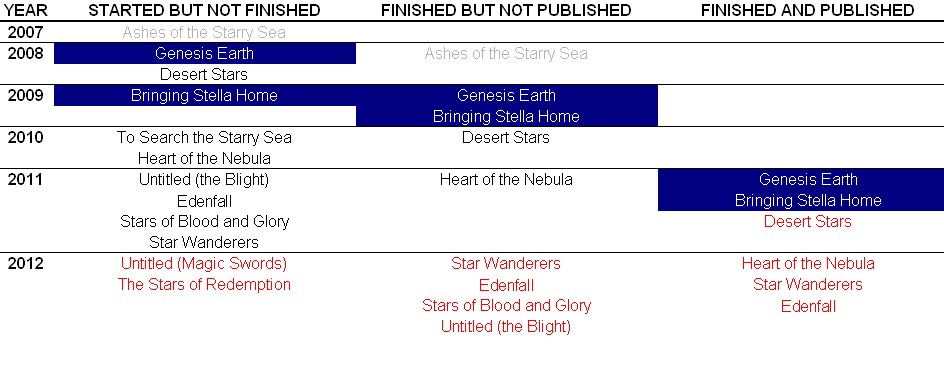
Perhaps the best way to see it is to look at this chart. It lists all of the novels that I started, finished, and published by year. The titles highlighted in blue are novels that I’ve epublished. Ashes of the Starry Sea was a practice novel, so I’ve grayed it out, but everything else is a project I intend to carry to completion.

While 2011 was a great year for me in terms of starting new works, it was a downright horrible year in terms of actually finishing anything new. I’m worried that unless I can force myself to buckle down and produce new material at a much faster rate, this handicap is going to bite me in the butt next year.

Here’s another way to think about it: if I want to write two novels per year, and I can only focus on one novel at a time, I should be able to complete any project in no more than 26 weeks. And yet, when I look at my word count spreadsheet (which only goes back to May 2009), here’s what I see:

  • Genesis Earth: 22 to 26 weeks
  • Bringing Stella Home: 50 to 54 weeks
  • Desert Stars: 52 to 56 weeks
  • Heart of the Nebula: 18 weeks (unfinished)
  • Edenfall: 2 weeks (unfinished)
  • Star Wanderers: 9 weeks (unfinished)

What this tells me is that my current writing method is unsustainable. Either I need to learn how to juggle two projects at once, or I need to learn how to produce quality material in half the time–and in all reality, I should probably learn how to do both.

For those of you who might be worried that I’ll sacrifice quality for speed, let me assure you that I don’t intend for that to be the case. Dean Wesley Smith makes a very compelling argument on this subject, how speed and quality are not mutually exclusive. The more I write, the more practice I’ll get, which will hopefully improve the quality of my writing.

One thing I really ought to do is write something new every day. For most of 2011, I was revising something I’d originally written in 2008 or 2009, maybe throwing out a couple of scenes to start from scratch, but overall simply revising an older work. It’s made me a little rusty, and I can feel it. I can say right now, that needs to change.

My biggest concern is that once I’m overseas, it will be much harder to balance these writing goals with everything else going on. However, this isn’t 2008; I don’t have all the obligations of a student. As for whether the obligations of a teacher are any worse, we’ll have to see.

What I really want to do is write a novel in a week–preferably, in three days. Even if the first draft isn’t very good, just the act of doing it will break down some major barriers, I feel. If I finish Star Wanderers by mid-January, I’ll turn it around and write a novel with the same events from Noemi’s point of view, all in a weekend if possible.

In short, this is what I want to do:

  • Produce a minimum of 2 publishable novels per year.
  • Reduce the time for each draft to 6 weeks average.
  • Write a minimum of 500 new words each day.
  • Learn to juggle two projects when revising.

This isn’t going to be easy; I have the feeling that it’s going to involve a fundamental shift in the way I approach writing. However, if I can pull through it, I think this might just transform my career in the way that I need in order to take things to the next level.

In the meantime, I’d better get some sleep. I’ve got a long day of travel ahead tomorrow, and I’ll need all the energy I can get if I want to get some serious writing done.

Last day for Desert Stars campaign

So today is the last day for the Desert Stars kickstarter campaign.  I’ve got a little under half the funds raised so far, but if I don’t reach the target goal by the end of the day, the project doesn’t get funded (at least, not through kickstarter).

All I need is about 35 people donating $10 each, or 14 donating at $25, so if you’ve been meaning to pledge but just haven’t gotten around to it, I’d appreciate it if you could take the time to do it.  Worst case scenario, the project doesn’t get funded, and you don’t pay anything.

I’m currently traveling across the country by train, so I won’t be back online until Friday when I arrive in Utah.  Right now, I’m in Chicago, getting ready to board the California Zephyr; internet is a little spotty at Union Station, but I’ve found a corner where I can check up on things.

Thanksgiving was great; I blogged about it on the travel blog.  It was good to spend some time with my parents and visit with family.  Christmas is going to be great, not only because all my sisters and their families will be there, but because we’ll be in Texas where the weather is a bit milder.  I’m looking forward to it!

As for the kickstarter campaign, whether or not it works out, I’ll definitely blog about it in the next couple of days.  Even if it doesn’t get funded, I’ve learned a lot from the experience, and I’m sure my fellow writers will be interested to hear about it.

So keep in touch, and I’ll be back on Friday!

Trope Tuesday: Scarpia Ultimatum

How far would you go to save the one you love?  Would you sacrifice your life?  Suffer an irreparable blow to your reputation?  Or would you sleep with your lover’s would-be killer?

Scarpia Ultimatum is when the villain threatens to kill the hero (or, alternately, a basket full of kittens) unless the romantic interest gives him some sort of  sexual favor or gratification.  It doesn’t have to explicitly involve the physical act, though if it does, it tends to take the story in a very dark direction.  G-rated examples of this trope tend to revolve around marriage or some sort of emotional commitment instead.

The standoff can end in one of the following ways:

  • The romantic interest submits to the villain’s demands.  Since the ultimatum involves a fundamental betrayal of fidelity, this rarely ends well.
  • The romantic interest decides she’s not all that interested in the hero after all.  Alternately, she does the villain’s job for him.
  • One of the side characters offers to go in the romantic interest’s place, and the villain consents.  IIRC, something like this happened in Enchanted.
  • The romantic interest submits to the villains demands, but the hero escapes and rescues her at the last minute.  Can be difficult to pull off, since it basically consists of having your cake and eating it too.
  • The romantic interest comes up with a third option that saves the hero without forcing her to give herself up to the villain.  By far, this is the most common solution.

At the heart of this standoff is the fact that both choices involve a betrayal.  If the romantic interest refuses, she lets the hero die.  If she submits, she becomes unfaithful.  Even if the standoff is over a basket full of kittens, it almost always involves a choice between two morally reprehensible options.

My favorite example of this trope is from Phantom of the Opera, where the Phantom forces Christine to choose between her freedom and Raoul’s llife.  She takes the third option and kisses the Phantom, making him have compassion on her because no one else had ever shown him such affection.  What makes this a crowning moment of awesome, for me at least, is the way that it empowers Christine without doing anything to diminish Raoul.  He shows himself willing to make a truly heroic sacrifice, while she proves that love is more powerful than violence.

As a way to add a moral dilemma to your story, this trope is highly effective.  The stakes are high, the options are limited, and the moral choices are far from black and white.  If your characters do take a third option, however, it should probably make some sort of commentary on the ethical questions raised–otherwise, it’ll probably come across as an ***-pull.

Heinlein’s rules for the digital age

I’ve been thinking a lot about Heinlein’s rules and how they apply to my own writing career.  While a lot of newer writers like to debate Heinlein, all of the long-time professionals tend to agree with him.  For that reason, I think it’s worth taking a serious look at his rules and doing my best to follow them.

The trouble is that Heinlein formulated his rules before the digital age, when self-publishing was non-viable and writers sold to editors, not to readers.  While I wouldn’t go so far as to say his rules are outdated, I do think that they need to be tweaked a little in order to apply to today’s aspiring professionals.

As a disclaimer, I should say that I’m only a beginning writer without much authority or experience.  However, my goal is not to debate Heinlein, but to explore ways in which his advice can be adapted to myself and writers in my position.  If any of you have any thoughts or input, I would very much like to hear it.

So anyhow, here we go:

Rule One: You Must Write.

Pretty straightforward: if you want to write for a living, then the bulk of your time should be spent writing.  Too many indie writers spend all their time and energy promoting their one book when they should be writing others.  If promotion gets in the way of writing, then you should stop promoting and just go write.

Personally, I could probably spend a lot more time writing new material as opposed to revising stuff I’ve previously written (yes, that’s the infamous third rule; I’ll get to it in a minute).  I tend to spend a month writing something new, then take a couple of months to revise old works without producing new material.  If I want to be strict about following Heinlein’s rules, I should probably change that.

Rule Two: You Must Finish What You Write.

Another straightforward rule, but you’d be surprised how hard it is when you know you can publish whatever you write.  Kris Rusch calls these ideas “popcorn kittens,” after a popular youtube video that embodies what goes on in our minds when we have the freedom to create anything.  The problem with too much freedom is that it’s a struggle not to flit from one idea to another, dabbling in all of them but carrying none to completion.

I myself had this problem over the summer, and to some extent I’m struggling with it now.  The key is just to buckle down and have the discipline to finish what you start.  Pretty straightforward.

Rule Three: You Must Refrain From Rewriting, Except to Editorial Order. 

This is Heinlein’s most controversial rule, especially for new writers.  However, I think he has a good point.  If a story is fundamentally broken, revising it is no more effective than stirring around a pile of crap; and if the story works, revising it without first getting a trusted second opinion could actually make it worse.  After all, writers are often the worst judges of their own work.

The key question, then, is where to go for that second opinion.  In the old days, money flowed from the editors to the writers (or at least from the publishers, who employed the editors), but in the new world of publishing, it’s exactly the opposite.  Most of us can’t afford to hire editors for extensive developmental edits, especially when we’re just starting out, and while it’s possible to publish a rough draft, for most of us it’s probably not a good idea.

My approach is to share my unpolished work with a network of trusted first readers, and use their feedback to guide me in the revision process.  I don’t always adopt all of their suggestions, but I carefully consider each one.  Most of the time, I use them to see where the problems are, then use my creative mind to come up with a solution, sometimes taking the book in an entirely new direction.  And if something works well for some but doesn’t for others, I figure it’s not a problem but a judgment call that requires my attention.

Using this method, it currently takes me about four or five drafts before I feel confident enough to publish something.  If I really wanted to follow Heinlein’s rules, I would probably try harder to nail it on the first draft, but I’ve found that my creative process works better in revision mode than while writing new material.  So long as I can revise efficiently enough to produce at least two novels each year, I think I’ll be in good shape.

Rule Four: You Must Put Your Story on the Market.

In the old days, this meant submitting your manuscript to contests, magazines, and publishing houses, not self-publishing.  For short stories, contests and magazines are probably still the best place to start.  However, with novels, indie publishing is generally much better.

The trouble is that publishing your own work is as scary as hell, especially when it’s close to your heart.  This is probably the main thing keeping most new writers from going indie: the need for external validation which grows out of a lack of much needed self-confidence.

The key, I believe, is to get some emotional distance between yourself and your work.  As a rule, I don’t respond to reviews, good or bad.  As for external validation, I don’t seek it at all.  I only publish the stories that I believe in, and even if I’m nervous about sending them out into the world, I figure it’s better to suck it up and do it anyway.  It was the same with writing queries; the only difference is that the market is now the readers, not the editors.

Rule Five: You Must Keep It On The Market Until It Has Sold.

This is especially challenging for indie writers.  When weeks go by without a single sale, it’s easy to believe that your work is crap and that you should just take it down.  It’s even worse when your book isn’t selling and you get a bad review.

Just like with queries, however, the key is to keep your work out there until it finds its natural audience.  With indie publishing, you have all the time in the world, provided you don’t lose confidence.

The key question in my mind is whether to take down your old, crappy stuff as your writing improves, or to leave it up alongside your newer, better work.  Personally, I think it should come down to the readers; if the old stuff is consistently getting bad reviews, it’s probably better to take it down, but if not, might as well keep it up.

So there you have it.  From Heinlein’s rules, I’ve more or less crystalized the following approach:

  1. Always make time to write, even at the expense of promotion.
  2. Only chase new ideas if you know you can finish what you start.
  3. Don’t revise without first getting feedback from trusted readers.
  4. Don’t wait for external validation before you publish.
  5. Keep your work up, even if it doesn’t sell.

Not quite as pithy as Heinlein’s rules, but they seem pretty reasonable.  I don’t have the experience to say whether they follow his, however, so if you have any comments or suggestions, please chime in.