Quick update and Star Wanderers cover previews

First off, I’m happy to say that Stars of Blood and Glory is coming along quite nicely.  I’m currently finishing up with the last couple of chapters, and should have the first draft done by the middle of next week.  Hopefully by then I’ll know if and when I’m starting my TEFL job overseas, but I’m sure I’ll have it finished before then.

This first draft is pretty rough, so I’m sure it’ll be a while before it’s up and ready for you to read.  For some reason, this draft is extremely short–I doubt it’ll be much longer than 80,000 words.  I don’t know if that means my writing has gotten tighter since Bringing Stella Home, or if I’ve unintentionally left too much out.  I’ll probably let it simmer for a few months, do a quick revision, and send it out to some first readers, just like I’ve done for Heart of the Nebula.

In the meantime, I’m getting really excited to pick up work again on Star Wanderers. I’ve been workshopping part II in Kindal’s writing group, just to get some reactions.  I’ll probably revise that part while I’m writing parts III and IV, getting it ready for publication after I hear back from Writers of the Future according to the serial model I outlined previously.

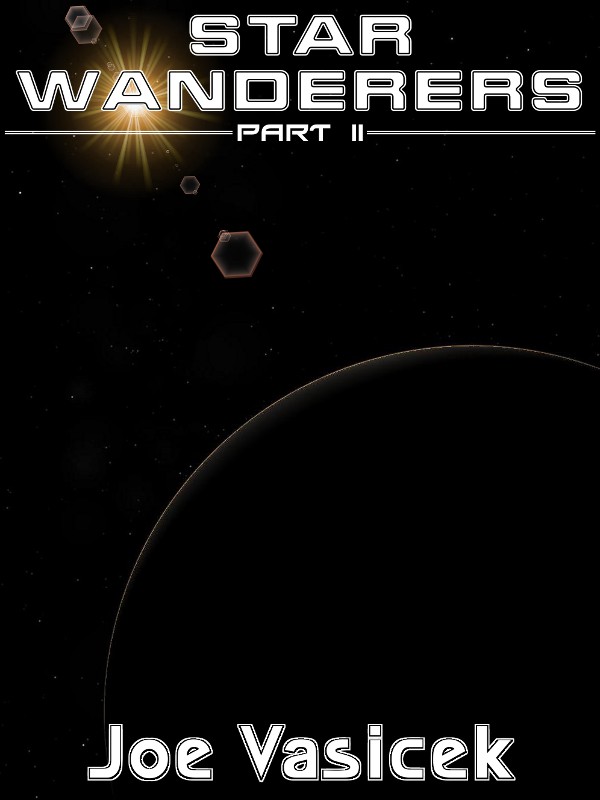
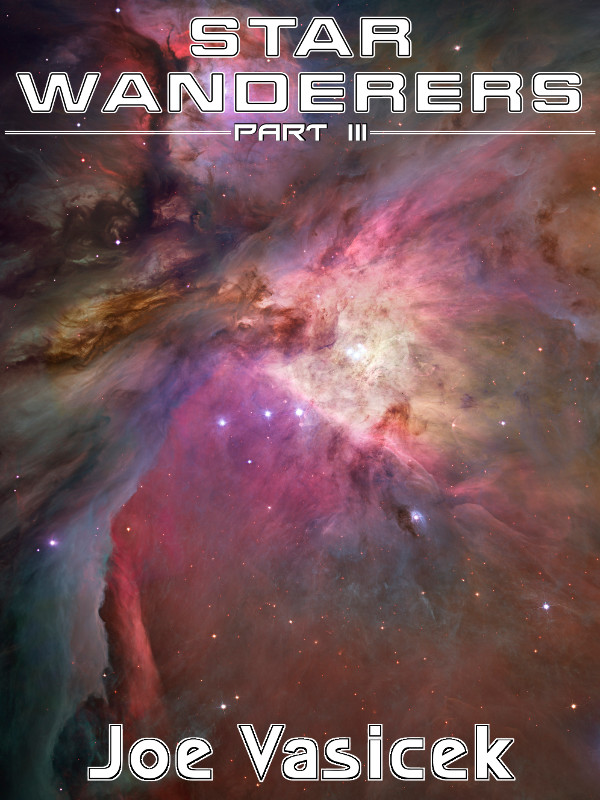
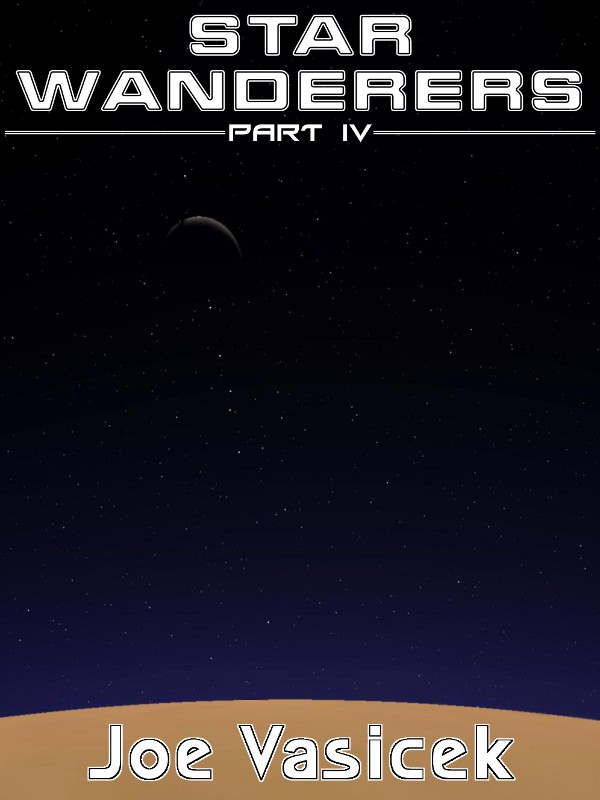
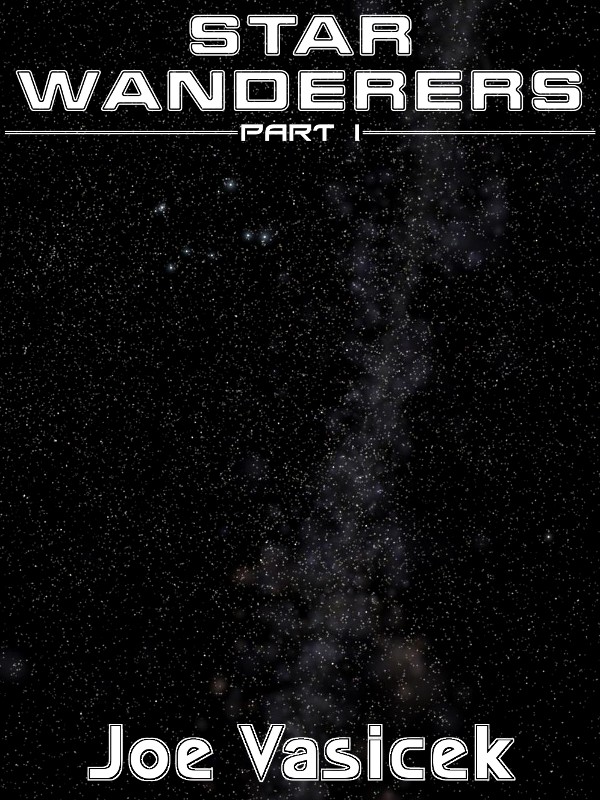
I’m so excited, in fact, that I went ahead and made some mock-ups for the cover art!

Pretty cool, huh?  These make me sooo happy. 🙂

I’m not quite sure if this is the right design, though.  Star Wanderers is very much a science fiction romance, and while these covers definitely scream “science fiction!” they don’t really seem to say “romance!”

My original idea was to use these as backgrounds and commission an artist to do some character portraits from the waist up, using one portrait each for the foreground.  But then again, that might make the covers a bit too complicated.  I can always redo the first one to get rid of the planet, keeping the galaxy–the other ones probably wouldn’t be so bad with a character in the middle.  But then again…

I don’t know.  What do you guys think?  If you saw one of these covers while browsing for ebooks, what kind of impression would it give you, and would you be interested in checking it out?

(By the way, I made the covers with Celestia.  Coolest.  Space simulation.  Ever.)

EDIT: I decided to redo the first cover; the planet wasn’t quite doing it for me.  I’m not sure if that means I should redo the cover for the third part, since that one is a heck of a lot more colorful than the others…hmm.  We’ll have to see.

Story Notebook #6

Alright, it’s time to go through another story notebook.  This one covers the spring and summer of 2010, right after I graduated.  It was a weird transitional period in my life, when I didn’t really know what I was doing or where I was going, but I was determined to keep on writing anyway.

I filled three pocket notebooks with story ideas in 2010, and last time I mistakenly thought I’d covered one that went from graduation through the end of the year.  While putting my records in order before going abroad, I found that this one actually came a little earlier.

Lots and lots of story ideas…2010 was definitely a good year for that.  So anyhow, here we go:

A planet settled by people with aircars: there will be no asphalt roads, only packed earth.

An interesting consequence of futuristic technology; too often, stories come up with something flashy without really thinking through all of the implications.  Can you imagine a world without asphalt?  If you can, then please take me there!

A task-oriented woman who thinks men are fickle because they’re always trying to come across as macho, trying to save face, etc.

This makes me think of something I heard somewhere about gender roles and politicians.  If I remember it correctly, most men go into politics for the fame, power, and glory, while most women go into politics because something in their community is broken and they feel it’s their duty to fix it.  Not sure if that’s true or not, but this story idea made me think of that for some reason.

Humanity has been domesticated by a super-intelligent alien race and bred into several different breeds with wildly varying physical characteristics.

In other words, a post-human universe where humans have been bred as pets, like dogs.  Can you imagine a world where the physical differences between humans of different races are as great as this:

Can these two even physically reproduce?

A fantasy where the traveling hero is actually the bad guy.

I think Girl Genius already beat me to that, though Othar is more of an annoyance than a genuine villain.

An interstellar Sir Richard Burton.

Now that would be an interesting series.  Sir Richard Burton was a British adventurer who went to the Middle East before doing that was cool.  He made the first English translation of the 1001 Arabian Nights (as well as the Kama Sutra, apparently), and was one of the first European explorer to sneak into Mecca–certainly the first non-Muslim explorer.  I hear he was quite a character.

A planet on a highly eccentric orbit where habitability is sustained by large glowstones that absorb high amounts of energy and emit heat slowly.

Ooh, I’d forgotten about this one.  I’ll have to use it sometime–maybe in a science fiction / fantasy mashup.  You know, with dragons and stuff.

A werewolf who is tame around just one person.

I’m pretty sure this one has been done, and I’m also pretty sure I’m not interested in reading it.  Sorry, Twilight fans–or maybe you’re welcome?

A landscape more vertical than horizontal, where the architecture reflects this (like the old Knight building).

The Knight building was a multi-split-level administration building at BYU where Leading Edge used to meet.  Lots of stairs, entrances on just about every level–it was a weird building (but not quite as weird as the JKB).  But yeah, a vertical landscape would be cool–though I guess that’s pretty common in cyberpunk, with all those cities.

An alien species that communicates only by touch.

“What the–augh!  Get it off of me!” Thus begins humanity’s first interstellar war.

Purgatory for fictional characters, where all the plot hole stories go.

I’m pretty sure that was a South Park episode.

A religious order that believes that developing math skills is the key to self and enlightenment, becuase math is the only science that is completely a priori.

Heh, I’ll bet my Dad would like that story.  It might be the first one of mine that he actually buys.

A man frames himself to go to prison so that he can go to law school / have time to write.

When you’re unemployed and struggling to make ends meet, some otherwise unsavory options begin to look pretty attractive…

What if humanity had a blight like the American Chestnut, where everyone over the age of 20 dies of a horrible disease?

I actually started writing that one.  Finished the first chapter, kind of in a pseudo-Victorian first person style, like Robinson Crusoe.  I have no idea when I’ll finish it, but the universe is really, really fascinating.

A world where novelists / storytellers convey their tales telepathically without translation into words.

And then SOPA gets passed, and all of us creative types are screwed.

What if the mountains were sentient? What would they think of the human race?

“Dang it!  Not another cavity!”

Land of the sleeping rainbows

I think this is actually a real place in southern Utah; I just thought it would make a cool story prompt.

What if the Amish really are 18th century people, guarding a natural time portal in central Pennsylvania?

That would be a fun one to research. “Hello, I’m writing a time travel novel…can I join your village for a year?”

Marital therapy that involves swapping bodies.

I’m pretty sure Disney did something like that in the 60s.  With the way the country has changed, I’m sure it would be much different if someone did it again today.

And that just about does it for this notebook.  As always, feel free to use any of these ideas in your own work.  It isn’t “stealing” if it hasn’t actually been written yet (unless congress passes a revamped version of SOPA that…hmm, that gives me an idea…).

Thanks guys!  See you around!

What I’ve been up to recently

I thought it would be a good idea to do a quick post explaining what I’ve been up to the past month or so, since a lot of things have changed and I’m sure they will be changing a lot more in the future.  So, here’s what’s up:

As you may or may not know, I decided about four or five months ago to leave the USA to teach English abroad.  For the past few little while, I’ve been applying for a program to teach English to elementary school kids in Georgia.  I had the interview over Skype just yesterday, and I think it went pretty well!  I should hear back in the next couple of days, so fingers crossed on that.

If they decide to hire me, I’ll leave in three weeks and stay until at least mid-June.  At that point, I’ll either sign up for another semester or go somewhere else, either the Middle East or Eastern Europe. The pay isn’t great, but it seems like a good cultural experience, and I’m a lot more interested in the Caucasus than I am in East Asia (no offense to Asians).

Ever since I graduated in 2010, I’ve been looking for a fulfilling career that I can balance with my writing aspirations.  I learned pretty quick that that simply doesn’t exist in Washington DC; either you sacrifice everything for your career, including your family, or you end up trapped in an office pushing papers all day.  In Utah, I bounced around a lot of temporary jobs while struggling to make ends meet, but I never found anything more permanent that seemed to strike a balance.

I hope that teaching English will help me to find that balance, and from what I’ve heard from some of my former expat friends, I’m optimistic that it will.  Perhaps more importantly, it will probably enrich my writing by exposing me to new peoples and cultures.  Desert Stars was certainly enriched by the time I spent in Jordan; without having lived in that culture, I don’t think I would have been able to write it.  Besides, English is something I’m good at, and so is teaching–so why not capitalize on the skills I already have?  It certainly sounds better than wasting my 20s in a warehouse.

So that’s the plan: launch a TEFL career and spend at least the next three to five years abroad.  At least.  I might not get married until my 30s–or who knows, I might find someone out there and go native–but this is something I want to do as a career, not just as temporary filler before I figure out what I want to do with my life.  I’m through with filler.  Whether it takes one year or ten for my writing career to take off, I’m going to get out and do something useful and worthwhile.

That’s the plan, anyway.  And of course, I’ll always keep writing.

Right now, I’m finishing up Stars of Blood and Glory; I’m on chapter 15, with only three more and an epilogue after that, so I should finish that well before I leave.  After that, the next big project is Star Wanderers, which is already about halfway finished.  I’ll probably take some time off and work on polishing part II, then release parts I and II sometime in the spring–unless by some weird fluke it wins Writers of the Future.  I’ll know in February.

And after that?  Well, I’m thinking it’s almost time to pick up Edenfall again, but I can’t say for sure. Probably, though–I definitely want to finish that one before the end of the year, and preferably get it published.  After Stars of Blood and Glory, I’ll probably take a break from the McCoy continuity in the Gaia Nova universe, though I may pick up something from Jeremiah’s timeline in Star Wanderers.  I really want to do a parallel novel from Noemi’s point of view–maybe that’s the one I’ll do in seven days, just to hit that resolution.  Everything has to be ready fist, though, and right now it isn’t.

So much is changing–I have no idea where I’ll be in the next six months, creatively or physically. But right now, I’m just enjoying a relaxing time with my parents and getting ready for the next big transition.  Life is good.

Trope Tuesday: Lawful Good

Lawful Good is the character alignment that is the most unambiguously heroic.  These are the white hats, the caped crusaders, the knights in shining armor who fight for Truth, Justice, and the American way.  They might not always be smart, and they might not always be nice, but you can always count on them to do the right thingalways.

From the easydamus character alignment page:

A lawful good character acts as a good person is expected or required to act. He combines a commitment to oppose evil with the discipline to fight relentlessly. He tells the truth, keeps his word, helps those in need, and speaks out against injustice. A lawful good character hates to see the guilty go unpunished.

Although most Lawful Good characters are unambiguous, their conflicts are often quite complicated.  This is because their dedication to the moral code is itself a weakness which an intelligent villain can exploit.  Typically, this is done by putting them in a situation where they have to choose between being lawful (catching the bad guys) or being good (saving all the innocent people who will die in the process).  A smart Lawful Good character, however, will come up with a third option that turns the ethical dilemma on its head, though it might require a heroic sacrifice.

Very often, these kinds of characters appeal to us because they represent some higher ideal which we wish we could follow.  However, that’s not always the case, especially in more cynical works like A Game of Thrones, where the most lawful good characters also tend to be the most stupid.  Ultimately, it all comes down to the bias of the writer; even when you’re trying not to be didactic, it’s hard not to use the Lawful Good character as a vehicle for some sort of message.

A shallow Lawful Good will be little more than a paragon for whatever virtue they’re meant to represent.  A more nuanced Lawful Good will have some sort of a flaw (besides the backhanded ones), or some sort of internal conflict connected with their moral code to make them more human and relatable.

My favorite Lawful Good would probably be Sir Galahad from Le Morte d’Arthur, but mostly because of the sharp counterpoint he provides next to all the thugs and criminals other Knights of the Round Table.  Carter from Halo: Reach is a pretty cool Lawful Good, though he wasn’t my favorite (that would be Jorge).  And even though he’s a complete idiot, Ned Stark is still the only adult character from A Game of Thrones that I found remotely likable.

In my own work, Jalil from Desert Stars starts out as Lawful Good, though he shifts to Lawful Neutral in the middle and up to Neutral Good by the end.  In Bringing Stella Home / Sholpan, Lars and Narju definitely fall under this alignment, putting a lot of pressure on Stella to live up to their ideals.  I explore Lars’s idealistic character a bit further in Heart of the Nebula, a direct sequel to Bringing Stella Home which I hope to release later this year.  And in Star Wanderers, Noemi tends to fall under this alignment–though the story is not so much about saving the world as it is about saving each other.

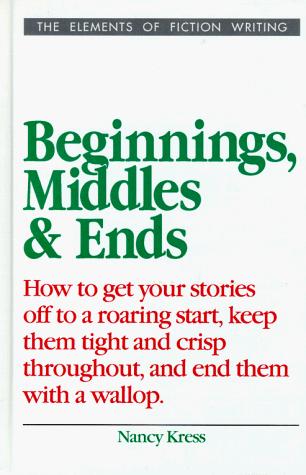
Beginnings, Middles, and Ends by Nancy Kress

I finished last week’s book a couple of days late, but I’m still going to count it.  It’s a book on writing by Hug0-award winning science fiction author Nancy Kress, and for anyone interested in writing stories in any genre, I’d highly recommend it.

Kress wrote this book back in the early 90s, after publishing six novels and a handful of short stories.  She also taught creative writing, and from the calibre of her writing advice, that’s abundantly clear throughout the book.  She tackles just about every aspect of story creation in a straightforward, methodical way, with a calm, almost motherly tone that is reassuring without being too heavy-handed.  She picks apart just about every element that is essential to a good story, and explains how it all works in a way that is clear and makes sense.

Because this was written back in the 90s, there are some artifacts of traditional publishing that make the book feel dated.  For example, the first few chapters focus on how to construct a beginning that will sell to an over-stressed, over-worked editor, with less of an emphasis on how to hook general readers.  Aside from that, however, much of her advice is still quite applicable to today’s indie writers.  The book’s main focus is on story, and good storytelling is important no matter which market you’re writing for.

The section on beginnings was a bit overwhelming, with so much “you must do this, you must not do this” kind of advice that it would probably kill my creativity if I were reading it as I was just starting a new book.  However, the sections on middles and ends were quite insightful, and sparked a ton of great new ideas for my current project.  Either way, her advice is spot on.

If you’re a new writer, I would recommend picking this book up after you’ve written a practice novel, or after you’ve finished a couple of short stories.  If you’re already an experienced writer, I would still recommend it, because even if most of the advice isn’t new, it will help you see much more clearly how a good story comes together.  It’s a short, easy read, but it’s so packed with good information that I’ll definitely reread it.  Highly recommended.

Writing log results

For the last month or so, I’ve been keeping track of my daily writing habits to look for patterns that might give me some insight on how to improve my creative process.  I’ve amassed somewhere around 65 data points, and I think the results are clear enough to notice some trends.

Just some preliminary background information: for most of this time, I’ve either been on vacation or at my parents’ house, waiting to start an English teaching job in another country.  I haven’t had school or a full-time job, so my schedule has been pretty open and flexible.  Also, the numbers track progress on the first drafts for Star Wanderers and Stars of Blood and Glory, and do not count revisions of any kind.

Here are the results:
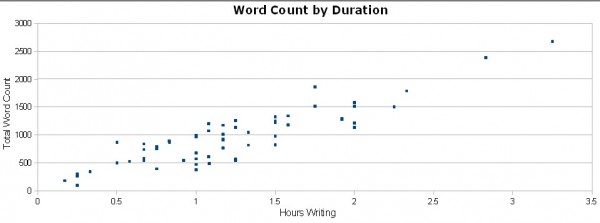
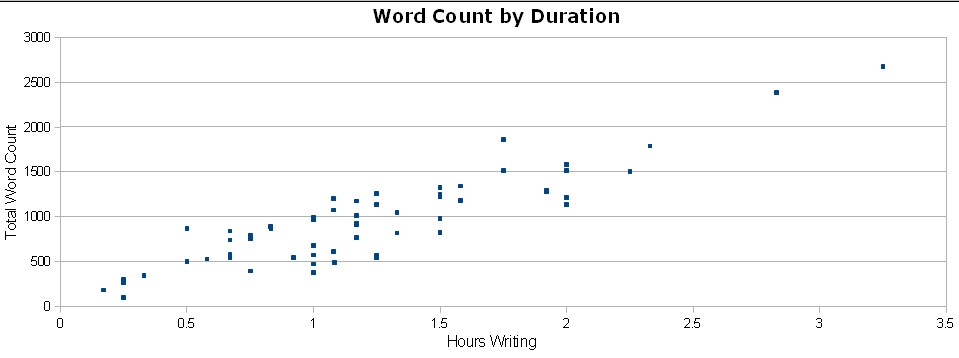
The first graph plots word count by duration spent writing.  As you can see, there’s a definite trend: the longer I write, the more I tend to write.  No surprises there.  Most writing sessions are somewhere between 45 and 90 minutes, or 500 and 1,500 words.
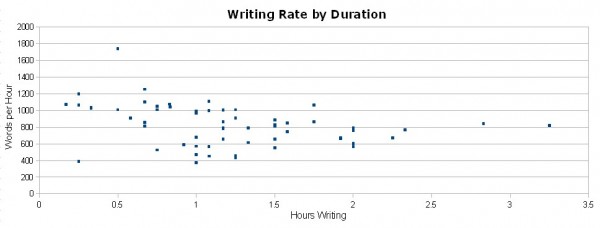
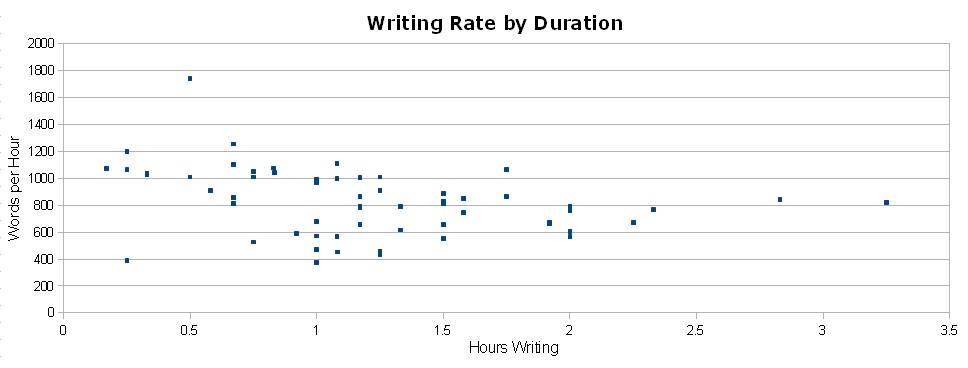
The second graph plots the average writing rate (in words per hour) per session by hours spent writing, and it’s a little bit murkier.  In writing sessions of less than 45 minutes, I tend to average a little over 1000 words/hour, but things get murkier between 45 and 90 minutes, and after 90 minutes, I tend to be around 600 and 800 words/hour.

The overall trend appears to be down–that is, the longer I write, the slower I tend to write–but there appears to be a counter-trend, too, where if I start off slow I can increase the pace by writing for a longer amount of time.  Is that true, or is that simply a sharper downward trend line?

I think it’s a genuine counter-trend, and here’s why:
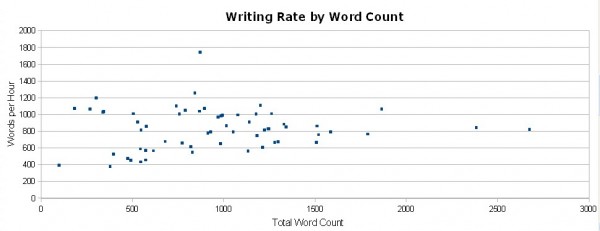
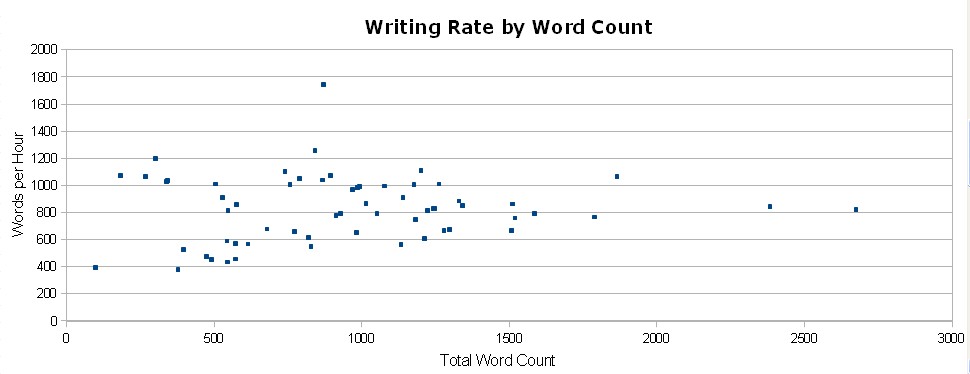
This graph shows writing rate plotted against word count, and it pretty clearly shows two trend lines: one starting at 1,000 to 1,200 words/hour and going slightly down, the other starting at 400 to 600 words and going up.  At about 1,500 total words, they converge at around 800 words/hour and appear to remain flat, though there isn’t really enough data to be able to say.

What I think this shows is that I have two different writing styles.  The first is to start off slow and gradually write my way into the story, picking up the pace but never really going over 800 words/hour.  The other is to start off at a sprint of 1,200 words/hour or so, but to slowly drop off to 800 words/hour at around 90 minutes or 1,500 words.
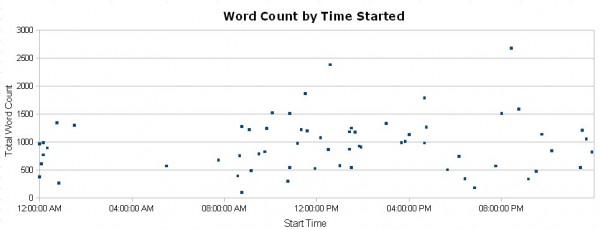
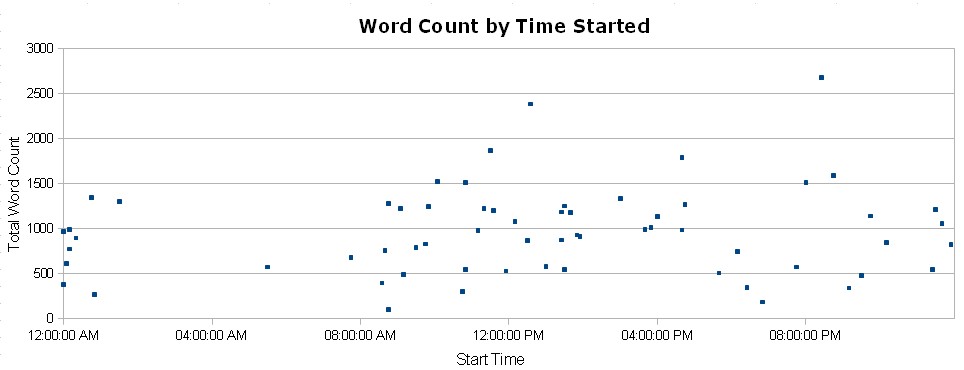
The next graph plots the total word count of each writing session by the time of day in which I started the session.  Interestingly, there is no trend; the points are all over the map.  This tells me that there is no “best time” for me to write.  Other time-related factors might influence how much I can write, but time of day itself does not.
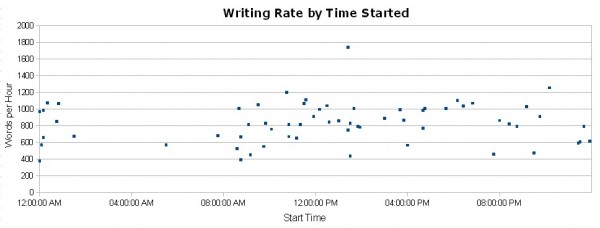
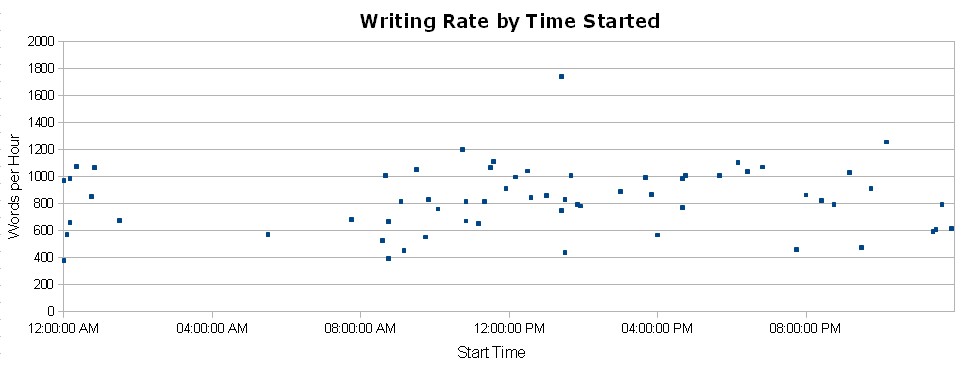
A quick glance at the next graph confirms this.  It plots writing rate by time of day, and the results are much the same as the graph for word count.  I tend to write at a more consistent pace in the afternoon–around 1,000 words/hour–but really, there is no consistent trend.

This tells me that my first session of the day tends to be slow and gradual, but that once I’ve written myself into the story, the writing comes a lot faster.  In other words, if I wake up early and hit the ground running, I tend to write more and write faster throughout the day.  If I get lazy and sleep in, the whole day tends to be shot.
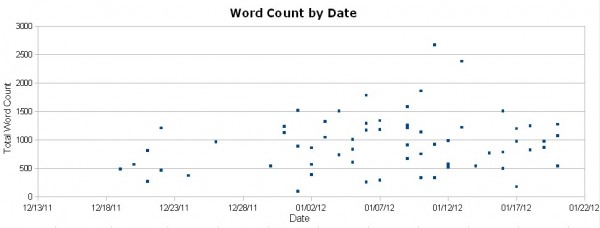
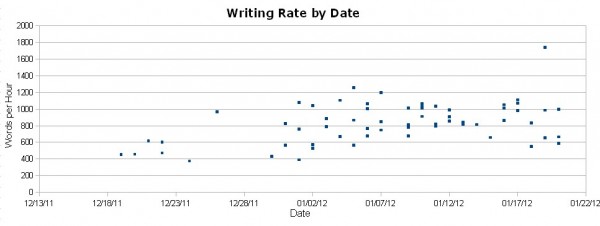
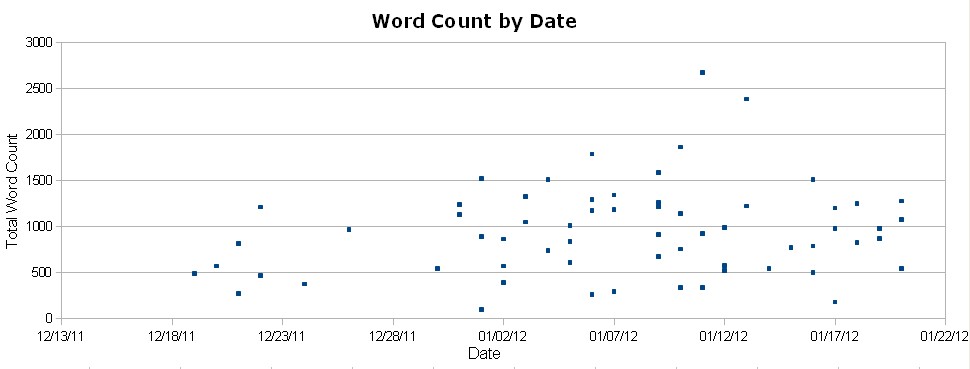
The last two graphs plot word count and writing rate by date.  Before January 3rd or so, I was either spending time with family or on the road / traveling cross-country by train.  Even so, there wasn’t a whole lot of variation, though my writing rate converged around 800-1,000 words/hour for a while before fluctuating again.

What this tells me is that stability and momentum tend to lead to more consistency in my writing habits.  If I’m constantly on the road, it becomes more challenging to keep up the pace.  Even so, as long as I can find make at least 45 to 90 minutes to write, I can pound out about the same number of words per session.

So in conclusion, it seems that the best way to improve my writing habits and streamline my creative process would be to:

  1. Get up early and start the day writing.
  2. Write in short, condensed sessions of 45 to 90 minutes each, with periodic breaks in between.
  3. Don’t worry about time of day when planning time to write; just do it whenever time can be made available.

However, unless I can get to the point where I’m regularly averaging +1,000 words after two hours, it’s going to be really hard to put in 10k words or more per day.  At 800 words/hour, it takes 12.5 hours to hit 10k, and after about four or five sessions at 1,000 words/hour, the well starts to dry up.

A much more practical goal, for now at least, would be to shoot for a consistent 5k words per day.  The week before last, I hit about 5.5k on Monday, a little less than 4k on Tuesday and Wednesday, and back around 2.5k for Thursday, Friday, and Saturday.  My running 7-day total for the entire week was above 20k, which is pretty good, but if I could get to stay between 25k and 30k for some time, that would be an accomplishment.

I haven’t totally given up on hitting a 10k/day average, but at this point, it seems that I need to set some stepping stones first.  5k/day seems like a much better goal for now–especially since I don’t know how things are going to change once I’m traveling again.  But at least I have a better idea of how my own process works.  I expect I’ll be writing a lot more in the weeks and months to come!
plot vs. PLOT and an interesting serial publishing idea

Back in English 318 at BYU, Brandon Sanderson used to tell us that there was a big difference between “little-p plot” and “big-p Plot.” The first applies mostly to chapters and scenes, which he said he could teach us.  The second refers to the overall story structure, which he couldn’t teach in a classroom setting and said we’d have to discover on our own.

I’ve been thinking a lot about this recently, because it seems that my books are starting to fall into a recognizable pattern–and that pattern has some interesting potential for serials and other alternate forms of publication.  Each book is divided into 3-4 parts, each part is divided into 3-6 chapters (typically 5), and each chapter is divided into 3-5 scenes.  Here’s how it works:

Chapter 1: Setup for the basic story arc.  Introduction of the characters and setting, the prominent theme or premise, and a little foreshadowing of the coming conflict.
Chapter 2: The inciting incident, a discovery or event that starts the plot rolling and puts the characters in motion and conflict.
Chapter 3: Complications arise, the problem gets worse, the first attempt at a solution fails, generally leaving the characters at a loss.
Chapter 4: Setup for the resolution.  The characters discover or build something that will help them to settle the conflict.  They stop reacting and start to be more assertive.
Chapter 5: The resolution.  The characters either succeed or fail, but the arc comes to a close either way.  The story question is answered, the thematic elements come full circle, and the story either closes or moves on to the next part.

Basically, it’s the 3-act format divided into five chapters.  When I wrote Heart of the Nebula, all four parts fell into this pattern, and now that I’m writing Star Wanderers, I’m finding myself  falling into the exact same pattern again.  Stars of Blood and Glory is a little bit different; there are three parts instead of four, and each part is divided into six chapters instead of five.  But still, it’s all very structured.

In short, Brandon was right.  It took me a few books to really learn “big-p Plot,” but now that I’ve found a story structure that works for me, it’s starting to come quite naturally.

The cool thing about this particular structure is that it’s very conducive to serialization.  Each chapter is between maybe 3,000 to 5,000 words, so each complete sub-arc is between about 15,000 to 25,000.  That’s the length of a short novella, and it takes me only a month or two to write (sometimes three, depending on how much revision it needs).

The only reason I haven’t done more with serialization up to this point is because I’ve found that sharing my work while it’s still unfinished tends to throw a wrench in my creative process.  The idea of publishing a work in progress on a chapter-by-chapter basis scares me, because if one of the story arcs has a flawed beginning, I wouldn’t be able to fix it.

However, by following a five-chapter arc format (with bits and pieces here and there to hint at a larger overarching structure), I can see myself publishing a novel or epic in a serial format.  It would be something like the Perry Rhodan series, which follows an arc structure of 25 to 100 issues (each a small novella) per cycle.

So here’s how I’m thinking of doing it:

  1. Publish the first installment and price it at free while writing the second one.
  2. Publish the second installment and price it at free, raise the price of the first installment to $.99 and write the third one.
  3. Publish the third installment and price it at free, raise the price of the second installment to $.99 and write the fourth one.
  4. Publish the fourth installment for $.99, drop the price of the first installment to free and publish the completed novel for $2.99.

So what do you think?  Does it seem like a good way to publish a book?  It gives the reader a reason to keep coming back, and rewards those who got in early by charging them less for the completed work.  By selling the novel in shorter chunks, I would be able to put more work out and hopefully gain more visibility, especially by making a portion of it free at any given time.

I’m seriously thinking about publishing Star Wanderers this way, once I hear back from Writers of the Future.  I’ve already finished the rough draft for the second part; it probably needs a good revision or two before it’s ready, but since it’s shorter, it shouldn’t take more than a few weeks to get feedback from some first readers and finish the next draft.  And if the third part is already finished by then…

So many awesome possibilities! 🙂 What do you think?

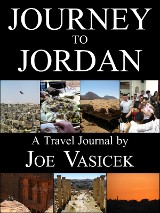
Journey to Jordan is now published!

My travel journals from the 2008 BYU Jordan Study Abroad are now available as an indie published ebook from Smashwords!

Originally published as a blog, I always wanted to make it available as a book someday.  I spent the last couple of months running through it, putting together all the old posts as well as a few private ones.

I’ve edited them to bring the quality of my writing up to date, but did my best to retain the original sense of enthusiasm and discovery.  I’ve also added a foreword and afterword to give it a little more context, especially in light of the past few years.

This is the unillustrated version; I’m not exactly sure how to format ebooks with pictures, so the illustrated version with the photographs will have to wait.  I can’t promise I’ll get it up before I head out to Georgia (I’m just waiting to get the call–I could be leaving as soon as next week), but I’ll do what I can.

This version will be exactly the same as the other except for the photos, however, so if that’s not important to you, the unillustrated version is cheaper and much less unwieldy (only 895 KB).  Also, until Smashwords allows for direct epub uploads in a little less than a year, the only version available from Smashwords will be this version.

It was a lot of fun putting this one together, and I’m excited to see it up!  As with all my books, thanks for taking the time to read it, and I hope you enjoy!

Trope Tuesday: Character Alignment

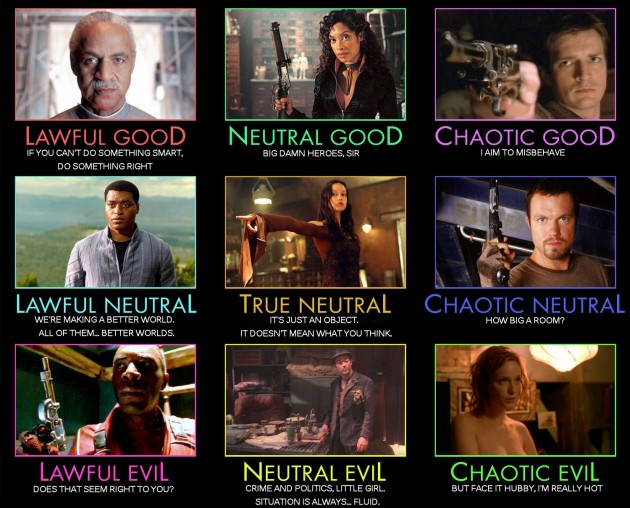
Alternate versions put 20th Century Fox in the Lawful Evil slot.

I love personality tests.  There’s something immensely satisfying about putting yourself on a grid that tells you something new and insightful about yourself and the people around you.  My personal favorite is the Meyers-Briggs test (I’m an ENTP), but I like playing around with others as well.

Character alignment is what you get when you combine fictional characters with the role they’re supposed to play in the story.  It’s a way to categorize the different ways they react to problems and ethical dilemmas, and to see which are inclined to be enemies and  which are inclined to be allies.

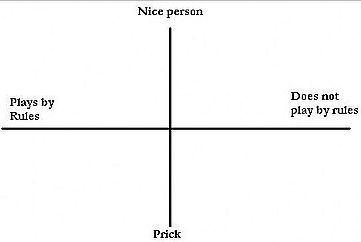
These systems initially arose out of RPG systems like Dungeons and Dragons, which use numbers, charts, and statistics to turn a story into a playable game.  There are many different kinds of alignments, but the most well-known is probably the one used by D&D, which charts characters along a good-evil axis and a lawful-chaotic axis.  In practice, the result looks a little like this:

Of course, that’s a very simplified version.  The tvtropes page goes into much greater depth, but I’ve personally found that this page right here does a much better job explaining the concepts behind the chart.

The horizontal axis, law vs. chaos, describes how much the character values order and authority vs. their own independence and freedom.  Lawful characters value honor and obedience, while chaotic characters value innovation and rebelliousness.  Characters who are neutral with regards to law and chaos generally respect authority, but put their own interests first and go against the established norms when that’s the best way to further their own ends.

The vertical axis, good vs. evil, describes how well (or poorly) characters tend to treat other people.  Good characters are altruistic and make sacrifices to protect the defenseless, whereas evil characters will kill, rob, or torture the innocent simply for the evulz.  Characters who are neutral with regards to good and evil don’t like to hurt others, but are not above pursuing questionable means to achieve their own goals.

Put together, the alignments create a 9-square chart, like the one at the top of the post.  While it’s certainly not obligatory to fill every slot, doing so can add a greater degree of depth to your story, as it certainly did with Firefly.

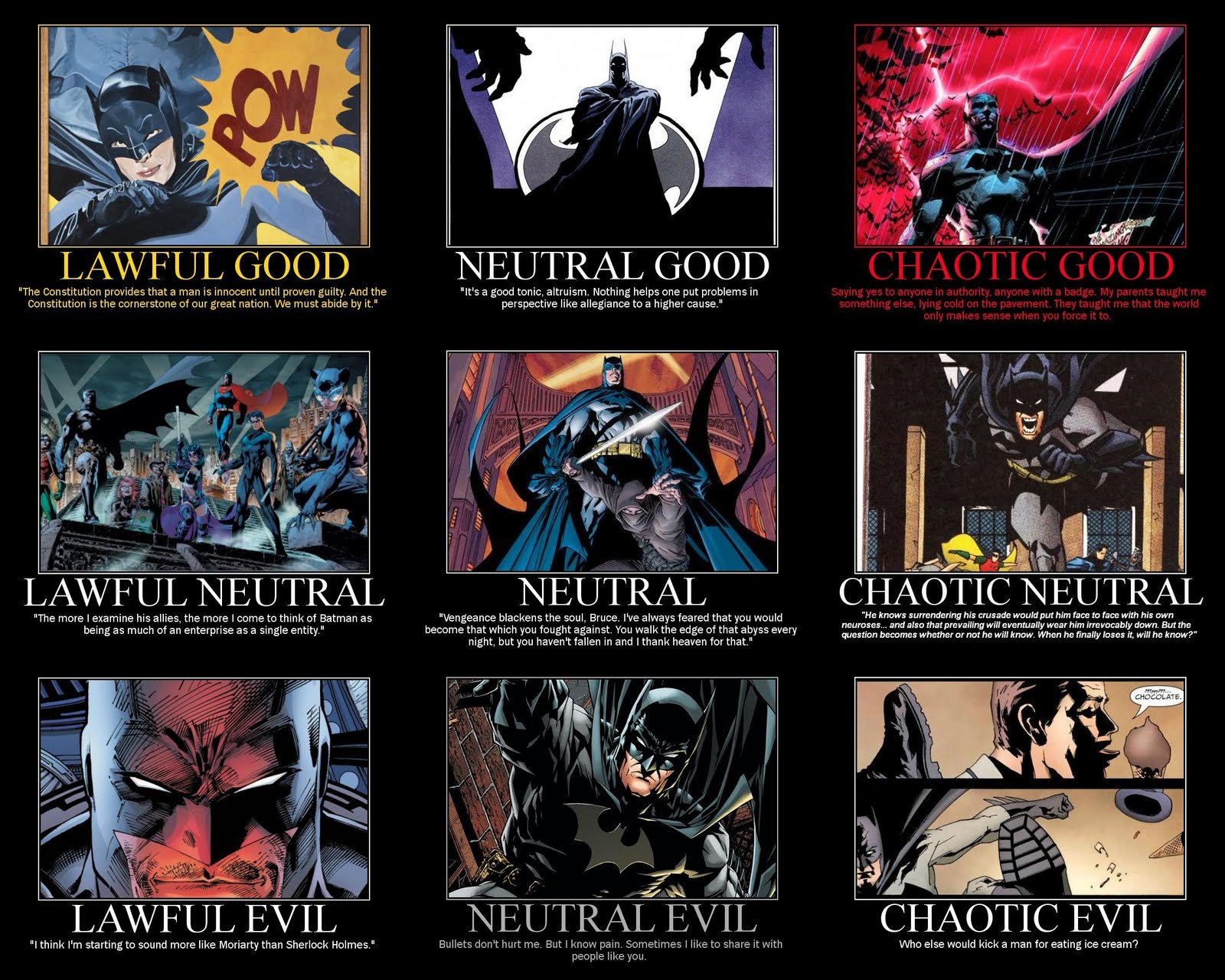
As with any formula, however, there is danger in holding too closely to the chart and becoming inflexible.  In real life, people switch alignments all the time, just as personalities can change and evolve (in high school, for example, I was an INTP).  Not only that, but some characters even fulfill all the possible roles, depending on the incarnation and the story.

Because I'm BATMAN!

The point is, character alignment is just a tool, not a hard-and-fast rule that needs to be used with every story.  If it’s a helpful way to think about your characters and set them up with interesting conflicts, great.  If not, don’t sweat it; Homer and Shakespeare were telling great stories long before this chart.

I’m going to be going overseas soon, so I expect my internet access is going to be spotty for the next couple of months.  Because of that, I’m going to write up a bunch of Trope Tuesday posts on each of the nine alignments and schedule them to post automatically.  So stay tuned for more!

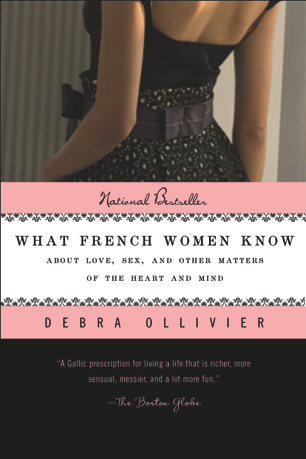
What French Women Know About Love, Sex, and Other Matters of the Heart and Mind by Debra Olliver

I have a confession to make: when I was at my sister Kate’s for Christmas, I saw this book on her shelf and stole borrowed it without permission.  I finished it just yesterday, and at the risk of embarrassing myself, I’m going to review it as my second book of this year.

This book presents a fascinating perspective on French lifestyle, attitudes, and culture.  Even though it’s geared more for women than for men, I enjoyed it in the same way I enjoyed Twilight–as an interesting anthropological experience.

It goes beyond that, though.  The picture Ollivier paints of French culture is fascinating in and of itself, if nothing else for the contrasts she points out between us (Americans) and them.  According to Ollivier, the key difference is that the French have a deep understanding of “the brevity of time and the immediacy of pleasure.” Ollivier follows this philosophy out to its logical conclusions to show that everything in French culture is an outgrowth of this–and it makes sense.

For a non-fiction book, the writing itself is quite entertaining, with constant pop culture references and a playful, humorous style.  It was a delight to read, and fairly easy as well.

However, I did get the feeling that it was a little too enthusiastic and non-critical to present a comprehensive or truly accurate picture of French culture.  Between the lines, Ollivier seems to be saying that if we Anglos would just be a little bit more like our “French sisters,” most of our problems (like our obsession with marriage, our frustrations with perfection, and our general lack of passion) would be solved.

I take issue with this: as much as we have to learn from the French, their culture has a lot of issues as well.  For example, I personally believe that Laïcité is fundamentally incompatible with a multicultural society, and leads to de facto state repression of legitimate religious expression in the public sphere (such as the wearing of the headscarf).

Also, whenever Ollivier described American culture, I always felt as if she was describing something completely alien to my own experience.  There might be a good reason for this, considering how for the past six years I’ve lived in Utah Valley, a bastion of Mormon culture so unlike the rest of the American mainstream.  However, it might also be that Ollivier exaggerates the worst excesses of this continent in order to more sharply contrast the subject matter of her book.

As a writer, though, I found this book inspiring–particularly as a writer of science fiction.  In my novels, I’m constantly inventing new cultures to populate the many worlds in my science fictional multiverse.  This book, with its clear and entertaining analysis of some very real-world cultural differences, gave me an excellent world-building prototype and a whole plethora (oh how I hate that word) bunch of new ideas for ways to enrich my stories.  In fact, this book gave me just what I needed to get through the block that had kept me from writing Star Wanderers, so if nothing else, there’s that.

So yeah, if you’re interested in world cultures or world-building cultures of your own, it’s worth your time to check out this book.  It’s perhaps not the most thorough or comprehensive book, but it is entertaining, and fairly insightful as well.  I mean, hey, if a science fiction geek like me enjoyed it, it’s got to be doing something right.