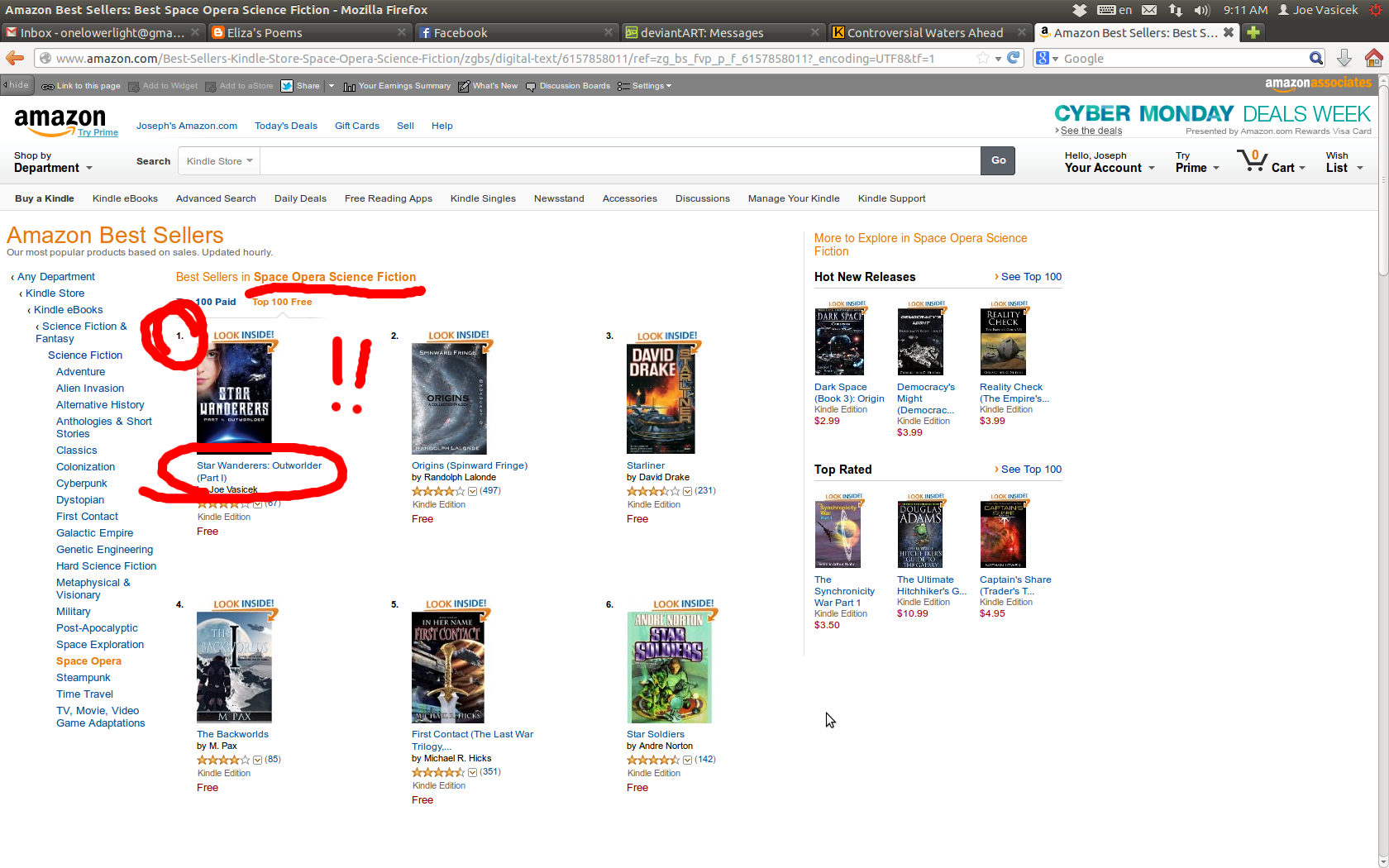
SW-I OUTWORLDER is #1 on Amazon’s Space Opera subcategory!

Check it out! 😀

Screenshot from 2013-12-03 09:11:24With the new cover, Star Wanderers: Outworlder (Part I) has been bouncing around the #3 / #4 slots, with the top slot taken by books with holiday weekend promos.  But now that it’s Tuesday, it’s right up there at the #1 spot!  This is without any kind of extra promotion on my part.

Outworlder has been kicking around on this list ever since it went free in October of last year.  With the old cover, it hovered somewhere between #10 and #15.  I’m not sure if this is the new cover, the holiday weekend, something else, or some combination of the three, but I’m happy to be riding the wave!

#1 on Kindle eBooks > Science Fiction & Fantasy > Science Fiction > Space Opera translates to #41 on Kindle Ebooks > Science Fiction & Fantasy > Science Fiction, which is not bad.  This is for free books, not paid books.  I haven’t cracked any of those subcategories yet, though the other Star Wanderers books are selling at a pretty decent rate.

This is for the Amazon.com store.  Here’s how it currently ranks at the other stores:

  • Amazon.co.uk (United Kingdom): #13
  • Amazon.ca (Canada): #18
  • Amazon.fr (France): #2
  • Amazon.in (India): #14
  • Amazon.com.au (Australia): #6

I may have a problem with checking my sales numbers too much. 😛

Not a new book, just a new cover!

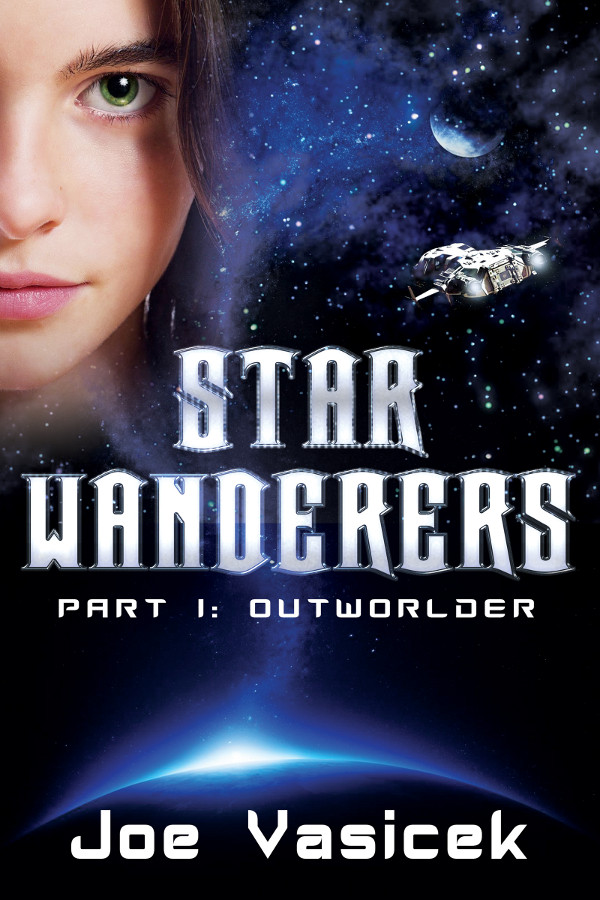
So a couple of weeks ago, I got an email out of the blue from Derek Murphy over at CreativIndie Covers.  He’s a cover designer who periodically does cover makeovers for indie writers, as a way to bring in business and build his own reputation.  He wanted to do an experiment to see if he could double my sales in a month by making over the cover for Star Wanderers: Outworlder (Part I).

Star Wanderers I (thumb)Well, I’ll be the first to admit that the original cover isn’t all that great.  The book was a bit of an experiment, to see if writing in a more serial format would be more effective than writing and releasing full-length novels.  I’d spent a fair amount of money to get Bringing Stella Home and Desert Stars up, and sales were too low at that time to justify another huge publishing project. In order to cut costs, I did the covers myself, using public domain images from NASA and Hubble.  They aren’t super great, but they do say “space!” which is better than a gray box with a question mark.

If anything, I’m surprised that the series has done as well as it has with the current covers.  Each book in the series sells in the double or triple digits monthly, and Outworlder has been in the top 20 on Amazon’s Kindle eBooks > Science Fiction & Fantasy > Science Fiction > Space Opera and Kindle eBooks > Romance > Science Fiction subcategories for over a year.  The consistency with which these books have been selling has really surprised me, so anything to push these books to the next level and put them in front of new readers will hopefully yield some awesome results.

So Derek and I went back and forth for a while, and this is what we came up with:

SW-I alt (cover)Pretty sweet, huh? 😀

I am extremely excited about this cover, and I’d love to see what he can do with the other ones.  First, though, we’re going to put this one up for the month of December to see if it has a noticeable impact on overall sales.  I’ve got data from last December as well as the last few months to compare it to, so we’ll see how it does.  And if there is an appreciable increase, I’ll probably go ahead and have him redo all the other covers as well.

Since this is still just an experiment, though, the covers for the print editions will remain the same as the old ones.  I don’t anticipate keeping them forever, though, especially if this experiment works out.  Even so, I’m still going to release them as I’d planned, so if you want the print versions, you can get them.

And who knows?  If these books take off, or I become a well-known author in the future, the original print versions of the Star Wanderers books may be worth something someday.  Maybe.  Who knows?

So far, it appears to be working.  The new cover went live on Amazon last night, and Outworlder has dropped about 700 rankings to #1,705.  That’s without any sort of advertising or promotion, except for the also-bots of course.  Last year around this time I participated in a fairly big group promo, so I’ll try to get this book listed in a couple of places to make up for that.  Or maybe we can extend the experiment through January, in the interest of keeping a really cool cover getting more accurate data?  We’ll see.

Man, it’s so much fun to be a self-published indie writer! 😀

Back to novels again

So yesterday I finished the rough draft of Sons of the Starfarers: Brothers in Exile.  It needs work, but at least I’ve got something to work with.  Of course, before I can do that, I need to take a break and work on something else.

For my next project, I’m going to do a massive revision of a novel I wrote almost three years ago.  Heart of the Nebula is a direct sequel to Bringing Stella Home, and features James McCoy as the main character.  He’s older and (somewhat) wiser, with a lot more responsibility resting on his shoulders as an officer in the Civil Defense Corps of the Colony.  With the Hameji occupation driving them into famine and poverty, the stakes are a lot higher than the first book, and the dangers and intrigue a lot more complex.  Not only are there pirates and criminals to deal with, but the Patrician is playing his own game, and James soon gets caught up in it.

Currently, this book is a real mess.  I’ve attempted numerous revisions of it before, but finished none of them.  The first part of the book is probably pretty close to where it needs to be, but then there are a bunch of broken subplots, characters who were excised from certain sections and left in others, scenes and chapters out of order, and relationships that develop either way too fast or hardly at all.

Before I dive in, I’m reading through the whole draft and making notes on a scene by scene basis.  I’ve got a map set up for where all the scenes need to go, and I’m putting together a checklist of all the changes I have to make.  I did the same thing when I wrote Bringing Stella Home and Genesis Earth (come to think of it, Desert Stars as well).  Hopefully, this will help the revision to go quickly and to fix all the broken elements without watering down or polishing out the good stuff.

Probably the most important thing about revision notes is that they help me to separate my critical mind from my creative mind.  When I’m looking at the book in my critical mind, I want to throw out the stuff that isn’t perfect and make lots of changes to the story.  However, that can be a lot more destructive than constructive, since it’s the creative mind that really makes the good stuff.  By writing a set of notes before diving into revisions, I can keep my critical mind from making too many changes to the actual story, and identify the problems so that when I go back to make the changes, I can switch the critical mind off and keep the creative mind on.  And often, instead of making the changes I told myself to make (or rather, the changes my critical mind told me to make), my creative mind comes up with something else that puts the story on a much better path.

That’s the theory, anyway.  We’ll see how it goes.  The revision notes are going pretty quickly now, and even though things are going to get more complicated deeper into the book, I don’t think it will take me more than three or four days to finish them (unless I get called in to a job somewhere). Once that’s done, I’ll dive right into the book, probably tossing half of it and rewriting from scratch.

Thing is, it’s been a long time since I’ve worked on a novel this way.  All last year, I’ve been writing novellas, and while some of them have required overhauls, it’s never been too complicated.  With novels, though, it can be a mess.  I’m sure I can do it, but I’m not sure how long it will take me.  Hopefully no longer than a month, but I’m not going to stress it.  The important thing is to do it right, and to really immerse myself back into this world.

So that’s what I’m working on now.  I hope these updates on my writing projects aren’t too boring.  They’re really helpful in writing the Author’s Notes at the end of each book, because I can go back to my blog, drill down the categories by book title, and see what I was working on at various different times when other stuff was happening in my life.  For a book like Heart of the Nebula, that’s going to be important, because it’s been almost three years in the making.  For most of that time, it was just sitting on the back burner (or, more accurately, the fridge), but it’s out again now and I’m focusing on it again.  We’ll see how it goes.

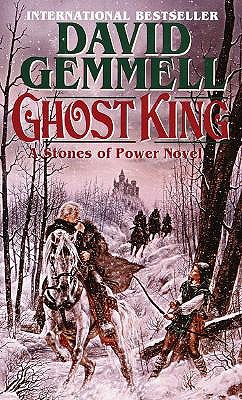
Ghost King by David Gemmell

Ghost KingAnother review of a David Gemmell book?  Yes, because I’m just that much of a fanboy.

With the Drenai series finished, I decided to sink my teeth into the Stones of Power series.  This series confuses me, because I’ve read The Jerusalem Man, which was retroactively put in as book three, but that’s a post-apocalyptic tale of the gunslinger Jon Shannow, but the series actually starts in Arthurian England.  As soon as I got a couple chapters into the first book, though, I began to see the connection.

Ghost King is an alternate history tale of King Arthur (Uther, in the book), and how he rises to become the Blood King of Britannia.  His grandfather, Culain, takes him into the mountains after the Brigantes assassinate his father, and there trains him to become a leader and a warrior.

Culain, of course, is one of the immortal Atlantians, just like his friend Maedhlyn (Merlin).  After the fall of Atlantis, they have wandered the Earth as gods, using the powers of the Sipstrassi stones to accomplish wonders.  Worshipped in turn by the Greeks, the Romans, the Hittites, and the Babylonians, Culain has tired of immortality and now wants to live out a mortal life.  But his jilted lover, the Ghost Queen, wants revenge on him for leaving her.  She was the one who killed Uther’s grandmother and mother, and who now wants to kill him and rule all of Brittania.  But her son Gilgamesh has corrupted her, so that in a parallel universe she must kill twenty pregnant woman every month just to replenish the magic of her Sipstrassi …

Okay, I might as well give up trying to explain the plot, because it only gets crazier.  Somewhere in this parallel dimension, a lost Roman legion has been wandering for hundreds of years, consigned to the void by Culain.  Also, Gain Avur (Guenevere) is in there too, as well as the Lance Lord (Lancelot), though he doesn’t come in until the epilogue.  There are also demons and vampyres, all sorts of battles, and lots of other crazy stuff.  It’s pretty freaking dang awesome.

I really enjoyed Uther’s transformation from the weak, bookish boy to the warrior king, as well as the budding of his relationship with Gain Avur (what can I say, I’m a sucker for romance).  My favorite character, though, was Prasamaccus, a crippled Brigante peasant who becomes one of Uther’s close advisors.  He’s basically a regular guy who gets sucked up into the whole adventure, but he’s level-headed and practical enough that he manages pretty well.  He’s also just a good person, which was quite refreshing in a world full of death and drama.

At one point, after rescuing Uther, he’s a guest in Uther’s chief general’s villa.  The general gives him a servant girl for the night, since in this world most men think nothing of bedding a slave.  Prasamaccus is a peasant, though, and he’s kind of shy.  The girl was actually captured in a raid in Germany, where she was raped, and this is her first time bedding someone since those traumati not the monster she’s afraid that he’ll be–they actually share a really tender moment of intimacy that heals much of her trauma and introduces him to the love of his life.c events.  She’s absolutely terrified, but so is Prasamaccus–he’s a cripple, and assumes that women just don’t want him.  He spends the night with the girl but doesn’t force her to sleep with him, and when she realizes how gentle he is–that she holds the power, and that he’s not the monster she’s afraid that he’ll be–they actually share a really tender moment of intimacy that heals much of her trauma and introduces him to the love of his life.

It’s poignant, story-rich moments like that that make me such a David Gemmell fanboy.  Usually they happen in the midst of war, between battle-hardened friends who are forced by circumstance to do something heroic, but they also happen in the quiet moments between characters who carry other scars.  That whole thing in the previous paragraph only happened in three pages or so, but it was still so incredibly powerful and moving.  Every moment of a David Gemmell book is like that, sometimes from the very first paragraph.  It’s awesome.

As far as David Gemmell books go, I’d put this one in about the middle of the pack.  It’s not quite as powerful as Legend or Wolf in Shadow, but it doesn’t meander as much as White Wolf or have such an anti-climactic ending as Ironhand’s Daughter (which was probably split by the publisher–more on that when I review The Hawk Eternal).  The characters aren’t quite as memorable as Druss, Skilgannon, or Waylander, but they are pretty awesome nonetheless.  I’d rate this book a 3 compared to Gemmell’s other books, but a 4.5 out of fantasy overall.  Definitely worth a read.
I’m not going to talk about nanowrimo

I’m not going to talk about nanowrimo because … yeah, I’m not going to talk about nanowrimo.

I’ve been doing a lot to get the print versions of the Star Wanderers novellas up, but beyond that, not a whole lot of writing.  Still one scene to go in Sons of the Starfarers: Brothers in Exile (that’s the working title, anyway), but I keep putting it off because … I dunno.  So many other things going on, maybe?  Sometimes it’s the easy stuff you put off the longest, sometimes, the hardest stuff.  But I already said I wasn’t going to talk about nanowrimo …

In any case, I set Thanksgiving as the deadline to get all the print versions out for Star Wanderers, and it looks like I’ll be able to hit it.  Outworlder, Fidelity, Sacrifice, and Homeworld are already up, and should propagate to Amazon in the next couple of days.  Dreamweaver is in the proofing process, and I should be able to typeset Benefactor and Reproach in the next couple of days.  It’s a relaxing thing to do while listening to podcasts, and the books are short enough that I can get all the work done in just a few hours.

In December, I hope to release a new Star Wanderers book: Deliverance, which covers the events of Homeworld from Mariya and Lucca’s points of view.  This was a fun one to write, so I’m looking forward to getting it out there for you guys to read.  It’s with my first readers now, who should get back to me by the first week of December or so.  The draft is already pretty clean, so unless they bring up some major issues, I should be able to get it out fairly quickly.

And after that, I think I’m going to take a break from the Star Wanderers universe for a while to work on some novels.  It’s been fun doing the shorter stuff, and I’ll definitely return to the novella form in the future, but there are a bunch of unfinished projects screaming at me to work on them.  First among them is probably Heart of the Nebula, which I haven’t even touched in almost a year.  It needs a huge overhaul–I’ll probably scrap a good half or so from the middle, probably more.  But the ideas behind the story are solid, and I would really like to get another Gaia Nova novel out soon.

But the one that’s calling the most to me is probably Lifewalker.  That’s the post-apocalyptic one with the guy wandering down the ruins of I-15 with a copy of Brandon Sanderson’s Mistborn toward a Las Vegas populated by cannibals.  There’s actually a lot more to it than that, but that’s the 10 second pitch I’ve been giving people.  The voice on that one was so different from anything else I’ve done, I had to take a break from it after I got to a good stopping place.  But recently, it’s been calling out to me to finish it.  I’ll probably move on to that one if I don’t go to Heart of the Nebula first.

Then there’s Edenfall, The Sword Bearer, a couple of other untitled ones, that Sword & Planet story I said I’d write … holy crap, so many unfinished books.  I feel like I’m a bad writer whenever I don’t finish everything I start, but that just seems to be part of my process.  Hopefully none of my readers are too impatient to get any particular book–although, come to think of it, that kind of pressure might be just what I need.

Either way, I really need to get back to writing.  But I already said I wasn’t going to talk about nanowrimo (I wonder if this blog post counts?)

😛 Later.

Trope Tuesday: Eagle Squadron

pdrm8846cYou’ve got your standard mercenaries: hired guns who fight for money.  Then you’ve got your fighting for a homeland types: mercenaries (usually) who used to have a cause to fight for, but now all they’ve got is each other, and maybe the hope that someday they’ll find a new homeland to replace the one they’ve lost.  Invert that, and you’ve got an eagle squadron: a ragtag bunch of volunteers who leave their homeland to fight for someone else’s cause, usually a sympathetic rebel faction or band of underdog freedom fighters.

It isn’t really fair to group these guys with mercenaries, since they aren’t fighting for money or fortune.  Far from it.  They believe so totally in the cause they’re fighting for that they’re willing to give up their lives for it, even though they could easily go home and live out their lives peaceably.  At least, that’s how it is on the idealist side of the sliding scale.  On the more cynical side, eagle squadron is really just a Legion of Lost Souls full of thugs and criminals who are hoping to clear their names.  Or, even further down the scale, perhaps they just love killing.

Even on the idealist side, there’s always the possibility that your terrorists are our freedom fighters.  After all, where did Al Qaeda come from?  The Mujahideen, volunteers from all over the Muslim world who joined with the Afghan freedom fighters against the Soviet invasion of the 80s.  When they won, it galvanized their Islamist cause and inspired them to take the fight to their homelands, many of which were ruled by dictators.  Since the United States props up many of these dictatorships, it was only a matter of time before they turned on us as well.

The name from this trope comes from three volunteer squadrons of US fighter pilots in World War II, who joined the RAF in the fight against the Nazis back when the United States was still neutral.  Since the Nazis have pretty much become the standard of all that is evil in the eyes of our modern society, the eagle squadrons are now heroes by default.  War is of course more complicated than that, though there is still room for heroism even in a world of moral ambiguity.

When the eagle squadron makes the ultimate sacrifice, you can count on them being remembered as heroes for all time.  That’s basically what happened with the Alamo: a bunch of frontier Americans sympathetic to the cause of Texan Independence went to join the fight against Santa Anna and made a bloody last stand when the war went out of their favor.  Of course, since history tends to be written by the victors, it’s arguable that this only happens if the survivors go on to win the war.  After all, plenty of expatriates volunteered to fight for the Nazis, but we don’t remember them in quite the same way.

Wow, this post turned out to be way more cynical than I’d intended.  The basic drive behind this trope is the yearning for an ideal, a cause to fight for.  We root for the eagle squadron because we want to believe that all it takes to defeat evil is for good men from across the world to take up arms against it.  If Eagle Squadron is led by the Incorruptible, then that might actually be the case, though it’s difficult to make that kind of a story anything other than black and white, one-dimensional, and utterly inauthentic.

I haven’t played with this trope too much yet, though I’ve been meaning to write a prequel book in the Gaia Nova series that tells the origin story for Danica and her band of Tajji mercenaries.  Her father was an admiral in the Tajji rebellion, and when the star system fell to the Imperials, they killed her entire family.  She escaped, though, and was taken in by an eagle squadron commander that fought alongside her father against the Imperial oppression.  After getting back on her feet, she leaves the Eagle Squadron to start her own military band, intent on getting revenge for the loss of her homeworld.  I’m not sure yet how the eagle squadron will play into that, but I see the commander as trying to dissuade her from this path.

In any case, it’s definitely a trope I want to play with.  I had a lot of fun with fighting for a homeland in Stars of Blood and Glory, so this would be a way to revisit some of the dynamics that made that story interesting.  You can definitely expect to see more of this from me in the future.

Nanowrimo is kicking my butt

… but that’s a good thing.  While procrastinating my daily word count, I’ve almost finished Book I of Sons of the Starfarers, formatted and orders proofs for the first four Star Wanderers novellas, alpha-read most of another book for a friend, and done a bunch of other things (which is nothing compared to a friend of mine, who procrastinated by getting a job).

Right now, I’ve got about 3,500 words written, which means I need to write about 2,000 words a day in order to hit 50k words before the end of the month.  Actually, that shouldn’t be too hard–most of the difficulty of writing is just getting out of the way, so when I put my hands on the keyboard and say “whatever you do, DON’T STOP WRITING,” good things actually happen.  At a nanowrimo get-together at Dragon’s Keep in Provo, I knocked out 1500 words in about an hour using that method.  It’s actually quite liberating–I should do it this way more often.

So why only 3,500 words, instead of the 11,666 that I’m supposed to have?  Because I REALLY REALLY REALLY have to finish this Sons of the Starfarers book, and that’s been taking up virtually all of my time and mental space.  I hit the action stuff a couple of days ago, and things were just flowing, but now it’s that last crucial scene and I’m not quite sure how to pull it off.  Probably I’ll write something and change it later, or tell myself that at least so I can just finish it and move on.

But UURGHH!

Anyways, that is all.  Back to writing.

Why boycotting Ender’s Game is stupid

First of all, let me just say that I don’t think there’s anything wrong with making a personal decision not to read a book or see a movie because you disagree with the views of the author.  We all should be free to consume (or not consume) the media we choose, and if a certain author offends for any reason, I think it’s perfectly fine to cut that author’s work out of your life–as a personal decision.
But with Orson Scott Card and Ender’s Game, there’s a group of people who are taking it a step further and organizing an all-out boycott.  They want the movie to fail, because Orson Scott Card holds some views about morality and homosexuality that they find offensive–views that have nothing to do with the movie at all.  The idea is that Orson Scott Card is a homophobe, and as such everything he creates should automatically be rejected out of hand.

There are a number of reasons why this idea is stupid, many of which have been discussed elsewhere.  There are those who agree with Card’s views and make their arguments on that basis.  I don’t care to go there, because he has been a controversial and divisive figure, and I do think there are legitimate reasons for disagreeing with his views.  There are views he holds that I disagree with very strongly.  However, I do think there is something to be said about the way his opponents have twisted his words.

Laying ideology aside, there are those who say the boycott is stupid because it will send the wrong message.  If the boycott is successful (which I doubt it will be), then all that filmmakers are going to take from it is that the public doesn’t want to see sci-fi movies of this type.  There’s nothing whatsoever in Ender’s Game that has anything to do with Card’s views on homosexuality, so boycotting it isn’t a very effective way to protest his views.

Those are all valid reasons, but none of them are the main reason why I think the idea of this boycott is flawed.  I’m not concerned with the impact this boycott will have on Orson Scott Card, but the impact it will have on the writers who follow after him.

Frankly, Ender’s Game is such a phenomenon, I doubt that this boycott is going to do any real harm, no matter how loudly some corners of the internet rage against him.  If anything, it’s just more publicity, and perhaps an opportunity for him to get back into the public arena to bring attention to some of his views. As of now, it seems he’s content to ignore the boycotters, which he can easily afford to do since he’s successful and well-established.

But the message it sends to budding writers is a lot more powerful, and much more dangerous.  For science fiction writers who are in the early stages of their careers, this boycott sends the message that there is an ideological orthodoxy in the science fiction community that will do everything it can to destroy you if you challenge the beliefs that they hold sacrosanct.  It sends the message that some beliefs should never be challenged, not even in a genre that is famous for challenging beliefs and ideas.  And finally, it sends the message that if you challenge the new orthodoxy, they will not engage your ideas in an intellectually honest debate, but do everything they can to marginalize and dismiss you.

I could understand this boycott if Orson Scott Card had actually done something illegal like committing hate speech–something that clearly crosses a line that we as a society have collectively agreed upon.  But he hasn’t.  He just holds some views that a lot of people, perhaps even a majority, find hateful and offensive.  But if that’s just a way of saying that he opposes the new status quo, how is it not regressive and reactionary to attack him for that?

If you disagree with Card’s views, engage him.  Make him eat his words.  Use the movie as an opportunity to bring up these old debates and point out just how wrong and offensive he was.  Don’t use something he said fifteen years ago to sabotage what is arguably the best sci-fi movie of the year, if not the decade.  And for the sake of all the books that are yet unwritten, don’t threaten the writers who dare to challenge the beliefs you hold sacrosanct.  Don’t replace one rigid orthodoxy with another.

There was a time when science fiction was known as the genre of ideas, where writers were free to question anything, even our most basic assumptions about humanity.  Let’s do what we can to bring those days back, not shut them off forever.

Publishing is as easy as the Irish Tinwhistle

David Gaughran has another excellent blog post up, this time about publishing in general and something that most newbies don’t realize when they first start out.  From his post:

I’m saying that when a newbie has been convinced that self-publishing is hard or expensive the chances of them falling into the clutches of a third-party which will result in a poor outcome increase exponentially. Because they’ll take any kind of deal, or sign up with any fly-by-night outfit, or engage one of the vanity presses masquerading as a self-publishing company.

So we need to get the message out. Yes, writing is hard, but these third parties will give you no help there. And yes, marketing can be tricky, but that’s probably going to fall on you no matter what path you choose.

Publishing, on the other hand, is easy.

I’ve found this to be exactly the case, and it’s one of the reasons why I’ve decided to stick with the indie publishing path.

Publishing is easy.  Publishing is fun, in fact.  There’s a lot of hair-pulling when you first start out, but once you get over the initial learning curve, it’s a blast.  These people selling “self-publishing packages” are almost all scammers, especially if they’re charging more than $1,000.

Marketing is an aspect of this business that currently eludes me.  Even so, I’m still doing all right.  I’ve been making a profit since 2012, and I’m currently about halfway to making a full-time living at this.  With the whims of the market, that could change at any moment, but there’s still a lot of room for things to go up so I’m not too worried.

As for writing, well, that’s probably always going to be hard.  I tend to self-edit a lot as I write, so hopefully nanowrimo will help me out with that.  Once you’ve found your voice and gotten the basics of your craft, you have to learn to let go and let the story happen, which is something I struggle with.

Right now, I’m having a hard time with putting out a consistent word count.  That’s probably the hardest part of taking the indie path–keeping yourself from getting spread too thin.  I’m trying to get print versions of the Star Wanderers novellas out on Amazon (Outworlder is already out!  Get it here!), so that’s taking a fair amount of time and energy, even though I’m taking it slow.  Really, though, I wonder how much of it is just fear or self-doubt or other writerly angst that pops up from time to time.  It’s a constant struggle.

But publishing?  Publishing is easy.  Give me a manuscript, and I can turn it into a fully functional, well formatted ebook in less than an hour.  For a print book, I can do the typesetting and cover design over a long weekend if I’ve got nothing else going on.  Easily.  And from there, it’s just a matter of uploading to Amazon / Smashwords / wherever, filling out the metadata fields, and clicking the button that says “publish.”

There is nothing about the technical aspects of publishing that a writer can’t learn how to do for himself.  If you can publish a blog, you can publish an ebook.  The only reason to pay someone to do it for you is if the opportunity cost of taking the time to learn is too high, which is only really the case if you’re a highly paid professional at something else and writing isn’t your main career.  Even so, it’s not hard to find someone (like me!) who can do a good job for $50 or less.

It’s kind of like the Irish tinwhistle.  Sure, you can pay through the nose for a limited edition collector’s piece (which probably has a very generic sound), but the best ones cost less than $20 and look like they’ve been used as a doorstop for a while.  The quality of the sound does not correlate at all with the price–in fact, you’re more likely to get a better instrument if you don’t pay through the nose.  You can even make your own!

In fact, there are a lot of similarities between self-publishing and playing the Irish tinwhistle.  You can teach yourself how to do it, pick up tips and tricks by hanging out with other unwashed, self-taught musicians, learn all sorts of tunes or make up your own, and play it any way you like.  You can play for pennies in the park, beers in a pub, or go for gold and hit the big time.

Dang–now I really want to get back into Irish music again!  One dream at a time, Joe–one dream at a time.

But yeah, publishing is easy–not to mention, fun!

Trope Tuesday: Made a Slave

Citizen of the GalaxyJust because something is heinous doesn’t mean that it won’t make a good story.  In fact, the Rule of Drama practically guarantees that it will make a good story.  For some weird reason, we humans are fascinated by things in fiction that would horrify us in real life, and love it when our favorite characters are put into situations where we would never want to find our loved ones.  Perhaps there are many reasons for this, some of them better than others.

One of the worst situations in which anyone can find themselves is slavery, in which they basically become the property of someone else.  Slavery takes many different forms (and has many different tropes), but the thing they all have in common is the denial of freedom, dignity, and the basic human rights that most of us take for granted.  So when a character who’s free gets made a slave, you can usually expect to see some pretty high drama as a result.

As the tvtropes page for this trope explains it:

There is often a scene in which the character is being sold on the slave market, showcasing all the evils of slavery; the protagonist will witness how families are torn apart, will have to undress and be examined like an animal, and will perhaps be beaten … If he looks strong, he will be told that he will go to the galleys or the mines — a Fate Worse Than Death — or perhaps to the Gladiator Games. If she (or occasionally he) is attractive, she will be told that she will make a buyer very happy indeed.

If the main character is a slave, this is usually a part of his (or her) backstory; it’s fairly rare for a character to be born into slavery these days, probably because slavery is no longer considered an acceptable social institution in our modern Western society.  In older stories, the slave character may be of noble birth, setting up a sort of Cinderella story where they realize who they are and eventually come into their own.  That still happens, though usually it’s more about them taking power into their own hands to rise above their awful circumstances.

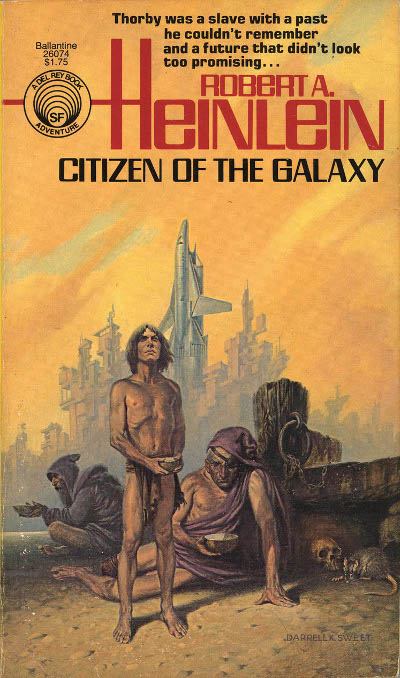
Surprisingly, this is a trope you’ll see with some frequency in science fiction.  Heinlein wrote a novel about it, pictured to the left (one of his better ones, in my opinion).  It happens quite a bit in the Sword and Planet subgenre, as well as any gladiator-type tale.  You’d think at some point our technology would become sufficiently advanced that we wouldn’t need to enslave each other, but apparently we will use manual labor in the future. Besides, at it’s core, slavery isn’t about acquiring cheap labor–it’s about owning someone, taking away their freedom and control.  Until human nature itself changes, we’re probably going to have to deal with slavery in one form or another for the forseeable future.

In any case, there’s something rousing–perhaps even inspiring–about the story of a character who rises above such an awful situation to win back, against all odds, their rights and freedoms.  That’s probably why we still enjoy retelling this trope.  A character can’t truly rise until they’ve bottomed out somewhere, and as far as hitting rock bottom goes, getting made a slave is pretty dang low.

I’ve played with this trope in a couple of my books.  In Sholpan and Bringing Stella Home, Stella goes through pretty much everything on the tvtropes page, which sets things up pretty well for … well, I won’t spoil it. 😉 In Stars of Blood and Glory, Abaqa tries to make the Princess Hikaru his slave, but since they’re both teenagers and he’s younger than her, it ends up being rather hilarious (she gets rescued soon afterward too, so it doesn’t stick long enough for the really bad stuff to happen.  And then the rescuers … well, I won’t spoil that either).

Right now, I’m playing with it a bit in Sons of the Starfarers, though I’m not sure where it’ll end up exactly.  Probably not so far as this trope, but I never really know what my characters will do–or what will happen to them.