So what should I work on next?

Now that Star Wanderers: Deliverance (Part VIII) is published, I’m back in the position of trying to figure out what to write next.  Usually, I just do this on my own, but this time I thought I’d run it by my readers and see what you guys have to say.  Here are the options:

Heart of the Nebula — This is a direct sequel to Bringing Stella Home.  It follows James, Lars, Stella, and several new characters as they struggle to keep the Colony from falling apart following the collapse of the New Gaian Empire.  This one is mostly a space opera story, with lots of action and political intrigue.  It also explores the wolf/sheepdog analogy that Danica brought up in Bringing Stella Home, with Lars’s rebuttal.

Mercenary Savior — Another Gaia Nova novel, this one showing the origins of Danica Nova and her band of Tajji mercenaries.  I’ve got a lot of ideas for this one, though I’ve only written the prologue so far.  This is going to be a military sci-fi story, with lots of action, lots of violence, and (hopefully) a few heart-wrenching moments as well.  Danica, Roman, Mikhail, Artyom, and several of the other mercenaries will appear in this one.

Empress of the Free Stars — Yet another Gaia Nova novel, this one a direct sequel of Stars of Blood and Glory.  It brings back Princess Hikaru, now the Empress of Shinihon, and shows her struggle to ensure the safety and freedom of her people in the face of a Federation that is fast transforming into an autocratic, totalitarian empire.  Colonel Webb is at the heart of the political intrigue in this one, and the stakes are as high as they’ve ever been.

Sons of the Starfarers — This is the spinoff series I’m writing to follow up Star Wanderers.  It takes place in the same universe as the Gaia Nova novels, except a thousand years before, and will eventually show the origins of the Hameji and tie all of these books together.  This is the one I’m most excited to write, as it brings back a bunch of characters from Star Wanderers and puts them into some interesting situations.  Hopefully, it will have the same stuff that made Star Wanderers so great while adding a bit more action/adventure stuff into the mix.

Edenfall — This one is the sequel to Genesis Earth, and the second book in what will eventually become a trilogy.  Basically, about fifteen years after Michael and Terra settle down on Icaria, a military expedition arrives from Earth, shattering the idyllic life they’ve made for themselves.  They try to convince the military people that there is no alien threat, but before they can do that, the ghost ship comes back, throwing everything out of balance.  This story is mostly from the point of view of Estee, Michael and Terra’s daughter, whose whole world is changed when the other humans appear.

Lifewalker — I’ve mentioned this one only a couple of times on my blog, but everyone who’s read the first chapter tells me that they want more.  This one is a completely different project from anything else I’ve done.  It’s a post-apocalyptic tale told from the point of view of a man who lives out his natural life where everyone else is infected with a disease that kills them at age 25.  After the first chapter, the he starts down the ruins of I-15 with a bible, a bicycle, and a copy of Brandon Sanderson’s Mistborn, searching for the mythical city of light known by the forefathers as Lavegas.  Little does he know, that place is now populated by cannibals.

The Sword Bearer — An epic fantasy about an ancient brotherhood of sentient swords who pass down the knowledge and skills of each bearer down through the generations.  The brotherhood has been broken, and the few swords that haven’t been lost have driven their bearers insane to the point where they’re now amassing an army to conquer and enslave the whole world.  The only sword who hasn’t gone down that path is the one prophesied to be wielded in the final battle to defeat this great evil, but it hasn’t taken a bearer for almost a thousand years–that is, until a curious young tavern girl from the mountains accidentally stumbles upon it.

Those are pretty much all the major options.  I have a couple ideas for other books, but nothing that I’ve really started.  Even though I have my preferences, I could go almost any way depending on what you guys want to read.  So if there’s one or two that you really want me to work on next, feel free to let me know!

STAR WANDERERS: DELIVERANCE (PART VIII) is now available!

SW-VIII (thumb)Well, guys, it looks like I’ve gone and published another book! Star Wanderer: Deliverance (Part VIII) is now live on Amazon, Smashwords, and Kobo, and will soon be up on Barnes & Noble, Sony, and the iBookstore.  In the next couple of months, I’ll probably put it up on Google Play and DriveThru Fiction as well.

This is the eighth Star Wanderers book, and more or less brings the series to a close.  That doesn’t mean that I’m finished with this universe or these characters, though.  I plan to bring a lot of them back with Sons of the Starfarers, a spinoff series that will follow Mariya’s brothers, Isaac and Aaron, as they fight to keep the Outworlds free from Gaian Imperial domination.  That series will also tie everything in with the Gaia Nova novels, and show the origins of the Hameji.  So be sure to look out for those!

Also, I’m happy to report that the print editions of Outworlder (Part I), Fidelity (Part II), Sacrifice (Part III), and Homeworld (Part IV) are now available on Amazon!  Each costs about $5, and is between 75 to 100 pages.  The print versions for Dreamweaver (Part V), Benefactor (Part VI), Reproach (VII), and Deliverance (Part VIII) will hopefully be out before the end of the month!

A note about the print editions: I’m currently using the same covers as the ebooks, with the generic NASA space art.  However, I recently made an agreement with Derek Murphy of CreativIndie Covers to redo the book covers for the entire series.  This includes the print versions, so once I have the new covers, I will replace them and the old versions will be unavailable.

If you want the best looking print book, it’s probably best to wait.  Derek did a really awesome job on Part I: Outworlder, and I expect that the rest of the covers will be just as stunning.  However, since there’s only going to be a limited number of the original versions, there is a chance that they might become more valuable if these books really take off.  I can’t make any promises about that, since I really have no idea, but if you would like to get the original versions, they will only be up for a couple of months as I gradually replace them.  I will have matching versions for each book in the series, though, so if you want to collect a complete set with the original cover art, you’ll definitely be able to do that.

That just about does it.  As always, thanks for reading!

Resolutions and such for 2014

Yes, I know this post is a couple of days late.  Yesterday I was busy publishing Star Wanderers: Deliverance (Part VIII), though, and the day before that I was on the train, and today I had to renew my vehicle registration … enough!  On to the resolutions.

1. Publish something every 6 weeks.

One thing I really need to get better about is publishing new work.  So this year, I’m going to do my damnedest to follow a regular publishing schedule.  I don’t know what I’ll be publishing, exactly, but I have a pretty good idea, and surprisingly enough it actually works out to a lot less work than you’d think:

  • WEEK 1: SW-VIII: Deliverance (already done)
  • WEEK 7: SW V-VIII:  Tales of the Far Outworlds (the second STAR WANDERERS omnibus–basically, I just need to write the Author’s Note and get a cover, since the stories have already been written).
  • WEEK 13: Science Fiction from A to Z (a book version of last year’s A to Z blogging challenge, released just in time for this year’s A to Z, for which I’ve already thought of an awesome theme).
  • WEEK 19: Heart of the Nebula (rough draft already written, just need to rewrite/revise).
  • WEEK 25: Sons of the Starfarers Book I: Brothers in Exile (already written).
  • WEEK 31: Sons of the Starfarers Book II: ??? (this one I still have to write).
  • WEEK 37: Sons of the Starfarers Book III: ??? (also need to write, but both of these are novellas so they shouldn’t take too long).
  • WEEK 43: Open slot–maybe I’ll publish Lifewalker in this slot.
  • WEEK 49: Sons of the Starfarers Omnibus I-III (just in time for Christmas).

Of course, this is all just a tentative schedule–I could definitely change it depending on which stories you guys want me most to write.  The point is that it’s doable–surprisingliy doable.  I might even break the schedule once or twice to release a surprise project, depending on how things go.

Then again, I might need the extra writing time in order to finish my second resolution, which is:

2. Write at least 2 short stories per month and submit them to traditional markets.

In other words, Operation Short Blitz.  Since I’ve already outlined my goals and objectives for that one, on to resolution 3:

3. Read a book every week

Or at least 50 books before the end of the year.  This is a recurring one that I’ve never quite been able to do, but I really need to read more, so I figured I’d bring it back.  It’s also a good excuse to get more active on Goodreads, which I’ve been meaning to do for some time.

Now for some non-writing related resolutions:

4. Keep a detailed weekly personal journal

I’ve kept a journal off and on since 2nd grade, but in the past few years I’ve been really lax about it.  My excuse was that the blog counts sort of as a journal, but that’s not really true, because there are things in my life that I would never want to talk about publically on this platform.  At the same time, I’m not a teenager anymore–I don’t need to keep a super secret diary stashed beneath my mattress in order to cathartically vent my hormones and thus maintain my sanity.

So for this year, I’m going to completely redo the way I do journal writing.  Instead of free-writing, I’m going to keep it deliberately structured.  Instead of writing it only for myself, I’m going to write it for the benefit of my future kids and grandkids.  I’ll include some private stuff in there, but nothing I wouldn’t mind being read years later.

Honestly, I still haven’t figured out exactly what I’m going to do for this goal, but I plan to at least write in it every week.  In any case, it makes for a good Sunday project–not just writing in it, but figuring out exactly where I want to go with it.

5. Get to the point where I can run a mile ever day.

Writing is a sedentary activity, and I definitely need to get out and be more active.  My grandpa got fit and lost a lot of weight later in his life, and one of the things he told me that was key was to run a mile a day.  Currently, I can’t quite do that–I tried that about a month ago, and I pulled something on the third day that put me out for about a week.  But it’s definitely something I can work up to.

My brother-in-law is a runner, and he advised me to start by walking.  Walk at least a mile a day for a week, then the next week walk two, then the week after that walk for most of the days but throw in a running day somewhere in there.  Gradually work up until you’re running more than walking, then soon enough you’ll be running every day.

So that’s what I’m going to do.  I’m starting out with the two-mile walks, since the one-milers are way too easy.  Maybe I’ll hike the Y a few times before I start running, just to build up muscle strength.  And when the snow melts, I’ll definitely be climbing some mountains.

What I’d really like to do is get a treadmill desk.  Those things are expensive, though, and there isn’t much room for them where I’m currently living.  In any case, the best resolutions are the ones that don’t require a huge monetary investment or a massive shift from your current lifestyle, since those are the ones that are most likely to get done.

And just for the heck of it, here’s a crazy impossible stretch goal:

6. Finish hiking the 7 peaks.

Those of you who have been following me for a while probably remember that last year, I made only one resolution, and that was to climb four of the seven peaks here in Utah county.  Well, I only got to two of them: Spanish Fork Peak and Santaquin Peak.  And guys–they were amazing!  Real adventures.  Santaquin peak especially was just spectacular–without a doubt, the most perfect hike of my life.  But then things got busy and I never got around to hiking the other two, blah blah blah lame excuses.

So this year, I want to revisit that goal, and since four is a lame number to stop at, I figure I’ll just shoot for all seven of them.  It’s going to be tough–Cascade Mountain is a beast, and from what I’ve heard, Lone Peak has some cliffs that are especially harrowing–but by golly, I’m going to do it!

And if I hike Mount Timpanogos this year, maybe I’ll finally break the curse that is keeping me trapped here in Provo.

In any case, those are my resolutions for 2014.  What are yours?

SW-VIII: DELIVERANCE coming out in January

SW-VIII (thumb)So when I left for family vacation in Iowa last week, I thought I’d put the cover files for Star Wanderers: Deliverance (Part VIII) in my dropbox folder.  It turns out, I didn’t–it’s still on my desktop back in Provo.  Since I don’t get back until late on New Year’s Eve, that means that it won’t be coming out until January.

Sorry about that, guys!  I hope you don’t mind the wait.  Everything else is coming along fine–if all goes well, I should be able to hit “publish” on January 1st, with the print version coming out later in the month.  The print versions are already up for most of the other books in the series, though Amazon hasn’t linked to all of them yet.  When they’re all up, I’ll post the links here on this blog.

Christmas has been really great this year.  I’m here in Iowa with my whole family–mother, father, sisters, brothers-in-law, niece, and nephews.  The kids got a bunch of new toys and have been playing with them all week, while the rest of us have been reading, chatting, cooking, and playing lots and lots of Settlers of Catan.  That’s more or less the family game now.  I’ve won two rounds so far: one with the 5-6 player expansion, another with 4 players on the old board (which is hard!).

I didn’t have much on my Christmas list this year, but I did get something I’ve needed for a long time–a new laptop computer.  I’ve been using an Asus eee PC since 2008, and it’s held out extremely well, but 1 GB of RAM just isn’t enough to cut it anymore.  Plus, the battery and adapter are both generic replacements, and if I try to charge the battery while the computer is on, it switches from wall-power to the battery and back again every second or so, which is annoying.

My new machine will be an Asus X200CA, with 4 GB RAM, a touchscreen, and an 11.6″ screen.  I wanted to keep it small, so I’d be able to use it as a travel machine.  It comes with Windows 8, but I ordered a 128 GB solid state hard drive to replace the one that it comes with, so I’ll be installing Ubuntu on it instead (probably 13.10).  I’m a little bit nervous how that will work with the new UEFI, but from what I can tell it seems that Ubuntu should work fine with it.  I’ll just go in and turn off secure boot before I replace the hard drive, so I can install the new OS from USB.

My roommate just got a solid state drive for his operating system, and now his desktop boots up in about six seconds.  Hopefully, it will be the same once I get this machine up and running.  128 GB isn’t a whole lot of space, but it should be plenty for all my writing needs.  I want to get out of Utah and do some traveling in 2014, so that’s going to be important.

That’s just about it from here.  There’s something cooking downstairs and it smells delicious, so I’d better get going.  See you guys later!

Midichlorians vs. the Philotic Web, or a new dimension to Brandon Sanderson’s first rule of magic

I got into an interesting discussion today with my brother-in-law about science fiction & fantasy, specifically about whether explaining something too much takes away from the sense of wonder that is so critical to those genres.  It started out with a discussion of Star Wars I: The Phantom Menace, which (surprisingly) he actually kind of likes, and eventually got on to Brandon Sanderson’s first law of magic.

I was trying to explain why The Phantom Menace was so broken, and after hemming and hawing over various things came to the midichlorians.  That, more than anything else, threw me out of the story.  By explaining the Force in such a banal, insipid way, it undid all the magic of the previous trilogy and completely sterilized it.  There was no sense of wonder after that point–explaining the Force completely killed it, just like over-explaining any magic system always kills that sense of wonder.

… or does it?  Because there are quite a few wonder-inducing magic systems that get explained in great detail.  Take the Philotic Web, for example.  In Xenocide, Orson Scott Card explains, in great detail, how the physics behind the ansible system works.  And yet, by doing so, he increases that sense of wonder to the point where Xenocide is one of my favorite of his books.  Why?  Because it introduces a bunch of implications that lead to even more questions, more mysteries.

With The Phantom Menace, of course, that isn’t the case–the midichlorian thing is basically a clumsy ass pull that fails in the magic department just as hard as Jar-Jar Binks does at comic relief.  But it doesn’t fail because it over-explains things, it fails because it explains the magic in a way that doesn’t allow room to explore the implications.  As much as I hate to admit it, Lucas could have pulled off the midichlorian thing if the implications had been relevant to more things in the story than just a simple plot point.

This is where Sanderson’s first law comes in.  Basically, Sanderson’s first law states that there’s an inverse relationship to how well the magic can induce wonder versus how well the magic can advance the plot.  In order to advance the plot through magic, you have to explain how the magic works to some degree, and that’s going to take away from the sense of wonder.

But as we’ve just shown, that isn’t always the case.  Sometimes the sense of wonder gets even stronger the more the magic gets explained.  This is especially true in science fiction that follows the one big lie approach, where one thing (wormholes, reactionless drives, time travel) is truly fantastic and everything else more or less follows the laws of physics as we understand them; in order to maintain the suspension of disbelief, the story is basically forced to explore all the implications of the magic, often to great detail.

In other words, explaining the magic isn’t always like building a wall–sometimes, it’s like building a door.  Yes, it lays down a boundary that closes off the imaginative spaciousness that a story really needs to convey that sense of wonder, but if the explanation leads to new questions–new mysteries–then that sense of wonder can be maintained.  Instead of walling the reader in, it throws the reader into a maze with countless secret chambers to explore.

The relationship between plot-based magic and wonder-based magic is not linear, as Brandon Sanderson’s first law implies.  Rather, there’s a second dimension that has very little to do with his law, and learning how to traverse that dimension is key to maintaining the sense of wonder in any story.

I haven’t figured out a pithy way to explain all this yet, but I’m going to, hopefully within the next few days.  If you guys have any thoughts on the subject, please feel free to share.  I’m definitely interested in hearing your perspectives on it.

Thoughts on sequels and the Desolation of Smaug

hobbit2-finalposter-fullSo last week I saw the new Hobbit movie, The Desolation of Smaug, and I really, really liked it … right up to the ending.  Why?

BECAUSE IT RESOLVED NOTHING!!!

Okay, sorry for the spoiler (though you probably should have guessed there would be spoilers in a post like this).  There’s going to be more in this post, so if you haven’t seen the movie yet, read on at your own risk.

Overall, I thought the movie was pretty good.  The action was fun, the fantasy elements were very well executed, and Benedict Cumberbatch was excellent as the voice of Smaug.  My only real hangups (beside the ending) are relatively minor, such as the impossible physics of Thorin’s luge run down the river of molten metal, or the fact that all of the gold ever mined in the history of the Earth would not fill a tenth of the stockpile in Erebor (seriously, all of the world’s gold would only fill a cube about 20 meters to a side … so maybe half of that big statue they melted at the end?).  Oh, and I thought the politics of Laketown were simplified to the point of caricature.  That was actually a fairly big issue for me, though I suspect the third movie will either make it or break it.

But all of those are dwarfed (no pun intended … okay, maybe a little) by the movie’s biggest flaw, which is that IT HAS NO RESOLUTION.

Seriously, none of the half-dozen subplots resolve in any meaningful way.  The one that comes closest is that love affair between the elf woman and the dwarf, since I guess she kind of saves him from his orc wound.  But he doesn’t even regain consciousness, which means that they aren’t even really reunited by the end.  And as for the other storylines … well, Smaug is still alive and about to burn Laketown, Gandalf is a prisoner of Sauron, Bard is a prisoner of that fat guy who wasn’t ever in the book and the dwarves still haven’t taken Erebor.

I understand that the middle installment in a series can’t resolve everything, but I still think it should resolve something.  Take The Empire Strikes Back, for example.  It ends on something of a cliffhanger, but there’s still enough of a resolution that it stands very well on its own.  Han Solo is frozen in carbonite, but Leia, Chewie, and the droids have escaped to safety.  Luke hasn’t defeated Vader, but he has learned something that completely changes the relationship between them both.  The Rebel Alliance hasn’t won yet, but they have gotten away from Hoth without being completely decimated by the Empire.

The Empire Strikes Back is not just part I of The Return of the Jedi–it stands on its own as a complete story.  It bridges A New Hope and Jedi by showing the tragic failure of Luke Skywalker to defeat Vader, rescue his friends, and become a Jedi.  By the end of the movie, he’s a very different person than he was at the beginning.  Could the same be said of Thorin, Bilbo, and the Desolation of Smaug?  Not really.

I suppose I have to be a bit cautious here, since there are those who would say that I’m guilty of this myself.  I’ll freely admit that I’ve written a few cliffhanger endings, most recently in some of the Star Wanderers stories.  However, I always try to resolve something, so that each book can stand at least partly on its own.

In Fidelity, for example, Jeremiah and Noemi haven’t found a home yet, but they do have one to work toward.  It starts with their arrival at Oriana Station and it ends with their departure–everything that they need to do there has been done.  In Sacrifice, the language barrier, cultural misunderstandings, and Jeremiah’s own personal shortcomings converge until he’s more or less forced to leave Noemi, at least temporarily.  It’s not a feel-good ending, but it is a resolution of sorts.  And in Reproach, Mariya comes to the horrifying realization that she’s destroyed everything that she was hoping to build.

I guess the key to bridging a series in such a way that the sequels stand on their own is to keep the individual conflicts and subplots distinct, especially the internal and external ones.  For example, I thought that The Unexpected Journey had a much better ending, not because the overall plot was resolved, but because Bilbo had transformed from a homebody to an adventurer.  The internal conflict had a satisfying resolution, and the growth arc had more or less come full swing.  The Desolation of Smaug could have done that with Thorin, and in some ways it seemed to be trying, but by the end it just fell short.

So am I going to see the third movie?  Well, yeah, so from a Hollywood perspective, I suppose the movie was a success.  But I’m not as excited for it as I was for Return of the Jedi.  And the lesson I’m taking from this is that cliffhangers are good, but you’ve got to deliver at least some satisfaction–you’ve got to resolve something.  Otherwise, people are going to feel cheated.

New STAR WANDERERS story coming soon!

SW-VIII (thumb)For those of you who have been following the Star Wanderers series, I’m happy to report that Deliverance (Part VIII) will be out soon!  My test readers have more or less gotten back to me on it, and aside from tying up a couple loose threads, it looks like we’re good to go.

This one is a bit longer than the other ones, and has quite a bit more action and adventure.  It basically shows the events of Homeworld from Mariya and Lucca’s points of view.  In Homeworld, most of the action takes place off the page while Jeremiah and Noemi work together in virtual space to hack the pirates’ network.  Well, Deliverance brings all that back, plus a whole bunch of other awesome stuff that I think you’re going to enjoy.

Of course, it wouldn’t be a Star Wanderers story without some kind of love story.  Homeworld of necessity glossed over the romance between Lucca and Mariya, but in Deliverance, that’s at the center of everything.  He sweeps her off of her feet when he rescues her from the pirates, but when the escape attempt fails and they crash on the alien planet, she sweeps him off of his.

Here’s the teaser:

SHE NEVER TOOK A CHANCE AND HE NEVER HAD A PLAN UNTIL THEY MET IN THE OUTWORLD STARS.

Lucca Tajjashvili isn’t a typical star wanderer. The youngest son of a wealthy planetborn family, he took out his inheritance early in order to build his own starship and seek his fortune on the Outworld frontier. The starfaring life suits him well, and he has no plans to settle down.

All of that changes when he picks up a distress signal in the Far Outworlds. A small colony has been taken over by pirates, and Lucca is the only one in a position to help. Among the prisoners is a beautiful young woman whom Lucca decides to rescue. But when the pirates see through his skillful ruse, any escape plan he might have had soon falls completely apart.

Mariya isn’t the kind of girl who likes to take chances. But when she finds herself stranded on an alien world with her would-be rescuer, that’s exactly what she has to do. Lucky for her, Lucca is just the sort of guy who can teach her.

So yeah, I should be finalizing the story in the next day or two.  My first readers really liked this one, so I’m going light on the revisions, basically just fixing a couple of small issues and tying up some loose threads that didn’t quite get enough resolution before the end.  If I don’t finish it tomorrow, I’ll definitely get it done on Monday.

The teaser and book cover are already good to go, so the only thing left is to proofread and format the thing, which I can almost certainly get done before January, even with the holidays.  Right now, I’m shooting for a publication date in the week between Christmas and New Year’s.  That might be a little ambitious, but it’s definitely doable, especially if I can get the proofreading done in the next ten days.

As with all the other Star Wanderers stories, I’ll be giving this one away for free via Smashwords to all my newsletter subscribers.  If you’d like to sign up, there’s a form in the sidebar over there. ———–> I only send out emails when I have a new release, so you don’t have to worry about getting spammed (unless, of course, you think I write too many books, in which case you’re probably not going to sign up anyway :P).  Smashwords has every ebook format, so if you get it from there you should easily be able to sideload it onto any device.

The print version probably won’t be available until January, seeing as it’s taking me forever to get the print versions up for the rest of the series.  But Outworlder is already available in print, albeit with the old cover.  Who knows, though–maybe those will be worth something someday.  At this point, it’s almost certain that I’ll change them, but I’ll do original covers for all the print books in the series, just for those who want a complete set.

… and that’s about it.  Lots of work to do, but I’m definitely having fun doing it!  This story is solid, so I can’t wait until I can put it in your hands.  If all goes well, I should be able to do that before the end of the month.

Take care, and as always, thanks for reading!

Operation SB #1: The Infiltrator

Title: The Infiltrator
Genre: Science Fiction
Word Count: 3,945
Time: 2 days

For my first story for Operation Short Blitz, I took a story idea that’s been bouncing around in my head for some time: that one of the best way for aliens to spy on us without being detected would be to send an infiltrator disguised as a homeless person.

I tried to do something with this idea before, but like many of my short story attempts, it turned into something longer.  For that one, I tried to tell the story from the point of view of a normal twenty-something single guy living in an apartment close to where the alien infiltrator had his base.  But then it started turning into a story about the guy, leaving the alien as the impact character, and the story became about something else.  I eventually lost interest and trunked it.

For this one, I kept it simple, telling it straight from the point of view of the alien.  I resisted the urge to put in extra subplots and instead focused on the core idea itself, making sure that everything in the story was directly connected to it.  That definitely helped to keep it short and focused.

I think it turned out pretty well.  It was hard not to self-edit as I wrote it, which was part of the reason it took two days to write instead of one.  I started it on Saturday, tried to finish it but went for a two-hour midnight walk instead.  Picked it up on Monday and finished it up then.

So now, after doing a quick proofread to fix typos and grammer, I’m going to put it on submission, sending it to Writers of the Future first and working my way down.  I don’t expect it to place, but maybe it will get honorable mention, which would be cool.  And who knows?  Nothing ventured, nothing gained.

Operation Short Blitz

Primary Objective: To master the art and craft of short-form storytelling.

Secondary Objective: To achieve name recognition in the speculative fiction field through publication in the major short story magazines.

For some time, I’ve wanted to branch out and learn how to write well in short form.  I’ve written several novels, and I feel I have a pretty good understanding of that form, but short stories have always eluded me.  I want to turn that around and really gain a degree of proficiency with short fiction, so that it’s not a big blind spot for me and that I can really master that aspect of storytelling.

My purpose in doing this isn’t to make money, though I certainly hope to make something (I write for a living, after all).  Rather, it’s to expand my storytelling capabilities and build a name for myself.  Most working SF writers have a short story component to their careers, so I figure it’s time to work on my own.

Since prestige is more important than money, I’m going to focus on getting published in the major magazines, and won’t self-publish unless either the story fails to sell anywhere (at which point I may just trunk it) or the first publication rights have already been exercised.  I do expect to self-publish my stories eventually, but not until I’ve gotten as much mileage out of them as I can.

Strategic Outline:

The Science Fiction & Fantasy Writers of America (SFWA) keeps a list of qualifying markets for membership, which is useful for picking out the best magazines to submit to.  If I can get my stories published in these magazines, which pay the highest rates and have the widest circulation within the field, I figure that Operation Short Blitz can definitely be considered a success.

In addition to the SFWA qualifying markets, there are a number of semi-professional markets that would be good to submit to as well.  I’ve heard that Ralan.com is a good site for finding those, as well as Duotrope (though the site now requires a subscription).  I won’t submit to the semi-pros until I’ve exhausted the professional markets first, though.

Even if I seriously doubt that a story is good enough to get picked up by the best markets in the field, I’ll still start at the top and work my way down.  I remember hearing that the editor of Analog (or was it Asimov’s?) once got really mad at a writer who told him that he didn’t have a story that was good enough for his magazine, since that writer was basically trying to do his job for him, and writing his own rejections instead of giving his stories a chance.  That isn’t going to be me.

(Although, there are some markets like Tor.com that have ridiculously long response times.  For those, I suppose it’s better to wait until I’ve really got a zinger of a story to send them, since I can only send one submission to a place at a time.)

I fully expect to get rejected by everybody, multiple times for multiple stories.  That’s okay–it’s all part of the process.  I’ll probably get a sidebar widget or something to track my progress, with total rejections as a prominent stat.  Maybe when I hit 500 or 1,000 or something, I’ll do something special.  It’s a milestone of progress, or at least of effort, so I definitely plan to own it as such.

Even though my goals aren’t financial, I probably won’t submit to markets that only pay in contributor copies (or don’t pay at all, for that matter).  Those publications aren’t really going to help me make a name for myself, and if I wanted to write for exposure, I could just as easily publish my stories myself.  There’s no sense in writing for exposure unless you’re the one who has the control.

Of course, I’m going to have to write a lot in order to have a lot to submit.  My goal for now is to write at least two short stories per month, preferably one every week.  I figure that’s a good balance to strike between this and my other writing projects.  My novels and novellas still take priority, but I’ll make time for Operation Short Blitz as well.  Besides, sometimes it helps to take a break and work on something that you can start and finish quickly.

For fun, I’ll post a quick summary of each story I write, with the word count, genre, how long it took me to write, and what my thoughts are on it.  If you guys can keep me honest and make sure I don’t slack too much, that would be awesome.  I won’t be posting them, though, or really any excerpts either, since I need to keep the first publication rights in order to sell them (almost no-one takes reprints, unfortunately).

Logistical Considerations:

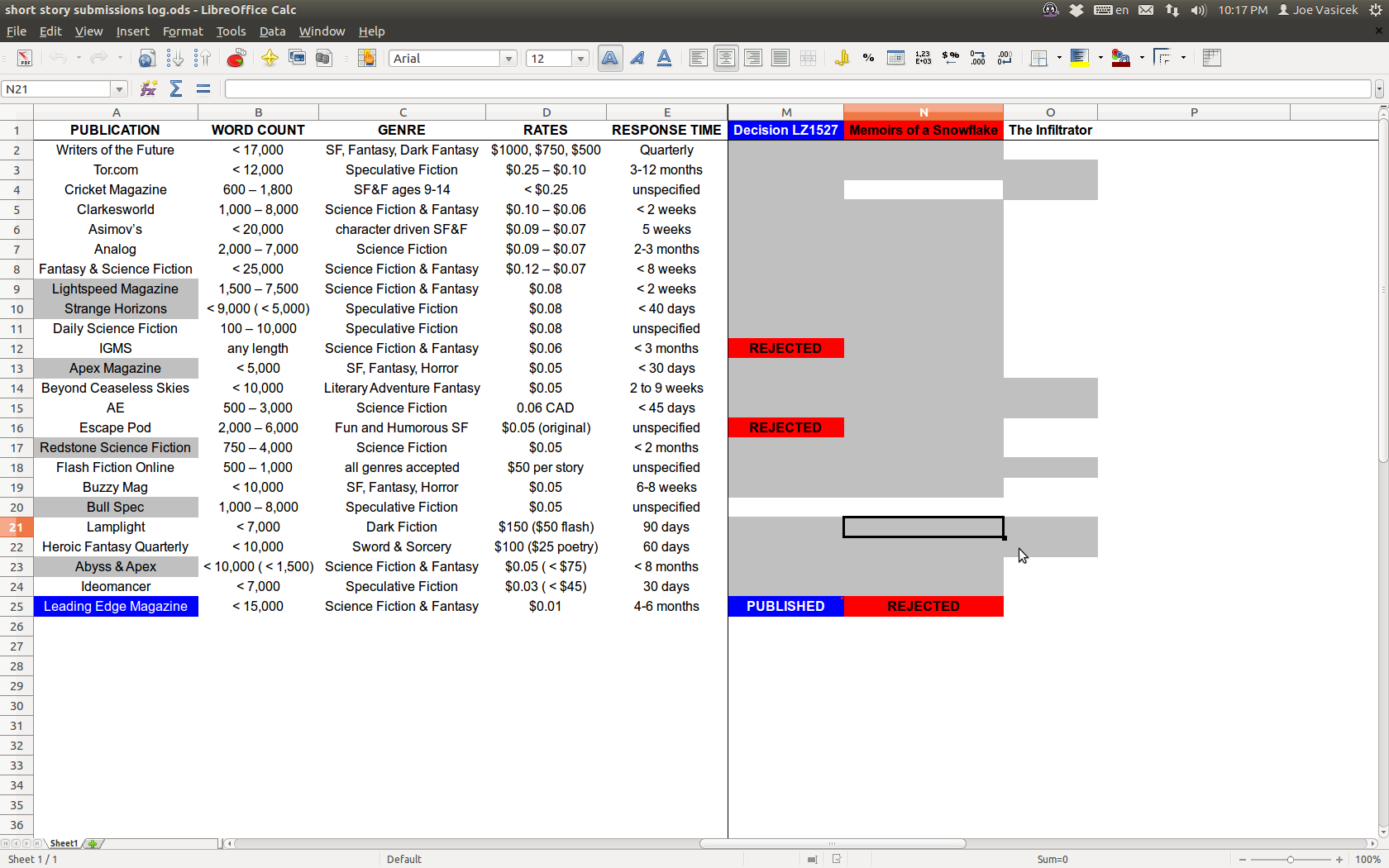
In order to do this as efficiently as possible, I’ve put together a spreadsheet of all of the magazines I hope to submit to, ranking them in order of preference and listing all of the relevant information about them.  This information includes:

  • Name of the publication.
  • Word count requirements.
  • Genre qualifications.
  • Payment rates.
  • Expected response time.
  • Name(s) of the editor(s).
  • Link to their guidelines.
  • Link to their submission system.
  • Whether they accept reprints.
  • Whether they accept multiple/simultaneous submissions.
  • Whether they’re a SFWA qualifying market.
  • The length of any exclusivity period in their contracts.

In addition to everything listed above, I’ll also keep a column for each story I’ve written, to indicate which markets I’ve sent them to and any result.  I’ll keep things color coded for convenience: red = standard form rejection, yellow = personalized rejection, green = currently on submission, blue = published, white = haven’t submitted yet, and gray = doesn’t qualify for submission.

Basically, it looks something like this:
Screenshot from 2013-12-10 22:17:50Whenever I write a new story, I’ll list it in a new column on the spreadsheet, gray out any markets that I don’t plan to send it to, and immediately send it out on submission, starting with the market at the top and working my way down.  If it goes through all the markets and doesn’t get picked up by any of them, then I’ll either trunk it or self-publish, but not until I’ve gone through all the markets first.

I’ve got to admit, one of the big motivations for me is this spreadsheet.  There’s something about having all of my stories organized and color coded in a place where I can see them all that makes me want to write more of them.  What can I say?  I’m a nerd.

Tactics:

For the duration of this operation, I’m going to adhere strictly to Heinlein’s rules, which are:

  1. You must write.
  2. You must finish what you write.
  3. You must refrain from rewriting, except to editorial order.
  4. You must put what you write on the market.
  5. You must keep it on the market until it has been sold.

No matter how great the temptation, I will not revise a story after it’s finished.  If it’s broken, I’ll just trunk it and write something else, or rewrite it from scratch.  If I workshop it, I’ll do it the way Dean Wesley Smith advises, which is to workshop it after you’ve sent it out, in order to learn how you can improve on the next one.

The reasons for this are twofold.  First, a lot of writers I whom respect (especially short story writers) swear by Heinlein’s rules, so I plan to try them out and see just how well they work for me.  Second, I don’t want to become a master reviser or editor, I want to become a master writer.  I wrote almost all of my college essays the night before they were due, and could easily pound out an A+ essay on a first draft by the end of my college career.  I wouldn’t be surprised at all if short stories are similar.

Since I have a lot of other writing projects to deal with, I’ll probably limit myself to two or three days at most for each story.  I average around 2,500 words a day when I’m on project, so if it takes me a week to write a 5,000 word short story, I’m probably doing something wrong.

Like I said above, my goal is to write at least two stories per month, preferably one per week.  I usually take Sundays off, so I figure that Friday/Saturday would be a good time to work on a short story.  It’s at the end of the week, so it won’t interrupt my normal work flow too much, and gives me a chance for a nice break.  If I don’t finish it in one weekend, I can put it off until the next one.  I’ll try that out and see how it goes.

Of course, the only way to get great at writing short stories is to read a lot of them too.  I already subscribe to Escape Pod and the Clarkesworld podcast, and just signed up for Daily Science Fiction as well.  If any of you guys have good recommendations for short stories or magazines, let me know–I’m definitely interested in reading as much great stuff as I can.  And of course, I’ll still keep working at the slushpile for Leading Edge.

That just about does it, I think.  This is definitely uncharted territory for me, so I expect I’ll be learning a lot of great stuff along the way.  For now, though, this is how I plan to go about doing it.  It will probably take a couple of years before Operation Short Blitz really comes to fruition, but I plan to stick with it until it does.

Wish me luck!  And if you want to join me by doing something similar, let me know how it goes!
Revisions, X-COM, and working on my short game

So I finished putting together the revision notes for Heart of the Nebula on Monday, and started working on those today.  It was interesting to compare the original rough draft (which was completely broken) with the incomplete revised version that I’d worked on about a year ago (which was also completely broken, but in different ways).  Fortunately, even though both drafts are train wrecks, they’re not unsalvageable.  In fact, I think there’s a pretty good story underneath it all.

Usually when I write a big novel like this, the first draft works pretty well up until about the middle, then either it falls apart or the scenes start getting out of order, or both.  In the first revision pass, I take out all the stuff that isn’t working, but struggle to come up with new stuff to replace it.  Usually, I’m just recycling the old stuff, and the result ends up a bit out of place and watered down.  On the third pass, I say “screw it” and come up with a bunch of new stuff, which helps me to see where the story is actually going and arrange the scenes in the correct order.  It’s not always as straightforward as that, but that’s the pattern.

In fact, I’ve learned a lot of interesting things from this revision, which I’ll probably save for another blog post when my thoughts on this are a lot clearer.  The big takeaway is that I need to clearly separate the tasks that should be done in my creative mind (like writing new words and coming up with story) and the ones that should be done in my critical mind (like mapping out what to cut and what to keep or recycle).  But more on that later.

About a week ago, I got X-COM: Enemy Unknown on a Steam sale and I’ve been playing it like crazy.  It’s a really awesome game!  I love the complex tactical thinking and how it really puts you there on the ground with your troops.  And then, an enemy pops out of nowhere, flanks you, gets a critical hit, and the next thing you know your favorite soldier who you’ve been meticulously leveling up over the last thirty missions is DEAD!  NOOOOO!!!

So yeah, that’s been eating up a lot of time–probably too much of it, to be honest.  But I’m still working on various writing projects, including a plan to improve my short game.  I put together a spreadsheet of all the major short story markets in the speculative fiction field, and ranked them in order of preference.  My plan is to write a short story every week (or at least twice a month) and put it on submission, going right down the line until I’ve exhausted all the appropriate markets.  No revisions, no holding stuff back because I think it’s not good enough–just writing and submitting until I’ve mastered that side of the art.

This is something I’ve been wanting to do for a long time, but I’ve been holding back because … well, I don’t know why I’ve been holding back.  Maybe I’ve just had it in my head that I’m not any good at short stories?  Well, maybe right now I’m not, but I’m sure that it’s something I can learn.  It’s a side of creative writing that I haven’t really explored yet, which means that there’s a lot of opportunity to learn and grow.  And if/when I do start getting picked up by the major magazines, that’s going to do a lot to advance my career.

Don’t worry, I still plan to keep working on novels and novellas.  This short story thing is something I’ll probably do when I need a quick break, to start something that I can finish in a day when I’m stuck in the middle of a gargantuan project.  I’ll probably limit my short story writing to Saturdays, so it doesn’t interrupt things too much, and try to write them in one or two sittings if I can.

So that’s what I’ve been up to in the past week.  In other news, it has gotten RIDICULOUSLY COLD out here in Utah, and I love it.  Cold weather means hot chocolate, borscht, and oatmeal!  It also means I need to get myself a bomber jacket–the kind with the awesome pockets on the arm.  It’s been years since I had one of those, and they are good quality jackets.

In any case, that’s enough for now.  I’ll do what I can to keep this blog updated as I move on with revisions and other stuff.  In the meantime, stay warm!