In science fiction, whenever two characters from different planets or different alien races have to interact with each other, they almost always speak the same language or have some sort of universal translator that magically makes them able to communicate with minimal misunderstandings.  This is especially common in Star Trek, though it happens in just about every franchise involving a far-future space opera setting of some kind.

I’ve got to be honest, I think this is a cheap plot device that almost always weakens the story.  As a writer, it’s tempting to have something like this so you don’t have to deal with any pesky language barriers, but when you do this, you remove a major potential source of conflict, thus violating the rule of drama.  Also, you make your fictional universe feel a little less grand, your aliens a little less alien.  After all, if everyone can perfectly understand each other, then there must not be a huge difference between Earth and the far side of the galaxy.

There are some times when having a universal translator allows you to broaden the story and focus on other conflicts.  For example, if some sort of interstellar legislation is under review in the grand galactic council, you can’t spend all your time focusing on basic communication difficulties.

However, if this is the case, then you can usually overcome the language barrier through other means–a galactic lingua franca, for example, or translation tools that may or may not misfire on occasion (much like Google Translate).  Of course, if you’re writing a comedy like Galaxy Quest (or parts of Star Control II), then falling back on a universal translator is forgivable.  But if you’re going for believability and a sense of wonder, this trope isn’t going to do you any favors.

While linguists and technologists have been working on translation programs for some time (and admittedly making some significant breakthroughs), I’m extremely skeptical that we will ever develop a perfect universal translator in real life.  If we do, I expect we will have to develop a sentient AI as a prerequisite, since the nuances of language are so inseparable from the things that make us human.

Here’s how translation services like Google Translate work:

  1. They amass an enormous database of language material by scanning websites, newspapers, and other documents.
  2. They analyze this database to look at word combinations and frequencies, observing the likelihood that any one word will appear in combination with any others.
  3. They compare these combinations and frequencies with those in other language databases to match words and phrases.

This data crunch method of translation works fairly well for simple words and phrases, but it falls apart in the more complex grammatical structures.  I see this any time I try to use Google Translate with an Arabic source.  Arabic is an extremely eloquent language, with all sorts of structures that simply don’t work in English.  One mistranslated word can completely change the meaning of the entire text, and even when it works, the technically correct English translation sounds as if it’s full of errors.

The methodology also falls apart for languages that are too small to have much of an electronic database.  The Georgian language is a good example of this.  It’s spoken by only about 4.5 million people worldwide, most of them in the country of Georgia, which is predominantly rural.  Internet access for most of the population is very limited, and most Georgians who do communicate online tend to use the Roman or Cyrillic alphabets more often than their own.  As a result, Google Translate for Georgian is utterly useless–seriously, you’re better off just sounding out the letters and guessing at the meaning.  There are some other sites like translate.ge that try to fill the gap, but they seem to rely on actual lexicons, not databases and algorithms.

All of this is between entirely human languages that developed in parallel on the same planet–indeed, languages between human cultures that have traded and shared linguistic influences for thousands of years.  What happens when we encounter an alien race whose biology makes it impossible for them to make human-sounding noises?  Or an alien race that communicates through smell or electromagnetic impulses instead of sound?  What happens when humanity is spread out across hundreds of star systems, each of which periodically becomes isolated from the others for hundreds or even thousands of years?  When our definition of human is stretched so thin that we would not even recognize our far-future descendents as anything but alien?

There is so much wasted potential whenever a science fiction story falls back on a universal translator.  Case in point, compare Halo I, II, and III with Halo: Reach.  In the first three games, the Master Chief’s universal translator enables him to hear exactly what the enemy Covenant troops are saying.  This is great fun when you’re chasing down panicked grunts, but it tends to get old after a while.  In Halo: Reach, however, the human forces haven’t yet developed a universal translator, so everything the Covenant say is in their original language.  All of a sudden, the game went from a hilarious joyride to a serious war against aliens that felt truly alien.  That one little change did wonders to the tone and feel of the entire game.

Needless to say, you won’t find a universal translator in any of my books.  In Star Wanderers, the language barrier is the heart and soul of the story–it’s a science fiction romance between two characters from radically different worlds who don’t speak the same language, and yet overcome that to develop a strong and healthy relationship.  In Sholpan and Bringing Stella Home, Stella knows a language that is fairly similar to the one spoken by the Hameji, but there are still words and phrases that elude her.  This detail is critical because it impedes her ability to understand and adapt to the Hameji culture, leading to some major conflicts later in the book.

As someone who’s lived for significant periods of time in Europe and Asia and learned languages very different from English, I can say that the language barrier is not something that we as writers should avoid, but something that we should embrace.  There are so many interesting stories that can be told when two characters don’t speak the same language.  Please, don’t be lazy and write that out of the story through a cheap plot device!  Let your aliens be truly alien, and your worlds and cultures so fantastic that we can’t help but feel hopelessly lost in them. More »

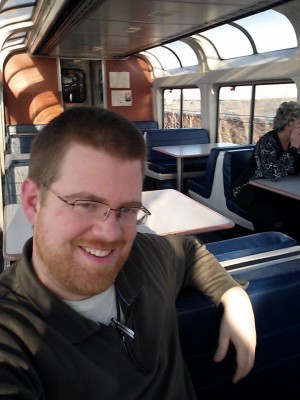
Chillin' on the observation car of the California Zephyr.

So Sunday afternoon, I boarded a train with most of my earthly possessions (at least, all of the ones I care to enjoy for the next year) and headed out to Utah.  I arrived Tuesday night, without a car, a job, or a place to live, but things have been working out really well so far and I hope to get all that stuff squared away in the next few days.

This was my sixth or seventh time traveling cross country by train, so I knew the drill.  The hardest part is getting enough sleep, so I brought a blindfold and some earplugs, and that actually worked out really well.  There were a lot of interesting people on the train, and I spent some time chatting with a few of them.  The train is one of the easiest place to make friends, just because the people who take it tend to be very laid back and friendly.

BAsUBItCIAAYenbMost of the time, though, I spent reading, figuring out my new phone, and writing.  Made some good progress on The Sword Keeper, though it looks like I’ll be putting it on hold for a while to get Stars of Blood and Glory ready for publication.  Wrote a little bit in Star Wanderers: Benefactor as well–man, whenever I need a good escape, it’s always fun to write a Star Wanderers story!  I have no idea when this one will be ready, but I think it will turn out well.
The train arrived in Provo late Tuesday evening, and I spent the night at my brother in law’s family, where I’m staying until I find a place to live.  Let me just say, it’s great to have friends and family to help you out when you really need it.  My old car was in the shop, so I set out on foot the next morning in search of an apartment.  Not much luck on that front so far, but I got my car back and found a few job leads, so it looks like I should be settled back down before long.

So why am I moving back to Utah?  A lot of reasons, but mostly because I just really like it out here.  I wanted to take a break before my next overseas adventure, catch up with some old friends and spend some time in a place that I know and love.  It also helps that there’s a good writing scene out here, with a bunch of great local conventions and conferences in the spring.

I didn’t always like Utah, but it’s really grown on me since I first came out here for college back in 2006.  The landscape is beautiful, with lots of amazing places to explore.  The people are really friendly and easy to get along with, even if your political views aren’t conservative (though admittedly, it’s harder).  The Mormon culture makes some things kind of quirky, but not in a way that makes it too hard for me to fit in.  In fact, if there’s any place in the world where I “fit in,” it’s probably here.

Things are kind of upside down right now, of course, but that will change once I find a place to live.  That’s going to take the focus away from my writing for a while, though hopefully not for too long.  In the meantime, today is another day, so I’d better get busy!

So last week was the first week of school here in Georgia, but before I blog about that, I thought I’d do a post on the short backpacking trip I did with a friend of mine the week before.  It was a lot of fun, even if our plans did change about a dozen times along the way.  That tends to happen a lot to plans here in Georgia, but if you’re flexible and can roll with it, you can have a lot of fun anyway.

So our original plan was to go from Baghdati to Sairme, a small resort town in the Lesser Caucasus range just south of Kutaisi, and from there catch a bus over the mountain and hike a few trails out in the western side of Borjomi National Park.

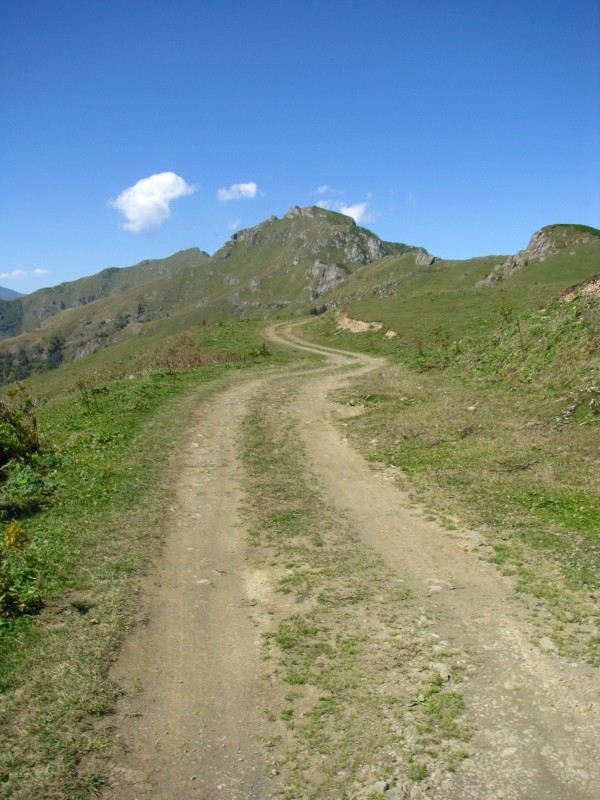
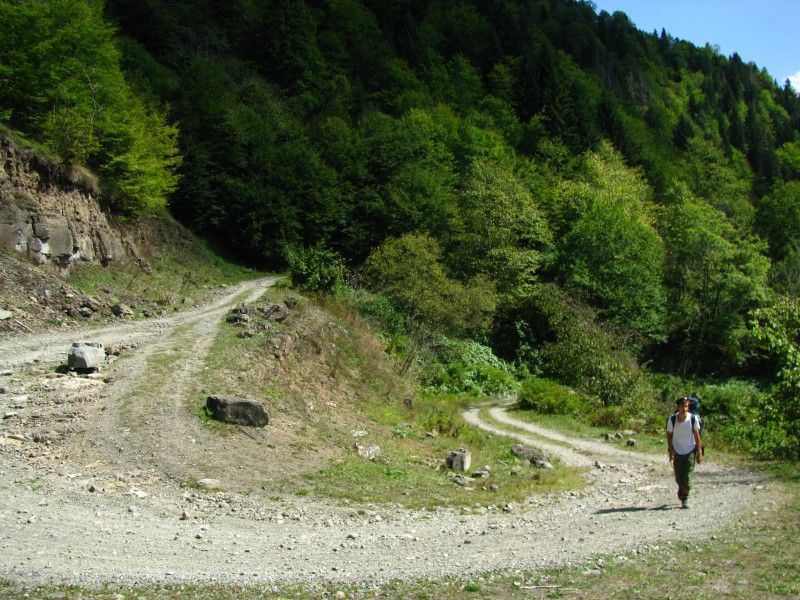
Well, when we got to Sairme, we found that there isn’t a bus that goes over that road, and for good reason.  It isn’t exactly a “road”–more like an unusually wide dirt path.  Farmers sometimes use it, but only because they’re local and it doesn’t make sense to go 80+ kilometers out of the way on the main route from Zestaponi to Surami.

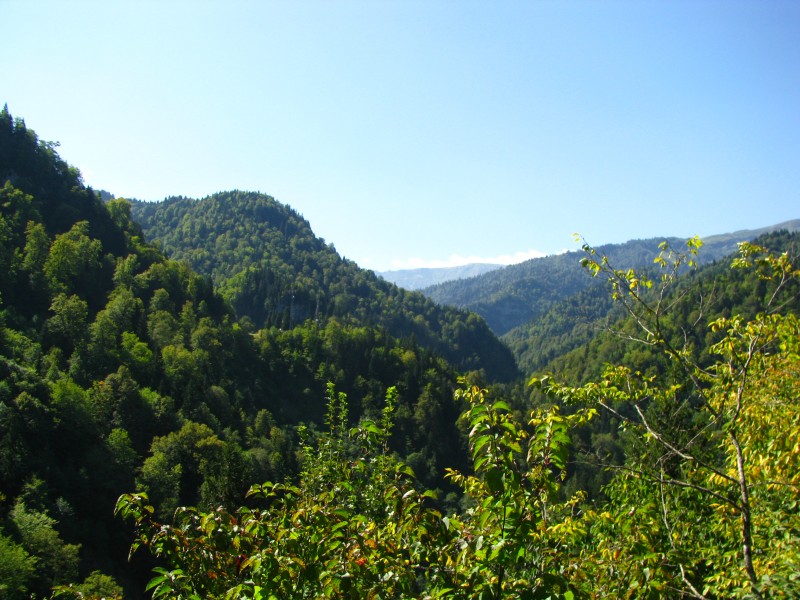
The mountains around Sairme.

The “road” from Sairme to Abastumani.

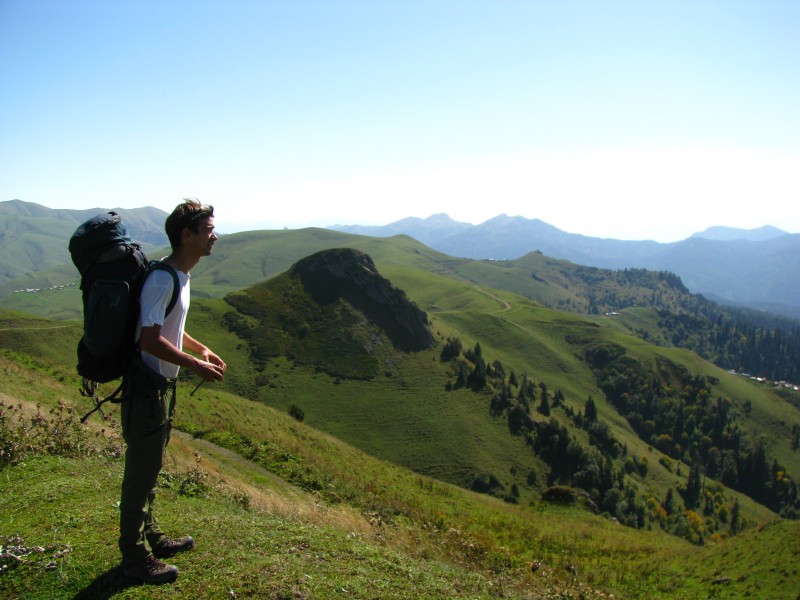
The locals told us it was about 35 km to walk to Abastumani, so we figured “hey, we have food, sleeping bags, and a tent–why not hike it?”  According to the map, if we left at 1pm and averaged 3 km/hr, we estimated we should reach the pass just around sunset.

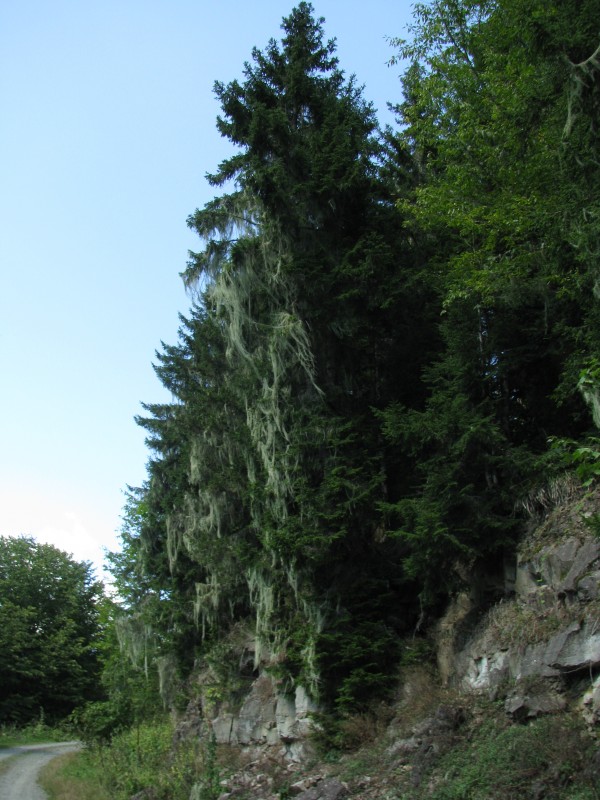
Some interesting moss around the 2,000 meter elevation mark.

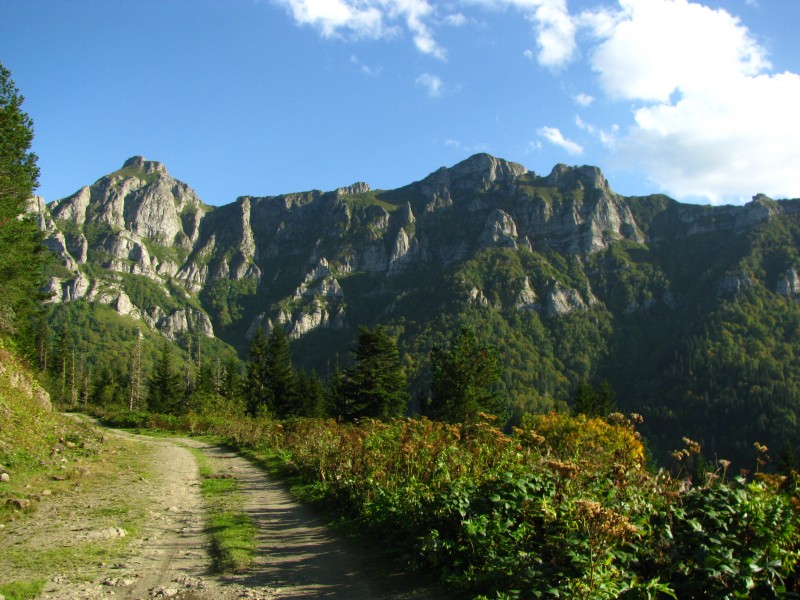
Mount Didmaghali, just above the treeline. We camped about two kilometers from here.

The calculations were fairly accurate; we hiked for about 6 hours, making about 18 kilometers on  the first day and climbing around 1300 meters.  In all that time, we only passed three vehicles, and they were all heading back to  Sairme.  One of them was carrying a bunch of guys who were so surprised to see us, they gave us a giant wheel of cheese.  We gave half of it to a local farmer who looked like he needed it more than us, and ate most of the rest over the course of the next few days.

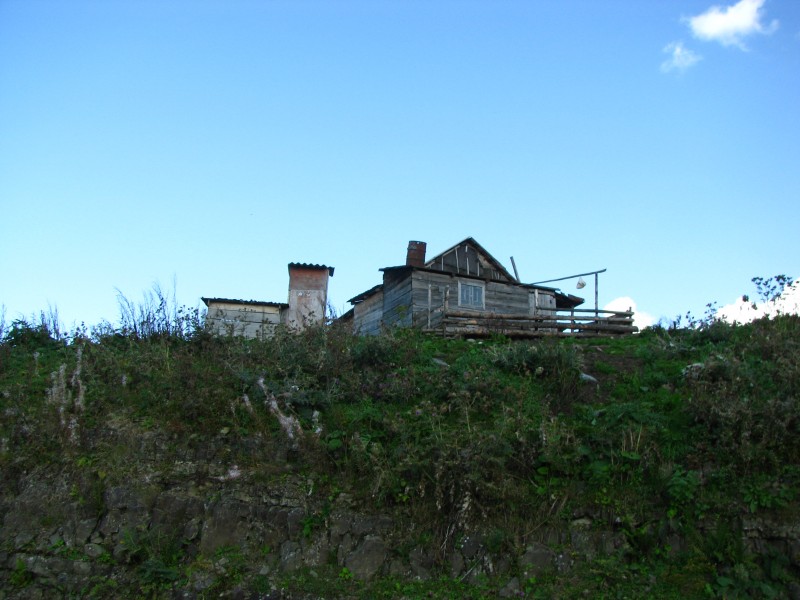
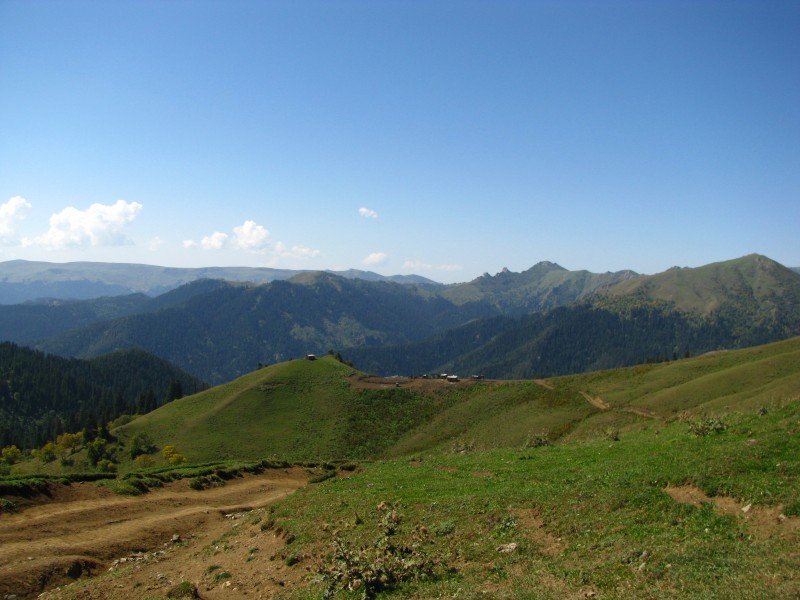
One of the farmers’ huts up above the treeline. The guys who farm here are generally seasonal workers, who live in the valley during the winter.

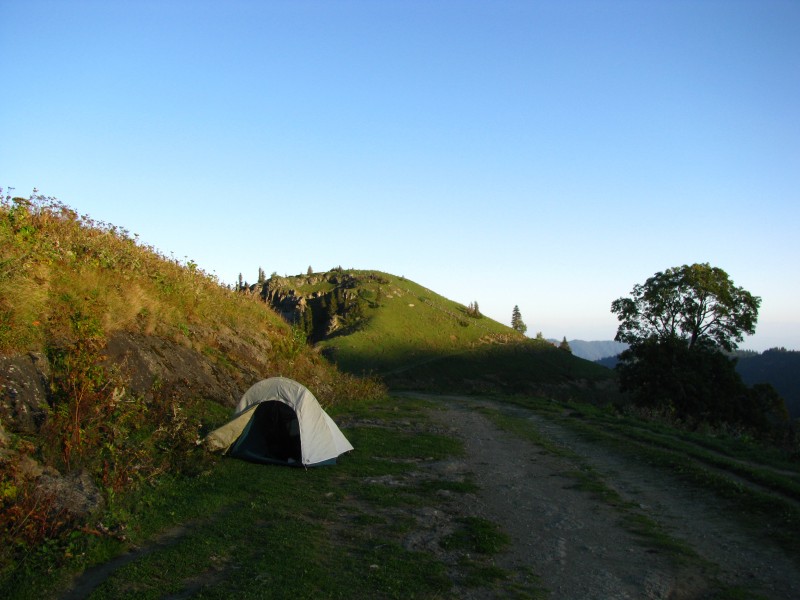
Our campsite, by the side of the road near Mount Didmaghali. It got a little windy at night, but was actually quite comfortable.

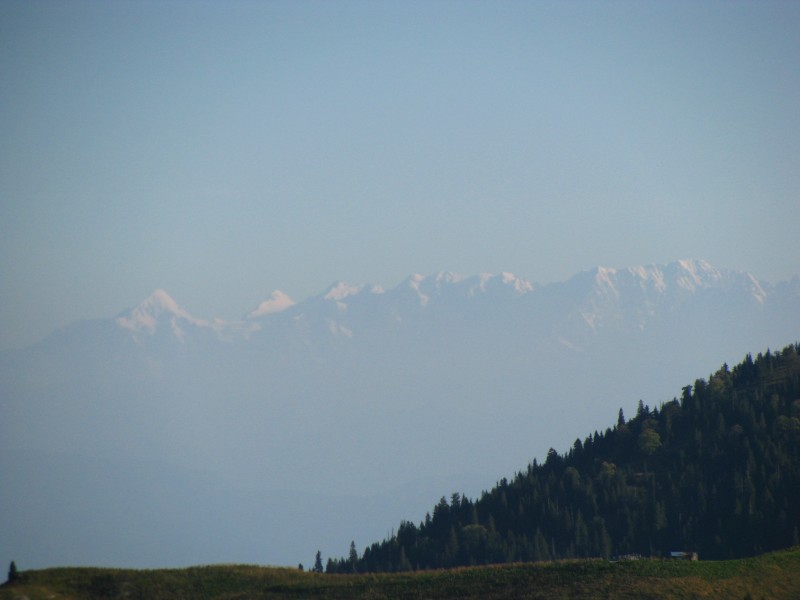
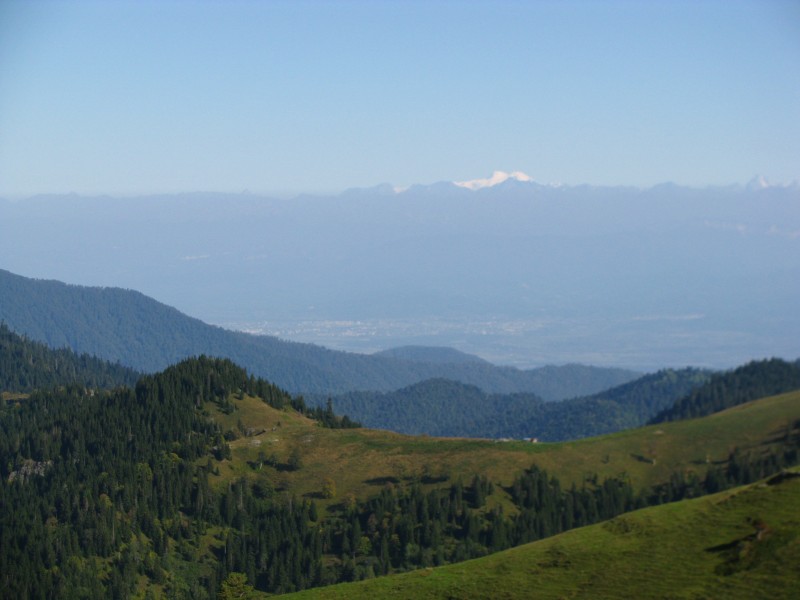
That moment when you realize “OMG, those aren’t clouds–those are MOUNTAINS!”

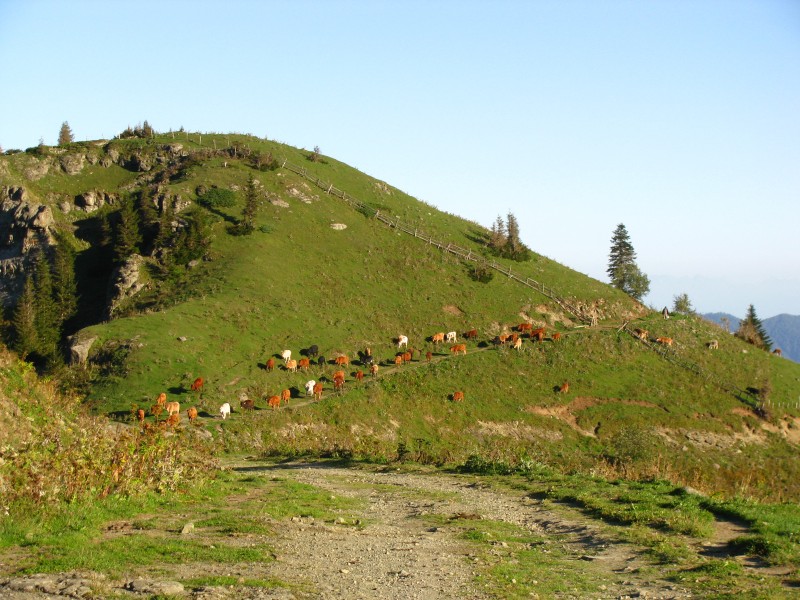
We camped out just above the treeline, next to a hill where a bunch of cows were grazing.  The local ranchers brought the herd back in while we cooked dinner, which was kind of cool.  Imagine a couple hundred cows walking past your tent.  The good thing about being so close to the farmers, of course, was that we didn’t have to worry as much about bears and wolves.

At one moment while we were looking out acros the way we came, the clouds on the horizon began to part somewhat, and I had one of those stomach-dropping moments as I realized that most of those white shapes weren’t clouds, but mountains.  We were looking at the Greater Caucasus range, with Mount Elrus standing above the mountains of Svanetti and a whole bunch of other snow-capped peaks further off to the east.

As the sun sent, the temperature dropped fairly quickly, and the wind picked up a lot.  I wasn’t able to sleep for a few hours, it was so strong.  But the stars were beautiful–at one point, I saw a satellite that was so bright it had to be the ISS.  Cool stuff!

The farmers bringing out the herd in the morning. One of the cows ate some of our bread, which was kind of annoying, but I guess I shouldn’t have left it out. Cows will eat (or try to eat) just about anything!

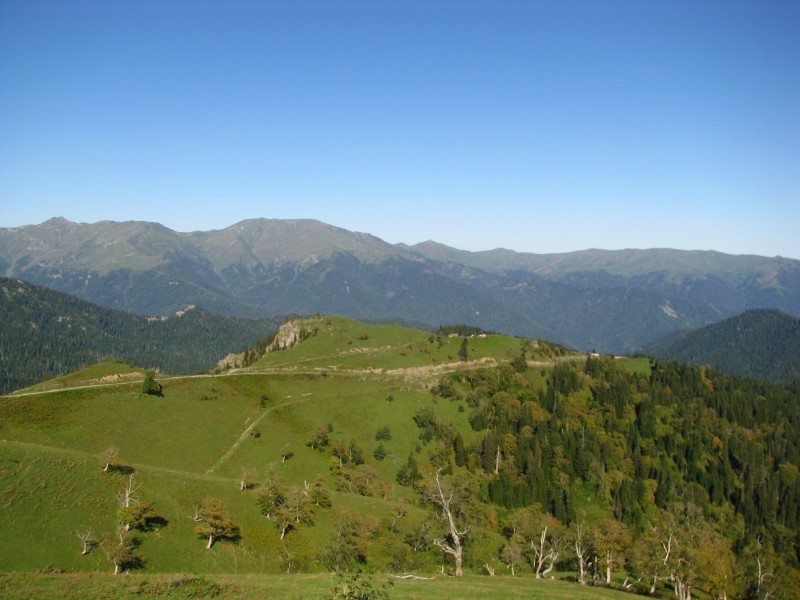
The view from the top of the first pass, just east of Mount Didmaghali. The little hill on the left is where we spent the night.

Mount Elrus, with several other major Caucasus peaks below it. You can also see Kutaisi and some other settlements in the valley.

The view from Zedeki pass.

The next day, we had a beautiful hike up to the first pass and over the mountains into Samtskhe-Javakheti.  The weather could not have been more perfect–it warmed up as soon as the sun came up, and was pleasant for the rest of the day.  We had some amazing views, too, especially from the top of the pass.

The road on the other side of the pass.

The view on the other side of the pass. Those are the mountains of Samtskhe-Javakheti, with Turkey and Armenia in the distance.

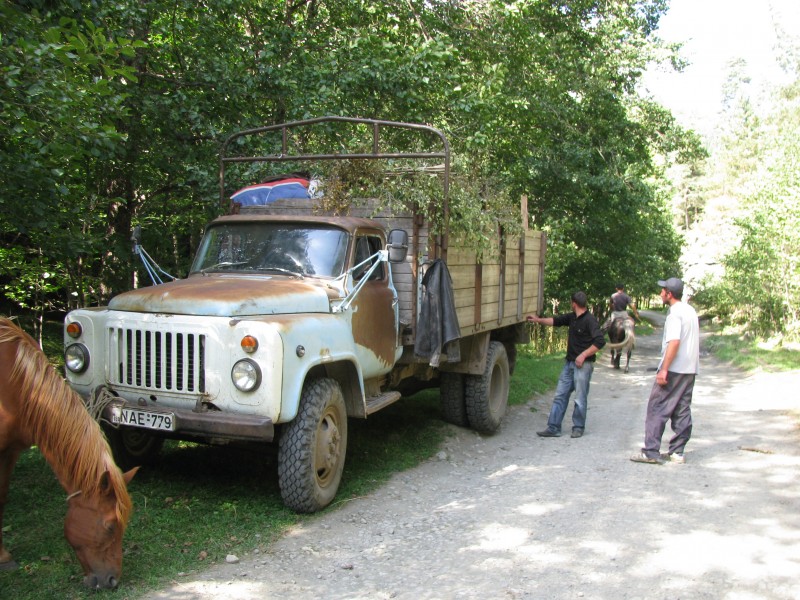
On the way back, we fell behind a bit, so we decided to hitch a ride with a passing farmer’s truck.  The guys were hauling some empty barrels, a bunch of brush, and some calfs, and they put us in the back with the animals.

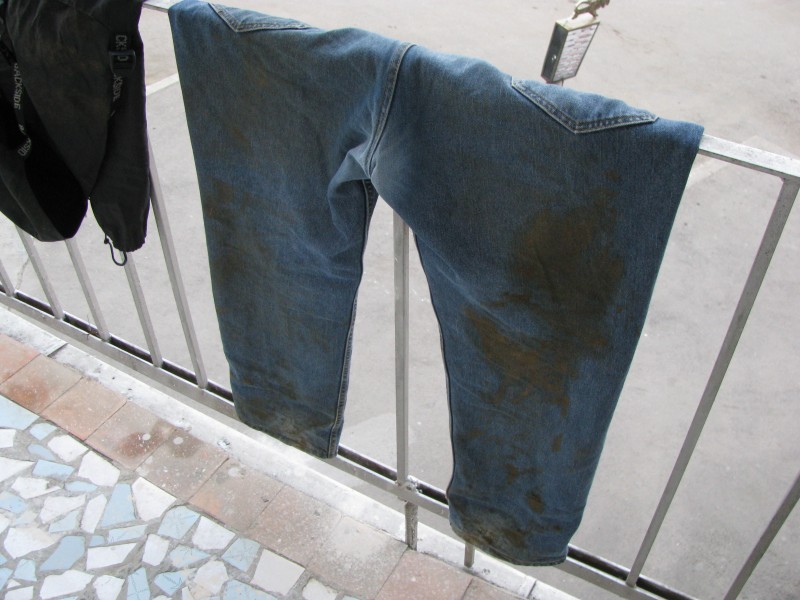
Wow, was it crazy!  The road was so bumpy, literally every other bounce almost threw us off of the truck.  The cage would pull back branches and snap them back so hard, some of them could have knocked us off as well, and the cows crapped all over the place, including the back of my pants.  For most of the way, we had a sheer cliff on one side, and even though there were lots of trees, it was pretty scary, especially at the switchbacks.

In other words, it was an adventure!

The truck that took us down most of the way. Bumpiest ride of my life!

My pants, after the cows got to them.

I wish I had some pictures from the ride, but it was all I could do to hang on for dear life.  After about 45 minutes, my hiking partner had had enough, and demanded that the guys stop and let us off.  My camera had fallen off in the truck bed, but I didn’t realize that until we were back down. Fortunately, we were only about 5 km from Abastumani, and found the guys just outside the settlement.  The camera was still in good shape, and in typical Georgian fashion, they invited us for bread, cheese, and cha-cha.

So it ended up being an awesome two days of hiking and backpacking.  The views from above the treeline were incredible, and the conditions were absolutely perfect–we could not have asked for better.  We spent the next couple of days exploring Akhaltsikhe, Borjomi, and Bakuriani, but I’ll save that for another post later–this one has gotten long enough.

So yeah, it was definitely worth the trouble bringing out all the backpacking gear from the States.  I hope to have plenty of opportunities to use it again before the end of the season!

I’m currently in Kutaisi, about to catch the night train to Tbilisi for church, but I thought I’d post a quick update just to let you know how I’m doing, and what I’ve been up to.

The last few days have been awesome. I went backpacking with a friend of mine from last semester, and we had a blast.  Hiked the pass near Mount Didmaghali between Sairme and Abastumani, up above the treeline.  I’ll do a big post on it sometime next week, with stories and everything (and boy, are there some stories), but before that, I wanted to share this:

That’s Mount Elbrus, the highest mountain in Europe, with the highlands of Svaneti just below it, and Kutaisi in the foreground down in the valley.  The elevation difference is over 5,500 meters (18,000 feet).  The picture is a bit fuzzy because of the haze, as well as the distance between points and the poor quality of my old camera, but it was an unbelievably beautiful day–as evidenced by the clear view of Elbrus’s summit.

Awesome, awesome stuff.  From Zedeki pass, we could see almost the entire Caucasus range, from Mount Elbrus in the west to Mount Kazbek in the east.  The conditions could not have been more perfect.  Covered between 35-40 km (20-25 m) in two days, in a beautiful, remote region between Imereti and Samtskhe-Javakheti where few people, let alone tourists, ever go.

I’ve got to go now, but expect to see a longer post on the trip soon.  School starts on Monday, so things might be a little crazy for a while, but I’m sure they’ll settle down soon into a comfortable and productive routine.  See you around!

Hey, just a quick post to let you guys know how I’m doing.

I made it out to the village yesterday, met my new host family and got more or less settled.  Due to some mixups, I ended up in Sairme (WAY up in the mountains) before making it down to Baghdati, but everything worked out well and I got to see some beautiful Georgian scenery at the same time.

My new host family is great!  It’s a 35 year old guy and his mom, living on a farm in a village with all their uncles and cousins and stuff pretty close by.  The guy, Dato, is way cool–he does IT at the school, farms his mom’s place, and otherwise just hangs out in the village.  We played nardi last night–I actually beat him on the first go, then he slaughtered me twice.  Then his aunt played him and things got really entertaining.

The house is WAY different from the apartment where I was living before.  Much more spacious.  It’s a couple hundred years old, though, so the wires are attached on the outsides of the walls and stuff.  We’ve also got chickens all over the place.  I’ll be sure to post some pictures, probably in a week or two.

I think I’ve hit it off pretty well with the family.  They’re impressed that I already know a bit of Kartuli, especially the aunt.  Things got a little tense when I turned down the wine and told them I can’t drink because my religion forbids it, but I don’t think it will be too much of a problem (though this being Georgia, you never know).

The mom is an awesome cook.  This morning, she made one of the best breakfasts I’ve ever had in my life.  The house is old but comfortable, I’ve got all the space and privacy I need, there’s a lot more nature out here in the village–I think I’m really going to like it here.  What’s more, Kutaisi is only a short half-hour marshrutka ride away.

After I’m through here, I’ll walk up to my old host family’s place and drop off some gifts: specifically, some RAM for their broken down computer.  Then I’ll head over to my old school, say hi to my old coteachers, run downtown to pick some stuff up, then head back out to the village.  Tomorrow, I’ll meet up with a friend of mine to get some stuff for camping, then head out the next day to go backpacking in Borjomi or Tusheti.  That’s the plan at least.

Oh, and about the trip to Ani: I tried to get down to Kars, but couldn’t find a bus.  I ended up in Akhaltsikhe, the Georgian border town, but the only way out was to catch a taxi to the crossing ($$$), catch a taxi on the other side to the Turkish town on the other side, and from there to catch a bus down to Kars (about 140 km).  I was traveling alone, didn’t know any Turkish, it was about mid-afternoon and I didn’t have a backup plan, so I ended up aborting and headed back to Tbilisi.

Oh well–it happens.  I’ll try again, though, probably in a few weeks.  This time, we’ll meet up in Georgia, where I actually know how to  get around.

In other news, I bought three author copies each of Genesis Earth, Bringing Stella Home, and Desert Stars before I left the US.  They’re signed and numbered, and if you want to buy one of them, just shoot me an email (joseph [dot] vasicek [at] gmail [dot] com).  The #1 copies are already sold, but the #2 and #3 copies of each book are still available.  You can buy them from me at the current Amazon paperback price, and I’ll have my parents ship them out to you.

That’s all for now.  Take care, and I’ll see you guys around!

…how much I’m looking forward to being back in Georgia.

My flight leaves from JFK on Saturday and arrives in Istanbul at about 6 am on Sunday.  The flight to Tbilisi doesn’t leave for another seven hours, so I plan to take the tram downtown and see some of the sights.  I’ll arrive in Tbilisi late that afternoon, spend the night at a hostel…

…and then take off the next morning for Kars, Turkey.  I plan to meet up with a friend there and go tour the ruins of Ani, ancient capital of Armenia.  I have no idea yet how I’m going to get there, but there should be some buses in Tbilisi or Akhaltsikhe, and from Kars you can charter a taxi.

So after all that, I’ll head out to Baghdati to meet my new host family!  For the fall semester, I’ve been assigned to the school in the village of Rokhi:


View Larger Map

It’s about an hour south of Kutaisi, right up against the Lesser Caucasus mountains, and it looks like an awesome place!  A couple of other TLGers have been there before me, and they tell me it’s really great.  It’s definitely going to be a change of pace, going from city to village, but it’s one I’m looking forward to.  There are only 300 students in the school (grades 1-12), so maybe I’ll learn all my students’ names this time.

The family I’ve been assigned to sounds a bit older, with a thirty year old son who works at the school.  It sounds a bit rustic, with Turkish toilets and no internet at home, but I’m looking forward to that, especially the no internet part.  Don’t worry, I plan to get out and blog regularly–I’m sure there are local internet cafes, plus Kutaisi isn’t that far and I know where to get internet there.

Getting out to church is going to be a bit tricky: I’ll probably go into Kutaisi on Saturday, take the noon train into Tbilisi (5 GEL) and spend the night at a hostel (15 GEL), or take the sleeper train (10 GEL) and show up in the morning.  Getting back shouldn’t be too difficult: the Baghdati marshrutka leaves from Didube at 16:00 (or so I hear), and from there it’s only about 6 or 7 kilometers.

I have no idea how long I’ll be in Georgia this time: my contract runs until the end of December but I may extend again, depending on what other options open up.  I’ve really fallen in love with Georgia since coming there, and may just choose to stay on another year.  The Caucasus is a really amazing place, full of hidden treasures and remote places.

Which reminds me: I’m bringing a tent and sleeping bag this time, to do some backpacking in Borjomi and Tusheti.  Packing them was tough: the airline restriction is 20 kg total of weight (44.1 lbs), and after a whole lot of work, I finally got it down to 42.5 lbs.  The disassembled backpack frame is going to have to go as a separate piece of luggage, since it was too big to fit in any bag, but it shouldn’t be too hard to reassemble it out in Georgia.

That’s about it.  I’ll leave you with this awesome Georgian song I found on youtube.  The dance troop is Erisioni, and they put on an amazing show that’s kind of like Riverdance, except for Georgia.  Let me tell you: when it comes to dance (folk or ballroom), I don’t think anyone in the world is as amazing as the Georgians.

Magaria!

So back in June I made a to do list of things I wanted to accomplish this summer.  I’ve only got a week left before I go overseas again, and I’m happy to say I’m on track to finish most of them.  A couple of them (such as doing a blog tour and submitting aggressively to book bloggers) I decided weren’t worth my time, and dropped them, but these are the major things I’ve accomplished:

  • Release print-on-demand editions of Genesis Earth, Bringing Stella Home, and Desert Stars through CreateSpace.
  • Redo cover art for Bringing Stella Home.
  • Redo blurb/description for all titles.
  • Put proper copyright page in all titles.
  • Publish all titles on Kobo Writing Life.
  • Find a better way to build an ebook and reformat all titles.
  • Finish the second draft of Stars of Blood and Glory.
  • Finish and publish parts I and II of Star Wanderers.

The only major thing I haven’t accomplished is figuring out how to sell ebooks directly from my website.  I figure I can set that up later, though, when I’ve got a large enough readership to justify it.  If it’s all online, I can probably do it from anywhere.

While I was vacationing with my family on Cape Cod, I had a chance to step back and take a long look at what I’m doing with my life, which helped me to set some new goals and get a renewed sense of direction.  I stopped tracking my daily writing word counts in July, which threw off my productivity a lot more than I thought it would.  After setting some long-term goals, though, I think I can find a better way to structure my writing.

In ten years (2022), I want to…

  • have 25+ published novels.
  • earn a solid middle-class income through my writing.
  • be married and have kids.
  • own a house.
  • live in the United States.

My lifetime goal is to publish 100+ novels, which is actually a lot more doable than it sounds.  It means writing a minimum of two novels a year, though, so I’m going to have to follow Heinlein’s rules a lot closer than I have been in the past.  That’s the trouble with keeping a daily word count: it made me look a lot more productive when I was in revisions, so I spent more time doing that than writing new work.

In three years (2015), I want to…

  • have at least 10 published novels.
  • make enough with my writing not to need another job.
  • be married or engaged.
  • have lived for at least three months in 3+ countries (not including USA).

I want to settle back down in the States eventually, but before that I want to get around and see the world a bit.  The absolute coolest thing would be to marry another world traveler and make enough on the writing to have a bunch of adventures together.  I’m not sure if I’ll find her in Georgia, but I’ll be sure to keep my eyes open.

As for short-term goals, I’m still trying to work them out.  Here’s what I have so far:

Quarterly Goals:

  • Start at least 2 new projects.
  • Finish at least 2 first drafts.
  • Publish at least 2 titles (print and ebook counts as two).

I think this is enough to stretch me while still being doable.  By my count, in the first quarter of this year I did 2-2-1, in the second quarter I did 2-2-0, and in the current quarter, I’m at 2-0-5 so far.  Of course, this includes all the Star Wanderers novelettes and novellas, which I hope to expand in the future.

I’m not going to count revisions as progress, except as part of the publishing stage.  Some stuff needs a lot of revision, other stuff, not so much.  What I really want to do is train myself to produce high quality work on the first or second write-through.  Of course, I’ll still use test readers to gauge my work before publishing anything.

Monthly Goals:

  • Finish at least 2 projects (first draft or revision).
  • Write at least 15k words of new material.

I can write a lot more than 15k words in a month, of course, but I figure this is a good starting point.  The key is that this is for new material.  When I looked back at my word counts, I found that months of revision would go by before I actually worked on something new.  I want to change that, but I still need to allow for longer projects that might require several weeks of revision (while emphasizing the need to produce new material, of course).

Weekly/Daily Goals:

  • Keep all project deadlines.
  • Start each day with writing.

I’ve found that if I don’t start off each day with writing, I keep putting it off until I’ve spent more time and energy angsting about it than actually doing it.  For a short period of time this summer, I put my butt in the chair and my hands on the keyboard first thing after waking up (even before getting dressed).  It was amazing how much of a difference that made.

Beyond that, I’m not really sure what other goals to set.  I want to plan things out on a project to project basis, but beyond that I haven’t yet figured out what kind of a daily structure I need to build.

It’s probably a good idea to keep things flexible at this point, though, since I have no idea what my schedule is going to be like once I’m in Georgia.  I do know a little bit about my next placement–more on that later–but for the first half of September, I’m going to be all over the place.  Ani, Tusheti, Kars, Akhaltsikhe, Tbilisi, Baghdati, and Istanbul–it’s going to be crazy!

For this next week, my goal is to finish the revisions for Star Wanderers: Sacrifice (Part III) and send that out to my beta readers.  I’ve been struggling with it all month, but I think I’ve got a pretty good idea of where I need to go with it.  I’m going to finish chapter 3 tomorrow, then rewrite chapters 4 and 5 from scratch.

After that…another Caucasian adventure! :)

That’s right–the first part of my novel Star Wanderers is now available on Kindle and Smashwords for $2.99!  Barnes & Noble, iTunes, and Kobo editions should be coming out shortly (though I’m waiting for Kobo to launch their direct publishing platform, which may take a while).

This is the first part of a four part novel, but really it’s more of a series of short novellas since each part has its own distinct story arc with a beginning, middle, and end.  This one is about 15,000 words (or 40-60 pages), and takes place in the Gaia Nova universe about a thousand years before the events of Bringing Stella Home.  It’s about a boy and a girl who don’t speak the same language but find themselves alone on a starship together.  Here’s the description:

HE WANDERS THE STARS IN SEARCH OF A HOME. INSTEAD, HE GOT A GIRL WITHOUT ONE.

When Jeremiah arrived at Megiddo Station, all he wanted was to make some trades and resupply his starship. He never thought he’d come away with a wife.

Before he knows it, he’s back on his ship, alone with his accidental bride. Since neither of them speak the same language, he has no way to tell her that there’s been a terrible mistake. And because of the deadly famine ravaging her home, there’s no going back. She’s entirely at his mercy, and that terrifies him more than anything.

Jeremiah isn’t ready to take responsibility for anyone. He’s a star wanderer, roaming the Outworld frontier in search of his fortune. Someday he’ll settle down, but for now, he just wants to drop the girl off at the next port and move on.

As he soon finds out, though, she has other plans.

Also, I’m happy to report that I finished the full-length version of Star Wanderers over the weekend, making it my seventh written novel!  Here are the stats:

words: 68,367
chapters: 20
ms pages: 317
start date: 1 September 2011
end date: 1 July 2012

And some other stats, just for fun:

kilometers traveled: ~32,000
languages encountered: English, Georgian, Russian, Mingrelian, Hebrew, Arabic, Turkish, Farsi, Polish, Slovakian, German, Armenian, Spanish, French, and Australian
other books started before finishing: 4
other books finished before finishing: 2
other books published before finishing: 2

Part II is pretty close to publication, but Parts III and IV still need a bit of work.  Since the rough draft is finished, though, it shouldn’t take too long to get everything else ready.  If all goes well, I’ll publish Part II in August or September, and the other parts in two month intervals.

This novel was a lot of fun to write, in spite of how difficult it sometimes was.  I always knew it was a story worth telling, and that gave me both the motivation to finish it and the courage to send it out into the world.  I think you guys are really going to like it, especially if you’ve enjoyed my other sci fi romance stuff.  As I said on Twitter back in 2011, girl + starship = WIN!

So yeah, check it out!  And be sure to keep an eye out for Part II, which should be coming out in just a month or two!