How I hacked my ADHD to triple my daily word count

Writing with ADHD can be tough. It’s easy to beat yourself up for being “undisciplined” or “lazy” when the greater problem is that you’re trying to work against your ADHD instead of finding ways to make it work for you. It’s like swimming against a rip current instead of swimming sideways to get out of it.

In the last month, I’ve made a really fantastic breathrough that I think will change the way I write from here on out. So far, it’s helped me to double or even triple my usual word count. The novel I’ve been wrestling with for more than a year now—the longest one I’ve written since I started indie publishing—now looks like it will be finished in just a few of weeks, when I expected it to take a couple of months. Needless to say, I’m really excited.

What changed? I found a way to make my ADHD work for me, rather than against me.

In my previous post, A reading hack for the ADHD addled brain, I explained how I exploited my ADHD to read more books. Basically, I did the same thing, but for writing. There was a lot that had to happen first, though, and the biggest of those was that I had to learn how to make and keep an outline.

Step 1: Learn how to outline properly

For years, I just sort of assumed that I was a discovery writer, probably because of the ADHD. Most of creativity has to do with finding novel or unexpected ways to combine two or more ideas, and when you have ADHD, your brain naturally jumps from idea to idea. That was why I always hated taking meds when I was a kid: I felt that it stifled my creativity. And since most of this idea jumping happened subconsciously, I assumed that outlining would also kill that process.

But after a few years of struggling as an indie author, I realized that my writing process was too slow. In order to succeed, I needed to publish more frequently, but in order to do that, I needed to produce more content regularly. Back then, I would usually write a novel from start to finish, laying it aside for a month or two if I ran into a serious block, and also after finishing each draft. A typical novel would go through two or three revision drafts, so it would literally take years before a +70k word novel was ready to publish.

I decided that the best way to shorten my writing process was to “cycle” through the book, combining all the drafts so that I was working on revisions while simultaneously writing the rough draft. In order to keep track of all that, I needed to keep an outline. So I tried out a few different methods and tweaked them until I came up with a method that worked well for me.

The thought of outlining can scare a lot of writers who consider themselves “pantsers” or “discover writers,” but the thing to keep in mind is that there is no one right way to keep an outline. In fact, there are probably as many ways to outline as there are writers. For some, a couple of quick sketches on the back of a napkin is enough, while for others, it turns into a massive story bible that’s just as long (or longer) than the actual book. But without trying out a lot of different methods, you’ll never figure out what works for you.

It took me a couple of years, but I eventually developed a method that worked really well for me. With it, I was able to write Edenfall and The Stars of Redemption, as well as the last two Gunslinger books, in much less time than it took for my other ones. I was also able to combine all eight of the Star Wanderers novellas into a novel—something I probably wouldn’t have been able to do very well without a solid outline to keep it straight.

But I still would run into blocks that would occasionally derail the project, at least for a little while. I ran into that a lot with my current WIP, Children of the Starry Sea. Sometimes, they were genuine story problems that I needed to work through. More often than not, though, the problem was one of momentum: I was having too many bad writing days interspersed with the good writing days, so that each day felt like I was starting from zero. After a while, that becomes difficult to keep up.

Step 2: Allow yourself to write out of order

When I came back from my second hiatus to work on Children of the Starry Sea, it was clear that my new method wasn’t working as well as I needed it to work. Children of the Starry Sea is much longer than anything I’ve published so far, and I found that I just wasn’t producing enough new words consistently to make my “cycling” process of revisions work.

Around this time, I remembered something I’d heard on a recent convention panel, where one of the authors shared how he collaborated with another author. Instead of going back and forth, he told his cowriter: “how about you just write all the odd chapters, and I’ll write the even chapters, and when we’re both done we’ll combine it all together and see how it turns out.” To their surprise, it actually turned out really well.

So with that in mind, I decided to experiment with skipping around my current WIP, rather than writing it in order from start to finish. If I woke up and felt like I wanted to write an action scene, I would pick one of the action scenes out of my outline and write that. If I felt like I wanted to write the ending, I would skip ahead and write that. If I felt like I wanted to write the next scene, I would go back to where I’d left off and write that.

The outline was the key. Without it, there’s no way I’d be able to keep everything straight and know where each part is supposed to go. The outline also had the added benefit of dividing the novel up into smaller chunks, making the overall project much less intimidating. The way to eat an elephant is to take one bite at a time, just like the way to climb a mountain is to take one step at a time. Same thing with novels.

That’s all well and good, you may be thinking, but what happens when you’ve written all the stuff that you want to write, and all that’s left is the stuff you didn’t want to write? Isn’t that a bit like eating your dessert first, and leaving your vegetables for last? Not really, because chances are that if you really don’t want to write a particular scene, the reader probably won’t want to read it either. So if you can find a way to rework your story so that scene becomes unnecessary, you’re probably better off doing that.

But I actually haven’t had that problem yet. The thing about ADHD is that it actually feels right to jump around all over the place like that. Just because I don’t want to write a particular scene on one day doesn’t mean that I won’t want to come back to it sometime later. And more often than not, writing a later scene actually makes things fall into place with the earlier scenes, and makes me more excited to write them.

It’s as if the project itself is a puzzle. Can you imagine trying to put a puzzle together in linear order, starting from the top left corner and moving to the bottom right? That would be pure torture! Instead, you pick up whatever pieces catch your eye, and try to fit them in with other, similar pieces, until the puzzle itself begins to take shape.

There a lot of disadvantages to writing with ADHD, but there are some areas where the ADHD can actually become a strength, if you learn to work with it instead of against it. I’ve already mentioned how it can help with creativity, since your mind is always bouncing around between different ideas. What I’ve learned in the last month is that writing out of order is another great way to harness ADHD as a strength, since something that leaps out from writing one scene can often lead to a breakthrough in another. Writing out of order gives your ADHD brain the space it needs to make those intuitive leaps, and harnesses the “oh, shiny!” toward something productive, rather than driving you to procrastinate.

Step 3: Start in the middle, not the beginning

For me, the hardest part of writing is getting started. That’s probably my ADHD: it’s always easier to get distracted than it is to settle down and do what you’re supposed to do. Once I’ve settled down, though, and gotten into a groove, I can usually stick with a task until it’s done. In fact, once you’re in something of a flow state, the ADHD can actually make you hyperfocus.

So if the hardest part of writing is getting started, how do you turn that from a weakness into a strength? By leaving the next scene(s) unfinished, so that the next time you sit down to write, the scene has already been started and you just need to figure out the next word. One word leads to the next, and before you know it, you’re in the groove again.

By far, this has been the biggest part of my breakthrough: realizing that I don’t have to write every scene from start to finish in one sitting. In fact, it’s better if I don’t. Instead, I’ll typically finish one or two scenes in the morning, then pick out three to four scenes in the afternoon and write the first couple hundred words or so, deliberately leaving them unfinished so that I have a variety of scenes to choose from the next day.

If the hardest part of writing is getting started, then the hardest part of getting started is feeling overwhelmed at how much you have to do. But if all I have to do is write a couple hundred words, that’s easy! It also works with my ADHD instead of against it, since I get to jump from scene to scene instead of getting bogged down.

With the way that I used to write, most of my “writing blocks” had less to do with the actual writing and more to do with working myself up to write. Many times, I found that if I just sat down and opened up my WIP without thinking too much about it first, the writing would come a lot easier. Starting in the middle is a great way to harness that, because you aren’t confronted with a blank page the moment you sit down. It takes a lot less effort to find the next word than it does to find the first word.

So with where things stand right now, I just need to start four new scenes every day this week and I’ll have every remaining scene in my novel WIP started by Saturday. From there, if I can finish two or three scenes a day, I can easily finish the rough draft stage of this novel WIP before the end of February—which will be amazing, since I’m only at the 65% mark right now, and historically that’s always the part where I find it most difficult to write.

I’m really looking forward to writing a whole novel from start to finish using this method. As soon as Children of the Starry Sea is finished, I’ll start outlining the sequel, Return of of the Starborn Son, and write it the same way. If things go well with my current WIP, I’ll be very optimistic about finishing the next one before the end of the year—perhaps even before the end of the summer.

I do expect things to get crazy around here soon, though. Our second child is due in the early spring, which means enduring a month or two of chronic sleep deprivation. I’ve gotten to be pretty comfortable with writing at 4AM, but we’re also getting a lot more uninterrupted sleep than we were when Princess Hiccup was a newborn. I anticipate that we’ll have at least a month where nothing gets productively done.

So it will be really fantastic if I can finish Children of the Starry Sea NOW, before the baby comes—and not just the rough draft, but the revisions too. Fortunately, I don’t think I’ll have too much difficulty with the revisions. I’ve already cycled through the first half of the book a couple of times, and it’s working pretty well. Also, revisions come a lot easier to me than writing new words. I’m not sure why that’s true, but it is.

And for the record, I don’t advocate jumping around all over the place while doing revisions. It’s probably best to do that part in sequential order, if nothing else than to make sure that all the scenes and chapters flow properly. I haven’t gotten to that part of this writing method yet, so it will be interesting to see how it goes. So far, the stuff I’ve cycled through actually seems to flow pretty well, but I need to take it from the beginning to really be sure.

2019-07-25 Newsletter Author’s Note

This author’s note originally appeared in the July 25th edition of my author newsletter. To sign up for my newsletter, click here.

So Mrs. Vasicek has been sick with the flu for the past two weeks. She’s getting better, but we’ve both been less than productive, and any semblance of a daily routine has basically been shot. Turns out that having your wife around all day is a very distracting thing. Who would have thought?

All of this has got me thinking about habits and routines: how important they are, how to make them work, and how not to get discouraged. I’ve been self-employed basically since graduating from college nine years ago. I’ve worked a lot of side jobs, but nothing that I’d call a “day job,” at first because there weren’t any (graduating in a major recession is tough), and later on because I wanted to focus on my writing career—which so far, has been working out.

When you’re self-employed, you basically have to make your own daily routine, because there isn’t anyone else to make it for you. A lot of people struggle with this, especially after quitting their day jobs. If you aren’t careful, you’ll find yourself sitting on the floor in your underwear eating peanut butter straight from the jar (not that I have any experience with this, of course). But if you buckle down and push through that phase, you learn a few things.

First, you learn that even the best routines always fall apart at some point. It’s just the nature of the beast. The circumstances of life are always changing, which means that you’ve got to be constantly adapting to them. Hanging on doggedly to a favorite routine just for the routine’s sake is setting yourself up for failure. Goals are a mean to an end, not an end in themselves.

Second, guilt is not a very good positive motivator. It’s helpful to keep you from doing the things you shouldn’t be doing, but it’s a horrible way to get yourself to do the things you should. I’ve known a lot of writers who constantly beat themselves up for not meeting their writing goals, to the point where it’s practically a full-time job. For a while, I’ve been there myself. Not good.

The best way to make yourself more productive is to find ways to make it more enjoyable. Personally, I find that writing is most enjoyable when I’m immersed in the story that I’m trying to tell. Sometimes, the best way to get immersed is to take a break, and sometimes, the best way is just to sit down and write. It takes a while to figure out what works. I’m still trying to figure it out better.

Third, when making a new routine, make sure to keep your eye on the end goal. What good is eating an elephant one bite at a time if you’re eating the wrong elephant? That’s why, when your routine starts to fall apart, it may be better to rethink what you’re trying to accomplish and rebuild it from the ground up, even though it’s easier just to tweak it.

That’s where I’m at right now. I could just push my deadlines back a couple weeks and try to go back to how things were going, but there’s a lot of other business related stuff on my plate that I’ve been neglecting, and I get the impression that the best way to move forward with writing is to prioritize that other stuff and get it out of the way.

Mid-August update

It’s already mid-August? Where in the heck did the last eight months go? Feels like the election drama from last year never really died down.

Don’t worry, this post isn’t about politics. Not enough time in the day to follow the latest circus sideshow in the Emerald City of Oz. Time has been on my mind, though: specifically, how to write 10k words a week (minimum) while catching up on the massive list of publishing tasks. I think I’ve found the answer.

I already get up every day around 7am to get ready for my part-time day job. Recently, I started getting up at 6am to put in an hour of writing first thing in the morning. The goal isn’t to pound out words so much as to get the mental gears turning, so that later in the day (such as lunch break) I can pick up very rapidly where I left off.

So far, it seems to be working. Plus, it’s a whole lot easier to sit down and write at the end of the day when you know you’ve already got more than a thousand words under your belt and can hit that daily word count goal with just another few hundred. My writing productivity is improving significantly, and as I continue to work out the kinks, I believe it will continue to improve.

On the writing front, I’ve put A Queen in Hiding on the back burner for the moment, and have instead moved on to Gunslinger to the Galaxy. This one is from Jane’s point of view, and so far, it’s a blast. Should be finished with that WIP by the end of September.

On the publishing side, there’s all sorts of stuff going on. I’ve got a cover artist for The Sword Keeper, and the preliminary sketches look really amazing! Also going through the edits and getting the metadata worked out. I’ll probably write the author’s note over the weekend. By the end of next week, it should be up for preorder with a release date of September 23.

My goal is to get to the point where I’ve always got a novel on preorder. Another goal is to have print books and audiobooks for every title more than 15k words, but that’s going to take some time.

This would all be so much simpler if I didn’t spend 30 hours a week at a day job. Time, money, or youth: you can only pick two of the three, and if you’re under 40 one of them has to be youth.

That’s what I’m up to these days. Expect to see some exciting stuff in the weeks ahead!

Write every day or quit now?

Hoo-boy, do a bunch of writers have their panties in a twist over this article. Who would have thought that the suggestion to “write every day” could be so triggering? Not just for aspiring writers, either, but for Hugo-award winning authors as well.

I’m being a jerk, of course. So is Stephen Hunter. But he isn’t wrong.

Writing is hard. Habits are automatic. Turn writing into a habit, and you’re much more likely to succeed. That’s it. That’s the whole message.

In particular, I really liked this part:

The most important thing is habit, not will.

If you feel you need will to get to the keyboard, you are in the wrong business. All that energy will leave nothing to work with. You have to make it like brushing your teeth, mundane, regular, boring even. It’s not a thing of effort, of want, of steely, heroic determination… You do it because it’s time.

Now, do I follow this advice? Do I write every day? No, but I probably should. It would certainly make life interruptions easier to deal with. I would probably finish a lot more books, too. Right now, I write almost every day, but there’s a very big difference between finding success and almost finding success.

As far as professional goals go, making writing into a daily habit is a pretty damn good one. Unless, of course, you’re just a professional victim and/or Twitter queen with a writing hobby. Which seems to be the case for a great many butthurt people.

And what if health, or circumstances, or whatever else prevent you from writing every day? What if just the title of the article throws you into fits of self-guilt? Remember that it’s free advice. It’s just an opinion. Take a deep breath and like it or leave it as you will.

Personally, I like it. It feels right. If writing were so habitual that I didn’t have to expend any willpower to do it, I could get so much other stuff done. Why would I want to do otherwise?

Great article. Check it out.

George R.R. Martin may not be your bitch, but I am

Last week, George R.R. Martin surprised no one and disappointed everyone when he announced that The Winds of Winter would not come out before the next season of the Game of Thrones TV series that covers the events in that book. He apologized profusely to his fans, most of whom seemed to take it graciously, at least to his face. However, it spawned some heated discussions in the online communities that I frequent (most notably The Passive Voice) about the implicit contract between writers and reades.

This discussion is not new, even with regard to Mr. Martin. Way back in 2009, Neil Gaiman addressed this issue in a blog post where he stated quite memorably that “George R.R. Martin is not your bitch”:

People are not machines. Writers and artists aren’t machines.

You’re complaining about George doing other things than writing the books you want to read as if your buying the first book in the series was a contract with him: that you would pay over your ten dollars, and George for his part would spend every waking hour until the series was done, writing the rest of the books for you.

No such contract existed. You were paying your ten dollars for the book you were reading, and I assume that you enjoyed it because you want to know what happens next.

So that’s one end of the spectrum: that writing is an art, that it can’t be forced, that trying to force it is wrong, and that writers have no obligation to their readers to force anything. Readers should not stalk their favorite writers or tell them what they should or should not be doing to produce the next book. As Mr. Martin said in his latest post:

Unfortunately, the writing did not go as fast or as well as I would have liked. You can blame my travels or my blog posts or the distractions of other projects and the Cocteau and whatever, but maybe all that had an impact… you can blame my age, and maybe that had an impact too…but if truth be told, sometimes the writing goes well and sometimes it doesn’t, and that was true for me even when I was in my 20s.

On the other end of the spectrum, we have Larry Correia. Two days after Mr. Martin announced that The Winds of Winter would not be finished in time for the TV series, Mr. Correia announced his own plans for the year: which of his books are coming out, which books he plans to write, which project he’s going to collaborate on, and which conventions and events he will (or more notably, will not) be attending.

I don’t know whether he meant this as a dig at Mr. Martin specifically, but he included the following statement:

To all those sensitive artist types who whine about how they can’t rush art, and can’t get any writing done, oh, BS. Quit your crying, put your big girl panties on, and treat it like your job. Because it is a REAL JOB. And like all real jobs, if you don’t work then you shouldn’t GET PAID. So shut up, quit screwing around, and get back to work.

The part that really stood out to me, though, was his announcement that he would not be at DragonCon or GenCon this year:

I’m skipping DragonCon and GenCon this year, which pains me because I love those, but again, I’m trying to up the novel production, and all those cons in a row over the summer kick my butt.

I found it interesting because George R.R. Martin is well-known as a frequent convention attendee, to the point that by his own admission attending these conventions is his “way of life.” Larry Correia knows that his writing productivity takes a hit when he attends too many conventions, but George R.R. Martin either doesn’t know or has chosen to prioritize attending fannish events over his own writing.

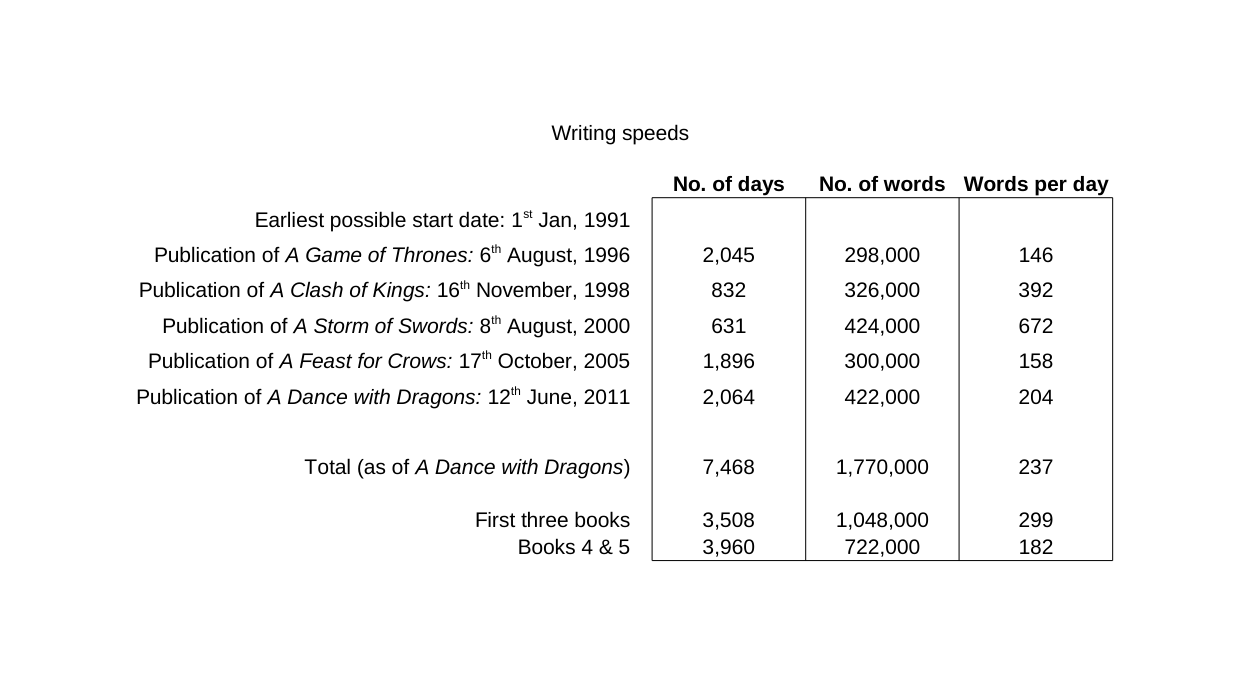
This made me curious about Mr. Martin’s writing productivity, so I did a little digging and found the following figures, calculated by his fans:

grrm_wordcount

Those numbers are rather stunning. He averaged only 200 words a day when writing A Dance with Dragons? Just for reference, this blog post is about seven hundred words so far, and I’m writing it while taking a break from my other writing (word count so far today: 1,100 words, and that’s a little low). Even if we allow for five drafts written at the same speed, five drafts still only comes to 1,000 words a day.

Now, I do think Mr. Gaiman makes a good point that it is neither healthy nor helpful to try and micromanage everything that a writer does. We can’t spend every waking hour working on the next book, and even if we did, it probably wouldn’t turn out as well, because refilling the creative well is an important part of the writing process. And I also have to admit that if you ran a similar calculation on my own books (especially the early ones), you would probably find some similarly embarrassing figures.

(Though to be fair to myself, I tend to have multiple irons in the fire at any given time, so a straight start date to publication date calculation doesn’t tell the whole story—and it probably doesn’t tell the whole story with George R.R. Martin as well. But still, even if those figures were twice as high, they would still be absurdly low for a working writer.)

When Mr. Gaiman and Mr. Martin say that the writing “comes when it comes” and there’s nothing they can do about it, I think they’re wrong. Dead wrong. Writing is an art, but it is also a craft. It can’t be forced, but it can be structured. Mr. Correia has evaluated how productively he writes and structured his convention-going plans accordingly. Has Mr. Martin?

I also think they’re dead wrong about the writer having no obligation to the reader. That’s total bunk. Reading is an act of collaboration between the writer and the reader: without readers, stories would never exist. They would just be markings on a page, or electrons on a drive, or at best ideas and daydreams in the writer’s head. If a tree falls in the forest, does it really make a sound? If a book is never opened, does it ever tell a story?

Part of this may be the difference in perspective between indie writers and traditionally published writers. In the traditional system, writers were paid an advance on royalties by their publishers. The contract also allowed for royalties, but those figures were set so low that most books never earned out their advance. Publishers made up for it by raising the advances for the writers they wanted to keep.

In contrast, indie writers live and die by their royalty checks. Had a good month? Congratulations, you can afford to eat. Had a bad month? Tsk, tsk. Better hurry up with that WIP of yours, because the longer it takes to publish it, the longer it takes for you to get paid.

But even for the fantastically successful writers who never have to worry about how they’ll pay their bills, I still believe that they have as much of an obligation to their readers as the rest of us. Without readers, we would not be able to do what we do. Without readers, it would be impossible to pursue writing as a career. We all want to live the dream, and the only way to do that is by treating our readers well.

So George R.R. Martin may not be your bitch, but I most certainly am. Writing is not something that happens only sometimes: it’s my job, and I do it every day. And as for accountability, I absolutely feel that I’m accountable to my readers. They are the whole reason I am able to do this in the first place. If that makes me their bitch, then so be it.

Resolution: 10k in 2016

Back in 2012, I set a resolution to write 10k words of fiction in a single day. I had read Rachel Aaron’s semi-famous blog post about it, and decided to give it a shot myself. The most I managed, however, was a handful of 5k writing days—impressive, but still far short.

In the years since, my writing pace has slowed down a lot more than I would like—not because of writing-related reasons, but because of things like procrastination, poor time management, and general disorganization. Well, it’s time for a change, and the new year seems like the best time to shake things up.

Rather than set a goal like “write every day” or “write X,XXX words per week,” I think this goal will do a lot more to put me in the right direction. It’s the difference between setting a goal to go to the moon vs. put something new in orbit every few months. When NASA set the moon as their primary goal, it not only provided them with the single-minded focus that they needed to get stuff done, but it led to a tremendous amount of scientific and engineering breakthroughs in the process. I’m hoping that something similar will happen with me.

So here’s the deal:

I can type at a maximum speed of about 100 WPM. Logistically, that means that the absolute minimum time needed to physically hit 10k words is 100 minutes, or 1:40 hours. That’s typing at top speed with no breaks, no mistakes, and no time to slow down and think.

I’ve measured my writing in the past, and found that my typical fiction writing speed is between 800 and 1,000 words per hour. To hit 10k words at that rate, I would have to work for an excruciating 10 to 12 hours a day—and that’s pure writing time. It doesn’t include things like breaks, water cooler chats, dinking around on social media, or any of the numerous other ways that regular employees waste time while on the clock.

Clearly, if I’m ever going to hit 10k words in a single day, I need to increase the speed at which I write. But how?

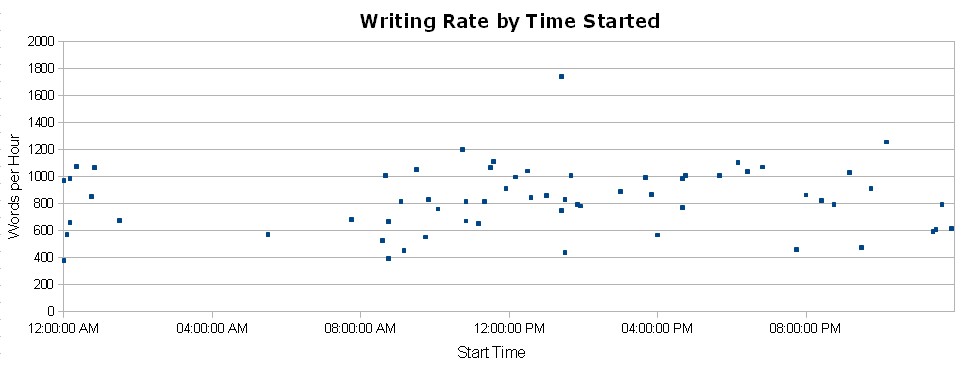
writingrate_by_starttimeWell, I know from my writing log experiment that the time of day doesn’t really affect my writing speed. That means I can start as early as I need to, and the earlier I can start the better. So that pretty much sets up the first step to achieving this 10k goal:

Step 1: Start off each day by writing as soon as possible.

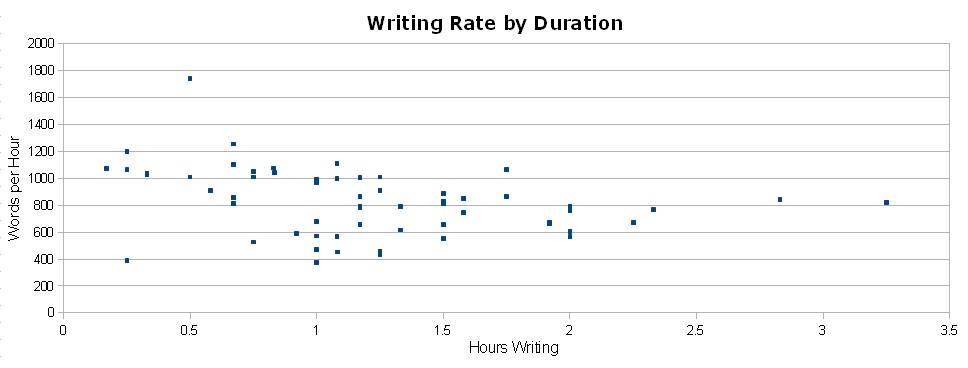
writingrate_by_durationFrom the writing log, it looks like I tend to write fastest in short sprints that are less than one hour. That makes sense: the longer the writing session, the easier it is to get distracted and fall into the procrastination trap.

I have a hunch that the best way to increase my writing speed is to write in short, focused bursts. I’ve never actually tried to limit my writing time before, but it seems that I could really achieve a lot more focus by doing so. It will take some experimentation to figure out the optimal session length, but judging from the data it will probably be less than one hour.

Step 2: Increase speed by writing in short, focused sessions.

Obviously 10 to 12 hours of pure writing time is unreasonable. Even without a day job or other time obligations, burn-out would be a major issue. A much more reasonable amount of time to plan for would be 4-6 hours of pure writing time per day.

At 6 hours, to reach 10k words I would have to write at about 1.6k words per hour, which is reasonable. At 4 hours, I would have to write 2.5k words per hour, which is a lot tougher but still well below the 6k WPH physical limit, especially if I’m writing in short, focused bursts. From this, it’s not difficult to derive the next couple of steps.

Step 3: Increase average writing speed to 2,000 words per hour.

Step 4: Structure each day to achieve 6+ writing sessions.

The real trick to achieving this, as Rachel Aaron and numerous others have pointed out, is to take care of all the non-writing things that make the writing possible. This involves having an outline of some sort, or at least some idea of what is going to go on the page.

I’m a pantser, so I don’t write detailed outlines. However, I’ve found that it can help a lot to sketch out the next few scenes before I write them, and to browse tvtropes like a menu. In addition, long walks really help me to flesh out the story in my head. Without these pre-writing activities, the blank page can be really oppressive.

In more specific terms, I think it’s reasonable to allot 1-2 hours each day to pre-writing activities. Anything more than that would encroach on my actual writing time. Fortunately, I can usually hit two birds with one stone: for example, using my time on tvtropes to find material for blog posts, or outline the next few scenes in my head while hiking or exercising. But it’s important to make time for these things.

Step 5: Spend time each day in pre-writing activities for the next day.

These five steps seem like a good place to start. I’ll post them on my wall and revisit them in a month or so to see how they’re working out.

Ten thousand words in a single day is going to be tough, but if I can hit it at least once this year, I think it will remove a major block in my head and allow the words to really flow. It’s not just about writing faster, it’s about proving to myself that this is something I can do, and to use that as motivation to accomplish much more.

Best of luck with your own resolutions in 2016!

Some new writing resolutions

So I’ve been following Dean Wesley Smith’s blog pretty closely over the last few days, as he posts about his creative process for a novel he’s ghost writing.  It’s more than a little mind-boggling–he started literally with nothing, not even a working title, and yet he’s averaging between 5k-7k per day.  If he hasn’t already, he’ll probably finish it tonight.

I’m learning a lot from these posts, especially about the importance of switching off your internal critic and trusting your creative instincts.  Over the last couple of days, I’ve tried to do just that with the sword & planet novel I mentioned last week, and I can say that it really works!  By doing all I can to put words on the page and ignoring everything else, I’m averaging about a thousand words per day and the story is unfolding wonderfully.  It’s like a trust fall with my muse, where instead of failing miserably I’ve found she’s there to catch me.

All of this has made me think that I need to reorder my writing routine and make some resolutions in order to keep this momentum going.  If I can overcome some of my bad habits and replace them with good ones, I can be a lot more productive, and writing will be that much more fun.

So here’s what I’m going to do this week:

  • Start every day with writing.  Even if it’s only fifteen or twenty minutes, as soon as I get out of bed I’m going to sit down at the writing computer and pound out a few hundred words.
  • Write in lots of little chunks, rather than one or two large chunks.  In other words, don’t put off writing until the chores are done–put off the chores!
  • Shoot for 1000 words per hour or better.  If the pace starts to flag, switch projects if necessary, even if the other project is fanfic.
  • Go for at least one walk at some point in the day.  Walks do more to re-energize my creative energy than just about anything else.

Basically, I’m going to treat my work-in-progress as something fun, rather than work or a chore.  I’ll use a stopwatch to keep track of how many hours I write each day, but I won’t give myself a quota.

My writing process isn’t the same as Dean’s, and I’m not going to try to imitate his process, but I am going to pick out what I like about it and see what works.  Also, I’m going to focus a lot more on quantity than quality, with the understanding that treating everything as practice will likely improve both.

As for the A to Z blogging challenge, I’ve got two posts left, Y and Z.  I haven’t written them yet, but I’ve got a great idea for both of them.  Since writing takes precedence, though, I may not get to them until later in the day.  It also depends on whether the temp agency calls me up in the morning with a job–they’ve been doing that a lot recently.  Last week I was at a factory making toothbrushes for dogs (true story).  This week, I could be doing anything–or nothing, as the case may be.  I’d like a couple of days of nothing, just for a good chance to write.

4:04 hours and 2.8k words. Not bad!

You know, sometimes I miss the days when I would churn out 1,000+ badly written words and throw up a badly written blog post, still reeling in awe from a white-hot creative heat.

Well, I think those days are coming back!  Except hopefully, my writing has improved since then.  Today was the first day I hit my four hour writing goal, and it was awesome.  Also, I wrote over a thousand words in two different projects: The Sword Keeper (which is my primary project right now) and Star Wanderers: Benefactor (a secondary project, though that may change in a month or so).  Not bad!

The really cool thing, though, is that when I woke up, my brain was actually wordsmithing.  It was weird–I was actually crafting sentences in my sleep.  Of course, being an idiot, I didn’t actually sit my butt in the chair until around 11:00 am.  Still, the words came out all right, and they didn’t stop coming all day.

I think my new time tracking goal is going to work out really well.  For most days this week, I managed to get at least 3:00 hours in.  Also, I noticed a lot of interesting things about the way I write.  Starting is the hardest part, especially first thing in the day.  Frequent short breaks can help, but the internet is a huge trap and should definitely be cut from my writing computer.  If I can’t manage 500 words/hour, chances are I’m not going to stay put for very long, but once I hit 800 wph, it’s smooth sailing.

Keeping a daily time goal also makes me conscious of a lot of things.  For example, when I first wake up, I look at the clock and think “if I do my full four hours right now, I’ll be finished by XX:XX.” That motivates me to start earlier, since it means I can finish earlier (or at least have less pressure later when I’m tired).  Also, it motivates me to write for longer lengths at a time, rather than writing in short, less productive bursts.  And even though I’m still keeping track of how many words I write, the pressure to hit a certain word count is less, since once the four hours are up, the goal is accomplished no matter what’s on the page.

Of course, all this mean I’m actually writing more.  Even on the days when I didn’t hit the full four hours, I wrote a lot more than I otherwise would have.  And the neat thing about writing is that the more you do it, the easier it comes.  It takes a while to build momentum, of course, but if you can just ease back on your inner editor and let the words come, they really will come.

So the next few days are going to be interesting.  I’m leaving Massachusetts on Sunday, to take the train across the country.  That will give me plenty of writing time, I’m sure, but once I arrive in Utah, things are going to get tricky.

My first priority will be finding an apartment, then a job–probably a crap job, though in this economy even those can be hard to find.  From what I’ve heard, things haven’t changed much since I left.  My writing is starting to take off, though, so I’m not too worried about the long-term–it’s the short-term that’s going to be a challenge.

I don’t know how long I’ll stay in Utah this time, but definitely until the summer.  There’s a lot of old friends to look up, and writing conferences to attend.  If I’m not totally broke by August, I’ll do my best to attend Worldcon as well.

That’s just about it for now.  I’ve got a lot of chores tomorrow, so I’d better get some sleep.  Later!

Slow going (but still going)

I’ve been back in the States for exactly one week now, and while my stomach is still having trouble adjusting, I’m more or less used to the American way of life.  Not much culture shock this time, though that could change once I get back to Utah.  That place is pretty strange.

So without a foreign culture to navigate (or a job, though hopefully that will soon change), I have a lot more time to focus on my writing.  Trouble is…it’s coming slow.  Like, reeeally slow, at least for me.  I’ve been clocking in at less than 800 words per hour, sometimes as low as 500.  I’m still hitting betwen 1.5k and 2k words per day, but still, it’s way more of a struggle than it needs to be.

I think the main problem right now is that I’m writing with my internal editor looking over my shoulder.  Somehow, I seem to have forgotten how to turn him off (maybe that’s why I didn’t get very much written in Georgia, hmmm…).  To compound matters, it seems like every ten minutes I want to get up and do something else.  That’s not a very good way to be productive at anything, let alone writing.

Fortunately, I think I’m slowly getting the good habits back.  I’m writing a little less than two scenes a day, and the momentum is building.  With this timer constantly staring me in the face, I’m much more conscious about how I structure my day.  I haven’t hit four hours of productive writing time yet, but I am consistently getting to three, so I think it’s just a matter of self discipline before I can up that to four.

All boring writer stuff, I know.  But the long and short of it is that I’m slowly getting back into the swing of things.  If I can turn off that internal editor and start writing faster, I think I can finish The Sword Keeper before the end of the month.  That would free me to work on a lot of other things, most noticably publication of Stars of Blood and Glory.  That’s the next one in the publishing queue, though I’m still waiting on a couple of first readers <cough>.

That’s about it.  I just wanted to vent some frustration, since man, writing is tough when your internal editor is breathing down your neck.  But don’t worry–I’ll shut him up soon, and my writing will be better because of it.

Time to get immersed back in story.

A new daily writing approach

So last summer, I decided to stop tracking my daily writing word count.  There were a lot of reasons for this, mostly having to do with the way it led me to focus on the wrong things and beat myself up in ways that were ultimately counterproductive.

The trouble is, I’d structured almost my whole writing life around keeping track of word counts.  Without an easy way to measure my daily progress, it was really hard to know whether I was being productive or not.  As a consequence, I didn’t push myself as hard as I could have, and ended up bouncing around between projects without really finishing anything.

Well, I think I’ve figured out a solution to that.  Instead of tracking daily word count, I’m going to use a countdown timer to make sure I spend at least X number of hours each day writing new words.  Whenever I take a break to do something else, even if it’s writing related, I’ll pause the timer, then start it up again when I get back to writing.

I tried it out last week, using a program called TimeLeft.  It worked out pretty well, I think.  Definitely gave me a lot more insight into my writing process.  I think it will help me to get some good habits back, like writing in the morning and staying focused for longer.  It will also help to have something I can accomplish each day.  It doesn’t matter how much I write, just that I spend the time actually writing.

To start out, I’m going to shoot for four hours of daily writing time.  It might not sound like a lot, and without a day job perhaps it isn’t, but I think it’s a good starting point.  Then again, if the guys at Writing Excuses are right, I might end up scaling back a bit.  Either way, I’ll probably end up adjusting that goal over the next few weeks.

Other writing stuff I’d like to figure out this year:

  • How to juggle two projects at the same time.  I’m kind of doing it now with The Sword Keeper and Star Wanderers: Benefactor, but it’s tough to keep one of them from getting the short end of the stick.
  • How to go for a week without checking my ebook sales.  Kris Rusch had a really good post on this last week.  I’ve tried it before, but I always end up breaking down and checking.  Well, no longer!
  • How to write good short stories.  I think I’ve put it off for too long.  Yes, novels and short stories are different arts, but they’re both writing, and I’m a writer.  Time to learn.

That’s just about it for now.  Hopefully, it will turn out well.