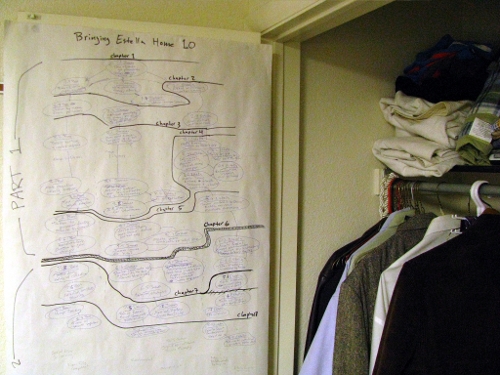
Do you like your chapters named or numbered?

There’s an interesting article linked on The Passive Voice blog about the importance of a table of contents, especially in ebooks.  The article is geared mostly for non-fiction, which is a whole different beast from novels and novellas, but the discussion on TPV got me thinking: for ebooks, is it better to name chapters or to merely number them?

In the comments section on TPV, Jamie makes an interesting point:

With e-books in particular I think there needs to be more care taken with the TOC. I can easily find my place with a print book even without a book mark, but with an e-reader, it’s possible to lose your place very easily, and “loc 4950″ is not going to be committed to my memory banks. I know what happens in the chapter titled “His Grace of Avon Takes Command of the Game,” but I’m not sure if that was chapter 16 or 15 “loc 1730″ or what. I won’t remember the number.

For organizational purposes for my own use I title my chapters, and I believe that readers will appreciate that habit, too, and will be more forgiving if they use the Look Inside feature and see those headers vs. if they just see “1, 2, 3.”

I try to make sure the titles are enticing and pique the curiosity of anyone who would see them in a TOC. They’re not spoilers, because unless you’ve made it to the end of the previous chapter, you’ll likely have no idea what the next chapter’s title is referring to (and if it is obvious, it simply increases the suspense/curiosity). The titles Makes Sense in Context (TM).

When I first learned how to make an ebook, the concept of a table of contents for a novel seemed pretty weird.  I was used to reading print books, which you can flip through much easier and find what you’re looking for just from the feel of the pages.  But with ebooks, obviously that’s much different.  A table of contents is more than just a list of chapters, it’s an important navigational tool that can’t be overlooked.

But if chapter hyperlinks are perhaps the only way to flip through the middle of the book, does that mean that merely numbering the chapters is insufficient?  I have to admit, the concept of naming each chapter seems a bit old-fashioned, but the technology has changed and as writers, we need to change with it.

In the context of a hyperlinked table of contents, numbers are practically meaningless.  They can even be quite ugly, if there’s a huge list of them that sprawls beyond the screen.  Chapter titles can sprawl even more, but they at least provide some idea of what lies on the other side of the link.

I’ve done it both ways.  For example, the table of contents for Genesis Earth looks like this:

Table of Contents

Copyright Page
Table of Contents

The Wormhole | The Mission | Terra | Cryothaw | The Ghost Ship | Trust and Deception | Betrayal and Discovery | Arrival | First Contact | Call and Answer | Earth | Rescue | Emotion and Reason | Planetfall | The Natives | Origin and Destiny | A New Genesis | Epilogue

Author’s Note | Acknowledgments

Most of the chapter titles are pretty mysterious, but I was kind of going for that.  And in any case, is it possible to make them completely unambiguous without spoiling key parts of the story?  It seems like the art of naming chapters is much subtler and more complex than you’d think at a first glance.

In contrast, the table of contents for Desert Stars looks like this:

Table of Contents

Copyright Page
Table of Contents

Prologue
Book I: Dome and Desert
1 | 2 | 3 | 4 | 5 | 6 | 7 | 8 | 9 | 10
Book II: Sand and Stars

11 | 12 | 13 | 14 | 15 | 16 | 17 | 18 | 19 | 20 | 21 | 22

Author’s Note | Acknowledgments

I kept the numbers for the chapters, but divided the novel into two sections or “books” and listed the numbered chapters as minimally as possible, to save space.  I suppose it looks all right, but as a guide to navigating the book, I’m not sure how useful it is–not to mention how hard it can be to click on a hyperlink that’s only one character long, especially on a touchscreen.

For Journey to Jordan, there were so many entries that I didn’t bother listing them all in the table of contents.  Instead, I divided each part into sections based on location, then listed the locations in the table of contents and the posts/chapters at the head of each section, complete with hyperlinks.

As a side note, it’s actually pretty amazing how internal hyperlinks can change the experience of the book.  For one thing, it opens up all sorts of possibilities for alternate endings and “Choose Your Own Adventure” type stories.  Is it possible to list a chapter in the <manifest> without including it in the <spine>?  I don’t think it is (at least, not in a well-formatted ebook), but if you could find a way to do that, you could add all sorts of hidden content and Easter eggs …

In any case, for my shorter Star Wanderers novellas, I think I actually prefer numbered chapters.  The stories are short enough that the numbered subdivisions still have meaning, and the chapter lists aren’t long enough to look too cluttered.  Besides, I’ve already started the series in this particular format so I think it will be better to keep it this way.

But for future books and future series … I don’t know.  What do you think?  Are ebook chapters better off named or numbered?

plot vs. PLOT and an interesting serial publishing idea

Back in English 318 at BYU, Brandon Sanderson used to tell us that there was a big difference between “little-p plot” and “big-p Plot.” The first applies mostly to chapters and scenes, which he said he could teach us.  The second refers to the overall story structure, which he couldn’t teach in a classroom setting and said we’d have to discover on our own.

I’ve been thinking a lot about this recently, because it seems that my books are starting to fall into a recognizable pattern–and that pattern has some interesting potential for serials and other alternate forms of publication.  Each book is divided into 3-4 parts, each part is divided into 3-6 chapters (typically 5), and each chapter is divided into 3-5 scenes.  Here’s how it works:

Chapter 1: Setup for the basic story arc.  Introduction of the characters and setting, the prominent theme or premise, and a little foreshadowing of the coming conflict.
Chapter 2: The inciting incident, a discovery or event that starts the plot rolling and puts the characters in motion and conflict.
Chapter 3: Complications arise, the problem gets worse, the first attempt at a solution fails, generally leaving the characters at a loss.
Chapter 4: Setup for the resolution.  The characters discover or build something that will help them to settle the conflict.  They stop reacting and start to be more assertive.
Chapter 5: The resolution.  The characters either succeed or fail, but the arc comes to a close either way.  The story question is answered, the thematic elements come full circle, and the story either closes or moves on to the next part.

Basically, it’s the 3-act format divided into five chapters.  When I wrote Heart of the Nebula, all four parts fell into this pattern, and now that I’m writing Star Wanderers, I’m finding myself  falling into the exact same pattern again.  Stars of Blood and Glory is a little bit different; there are three parts instead of four, and each part is divided into six chapters instead of five.  But still, it’s all very structured.

In short, Brandon was right.  It took me a few books to really learn “big-p Plot,” but now that I’ve found a story structure that works for me, it’s starting to come quite naturally.

The cool thing about this particular structure is that it’s very conducive to serialization.  Each chapter is between maybe 3,000 to 5,000 words, so each complete sub-arc is between about 15,000 to 25,000.  That’s the length of a short novella, and it takes me only a month or two to write (sometimes three, depending on how much revision it needs).

The only reason I haven’t done more with serialization up to this point is because I’ve found that sharing my work while it’s still unfinished tends to throw a wrench in my creative process.  The idea of publishing a work in progress on a chapter-by-chapter basis scares me, because if one of the story arcs has a flawed beginning, I wouldn’t be able to fix it.

However, by following a five-chapter arc format (with bits and pieces here and there to hint at a larger overarching structure), I can see myself publishing a novel or epic in a serial format.  It would be something like the Perry Rhodan series, which follows an arc structure of 25 to 100 issues (each a small novella) per cycle.

So here’s how I’m thinking of doing it:

  1. Publish the first installment and price it at free while writing the second one.
  2. Publish the second installment and price it at free, raise the price of the first installment to $.99 and write the third one.
  3. Publish the third installment and price it at free, raise the price of the second installment to $.99 and write the fourth one.
  4. Publish the fourth installment for $.99, drop the price of the first installment to free and publish the completed novel for $2.99.

So what do you think?  Does it seem like a good way to publish a book?  It gives the reader a reason to keep coming back, and rewards those who got in early by charging them less for the completed work.  By selling the novel in shorter chunks, I would be able to put more work out and hopefully gain more visibility, especially by making a portion of it free at any given time.

I’m seriously thinking about publishing Star Wanderers this way, once I hear back from Writers of the Future.  I’ve already finished the rough draft for the second part; it probably needs a good revision or two before it’s ready, but since it’s shorter, it shouldn’t take more than a few weeks to get feedback from some first readers and finish the next draft.  And if the third part is already finished by then…

So many awesome possibilities! 🙂 What do you think?

Danger: difficult plot ahead

Just a quick post before I turn in and try to catch up on the sleep that I didn’t get last night (insomnia sucks).

I’m entering a very difficult part of the revision for Mercenary Savior. I’m a little more than a third of the way through the story (as you can tell from the status bar to your right), which is usually where my writing starts to get iffy.

Up until now, most of the work has to do with revising or rewriting individual scenes.  That’s no too difficult; it’s very easy, for me at least, to focus on the page itself and fixing problems on the sentence and paragraph level.

The problem now, though, is that some of the chapters aren’t working as coherent units.  Some of them feel slapped together, as if scenes that don’t really have much in common have been thrown in the same chapter merely because I didn’t know where else to put them.  That doesn’t make for good chapters.

So now, I need to take a few steps back from the page and look at the forest instead of the trees.  I need to figure out which events need to be clustered into which chapters, in order for the scenes to resonate with each other and build up to the climax without bumbling on each others’ toes.

I’m going to try out a few new tools to help with the plotting, most notably Dan Well’s 7 point system.  I’ve already worked out the essential plot points for about a dozen of the conflicts in the story; now I just need to see which ones go in which chapter.

I wish I had time to use it now, but dagnabit, it’s 1:30 in the morning, and I have to get up at 7:00 tomorrow.  Dang.  Well, at least I have work–and it’s good work for an aspiring writer in my position.  More on that in a later post.

Anyway, good night.

Bringing Stella Home 2.0 is finished!

Just in time for the new year, too!  I finished it at approximately 11:25 pm on New Year’s eve 2010.  Here’s the breakdown:

ms pages: 491
words: 136,095
file size: 1,869 KB
chapters: 30
start date: 14 July 2009
end date: 31 December 2009

And the wordle image:

Wordle: Bringing Stella Home 2.0

I’m glad to have it finished. It’s got tons of issues with it–way too many for me to show it to an agent/editor–but I think this draft is significantly better than the first one. In particular, I’ve worked on improving the chapter structure: making sure that each chapter has consistent rising action, a central focus, a climax that develops the main story in some way, and compelling transitions that propel the reader into the next chapter. I don’t do any of that very well in first drafts.

So now that the second draft is finished, time to lay it aside for a while and work on something else. After a few months, I’ll be in a better position to pick it up and fix the major issues.

In the meantime, on to something new–in more ways than one!

Happy new year!

Genesis Earth 3.0 is almost finished!

Yeah!  Only five more scenes to go!

I love revising.  Every time I finish a scene, or a chapter, or a draft, I look back and think “man, this is so much better than it used to be!” Later, maybe, I look at it and say “okay, it still needs work,” but to know that I made something good into something better, that’s satisfaction!

My self-imposed deadline for this draft is this weekend.  I’d like to finish it tomorrow, but if all else fails, I’ll finish it on Sunday.  Shouldn’t be too hard.  I’ve done a lot of work to get this far, averaging about 2,200 words a day.  The ending is a lot trickier to fix than the beginning, since I’m much better at beginnings and middles than at endings (not as much practice), but it’s coming along.

Yesterday, I wrote about 3,500 words in this beast.  It felt so satisfying at the end of the day!  Finishing up another chapter, knowing that I was right on target.

Today, for some reason, I haven’t been able to get into the writing mindset, but that’s not too bad.  I spent some time looking over the last three or four chapters, making spot edits, re-arranging a couple of the chapter breaks to make them more coherent, etc.  Chapter organization is still a challenge for me, especially towards the end of a project.  Hopefully, I’m doing it better in this draft than the last one.

Today is Pioneer Day, a holiday in Utah.  I’m spending the afternoon and evening with family, so I probably won’t do much more writing today.  Maybe another scene sometime tonight, but that’s okay–the way I’ve re-arranged it, the chapter I need to revise for today needs just one more scene to be complete.  I’ve been working hard these past three weeks, and I’m looking forward to having a fun holiday with family.  The break will probably help me to write better, anyway.

So, that’s how things are looking from here.  In the meantime, I’m getting psyched up for my next big project: revising Bringing Stella Home and getting ready to start something completely new in the fall.  Once Genesis Earth is finished, I’ll be able to commit more creative space to those projects.  Looking forward to it!

13,837 words in a day?

Yeah, that’s right.  Believe it or not, I barreled through about 13,837 words today.  That’s thirteen THOUSAND, not thirteen hundred.

Now, only about a thousand of that was new stuff  that I was writing.  Most of the rest of it was rearranging scenes that I’d already written, touching them up only a tiny bit.  I did merge a couple of scenes, delete or tone down some stuff, etc.

So really, about 90% of my work today was just revision, and not even really hardcore revision at that.  I’m still treating this version of my story as a rough draft; I’m not taking the time to polish things up and fix the known minor problems.  Really, I’m just running through what I’ve already written to make sure I have what I need to get past the roadblock I hit back in April.

The biggest thing I’m doing right now is rearranging scenes into entirely new chapter arrangements.  This seems to be a problem everytime I write a story with multiple viewpoints: I never seem to get the prelude-rising-falling-resolution-cliffhanger action that good chapters have.  I write scenes as they come to me, in a progression that seems natural at the time, but once I take a step back, I find that things work better on the macro-level if I complete rearrange which scenes come where in the narrative.

Part of that is that sometimes I just need to write a few paragraphs (or even a few scenes) just for me to figure out what’s going on, plotwise or settingwise.  What I’m finding with Bringing Stella Home is that I’m taking scenes from James and Danica’s viewpoints and moving them up a chapter or two, cutting out the filler in the middle.

I’ve got a long way to go before I master the art of good chapter structure.  Or perhaps it’s something that I do better when I’m revising, not drafting.  After all, I think I’m more of a discovery writer than a firm outliner.  Perhaps I write in a sort of puzzled up everywhere kind of way, and then do best when I don’t put all the pieces together until after I’ve vomited them all on the page.

I am getting more excited about this story, though.  Taking a step back and looking at things from a more global perspective has really re-energized me.  I can see the major turning points, and that helps me to build up for them much better.

I’m only worried that the “midpoint” is going to be somewhere around the 3/5ths mark, not the halfway mark as it should be.  One of my goals with this book is to see if I can hold to the three act structure and whether that makes my story any stronger.  But, according to the website, the midpoint occurs “approximately” at the halfway point, so I guess I can fudge it.

Also, the midpoint is supposed to be where the main character hits rock bottom.  Hee hee hee…oh, he will.  He will.  Bwahahahaha!!!

In the meantime, you owe it to yourself to listen to this:

Ugh. Just ugh.

Man, it was hard to write.  So hard, I only just finished, and it’s 1:30 am.  Ugh.

The reason it was hard was because the character’s reactions in this scene needed to be totally revamped.  That also necessitated a complete shift in the structure of the writing, because the rough draft consisted almost entirely of internal feelings and reflections.  Indeed, the rough draft of this scene was about as close to an info dump as I will ever allow myself to come.

Or so I tell myself.  The first rewrite tried to keep things internal, just with the new reactions and motivations, but…well, before I knew what I was doing, I was info dumping.  Yes.  Shame on me, I went and committed one of my greatest pet peeves.  And I felt dirty afterwards, too.

Well, guess what happened?  I just kept writing, dumping out the info that I , but it kept coming out slower and slower, like wringing the last few drops out of a washcloth.  I didn’t know where to end, so I decided to cut it out somewhere in the middle…but then I got to the next scene from this character’s point of view, and realized that I was lacking the right transition to that part of the story.

Everything was falling apart.

So…I couldn’t just cut out all that stuff that I’d vomited onto the page.  It was a butt ugly info dump, but I had to get it across somehow.  I decided the only way to do it was to add in an extra scene.

 Trouble was, for the sake of the flow of the  chapter itself, I couldn’t just add all that stuff in another scene.  For starters, the nature of the stuff I’d just dumped on the page necessitated two scenes, but I didn’t have another one to bring in to break them apart.  I didn’t want to have three scenes all in a row from the same point of view–that would just be clumsy.

Ugh.  Just ugh.

So, how to solve it?  Take out a chainsaw and perform some delicate surgery.  I threw out virtually the entire info dump that I’d spent a good part of my day writing, and made some fundamental changes to the world that I’m writing that totally negated all of that previous stuff (I can do that, you know.  One of the perks of being a science fiction / fantasy writer–you can play god with the world you create).  Then, with the new changes I’d made to the world, I came up with a totally different scene–one that actually worked–and inserted that after the very brief, almost prologue-ish opening scene of introspection.

And then, when I was working with something a little more concrete, I was back in that wonderful place where character shines through and suspense builds through a functional plot.  No more info dumping–I felt so clean, so free of sin.  Great.

It still took bloody forever to finish, though.  All that wrangling from earlier in the day killed my momentum, so it was an uphill battle the whole way.  Ugh.

Looking back, am I satisfied with what I wrote?  Honestly, no.  But the revisions it need are the kind that can wait until the 2.0 draft, not the kind that are preventing me from finishing the first draft.

Those problems, I’m afraid, are yet to come.

Almost at part 3

Wow, writing this novel is going a lot faster than I had thought. At the same time, though, I sometimes worry that I’m not going fast enough.

I broke the 50k mark this week, and I haven’t even gotten to any of the major climaxes yet. This thing could easily go to 90k words before the end. With only 6 1/2 weeks left in the semester, can I finish it in time?

At the same time, I have NO IDEA what I’m doing this summer. Really. I have a lot of possibilities, but no concrete plans. With the semester coming to a close in a little more than a month and my housing contract with the FLSR coming to an end, that is a little bit unnerving.

Whatever I do, I want to devote some serious time to revising and rewriting these novels, getting them polished. Finding a spring/summer contact isn’t that hard in Provo; the question is whether I can find a job. I also want to go to the Middle East for a while, and if I go home to Massachusetts in August (which I would like to do) another possibility is Worldcon 2009 up in Montreal.

As far as how Bringing Estella Home is coming, it’s coming along very well. I have all of the key climaxes mapped out in my head, and the one that ends part 2 and begins part 3 is only two chapters from where I am now. I don’t normally keep a detailed outline of the whole novel, but I can usually see at least one chapter ahead. Kind of like the faith-promoting story of how a train conductor only has to see as far as his headlights, except that with novel writing, getting derailed is a very real possibility. I know I’ve crashed and burned in my novel attempts before. Fortunately, this one seems to be right on track.

This semester hasn’t been too hard, but last week was somewhat harder than usual. However, it seems like things are starting to calm down into another lull (knock on wood), so I think I can shoot a little higher as to where I want to be at the end of this week (in terms of my novel). I’ve found that I can do about one viewpoint scene per day, one chapter per week. This week, I’m going to shoot for two chapters by Monday. It seems a bit tough, but since I’ve already written the first scene in chapter 9, I think I can do it.

Also, as an experiment, I’m going to try to wake up early and get in a solid hour of writing before I start my day. I found a random website the other day (lost the link, sorry) that showed the routines of several famous, successful writers. Almost all of them woke up early in the morning and did most of their work before noon. Right now, I write almost everything between eleven at night and three in the morning, so I’d like to see if I can change that. I may fail miserably, but what the heck. Now is the time in my life to figure out what works and what doesn’t.

Progress!

I’m sludging through the middle of Bringing Estella Home.  I’ve heard people call this the “blue collar work” of writing, all the parts between the beginning chapters and climactic ending chapters.  I believe it.

In particular, I was having some difficulty with chapter 7 last week.  I have, basically, three separate plot threads tied up in four viewpoints.  Sometimes, it can be frustrating to give them all equal time while putting the scenes together in such a way that they contrast and build off of each other.  In particular, it’s difficult to get the chapters right.

I’ve heard that each chapter is supposed to be its own distinct sub-story, with its rising action, a mini-climax, and a falling action of some kind.  I’m fairly confident that I can do this intuitively over one or two viewpoints, but over four viewpoints, with three different plot lines?  It’s tough.  Last time I tried was with my first novel, and when I went back for the rewrite I had to reorder several of the chapters, especially the first three ones.

The way I’m doing it for Bringing Estella Home is picking one of the plot lines to be the main subject, if you will, of the chapter.  I build on the other plot lines as well, but the big climax, the big reveal, comes in the plot line that I’ve designated for that chapter.  Typically, I’ll start each chapter with a viewpoint from the plot line that is central to the rising and falling action of that chapter–or, if I don’t start it with the viewpoint, I start it with the characters talking about the idea that is central to the climax of the chapter.

Originally, I thought that the climax / central aspect of chapter 7 would be the brainwashing / mind-altering procedures that Ben undergoes in becoming a soldier for the Hameji.  I started with James discussing the Hameji with the other mercenaries on the ship and talking about various legends they’ve heard of mind-altering drugs that give the Hameji special powers.  The next scene was Ben forced to take some of those drugs.

However, I really hadn’t figured out Ben’s part of the story at this point.  I knew he’d take the drug, and I knew how it would change him, but I didn’t know what happened next.  As a result, the rest of the chapter just felt like a chore, one that I accomplished over several late nights (probably to the detriment of the quality of the writing :P)

It wasn’t working.  The chapter just didn’t feel like it held together.

Then, I had a genius idea–why not make the last scene of chapter 6 the first scene of chapter 7?  The viewpoint was from Estella, meeting the jealous head wife of the Hameji overlord.  That scene set up the conflict for the next two chapters of Estella’s story–in retrospect, why didn’t I make it an opening scene for that reason alone?

I don’t know.  But it worked out wonderfully well!  Once I shifted the central focus of the story to Estella, EVERYTHING fell into place!  Her conflict at this point really was a lot more interesting than anything else in the chapter.

So now, with chapter 7 under my belt, I am WAY excited for chapter 8!  While I was walking back from school one day, I figured out exactly what needs to happen next in his story, and it is amazing!  Brutal, violent, and torturous, but it is amazing!  And this is the perfect chapter to insert James’s philosophical discussion with Danica, the one that I wrote down nearly a month ago just because I had to get it out!  I’m excited.  Maybe I’ll even finish it before Saturday.

Anyways, it is 2:30 am, and I am way tired.  Time to get some sleep.  Thank goodness my first class doesn’t start until noon! 🙂

update on the novel

Ughh…….

Alright, in the tradition of last year when I would write until 2am every night and then blog on it before going to bed, here is another update on how Bringing Estella Home is going right now.

It’s getting tougher.  I’m right in the middle of it right now, in chapter 7, and I’m not sure whose viewpoint I should do next or how I should be organizing these chapters.  I’ve got four viewpoints, but really there are three separate subplots going on, and I need to give them each equal time while structuring them so that the tension builds from one to the other.  When you don’t know what your chapter is doing in relation to the novel as a whole, it’s difficult.

My readers in English 318 tell me that one of the most interesting things in this story is the culture of the antagonists, the Hameji, and that’s really good because I want it to be interesting.  I’ve created a sort of ruthless, cold-hearted, irrationally violent barbarian culture, and over the course of the rest of the novel I’m going to show exactly WHY they are so violent, what drove them to it, etc.  Sound familiar?  It’s my Mongols in space idea, and it’s coming along very well…

…except that I didn’t have Ben’s part figured out very well.  He’s the one who gets brainwashed and turned into one of their soldiers, given a drug that melds his emotional being with that of a collective–kind of like the borg, but only with feelings and emotions, not with thoughts.  It will be interesting to play with that idea, but this chapter, which was originally supposed to focus more on his experience with that transition, just…didn’t work out as well.  Not a lot of screen time for him, for some odd reason.

So I did a little bit of thinking as I was walking home today.  I thought to myself, “if I were a Hameji commander, how would I train these guys?” And it worked out very well!  I think I know what I need to do now, what Ben’s story is going to be for the next couple of chapters.  That’s very good.

Man, going for a walk can really help you sort things out and figure out what happens next.  Even though I have an mp3 player, I rarely listen to it as I’m walking to and from campus.  Many times I have my best ideas while making the commute.  If/when I become a professional novelist, I’m going to have to set aside time each day for long walks.

Finally, I’m a little worried that I’m falling behind on my deadline.  I wanted to finish this thing by the final exam day, sometime in April, but now that I’m sludging through the middle, I wonder if it might take longer.  I have the climaxes figured out very well, but I’m still a long ways away from them.  I might not finish this novel until the end of May, especially since I’ll have to do some major revisions of the first three chapters to hand it in for the English 318 final.  That won’t give me a lot of time to revise my novels for World Fantasy 2009…

Bah.  There is so much to think about.  Rather than deal with it now, I’m going to go to bed.