How I hacked my ADHD to triple my daily word count

Writing with ADHD can be tough. It’s easy to beat yourself up for being “undisciplined” or “lazy” when the greater problem is that you’re trying to work against your ADHD instead of finding ways to make it work for you. It’s like swimming against a rip current instead of swimming sideways to get out of it.

In the last month, I’ve made a really fantastic breathrough that I think will change the way I write from here on out. So far, it’s helped me to double or even triple my usual word count. The novel I’ve been wrestling with for more than a year now—the longest one I’ve written since I started indie publishing—now looks like it will be finished in just a few of weeks, when I expected it to take a couple of months. Needless to say, I’m really excited.

What changed? I found a way to make my ADHD work for me, rather than against me.

In my previous post, A reading hack for the ADHD addled brain, I explained how I exploited my ADHD to read more books. Basically, I did the same thing, but for writing. There was a lot that had to happen first, though, and the biggest of those was that I had to learn how to make and keep an outline.

Step 1: Learn how to outline properly

For years, I just sort of assumed that I was a discovery writer, probably because of the ADHD. Most of creativity has to do with finding novel or unexpected ways to combine two or more ideas, and when you have ADHD, your brain naturally jumps from idea to idea. That was why I always hated taking meds when I was a kid: I felt that it stifled my creativity. And since most of this idea jumping happened subconsciously, I assumed that outlining would also kill that process.

But after a few years of struggling as an indie author, I realized that my writing process was too slow. In order to succeed, I needed to publish more frequently, but in order to do that, I needed to produce more content regularly. Back then, I would usually write a novel from start to finish, laying it aside for a month or two if I ran into a serious block, and also after finishing each draft. A typical novel would go through two or three revision drafts, so it would literally take years before a +70k word novel was ready to publish.

I decided that the best way to shorten my writing process was to “cycle” through the book, combining all the drafts so that I was working on revisions while simultaneously writing the rough draft. In order to keep track of all that, I needed to keep an outline. So I tried out a few different methods and tweaked them until I came up with a method that worked well for me.

The thought of outlining can scare a lot of writers who consider themselves “pantsers” or “discover writers,” but the thing to keep in mind is that there is no one right way to keep an outline. In fact, there are probably as many ways to outline as there are writers. For some, a couple of quick sketches on the back of a napkin is enough, while for others, it turns into a massive story bible that’s just as long (or longer) than the actual book. But without trying out a lot of different methods, you’ll never figure out what works for you.

It took me a couple of years, but I eventually developed a method that worked really well for me. With it, I was able to write Edenfall and The Stars of Redemption, as well as the last two Gunslinger books, in much less time than it took for my other ones. I was also able to combine all eight of the Star Wanderers novellas into a novel—something I probably wouldn’t have been able to do very well without a solid outline to keep it straight.

But I still would run into blocks that would occasionally derail the project, at least for a little while. I ran into that a lot with my current WIP, Children of the Starry Sea. Sometimes, they were genuine story problems that I needed to work through. More often than not, though, the problem was one of momentum: I was having too many bad writing days interspersed with the good writing days, so that each day felt like I was starting from zero. After a while, that becomes difficult to keep up.

Step 2: Allow yourself to write out of order

When I came back from my second hiatus to work on Children of the Starry Sea, it was clear that my new method wasn’t working as well as I needed it to work. Children of the Starry Sea is much longer than anything I’ve published so far, and I found that I just wasn’t producing enough new words consistently to make my “cycling” process of revisions work.

Around this time, I remembered something I’d heard on a recent convention panel, where one of the authors shared how he collaborated with another author. Instead of going back and forth, he told his cowriter: “how about you just write all the odd chapters, and I’ll write the even chapters, and when we’re both done we’ll combine it all together and see how it turns out.” To their surprise, it actually turned out really well.

So with that in mind, I decided to experiment with skipping around my current WIP, rather than writing it in order from start to finish. If I woke up and felt like I wanted to write an action scene, I would pick one of the action scenes out of my outline and write that. If I felt like I wanted to write the ending, I would skip ahead and write that. If I felt like I wanted to write the next scene, I would go back to where I’d left off and write that.

The outline was the key. Without it, there’s no way I’d be able to keep everything straight and know where each part is supposed to go. The outline also had the added benefit of dividing the novel up into smaller chunks, making the overall project much less intimidating. The way to eat an elephant is to take one bite at a time, just like the way to climb a mountain is to take one step at a time. Same thing with novels.

That’s all well and good, you may be thinking, but what happens when you’ve written all the stuff that you want to write, and all that’s left is the stuff you didn’t want to write? Isn’t that a bit like eating your dessert first, and leaving your vegetables for last? Not really, because chances are that if you really don’t want to write a particular scene, the reader probably won’t want to read it either. So if you can find a way to rework your story so that scene becomes unnecessary, you’re probably better off doing that.

But I actually haven’t had that problem yet. The thing about ADHD is that it actually feels right to jump around all over the place like that. Just because I don’t want to write a particular scene on one day doesn’t mean that I won’t want to come back to it sometime later. And more often than not, writing a later scene actually makes things fall into place with the earlier scenes, and makes me more excited to write them.

It’s as if the project itself is a puzzle. Can you imagine trying to put a puzzle together in linear order, starting from the top left corner and moving to the bottom right? That would be pure torture! Instead, you pick up whatever pieces catch your eye, and try to fit them in with other, similar pieces, until the puzzle itself begins to take shape.

There a lot of disadvantages to writing with ADHD, but there are some areas where the ADHD can actually become a strength, if you learn to work with it instead of against it. I’ve already mentioned how it can help with creativity, since your mind is always bouncing around between different ideas. What I’ve learned in the last month is that writing out of order is another great way to harness ADHD as a strength, since something that leaps out from writing one scene can often lead to a breakthrough in another. Writing out of order gives your ADHD brain the space it needs to make those intuitive leaps, and harnesses the “oh, shiny!” toward something productive, rather than driving you to procrastinate.

Step 3: Start in the middle, not the beginning

For me, the hardest part of writing is getting started. That’s probably my ADHD: it’s always easier to get distracted than it is to settle down and do what you’re supposed to do. Once I’ve settled down, though, and gotten into a groove, I can usually stick with a task until it’s done. In fact, once you’re in something of a flow state, the ADHD can actually make you hyperfocus.

So if the hardest part of writing is getting started, how do you turn that from a weakness into a strength? By leaving the next scene(s) unfinished, so that the next time you sit down to write, the scene has already been started and you just need to figure out the next word. One word leads to the next, and before you know it, you’re in the groove again.

By far, this has been the biggest part of my breakthrough: realizing that I don’t have to write every scene from start to finish in one sitting. In fact, it’s better if I don’t. Instead, I’ll typically finish one or two scenes in the morning, then pick out three to four scenes in the afternoon and write the first couple hundred words or so, deliberately leaving them unfinished so that I have a variety of scenes to choose from the next day.

If the hardest part of writing is getting started, then the hardest part of getting started is feeling overwhelmed at how much you have to do. But if all I have to do is write a couple hundred words, that’s easy! It also works with my ADHD instead of against it, since I get to jump from scene to scene instead of getting bogged down.

With the way that I used to write, most of my “writing blocks” had less to do with the actual writing and more to do with working myself up to write. Many times, I found that if I just sat down and opened up my WIP without thinking too much about it first, the writing would come a lot easier. Starting in the middle is a great way to harness that, because you aren’t confronted with a blank page the moment you sit down. It takes a lot less effort to find the next word than it does to find the first word.

So with where things stand right now, I just need to start four new scenes every day this week and I’ll have every remaining scene in my novel WIP started by Saturday. From there, if I can finish two or three scenes a day, I can easily finish the rough draft stage of this novel WIP before the end of February—which will be amazing, since I’m only at the 65% mark right now, and historically that’s always the part where I find it most difficult to write.

I’m really looking forward to writing a whole novel from start to finish using this method. As soon as Children of the Starry Sea is finished, I’ll start outlining the sequel, Return of of the Starborn Son, and write it the same way. If things go well with my current WIP, I’ll be very optimistic about finishing the next one before the end of the year—perhaps even before the end of the summer.

I do expect things to get crazy around here soon, though. Our second child is due in the early spring, which means enduring a month or two of chronic sleep deprivation. I’ve gotten to be pretty comfortable with writing at 4AM, but we’re also getting a lot more uninterrupted sleep than we were when Princess Hiccup was a newborn. I anticipate that we’ll have at least a month where nothing gets productively done.

So it will be really fantastic if I can finish Children of the Starry Sea NOW, before the baby comes—and not just the rough draft, but the revisions too. Fortunately, I don’t think I’ll have too much difficulty with the revisions. I’ve already cycled through the first half of the book a couple of times, and it’s working pretty well. Also, revisions come a lot easier to me than writing new words. I’m not sure why that’s true, but it is.

And for the record, I don’t advocate jumping around all over the place while doing revisions. It’s probably best to do that part in sequential order, if nothing else than to make sure that all the scenes and chapters flow properly. I haven’t gotten to that part of this writing method yet, so it will be interesting to see how it goes. So far, the stuff I’ve cycled through actually seems to flow pretty well, but I need to take it from the beginning to really be sure.
A weird thing I’ve noticed

So I’ve been making good progress on Children of the Starry Sea, writing about 2k words or one scene per day. But in the last couple of weeks, I’ve also had a bunch of short stories drop in my lap, two of them from dreams.

My best writing time is between 4am and 6am, so on both occassions I simply wrote the story as I dreamed it, or as I reimagined it right after waking up. This has taken a little bit of time away from working on Children of the Starry Sea, but not too much. For the first story, “We Should Have Named You Corona,” I spent one day knocking it out, then was back to work on my novel WIP the next day.

The other story is “On the Eve of the Flood,” and it’s more like I dreamed the general setup, not the actual story. I spent most of today working on it (I had the dream last night), but I still managed to finish another short scene from Children of the Starry Sea, so I don’t think this one is going to distract much from my novel WIP going forward—unless I decide to just buckle down and finish it in the next couple of days, which I may decide to do.

The third story, “Hell From Beneath,” is actually a J.M. Wight story that I wrote a few months ago, but wasn’t very satisfied with. One day, though, the solution to that story’s problems just sort of opened up to me, and I knew what I had to do to fix it. I wasn’t even thinking about it at all—I was working on Children of the Starry Sea, and making quite good progress on it, not even thinking about this other story.

With that one, it took me another three or four days to get back into the headspace for Children of the Starry Sea, just because the other story is so much darker and heavier. But that was more of a momentum / procrastination thing: getting started is always the hardest part of writing, at least for me, and I delayed starting back on Children of the Starry Sea until I was no longer in that headspace. In retrospect, I probably could have solved the headspace problem just by getting back to work, maybe with a partially written scene that was easy to finish.

In any case, the weird thing I’ve noticed is that the more I work on one project, the more it stimulates my mind to work on other projects. It’s not even that it detracts from the primary project—which is good, since otherwise how would I ever finish anything? But it does mean that if I want to have more story ideas, I should focus on whatever project is on my plate, rather than laying it aside and trying to come up with story ideas. In that way, it’s kind of like stargazing: if you look at a star directly, it tends to disappear, but if you look at it sideways, it becomes much more visible.

Or maybe it’s this new writing technique I’m trying out. Instead of trying to write my whole novel front to back, I’ve broken into scenes, and outlined the scenes well enough that I can write them out of order. So each day I ask myself “which scene(s) do I feel like writing today?” which is actually quite liberating.

I’ll do a deeper blog post on this writing technique after I’ve finished Children of the Starry Sea. If it works out well (and so far I think it is) I’ll have a lot of interesting things to share with you. But for now, I find it interesting that the more I write in my novel, the more ideas I get for other stories—and the easier it is to write them.

Towards a new measure of writing productivity

When I decided back in college that I wanted to write professionally, I made a point of tracking my daily word counts. I even made graphs with the data, showing both my daily count and a seven-day rolling total (some of you may remember how I used to post those graphs on this blog). Tracking my daily word count like that was very helpful when I first started out. It helped me to develop the discipline to write daily, and gave me the encouragement I needed to push ahead even when I didn’t feel like writing. It also gave me a lot of satisfaction to see how much I had written over time.

But then I started to notice some problems with that system. For one thing, it didn’t track revisions very well. I eventually decided to count progress on a revision the same as counting new words, but that meant that whenever I revised something, my word count shot up dramatically. Consequently, I focused more on revising old stuff than on writing new words, since that was the fastest way to boost my word count. Also, because I didn’t feel as much pressure to push forward, I sometimes spent months at a time on revisions that should have taken just a couple of weeks.

Then I went overseas, and everything about the old system threw me into a funk. Adjusting to a new culture can be difficult and exhausting, not to mention that it takes up a lot of mental headspace. These made writing extremely difficult, but because of the daily word count tracking, I didn’t feel like I could take a break. But when I tried to write, it didn’t come out well because of all the stress I was going through. Of course, the more I failed to meet my word count expectations, the worse I felt for it. The thing that had been such a great motivator at the start of my career now threatened to drag me down.

So I did what all good creative people do and abandoned the routine that wasn’t working. And it helped–it really did. Without all the useless pressures and misplaced incentives, I wrote a novella in little less than a month.

But then I started to feel lost. Without those word counts, I had no way of measuring my productivity. The pressures were gone, sure, but so was any sense of orientation. I had no idea whether I was writing as much as I could reasonably expect to, or whether I was falling behind. My daily rhythms would fall out of whack at the slightest interruption. The self-imposed deadlines that I thought would keep me in line instead gave me one more thing to procrastinate about–and I am a master of procrastination.

So I looked for other metrics that I could use to gauge my productivity. For a while, I tried using a timer, with the idea that measuring time spent writing would be better than measuring raw word count. That experiment ended in disaster. It added even more pressure than the word counts did, and drove me so hard to busywork that my creativity was almost stifled. For some people, the clock might be a good source of motivation, but for me it was absolutely horrible.

I looked around for something better than word count, and never really found it. Eventually, I learned how to do my work without a direct way to measure it. When writing is your calling, you can’t not write, so I learned how to listen to my own creative rhythms and nurture them. That worked pretty well when I was excited about a project, but when I ran into a block, everything took a hit. And even when everything was going well, I still felt kind of lost without a concrete way to measure my productivity.

Last month, I ran into a pretty big block with Strangers in Flight (Sons of the Starfarers: Book III). I had expected to finish that book by the end of May, but instead I ran into some problems and had to go back and rewrite a few chapters. That should have taken two or three days, but instead it took two or three weeks. And during those weeks, I figured that I needed to change things up a bit.

I decided to base my new system on word count, since that seems to be the most reliable and objective measure of writing productivity. Instead of measuring it quantitatively, though, I decided to set a daily minimum word count, and mark on a calendar the days where I reach it. For new words, that minimum is 2,000, and for revised words, it’s 4,000. That seems to work with my natural rhythms–just enough so that I have to push myself, but not so much that I put it off and procrastinate instead.

So far, the new system seems to be working. As soon as I implemented it, progress on Strangers in Flight took off, to the point where it should be finished in just a couple of days. This past week, my daily routine was thrown off a bit from getting Comrades in Hope ready for publication, but even while I was busy with formatting and uploading, I managed to get 2k words written (on the author’s note and a short story). That surprised me, and makes me wonder if maybe the next time I publish a book, I can still manage to keep my writing routine intact.

The really nice thing about having a concrete way to measure your daily productivity is that it helps you to separate your work life from your personal life. When you’re self-employed, the two tend to blend into each other a lot, so that you’re always wondering if you should be spending your time doing something work related. But by keeping a daily minimum word count, I can say to myself “all right, today’s work is done–time to go play” and not feel guilty about it.

The danger, of course, is that the daily minimum will become a ceiling instead of a floor, holding me back from being as productive as I could be instead of pushing me to do that last little bit. However, I think I have a way around that. On the calendar that I’m using to keep track of all this, I’ll mark down not only the days where I hit my minimum word count, but the days where I double (or even triple) it. That way, if I hit the 2k mark a little early, I’ll still have incentive to push farther. Besides, that 2k minimum isn’t set in stone. I plan to review it each month, and change it accordingly.

In any case, that’s my new system. If you guys want an update in a month or two on how it’s working, let me know–I’d be happy to share any insights I might have. But blog posts don’t count toward my daily word count, and since the rest of my afternoon is wide open, I’d better get cracking at it!

Operation SB #3: L’enfer, c’est la solitude

Title: L’enfer, c’est la solitude
Genre: Science Fiction
Word Count: 6,962
Time: about 40 days

I can’t stand people who humbrag, so I’m just going to come out and say that this story is awesome. Seriously. Kickass freaking awesome. It may be the best short story I’ve written to date. Six months from now, I may come to hate it (like I’ve come to hate some of my other stories), but I seriously doubt that will be the case with this one. This represents some of my best work, and I’m extremely proud of it.

Now that that’s out of the way, I guess I should explain a little what this story is about. The title (which I didn’t figure out until after I’d written the story) is a play on the Sartre quote: “L’enfer, c’est les autres” (“hell is other people”). The story basically takes the exact opposite point of view, by showing how two people from opposing planets stranded on an isolated post basically go through hell because of their isolation, and the way it both brings them together and pits them against each other.

The idea for the story came to me years ago, when I was studying political science and modern philosophy. I imagined a situation where two worlds in a cold war type standoff both claimed an isolated, unpopulated planet somewhere, where each maintained a tiny outpost with only one person in order to stake the claim. Even though they’re enemies, the two opposing soldiers would, in many ways, be closer to each other than to their other comrades. Or would they?

The balance of power changes when one soldier’s station goes down in a meteoroid collision and he’s forced to go over to the other soldier’s station in order to survive. On the way, though, he gets a transmission from his superiors that their two worlds are now at war, and he has orders to kill the enemy soldier who has just saved his life. Can he carry them out? Is it right for him to do so? Or did the other soldier receive the same order, and is he now planning to kill him?

The idea for this story bounced around in my head for a long, long time, but I never sat down to write it because I didn’t know how to resolve it. Then, a little over a month ago, I got a crazy awesome idea for how to do it. All the other details came together, and I knew exactly what was supposed to happen.

I wish I could say that the story practically wrote itself from there, but unfortunately that was not the case. I started it back in early February, but kept putting it off because the story in my mind was so awesome, I didn’t know if I could do it justice on the page. That fear was absolutely crippling, and it’s the main reason I didn’t write any short stories at all for the month of February. It wasn’t that what I had written was bad–in fact, the beginning was pretty good. It was the fear that my skills just weren’t yet up to writing this one.

Well, those fears were pretty unfounded. While talking about the story with some friends this last Tuesday, I realized that the whole thing was silly and I should just sit down and write it. Two days later, the story was finished–and it was actually pretty good.

I know as a part of this short story challenge, I’m supposed to keep Heinlein’s rules, including rule 3 which states “you must refrain from revising, except to editorial order.” I mostly kept to that rule for this one, but not entirely. I did a lot of cycling–reading through and tweaking previous sections before putting new words on the page–as well as some significant cutting. The original draft clocked in at about 7,700 words, and Analog puts a cap at 7,000, so I went through and cut about 10%. Hopefully, though, that will just make it stronger.

I really, really like this story. It’s in first person, and the voice is quite a bit darker than some of my other stuff, but I really connected with the viewpoint character and I think it shows. Besides that, the buildup and suspense was just a ton of fun. I really hope this story gets picked up soon, because I think you’re really going to enjoy it!

This brings the number of short stories on submission now to three. I’ve garnered two rejections for “The Infiltrator,” but that’s it so far. I’m honestly not sure whether to just trunk that one, but I’ll keep it on submission for a while just in case. As Kris Rusch said in a recent blog post, you should let the editor decide what goes in her magazine without pre-editing for her.

That’s just about it. One short down for March–seventeen days to write the second one. Let’s do it!

Random thoughts on creativity and a cover preview

I’ve noticed that I tend to go through at least two revisions on most of my stories.  The first one generally identifies the problems in the rough draft and eliminates them, while the second one adds anything that’s missing and smooths the story over so that it works as a whole.  They both use different parts of my brain: one critical, the other creative.  Since both are important, I can’t easily skip either of them, and combining them into one mega-revision doesn’t really work because it’s hard to switch from one mode to the other.

I’m currently in the second revision for Star Wanderers: Dreamweaver, and it’s coming along really well so far.  Now that I’m in creative mode, it’s a lot easier to add stuff that was missing from the first draft and tidy up some other parts that seem a little disjointed.  With luck, this revision should be finished in a day or two.  It’s really only one chapter that needs the bulk of the work–according to my first readers, everything else is pretty good.  Far be it from me to fix something that isn’t broken.

###

The other day, an old friend of mine emailed me with a question about the world building / plotting process I followed for Star Wanderers.  I wrote a fairly lengthy response, and while most of it was a more detailed explanation of the stuff I’ve already included in the various author’s notes, I came up with some advice that surprised me:

If I had to give any advice, I’d say that the most important thing is to just feed your creativity.  You can’t force your imagination, just like you can’t get any more golden eggs by killing the goose that lays them.  However, you can organize your life and your environment in such a way that bursts of creativity are longer and more frequent.  A huge and important part of it is learning to turn off your internal critic, especially on the rough draft.  Sometimes, if I spend too much time thinking about writing, it paralyzes me so that I can’t actually write–but if I trick myself into opening my WIP without really thinking about it, then ten minutes later I’m plugging away and the ideas are flowing.  And just as bad habits can be very harmful, good habits can be very helpful.

I think a lot of us creative types tend to force ourselves a little too much, especially when we’re first getting started.  We want to be productive, we want to have something that we can show for ourselves in order to feel validated, especially with so many people raising eyebrows at our dreams and creative pursuits.  But productivity goals, while important, are really only a means to an end–and they’re not even the most important means most of the time.

If you want your work to ring with authenticity, or to reflect the truth and beauty you see in the universe, you have to be in touch with that kind of stuff.  And once you get back in touch with the stuff that drove you to create in the first place, there’s nothing that you want to do more.

This morning, I wrote for three hours in one sitting, and I wasn’t tempted by any distractions at all.  I only produced about 1.3k words, but they were good words that added both to the story and my understanding of the story.  I got back in touch with the spark that drove me to write it in the first place, and hopefully that spark will carry through to the readers.  I think that it will.

So yeah–it’s not about productivity goals, or reworking our creative process to be more like someone else’s, or any number of other writerly insecurities.  It’s all about story, and everything that drives us to tell them.

###

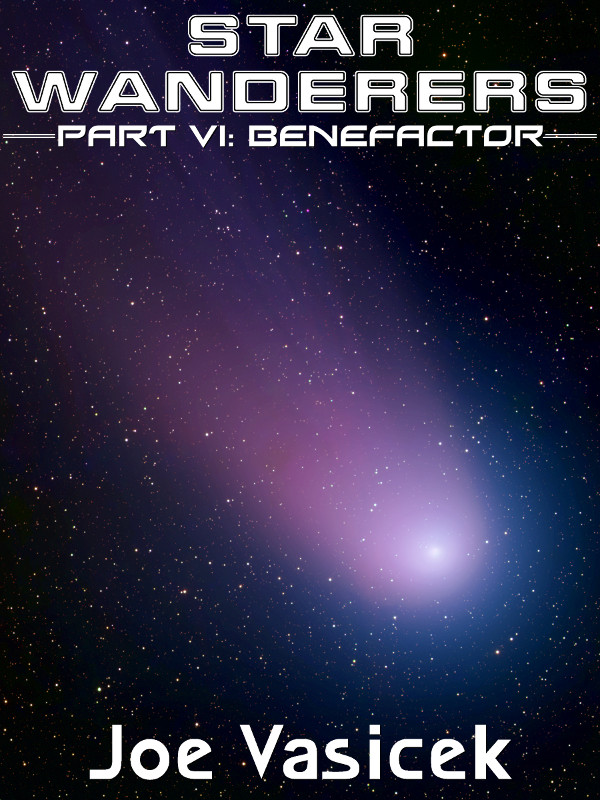
All right, if you’re still reading (or even if you cheated and skipped ahead), I have a treat for you.  I just found the AWESOMEST image for the cover of Star Wanderers: Benefactor, which I hope to finish up later this week after finalizing the revisions for Dreamweaver.  Here’s the cover:

SW-VI Benefactor (cover)

Pretty cool, eh? I <3 NASA. 😀

The picture is of Comet C/2001 Q4 (NEAT), taken by the WIYN 0.9-meter telescope at Kitt Peak National Observatory near Tucson, Arizona.  It was taken on 7 May 2004, and covers an area roughly five times the size of the moon.  As with all NASA images, it’s in the public domain.

The inspiration actually came from comet PANSTARRS, which is visible in the sky right now.  I tried to catch a glimpse of it tonight from the Y Mountain trail head, but there were too many clouds on the horizon to see it clearly.  Hopefully, the skies will be clearer tomorrow.

In related news, comet ISON later this year is expected to put on a really incredible show.  Astronomers think that for a brief time, it may even shine brighter than the moon, making it visible even during the day!  If that happens, it’s going to be AWESOME.  Mark it on your calendars for November–it’s going to be great!

That’s just about it for now.  I’d better get back to forming those good habits I mentioned earlier–like actually getting to bed at a reasonable hour. Later!

Unstuck again

For the past few weeks, I’ve been kind of stuck on chapter 3 in Star Wanderers: Benefactor.  This one is a parallel novella to Fidelity, from Jakob’s point of view.  It’s been a lot of fun to write so far–Jakob struggles with a lot of the same issues I do, like self-reliance and independence vs. accepting help from others–but there was this one scene that just kind of knocked the momentum out of it for me.

Well, I started out the day by rereading Fidelity.  Actually, I started reading it yesterday right as I was falling asleep, and had some really weird dreams that I’ve since forgotten.  After rereading Fidelity, I went to the Provo Library to write, and everything just sort of clicked.  Finished the chapter today, and if all goes well, I’ll finish the first draft sometime this week or next.

I think the thing that was blocking me was that I wasn’t as familiar with the story I was writing parallel to.  Which is funny, because Benefactor has very little overlap with Fidelity, even in terms of plotting.  This is Jakob’s story, and it’s very different from Jeremiah’s or Noemi’s.  Even so, the nagging feeling that I was missing something really slowed me down.  When you’re in a dark, empty room and can’t see anything, you’re not going to run across it even if you know there isn’t anything to trip on.

###

Just recently, I added some new book teasers to the back matter of the Star Wanderers ebooks.  They look a little like this:

If you enjoyed Star Wanderers: Outworlder, be sure to check out Part II: Fidelity!

Star Wanderers II (thumb)

IS FIDELITY WORTH THE PRICE OF FREEDOM? CAN LOVE TAKE ROOT BEYOND THE STARS?

Oriana Station: a bustling frontier settlement between the Outworlds and the Coreward Stars. A popular port-of-call for free traders and independent starfarers alike—and the latest target in the aggressively expansionist plans of the Gaian Empire.

Life was simple for Jeremiah and Noemi before they arrived. Though neither of them speak the same language, they’ve reached an understanding that goes beyond words. But when the colonial authorities make them into second-class citizens of a fractured empire, even that might not be enough.

Their newfound friends in the immigrant community can only do so much. With Noemi and her people depending on him, Jeremiah must find a way back to the Outworlds—before they lose everything that they came for.

Each one has a teaser for the next one in the series, including Homeworld (for the as-yet unpublished Dreamweaver).  Ideally, I’d like to put out a new Star Wanderers novella every month or two, but time things so that I can have the teaser for the next one ready before publishing the one previous.

So far, the Star Wanderers series has been selling a lot better than anything else I’ve published.  That’s great, because I really enjoy writing in this universe!  The short novella length is perfect for exploring one or two characters in-depth over the course of a much more intimate story than you usually see in a novel.  The really cool thing, though, is that the more I write in this universe, the more characters and storylines unfold.  It’s like watching a flower bloom, where each individual petal is a single story.

Anyhow.  I’m really excited to keep writing in this series.  Some of the stories I have kicking around in my head:

  • A parallel novella to Sacrifice, primarily in Mariya’s point of view but also perhaps with a bit of Noemi.  Basically, something exploring the subtext behind the polygamy that drove most of the conflict in Sacrifice.
  • A parallel novella to Homeworld, from both Lucca’s and Mariya’s points of view.  Basically, an adventure romance that actually shows the final battle between Captain Helena and the colonists.  In Homeworld, it didn’t make sense to show that battle since the story was about Jeremiah and Noemi, and both of them were plugged into a simulator at the time.  But my first readers really want to read a story about the battle itself, so that’s one story I definitely have to write.
  • A story from Master Korha’s point of view, showing the gradual collapse of Megiddo Station and the buildup to his decision to give his daughters away.  This one is going to be more tragic, or at the very least, bittersweet.  But hey, I kinda like bittersweet endings.
  • A story from Samson’s point of view.  Actually, I’ve already got this one plotted and ready to go.  The only trouble is, well, it’s Samson.  With his ethical slut mentality, whatever I write, my family is going to be scandalized by it (and I might be, too, when my kids are old enough to read it).  Don’t worry, though–I’ll get around to it eventually.  This isn’t a story that I can just walk away from.
  • Something from Jakob’s sons’ point of view, Isaac and Aaron.  Except … I can’t really say much about this, because Benefactor isn’t out yet. o.0
  • At some point, I’d like to write a full-length novel from the point of view of Jeremiah and Noemi’s kids.  I don’t have a plot or anything else figured out for this one, but I’d really like to revisit their world again through their kids’ eyes.  I even have a title: Children of the Starry Sea.  But yeah, that’s probably not going to come out for another couple of years or so.

So yeah, those are some of the things kicking around in my mind.  Once I finish the parallel novellas to Fidelity, Sacrifice, and Homeworld, anything is free game really.  Is there any story in particular that you guys would like to see?  Now’s the time to drop-kick my imagination–once it gets fixated on something, it won’t give me any rest until a story comes out the other end.

And that’s enough for now.  Tomorrow, I promise, I’ll do a Trope Tuesday post.  I’ve got a job interview in the morning and probably won’t have work for the rest of the day, so while that kind of puts a cramp on my wallet, it means you’re more likely to get a blog post.  In the meantime, I’d better get some sleep.

Later!

On the verge of another story

So with Star Wanderers coming to a close, at least as far as the actual writing is concerned, I’ve recently found myself back in that weird writerly place where I don’t have any pressing projects to work on.  Whenever this happens, I find that it’s generally a good idea to start something new.

Until just a couple of days ago, though, I wasn’t sure which project to start.  At first, I thought I should do the sequel to Stars of Blood and Glory, since I’m currently getting that one ready to send off to my editor, but beyond a tentative title (Empress of the Free Stars) and a really awesome opening scene, nothing has really sparked for that one.  With time, I’m sure my ideas will come together, but for now it’s just not ready to come out of the incubator.

So then I went back to The Swordkeeper, going back over the ideas that had sparked that one.  I started the opening scene back in March, but it’s currently lackluster, and none of my attempts at worldbuilding have gotten me anywhere.  For the past six months, I haven’t really touched it.

But when I took the time to just think about the story, something amazing happened.  All my ideas came together, and the ending just came to me–not just for the first book, but for the entire series.  Seriously, I must have spent hours staring out across the Georgian countryside from my farmhouse balcony, totally in awe of the story in my head.

A similar thing happened to me last summer with Stars of Blood and Glory.  It took me a few months to finally get around to writing it, but when I did, the first draft flew out in just a matter of weeks.  I’ve since made a few relatively minor fixes to the beginning and added some scenes that were missing, but otherwise haven’t made any substantial changes, and the comments from my first readers so far confirm that that’s the right decision.

So if all goes well, I’ll finish up with Stars of Blood and Glory by the end of this next week, and restart The Swordkeeper soon after that.  Things are looking good, and I can’t wait to get immersed in this next story.  It’s a fantasy, so that’s going to be a major shift, but I think it will help to keep things fresh.

Anyhow, that’s all for now.  More later.

Managing time and mental space in a foreign country

Some of you asked for a writing update, so I figure I might as well do a quick post on my current projects and where they are.  I’ve also been experimenting with my daily schedule a bit, so it would probably be good to blog about that as well.

Right now, the main project taking up all of my attention is the 3.0 draft of Heart of the Nebula.  It’s a direct sequel to Bringing Stella Home, and continues the story from James McCoy’s point of view, five years later.  I’m making a lot of changes, toning down the romantic subplot and emphasizing the more interesting social and ethical issues.  When I’m through, I think it will be completely different from the first couple of drafts, but in a way that’s truer to the spirit of the first book.

I’ve only been managing about 500 to 1,500 words per day, though, which is abysmally low compared to my usual word count.  Part of that is because I’m throwing out entire sections and drafting new ones from scratch, but the more significant part is that I don’t have as much mental space for writing as I did back in the States.

Basically, moving to a foreign country and starting a new career has taken a lot more out of me than I thought it would.  I teach 18 lessons per week, some with as many as 30 or 35 kids, across grades 1 through 12.  Culturally, everything is completely different too.  So far, the shock hasn’t been too bad–I really love it out here in Georgia–but it’s made the writing a little bit more difficult than I’d expected.

I have a lot of free time, though, so that’s not a problem: the problem is clearing my mind and keeping the creative juices fresh.  Here’s how I’m going to do it:

  1. Limit internet time.  As tempting as it is to turn to the familiarity of the internet, it’s a huge time-suck and doesn’t really do anything for the culture shock.  A much better thing for that would be to spend more time reading.  From now on, I’m going to limit myself to one internet session per day, no longer than 2 hours (more if there’s something I actually need to do).
  2. Get out more.  I get cabin fever very easily, and it’s only gotten worse now that I’m in a foreign culture.  Fortunately, there are tons of places to explore, and in my local neighborhood I’m kind of a celebrity (hey look, it’s the American!  Let’s chase him and shout ‘hello’!).  The prime time for this is the late afternoon, when everyone’s out and things are still open.  If I check the internet right after school and get out immediately after, I think that will help me better to focus.
  3. Get up early to write in the morning.  I tried this last week, and it was a great way to get focused and build more momentum.  Even if I only manage a couple hundred word, it gets me thinking about the story for the rest of the day, which makes it easier to pick up in the afternoon and evening.

So that’s the plan for now.  My goal is to finish Heart of the Nebula before the end of May, which is going to require a significant change of pace.  It should be pretty straightforward, though, and after this draft it shouldn’t need too many more revisions before it’s ready to publish.  If all goes well, I foresee a publishing date sometime in the fall or winter.

Do you have any other ideas for ways to manage creativity in a totally foreign culture?  If so, I’d love to hear it–that’s my biggest struggle right now.

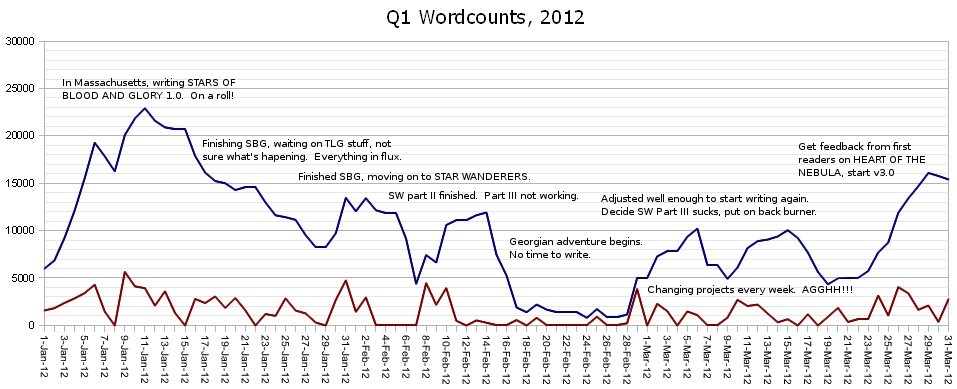
Q1 2012, or what writer’s angst looks like

Actually, this last quarter wasn’t quite so bad as the title might make it seem.  For the first part, I was on roll, writing almost 25k new words a week.  But then I finished that project, started a new career, moved to the other side of the world…yeah, my writing took a hit.  Or at least, that’s how it feels.

In January, I was working on Stars of Blood and Glory, and was really on a roll.  The application process for TLG was still pending, but I pretty much knew I was getting in, and since I was staying with my parents until it went through, I didn’t have to worry much about money issues.  With lots of writing time, I finished SBG in about 6 weeks and published Journey to Jordan.  Life was good.

After Stars of Blood and Glory, I went back to Star Wanderers, finishing up Part II and starting Part III.  However, something felt wrong, and I didn’t really know what it was.  With my TLG departure date imminent, it was really hard to focus, and I wasn’t in much of a position to move on to anything else.  That’s when the angst began.

I flew out to Georgia on February 15th, did a week of training in Tbilisi, and then was whisked about 220 kilometers away to Kutaisi.  As a consequence, I didn’t get any real writing done for almost a month.  However, I didn’t have any major challenges navigating the new culture, and was soon settled pretty comfortably.

The trouble was, nothing was working.  Star Wanderers was broken, and I was too close to the project to fix it.  But after putting it on the back burner, I didn’t know what to do.  For most of March, I switched from one project to another.  Nothing seemed to stick, though, and by the end, I was getting pretty antsy.

What if I’d made a mistake to come to Georgia?  What if that was the reason nothing was working?  It sounds silly now, but that was what was going through my mind.  I still worry about it a little, but I think it has to do more with my creative process than anything here in Georgia.

I have a very non-linear way of writing first drafts.  After starting the revision for Heart of the Nebula and making some good progress on that, I got an idea for Star Wanderers and moved back to that.  At this point, I think the only way to get productive again is to finish that project, even if it sucks.  I’ve got a lot of great ideas for other stories, but until I can close the book on this one, I don’t think I’ll be able to make much progress.

So that’s where things stand right now.  All in all, it wasn’t a bad quarter, but I’ll be happy when I’ve actually finished something for a change.  Hopefully, that’ll only be a couple of weeks.  In the meantime, I’ll keep writing.

Getting settled in the land of the Kartulis

About three weeks have passed since I came to Georgia, and I’m starting to feel comfortably settled in this new place.  I like it a lot out here: my host family is great, I get along really well with everyone at the school where I work, the kids are so crazy eager to learn it’s awesome…really, I couldn’t ask for more.

Of all the places in Georgia where TLG volunteers are placed, Kutaisi seems like one of the best.  It’s the second largest city in the country, so it has access to several amenities such as markets, hospitals, restaurants, parks, and basically anything else you’d  expect in an urban center.  However, it’s about 200 km from Tbilisi and has very little exposure to the West, so culturally it’s very authentically Georgian.  It’s also much less crowded, and (in my opinion) much more beautiful.

My host family is great; I get along with them real well and already feel like a member of the family.   My youngest host brother, Kako, is 9 years old; I showed him Star Control II over the weekend, and he’s been addicted to it ever since.  We also play chess, and I’ve kind of taken him under my wing to teach him the basics of good strategy.  He’s getting steadily better!

Gura and Kati are the two teenage kids; they also speak English, so we’ve had some fun discussions.  Besides Facebook and her cell phone, Kati is really into books; I showed her my Kindle, and she wants me to help her persuade her father to get her one!  Gura is into Call of Duty and spends a lot of time hanging out with his friends; he lacks confidence when it comes to English, but he knows it better than he thinks he does.

The parents don’t speak much English, but they are really good people.  It’s a working class family; the dad works as a welder, and the mom is a nurse part-time and a home-maker full time.  They spend an amazing amount of time and energy on their kids, which is pretty typical for this part of the world.  They’re both non-smokers, and they’re very respectful of the fact that I don’t drink coffee, tea, or alcohol.  Some of the extended family keeps trying to push wine on me, but in the land known as the cradle of wine, that’s to be expected.

We basically spend all of our time in the family room when we aren’t sleeping; it’s where the heater is, so despite the relatively cramped space it’s the most comfortable room in the apartment.  Furniture consists of a couch, a computer desk and office chair, a bucket seat from an old van, a folding table, several small wooden chairs and a stool.  The TV isn’t quite a member of the family, but when the power isn’t out, it’s usually on.

The neighborhood is this bizarre mix of urban and rural elements.  The roads are super muddy and free-range chickens wander everywhere at will, but everyone lives in 9-story apartments that were built back in the Soviet days, when Kutaisi was a major center for the auto industry.  The school was built 50 years ago this year and has barely been renovated since, but it’s just starting to get some much-needed attention, with a computer center and a resource room for special needs students.  When the weather clears up, I’ll bring my camera to school and take some pictures so you can see what the classes are like.

I’ll have to do a post later on Georgian culture; there are some really bizarre and paradoxical juxtapositions, such as the way they mix religion and alcohol, or their strong belief in the nuclear family with their easy-going acceptance of bride-napping as a “Georgian tradition.” I have yet to really get a handle on all this stuff.  However, as a culture, they have a great respect for literature; when people ask my profession and I tell them I’m a writer, their eyes light up, and they show me a degree of deference that I never would have gotten back in the States.

Partly to have something to talk with them about, I’m reading War and Peace by Leo Tolstoy right now.  I just finished Book III, where Napoleon smashes the Russians and Austrians in the Battle of Three Emperors.  Everyone says that it’s the best novel ever written, and now that I’m in the thick of it, I’m starting to agree with them.  There’s a lot of really good storytelling here, as well as passion and depth.  I have the feeling that I’m going to be on a Russian literature trip for a while, though I should probably pick up some Rustaveli and Kurban Said as well.

As far as writing goes, I’ve had some difficulty settling down into a solid routine, not because of lack of time so much as trouble with my current WIPs.  Star Wanderers has more or less stalled; I ran into another wall midway through part III, and I’m still not quite sure how to get past it.  I’ve decided to take a break for a while, but I think my experiences here with the Georgian language are going to give me what I need to really make this novel come together.

In the meantime, I’m working on the 2.0 draft of Stars of Blood and Glory.  I’ve decided to try something new: revising not by chapter, but by viewpoint character.  Isolating each of the five viewpoints is helping me to see which ones work, and which ones are missing something.  I’ve also been using Dan Well’s 7-point outlining method, which is helping out a ton.

It feels like I could be writing more, but I’m not pushing myself too hard at this point.  I’m still adjusting to life in this totally new culture, and I’m also spending a lot of energy getting my TEFL career off on the right foot.  It’s paying off; I’m having a great time teaching, more than I thought I would.  Pretty soon, though, I’m going to start putting more energy into my writing.  I just hope that I’ll have enough mental space left over to really immerse myself and make it work.