Ugh. Just ugh.

Man, it was hard to write.  So hard, I only just finished, and it’s 1:30 am.  Ugh.

The reason it was hard was because the character’s reactions in this scene needed to be totally revamped.  That also necessitated a complete shift in the structure of the writing, because the rough draft consisted almost entirely of internal feelings and reflections.  Indeed, the rough draft of this scene was about as close to an info dump as I will ever allow myself to come.

Or so I tell myself.  The first rewrite tried to keep things internal, just with the new reactions and motivations, but…well, before I knew what I was doing, I was info dumping.  Yes.  Shame on me, I went and committed one of my greatest pet peeves.  And I felt dirty afterwards, too.

Well, guess what happened?  I just kept writing, dumping out the info that I , but it kept coming out slower and slower, like wringing the last few drops out of a washcloth.  I didn’t know where to end, so I decided to cut it out somewhere in the middle…but then I got to the next scene from this character’s point of view, and realized that I was lacking the right transition to that part of the story.

Everything was falling apart.

So…I couldn’t just cut out all that stuff that I’d vomited onto the page.  It was a butt ugly info dump, but I had to get it across somehow.  I decided the only way to do it was to add in an extra scene.

 Trouble was, for the sake of the flow of the  chapter itself, I couldn’t just add all that stuff in another scene.  For starters, the nature of the stuff I’d just dumped on the page necessitated two scenes, but I didn’t have another one to bring in to break them apart.  I didn’t want to have three scenes all in a row from the same point of view–that would just be clumsy.

Ugh.  Just ugh.

So, how to solve it?  Take out a chainsaw and perform some delicate surgery.  I threw out virtually the entire info dump that I’d spent a good part of my day writing, and made some fundamental changes to the world that I’m writing that totally negated all of that previous stuff (I can do that, you know.  One of the perks of being a science fiction / fantasy writer–you can play god with the world you create).  Then, with the new changes I’d made to the world, I came up with a totally different scene–one that actually worked–and inserted that after the very brief, almost prologue-ish opening scene of introspection.

And then, when I was working with something a little more concrete, I was back in that wonderful place where character shines through and suspense builds through a functional plot.  No more info dumping–I felt so clean, so free of sin.  Great.

It still took bloody forever to finish, though.  All that wrangling from earlier in the day killed my momentum, so it was an uphill battle the whole way.  Ugh.

Looking back, am I satisfied with what I wrote?  Honestly, no.  But the revisions it need are the kind that can wait until the 2.0 draft, not the kind that are preventing me from finishing the first draft.

Those problems, I’m afraid, are yet to come.

Almost done!

Yay!  I’m almost done with Genesis Earth 2.0!  6k words of revision done today, bringing the project up to 95% complete.  Just the final scene of the final chapter, and then the epilogue, and she’s done!

(Well, at least the second draft is done.  She’s probably going to need a lot more work after that, but if I don’t put some distance between myself and this novel for a month or two, I’m not going to be able to see what she needs.  Still, I feel confident that this rewrite is a significant improvement from the first draft.)

The coolest thing about this revision process is that it’s actually been kind of fun.  It has involved a lot of work: hours and hours of grappling with the text to find the right way to say things, research ranging from various psychological disorders to the structure of wormholes to the composition of DNA, and lots and lots of time thinking through various aspects of the story (basically, daydreaming…but hey! it was hard work!).  But even though it was a lot of work, it was fun work and I really enjoyed it.

What’s even cooler is that I’ve got 22 beta readers lined up to read it and give me feedback–boo yah!  Inshallah I’ll be finishing the second draft tomorrow sometime and sending it out to everyone before the end of the day.  

After this project, I’ll be moving on to Bringing Estella Home.  It needs a major rehaul before I can pick it up from where I left off (the rough draft is currently incomplete), but that shouldn’t be too hard.

I put up a status bar for Bringing Estella Home on the sidebar, even though it’s stilll the rough draft.  It’s currently at 60k words, and I set 100k as the base for calculating the percentage complete.  It probably won’t be more than 100k…120k at the very most.  We’ll see how that works out.  

Currently, it’s at 0%, since I’m going to start from the very begining and rewrite it up to where I left off.  I know, everone says that’s not a good idea–and usually it is–but it’s been almost a month since I’ve worked on this project, and I need to get back into it, starting with the beginning.  

Taking a break from it for a while was a good idea, I think, because I realized things just weren’t working.  The time off helped me to step back and see what was wrong, as well as recouperate my energy and enthusiasm for the project.  I made the mistakes of simultaneously outlining too much and too little as I was still writing the rough draft; too much, because I was keeping a map of every scene on a piece of butcher paper, cementing scenes where some of them needed to be cut; too little, because I tried to create a private mercenary outfit without figuring out all the crew roles I needed the various characters to fill.  

But now, none of that is an issue, and I’m ready to get started.  Tomorrow, in fact, if all goes well.  🙂

Downbelow Station by C. J. Cherryh

“The stars, like all man’s other ventures, were an obvious impracticality, as rash and improbable an ambition as the first venture of man onto Earth’s own great oceans, or into the air, or into space.” Thus begins Downbelow Station, an epic tale of man’s future beyond Earth.

The outer colonies of Earth have rebelled and are fighting a long, ferocious war against the Earth colony. Mazian’s fleet, the main battle fleet aligned with Earth, has been out of contact with their superiors for so long that Earth company no longer controls them. As they fight their losing war against the Union of outer stations, they leave wreckage and destruction in their wake, determined not to give Union forces anything that could be used against them. One by one, the stations that serve as stepping stones to the Beyond fall into destruction in this terrible, senseless war of attrition.

Pell is the last major station before Earth, the nexus point between the two warring sides. It is also the only station orbiting a marginally habitable world with sentient life–the peaceful and primitive Hisa, who worship the sun and dream of traveling one day to the stars. The Konstantin family is determined to do everything they can to maintain Pell’s neutrality, but with the war coming closer and floods of refugees bringing crime and disorder, that proves increasingly difficult. It is made even more difficult by power players within the station who, unbeknown to Mazian or the Konstantins, are seeking to strike a deal with Union.

This story won the 1982 Hugo award. Since I like to write science fiction, specifically epic space opera much like this, I was very interested in reading this book and seeing what Cherryh’s vision of the far future looked like.

Her worldbuilding in this book is really, really cool. In the first chapter, she outlines how human history takes mankind to the stars–through commercial means and business interests, not government expansion. Each station serves as a jumping off point for the next expedition to the next star system, with independent merchanters hauling the profits back to Earth and conducting trade between the stations. As humanity expands, however, communication between Earth and the Beyond becomes more and more difficult, and when the Earth company tries to impose taxes on the outer stations, they rebel and form the Union.

Stationers and merchanters have distinct cultures, with the stationers feeling much more rooted to one place, trusting more in bureaucracy, and feeling more of an allegiance with Earth and the company. Merchanters, on the other hand, are much more nomadic and independent, putting more credence to family names than port of origin, and tend to have single-parent families (to keep the population from becoming inbred, merchanter women remain single, obtaining their children through short-lived relationships whenever they come into port). Two of the main characters (Damon and Elene) are a stationer-merchanter couple, and the cultural differences really come out in the way they interact with each other.

At the same time, it’s a story of first contact and what happens after first contact. The Hisa are a distinct race of sentient beings, creatures who don’t understand the ways of the humans, especially war. Their presence adds a degree of tension, especially when you consider how disastrous the war could be on Human-Hisa relations. The Hisa, however, are very clever, and the humans come to realize that they have a lot to learn from this peaceful race of furry little creatures. One of the viewpoint characters is a Hisa, and it’s really interesting to look at the station, the world, and the humans from this alien perspective. Cherryh did a good job creating a believable, complex alien race.

Overall, this story is more about grand ideas and concepts than it is about individual characters, so while Cherryh did a fair job with her characterization, her point of view was always a bit distant and I never felt extremely close to any of her characters (except perhaps Mallory–more on that later). That made it a bit hard to read the story as I got deeper and deeper into the story. There was a lot of setup before the action really started to break, and because I wasn’t very close to the characters, I didn’t feel as engaged by the story.

The action, too, was very difficult to visualize. I never really understood how faster-than-light travel worked in this book, and because all of the space battles happened partially inside warpspace, I never knew what was going on. That was a little frustrating, and kept me from really understanding or getting the tension. The gunfights and hand to hand combat was good, but it was almost always chaotic mobs against lines of armed police and/or soldiers, and never really described all that concretely. Cherryh didn’t really describe what the soldiers were wearing, what they looked like, what their guns were like, what the mobs looked like, sounded like, etc. Distant viewpoint, more conceptual than immediate.

The political situation, however, was very interesting and complex. There were a lot of different players, each with their own distinct goals and interests. There is the Company, whose chief spokesman in the beyond is Ayres, a diplomat whose delegation essentially becomes prisoner to the Union; the Union, lead by Admiral Azov, a shrewd, effective military commander; there’s Pell, led by the Konstantin family (Damon, Emilio, Angelo); but then within these three main parties there are all sorts of other divisions, such as Mazian’s fleet (and within Mazian’s fleet there is another division, with Mallory and her ship as a sort of loose cannon), the merchanters, the Lucas company (Konstantin’s main rivals within Pell), the refugees of Pell (known as “Q,” for quarantine), etc etc.

With some of these groups, you know clearly who is good and who is evil. With others, however, you’re not so sure. Mallory was a fascinating character to me–fascinating because even though I hated what she was doing to everyone else, I really admired the way she ran her ship, the way she respected and took care of her troops, and the way she was always on top of things. She earned my respect, despite that I spent a good portion of the book hating her, and of all the characters, she was the one I felt closest to. She always did what needed to be done, even if it meant getting her hands bloody, and though she was a bit arrogant, she made up for it by being an excellent, top-rate leader. She was by far the most interesting character, the wild card, and Cherryh played her very well.

Cherryh’s writing is very dense and abstract; this book took me a lot longer than I thought it would. It’s not for everyone, and I wouldn’t be surprised if ended up quitting midway through. I almost did that, but I forced myself to read through it until the plot really took off. Cherryh’s vision of the future, however, is really fascinating, something complex, futuristic, and yet very believable, from the way she connects everything together. A fascinating world, and a vision that is, for all the war and horror, satisfyingly hopeful in the end.
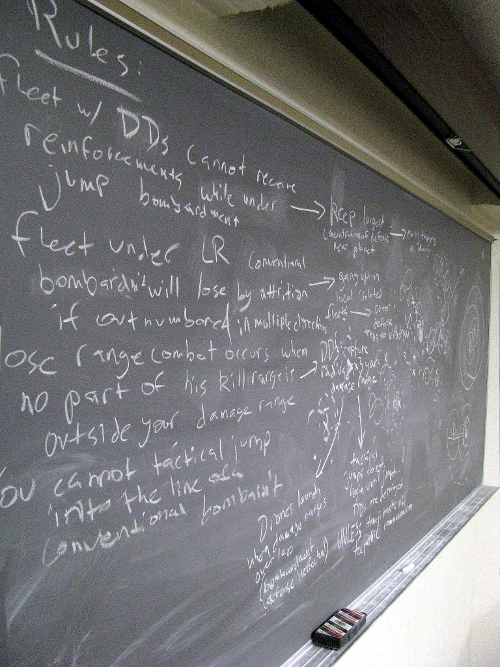
Worldbuilding

This is what I was doing the other day.  The FLSR (Foreign Language Student Residence) at BYU has chalkboards in the common rooms, and I just discovered that those can be WAY useful for diagramming your story.

On this occasion, I drew out a couple of space battles, according to how they’d play out with the FTL technology I’ve been thinking up and a few other things.  I worked things out logically and figured out a few basic rules of combat–some basic strategies that you can expect people to follow.  I then took what I know about the Hameji, the main antagonists in my novel, and figured out how they would use their special abilities to counter these tactics.

Pretty fun.  Now, when I go back and rewrite the beginning, I can make the opening space battles feel a lot more vivid, immediate, and engaging.

I finished part 1 of my story last week, and now I’m at the beginning of part 2.  I’ve got the novel roughly outlined out in my head, and it’s following fairly closely to the three act structure.  Not exactly, but pretty close.

According to Brandon Sanderson (and several other people), act 2 is the most difficult part of the story.  It’s where  you need to do the “blue collar work” of simply sludging through and writing the thing.  It’s where things get complicated enough that you can get lost if you don’t know how to plot things out.  Considering the fact that I’ve only gotten this far with two other novels I’ve written, I’m expecting this part to be really difficult.

Only 599 words today, and none on Sunday (more because I was feeling sick than anything else).  It really is getting easier to get hung up on a single scene; even if I know where I want to be three or four chapters from now, if the scene right in front of me isn’t working out, it’s almost impossible to move past it and get things to work.

Today I took a big piece of butcher paper from upstairs and drew a diagram of everything I’ve written so far, scene by scene.  That was immensely helpful.  Now I know what this chapter is about, what I need to do to bring it to a natural close and leave a hook for the next few chapters, and how to develop my characters and what they’re doing.

While taking a shower, I figured out what Estella needs to do next, and how to take her story over to the end of act 2 and carry her to act 3.  That’s something of a breakthrough.  I’m excited.

And…it’s late.  I’d better get some sleep.