Trope Tuesday? Oh yeah, about that…

I’ve been so hard at work on the edits and book teaser for Stars of Blood and Glory that I completely forgot about Trope Tuesday.  In addition, I’m working a two week job that runs 8 to 5, with a half hour lunch break.  Sorry for those of you who enjoy this feature, but it looks like Trope Tuesday will be on hold for a week or two.

I haven’t forgotten about it, though.  If there’s any particular trope you’d like me to cover, I’m open to requests.  Just mention them in the comments below.

In the meantime, here’s a good example of the cannon fodder trope.  After watching this video, no explanation should be necessary.

Take care!

Trope Tuesday: Planetville (aka Adventure Planets)

swmapsmall

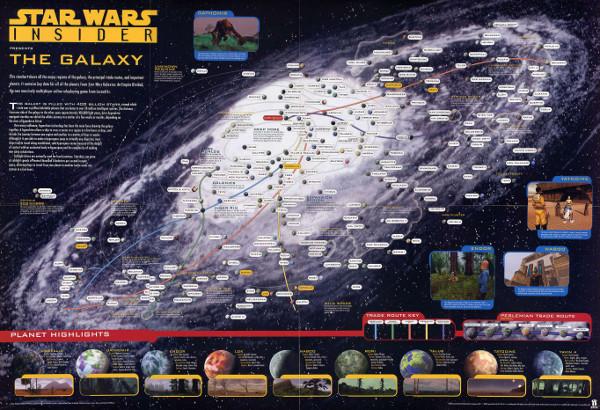
Adventure townsIN SPAAACE!!!

Seriously, that’s the best way to describe it.  In Westerns and TV serials, the heroes travel from town to town, with a new adventure in each place.  Well, in science fiction, we don’t hop towns, we hop planets.  Why?  Because we can.

Unfortunately, since planets and towns are actually pretty different kinds of places, there’s a lot of room to do things poorly and turn this trope into a cliche.  Any story that doesn’t consider (or at least lampshade) the implications of space travel and planetary colonization is in danger of becoming over-the-top campy–although, to be fair, there is an audience for that.

That doesn’t mean there isn’t room for this trope in fiction that takes itself a little more seriously.  In fact, I take issue with some of the descriptions on the Planetville page.  From tvtropes:

Unfortunately, because Sci-Fi Writers Have No Sense of Scale, stories about Planetville make no sense. Nobody seems to realize how BIG a planet is — everything in Planetville takes the same amount of time as stories set in towns or countries. In the updated Wild West story, the outlaws are “exiled from the planet” just like they’d be exiled from Dodge City, and have to quietly leave… instead of flat out challenging the authorities to find them when they have an entire planet in which to hide. When the space Nazis invade, they seem to need the same number of soldiers and time as the Earth Nazis needed to invade Europe. And when the crew of the Cool Starship finds the cure for the alien plague, the logistical issues of distributing it to an entire planet rarely get mentioned at all. These considerations are minimized or left out entirely in many stories.

To address these criticisms point by point:

1) Scale is relative to technology and the predominant modes of transportation.  When my ancestors crossed the plains to settle in modern-day Utah, they had to walk.  It took them months to get here and many of their family members died along the way.  Today, I can make the same trip by car in a day or two.  As technology changes, so does the sense of scale.

2) Unlike what some tropes would have you believe, not all planets are Earth-like.  In fact, it appears that most planets outside our solar system are wildly different.  In practical story terms, this means that any part of the world that’s remotely habitable is probably going to be immediately around the colony. Consequently, the local authorities probably will have the power to exile trouble makers from an entire planet, since exile from the colony would mean de facto exile from the planet as well.

3) Anyone venturing outside of the dome would have to carry just about everything necessary for life, including air, water, food, etc.  You might as well try to hide in Antarctica as hide on an alien planet.  It can be done, of course, but to do all that and stay hidden, that’s going to be tough.  You might as well set up a rival colony for all the effort–but at that point, the story is about a lot more than just hiding from the authorities.

4) If your planetary colonies are only as populous as an average WWII era city/town, then yeah, you’ll only need as many soldiers as it took to conquer them.  The biggest difference is that they’ll fly a really cool starship.

5) Again, if the planet isn’t habitable and the population is contained within a handful of relatively small colonies, then distribution shouldn’t be too much of a problem.

However, the tvtropes page does make this valid point:

A side effect of this is that the characters never realize that things can happen in parts of planets. You will never see aliens trying to capture a planet’s equator, or its polar caps — it’s the whole planet or bust.

In the end, I think the key to doing this trope well is to know your setting well enough to fit the story to it.  Tropes are tools, and when done well, this trope can accomplish everything it sets out to do while making perfect sense within the context of the story.

In my own work, this trope is most prevalent in the Star Wanderers series.  Every novella takes place at a different planet or space station, sometimes multiple planets per station.  Because most of the stars in this universe have only recently been settled, the colonies are small and terraforming is quite limited.  In Desert Stars, I used a similar concept, except with large domed areas of a single planet, instead of multiple planets (Adventure townsUNDER THE DOME!!!).  In cases where the planets are Earth-like, however, or where travel between planets is costly and difficult, this trope doesn’t really ever come into play.

Trope Tuesday: Arcadia

Happy_Arcadia_by_Konstantin_Makovsky

What happens when you cross the Ghibli Hills with the Call to Agriculture?  You get Arcadia, a simple, uncomplicated utopia where people keep to the good old ways and live in harmony with nature.  As home sweet home for the farm boy and the country mouse, it’s often the starting point for the hero’s journey, though you’ll also see an occasional retired badass or old master take up residence after their adventuring days are over.  Then again, it might just be a ten minute retirement before they’re back in harm’s way.

This is NOT a town with a dark secret or any other kind of twisted dystopia.  There are no knights templar who believe that Arcadia justifies the means.  If there is any sort of moral or message behind this place, it’s a green Aesop.  If there’s anyone who fights to defend this place, it’s usually the good shepherd.

Because of the Rule of Drama, it seems almost paradoxical that a place as peaceful as Arcadia would exist in any story.  However, sometimes it’s good to have the contrast.  It also helps to raise the stakes by giving the hero a home like this to fight for.  By keeping this in the back of their minds, it can be an effective way to keep them from crossing the despair event horizon.

The hero can visit Arcadia at any point in the story, but it tends to fulfill different roles depending on when they go there.

If the hero starts out in Arcadia, it’s usually the known, familiar world which he leaves behind after getting the call to adventure.  He may or may not be able to go back once the adventure is over, depending on how much he’s changed and whether he can adjust to a boring, peaceful life after so much adventure.  A good example of this is The Shire from The Hobbit and Lord of the Rings.

If the hero ends in Arcadia, then it’s usually a way to show that everyone lived happily ever after (more or less).  Tolstoy was a big fan of this one, though he was also sure to show that living in Arcadia can be hard work–but in his view, the work is part of the reward.  In Lord of the Rings, Samwise Gamgee ended in Arcadia on this note.  Frodo didn’t.

If the hero visits Arcadia during the middle of the story, it’s usually part of an Arcadian Interlude.  The down time may give him a chance to rest and recuperate, as with Medwyn’s realm in The Chronicles of Prydain, Resembool in Full Metal Alchemist, or Tom Bombadil in Lord of the Rings.  Alternately, it may be a leave your quest test–because really, who wouldn’t want a nice, peaceful life when faced with the hardships of adventure?

While the idyllic rural setting of Arcadia seems great to us now, this wasn’t always the case.  In all the old stories, when characters strayed into the country, they tended to find themselves in the Lost Woods.  And while Vice City is normally considered the exact opposite of Arcadia, the Shadowland, which may or may not be rural, also qualifies.

In the end, the thing that makes Arcadia great isn’t just the rural, agricultural setting, or the simple way of life, or the lack of poverty (or extravagant wealth, for that matter), it’s the combination of all three, combined with a sense that the place is truly incorruptible.  It may be full of simple-minded, naive little people who have no idea what’s going on in the rest of the world, but it’s a place where you can feel safe.

In my own work, Terra 4 Dome from Desert Stars probably qualifies as this.  Even though it’s an archipelago of small islands rather than the rolling farmlands most often associated with Arcadia, it fulfills the same role more or less.  I don’t think I played with this trope at all in Bringing Stella Home, though in Stars of Blood and Glory, there are a couple of places that qualify.  And in Star Wanderers, various examples pop up from time to time, some more relevant than others.

As someone who dreams of settling down in a real-life version of Arcadia at some point, you can definitely expect to see me play with this trope in the future.

Trope Tuesday: Honor Before Reason

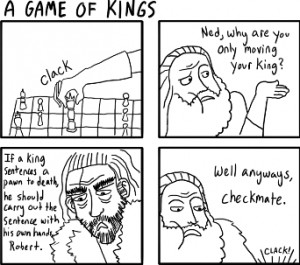
nedstarkIf you can’t do something smart, what do you do? Something right–at least, when this trope is played straight.

Characters who place honor before reason tend to be idealists, starry-eyed or otherwise.  It’s not that they’re stupid–at least, not always–but they do tend to be vulnerable to flaw exploitation.  If the Fettered can’t take a third option, this is how he often gets trapped.

On the other hand, without this trope, we wouldn’t have as many heroic sacrifices or men of their word. In the dark, everyone would turn out to be a jerkass, and the world would be a terrible place to live.

Since the best stories often have some sort of moral dilemma at their core, there’s something about this trope that speaks to us, even (or perhaps especially) in the face of sadistic choices and necessary evils.  It appeals to the more innocent part of us that still wants to believe in incorruptibility.  On the other hand, characters who follow this path don’t tend to think creatively enough to actually solve the problem–or at least, solve the problem without committing the ultimate sacrifice.

Not surprisingly, this trope is a very good indicator of where a story stands on the Sliding Scale of Idealism vs. Cynicism.  In idealistic stories, characters who place honor before reason are often vindicated, such as Bilbo in The Hobbit or Luke Skywalker in Star Wars.  In more cynical stories, the honorable characters not only get eaten alive, their noble idealism actually makes the problem worse.  The classic example of this is Ned Stark from A Game of Thrones, as the cartoon above suggests.

The opposite of this trope, reason before honor, is shoot the dog.  Interestingly enough, in the first scene in which Ned Stark appears, he commits an act that arguably fulfills both tropes at the same time (executing a man who is most likely innocent but has been found guilty by the law).  Lawful stupid doesn’t necessarily come into play, but it often overlaps.  Again, it all goes back to the scale.

This trope pops from time to time in my own writing, though I’m not nearly as cynical about it as George R.R. Martin.  Jalil from Desert Stars generally fits this trope, though Tiera is just as honorable and definitely not stupid about it.  Stella from Bringing Stella Home fits this trope at first, though her choices are vindicated later on.  In Stars of Blood and Glory, though, there’s a character who fits this trope perfectly, and I’m not sure whether he gets vindicated or not.  It will be interesting to see what the readers have to say about that.

Trope Tuesday: Elegant Weapon for a More Civilized Age

Before the world fell apart and the Empire took over, when there were still men of honor in the world who stood boldly against evil and fought for the weak and the downtrodden, there was this trope.  The weapon of choice of a bygone age, more elegant and noble than the crass instruments of wanton destruction so common in the world today.  It might not be practical–or sometimes, even usable–but it definitely will be cool.

Because katanas are just better, this weapon often takes the form of a cool sword, especially in science fiction.  The eponymous example is of course from Star Wars, where Jedi Knights errant fight against evil with laser blades, but it also features prominently in Star Trek (ever been to a Klingon wedding?) and Dune.  The one who introduces the weapon is usually an old master, or a mentor figure of some kind.  Often, the weapon is handed down from generation to generation.

In a lot of ways, this trope reflects the age-old tension between Romanticism and Enlightenment, hearkening back to a simpler time rather than looking ahead to a glorious future.  Perhaps that’s why many of these weapons tend to be swords rather than guns.  And since science fiction is traditionally the more forward-looking genre, perhaps that’s why it’s invoked so often in subgenres like space opera that lean more toward fantasy–to provide ready contrast.

When used well, the effects of this trope can be awesome.  It wasn’t just the shiny blade and the cool sound effects that made lightsabers so awesome as a kid–it was the sense that something about the weapon was special.  None of the mooks had one, after all, and Luke’s came from his long-lost father.  It probably helped that Star Wars paired this trope with the call to adventure (in a very specific way).

In my own work, this appears in Desert Stars with the heirloom rifle that Sathi gives to Jalil.  At least, I think it qualifies.  The rifle is more of a status symbol than a combat weapon, but it does figure prominently in the story.  However, my forthcoming novel Stars of Blood and Glory goes a lot further with this trope than Desert Stars.  It has Katanas, and a far-future Polynesian-Japanese society that knows how to use them.

Trope Tuesday: Peking Duck Christmas

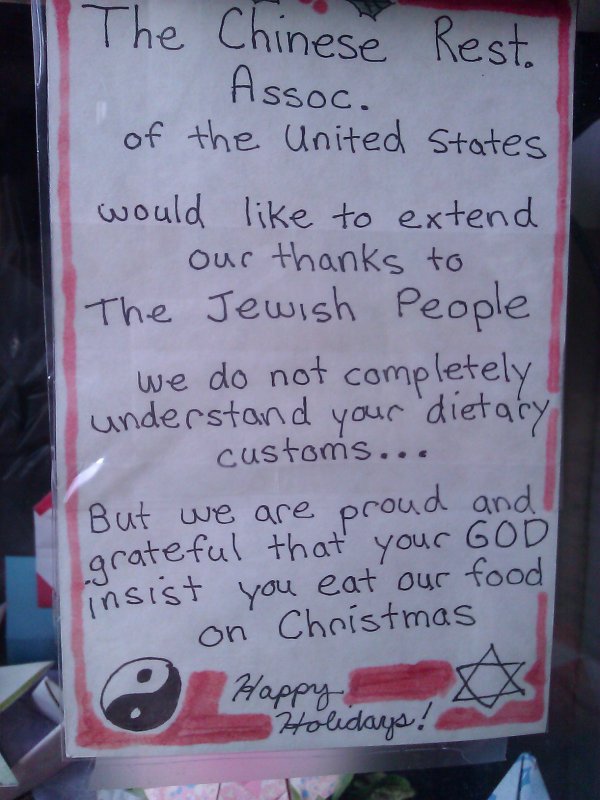
pekingduckxmasIt’s Christmas, but for whatever reason (most likely because you’re Jewish), you don’t celebrate.  Or maybe you do celebrate Christmas, but you live in a place where no one else does.

So December 25th comes around and you feel left out.  What do you do?  Simple–you find a cheap Chinese place, or somewhere similarly non-festive that’s open, and you eat out there.  As the tvtropes page adds, bonus points if you bond with the owner despite the language barrier.

This trope is more of a one-liner than anything else, but it pops up here and there.  Jon Stewart used it a couple of times on his show, and Brandon Harris Walker wrote his break-out song about it.  Also, at Elena Kagan’s congressional hearing for the U.S. Supreme Court, she referenced this trope:

Sen. Lindsey Graham (R-SC): Christmas Day bomber. Where were you at on Christmas Day?
Supreme Court nominee Elena Kagan: Senator… I assume the question you mean is whether a person who’s apprehended in the United States—
Graham:(interrupting) Nah, I’m just asking where you were at on Christmas.
Kagan(laughs) You know, like all Jews, I was probably at a Chinese restaurant.
(Laughter from crowd)
Graham: Great answer!
Sen. Patrick Leahy (D-VT): I could just see that one coming…
Sen. Chuck Schumer (D-NY)Because they’re the only places open.

So yeah, there’s actually a fair degree of truth to this trope, as I’m finding out this year.  Due to some poor planning on my part, I’m spending Christmas in Georgia, a full 14 days before the Georgian Orthodox Church celebrates it.  Yeah, December 25th in Tbilisi is pretty much the same as the 24th, or the 26th.

But it’s actually not so bad.  I didn’t eat Chinese last night, but I did go to a local Georgian place with two Frenchmen, an Iranian, a guy from Singapore, a guy from Japan, a Georgian-American, and a global nomad who doesn’t know where he’s from anymore.  Today, I went to the Dry Bridge bazaar and bought myself an ornate mosaic chess board.  I’ll probaby fix some spaghetti tonight and Skype with my family before going to bed.

So yeah, to those of you celebrating Christmas in the western hemisphere right now, merry Christmas!  And to everyone else, I hope you have a great day too!

Trope Tuesday: Terraforming

The fantastical element here isn’t that Mars could actually look like this in a millenia or two, but that NASA might actually get the funding.

One of the problems with interplanetary colonization is that Earth-like worlds are fairly rare (though possibly not as rare as we once thought).  In our own solar system, the only other world that comes anywhere close (Mars) is a radiation-blasted desert with only the barest hint of an atmosphere and a surface temperature colder than Antarctica.  To get around this problem, you can do one of two things: build an artificial enclosed environment to house the colony, or change the world itself to make it more Earthlike–in other words, terraform it.

The actual science of terraforming is far too complex (not to mention way over my head) to do it justice in this post.  Instead, I’ll just point you to the Terraforming Wikipedia page as a starting point and focus on how the concept is used as a story trope.

According to tvtropes and Wikipedia, the term came from a 1942 novella by Jack Williamson titled “Collision Orbit.” The concept of changing the environment of an entire planet actually goes back much further, with H.G. Wells subverting the trope in War of the Worlds (instead of humans terraforming other worlds, the hostile Martians try to xenoform Earth to make it habitable for them).  Before the U.S. and U.S.S.R. put probes on the surface of Mars and Venus, it was fairly common for writers to speculate that those planets were able to support human life, at least on a basic, rudimentary level.  Once the science showed that that isn’t actually the case, terraforming as a story trope really began to take off.

Today, this trope occurs commonly across all ranges of the Mohs scale.  Soft sci-fi stories (such as Firefly) use it as an excuse to have planets that look and feel like Earth.  Hard sci-fi stories (such as Red Mars, Green Mars, and Blue Mars) use it as a fundamental premise, or to pose questions like “what is the ultimate destiny of human evolution?” or “how important is it to our species’ survival that we spread out beyond Earth?” Although it’s not something that we as a species have (yet) done, our present science seems to place it well within the range of the plausible, and that means that makes it fair game for any kind of science fiction.

In order to be believable, however, any significant terraforming project requires two things: resources and time.  LOTS of time.  We’re talking on the order of centuries and millenia here.  Because of that, stories that use this trope generally fall into the following categories:

  • The terraforming happened a long time ago and is part of the world’s ancient (or near ancient) history.
  • The terraforming is on-going and directly impacts almost every element of the world’s culture and setting.
  • The terraforming has failed in some way, which may (or may not) make it a key element in the story conflict.

As with generation ships, the scope of this trope spans more than just the interests of a single character–it deals with the ultimate destiny of entire cultures and civilizations.  In hard sci-fi stories, the planet that’s being terraformed may actually become more of a character in itself than the individual people who are terraforming it.  Unless they have some form of immortality, they have little hope of ever seeing the ultimate end of it.

Of course, that almost makes the project more of a religion to the colonists than a science, with all sorts of interesting philosophical and story implications.

Why is this trope so widespread in science fiction?  I can think of a few potential reasons.  First, it hits on some of the key issues that lie at the very heart of the genre, such as the ultimate destiny of humanity and the ethical issues surrounding our ability to play God through the wonders of science.  Also, it captures the imagination in a way that few other tropes can equal.  Because the scope of any terraforming project is so vast, the implications touch on almost every key element of the story, including setting, character, and conflict.

But on an even more fundamental level, it hits on one of the key elements of any fantasy magic system: limitations.  We can’t live on an alien world because the conditions are too hostile, but we can’t just wave our hands to make it Earth-like either.  We have to undergo a painstaking, laborious process that could unravel at any point and throw everything we’ve worked for into chaos.  We have to dedicate our whole lives to the project for dozens of generations before it will ever pay off.  There are no shortcuts–none that won’t strain our readers’ suspension of disbelief, anyway.  But if it all works out, then we will have created a new Earth–and how is that not magic?

Needless to say, I’m a big fan of this trope.  I’ve used it in just about every science fiction story I’ve written, though I probably play with it the most in Star Wanderers.  The main character of that story comes from a world where a terraformation project failed, having severe religious implications that drive the whole series.  Sacrifice is largely set in orbit around a world that is midway through the terraforming process.  Elswhere in the Gaia Nova universe, people build domes just as often to keep humanity from screwing over a terraformed world as they do to provide room to live on one that isn’t.  After all this, though, I feel like I’ve only begun to scratch the surface of this trope.  You can definitely expect to see it in my work in the future.

Trope Tuesday: Settling the (Final) Frontier

I love stories about colonization, especially when they’re set in space.  There’s just something about a small group of rugged pioneers striking out into the harsh, unforgiving wilderness to make a new life for themselves.  Maybe it’s just something about my American heritage, or all those 4x games I played as a kid, but I doubt it.  Ever since the dawn of time, we humans have been on the move, looking for new and better places to call home.  Small wonder, then, that so many of our stories, both ancient and modern, are about settling the frontier.

Since space is the final frontier, this trope is very common in science fiction.  Heinlein was a huge fan of it, but he wasn’t the only one to play with it–not by a long shot.  John Scalzi (The Last Colony), Nancy Kress (Crossfire), C.J. Cherryh (40,000 in Gehenna), Anne McCaffrey (Freedom’s Landing), and Kim Stanley Robinson (Red Mars, Green Mars, and Blue Mars) are just a few of the many science fiction writers who have explored this trope in their works.  In recent years, several sci fi miniseries (Battlestar Galactica, Terra Nova) have used it as a major premise as well.  And of course, you have all the classic 4x games like Masters of Orion and Alpha Centauri.

Space Colonies can come in a variety of different flavors:

  • Lost Colony — What happens when the original colonists lose all contact with the outside universe and no one thinks to check up on them for a while.  Can either turn into a story of survival or a clash of cultures, if/when they ever re-establish contact.
  • Cult Colony — Religion is one of the few things that will drive massive numbers of people to leave everything behind and start over in a new world.  Just look at the Pilgrims for a real-world examples.  In space colonies of this type, you can expect to see some extremely radical people, since the isolation of deep space tends to compound their fundamentalist tendencies.  Expect these to be both weird and frightening.
  • Space Amish — Something of a combination of the two, except with much more primitive technology.  Expect to see log cabins, horse- (or giant lizard) drawn carriages, and other tropes closer to the Western genre.  Sometimes, they may be hiding a superweapon.
  • Penal Colony — Australia in space (ahem…IN SPAAACE!!!).  What happens when the empire needs a place to conveniently exile all the troublemakers and rabble rousers.  Not a place for the faint of heart.
  • Wretched Hive — What happens to a penal colony when the prisoners actually run the place.  Like the previous type, except taken up to eleven.  Or not, depending on the history and culture.  Tatooine is the eponymous example.
  • Death World — As the name would suggest, this is not the kind of place you’d want to homestead.  Anyone who does is bound to be a badass.  The Empire and the Federation often recruit most of their soldiers from here.
  • Company World — I couldn’t find this one listed on tvtropes.  Basically, it’s a planet that is owned and governed entirely by a private corporation, which expects to make a tidy profit off of the place.  The colonists are basically indentured servants (since robots simply wouldn’t do) and have almost no property or rights.  Expect the story to be about sticking it to the man.

These are just a few of the many possibilities that you can play with when settling the frontier.  In my opinion, however, the essential elements are as follows:

  • The story is not just about exploring a new world, but establishing some kind of a permanent presence there.
  • By coming to the new world, the colonists must leave everything from their old, familiar lives behind.
  • The colonists must resolve the story conflict through their own self-reliance, not by waiting for an outside force to save them.

I’ve only dabbled with this trope, but it does play a role in many of my stories, most notably in the Star Wanderers series.  Genesis Earth also has elements of it as well, though it’s not the main driver for the plot.  It is a major factor in Heart of the Nebula, though, the (currently) unpublished sequel to Bringing Stella Home.  And in my future books, you can definitely expect to see this trope again.

Trope Tuesday: Space Cossacks

I’m going to take a break from the hero’s journey trope posts for a while, until I have the time to do them justice.  In the meantime, let’s have a little fun.

Some of my favorite science fiction stories are the ones about a culture of nomadic starfaring people wandering the universe in search of a new homeworld.  Earth is usually a half-forgotten legend, and their starships have probably seen better days.  On tvtropes, the page for these stories is Space Cossacks, named after a real world culture in historic Russia that basically experienced the same thing, albeit on a terrestrial scale.

The description of this trope on the tvtropes page is so good, I’m just going to repost it here.  Seriously, every one of those cross links is worthy of your click.

There is no hope and You Can’t Go Home AgainThe Empire is spreading out. Even The Federation has too many Obstructive Bureaucrats. There is no way for free men to get out of the reaches of The Government and even mounting La Résistance will be of no avail.

So what do you do? You become Space Cossacks.

You flee to the border and live in a tough area where you all have to be sharp. You set up as Space Pirates or as Hired Guns or as Intrepid Merchants. Or all of these at once.

With you are various dissidents like people who feared being Made a Slave. There might be a Noble Fugitive or two, perhaps even a Defector from Decadence. You and your brave band of Fire-Forged Friends will struggle on to survive and maintain your freedom and heed no laws but your own.

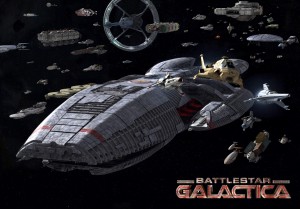
One of the things that I think should qualify a story for this trope is that the society of space cossacks is just that: a community of people who share at least a few cultural bonds.  Battlestar Galactica definitely qualifies, but I’m a little on the fence as to Firefly, since that story is more or less about a ragtag band of failed revolutionaries.  Are the Browncoats all from the same culture, like the Kurds or the Circassians or the Ossetians, or are they just a pologlot group of frontiersmen from all over the settled worlds?  Does it even matter?

In the end, I suppose it doesn’t.  The spirit of this trope is a lot like that of Fighting for a Homeland: a bunch of displaced underdogs on the fringes of civilization trying to make their way in the universe.  The nature of the conflict is such that by the end, they can’t help but form their own distinct subculture.

I don’t know why I love this trope so much.  Maybe it has to do with the way it blends elements from the Western genre in a classic Science Fictional setting.  Maybe it’s because I was born in the wrong century and naturally dream of settling the frontier.  Maybe it’s because this is one of the best ways to get awesome space battles.

Whatever the reason, I can’t get enough of it, as you can probably guess from reading my books.  In Bringing Stella Home, Danica and her band of Tajji mercenaries fit this trope to a T.  Stars of Blood and Glory delves quite a bit deeper into their background, with Roman as a major viewpoint character.  In Heart of the Nebula, the people of the Colony basically become Space Cossacks over the course of the novel.  Both of those novels are currently unpublished, but I hope to put them up in the next year.

On the subject of roving bands of displaced Eastern Europeans, I listened to this Circassian folk song maybe a dozen times while writing this post:

Awesome stuff–I’m totally putting it in the soundtrack for my next Gaia Nova novel.  Also, I’ll have to name a moon or a planet in the Tajjur system after Mount Elrus or something.  Space Cossacks indeed!

Oh hey! Happy Thanksgiving!

Funny how holidays creep up on you when you’re in a foreign country.

We have Friday off here in Georgia, due to an Orthodox religious holiday.  I’ll probably head east and check out the Stalin museum, maybe Mtskheta and Qazbegi depending on the weather.  A friend of mine in Tbilisi said she’d get me a Svan hat, so if that works out, I’ll be sure to post pics.

In school today, we made the hand-traced turkeys from construction paper, with “I am thankful for…” on it.  I got to tell the kids the thanksgiving story, too.  I’m not sure how historically accurate it was, but they seemed to enjoy it.  They also enjoyed all the stickers I gave them for their finished projects.  The Nintendo stickers were the most popular.

So what am I thankful for this year?  Let’s see…

  • Delicious homemade Georgian food.  Beans, cheese, bread, potatoes, peppers, chicken, borscht–almost all of it grown right here in the village where I live.  It’s awesome.
  • My students.  Seriously, some of the awesomest kids I have ever known.  Every day when I get to teach them, I feel like a rockstar.  I’m going to miss them when the semester is over.
  • My friends and family.  Even though I’m literally on the other side of the world and hardly ever have internet, I’m glad that we still keep in touch.
  • My readers.  Seriously, it’s awesome that you guys are reading and enjoying my books.  I just wish I could put them out faster.
  • My first year of running a profitable business.  That’s right–with last month’s sales reports, I’m on track to run a modest profit for 2012.  Let’s hope that this growth continues well into the future!
  • The changing face of publishing.  Seriously, it is so awesome that for a very little upfront cost, a guy like me can sell his books across the world and find fans in places as far away as Singapore and the Czech Republic.  There are so many choices, so much freedom, that it’s staggering to see how different things were just a couple of years ago.  Kris Rusch said it much better than I did, so be sure to check out her most recent post on the subject.

There’s more, of course, but those are the big ones off the top of my head.

I know I missed Trope Tuesday again this week, but I wrote up a long post and then got dissatisfied with it just as I ran out of time.  We’re on the magic flight stage of the hero’s journey, but I’m having trouble finding a page on tvtropes that really fits it.  It’s not really a stage that I’m all that familiar with, either, so it’s going to be a bit of a challenge to figure it out.  But I will, don’t worry–hopefully next week.

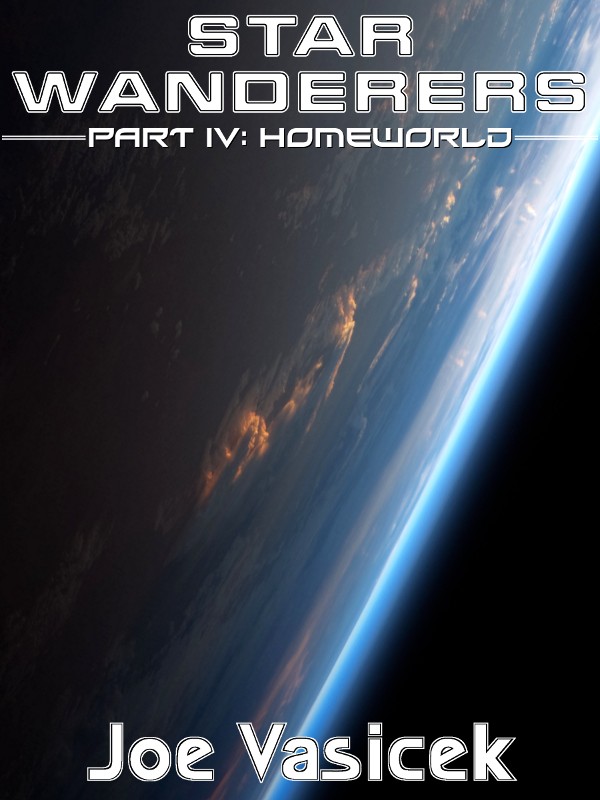
As far as Star Wanderers goes, I’m working on the final revisions for Homeworld (Part IV) right now.  It’s going really well so far, so I expect to be finished in a week or two.  After that, I just need to get it copy edited / proofread, and then it should be good to publish.

Just to tease you all, here’s the cover:

So yeah, definitely look out for that soon!

I’ve got to go, but I’ll post again when I get the chance.  Happy Thanksgiving, and I’ll see you around!