Trope Tuesday: Celibate Hero vs. The Fettered

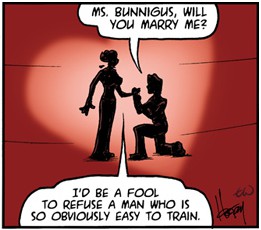
Yes, there are still good men out there...and they tend to know who's boss.

I’m mashing up two tropes this week because I’m not satisfied with the one.  There are a bazillion tropes about characters who are sexually active, but very few about sexually chaste characters that don’t portray them as weak, clueless, or socially inept.

According to tvtropes, a celibate hero is a main character who “doesn’t do the romance thing.” Unlike the chaste hero, who is just clueless, the celibate hero has made a conscious decision not to engage in sexual relations or get tied down in a relationship.  There may be any number of reasons for this, but it usually comes down to some combination of Love is a Weakness, Love Hurts, and It’s Not You, It’s My Enemies.

(As a hilarious example of this: TESLA!!!)

But what about the character who isn’t necessarily opposed to romance, but feels that they should wait until marriage to have sex?  Unfortunately, this trope is pretty rare nowadays.  I can only think of two mainstream examples: Edward from Twilight and Reverend Theo from Schlock Mercenary.

Theo in particular is a great example of this, because he’s not clueless, he’s not weak, and he not only gets the girl, he gets the girl that everyone wants.  The only reason he holds out is because his religious order forbids sex before marriage.  It does permit priests to marry, however, so Theo does manage to balance the two.

So why are characters like this so rare?  Unfortunately, I think it comes down to the widespread notion that a true man isn’t a virgin, and that sex makes people cool.  If we accept these tropes as true, then that means that men who exercise self-restraint are actually weak and pitiful, and couples who choose to wait are pathetic losers.

It’s worth pointing out that both Edward and Reverent Theo were created by writers who are practicing Mormons–people who belong to a religious community where it’s still the norm to wait until marriage.  If literature is the way that the culture speaks to itself, then this goes to show just how unrestrained the rest of Western society has become.

This is why I think that the better trope for this kind of character is The Fettered.  Unlike the celibate hero, who usually gives up sex for some kind of external reason, the fettered gives it up as a matter of principle.  Living by his ideals isn’t easy, and he’s constantly tempted to give in and break his moral code.  However, by resisting these temptations, the fettered gains great strength, and can stand like a beacon of light in an otherwise disillusioned world.

This is actually something that I tried to do with my latest novel, Desert Stars.  The main character, Jalil, is a man who believes in honor, and follows a code of abstinence before marriage.  However, to manipulate him into staying at the camp, his father charges Mira, the female protagonist, to seduce him.  Since the fettered’s strength is also his greatest weakness, if Mira can get Jalil to sully her honor, then out of shame he will return and marry her.

The catch?  She actually has feelings for him, and doesn’t want to manipulate him in this way.  In this way, merely persuading him to have sex isn’t a win condition–in fact, if done in the wrong way, it could be a very serious “game over.”

Whether or not I actually pulled it off well is up to the readers to judge.  But one thing I was definitely shooting for was to write a character who fulfills this trope in an unconventional yet powerful way.  And if you’ll permit me to step onto my soapbox for a little bit, I think our culture desperately needs more heroes like this–heroes who show that real men are capable of self-restraint, and that following a moral code is still cool, even if it means waiting to consummate a relationship.
Trope Tuesday: Space pirates with Kindal Debenham

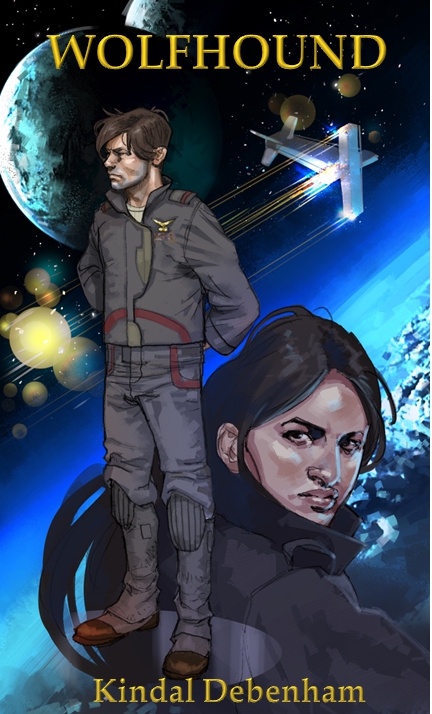
For today’s Trope Tuesday post, I thought it would be fun to bring on my friend Kindal Debenham to speak about one of the tropes in his new book, Wolfhound.

Kindal and I were in the same writing group in college, and attended Brandon Sanderson’s English 318 class together.  I just picked up a copy of his book, and it’s pretty good–definitely the kind of science fiction that I love.  You can currently find Wolfhound on Amazon, as well as Kindal’s self-publishing site.

So anyhow, here’s Kindal’s discussion of space pirates in Wolfhound.

==============================

Space pirates are kind of a staple in science fiction. We’ve seen them in all sorts of different forms since the genre came into being. As the trope states, though, there are basically two main classes. The first class is basically a bunch of violent criminals on a spaceship, kind of mirroring the behavior of modern day pirates in Somalia or Southeast Asia. The second are a corny recycled in space variant of the eighteenth century Caribbean pirate with robotic peg legs and a space parrot. Obviously one is a bit more realistic than the other. 🙂

The version I went for leans a lot more heavily on the first class of space pirates rather than the second. I wanted a smaller scale conflict in order to introduce my main character, and pirates seemed to be a good opponent to use for that purpose. Since the ship that Jacob Hull is on was partially based on the USS Constitution, I decided that I could use some of the pirates that ship fought during its history: the Barbary pirates.

These pirates weren’t your clichéd corsairs with parrots and a desire for plunder. The Barbary pirates were a collection of raiders that operated out of northern Africa. Their motivation was to support their nations by taking ships and capturing crews, which they then added to their fleet and put to work as slaves. In addition to raiding ships, the Barbary pirates also went on slave raids throughout southern Europe. They would accept tribute to ignore the ships of certain countries (think ‘protection money’ for a mob equivalent). The US had to pay about a fifth of the early national budget in tribute to these pirates until the politicians decided that guns were cheaper to buy—which led directly to the creation of the USS Constitution.

Building off of those ideas, I created the Telosian pirates. Vicious, more interested in valuable ransom for prisoners and well armed ships than simple cargo, and willing to do just about anything to satisfy their greed. With an utter ruthlessness only matched by their subtle plots, they made quite a good enemy for Jacob Hull and the rest of Wolfhound’s crew, and they were a much more interesting enemy to fight than a stereotypical Pirate-with-an-Eyepatch would have been. In my opinion at least, though I’m a little biased.

So those are the bad guys of Wolfhound—at least, they’re the majority of the bad guys—and believe me, they live up to their reputation as nasty pieces of work. Hope you guys enojoyed the background, and I hope I didn’t get too history nerd on you guys. See you around!

Trope Tuesday: The Bechdel Test

The Bechdel Test is a way to measure how prominently women figure in a story.  It mostly comes up in discussions of TV and film, but can also be applied to works of literature.  To pass the test, the story must have

  1. at least two named female characters
  2. who talk to each other
  3. about something other than men.

The surprising thing, as you can see in this discussion of the trope, is that so few stories actually pass this test. Even in literature, works like The Odyssey, Romeo & Juliet, and even War & Peace fail to pass or only barely pass this test.

Closely related to the Bechdel Test is the Smurfette Principle, where only one of the major characters is female–the token chick.  Stories that fail to pass the first part of the test fall into this category.

So why does this happen?  It may be because most writers are male, but that isn’t necessarily true of books and literature.  Novel writing, after all, was originally considered a womanly pursuit, and the English major was created in the so that women could have something to study while they were in college.  Not surprisingly, 19th century works by female writers like the Bronte sisters tend to pass…

…or do they?  It’s been a while since I read Jane Eyre or Pride and Prejudice, but the impression I got was that the women in those books spend only really talk with each other about men.  And when you look to contemporary writers like Dickens and Tolstoy, the trend holds.  After all, how many female characters are there in A Christmas Carol?  Do any of them ever even talk to each other?

This isn’t necessarily a measure of how good or bad a story is, or even of how feminist it is (Aliens, after all, technically passes), but it is a measure of how independent and well rounded the female characters really are.  If the story doesn’t pass, it’s a sign that the women only play a role in relation to the men, or that the male characters are the ones who advance the plot.

I don’t usually like to bring up my own stories in relation to these tropes, but I thought it would be useful to apply this test to my own books and see how they shape up.  As a writer, I think it’s a good idea to do this periodically, to make sure my work isn’t slipping into a rut.  So here we go:

Genesis Earth

Point 1: Yes, there are two named female characters: Terra and Stella.

Points 2 & 3: No, they never talk.  However, when you apply the reverse Bechdel test (two men who talk to each other about something other than women), Genesis Earth only barely passes.  Michael talks with Tom in the first chapter, mostly about Terra, and for the rest of the book he and Terra are alone.

Bringing Stella Home

Point 1: Yes, it passes.  Named female characters include: Stella McCoy, Danica Nova, Anya Sikorsky, Tamu, Lady Borta, Lady Zeline, Sergeant Maria.

Point 2: Yes; in most of Stella’s scenes, she’s talking with Tamu or Borta or one of the other Hameji women.  Also, since Danica is the captain of the Tajji Flame and Anya is the chief pilot, they interact quite a bit.

Point 3: Yes, but just barely.  In most of their scenes together, Stella and Tamu are talking about Qasar or the harem or sex.  There are a couple where they talk about each other and their past, but it all relates back to their captivity under the Hameji.  At one point later in the book, Anya goes AWOL and Danica has to talk her down, which is probably the scene that makes the book pass, but a hardcore feminist might argue that that conversation is indirectly about a man.  Still, I’m counting it.

Desert Stars

Point 1: Yes, there are plenty of women.  In fact, as you can see from this list of non-minor characters, there are almost as many women as there are men:

Female Male
Mira Jalil
Shira Sathi
Zayne Hamza
Tiera Rumiya
Lena Gregor
Surayya Kariym
Amina Ashraf
Rina Ibrahim
Sarah Lars
Michelle Nash
Mark
Will

Point 2: Yes, plenty of these women talk to each other.  Surayya and Amina are practically joined at the hip, Tiera, Shira, and Lena all have private conversations with Mira, and the only time Rina even talks is when she and Mira are alone.

Point 3: While most of the conversations between the female characters revolve around men and marriage, Tiera talks with Mira about honor, and Rina talks with Mira about leaving home.  Without spoiling too much, there are other conversations that have nothing to do with men, though they happen off-stage and only get reported second-hand.  Either way, I’d say this book passes.

None of this is to say that a good story must pass the Bechdel test.  Lawrence of Arabia, for example, doesn’t have a single female actress–not one single actress!–and it’s an amazing film.  As a counterpoint, I’m sure there are plenty of good stories out there (most of them probably anime or manga) that do not pass the reverse Bechdel test.

However, it is a good measure of female presence and how much the story is driven by men.  And as a lens through which to view the wider culture, it offers a surprising and somewhat disturbing perspective on male-domination in fiction.

Trope Tuesday: Scarpia Ultimatum

How far would you go to save the one you love?  Would you sacrifice your life?  Suffer an irreparable blow to your reputation?  Or would you sleep with your lover’s would-be killer?

Scarpia Ultimatum is when the villain threatens to kill the hero (or, alternately, a basket full of kittens) unless the romantic interest gives him some sort of  sexual favor or gratification.  It doesn’t have to explicitly involve the physical act, though if it does, it tends to take the story in a very dark direction.  G-rated examples of this trope tend to revolve around marriage or some sort of emotional commitment instead.

The standoff can end in one of the following ways:

  • The romantic interest submits to the villain’s demands.  Since the ultimatum involves a fundamental betrayal of fidelity, this rarely ends well.
  • The romantic interest decides she’s not all that interested in the hero after all.  Alternately, she does the villain’s job for him.
  • One of the side characters offers to go in the romantic interest’s place, and the villain consents.  IIRC, something like this happened in Enchanted.
  • The romantic interest submits to the villains demands, but the hero escapes and rescues her at the last minute.  Can be difficult to pull off, since it basically consists of having your cake and eating it too.
  • The romantic interest comes up with a third option that saves the hero without forcing her to give herself up to the villain.  By far, this is the most common solution.

At the heart of this standoff is the fact that both choices involve a betrayal.  If the romantic interest refuses, she lets the hero die.  If she submits, she becomes unfaithful.  Even if the standoff is over a basket full of kittens, it almost always involves a choice between two morally reprehensible options.

My favorite example of this trope is from Phantom of the Opera, where the Phantom forces Christine to choose between her freedom and Raoul’s llife.  She takes the third option and kisses the Phantom, making him have compassion on her because no one else had ever shown him such affection.  What makes this a crowning moment of awesome, for me at least, is the way that it empowers Christine without doing anything to diminish Raoul.  He shows himself willing to make a truly heroic sacrifice, while she proves that love is more powerful than violence.

As a way to add a moral dilemma to your story, this trope is highly effective.  The stakes are high, the options are limited, and the moral choices are far from black and white.  If your characters do take a third option, however, it should probably make some sort of commentary on the ethical questions raised–otherwise, it’ll probably come across as an ***-pull.

Trope Tuesday: Walking the Earth

Oh there’s sober men in plenty
And drunkards barely twenty
There are men of over ninety
That have never yet kissed a girl.
But give me a wandering rover
From Orkney down to Dover
We will roam the country over
And together we’ll face the world.

When a character decides to walk the Earth, they leave behind friends, family, and earthly possessions to wander from town to town in search of adventure. In real life, we think of these people as bums, but in fiction these characters are often the protagonists–or if not, then some sort of wise figure or noble adversary.

There are two character archetypes that tend to fill this trope: the drifter (or “the stranger” as Joseph Campbell called him) and the knight errant. For the knight errant, walking the Earth is simply part of the job description: always in search of evil to slay and damsels to rescue, he cannot stay in one place for long. It’s the same with the drifter, though he might not have the same skill set or code of honor.

As you can imagine, this trope tends to be most prevalent in Westerns, with the knight errant transformed into a gunslinger and the drifter wandering the wide frontier. American culture has definitely embraced this trope; what else did you expect from the nation that invented cars, highways, and the road trip? However, it’s also quite prevalent in East Asia as well, with the ronin and other wuxia archetypes.

Of course, this trope is only possible in a society that has a long tradition of sacred hospitality; otherwise, the wandering hero will almost certainly starve. That’s one way to spot stories where this trope is done poorly: if the wanderer has no visible means of support, yet appears clean and well-fed, the author hasn’t connected the dots. Also, characters who walk the earth are almost always male, since women who travel alone are more likely to get raped or assaulted.

One of my favorite examples of this is Van Hoenheim from Full Metal Alchemist. <SPOILER: highlight to read>After he unwittingly helps the first humunculous to sacrifice the population of Xerxes to make two giant philosopher’s stones, Hoenheim sets off to wallk the Earth as an immortal being, his sorrow too great to allow him to settle down. However, while the humunculous uses his stone to acquire even greater power, Hoenheim becomes familiar with every damned soul trapped in his and enlists their help. In the final battle, we learn that Hoenheim has used his centuries of walking the Earth to bury the damned souls in such a way to counter the humunculous’s transmutation circle, thus saving the people of Amnestria.</SPOILER>

There’s a dark side to this trope, however: the flying dutchman, cursed to wander the earth forever. By definition, every adventure must come to an end; when it doesn’t, it becomes instead a sentence of exile. Perhaps this is why characters who walk the Earth in a post-apocalyptic setting (like the wandering Jew in A Canticle for Leibowitz) tend to lean more towards this: after the world ends, there is no going home.

Which makes me wonder: in order for this trope to be positive, is it necessary for the main character to have the option of settling down whenever he wants to? Certainly there are those who choose a life of eternal adventure, but that implies that they have a choice. Even if they would have chosen not to settle, when that option is taken from them does that always make the story darker and less hopeful?

Either way, this trope intrigues me. Expect to see it in my own work soon.

Lyrics from “The Ramblin Rover” by Silly Wizard.

Trope Tuesday: Bittersweet Ending

WARNING! CONTAINS SPOILERS FOR AMERICAN GODS, LAGAAN, LORD OF THE RINGS, TREASURE ISLAND, AND CROUCHING TIGER HIDDEN DRAGON.

And he sang to them, now in the Elven-tongue, now in the speech of the West, until their hearts, wounded with sweet words, overflowed, and their joy was like swords, and they passed in thought out to regions where pain and delight flow together and tears are the very wine of blessedness.

Tolkien, J.R.R. The Return of the King.

I love bittersweet endings.  I love stories that warm my heart even as they make me cry.  There’s something about reading them that makes me feel alive, and something about writing them that makes me feel like I’ve truly told a story worth telling.

The tvtropes page claims that bittersweet endings fall more to the cynical side of the sliding scale of idealism vs cynicism, but I disagree.  Without tasting the bitter, how can we know the sweet?  Too many of our modern stories are like high fructose corn syrup, where everything gets tied up with a pretty bow and the characters remain essentially unchanged.  I firmly believe that it’s only through sacrifice that we can know true joy, and stories that follow this often end up being bittersweet on some level, even if they are idealistic.

The tvtropes page lists six types of bittersweet endings, which are:

  • Did Not Get the Girl: When the hero either loses the girl or has to give her up to win the day.  American Gods is a good example of this, I think: Shadow never actually gets back with Laura, even though he spends most of the book looking for a way to bring her back.
  • The Greatest Story Never Told: When the hero fades into obscurity after winning the day.  Lagaan, one of my favorite Bollywood movies, is an excellent example of this.  The last line of the movie is the narrator explaining how after the events of the story, the village faded into history until it was forgotten.
  • End of an Age: When the triumph over evil transforms the world so completely that there is no going back to the way things used to be.  Lord of the Rings is the best example of this: after the one ring is destroyed, all the other rings lose their power, and the elves must pass into the west.
  • Heroic Sacrifice: When victory comes only after the death of many or all of the main characters.  This is basically every David Gemmell book ever written, which is why I can’t get enough of him.
  • Only the Leads Get a Happy Ending: Where life is great for the main characters but everyone else ends up suffering.  I can’t think of any examples where this is done well; it’s probably just bad storytelling.
  • Karma Houdini: When the bad guy doesn’t get what’s coming to him.  The best example of this is probably Treasure Island, where Long John Silver gets away with the treasure in the end, leaving the good guys to say “I can almost find it in my heart to hope he makes it.”

It’s important to point out that this trope is not simply a tragic tale with a heart-wrenching twist.  Crouching Tiger Hidden Dragon, for example, is a straight up tragedy: even though Mu Bai confesses his love to Shu Lien, he promptly dies, and Jen commits suicide.  It’s an awesome ending to an awesome story, but there is no sweet in it.

When done poorly, a bittersweet ending can feel confusing or anti-climactic.  When done well, however, I think it adds a wealth of depth and feeling, as well as a degree of believability and realism.  After all, how many of our victories are complete?  How often do we have to give up something good for something greater?

So yeah, I love this trope.

Trope Tuesday: Childhood Friend Romance

Oh come on--you just KNOW that they get together!

There’s something heartwarming about a romantic couple that knew each other as children.  Maybe it’s that return to innocence, or a sense that destiny is on your side, but I find these kinds of stories hopeful and encouraging.

My favorite example of this is probably Deanna and Michael from For Better or for Worse.  My sister was obsessed with that comic growing up, so my parents bought her just about every book and I got to read them all.  I still remember when Deanna showed up again, after seven or eight books: at first, I was like “holy cow, is it the same girl from way back when Michael was a little boy?” And then he started dating her, and I was like “YES!!!”

Another good example is Phantom of the Opera, with Christine and Raoul.  Lloyd Alexander’s Chronicles of Prydain also had a long-running friendship between Taran and Eilonwy, which eventually took a romantic turn.  Apparently, Jane Austen was also fond of this trope, though I haven’t read enough of her to be able to say.

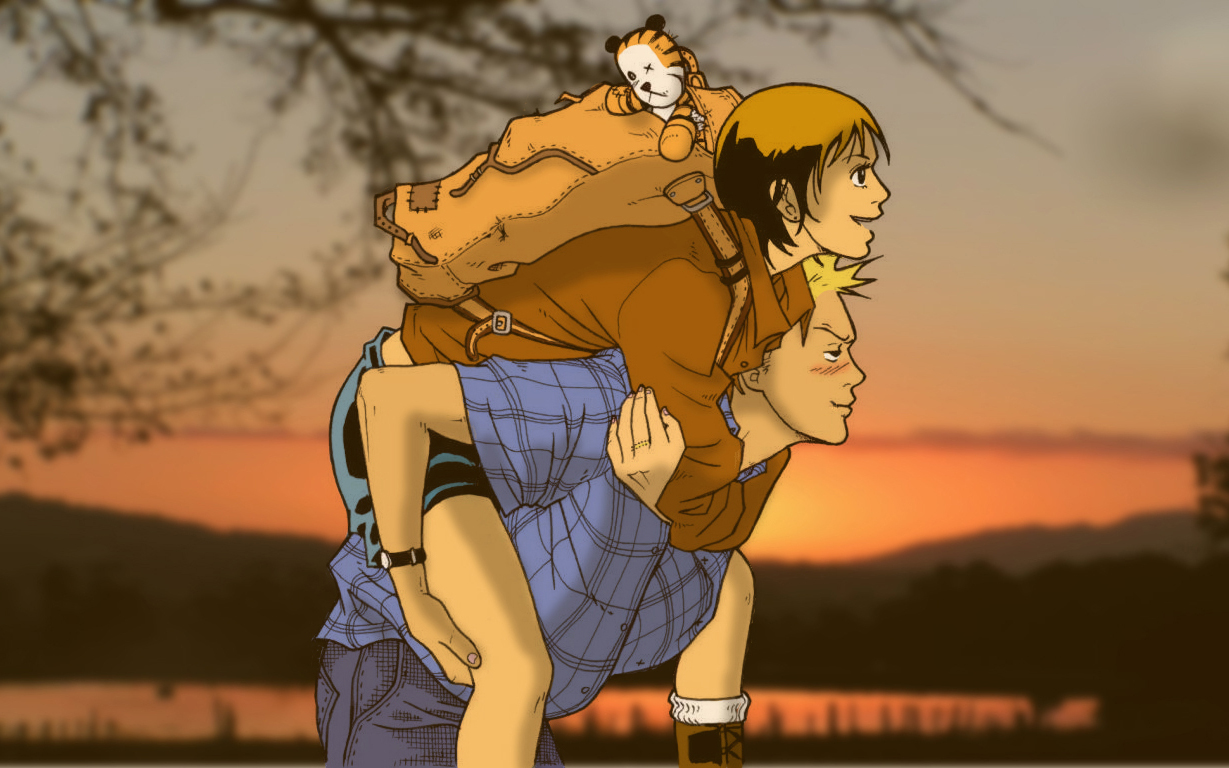
A lot of times, this trope is coupled with a childhood marriage promise.  It doesn’t have to be, though; I just love the thought that Calvin and Susie eventually end up together, even though they hate each other as kids.  As a storytelling device, this trope can also work well in conjunction with first girl wins.

Sometimes, though, the love is unrequited.  In many stories, this happens when one of the friends thinks their relationship is more like a brother and sister thing.  The scientific rationale for this is called the Westermarck effect, where people become sexually desensitized to those with whom they grow up together.  A good example of this would probably be Cyrano de Bergerac; the whole nose thing was more a self-esteem issue for Cyrano than a turnoff for Roxane.

In the Middle East, where it’s still common for first cousins to marry, this trope tends to be a lot more prevalent.  In Arabic 202, we read several magazine stories about couples who fell in love after growing up together.  There might be a bit of a squick factor there for Western readers, though–and that’s something you have to look out for with this trope.  If the characters really are like brother and sister, and they get together anyway…ew.

So there you have it.  For an innocent, hopeful, satisfying romance or romantic subplot–or a crushingly depressing tale of unrequited love–the childhood friend romance trope can be used to great effect.

Image courtesy sora1589. Line art by nami86.

Trope Tuesday: Recycled IN SPACE!

Or, as my friends at Leading Edge would say, IN SPAAACE!!!

The basic idea behind this trope is that setting a story in space makes it cool and different.  The tvtropes article focuses mainly on how this trope is used in children’s cartoons, but it actually goes much wider.  In fact, most space stories are actually based on stories from other genres, or even from history.

For example, Asimov’s Federation series is based on Edward Gibbon’s Decline and Fall of the Roman Empire, David Drake’s Lieutenant Leary series is based on Patrick Obrian’s Master and Commander series, and Frank Herbert’s Dune is based on the rise of Islam.  Westerns are especially prone to get the space treatment (Firefly, anyone?), which is where we get “wagon train to the stars.”

At its worst, this trope is nothing more than a pointless gimmick.  At its best, however, it can produce some extremely good work.  The key, as always, is to work within the limitations of the setting.

One of the best examples of this is Dune.  Frank Herbert didn’t merely lift 7th century Arabia into space and call it Arrakis; he created a distinctly alien world with its own history, culture, biology, and role within the galactic empire.  For example, Herbert solved the FTL problem by linking interstellar travel to the spice, tying his space-Arabs to the politics and economics of the rest of the galaxy.

Interestingly, your space physics don’t have to be perfect for this trope to work; they just have to be believable.  For things like artificial gravity and faster than light travel, most people will accept a little hand-waving, provided that you do it well.  The important thing, as always, is the story.

Trope Tuesday: Pet the Dog

Awwwww!!

The basic principle behind this trope is that when you want your readers to feel some kind of sympathy toward a character, have them pet a puppy / puppy equivalent.  Often used to show who the good guy is, but can also be used to add depth to a villain.

I first learned about this trope in Brandon Sanderson’s English 318 class, where he taught it as a way to build immediate sympathy when introducing a major character.  A good example from his own work is Mistborn, where Kelsier’s first scene shows him giving the manor lord’s food to the skaa.  From that moment on, there’s never really any doubt that Kelsier is the good guy.

Although often used to introduce a good guy, this trope can also be used quite effectively in the middle of the story, especially in a gray and black world where it seems that everyone’s a bad guy.  A good example of this is Shadow from American Gods, who flips a coin with a hitchhiker to see who pays for dinner.  Even though he’s a thief and an ex-convict, he rigs the coin toss so that he can pay for her.  Through little gestures like this, Gaiman maintains rooting interest in his protagonist, even though everyone else in the novel is basically a jerk.

Another good example from a darker work is Angelo Osic from On My Way to Paradise.  On the very first page, a fugitive shows up at his pharmacy booth, asking him to grow her a new hand.  Even though he knows it’s dangerous, he takes her in and does what he can to help her.  Later on, this same character rips out a man’s testicles and guts him like a fish.  As repulsive as that is, however, I still keep rooting for him because I know that at his heart, he’s a good person.

Of course, when used most effectively, the pet-a-puppy moment has to grow naturally out of a person’s character.  Even though Shadow is an ex-con, he served his time and feels genuinely sorry for what he did.  Angelo Osic is a doctor, so it’s natural for him to try to help others; whenever he commits an act of violence, a part of his humanity dies, which becomes a major driving conflict throughout the book.

Don't. Touch. Me.

Finally, though this trope is often used to create rooting interest in a protagonist, it can also be used to add depth to a villain.  A prime example for this is Captain Nemo from 20,000 Leagues Under the Sea.  The first moment happens when he rescues the main characters after their ship sinks, but it happens many more times too, such as when Arronax finds him weeping over a picture of his family.  At the end of the book, even though we know that Nemo is the bad guy, we can’t help but feel a little sorry for him after he’s gone.

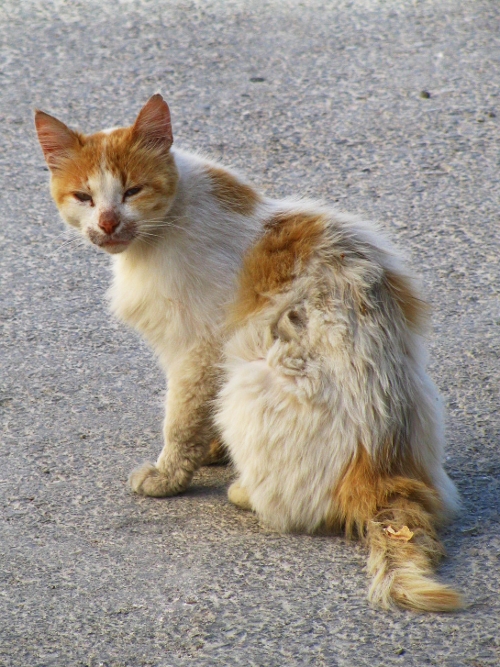
Puppy image courtesy Wikimedia.  Cat image taken by me.

Trope Tuesday: The Call Knows Where You Live

Yeah, it's kind of like that.

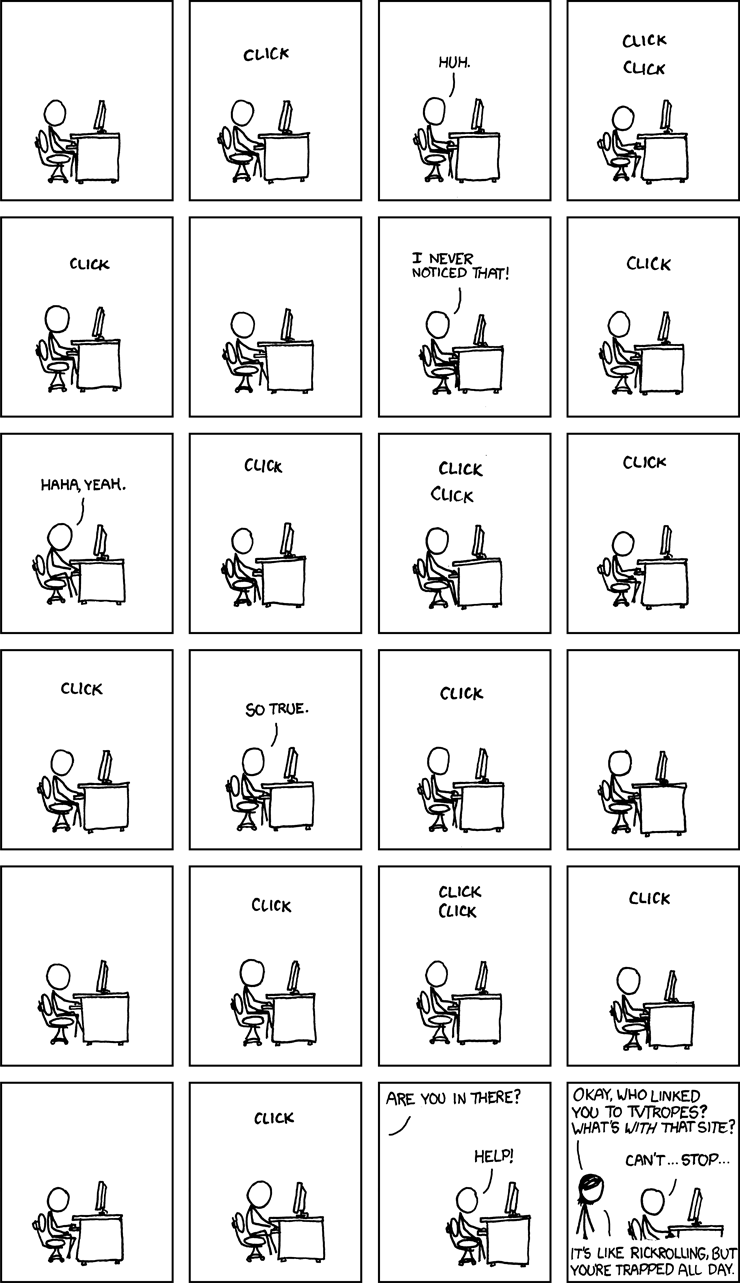
I have a confession to make: I’m a tvtropes addict.  Fortunately, it’s only about as bad as vicodin, which means that doses which would knock other people out do nothing to me–but still, I’ve wasted many, many hours on that site.

So anyhow, I thought it would be fun to do a weekly series where I pick out a trope and discuss it.  After a lot of deliberation (and much clicking), I decided to start with:

The Call Knows Where You Live

This trope stems from one of the stages of the archetypal Hero’s Journey.  The hero usually starts out in some sort of familiar setting, so that the reader gets a sense of who he is and where he’s coming from.  To get the story started, someone or something from the realm of the unfamiliar calls him to leave on an adventure.

Most of the time (but not always), the hero turns down the call at first, not wanting to leave his comfort zone.  This is called the Refusal of the Call, and it happens a lot.  In The Matrix, Neo refuses to climb outside the window to escape the agents.  In Ender’s Game, Ender Wiggin doesn’t actually want to go to Battle School, he just wants to be a normal kid and stay with his sister Valentine.  In Star Wars IV, Luke tells Obi-Wan that he can’t go to Alderaan because he’s needed on the farm.

Unfortunately, the Call is not so easily evaded.

Uncle Owen? Aunt Beru?

Sometimes, the best way to send a character off on an adventure is to have him lose everything right at the very beginning.  With nothing to hold him back, the hero is free to go off and do something truly reckless.

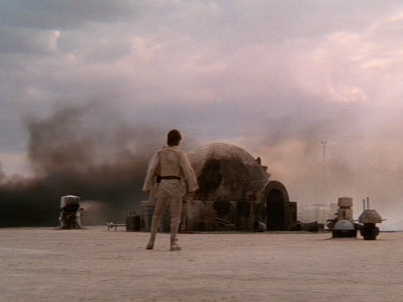
I still remember how I felt when I first saw the burning homestead scene in Star Wars IV.  The sinking feeling when I saw the smoke billowing from Luke’s house, the wide-eyed gasp at the mangled bodies of Luke’s aunt and uncle (I was so young, I had to close my eyes for that part).  All of a sudden, the conflict felt a lot more real–and a lot more inevitable.

Of course, this trope only works for a certain kind of story. If the hero’s family is dead before he even leaves his home, there had better be some serious action later on. Also, the villain had better be the real thing–if nothing else in the story lives up to the depravity at the very beginning, a major promise has been left unfulfilled.

Alternately, I suppose you could have the hero’s family killed off by a natural event, or an unintentional accident–something where he has no one to blame and no face to put to the tragedy.  I can’t think of any examples of this off the top of my head, but it seems a plausible motivation for, say, a scientist who wants to find a cure for some disease, or the source of some magnificent and dangerous anomaly.

Now, if I were an overlord, I would avoid this trope altogether by cozying up to the hero’s parents, perhaps even sending them Christmas cards.  I might consider imprisoning them alive as collateral, but that would give the hero too much of an incentive to storm my castle.  And of course, when slaughtering villages, I would make absolutely certain that everyone in the village is dead.

So what do you guys think of this trope?  Any other cool examples you can think of, or interesting ways to subvert it?  Let me know!